
The Gaze
Published 26 Dec 2019The Far Side by Gary Larson is one of the best and most praised cartoons in history. But what makes The Far Side so good? What is the legacy of Gary Larson? And most importantly: what can we learn from The Far Side?
0:00 Pixar and Storytelling
1:22 How Gary Larson tells a story
2:42 The Far Side facts and figures
3:22 The level of detail in The Far Side
4:04 Telling a story with one image and a punchline
5:09 What is The Far Side about?
7:11 Gary Larson and naturalism
7:40 Controversy over The Far Side
8:10 The legacy of The Far Side
9:00 Conclusion
(more…)
June 13, 2023
Why The Far Side is a masterclass in storytelling
June 9, 2023
QotD: The Fundamental Paradox of Internet Liberalism
- If you were smart enough to understand what I’m saying, you’d be a liberal, too
- You aren’t smart enough to understand it, because you’re not a liberal
- And yet here I am, arguing with you anyway.
So who, exactly, is the dumb one?
Severian, “Alienation II”, Rotten Chestnuts, 2020-10-30.
Comments Off on QotD: The Fundamental Paradox of Internet Liberalism
June 5, 2023
QotD: The four types of college papers for English Majors – 4. The Old Switcheroo
Only superstars write the Old Switcheroo. But if you pull this off, the sky is the limit. You might end up as a Senator or in the Cabinet, or have a prominent byline in a newspaper of record.
That’s because the Old Switcheroo turns everything into its opposite. If you master this technique, you can prove anything, no matter how implausible. Water isn’t wet. War is Peace. We have always been at war with Eastasia. You name it.
Everybody thinks that Shakespeare’s King Lear is a tragedy, but for the Old Switcheroo, you prove that it’s actually a comedy. Everybody thinks that Mozart is a great composer, but you prove that he stole everything he wrote from Salieri’s butler. Frankenstein wasn’t a monster, but a respected scientist. Etc. etc.
Up is down. Black is white. Fire is ice.
Make no mistake, the Old Switcheroo is A+ work, and no fooling. Even more, it’s a surefire path to career success. There’s just one tiny problem: The people who master the Old Switcheroo are batshit crazy and have a psychological profile dangerously close to that of a serial killer. They might end up in the White House, but you wouldn’t trust them to house-sit your chia pet.
Ted Gioia, “The 4 Types of College papers for English Majors”, The Honest Broker, 2023-02-27.
Comments Off on QotD: The four types of college papers for English Majors – 4. The Old Switcheroo
June 4, 2023
QotD: The four types of college papers for English Majors – 3. The DIM
Those bozos think that Moby Dick is a novel about a great white whale. But we know there’s a Deep Inner Meaning to the book — that whale is actually a stand-in for the author’s annoying mother-in-law. Or maybe it’s a surrogate for the President of the United States. Or a displaced sex object.
Let your imagination run free. It really doesn’t matter which you choose. It just can’t be anything obvious. And then you need to talk a good game, and not pay too much attention to facts and plausibility.
And who said you don’t learn useful job skills as an English major?
If you spread the B.S. thick enough, and never let on that you even sniff the stench, you have better than even odds of getting a top grade. It helps, by the way, if you show up in class dressed in something unseemly and having omitted several steps in your morning grooming routine — which are seen as signs of incipient genius in the School of Humanities.
Ted Gioia, “The 4 Types of College papers for English Majors”, The Honest Broker, 2023-02-27.
Comments Off on QotD: The four types of college papers for English Majors – 3. The DIM
June 3, 2023
QotD: The four types of college papers for English Majors – 2. The TWIT (They Were Idiots Then)
We know that unfailingly, for the simple reason that they didn’t think like us. They were stupid and stodgy and superstitious and held all sorts of irritating views.
And it’s true. You can take absolutely any book from a hundred years ago, and find infractions on almost every page. The past is a different country, where everybody is a knucklehead.
Here’s how to write a TWIT: You take a yellow marker and highlight every time somebody in the book makes a blunder, according to our current rules of decorum this week. Trust me, you won’t even have to read the whole book. Within a chapter or two, your book will have more yellow highlights than Nicki Minaj’s hairdo.
Now you’re ready to roll.
You write up the infractions like it’s a district attorney’s indictment. But here’s the key — you must give it some fancy name. You can’t just call a twit a twit in your TWIT paper; you have to refer to your harangue as a critique or an exegesis or a deconstruction, starting with the title — which should be something like “A Critique of Phallogocentrism in Henry James’s Turn of the Screw“.
Once you get the hang of this, it’s as easy as shooting fish in a barrel. There’s just one problem — everyone else in the class is also writing TWIT papers. It’s the most popular thing on campus since the invention of the senior admin job. So you only get a B on these. Or maybe B+ if you throw in a few French words (for example, inserting différance whenever you’d normally say difference).
Ted Gioia, “The 4 Types of College papers for English Majors”, The Honest Broker, 2023-02-27.
Comments Off on QotD: The four types of college papers for English Majors – 2. The TWIT (They Were Idiots Then)
June 2, 2023
QotD: The four types of college papers for English Majors – 1. The Reliable C&C
Then you list 5 ways they are similar and 5 ways they are different. Voilá — you’ve written a college paper!
Ernest Hemingway and Jane Austen are both writers who share the same language: English. But Hemingway is an American who liked bullfighting and drinking martinis. Jane Austen is English and never fought a bull. She probably drank tea, because the martini wasn’t invented until 1863, some 47 years after her death …
You can write this stuff in your sleep, provided you dream about Wikipedia entries. But be forewarned: the reliable C&C probably only gets you a reliable C grade.
Ted Gioia, “The 4 Types of College papers for English Majors”, The Honest Broker, 2023-02-27.
Comments Off on QotD: The four types of college papers for English Majors – 1. The Reliable C&C
May 30, 2023
QotD: The technical flaws of modern cameras
Theodore Dalrymple, “The Grand Illusion”, Taki’s Magazine, 2017-08-19.
Comments Off on QotD: The technical flaws of modern cameras
May 25, 2023
The greatest economic moment of the 20th Century was when Thomas Edison invented the chicken
What’s that, you say? Edison didn’t invent the chicken? Yes, yes, okay. Technically it wasn’t Edison and technically the chicken already existed long before then, but Robert Graboyes explains why it’s kinda true:
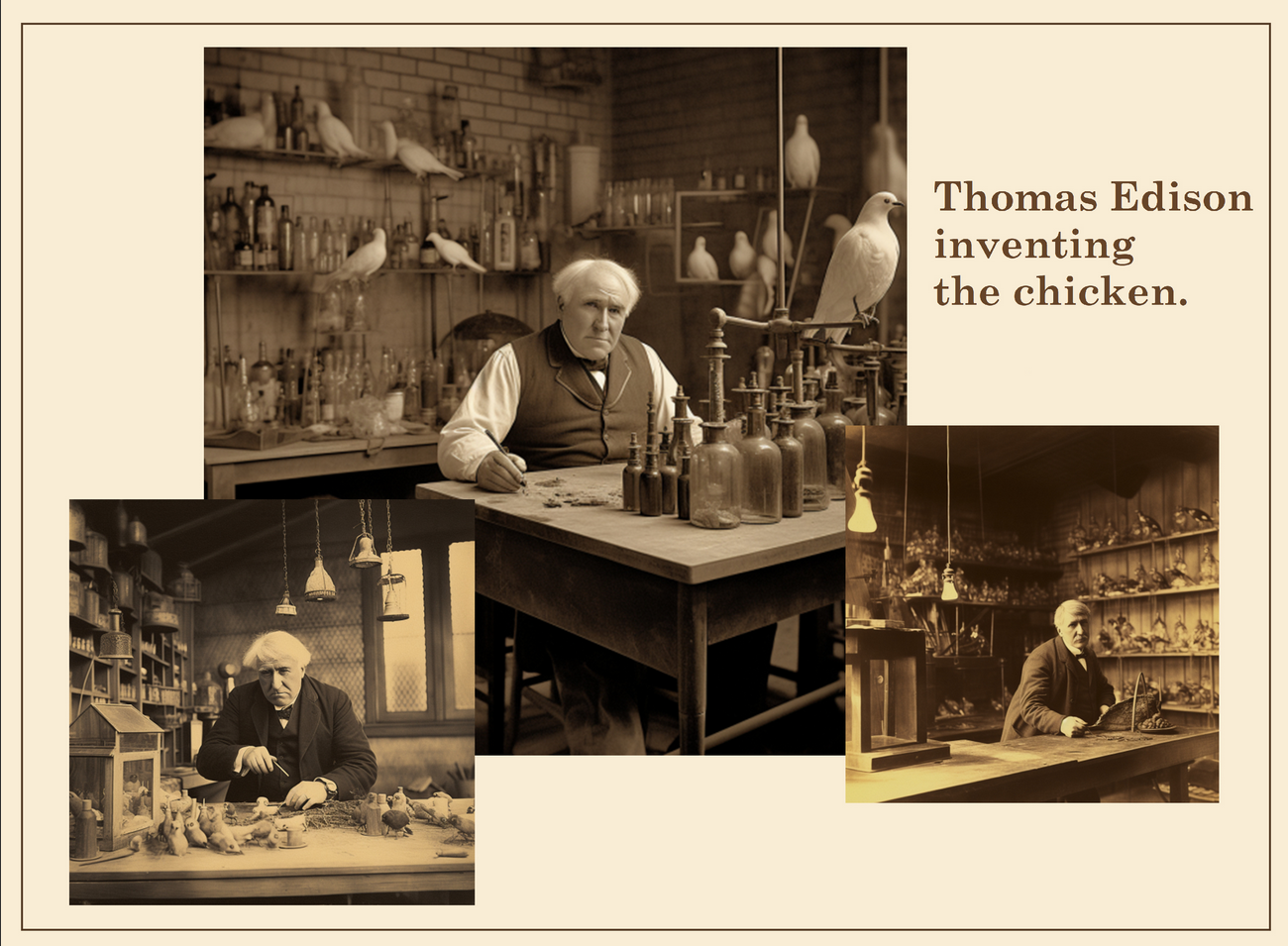
No, Thomas Edison didn’t invent the chicken, despite my fake, AI-generated photographs above. But around the time of the Apollo moon landings, a future Nobel laureate allegedly declared that the most important invention of the 20th century was the chicken. This cryptic statement offers profound wisdom about possible paths of healthcare innovation in the 21st century. The chicken quote was attributed to Robert Mundell, 1999 Nobel economist, by Dick Zecher, who was my boss at Chase Manhattan Bank and, before that, Mundell’s colleague at the University of Chicago.
How is the chicken — first domesticated more than 5,000 years ago — a 20th-century invention at all? And how was the chicken more important than the airplane, computer, atomic bomb, television, interplanetary rocket — or the countless works of Edison and his crew?
Dick told me that the comment, delivered during an Economics Department seminar, attracted the blank stares that often met Mundell’s odd, enigmatic, and always-profound observations. After a prolonged silence, the befuddled seminar speaker asked what Mundell meant.
His insight was that in the 20th century, modern production methods so drastically reduced the price of chicken that the bird became, for all practical purposes, an entirely new good. According to W. Michael Cox and Richard Alm (“Myths Of Rich And Poor: Why We’re Better Off Than We Think“), a typical American in 1900 worked 160 minutes to earn enough money for a 3-pound chicken. An equivalent worker in 2000 needed only 14 minutes of wages to buy that chicken. Pre-1950s, consumers generally had to eviscerate a commercially bought bird or have a butcher do it. (My mother used to shudder when she recalled the itinerant butcher who would slaughter chickens for my grandmother in their kitchen sink.) Herbert Hoover’s promise of “a chicken in every pot” rings dull to our ears, but in 1928, the phrase sounded like “a flying car in every garage” sounds to ours.
Revolutionary production, distribution and storage methods changed chicken from a Sunday luxury item to the everyman’s protein. Our concept of chicken bears little resemblance to our great-grandparents’ image. Massive reductions in food prices explain why rates of malnutrition and starvation have plummeted worldwide since the mid-20th century.
Comments Off on The greatest economic moment of the 20th Century was when Thomas Edison invented the chicken
May 22, 2023
QotD: Gamesmanship in golf
Which also applies to the subtle art of gamesmanship. No in-your-face screaming “Bring It On!” chest-thumping or trying to put your opponent off his shot; just quiet, subtle digs designed to get inside his head to make him change his game, to his disadvantage or your advantage.
I remember once mis-hitting a drive which just managed to stay on the fairway, but only went for about 150 yards — whereupon my opponent asked disingenuously: “Does your husband also play golf?” implying, of course, that I hit like a girl.
And before anyone thinks that this kind of remark is in any way demeaning to women — it isn’t, because the fact of the matter is that women can’t hit the ball as far as a man can, which is why all golf courses have a “Ladies Tee” in each hole, usually many yards closer to the fairway and green than those used by men.
So when Tiger Woods (47) surreptitiously handed his opponent Justin Thomas (29) a tampon after his drive had traveled further than the younger man’s, everyone knew exactly what he was doing: teasing Thomas, and playing a little gamesmanship.
Kim du Toit, “Growing Skin”, Splendid Isolation, 2023-02-21.
Comments Off on QotD: Gamesmanship in golf
May 21, 2023
QotD: Swearing
Theodore Dalrymple, “Get stuffed, sunshine”, The Independent, 1998-10-10.
Comments Off on QotD: Swearing
May 13, 2023
Arnold Ridley – “Private Charles Godfrey” – a real story from Dad’s Army
The History Chap
Published 1 Feb 2023The story of Arnold Ridley — Private Charles Godfrey — Dad’s Army
After my last video all about Lance Corporal Jones in Dad’s Army I have been inundated by requests for the real story of another character from the classic comedy series: Private Godfrey.
Private Charles Godfrey, played by Arnold Ridley, is an ageing and slightly doddery member of the Walmington-on-Sea Home Guard platoon. His comrades are somewhat surprised and concerned when he announces that he was a conscientious objector during the First World War. However, thanks to his sister, the platoon learn his real (well, fictitious as it is a TV comedy show) story. Godfrey was indeed a conscientious objector but like many others he did volunteer to serve his country – just not to kill. Many men who felt likewise, joined the Army Medical Corps. Whilst not fighting they not only served their country and played a valuable role in the war effort but they also put themselves in harm’s way. Many of them became stretcher bearers, going out into no man’s land to fetch the wounded to safety. And many were decorated for their bravery.
William Coltman, became the most decorated NCO in the entire British army during the First World War … and he never fired a shot in anger!I will be telling the story of William Coltman VC in the near future.
Private Charles Godfrey was awarded the Military Medal for bravery during the battle of the Somme.
What makes Godfrey’s character all the more fascinating is that his actor, Arnold Ridley, was no conscientious objector but a volunteer in World War One. he was severly injured at the battle of the Somme in 1916 and discharged the following year.
Indeed, his injuries would influence how he played his character in Dad’s Army.
After the war, Ridley became a play writer. Arnold Ridley penned over 30 pays, the most famous of which was The Ghost Train written in 1923.
At the outbreak of the Second World War he once more volunteered to serve his country. Following the battle of Boulogne in 1940, he was evacuated to Britain, having been injured, once more, he was again given a medical discharge.
For the rest of the war he worked for ENSA – the forces entertainment organisation — and was a member of his local Home Guard. He continued his acting career through the 1940’s and 50’s before landing the role of Private Charles Godfrey in Dads Army in 1968. He was ever-present until the show ended in 1977. By then he was 81 years old.
Arnold Ridley died in 1984 and is buried in Bath Abbey.
(more…)
Comments Off on Arnold Ridley – “Private Charles Godfrey” – a real story from Dad’s Army
May 12, 2023
TL;DR Edition Of All 66 Books Of The Bible
The Babylon Bee
Published 3 Feb 2023With The TL;DR Edition of the Bible, you can forget about reading through the Bible in a year — now you can read through the Bible in about five minutes!
(more…)
Comments Off on TL;DR Edition Of All 66 Books Of The Bible
May 8, 2023
Father Ted as Ireland’s answer to Fawlty Towers
Conor Fitzgerald on the tragically short run of the classic Irish comedy Father Ted:
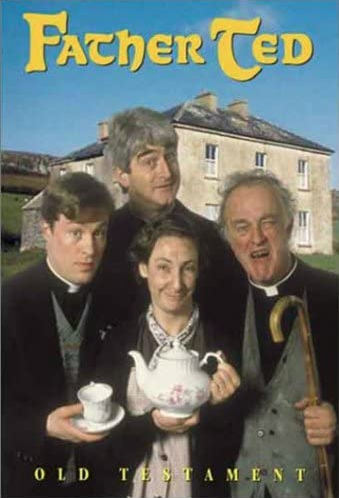
Fondly remembered and occasionally quoted, Father Ted has its place in the broad canon of the British sitcom. But in Ireland, even 25 years since its finale, it has always been so much more. Its status is closer to Fawlty Towers in England or Cheers in the United States: the national sitcom, a piece of light entertainment that nevertheless Says Something Meaningful About Us.
Not only was Father Ted one of the few successful TV representations of Ireland, it was made during Ireland’s version of the Swinging Sixties, our flux decade of the Nineties. The accelerating collapse of the Church and the exposure of longstanding political corruption coincided with the dawn of the Celtic Tiger years, lending peripheral Ireland a sense of self-conscious modernity. It was a unique national turning point, where our 19th-century past seemed to co-exist with our 21st-century future. In reflecting this upheaval, Father Ted has become not just a social historical document, but a portent of where Ireland stands today.
It’s not the sort of thing that national epics are normally made of. The programme is about three Catholic Priests — Fathers Ted Crilly, Dougal McGuire, and Jack Hackett — on Craggy Island, a remote settlement off the west coast of Ireland. All three priests have been exiled to this purgatory by the terrifying Bishop Len Brennan (their misdemeanours are never referred to directly, but Ted often makes oblique reference to the fact that “the funds were only resting in my account”). Most episodes revolve around an absurdist version of Church life, Ted’s schemes to escape the island and their interactions with the island’s townsfolk.
Rarely for domestic Irish TV, it was a sitcom written by Irish people and it was set within a central Irish institution, the Catholic Church. And the dearth of representations of Irish people in entertainment meant it crystallised many Irish archetypes for the first time. Ireland itself hadn’t always been a welcoming place for satirists. Ted star Dermot Morgan knew this well — his major project before Ted had been a political comedy radio show named Scrap Saturday, which upset all the wrong people, and was eventually cancelled amid allegations of political interference.
Unlike Scrap Saturday, Ted never sought to be political or self-consciously “relevant”. But Craggy Island is a capsule of Irish life at this time of major social change — not least for gender relations and the Church. Take one married couple, John and Mary, who own the corner shop on Craggy Island. They contrive to show a winsome, loving front to the priest whenever they encounter him, but turn to violent bickering once his back is turned. At one point, Mary tries to drown John in a bucket of water; at another, Father Ted comes into the shop and finds John has locked Mary in a cupboard. When he leaves, they’re arguing over a shotgun.
This peck-and-scratch marriage is still funny, but in 2023 the laughter it provokes is nervous. It’s a product of an Irish society still processing the reality of divorce, only legalised by a referendum in Ireland in 1995, the same year Ted first aired. Though it was not uncommon at that time for people to separate, the divorce campaign had been ugly and emotional. One billboard for No bore the slogan “Hello divorce, goodbye daddy”. The referendum was passed by the tiny margin of 9,000 votes.
Divorce was only one step in the very gradual withering of religious power in Ireland — far more gradual than the rest of Europe. Remember that abortion was only legalised in Ireland five years ago. When Ted was broadcast, the Church was formally still one of the central pillars of Irish life, but its authority rang hollow. Priests often felt like administrators of a vanished country. And on remote Craggy, Ted, Dougal and Jack mirror this directly. All good sitcoms feature characters who are trapped, but Ted is doubly so: first on his island; and second in an institution people are coming to see as irrelevant. He is still an essential member of the community, more than just a ceremonial functionary for weddings and funerals. But it’s just not clear what the essential thing he does is anymore, beyond being a common reference point that deserves token respect.
Comments Off on Father Ted as Ireland’s answer to Fawlty Towers
May 6, 2023
History Summarized: Chicago’s Tribune Tower
Overly Sarcastic Productions
Published 20 Jan 2023It’s not a Dome, but it’s still pretty darn good.
(more…)
Comments Off on History Summarized: Chicago’s Tribune Tower
May 2, 2023
Dad’s Army: What Was The Military Career of Lance Corporal Jones?
The History Chap
Published 25 Jan 2023Lance Corporal Jack Jones is one of the most loved characters in the classic British comedy Dad’s Army. Constantly referring to his exploits in the Sudan, the North West Frontier (India) and the First World War.
So I thought I would make a short video exploring his long (& fictitious) military career.
The local butcher, Jack Jones, is a member of Walmington-on-Sea Home Guard during World War Two. This fictitious Home Guard unit are the stars of the classic BBC comedy: Dad’s Army.
What I found amazing is that the BBC created a back story for the character of Lance Corporal Jones. researching the medal ribbons that Jones wears on his Home Guard uniform I have put together a timeline of his military career in the 1st battalion, Warwickshire Regiment.
The story starts when young Jack Jones joins the Royal Warwickshire’s in 1884 as a drummer boy. He is to spend 31 years serving in the British army where he participates in the Gordon Relief Expedition, the re-conquest of Sudan under General Kitchener, the Boer War, the North West Frontier of India, and the First World War.
Comments Off on Dad’s Army: What Was The Military Career of Lance Corporal Jones?


