
Medievalists
Published on 30 Jun 2016“Moving in harness”, a short film by Daniel Jaquet, realised by Vincent Deluz. On display at the exhibition “Armatus Corpus” at the Military Museum, Castle of Morges, Switzerland – The issue of mobility in armour is addressed there with striking images of actual armour pieces to demonstrate the range of movement allowed when worn. Today, our contribution follows the same goals, but with other technological means and approach. In this video we have put in images the deeds of the famous knight Jean le Maingre, known as Boucicaut, which were put in writing in the early 15th century. It includes a well-known passage where his training in armour is described in some details, outlining what you could actually do in a late medieval armour.
Learn more at http://www.medievalists.net/2016/07/can-you-move-in-armour-an-experiment-in-mythbusting/
October 21, 2017
Can You Move in Armour?
October 20, 2017
Operation Albion Concludes – Allied Failures In Belgium I THE GREAT WAR Week 169
The Great War
Published on 19 Oct 2017100 years ago this week, Operation Albion comes to a successful end for the Germans, as revolution is on the horizon in Russia. The Allies aren’t faring quite so well on the Western Front, where the weather continues to worsen and the death toll climbs ever higher. Haig believes a breakthrough is imminent and German morale is tested. The stalemate continues, but sooner or later the Battle of Passchendaele must come to an end.
October 18, 2017
Wheel of Future History
exurb1a
Published on 16 Oct 2017It’s 2017. No jet packs yet, but 3D printed beer will be here soon so just shhhhhhhhh.
The poem near the end is ripped off from Rudyard Kipling’s “If”. It’s a good one. Check it out ► https://www.poetryfoundation.org/poems/46473/if—
Are There Parts of German WW1 Warships in Space?
Real Engineering
Published on 19 Jul 2017
QotD: The course of economic progress in a nutshell
It is customary in these days of “slow food” to sneer at these devices, to aver that a real cook doesn’t need more than a cast-iron dutch oven, a good chef’s knife and a sense of adventure. As someone who took herself off to Chicago for three months with pretty much exactly this set of equipment (okay, also an electric pressure cooker), I can testify that this is true — sort of. You can get by with a very minimal set of equipment if you know how to cook. But as someone who has done so, I have to ask: Why would you?
I mean, yes, I know how to chop onions just fine. But doing so makes me cry like the dickens, unless I wear goggles. I know how to make great lemon curd, béchamel, hollandaise, caramelized onions. But my Thermomix makes them just as well, and I can read a novel instead of standing at the stove, stirring. I can whisk up an angel food cake in a copper bowl … or I could let the stand mixer do that, and my arms won’t hurt.
For that matter, I could also go out and grow my own wheat, mill it myself, and then mine some salt and cultivate some wild yeast to bake bread. But I don’t do these things, because subsistence farming is actually pretty arduous and unrewarding, which is why few of us have chosen to live off the grid. I see no reason to romanticize the grunt labor of the kitchen. If a machine does it as well as I do, and fits in my paycheck, I’ll happily outsource to the machine, and save my labor for the stuff the machine can’t do. This being basically the entire history of human economic progress to date.
Megan McArdle, “Give Thanks for Williams-Sonoma and the Garlic Press”, Bloomberg View, 2015-12-07.
October 17, 2017
Brazil in World War 1 – The South American Ally I THE GREAT WAR Special
The Great War
Published on 16 Oct 2017Though joining the war later than most, Brazil was the only South American nation to play an active role, albeit a brief one. After initially declaring neutrality in August 1914, a series of sunken ships and dead Brazilians on behalf of the Germans’ submarines forced Brazil’s hand, as anti-German sentiment in the country rose during the first three years of the war. With newly acquired ships, Brazil was ready to join the war as a naval power. Her involvement may not have lasted long, but it did earn Brazil a seat at the table during the Versailles peace conference.
October 16, 2017
Otto von Bismarck – I: The Wildman Bismarck – Extra History
Extra Credits
Published on 13 Oct 2017Otto von Bismarck became the greatest statesman of a generation, but he began as an intransigent and irresponsible youth. He coasted through college, got himself thrown out of an early political appointment, and caused havoc with his divisive opinions during a meeting of parliament.
What Happens When You Inbreed? – Brit Lab
BBC Earth Lab
Published on 17 Dec 2015Does inbreeding really lead to deformities and nasty diseases could inbreeding actually be a good thing? Greg Foot finds out the answers.
October 15, 2017
The Edge of the Abyss – Mountain Warfare On The Italian Front I THE GREAT WAR Special
The Great War
Published on 14 Oct 2017The mountains along the Italian front made for one of the most brutal and unforgiving battlefields of the World War 1, and the soldiers who fought here were tougher and more resilient than most. The Italian Alpini and the Austro-Hungarian Alpenjäger and Kaiserschützen who fought in the Dolomites waged different versions of mountain warfare, but both were subject to the harsh conditions of the peaks.
The end of the Bronze Age
Colby Cosh linked to an article discussing a convoluted survival from about 1180BC (the image was preserved, but the work itself was destroyed in the late 19th century), which casts some light on the fall of the great Bronze Age cultures of the eastern Mediterannean:
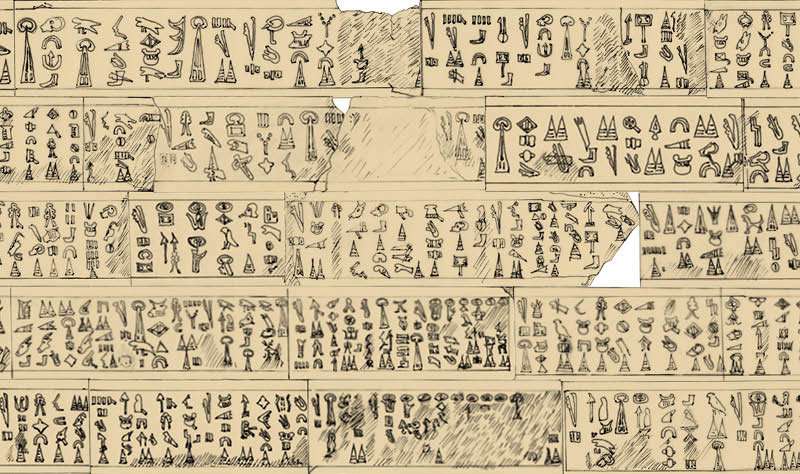
Luwian Hieroglyphic inscription by the Great King of Mira, Kupanta-Kurunta, composed at about 1180 BC.
Credit: Luwian Studies
The 35-cm tall limestone frieze was found back in 1878 in the village of Beyköy, approximately 34 kilometers north of Afyonkarahisar in modern Turkey. It bears the longest known hieroglyphic inscription from the Bronze Age. Soon after local peasants retrieved the stones from the ground, the French archeologist Georges Perrot was able to carefully copy the inscription. However, the villagers subsequently used the stones as building material for the foundation of their mosque.
From about 1950 onwards, Luwian hieroglyphs could be read. At the time, a Turkish/US-American team of experts was established to translate this and other inscriptions that during the 19th century had made their way into the collections of the Ottoman Empire. However, the publication was delayed again and again. Ultimately, around 1985, all the researchers involved in the project had died. Copies of these inscriptions resurfaced recently in the estate of the English prehistorian James Mellaart, who died in 2012. In June 2017, Mellaart’s son Alan handed over this part of the legacy to the Swiss geoarcheologist Dr. Eberhard Zangger, president of the Luwian Studies foundation, to edit and publish the material in due course.
[…]
The inscription and a summary of its contents also appear in a book by Eberhard Zangger that is being published in Germany today: Die Luwier und der Trojanische Krieg – Eine Forschungsgeschichte. According to Zangger, the inscription was commissioned by Kupanta-Kurunta, the Great King of Mira, a Late Bronze Age state in western Asia Minor. When Kupanta-Kurunta had reinforced his realm, just before 1190 BC, he ordered his armies to storm toward the east against the vassal states of the Hittites. After successful conquests on land, the united forces of western Asia Minor also formed a fleet and invaded a number of coastal cities (whose names are given) in the south and southeast of Asia Minor, as well as in Syria and Palestine. Four great princes commanded the naval forces, among them Muksus from the Troad, the region of ancient Troy. The Luwians from western Asia Minor advanced all the way to the borders of Egypt, and even built a fortress at Ashkelon in southern Palestine.
Panzers in Poland 1939 – Success, Failures & Losses
Military History Visualized
Published on 1 Sep 2017German Panzers in Poland 1939 were crucial in the success, but also suffered quite some losses and various shortcomings were detected.
October 14, 2017
QotD: WW2 sabotage manual or typical management at your company?
(1) Insist on doing everything through “channels.” Never permit short-cuts to be taken in order to expedite decisions.
(2) Make “speeches.” Talk as frequently as possible and at great length. Illustrate your “points” by long anecdotes and accounts of personal experiences. Never hesitate to make a few appropriate “patriotic” comments.
(3) When possible, refer all matters to committees, for “further study and consideration.” Attempt to make the committees as large as possible — never less than five.
(4) Bring up irrelevant issues as frequently as possible.
(5) Haggle over precise wordings of communications, minutes, resolutions.
(6) Refer back to matters decided upon at the last meeting and attempt to re-open the question of the advisability of that decision.
(7) Advocate “caution.” Be “reasonable” and urge your fellow-conferees to be “reasonable” and avoid haste which might result in embarrassments or difficulties later on.
(8) Be worried about the propriety of any decision — raise the question of whether such action as is contemplated lies within the jurisdiction of the group or whether it might conflict with the policy of some higher echelon.
Office of Strategic Services (OSS), Simple Sabotage Field Manual, 1944.
October 13, 2017
Operation Albion – Passchendaele Drowns In Mud I THE GREAT WAR Week 168
The Great War
Published on 12 Oct 2017The situation for the German Army on the Western Front looks grim, but in the East they have the upper hand and this week begin to put pressure on the Russians in Operation Albion – an amphibious landing operation in the Estonian archipelago. At the same time, the battlefield at Passchendaele is turning into a muddy swamp.


