
seangabb
Published 5 Feb 2021[Update 2023-03-02 – Dr. Gabb took down the original posts and re-uploaded them.]
Here is the third lecture, which describes the decay of the Roman Constitution as a result of changes in patterns of land tenure in Italy after the Second Punic War, and as a result of the flood of foreign money into Rome from military victories and war indemnities and bribes.
(more…)
February 28, 2022
Roman Republic to Empire 03 Inequality and Corruption
Comments Off on Roman Republic to Empire 03 Inequality and Corruption
The History of Pecan Pie
Tasting History with Max Miller
Published 16 Nov 2021Support the Channel with Patreon ► https://www.patreon.com/tastinghistory
Merch ► crowdmade.com/collections/tastinghistory
Instagram ► https://www.instagram.com/tastinghist…
Twitter ► https://twitter.com/TastingHistory1
Tiktok ► TastingHistory
Reddit ► r/TastingHistory
Discord ► https://discord.gg/d7nbEpy
Amazon Wish List ► https://amzn.to/3i0mwGtSend mail to:
Tasting History
PO Box 766
Burbank, CA 91503SOURCES**
The Pecan: A History of America’s Native Nut by James McWilliams: https://amzn.to/3mQ2JxJ
Antoine of Oak Alley by Katy Morlas Shannon: https://amzn.to/3kf6sTG**Some of the links and other products that appear on this video are from companies which Tasting History will earn an affiliate commission or referral bonus. Each purchase made from these links will help to support this channel with no additional cost to you. The content in this video is accurate as of the posting date. Some of the offers mentioned may no longer be available.
Subtitles: Jose Mendoza | IG @ worldagainstjose | @Ketchup with Max and Jose
PHOTO CREDITS
Dickey’s BBQ Pecan Pie: Willis Lam, CC BY-SA 2.0 https://creativecommons.org/licenses/…, via Wikimedia Commons
Pecan Tree: By Bruce Marlin – Own work: http://www.cirrusimage.com/tree_pecan…, CC BY 3.0, https://commons.wikimedia.org/w/index…
Oak Alley Plantation: Michael McCarthy via flickr, https://creativecommons.org/licenses/…#tastinghistory #pecanpie #thanksgiving

Comments Off on The History of Pecan Pie
February 27, 2022
“Putin finally called our bluff. The question to me is when and if Xi will decide to do the same”
Andrew Sullivan on what Winston Churchill referred to as “the historic life-interests of Russia”, the inability (and unwillingness) of the western nations to do more than send hopes and prayers to Ukraine, and the parallels between the Russia-Ukraine situation and the China-Taiwan potential conflict:
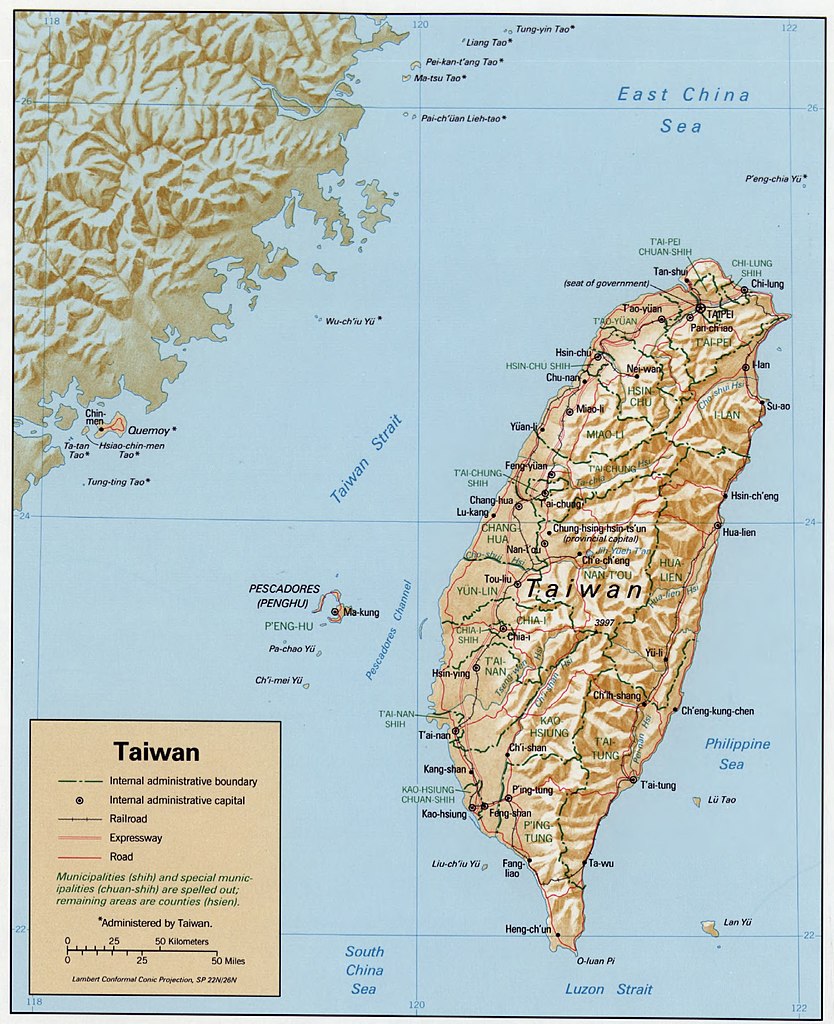
Taiwan relief map.
Library of Congress Geography & Map Division via Wikimedia Commons.
… in one crucial sense, Putin has already won a victory. A nuclear-armed great power has invaded and occupied a neighboring country in Europe, and there is nothing anyone else has been able to do to stop it. Many in the West assumed Putin wouldn’t go that far — surmising that international law, universal condemnation, economic sanctions, and the lack of any serious threat from Ukraine to Russia would restrain him. But he has called our bluff. He has even hinted at Russia’s nuclear capacity to intimidate other states from intervening. And so we have a precedent. Ukraine is a Russian possession. A fact on the ground. All we have been able to do is watch.
All of which brings us to what seems to me to be the larger dimension of this clash: how it will resonate in Beijing and Taiwan. With apologies to Mitt Romney, China is easily the greater geostrategic challenge. And the parallels with Russia are as striking as they are unnerving. China sees Taiwan as part of its national identity in a similar way to how Russia sees Ukraine as part of its. And we are committed to the defense of Taiwan the way we have committed to the defense of Ukraine: kinda, but not really. In the face of this underlying Western ambiguity, the fall of Kiev is news that Xi will be watching closely.
The parallels are not exact, but nonetheless striking. Taiwan is next door to and deeply entangled with China in its history and culture, just as Ukraine is uniquely entangled with Russia. Seeing Taiwan and China (like Ukraine and Russia) as simply random sovereign states with a right to self-determination under international law is correct, so far as it goes. It’s also moral — as majorities of both Ukrainians and especially Taiwanese want independence and have constructed nascent democracies in the wake of autocracy.
But the nationalist passion Russia feels about Ukraine and China feels about Taiwan is real, visceral, and hard for outsiders to understand intuitively. The sense of a rogue region that somehow got away from the homeland is vivid among Russian and Chinese nationalists. This kind of understanding — claiming a “sphere of influence” — is now deemed reactionary by the West’s foreign policy elites, as, perhaps, it should be. But that doesn’t mean that everyone, especially China and Russia, have actually moved past it. Even Americans have very different emotional responses to perceived threats in our own hemisphere compared with the rest of the world. So this is also a culture clash of sorts — globalism and the nation state vs nationalism and spheres of influence.
I’m not saying that this belief in a sphere of influence is a universal view in Russia or China — or that it is justifiable. I’m just saying it is real. And I’m not excusing Putin or Xi from taking a particularly zealous view of this irredentist nationalism, which they both do, for their own personal and political advantage. I’m just noting how national pride deeply informs them, that resentment of the West consumes them, that a sense of historical grievance spurs them on — and that they are not outliers among their compatriots. It is crazy to underestimate the power of this kind of revanchist nationalism — among rulers and ruled. And I fear we underestimated it in the case of Putin.
This means, as Barack Obama once insisted, that Russia will always care much more about Ukraine than we do; and China will always care much more about Taiwan than we do. In those cases, the last thing we should do is promise support that we do not seriously — truly seriously — intend to provide. The vague pledge by the Western powers not to rule out future NATO membership for Ukraine was the worst of all worlds: poking the bear, with no serious intention of fighting it.
The fall of Afghanistan was a margin call … and Ukraine is the point where airy western “guarantees” will have to be backed up with actual force. But western leaders have grown very comfortable in a world where gestures were taken seriously and few if any such gestures actually had to be followed-through with meaningful action. And now, the geopolitical pantomime is over and we’re back in a world where gestures are seen as signs of weakness and do nothing to deter adventurism.
Comments Off on “Putin finally called our bluff. The question to me is when and if Xi will decide to do the same”
The Blitzkrieg is Back – WW2 – 183 – February 26 1943
World War Two
Published 26 Feb 2022Erich von Manstein’s Axis counterattack on the Eastern Front begins this week and right away smashes through the Red Army lines, threatening all the recent Soviet gains. The Allies — the Americans — also suffer a big defeat in Tunisia at the Kasserine Pass, though in the Pacific it is the Americans who occupy the Russell Islands.
(more…)
Comments Off on The Blitzkrieg is Back – WW2 – 183 – February 26 1943
Who is Springfield Armory? A Tale of Two Entities
Forgotten Weapons
Published 20 Feb 2018Today we will take a look at the history of Springfield Armory – both the American national arsenal founded in the 1770s and the commercial entity founded in the 1970s.
http://www.patreon.com/ForgottenWeapons
Cool Forgotten Weapons merch! http://shop.bbtv.com/collections/forg…
If you enjoy Forgotten Weapons, check out its sister channel, InRangeTV! http://www.youtube.com/InRangeTVShow

Comments Off on Who is Springfield Armory? A Tale of Two Entities
QotD: Tactics, operations, strategy, grand strategy … let’s call the whole thing off
I watched this video by Military History (not) Visualized on the distinction between tactics, operations and strategy a couple of years ago, but I ran across it again, and I think it is interesting, although I do not entirely agree with the taxonomy. The are a few linked major changes I would have made – and these aren’t really corrections (he isn’t wrong), so much as preferences. First, I think it should probably be more strongly stressed that “grand strategy” is often not broken out in this taxonomy; MHnV is very much presenting a taxonomy with grand strategy as its own distinct entity (and consequently, the space for regular strategy is dramatically shrunk). He notes this, but doesn’t note strongly enough that in selecting grand strategy out, he is effectively presenting not a three-part taxonomy (as his title and structure implies), but a four-part taxonomy, with the fourth part removed. That’s a pretty important difference to leave out!
That in turn leads him to under-emphasize the massive difference between the two definitions of strategy he presents (though he seems aware of its significance, a viewer might not be): one of which confines itself to how to achieve policy ends by military force and the other of which includes the decision not to use force to achieve those ends. I very much prefer the latter definition of strategy, to the point that I am fond of saying that “any game which doesn’t let you declare peace is merely Real Time or Turn Based Tactics.” A definition of strategy that includes only “how to use military force to achieve policy ends” risks fading rapidly into operations and […] mistaking operations for strategy is a classic and disastrous planning blunder.
It’s still a very useful video, especially as a starting point for thinking about these terms, but those are points I think could have done with a touch more clarification; again, not a critique per se – nothing MHnV says is wrong, just a preference.
Bret Devereaux, “Fireside Friday: August 14th, 2020”, A Collection of Unmitigated Pedantry, 2020-08-14.
Comments Off on QotD: Tactics, operations, strategy, grand strategy … let’s call the whole thing off
February 26, 2022
In The Highest Tradition — Episode 3
British Army Documentaries
Published 27 Oct 2021This third episode in a six-part series delving into the world of regimental tradition looks Gurkhas’ history and commitment to the British Army. They swear their oath of allegiance directly to Her Majesty the Queen and continue to revere “The Queen’s Truncheon”, which was awarded to them by Queen Victoria in recognition of their service during the Indian Mutiny.
© 1989
This production is for viewing purposes only and should not be reproduced without prior consent.
This film is part of a comprehensive collection of contemporary Military Training programmes and supporting documentation including scripts, storyboards and cue sheets.
All material is stored and archived. World War II and post-war material along with all original film material are held by the Imperial War Museum Film and Video Archive.

Comments Off on In The Highest Tradition — Episode 3
“The [House of] Commons of 1621 would get completely out of control — all thanks to beer”
In the latest Age of Invention newsletter from Anton Howes, we’re still back in the reign of King James I of England (also at the same time King James VI of Scotland), and the king has a financial woe that has forced him once again to try getting Parliament to vote him the funds he needs to wage war:
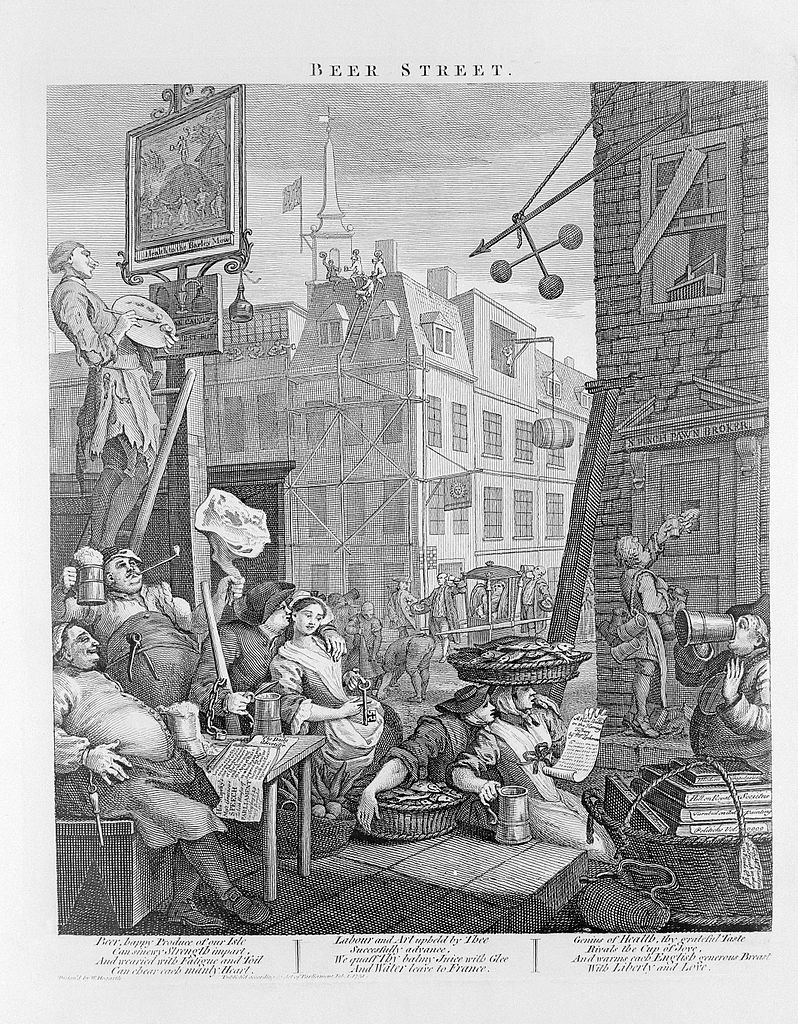
Beer Street, from Beer Street and Gin Lane by William Hogarth. The picture is a counterpoint to the more powerful Gin Lane — Hogarth intended Beer Street to be viewed first to make Gin Lane more shocking — but it is also a celebration of Englishness and depicts of the benefits of being nourished by the native beer.
Wikimedia Commons.
1620 was a dramatic year for England. As I mentioned last time, the rashness of the king’s son-in-law threatened to pull the country into a major European conflict. Religion, honour, and family — James I’s grandchildren were set to lose their inheritance, the Palatinate of the Rhine — dictated that the king should break his decades-long habit of peace. But war was hugely expensive, and the king already heavily in debt. He was forced to summon Parliament so that it could vote him the taxes he would need to wage war.
Parliament was already a major source of annoyance to James I. After 1610, he had done everything in his power to rule without its aid, at one point even comparing its lower house, the Commons, to a “House of Hell”. Yet the MPs of 1610 would come to seem almost angelic compared to those who assembled in Westminster in 1621. The Commons of 1621 would get completely out of control — all thanks to beer.
Beer (and ale, made without hops) was the most important source of calories after bread, and the first choice for hydration — cheaper than wine and safer than water, with coffee, tea, and spirits only becoming popular much later. It financially supported inns, the crucial infrastructure for travellers. Alehouses also provided a major focal point for socialising. If you controlled beer, you controlled society — second only, perhaps, to religion.
If beer was too strong, it could lead to drunkenness and unrest. If inns went unpoliced, they could become havens for criminals, heretics, sinners, and rebels. If brewers used too much malt, made from grains like barley, they could drive up the price of bread and cause famine. If beer-brewers demanded too many hops — used as both a preservative and a source of bitterness compared to sweeter ale — they could also put pressure on otherwise scarce land for food. Regulating the drinks industry correctly was thus a major priority for those in charge.
The making and selling of ale had originally been dominated by brewsters — that is, by female brewers. (Compare with the more persistent word spinster, to mean a woman who spins thread. Spinning remained women’s work long after the brewsters had been driven out of their industry. Only later, because of the independence that earning one’s own money brought, did spinster gain the more general meaning of a woman who was unmarried.) Meanwhile, hopped beer had been the preserve of immigrants. As one popular ditty put it, “Hops, Reformation, baize, and beer, Came into England all in one year”, though it had actually happened more gradually over the course of the late fifteenth and early sixteenth centuries.
Yet with population growth, and the dramatic expansion of London in particular, the drinks market became larger and more concentrated, while hop-less ale gave ground to the rise of beer. Male, English ale-brewers seized an opportunity to suppress their competition. London’s Ale Brewers’ Guild, for example, abandoned the use of hucksters — predominantly female ale-sellers — and then in 1556 absorbed the Beer-Brewers’ Guild, which had largely consisted of immigrants. The newly-amalgamated Worshipful Company of Brewers then barred immigrants from becoming members, while the English ale-brewers switched to producing beer. In 1574, they even successfully lobbied for the city to bar foreigners from being members of any guilds at all, including even second-generation immigrants born in England. The bigger the business, the more ruthless it became.
Comments Off on “The [House of] Commons of 1621 would get completely out of control — all thanks to beer”
Tank Chats #140 | M24 Chaffee | The Tank Museum
The Tank Museum
Published 19 Nov 2021Our Patreons have already enjoyed Early Access and AD free viewing of our weekly YouTube video! Consider becoming a Patreon Supporter today: https://www.patreon.com/tankmuseum
David Fletcher is back with another Tank Chat on the M24 Chaffee. Learn all about this American light tank and how it was used at the end of the Second World War and in post-WW2 conflicts.
(more…)
Comments Off on Tank Chats #140 | M24 Chaffee | The Tank Museum
February 25, 2022
Total War NOW – WAH 053 – February 1943, Pt. 2
World War Two
Published 24 Feb 2022Germany declares total (unconditional war) putting its economy on a full war footing over three years into the war. Given the unconditional war they are already waging, and the resistance and opposition they now face, it’s unclear what it shall mean.
(more…)
Comments Off on Total War NOW – WAH 053 – February 1943, Pt. 2
This tiny railway across the sea has an important job
Tom Scott
Published 15 Nov 2021The Lorenbahn, the Lüttmoorsiel-Nordstrandischmoor island railway, is famous for the tiny, private trains that take residents to and from the mainland. But that’s not why it was built: and it’s got a more useful purpose as well.
Thanks to everyone from Landesbetrieb für Küstenschutz, Nationalpark und Meeresschutz Schleswig-Holstein, and to the islanders, for all your time and patience!
Camera operator: Richard Bielau
Producer: Maximilian Thesseling of Klein Aber https://kleinaber.de/I’m at https://tomscott.com
on Twitter at https://twitter.com/tomscott
and on Instagram as tomscottgo

Comments Off on This tiny railway across the sea has an important job
QotD: The lure of the forbidden knowledge
Forbidden ideas have an appeal that orthodoxy never does — just ask Martin Luther. In fact, the parallels between the rise of the alt-right and the Reformation are interesting. In Luther’s world the printing press had recently created new and difficult to control ways for people to share subversive ideas. Early forms of capitalism led to the rise of new social classes and fueled resentment against traditional elites and traditional forms of authority. There were even early forms of the meme. Long before Pepe the Frog was co-opted by the alt-right, drawing donkey ears on images of priests was a way of provoking the powerful.
It’s surely the case that some of the speech that activists and university administrators seek to suppress poses a much more direct threat to real people than does a debate about supply side economics or evolution, but it’s worth remembering that to the Church, the Lutheran heresy was a real threat too. It posed a mortal danger to the eternal souls of people who were deceived by its falsehoods and rejected orthodoxy. I doubt that the Inquisitors felt any more qualms about deplatforming Lutheran heretics than did the activists at Middlebury.
As the Church learned, simply suppressing heresy cannot guarantee that it will go away. If anything, meeting heretical speech with violence or disruption just adds to its allure, confirming in the minds of the already convinced that they are right and leading the fence sitters to take another, perhaps more sympathetic, look. Dismissing heretical speech because it falls into a category that is rejected by the orthodox is not that much more effective a strategy.
We can do a lot to keep things from getting to the sort of highly contentious encounters like the ones at Middlebury and Berkeley, just by addressing uncomfortable issues with evidence rather than just categorization in our courses. Next time you are tempted to sidestep contentious issues in your class or to dismiss a student’s question because it falls into a forbidden category, don’t.
In the long run we can’t win an argument by avoiding it.
Erik Gilbert, “Liberal Orthodoxy and the New Heresy”, Quillette, 2019-02-04.
Comments Off on QotD: The lure of the forbidden knowledge
February 24, 2022
Got Wood? – The de Havilland Mosquito
World War Two
Published 23 Feb 2022What if there was a plane that the enemy could neither catch nor reach? One that fully relied on speed instead of defensive armaments? The de Havilland DH.98 Mosquito was the first multi-role aircraft developed during World War Two. Made mostly out of wood, the “Wooden Wonder” could be easily converted into different roles — a fighter, a fighter-bomber, a bomber, and a reconnaissance aircraft.
(more…)
Comments Off on Got Wood? – The de Havilland Mosquito
Politicians Ruin Everything: Dutch Luger Trials
Forgotten Weapons
Published 27 Oct 2021http://www.patreon.com/ForgottenWeapons
https://www.floatplane.com/channel/Fo…
Cool Forgotten Weapons merch! http://shop.forgottenweapons.com
The Dutch military started looking for semiauto pistols to replace its aging revolvers around 1899. They tested all the early models: the Roth, Borchardt, Mauser and Mannlicher — and then they obtained a Borchardt-Luger (aka, a Parabellum, or Luger). They first tested a long-barreled model with shoulder stock for artillery crews in 1901. The guns performed very well mechanically, but the officers in charge were dubious about the utility of the gun.
In 1903, another set of trials was run by the infantry, this time on short-barreled Lugers in both 9mm and 7.65mm. In addition, the Dutch requested a number of special changes to a subset of their guns – this “Dutch Model” was to have Dutch markings and a stronger coil mainspring designed by the Dutch ordnance department. That coil mainspring would be adopted by DWM and became the most significant improvement in the New Model Lugers.
Anyway, the 1903 trials were concluded with much success in 1905, and the Dutch War Minister happily adopted the Luger in 9mm. He wrote out an order to start getting the Army new modern pistols … only to be overridden by the Dutch Parliament. They decided that the new guns were basically too dangerous, and cancelled the adoption. This left the Army in a rather unexpected lurch, and they had to restart production of revolvers in 1906 to make up the shortages in handguns.
Contact:
Forgotten Weapons
6281 N. Oracle 36270
Tucson, AZ 85740

Comments Off on Politicians Ruin Everything: Dutch Luger Trials
February 23, 2022
From Shell Shock to PTSD – Understanding the Trauma of War – WW2 Special
World War Two
Published 22 Feb 2022Humanity has spent millennia developing ever more efficient ways to kill. This reaches its apogee in WWI and WWII, the most terrible conflicts in human history. Broken bodies bring with them broken minds. The trauma of war brings with it the mysteries of shell shock, war neurosis and PTSD.
(more…)
Comments Off on From Shell Shock to PTSD – Understanding the Trauma of War – WW2 Special


