
March 11, 2011
Reason.TV: Should governments subsidize alternative energy?
March 10, 2011
Stephen Gordon: “business groups are pro-BUSINESS, not pro-MARKET”
Stephen Gordon provides a useful reminder about not conflating “business” interests with “free market” interests: they’re often in conflict.
This is something that should always be kept in mind in economic policy discussions: business groups are pro-BUSINESS, not pro-MARKET.
It is especially important to keep this in mind when we read news items such as this, in which several of Canada’s largest banks voice their opposition to the proposed TMX-LSE merger.
It is true that business groups will often make use the language of markets, and it is obviously in their interest to portray themselves as defenders of markets.
But they are a lobby group like any other, and cannot be relied upon to defend the general public interest.
This point is sometimes hard to see, especially since many business groups have the reputation of favouring such pro-market policies such as free trade. And so they do, but for precisely the wrong reason: as a way of increasing exports.
This is why you can often find big business working hand-in-mailed-gauntlet with regulators to shut down competitors and make it harder for new competitors to enter their markets: corporations do not naturally favour free markets. Corporations exist to maximize profit for their shareholders, not primarily to serve customers. Serving customers is one way to accomplish that end, but in a regulated economy it may not be the best way to do it. If you can get the naked force of government to muscle in and suppress other businesses, that leaves more profit for you (as long as you co-operate with the government, that is).
Small businesses don’t have the ability to cosy up to government in the same way big corporations can, so even if they band together in trade groups, they won’t have the ability to capture and direct the regulators in the way big businesses often can.
March 8, 2011
Canadian banks forced to enter 21st century
In a long-overdue move, the Canadian government is putting pressure on the banks to improve their glacial cheque-clearing time:
Ottawa is cutting the amount of time banks can hold cheques up to $1,500 to four business days from seven for consumers and small- and medium-sized businesses.
The measures detailed today, part of last year’s budget, will also give consumers “immediate access” to the first $100 deposited by cheque. There will be a 30-day period for comment.
“Lower-income seniors, Canadians without significant balances in their accounts, younger Canadians who do not have a long banking history, and people who receive cheques from newer employers or clients are often subject to longer cheque hold periods,” the Department of Finance said. “These are often the Canadians who most need quick access to their funds.”
This is great news for me personally: I’m self-employed. I bill my clients directly for a month’s work, they take time to process my invoice and issue a cheque, then I deposit it into my business account. Seven business days later after that, I can actually get some of that money into my personal account. It’s amazing how long seven business days can seem when you’re juggling the mortgage, property tax bills, utilities, and all the other things that can’t be postponed to a time when the bank lets you get at your own money.
H/T to Elizabeth for the link.
March 7, 2011
Your energy consuming future
Britain is facing a very different future, from the point of energy consumption, according to Steve Holliday, CEO of National Grid:
Because of a six-fold increase in wind generation, which won’t be available when the wind doesn’t blow, “The grid is going to be a very different system in 2020, 2030,” he told BBC’s Radio 4. “We keep thinking that we want it to be there and provide power when we need it. It’s going to be much smarter than that.
“We are going to change our own behaviour and consume it when it is available and available cheaply.”
The more of your electricity that is produced from wind power, the more there will be very noticeable peaks and valleys in available electricity. Not only do you need more sources, you need over-capacity in some areas to generate sufficient power to supply to areas which are becalmed.
Under the so-called “smart grid” that the UK is developing, the government-regulated utility will be able to decide when and where power should be delivered, to ensure that it meets the highest social purpose. Governments may, for example, decide that the needs of key industries take precedence over others, or that the needs of industry trump that of residential consumers. Governments would also be able to price power prohibitively if it is used for non-essential purposes.
Perhaps it’s just the libertarian in me that finds the term “highest social purpose” to be very disturbing: just who the hell is going to be making that determination? And on what basis will the new high priests of the lightnings be making that call?
Smart grids are being developed by utilities worldwide to allow the government to control electricity use in the home, down to the individual appliance. Smart grids would monitor the consumption of each appliance and be capable of turning them off if the power is needed elsewhere.
Like the idea that someone at your local electrical board can decide that you don’t really need to run that TV set or that toaster right now? If the control freaks at the utilities manage to foist this off on us, we’ll be techno-peasants who are only allowed to run electrical devices that meet “social purpose” guidelines.
March 5, 2011
March 4, 2011
The complicated NFL labour situation
Update: Twitter rumours are now that the CBA will be extended for another week to allow further negotiations. New deadline is Friday March 11 at 5pm Eastern time.
March 1, 2011
American high speed rail plans an expensive mirage
Philip Klein looks at the faulty notions behind the Obama administration’s push for high speed railways:
To most Americans, the passing reference to California was likely an afterthought, lost amid all the dreamy rhetoric of rebuilding the nation. But upon closer inspection, the state’s proposed high-speed rail system serves as a perfect example of the gap between the promise of transformational liberalism and the reality of big government. Taxpayers everywhere should pay attention, because the project has already been granted $3.2 billion in federal funds, mostly through Obama’s economic stimulus package — and its backers hope to gobble up billions more over the next decade.
The $43 billion transportation project to link Los Angeles to San Francisco with a bullet train by 2020 would be considered grandiose during the plushest of times, yet it’s being pursued during an era when governments at all levels are mired in deep fiscal crises. The plan has been subject to a series of scathing reports by independent analysts, raising concerns about everything from its cost estimates to its business model. The University of California at Berkeley has questioned its lofty ridership projections. And even the Washington Post has editorialized against it.
It’s a huge wodge of cash from a government that’s already struggling with record deficits, handed to state governments who are in many cases even worse off financially, yet must match the federal funds or lose the subsidy.
Calling it a “system” is misleading, as none of the currently imagined lines would inter-connect. Nobody seems to be worried that there will not be enough passenger traffic to justify the enormous acquisition, construction, and operational costs for these train services.
“The cost projections are overly optimistic,” Wendell Cox, a public policy consultant and co-author of a critical report for the libertarian Reason Foundation, says. “The ridership projections are absolutely crazy. The thing will have no impact on highway traffic and will have little or no impact on the amount of planes in the air. This project really defines the term ‘boondoggle.'”
[. . .]
BRINGING HIGH-SPEED RAIL to America has been a decades-long dream for liberals, who have long envied Europe’s extensive rail system. Building a high-speed rail network, they hope, would move the nation away from automobiles and reduce pollution. It has the added bonus of being a massive, centrally planned public works project. The problem is just because rail has worked elsewhere, that doesn’t mean it makes sense here.
“We’re not like Spain or France, where the population densities are a lot higher, and the cities are not as spread out,” Ken Orski, a former transportation official in the Nixon and Ford administrations and publisher of the newsletter Innovation Briefs, says. “So you can connect cities like Barcelona and Madrid or Paris and Marseilles easily.”
The best place to build a high speed rail system for the US would be the Boston-New York-Washington corridor (aka “Bosnywash”, for the assumed urban agglomeration that would occur as the cities reach toward one another). It has the necessary population density to potentially turn an HSR system into a practical, possibly even profitable, part of the transportation solution. The problem is that without an enormous eminent domain land-grab to cheat every land-owner of the fair value of their property, it just can’t be done. Buying enough contiguous sections of land to connect these cities would be so expensive that scrapping and replacing the entire navy every year would be a bargain in comparison.
The American railway system is built around freight: passenger traffic is a tiny sliver of the whole picture. Ordinary passenger trains cause traffic and scheduling difficulties because they travel at higher speeds, but require more frequent stops than freight trains, and their schedules have to be adjusted to passenger needs (passenger traffic peaks early to mid-morning and early to mid-evening). The frequency of passenger trains can “crowd out” the freight traffic the railway actually earns money on.
Most railway companies prefer to avoid having the complications of carrying passengers at all — that’s why Amtrak (and VIA Rail in Canada) was set up in the first place, to take the burden of money-losing passenger services off the shoulders of deeply indebted railways. Even after the new entity lopped off huge numbers of passenger trains from its schedule, it couldn’t turn a profit on the scaled-down services it was offering.
Ordinary passenger trains can, at a stretch, share rail with freight traffic, but high speed trains cannot. At higher speeds, the actual construction of the track has to change to deal with the physical problem of safely guiding the fast passenger trains along the rail. Signalling must also change to suit the far-higher speeds — and the matching far-longer safe braking distances. High speed rail lines cannot be interrupted with grade crossings, for the safety of passengers and bystanders, so additional bridges and tunnels must be built to avoid bringing road vehicles and pedestrians too close to the trains.
In other words, a high speed railway line is far from being just a faster version of what we already have: it would have to be built separately, to much higher standards of construction.
Getting back to the California HSR line; it goes from A to B on this map:
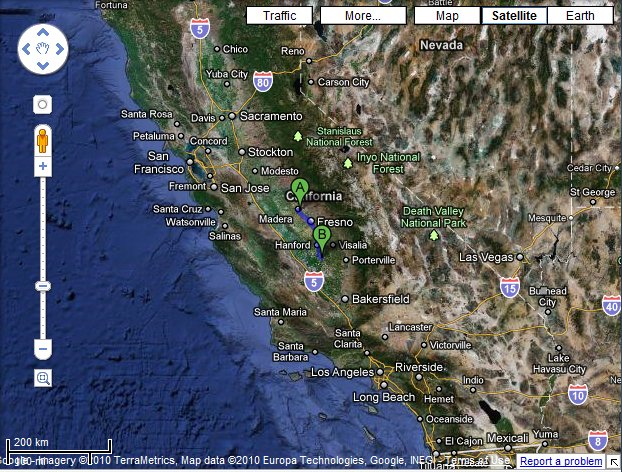
Okay, you think, at least Fresno will get some snazzy slick rail service . . . except this section will be built but not operated until further connecting sections are built . . . at a later date. Maybe. It will be the track, including elevated sections through Fresno, and the physical right-of-way, but no electrical system to power the trains; but that’s fine, because the budget doesn’t include any actual trains.
Of course, this is an old hobby horse of mine and I’ve posted about High Speed Railways a few times before.
CBC posts G20 mini-documentary
I haven’t had a chance to watch it yet, but Cory Doctorow says “This video makes me ashamed to be a Canadian”. You Should Have Stayed At Home:
It’s been eight months since the G20 and the iconic images are still with us — burning police cars, rampaging mobs, the massive security presence that according to the official story is all that stood between Canada’s largest city and chaos. But that’s not the whole story of Toronto’s G20. Astonishing new images caught on camera are now emerging and they expose a troubling new picture of what happened to hundreds of ordinary citizens caught in the huge police dragnet during those three highly-charged days last June.
Gillian Findlay presents a revealing new street-level perspective of what happened when thousands of police were deployed in downtown Toronto and instructed to do what was necessary to ensure the wall around the G20 Conference Centre was never breached. Exclusive eyewitness video obtained by the fifth estate brings to light startling images captured on cellphones and minicams by the innocent bystanders who found themselves on the wrong side of all that G20 “order.” In a rare television interview, Toronto Police Chief Bill Blair explains why police took the actions they did.
I was critical of the G20 even before things went off the rails. It was a stupid idea to hold it in the middle of Canada’s biggest city, and the police reaction to provocation was worthy of any rag-tag third world dictatorship.
February 27, 2011
QotD: Big government and big unions
The Times managed to get the salient feature of the story entirely wrong. They were not an “anti-government” mob, but a government mob, a mob of “public servants” objecting to austerity measures that would end, for example, the tradition of 14 monthly paychecks per annum. You read that right: the Greek public sector cannot be bound by anything so humdrum as temporal reality. So, when it was mooted that the “workers” might henceforth receive a mere 12 monthly paychecks per annum, they rioted. Their hapless victims — a man and two women — were a trio of clerks trapped in a bank when the mob set it alight and then obstructed emergency crews attempting to rescue them.
You don’t have to go to Athens to find “public servants” happy to take it out on the public. In Madison, politicized doctors provide fake sick notes for politicized teachers to skip class. In New York’s Christmas snowstorm, Sanitation Department plough drivers are unable to clear the streets, with fatal consequences for some residents. On the other hand, they did manage to clear the snow from outside the Staten Island home of Sanitation Dept head honcho John Doherty, while leaving all surrounding streets pristinely clogged. Three hundred Sanitation Department workers have salaries of over $100,000 per year. In retirement, you get a pension of 66 grand per annum plus excellent health benefits, all inflation proofed.
That’s what “collective bargaining” is about: It enables unions rather than citizens to set the price of government. It is, thus, a direct assault on republican democracy, and it needs to be destroyed. Unlovely as they are, the Greek rioters and the snarling thugs of Madison are the logical end point of the advanced social democratic state: not an oppressed underclass, but a spoiled overclass, rioting in defense of its privileges and insisting on more subsidy, more benefits, more featherbedding, more government.
Mark Steyn, “States of the Unions”, SteynOnline, 2011-02-26
February 26, 2011
The increasing length of freight trains in Canada
Some eye-opening statistics on the length of freight trains being run by Canadian National (CN) and Canadian Pacific (CP) these days:
Transport Canada launched a six-part study into the long-train strategies at the country’s largest railways this month with an eye on developing policies for how these longer, heavier trains are assembled and run. The goal of the two-year study is to develop science-based regulations that will hopefully reduce the number of derailments in the country.
Despite the concern from regulators, these longer, heavier trains in recent years have been a godsend for North American railways, which swear by their safety. Not only do they improve the efficiency of the rails by reducing the number of trains required to transport goods, but they in turn reduce the crews needed and the fuel used to move their shipments.
If properly built, they can also reduce wear and tear on the trains and the tracks themselves by cutting down on in-train forces, lowering maintenance costs substantially over time.
The cynic in my asks why, if CN (for example) actually managed to reduce the number of rail accidents to an all-time low last year, the regulators are now launching the investigation. Fewer accidents now equals a point of serious concern on the part of the regulators? Why?
Up until the 1990s, the average freight train in Canada was about 5,000 feet (1.54 kilometres) long and weighed 7,000 tons. But it is now not uncommon to see these trains stretch to 12,000 feet, sometimes as much as 14,000 feet (more than four kilometres), weighing up to 18,000 tons.
While CN is comfortable sticking with the size of its longest trains now, about 12,000 feet, CP continues to push the boundaries of how long it can build its trains by developing some of the industry’s most cutting-edge technology in recent years to help it do so.
The benefits are clear. CP estimates, for example, that the labour costs alone on a typical transcontinental train are now 30% lower than they would be if it was using smaller trains.
So, the trains are longer, carry far more freight, cost less to run, and customers are happy. The government must act!
February 24, 2011
They’re called “factoids”, not “facts”
There’s a factoid in common circulation at the moment that, measured by SAT scores, the states that ban collective bargaining for teachers rank almost dead last, while Wisconsin ranks 2nd. Neal McCluskey explains that this is not particularly true:
Now, aside from the factoid, if true, providing no real insight into whether collective bargaining is good or bad for education — there are myriad variables at work other than collective bargaining, none of which does this control for — but the factoid itself is highly dubious. Again, it is hard to find the original source for this, but I looked up 2009 ACT and SAT state rankings, and at the very least it seems highly unlikely that Virginia ranks 44th out of all states. According to the ACT ranking, for instance, Virginia places 22nd, and on the SAT (assuming the linked to list is accurate — I’m doing this fast), it ranked 33rd. It’s hard to see how those would be combined for a 44th place overall finish.
How about the Wisconsin second place-finish? Well, that is accurate for the SAT, but notably only 5 percent of Wisconsin students took the SAT — a negligible rate. On the ACT, which is the main test taken in the Badger State, Wisconsin finished 13th — not bad, but hardly great.
So what does this tell you? Not that collective bargaining is educationally good or bad — like I said, you just can’t get there from here — but that you have to be very careful about your sources of information. Unfortunately, that seems especially true when you’re dealing with education.


