Quotulatiousness

April 16, 2010

Exposing the truth about government-run Ponzi schemes

Filed under: Economics, Government, Politics — Tags: , , , — Nicholas @ 09:22

Kathy Shaidle is exactly right in her analysis of the key weakness of the Tea Party movement:

The Tea party movement contains the seed of its own failure

It preaches self-reliance and small government, but old people still want their pittance of gubmit cheese, ie Social Security.

If they/we were intellectually honest, we would be calling on the raising of the eligibility age to 90, which is more in line with Bismark’s original plan: a little pension for those who were never expected to live long enough to ever get it.

It was meant to be a “look how generous I am” gesture with no real impact; the original designers never thought we’d live long enough to cash the checks.

Older Tea Partiers (and all of us) should be petitioning the government to write everyone a one time check for the exact amount they were forced to contribute, plus maybe 5% interest if that is do-able.

And then the program should be abolished.

I hope most of my readers are not depending on their “government benefits” to get them through in their retirement years: the economics of the situation almost certainly won’t allow it. There are several problems with government-run retirement schemes, starting with the fact that most of them are not in any sense of the word “funded”. Most governments have been using the contributions as a giant low-interest revolving fund: you contribute, they withdraw and leave a promissary note in the kitty. The promissary note is drawn on you and your children. There is, technically speaking, no money in the kitty.

The people who will be worst hurt by the necessary changes to government pension schemes are the ones who earned too little (or spent too much) during their working lives and didn’t make any private provision for retirement. As Kathy points out, the first government pensions were designed so that most potential recipients would be unable to collect, because the start date of the pension income was set beyond the average lifespan of the population. Looking forward to a pension would be much less realistic today if the official “retirement age” was set to 90!

April 15, 2010

A very disturbing notion

Filed under: Economics, Europe, Government, Politics, USA — Tags: , , , — Nicholas @ 12:59

The Cato Institute’s Richard W. Rahn speculates about some very disturbing notions:

Politicians in developed countries have found that their citizens often get upset when inflation reaches high levels and then tend to vote out the culprits. You may recall that the less-than-astute Jimmy Carter lost his re-election campaign, in part, because inflation at one point reached 14 percent and the prime interest rate hit 21 percent.

An insightful European banker suggested to me over breakfast a couple of weeks ago that the European political class would use selective expropriation, rather than inflation, to avoid paying back all of the debt. The way this would be done would be that the political leaders would announce they would only pay back those bonds with full interest that were held by labor unions and other “politically correct” interest groups but not the bonds held by “greedy bankers” and rich people. Maturities would be extended and promised interest rates lowered – effectively reducing the value of the bonds.

My initial reaction was that, yes, such a selective expropriation might work in Europe, but not in the United States. As I thought more about it, however, looked at what was happening and heard President Obama’s rhetoric attacking “greedy” bankers and insurance companies, I began to think that not only was my European friend right about Europe, but his scenario was equally valid here.

The Obama administration has already indicated that it’s quite comfortable with protecting unions at the expense of other contracting parties (in the Government Motors case, at the very least), so it’s not much of a stretch to see this as a possibility in larger matters.

March 31, 2010

More on the growth in public sector employment

Filed under: Bureaucracy, Economics, Education, Government, Politics, USA — Tags: , — Nicholas @ 09:11

More on this topic here, here, here, here, and here.

March 29, 2010

Americans to lose privacy in offshore banking

Filed under: Economics, Government, Liberty, USA — Tags: , , , — Nicholas @ 09:27

Of course, the headline assumes that they had any such privilege in the past . . .

Samuel Taliaferro is disturbed by provisions in a new law which will extend US government intervention into foreign bank business:

The name of the bill is the Hiring Incentives to Restore Employment Act (H.R. 2487) commonly known as the HIRE Act. This is the jobs incentive bill that was signed by the President on March 18th amid little fanfare.

Relatively small by Washington standards (“just” an $18 billion stimulus package) the bill was drafted to provide incentives to employers to hire more people but contains some very disturbing language concerning the ownership and transference of money to any overseas account. The truly galling part of the bill is that it attempts to require “foreign financial and non-financial institutions to withhold 30% of payments made to such institutions by U.S. individuals unless such institutions agree to disclose the identity of such individuals and report on the bank transactions”. Think about this — the U.S. government is attempting to strong arm foreign financial and non-financial institutions (think banks and law firms) to either withhold 30% of the transactions in a U.S. individual’s account (and presumably remit this to the U.S. Treasury) or disclose the account details to the U.S.. The language of the bill addresses both bank accounts and any foreign trusts (ie- Private Interest Foundations).

In other words, the US government is afraid more Americans are going to be worried about the security of their money and will look to offshore institutions to preserve their savings. The government is moving pre-emptively to deter that flow of money away from their direct control. You’d almost think they didn’t trust their own citizenry.

March 25, 2010

QotD: The all-conquering Commerce clause

Filed under: Government, Law, Liberty, Quotations, USA — Tags: , — Nicholas @ 16:50

. . . this kind of argument proves too much, since it means that everything people do or don’t do potentially qualifies as interstate commerce, once you consider substitution effects, secondary and tertiary consequences, and similar behavior by other people. If sleeping with the windows open or failing to purchase an air filter triggers people’s allergies and causes them to “purchase over-the-counter remedies,” it affects interstate commerce. By Balkin’s logic, Congress therefore could pass a law requiring everyone (or maybe just allergy sufferers) to close their windows at night or purchase air filters. Mandatory calisthenics, which would make the population fitter and thereby reduce health care costs, likewise should qualify as regulating interstate commerce, along with myriad other measures aimed at increasing health-promoting behavior or reducing health-compromising behavior: a national bed time, mandatory tooth brushing, a donut ban, a weight tax, etc.

And these are just the possibilities suggested by the government’s interest in health care. Add in the other five-sixths of the economy, and the Commerce Clause swallows pretty much everything, subject to specific limits such as those listed in the Bill of Rights. Hence Congress could not stop us from watching a particular TV show or playing a particular video game (which would violate the First Amendment), but it could prevent us from engaging in such sedentary activities for more than an hour a day in the name of improving our health and boosting our productivity, both of which would have consequences that ripple through the economy and have a cumulative effect on interstate commerce.

Jacob Sullum “Uninsured People Do Things, So They Should Be Punished”, Hit and Run, 2010-03-25

March 23, 2010

Comparing congress to prostitutes is unfair to prostitutes

Filed under: Government, Humour, Politics, USA — Tags: — Nicholas @ 17:12

Scott Stein upbraids Glenn Reynolds (aka the Instapundit) for his sloppy and insulting comparison:

[P]rostitutes sell themselves for money — the most intimate part of themselves, even their souls, some opponents of legalized prostitution might say. So looked at this way, Congress is full of prostitutes. Members of Congress sell their souls (if any in Congress have such things). Principles, values, the interests of the nation, the Constitution — all of it — are up for sale to the highest bidder, and that bidder need not be offering money directly. Votes or influence in a political party will often do just fine. Of course, these lead to money and power, which is what the whores in Congress want.

But in many ways Congress is nothing like a prostitute. A prostitute only wants cash that customers actually have, and usually tells them the real price of the services being purchased. A prostitute doesn’t impose hidden fees through inflation (we don’t generally give prostitutes the power to print money, but somehow we let Congress approve stimulus packages and spend money that doesn’t exist). A prostitute doesn’t increase the national debt (in fact, it is government, by keeping prostitution illegal, that increases the deficit in yet another way, by making income from prostitution outside of the system and not taxable).

[. . .]

Yet I’ve never heard of a prostitute that had to convince constituents that they wanted to get laid. I don’t recall prostitutes having to give speeches to persuade their constituents that the sex would be good for them and worth the price. Prostitutes have willing and eager constituents. Prostitutes might proposition men, advertise their wares, but they don’t have to force themselves on johns. Prostitutes don’t have to rape anyone.

Can the same be said of Congress?

Glenn, comparing prostitutes to Congress is insulting — to the prostitutes. Perhaps you owe them an apology.

Stimulus did little, private sector did much more

Filed under: Cancon, Economics, Government — Tags: , — Nicholas @ 12:09

Despite all the expensive ads (especially noticeable during the Vancouver Olympic coverage), it wasn’t the federal government’s stimulus package that has been creating jobs: it was the private sector:

Canada’s economic fortunes have seen a dramatic turnaround in the last year, but according to a new study by one of the country’s leading think-tanks, it had little to do with the federal government’s $47.2-billion Economic Action Plan.

The Fraser Institute released a study Tuesday that found that government stimulus packages contributed only 0.2 percentage points to the rise in GDP between the second and third quarter of 2009 and nothing between the third and fourth quarter.

The group found that it was private-sector investment and increased exports that were the driving forces behind the change in GDP growth.

“Although the federal government has repeatedly claimed credit for Canada’s improved economic performance in the second half of 2009, Statistics Canada data show that government spending and investment in infrastructure had a negligible effect on the country’s improved economic growth,” said the Fraser Institute’s senior economist, Niels Veldhuis.

Here is the news release from the Fraser Institute.

This shouldn’t be a surprise: the stimulus was, and continues to be, a media exercise much more than it was an economic plan. As with any outcry in the mass media, the government had to be seen to be doing something, regardless of the likely success. The illusion of positive motion was necessary, and the federal government knows it has little wiggle room as far as the mainstream media is concerned — doing nothing was not going to be an acceptable choice, even if doing nothing was the “correct” response.

The government can’t really “create” jobs — although it certainly can destroy ’em — most of the jobs “created” in response to government funding are going to go away as soon as that funding dries up. There’s no economic justification for them to exist, absent the stimulus money. If there was an economic justification, private employers would have created them (where not hindered by government action of one form or another, that is).

The increase in public sector employment is unsustainable: the money to pay salaries and benefits (ahem), training, equipment, and facilities all has to be taxed from individuals and companies. The more public sector jobs, the greater the drain on the private sector. The greater the burden placed on the private sector, the slower the growth of the economy. As you approach the “break even” point, where the private sector can no longer fund all the demands from the public sector, the economy gets more and more sluggish — no sane private employer is going to expand business if there’s no profit to be made. No expansion means no new jobs.

It might be possible for us all to live by “taking in one another’s laundry”, but it’s not possible for us all to live by approving permission forms, having meetings, and bureaucratic empire-building.

March 18, 2010

Compare and contrast

Filed under: Cancon, Government, History, Politics, USA — Tags: , — Nicholas @ 13:16

Andrew Coyne looks at what would have happened in the Watergate scandal (the original “-gate”) if President Nixon had the same scope of power that a Canadian Prime Minister enjoys:

As the Watergate scandal deepened, the U.S. Senate struck a committee to investigate. Headed by Sen. Sam Ervin, it had broad powers to subpoena documents and compel evidence, together with a staff of investigators and legal counsel.

On July 13, 1973, Alexander Butterfield, Richard Nixon’s deputy assistant, told committee staff that discussions in the Oval Office were routinely tape-recorded. Before long, judge John J. Sirica had launched proceedings to force the president to hand over the tapes. Nixon refused, citing executive privilege, but in the end complied with a Supreme Court ruling ordering their release, with consequences that are well known.

But suppose the U.S. Congress functioned like Canada’s Parliament, and Nixon had the powers, not of a president, but of a prime minister of Canada. The committee, uncertain of its jurisdiction and with little in the way of staff or resources, would very likely never have learned of the tapes’ existence. Had it persisted with its inquiries, Nixon could have shut down the committee, and the Congress with it. And, rather than defend his case in court, Nixon could have hired a former Supreme Court judge to “advise” him on whether to release the tapes. And that would more or less be that.

He does say that he’s not trying to draw a direct comparison between the two situations (Watergate versus the Afghan detainee issue), but to highlight the relative amount of power a “mere” prime minister wields.

Adding “ordinary” criminals to the sex offender registry

Filed under: Government, Law, Liberty, USA — Tags: , — Nicholas @ 08:00

The sex offender registry in most jurisdictions doesn’t work — at least, it doesn’t work to deter re-offence and it almost certainly doesn’t work to protect the public. What these registries do quite successfully, however, is to continue punishing the criminals long after they have served their sentences.

People who appear in these registries have a long list of prohibited activities, most frequently requiring them to stay a certain distance from schools (which often means there is little or no choice for where they can live, work, or travel, as the legallly mandated distance exceeds the average distance between schools). Ordinary ex-cons have great difficulty getting employment even in a growing economy, and the situation for identified “sex offenders” is close to impossible.

As a general rule, having your name added to the sex offender registry is as close to a life sentence as possible, but with no hope of parole and no hope of even a semblance of living a normal life.

Georgia apparently thinks this situation is not only fine, but they’d like to add non-sexual offenders to the registry too:

Georgia’s Supreme Court is upholding the government’s right to put non-sex offenders on the state’s sex-offender registry, highlighting a little-noticed (but growing) nationwide practice.

Atlanta criminal defense attorney Ann Marie Fitz estimated that perhaps thousands of convicts convicted of non-sexual crimes have been placed in sex-offender databases. Fitz represents a convict who was charged with false imprisonment when he was 18 for briefly detaining a 17-year-old girl during a soured drug deal. He unsuccessfully challenged his mandatory, lifelong sex-offender listing to the Georgia Supreme Court, which ruled against him Monday.

Under the Adam Walsh Child Protection and Safety Act of 2007, the states are required to have statutes demanding sex-offender registration for those convicted of kidnapping or falsely imprisoning minors. The Georgia court ruled that the plain meaning of “sex offender” was overridden by the state’s law.

If it’s your world view that criminals should never be forgiven for their transgressions, then this sort of deliberate act is understandable. It’s morally indefensible, but it’s understandable.

March 15, 2010

PSAC president says public servants not paid as well as private sector workers

Filed under: Bureaucracy, Cancon, Government — Tags: , , — Nicholas @ 12:55

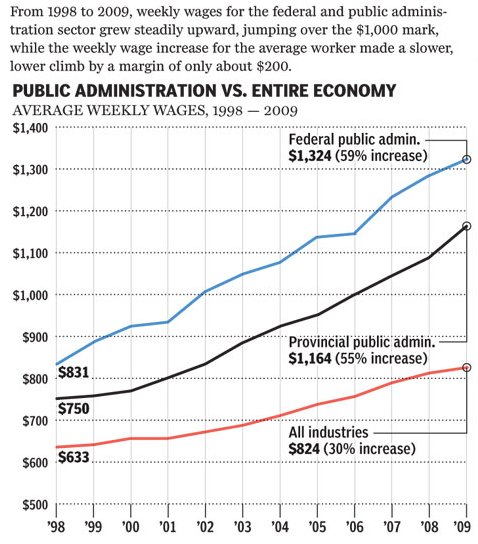
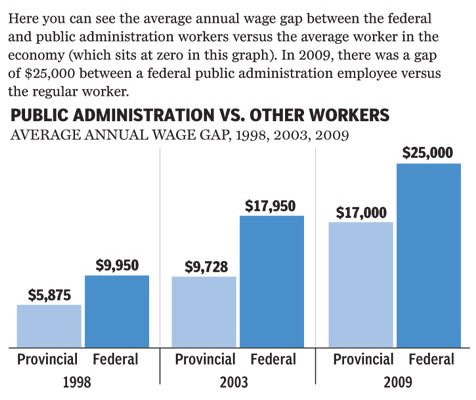
In direct opposition to common belief, John Gordon of the Public Service Alliance of Canada says that civil servants are worse-paid than private sector workers:

“Here we are again,” says John Gordon, the president of the Public Service Alliance of Canada that represents 165,000 workers.

“Every time the government gets into [trouble] they kind of ramp up the rhetoric and the Canadian public starts to believe them . . .” he said.

In general terms, he added, his members’ wages run behind those in comparable positions in the private sector.

His workers are an easy target, he said, because the government fails to explain what it means to get rid of public servants — that services provided to the public would be affected.

For example, Mr. Gordon points to the work done by federal public servants during the H1N1 crisis to get vaccines in place and deal with the pandemic.

“It’s easy to broad brush it and say they should be freezing wages, which they have already done and cutting public services, which they are already doing . . .” he said, but added that the public has to ask itself what services it would like to see gone.

You see, unlike in the bloated private sector, where jobs are for life, and pensions are awesome, civil servants are overworked and underpaid. Any hint of reducing the costs of the civil service will automatically produce the most painful cuts for the public — that’s how the game is played. Even a freeze would somehow, through the arcane alchemy of public service financing, result in cuts only in the services most visible to the public.

Update, 16 March: An interesting sidelight to this is reported in Hit and Run:

California citizens are now encountering “state and local government officials [who are] increasingly . . . blaming budget cuts and furloughs when they withhold or delay the release of information requested under the state Public Records Act.”

QotD: Process matters

Filed under: Government, Law, Liberty, Politics, Quotations — Tags: , — Nicholas @ 12:50

Libertarians are process people, something that our political opponents find impossible to believe can be real, rather than disingenuous. So when I say that I think Lawrence v. Texas might be the right result morally but the wrong result legally, it must be that I secretly want sodomy to be illegal, or at the very least don’t care. Or when I am troubled by government intervening in the Chrysler bankruptcy process, it’s because I hate unions. And of course, when I am against post-hoc legal judgments against bankers or their bonuses, it’s just because I’m an apologist for rich people.

But to a libertarian, process matters. Having a good process is better than getting a good outcome, because a good process is one that maximizes your chances of getting good outcomes over time.

Megan McArdle, “The Process of Passing Health Care”, The Atlantic, 2009-12-22

March 13, 2010

Privatization? Let’s not be ideological!

Filed under: Bureaucracy, Cancon, Economics, Government — Tags: , , , , , , — Nicholas @ 13:03

Robert Fulford on the problems with unions in the public service:

Unions hate the very word “privatization.” And no wonder. Their present system is close to perfect: Their workers can’t be fired but can strike, as they do from time to time, demonstrating their power. They win most of their struggles with politicians, who throw billions at them just to keep them quiet. (After all, it’s not as if the politicians were spending their own money.)

This arrangement became commonplace in Canada about half a century ago, turning public-sector employees into princes of the working class who make more money than other people doing the same jobs, and receive more generous benefits.

Union members passionately believe this is no more than their due. The unions and their friends believe public ownership is fundamentally good, private ownership at best dubious. In 1994, when it seemed possible that Ontario would privatize liquor sales, the Ontario Liquor Boards Employees’ Union commissioned a study by a York University economist, Nuri Jazairi. He found, no surprise, that this was a bad idea and that the provincial government should continue to control every ounce of liquor sold within provincial boundaries, presumably for eternity.

But his report was most revealing when he turned to the motives of those who favour privatization. He suggested the idea sprang from “purely political and ideological reasons,” among which he listed “the control of public expenditures” and “limiting the role of government in managing the economy.”

It’s no surprise that the folks who benefit disproportionally from the current arrangement are the most vocally opposed to any changes which would reduce their advantages. If the government did get enough political will to go ahead and privatize, there’s no way (unless the government tied their hands in advance) that private enterprise would give — or could afford to give — their employees the same pay and benefits they currently enjoy under public ownership.

Update: Speaking of situations which could only arise under public ownership, here’s a perfect example:

More than 1,250 Ontario Ministry of Revenue employees will soon be receiving severance packages of up to $45,000 each — but they won’t be out of work. Most of them aren’t even switching desks. They’re simply being transferred from the provincial payroll to the federal payroll when the province moves to a federal harmonized sales tax this summer.

March 11, 2010

QotD: Green jobs

[G]reen jobs have become the ginseng of progressive politics: a sort of broad-spectrum snake oil that cures whatever happens to ail you. They are the antidote to economic malaise, an underskilled labor force, the inherent unwillingness of the public to suffer any significant economic and personal dislocation in order to save the environment. They enhance nationalistic vigor. (If we don’t act now, the Chinese will steal all of our green jobs!) They stave off aging of stale political platforms. And I’m pretty sure they’re good for bunions, too.

Megan McArdle, “The Jobs Are Always Greener…”, The Atlantic, 2010-03-11

March 10, 2010

George Monbiot: “There goes my life’s work”

Filed under: Environment, Government, Media, Science — Tags: , , — Nicholas @ 12:32

As I mentioned when the Climategate scandal started to break, I fear that the misdeeds of climate scientist-activists would rebound against all scientists. George Monbiot seems to be coming around to sharing that concern:

The attack on climate scientists is now widening to an all-out war on science. Writing recently for the Telegraph, the columnist Gerald Warner dismissed scientists as “white-coated prima donnas and narcissists . . . pointy-heads in lab coats [who] have reassumed the role of mad cranks . . . The public is no longer in awe of scientists. Like squabbling evangelical churches in the 19th century, they can form as many schismatic sects as they like, nobody is listening to them any more.”

A small clique of activists managed to temporarily hijack the global agenda, with the potential to destroy untold trillions of dollars of economic development and reduce the freedom of billions of human beings. If the CRU data leak hadn’t taken place, we’d now be looking at massive government intervention in all areas of human existance, far beyond the dreams of power-mad dreamers.

If the threats to human existance were as bad as the CRU and IPCC declared, the actions our governments would have to take would be catastrophic for much of the world. To reduce carbon dioxide emissions to the level the global warming activists deemed appropriate, we’d have to pretty much give up fossil fuels altogether. We’d be condemning billions of people to starvation . . . without modern farming and modern transportation and storage facilities, we couldn’t feed the current population of the world.

To say that this is a setback to science is an understatement, for the actions of those few scientists will make all scientists that much more suspect. Given the alternative of forced curtailment or even abandonment of industrial civilization (and a death toll of unimaginable size) or scientists being given less credence by the public, the latter is by far the lesser evil.

Despite my iconoclastic, anti-corporate instincts, I now spend much of my time defending the scientific establishment from attacks by the kind of rabble-rousers with whom I usually associate. My heart rebels against this project: I would rather be pelting scientists with eggs than trying to understand their datasets. But my beliefs oblige me to try to make sense of the science and to explain its implications. This turns out to be the most divisive project I’ve ever engaged in. The more I stick to the facts, the more virulent the abuse becomes.

This doesn’t bother me — I have a hide like a glyptodon — but it reinforces the disturbing possibility that nothing works. The research discussed in the Nature paper shows that when scientists dress soberly, shave off their beards and give their papers conservative titles, they can reach across to the other side. But in doing so they will surely alienate people who would otherwise be inclined to trust them. As the MMR saga shows, people who mistrust authority are just as likely to kick against science as those who respect it.

Perhaps we have to accept that there is no simple solution to public disbelief in science. The battle over climate change suggests that the more clearly you spell the problem out, the more you turn people away. If they don’t want to know, nothing and no one will reach them. There goes my life’s work.

H/T to Elizabeth who wrote “Is Monbiot on the road to Damascus? He hasn’t got there yet but he certainly is starting to question a lot of the greenery.”

California launches yet another attempt to tax out-of-state corporations

Filed under: Books, Bureaucracy, Economics, Government, Politics — Tags: , , — Nicholas @ 08:28

California is getting desperate to scrape up every penny it can, so a renewed proposal for a tax grab vetoed by Governor Arnold Schwarzenegger last year is back in play:

The online retail giant [Amazon.com] has enjoyed an edge over many competitors in the state because it is not required to collect sales tax from residents who buy books, top-of-the-line plasma televisions, cases of diapers and thousands of other products from its website. The Seattle corporation has no store, warehouse, office building or other physical presence in California, and the state cannot tax such businesses under a 1992 Supreme Court decision.

Consumers here are required to pay sales tax on the goods they purchase at Amazon but almost never do, because the state has no mechanism for tracking Amazon purchases and collecting the money.

No story is complete without a nasty accusation:

The Democrats who control California’s Legislature plan to put their own bid on the governor’s desk this month in hopes of reaping up to $150 million annually for state and local coffers. The revenue would make only a tiny dent in the state’s $20-billion deficit, but supporters say every dollar counts in tight times, and there’s a principle at stake.

Amazon has “built an entire business model based on tax avoidance,” said Assembly tax committee Chairman Charles Calderon (D-Montebello).

Of course, tax avoidance is perfectly legal . . . he’s trying to smear Amazon (and every other business selling to customers in California) as being tax evaders. Avoidance is not only legal, it’s a sensible strategy to minimize costs and gain a competitive advantage. Tax evasion, on the other hand, is illegal.

So who is going to get hurt if the measure passes — other than Californians who have been remiss in declaring and remitting their sales taxes?

The California proposal seizes on the thousands of online sales affiliates that Amazon contracts with to get customers to its site. Those companies advertise Amazon products, provide links to the company’s website and get a percentage of the resulting sales.

Many of the affiliates are in California. Supporters of the Democrats’ bill, ABX8 8, say that the connections amount to a presence for Amazon as well and that California should be able to force the firm to collect sales tax.

H/T to Clive, who became aware of this through a website he visits regularly which may have to close down due to the proposed law.

« Newer PostsOlder Posts »

Powered by WordPress