
November 7, 2013
Rick Mercer on the plight of injured veterans
November 5, 2013
Camelot? Not so much…
Gene Healy thinks that after fifty years, it’s time we stopped pretending that John F. Kennedy was a great president:
In a December 1963 interview, the president’s widow gave a name to the Kennedy mystique, telling journalist Theodore White of Jack’s fondness for the lyric from the Lerner and Loewe musical about King Arthur: “Once there was a spot, for one brief shining moment, that was known as Camelot.”
Much more than a “moment,” Camelot has proven an enduring myth.
JFK places near the top 10 in most presidential ranking surveys of historians, and in a 2011 Gallup poll, Americans ranked him ahead of George Washington in a list of “America’s greatest presidents.”
Kennedy’s murder was a national tragedy, to be sure, but an honest assessment of his record shows that our lawless and reckless 35th president was anything but a national treasure.
[…]
Indeed, JFK rarely let legal specifics deter his exercise of presidential power. At his behest in 1961, the Internal Revenue Service set up a “strike force,” the Ideological Organizations Project, targeting groups opposing the administration.
In 1962, outraged that American steel manufacturers had raised prices, he ordered wiretaps, IRS audits and dawn FBI raids on steel executives’ homes.
In 2011, Pulitzer Prize-winning national security journalist Thomas E. Ricks opined that JFK “probably was the worst American president of the [20th] century.”
In foreign policy, Ricks said, “he spent his 35 months in the White House stumbling from crisis to fiasco.”
True enough, after being buffaloed into the disastrous Bay of Pigs operation by the CIA, Kennedy helped bring the world to the brink of thermonuclear war in the Cuban Missile Crisis — not because Soviet missiles in Cuba altered the strategic balance of power (they did not), but because, as former Defense Secretary Robert McNamara later admitted, the missiles were “politically unacceptable” for the president.
Moreover, Kennedy’s aura of vitality and “vigah” depended on deliberate lies about his medical fitness for office: “I never had Addison’s disease … my health is excellent,” JFK told a reporter in 1961.
As Kennedy biographer Richard Reeves notes, JFK, who “received the last rites of the Catholic Church at least four times as an adult,” was “something of a medical marvel, kept alive by complicated daily combinations of pills and injections,” including a psychiatrically dangerous cocktail of painkillers and amphetamines regularly administered by celebrity physician Max “Dr. Feelgood” Jacobson.
Update, 6 November: Nick Gillespie assigns the blame (for the still-going hagiography) on the boomers in a piece titled “JFK Still Dead, Baby Boomers Still Self-Absorbed”
Indeed, by the early 1970s, what American over or under 30 didn’t agree with the sentiments expressed in a 1971 New York Times Magazine story on youth politics co-authored by Louis Rossetto, the future cofounder of Wired magazine? “John F. Kennedy, one of the leading reactionaries of the sixties, is remembered for his famous line, ‘Ask not what your country can do for you; ask what you can do for your country,’” seethed Rossetto and Stan Lehr. “Today, more and more young people are instead following the advice of [author] David Friedman: ‘Ask not what government can do for you… ask rather what government is doing to you.’”
But boomers were so much older then, they’re younger than that now, right? Despite the raft of revelations not just about governmental abuses of power generally but those involving JFK specifically, boomers just can’t quit him (or their airbrushed image of him) as their own mortality comes into focus. Here’s Vanity Fair’s James Wolcott, known for an “artful nastiness that’s long disappeared from his peers’ arsenal,” still going weak in the knees for Jack:
I remember the light at the end of the school hallway reflecting off the floor as word went round and the weight in the air the days after. For kids my age, it was like losing a father, a father who had all of our motley fates in his hands…
As Splice Today’s Russ Smith — himself a boomer old enough to remember where he was when Kennedy was shot — notes, this is pure overstatement: “It wasn’t ‘like losing a father,’ and to suggest so is an affront to all the children who actually did lose their own father at a tender age.” Smith, who as the founder of the Baltimore and Washington City Papers and The New York Press knows a thing or two about reader appetites, is “betting that most of these books bomb, mostly because for most Americans those tumultuous days in 1963 are ancient history. Kennedy’s assassination might as well have occurred in the 19th century. Save for ascending and budding historians, where’s the audience for yet another encore of Camelot?”
QotD: Accumulated bureaucratic turkeys
Anyone with family or friends in the civil service hears about the hours wasted on bureaucratic wrestling with the guy who spends his energy crafting strategies to get you to do his work. My favorite came from a doctor in a prestigious department at a state hospital whose secretary threw out most of his mail, including all of the invitations, because answering it was too much work. He ended up getting his wife to come into the office and act as his unpaid secretary, because firing or replacing the secretary was way too much trouble.
I am not slamming all civil servants as lazy lackwits; these stories come from good civil servants who are endlessly frustrated by the obstructive and destructive minority. Turkeys in government are like prizes on Wheel of Fortune: Once you win one, it’s yours to keep. They can’t be fired, and they rarely quit; the best you can do is wait for a chance to transfer them somewhere else.
Because of the Universal Law of Turkey Accretion, the quality and effectiveness of a government agency’s personnel are likely to peak very shortly after that agency is established. HHS has been around for a long time, and so has its IT staff. Which means it has more than a few turkeys. Or, as David Cutler put it in a 2010 memo to Larry Summers, “The agency is demoralized, the best people have left, IT services are antiquated, and there are fewer employees than in 1981, despite a much larger burden.”
Megan McArdle, “Get Rid of Obamacare’s Turkeys”, Bloomberg.com, 2013-11-04
November 4, 2013
QotD: Software quality assurance
The fundamental purpose of testing—and, for that matter, of all software quality assurance (QA) deliverables and processes — is to tell you just what you’ve built and whether it does what you think it should do. This is essential, because you can’t inspect a software program the same way you can inspect a house or a car. You can’t touch it, you can’t walk around it, you can’t open the hood or the bedroom door to see what’s inside, you can’t take it out for spin. There are very few tangible or visible clues to the completeness and reliability of a software system — and so we have to rely on QA activities to tell us how well built the system is.
Furthermore, almost any software system developed nowadays for production is vastly more complex than a house or car — it’s more on the same order of complexity of a large petrochemical processing and storage facility, with thousands of possible interconnections, states, and processes. We would be (rightly) terrified if, say, Exxon build such a sprawling oil refining complex near our neighborhood and then started up production having only done a bare minimum of inspection, testing, and trial operations before, during and after construction, offering the explanation that they would wait until after the plant went into production and then handle problems as they crop up. Yet too often that’s just how large software development projects are run, even though the system in development may well be more complex (in terms of connections, processes, and possible states) than such a petrochemical factory. And while most inadequately tested software systems won’t spew pollutants, poison the neighborhood, catch fire, or explode, they can cripple corporate operations, lose vast sums of money, spark shareholder lawsuits, and open the corporation’s directors and officers to civil and even criminal liability (particularly with the advent of Sarbanes-Oxley).
And that presumes that the system can actually go into production. The software engineering literature and the trade press are replete with well-documented case studies of “software runaways”: large IT re-engineering or development projects that consume tens or hundreds of millions of dollars, or in a few spectacular (government) cases, billions of dollars, over a period of years, before grinding to a halt and being terminated without ever having put a usable, working system into production. So it’s important not to skimp on testing and the other QA-related activities.
Bruce F. Webster, “Obamacare and the Testing Gap”, And Still I Persist…, 2013-10-31
November 2, 2013
Catalonia – the next state in Europe?
Daniel Bogre Udell looks at the state of the independence movement in Catalonia, which has been part of Spain since the War of Spanish Succession in 1714, except for a brief interlude during the Spanish Civil War:
This year, on September 11, hundreds of thousands of Catalans joined hands to form a human chain that extended 460 kilometers across their region, from the French Pyrenean border to Valencia. Complete with matching t-shirts and slogans, this robust act of protest was astonishingly well-organised, which came as no surprise: it was in fact the echo of a mass demonstration that took place one year prior, when a million people took to the streets of Barcelona under the banner: “Catalonia: The Next State in Europe.”
The day after that first demonstration, Catalan President Artur Mas publicly endorsed the protest and called for a referendum on independence. Shortly after, he convoked early elections which produced a sweeping pro-referendum majority in Barcelona.
Overnight, Catalan politics changed. The Independentists were now in control. Unionists softened their rhetoric. Nearly two hundred towns in the Catalan countryside preemptively declared independence [ca]. Parliament passed a declaration of sovereignty.
Instead of taking this clamor seriously and engaging the Catalan public, most in the Spanish government, including Prime Minister Mariano Rajoy, positioned themselves firmly as antagonists. They insisted that referendum was illegal, framing Catalan nationalists as enemies of democracy and, in some extreme cases, comparing the sovereignty movement to Nazism.
They have also tried to promote the idea of Catalan nationalist ambitions as parochial and irrelevant. After a meeting with Catalan business leaders in Barcelona this month, Spain’s Deputy Prime Minister claimed not to have noticed any strong markers of regional identity. In a recent English-language interview with The Wall Street Journal, Prime Minister Rajoy described the hypothetical advent of Catalan independence as contrary to the world’s “natural evolution.” When addressing the Spanish public at the UN General Assembly, he went out of his way assure those in the chamber that none of his fellow world leaders had asked him about Catalonia.
Behind closed doors, however, it seems that Spanish officials are more concerned than their dismissive behavior implies: recently, Spain’s UN delegation drafted a report on how best to respond if Catalan leaders take their case to the international community in the wake of a successful referendum on independence. It asserted that Madrid could possibly draft security council allies into blocking Catalonia’s full statehood, but would be relatively powerless to stop the region’s admission as a General Assembly observer.
“Catalonia: The Next Partially-Recognized State” may not be as elegant a turn of phrase as those coined by activists, but it nonetheless haunts politicians in Madrid.
November 1, 2013
October 31, 2013
Reason.tv – Do the Healthcare Mash
Trick or Treatment? Remy channels Bobby “Boris ” Pickett for this Healthcare.gov-Halloween mash-up.
Written and performed by Remy. Video by Sean Malone.
[…]
Lyrics:
He was working on his laptop late one night
when his eyes beheld a ghoulish site
He could not log in despite several tries
then suddenly to no one’s surprise(he did the Mash)
He did the Healthcare Mash
(the Healthcare Mash)
it was a keyboard smash
(he did the Mash)
the website was trash
(he did the Mash)
He did the Healthcare mashWho could design such a site so flawed and so sloppy?
The code is so ancient, perhaps it was Hammurabi
He’d try to apply but the site would suspend
I’ve seen a eunuch with a more functional front end(he did the Mash)
He did the Healthcare Mash
(the Healthcare Mash)
it was a keyboard smash
(he did the Mash)
He tried to clear his cache
(he did the Mash)
He did the Healthcare mashHundreds of millions of dollars were spent
for a website that has trouble loading
How could the government’s web designers
create a site with such awful coding?(they did the Mash)
Ahh, they did the Healthcare Mash
(the Healthcare Mash)
it was a keyboard smash
(they did the Mash)
they spent all of our cash
(they did the Mash)
They did the Healthcare Mash
October 29, 2013
Obamacare’s technical issues
A comment at Marginal Revolution deservedly has been promoted to being a guest post, discussing the scale of the problems with the Obamacare software:
The real problems are with the back end of the software. When you try to get a quote for health insurance, the system has to connect to computers at the IRS, the VA, Medicaid/CHIP, various state agencies, Treasury, and HHS. They also have to connect to all the health plan carriers to get pre-subsidy pricing. All of these queries receive data that is then fed into the online calculator to give you a price. If any of these queries fails, the whole transaction fails.
Most of these systems are old legacy systems with their own unique data formats. Some have been around since the 1960′s, and the people who wrote the code that runs on them are long gone. If one of these old crappy systems takes too long to respond, the transaction times out.
[…]
When you even contemplate bringing an old legacy system into a large-scale web project, you should do load testing on that system as part of the feasibility process before you ever write a line of production code, because if those old servers can’t handle the load, your whole project is dead in the water if you are forced to rely on them. There are no easy fixes for the fact that a 30 year old mainframe can not handle thousands of simultaneous queries. And upgrading all the back-end systems is a bigger job than the web site itself. Some of those systems are still there because attempts to upgrade them failed in the past. Too much legacy software, too many other co-reliant systems, etc. So if they aren’t going to handle the job, you need a completely different design for your public portal.
A lot of focus has been on the front-end code, because that’s the code that we can inspect, and it’s the code that lots of amateur web programmers are familiar with, so everyone’s got an opinion. And sure, it’s horribly written in many places. But in systems like this the problems that keep you up at night are almost always in the back-end integration.
The root problem was horrific management. The end result is a system built incorrectly and shipped without doing the kind of testing that sound engineering practices call for. These aren’t ‘mistakes’, they are the result of gross negligence, ignorance, and the violation of engineering best practices at just about every step of the way.
October 28, 2013
Nanny gets bigger – mission creep in “public health”
In sp!ked, Christopher Snowdon starts off by listing a few “public health” proposals that have been suggested recently:
An abridged list of policies that have been proposed in the name of ‘public health’ in recent months includes: minimum pricing for alcohol, plain packaging for tobacco, a 20 per cent tax on fizzy drinks, a fat tax, a sugar tax, a fine for not being a member of a gym, graphic warnings on bottles of alcohol, a tax on some foods, subsidies on other foods, a ban on the sale of hot food to children before 5pm, a ban on anyone born after the year 2000 ever buying tobacco, a ban on multi-bag packs of crisps, a ban on packed lunches, a complete ban on alcohol advertising, a ban on electronic cigarettes, a ban on menthol cigarettes, a ban on large servings of fizzy drinks, a ban on parents taking their kids to school by car, and a ban on advertising any product whatsoever to children.
Doubtless many of the proponents of these policies identify themselves as ‘liberals’. We must hope they never lurch towards authoritarianism. […]
As the definition of ‘health’ has been changed, so too has the meaning of ‘public health’. It once meant vaccinations, sanitation and education. It was ‘public’ only in the sense that it protected people from contagious diseases carried by others. Today, it means protecting people from themselves. The word ‘epidemic’ has also been divorced from its meaning — an outbreak of infectious disease — and is instead used to describe endemic behaviour such as drinking, or non-contagious diseases such as cancer, or physical conditions such as obesity which are neither diseases nor activities. This switch from literal meanings to poetic metaphors helps to maintain the conceit that governments have the same rights and responsibility to police the habits of its citizens as they do to ensure that drinking water is uncontaminated. It masks the hard reality that ‘public health’ is increasingly concerned with regulating private behaviour on private property.
The anti-smoking campaign is where the severe new public-health crusade began, but it is not where it ends. Libertarians warned that the campaign against tobacco would morph into an anti-booze and anti-fat campaign of similar intensity. They were derided; ridiculed for making fallacious ‘slippery slope’ arguments. In retrospect, their greatest failing was not that they were too hysterical in their warnings but that they lacked the imagination to foresee policies as absurd as plain packaging or bans on large servings of lemonade, even as satire.
Reason.tv – What We Saw At The Anti-NSA “Stop Watching Us” Rally
On October 26, 2013, protesters from across the political spectrum gathered in Washington, D.C. to take part in the Stop Watching Us rally, a demonstration against the National Security Agency’s domestic and international surveillance programs.
Reason TV spoke with protesters — including 2012 Libertarian Party presidential candidate Gary Johnson and former Congressman Dennis Kucinich — to discuss the rally, why people should worry about the erosion of privacy, and President Barack Obama’s role in the growth of the surveillance state.
Correction: Laura Murphy, Director of the ACLU Washington Legislative Office, was incorrectly identified as Susan N. Herman, ACLU President.
Produced by Joshua Swain, interviews by Todd Krainin.
Mark Steyn on the Obamacare software
Mark Steyn’s weekend column touched on some items of interest to aficionados of past government software fiascos:
The witness who coughed up the intriguing tidbit about Obamacare’s exemption from privacy protections was one Cheryl Campbell of something called CGI. This rang a vague bell with me. CGI is not a creative free spirit from Jersey City with an impressive mastery of Twitter, but a Canadian corporate behemoth. Indeed, CGI is so Canadian their name is French: Conseillers en Gestion et Informatique. Their most famous government project was for the Canadian Firearms Registry. The registry was estimated to cost in total $119 million, which would be offset by $117 million in fees. That’s a net cost of $2 million. Instead, by 2004 the CBC (Canada’s PBS) was reporting costs of some $2 billion — or a thousand times more expensive.
Yeah, yeah, I know, we’ve all had bathroom remodelers like that. But in this case the database had to register some 7 million long guns belonging to some two-and-a-half to three million Canadians. That works out to almost $300 per gun — or somewhat higher than the original estimate for processing a firearm registration of $4.60. Of those $300 gun registrations, Canada’s auditor general reported to parliament that much of the information was either duplicated or wrong in respect to basic information such as names and addresses.
Sound familiar?
Also, there was a 1-800 number, but it wasn’t any use.
Sound familiar?
So it was decided that the sclerotic database needed to be improved.
Sound familiar?
But it proved impossible to “improve” CFIS (the Canadian Firearms Information System). So CGI was hired to create an entirely new CFIS II, which would operate alongside CFIS I until the old system could be scrapped. CFIS II was supposed to go operational on January 9, 2003, but the January date got postponed to June, and 2003 to 2004, and $81 million was thrown at it before a new Conservative government scrapped the fiasco in 2007. Last year, the government of Ontario canceled another CGI registry that never saw the light of day — just for one disease, diabetes, and costing a mere $46 million.
But there’s always America! “We continue to view U.S. federal government as a significant growth opportunity,” declared CGI’s chief exec, in what would also make a fine epitaph for the republic. Pizza and Mountain Dew isn’t very Montreal, and on the evidence of three years of missed deadlines in Ontario and the four-year overrun on the firearms database CGI don’t sound like they’re pulling that many all-nighters. Was the government of the United States aware that CGI had been fired by the government of Canada and the government of Ontario (and the government of New Brunswick)? Nobody’s saying. But I doubt it would make much difference.
October 25, 2013
The glamour of big IT projects
Virginia Postrel on the hubris of the Obamacare project team:
The HealthCare.gov website is a disaster — symbolic to Obamacare opponents, disheartening to supporters, and incredibly frustrating to people who just need to buy insurance. Some computer experts are saying the only way to save the system is to scrap the current bloated code and start over.
Looking back, it seems crazy that neither the Barack Obama administration nor the public was prepared for the startup difficulties. There’s no shortage of database experts willing to opine on the complexities of the problem. Plenty of companies have nightmarish stories to tell about much simpler software projects. And reporting by the New York Times finds that the people involved with the system knew months ago that it was in serious trouble. “We foresee a train wreck,” one said back in February.
So why didn’t the administration realize that integrating a bunch of incompatible government databases into a seamless system with an interface just about anyone could understand was a really, really hard problem? Why was even the president seemingly taken by surprise when the system didn’t work like it might in the movies?
We have become seduced by computer glamour.
Whether it’s a television detective instantly checking a database of fingerprints or the ease of Amazon.com’s “1-Click” button, we imagine that software is a kind of magic — all the more so if it’s software we’ve never actually experienced. We expect it to be effortless. We don’t think about how it got there or what its limitations might be. Instead of imagining future technologies as works in progress, improving over time, we picture them as perfect from day one.
October 23, 2013
Perhaps the “starve the beast” plan is working
In Maclean’s, Stephen Gordon provides an updated look at the Harper government’s ongoing “starve the beast” policy:
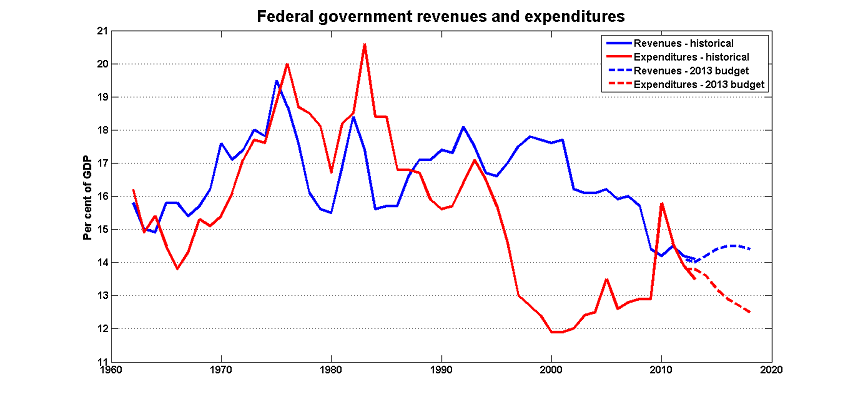
Canadian federal government revenues and expenditure, 1960-2013
As I’ve written before, the Conservatives have applied the “starve the beast strategy“: First, cut taxes; second, cut spending in order to match lower revenues; third, obtain a balanced-budget for a smaller government. As the red line in the chart shows, the Harper government was temporarily thrown off this past by the financial crisis, which required emergency stimulus spending. They are, however, back on track.
Once again though, we need to be careful to see that the government’s revenues are back above expenditures (so the yearly deficit has been reduced over time), but the government’s outstanding debts are still quite substantial: $892 billion for 2012-13. As long as interest rates stay low, the debt should start to decline, but if-and-when interest rates rise, so will that big pile of accumulated debt.
October 21, 2013
The US debt iceberg
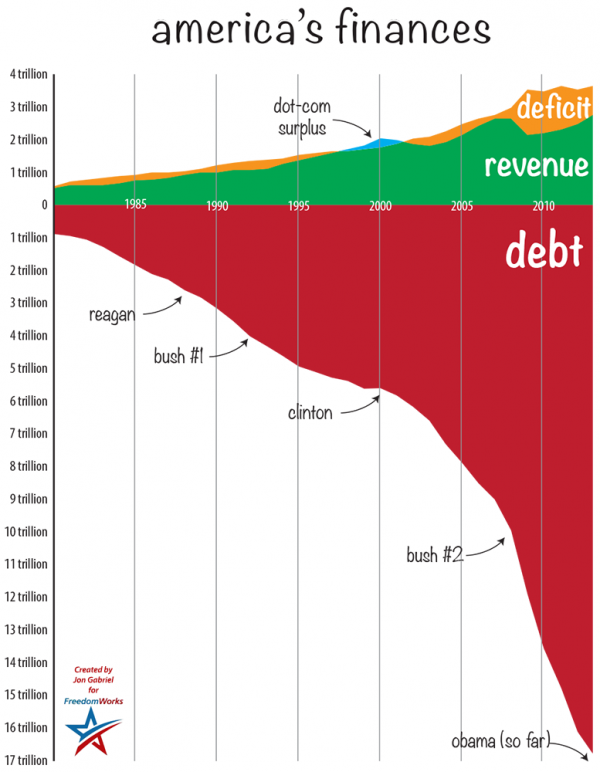
Jon Gabriel has put together a clear, understandable way to show the relationship between the US government’s revenue, deficit and debt numbers:
When Washington raised the debt ceiling this week, the Beltway media breathlessly reported that the fiscal crisis had ended. Lawyers danced in hallways, bureaucrats twerked on the Metro, congressional aides kissed strangers in the streets — the Tea Party has been defeated! It was like VJ day for wonks.
As our political class exchanged high fives and reporters praised a return to “sanity,” I wondered how these odd creatures defined insanity.
America’s fiscal crisis is not that our debt ceiling was too low, the fiscal crisis is that our debt is too high. When I mentioned this to left-leaning folks, they seemed indifferent. “Obama lowered the deficit.” “I think Bush spent more.“ “It’s Reagan’s fault!”
So I made this infographic:
Since most graphs look like this, I focused on just three big numbers: Deficit, revenue and debt.
The analogy is imperfect, but imagine the green is your salary, the yellow is the amount you’re spending over your salary, and the red is your Visa statement. Then imagine your spouse runs into the room and shouts, “great news honey, our fiscal crisis is over. We just got approved for a new MasterCard!” Your first call would be to a marriage counselor or a shrink.
H/T to Nick Gillespie:
What is it that Hemingway always used to say? That thing’s not loaded? Or something about how the “dignity of movement of an ice-berg is due to only one-eighth of it being above water.” Yeah, well, the horrors of federal finances is pretty undignified just looking at the amount of spending versus revenue we do and then it gets really sloppy when you look at the huge amount of debt below the waterline.


