What does the soul of a people sound like? With the Germans, you have adequate proof; Wagner spoke for them, for better or worse — grandeur and myth that elevated the soul as easily as it rotted to the soundtrack for a meglomaniacal death cult. Italian music — well, no one ever marched off to war to Respighi’s ode to a peacock. Music for life, lived without lasting consequence. (They did their part in the Roman times; they’ve earned a nap.) French music is best expressed by the gauzy wash of Debussy and his comrades, music that doesn’t confront the ear but gently appeases it. America: cheerful tootling Souza marches or great broad optimistic Copeland yawps. Or jazz. Or rock and roll. Or country twangs. (It’s not that we have no sound — we have many, and each is as much a part of us as the other. Few cultures can pull that off.) Russian music has that delicious third-drink moodiness. Canadian music — no such thing, really, which is telling. Unless you define it as American style music recorded in a Canadian studio to satisfy a government requirement.
James Lileks, Screedblog, 2005-07-08.
January 9, 2020
QotD: National music
January 7, 2020
Isaac Asimov at 100 … ish
It’s probably the centenary year for the late Isaac Asimov, but the date is only approximately correct:

Robert Heinlein, L. Sprague de Camp and Isaac Asimov at the Philadelphia Navy Yard in 1944.
US government photo via Wikimedia Commons.
In actual fact the centenary is a bit of a fudge because Asimov never knew his actual birthday and picked January 2 as a likely date, and one that allowed for an extra holiday after the Christmas festivities. He was born around the turn of the year in 1920, three years after the Russian revolution, in the Soviet town of Petrovichi, although he emigrated to the US at the age of three.
Like many Russian Jews the family moved to Brooklyn in New York, and Asimov’s father ended up running a confectionery store and newsagent. Asimov taught himself to read at the age of five and taught his sister too, and consumed the pulp science fiction magazine stocked in his father’s shop.
At the age of 15 he applied to Columbia but was rejected, ostensibly on age grounds but, as he wrote in his autobiography I, Asimov, he recounted that the university had filled its quota of Jews for the year. After multiple rejections he eventually earned his Master of Arts degree in chemistry in 1941 and earned a Doctor of Philosophy degree in chemistry in 1948, serving as a civilian in the US Army in the Second World War.
An academic career beckoned and in 1949 he joined the Boston University School of Medicine as a biochemistry teacher. But by then he had already been getting science fiction short stories published for nearly ten years. In 1950 he wrote his first book and largely abandoned his teaching career, finding writing more lucrative and enjoyable.
[…]
Some thought Asimov had peaked as a science fiction writer by the mid 1960s, as he spent the next few years writing a lot of popular science books, non-fiction and school textbooks. He was even asked by Paul McCartney to write a science fiction musical for his then-band Wings, although the idea was eventually dropped.
But in the 1970s he came back into the SF fold with a series of books and short stories, winning two Hugo and two Nebula awards in the decade. He was also involved in some television and film work, having acted as a consultant on Star Trek in the 1960s.
In 1981 he was approached by a publisher to return to the Foundation series and add more to the canon. Foundation’s Edge was published the next year year, to wide acclaim. This was followed by Foundation and Earth in 1986, Prelude to Foundation in 1988, and finally Forward the Foundation, which was published in 1993, one year after Asimov’s death.
January 4, 2020
Ivan the Terrible – the first Russian tsar I IT’S HISTORY
IT’S HISTORY
Published 14 Feb 2018Ivan IV Vasilyevich commonly known as Ivan the Terrible was the first tsar of Russia. Did he deserve his title?
January 1, 2020
Communist jokes through the ages
At Catallaxy Files, Steve Kates recently read Hammer and Tickle: A History of Communism Told Through Communist Jokes by Ben Lewis:
It looks at the jokes themselves; the evolution of these jokes as communism aged and new leaders took over; it looks at the different kinds of jokes told in different communist countries; it examines the fate of those who told such jokes and the difference in the fate of those who made such jokes depending on who was the leader of the Party; it asks whether such jokes helped the communists consolidate power or whether they helped bring communism down; it looks into the difference between telling anti-Nazi jokes in Nazi Germany versus telling anti-communist jokes in communist countries; it asks about the psychology of those who told such jokes and whether they helped relieve tensions; and much else. But I will say this, some of I found really funny. This is my favourite.
Khrushchev is walking through the Kremlin, getting worked up about the Soviet Union’s problems, and spits on the carpet in a gesture of disgust.
“Behave yourself, Nikita Sergeyevich,” admonishes the aide. “Remember that the great Lenin walked through these halls!”
“Shut up,” responds Khrushchev. “I can spit all I like here; the Queen of England gave me permission!”
“The Queen of England?”
“Yes! I spat on her carpet in Buckingham Palace too, and she said, ‘Mr Khrushchev, you can do that all you like in the Kremlin if you wish, but you can’t behave like this here …'”
Easy to see this one added to the Donald Trump canon and now that I have pointed it out, I expect it to be.
I therefore thought I might have a look at what passes for Donald Trump jokes. And google all you like, there really is not much although there was this: Donald Trump Jokes. None were funny but I did like this:
Where’s Donald Trump’s favorite place to shop?
Wall-mart!
Mere pun though it is, it seems appropriate. At least it’s policy-related and almost entirely a joke that could only be told about Trump. The rest are re-treads, never specifically about anything related to Trump himself and his policies, but are almost entirely forms of insult than anything with any associated wit or insight. The most interesting part to me about the communist jokes was that the ones that became acceptable were those directed at the failures of communism relative to the promises that had originally been made. Lots like that. The way to end up in the gulag was to tell jokes about actual party leaders, especially Lenin and Stalin. Very few like that.
I rather liked the one from the Amazon page for the Kindle edition: “Q: Why, despite all the shortages, was the toilet paper in East Germany always 2-ply? A: Because they had to send a copy of everything they did to Moscow.”
December 28, 2019
Shpagin’s Simplified Subgun: The PPSh-41
Forgotten Weapons
Published 15 Dec 2017http://www.patreon.com/ForgottenWeapons
Cool Forgotten Weapons merch! http://shop.bbtv.com/collections/forg…
After making the decision to mass produce a submachine gun, the Soviet Union adopted the Degtyarev PPD-38 and PPD-40, but this design was too expensive for the huge scale of production that the USSR intended. A new design was needed, and was put into development almost as soon as the PPD was entering production.
Shpagin won the design competition with the PPSh-41, a weapon which required virtually no lathe work at all. It was assembled from a combination of heavy-gauge stampings and simple milled parts, and it fit the Soviet requirements quite well. Shpagin retained the high rate of fire and large drum magazines from the PPD, and even had a semiauto selector switch in his submachine gun, a bit unusual in a weapon intended for minimum expense.
The drum magazines proved to be the weak point of the design, being only somewhat interchangeable between weapons and being rather complex to manufacture as well as bulky to carry and fairly easy to damage. A 35-round box magazine was introduced later on which ameliorated some of these issues, although not all of them. The PPSh-41 would go on to be deemed itself too complex, and supplemented by the PPS-43 submachine gun, although it was never fully replaced during World War Two. In addition to Soviet service, it would be copied and manufactured by several other nations.
Thanks to Marstar for letting me examine and shoot their PPSh-41!
If you enjoy Forgotten Weapons, check out its sister channel, InRangeTV! http://www.youtube.com/InRangeTVShow
December 22, 2019
The North Magnetic Pole … a refugee from Canada’s Arctic
Colby Cosh on the latest refugee to flee from Canada:
On Dec. 10, the World Magnetic Model used to calibrate compasses was officially updated. The “model” can be thought of as a map that you would use, given your location on or near the Earth’s surface, to find out how many degrees your magnetic compass is off from true geographic north (or south). This ordinarily happens every five years, but the wizards in charge of the system decided to update a year early because the north magnetic pole is moving particularly fast right now.
Positions of North Magnetic Pole of the Earth. Poles shown are dip poles, defined as positions where the direction of the magnetic field is vertical. Red circles mark magnetic north pole positions as determined by direct observation, blue circles mark positions modelled using the GUFM model (1590–1890) and the IGRF-12 model (1900–2020) in 1 year increments. For the years 1890–1900, a smooth interpolation between the two models was performed. The modelled locations after 2015 are projections.
Map by Cavit via Wikimedia Commons.As most Canadians will have heard, magnetic north is, at the moment, fleeing Canadian territory and heading toward Russia. The rate of change is still very high by historic standards, first established in the early 19th century, but it has slowed just a little. In the year 1900 the pole was firmly in the Canadian Arctic, off Somerset Island. It wandered north, broke out of our high Arctic archipelago in about 2000, and has been streaking Siberia-ward across the open sea at more than 50 km a year since. The time component in the new WMM forecasts a slight slowing over the next five-year period, to about 40 km/yr.
This, like everything else involving Earth’s magnetic field, is a bit of a guess. The WMM has to be updated often because it does incorporate guesswork about the magnitude and direction of changes in the short-term future. The model will be most accurate now, and increasingly less so over the five-year term as the magnetic poles do their little dance — independently, by the way; the magnetic poles are not exactly opposite the Earth from one another, and the “south” one is scooting along much more slowly than the “north.” (Also, the magnetic north pole, the one to which the “north” needle of your compass is attracted, is actually a “south” pole to physicists.)
The truth is that the naive inquirer should not research Earth’s magnetism in the expectation that it is as well understood by scientists as, say, oceanic tides. (You can probably detect that I am talking about myself here.) The question “Why is the magnetic pole leaving Canada?” does not really admit of a solid answer. Maybe it’s the investment climate?
Probably most everybody is dimly aware that the magnetic poles flip outright from time to time — every half-million years on average. But the assumptions embedded in your handheld compass run much deeper than that. The Earth itself is only a big dipole magnet generally, rather than locally, and there is no guarantee of only one “north magnetic pole” as the field is measured near the surface. Competing “north poles” can form. (Which would, at least, let Russia and Canada each have their own …)
December 10, 2019
“NATO [reminds] me of the pre-reformation medieval church. Their stated objectives sound Godly and noble but their true purpose is to keep a bloated priesthood in luxury”
NATO still exists, decades after the threat it was designed to counter dissolved. Tom Paine wonders why this is so:
The dismal science teaches us to distinguish between peoples’ stated preferences (often virtue-signalling lies) and their revealed preferences (how they spend their money). All NATO members say they believe in the alliance. Only four — the USA, the UK, Poland and Greece — meet their obligation to contribute more than 2% of their GDP. If you’re wondering, Greece has only accidentally met that target because of the catastrophic fall in its GDP.
Opinion polls and my own experience of the bitter, sneering anti-Americanism of my otherwise delightful continental chums suggest that as usual the revealed preference is the truth. The Germans and French would not go to war in defence of America or Britain if we were attacked. Britain was attacked, when the Falklands were invaded, and our “allies” and “friends” sold arms to our enemies and gave them all kinds of moral support. Remember the Welsh Guards (my grandfather’s old regiment) massacred by Exocets fired from Mirages? The USA has often gone to war since the alliance was formed and mostly only British warriors fought, died or were injured alongside theirs.
Germany, France and their freeloading friends have quite simply been taking the piss from the outset. They take the Americans (and us Inselaffen and rosbifs) for mugs. They plot to form an EU Army and regret that Brexit means they won’t be able to continue to rely on English-speakers as their cannon-fodder.
The continued existence of NATO has fuelled the epic paranoia of Russia’s military/intelligence apparatus. Desperate not to be decommissioned the generals and chekists have claimed that “the West” they grew up opposing is intrinsically hostile — rather than, in truth, insultingly indifferent — to Mother Russia. Their only “proof” of this nonsense was NATO.
[…]
NATO is yet another of many examples of the truism that, once a bureaucracy acquires a competence, it will never disband. It continues because it can. The political and economic ills that drove the creation of what is now called the EU have long since faded into history. But the plump parasites of its apparatus have repeatedly repurposed it. Britain is a paradise of social, ethnic and sexual equality compared to the days when the precursors of the Equalities Commission were formed but its staff will find imaginary evils by the thousand before they’ll return to productive labour. Marx would gasp at the generosity of Britain’s welfare state and marvel at the lifestyle of even the poorest Brit and yet trivial micro aggressions are enough to sustain the revolutionary fervour of Marxist academics desperate to live as idly and unproductively as the man himself.
December 8, 2019
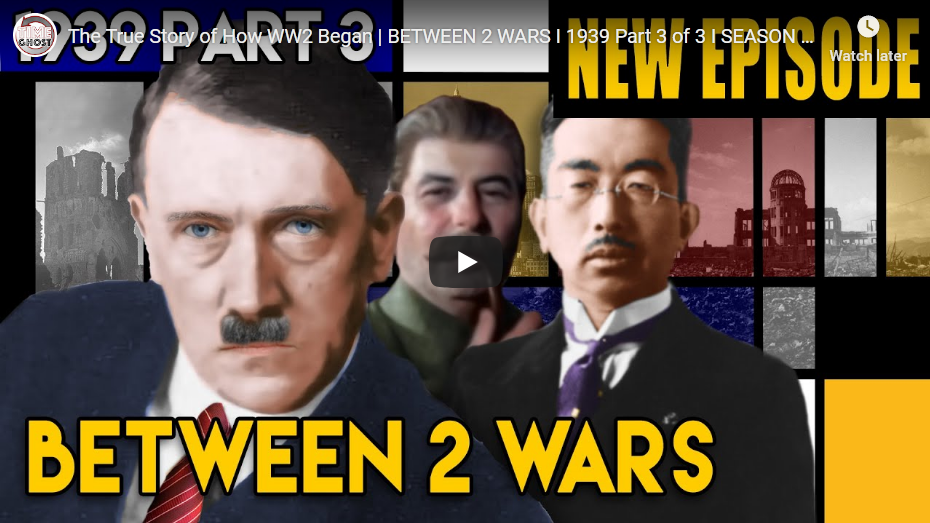
The Road to Moscow – German Invasion Plans – WW2 – 067 – December 7, 1940
World War Two
Published 7 Dec 2019Wilhelm Canaris once again disturbs Hitlers plans to drag Spain into the war, as the Germans finalize their plan for the Invasion of the Soviet Union which is scheduled for the summer of 1941. Meanwhile, the Greek counter-offensive into Albania loses steam and the Pope objects to the German T-4 euthanasia program.
Join us on Patreon: https://www.patreon.com/TimeGhostHistory
Or join The TimeGhost Army directly at: https://timeghost.tvFollow WW2 day by day on Instagram @World_war_two_realtime https://www.instagram.com/world_war_t…
Join our Discord Server: https://discord.gg/D6D2aYN.
Source list: http://bit.ly/WW2sourcesWritten and Hosted by: Indy Neidell
Produced and Directed by: Spartacus Olsson and Astrid Deinhard
Executive Producers: Bodo Rittenauer, Astrid Deinhard, Indy Neidell, Spartacus Olsson
Creative Producer: Joram Appel
Post-Production Director: Wieke Kapteijns
Research by: Indy Neidell
Edited by: Mikołaj Cackowski
Map animations: Eastory (https://www.youtube.com/c/eastory)Colorizations by:
– Cassowary Colorizations
– Julius Jääskeläinen – https://www.facebook.com/JJcolorization/Sources:
Narodowe Archiwum Cyfrowe
USHMM, photograph number 60468
IWM (HU 76031)Archive by Screenocean/Reuters https://www.screenocean.com.
A TimeGhost chronological documentary produced by OnLion Entertainment GmbH.
From the comments:
World War Two
2 days ago (edited)
YouTube has age-restricted our Blitz Spirit WW2 video and had REMOVED our Between Two Wars episode on the Holodomor (1932-02). We received a warning, which means that next time this happens we will be banned from publishing content for one week. They state that our “content was removed due to a violation of our Community Guidelines,” on account of publishing “violent of graphic content”, explaining that “Violent or gory content intended to shock or disgust viewers, or content encouraging others to commit violent acts, is not allowed on YouTube.”EDIT: After pushing our appeal, YouTube has reinstated the episode and it’s back up. The Blitz video is still age-restricted.
Needless to say, we were shocked and disgusted by this action and legitimisation. Though it’s back up [here], this still shows how much our independence depends on our Patreon supporters. Without them, we would have been long gone. So please consider supporting our effort and help us spread vital knowledge about our world’s history, albeit hard to swallow or confronting. Don’t let YouTube decide what will be a part of our public memory! You can support us on https://patreon.com/timeghosthistory or https://timeghost.tv.
Cheers,
Joram
December 7, 2019
History of Space Travel – One Small Step – Extra History – #5
Extra Credits
Published 5 Dec 2019Start your Warframe journey now and prepare to face your personal nemesis, the Kuva Lich — an enemy that only grows stronger with every defeat. Take down this deadly foe, then get ready to take flight in Empyrean! Coming soon! http://bit.ly/EHWarframe
The United States was losing the space race. A number of unfortunate missteps and mistakes had hindered their progress. But the United States had also structured its space program entirely differently from the USSR. Instead of being helmed by the military, the National Aeronautics & Space Administration was created by Eisenhower with an emphasis on exploration and research. And in the end, the later but more advanced satellites will collect the data required a dream firmly placed in the American consciousness by JFK. A dream to place a man on the moon.
From the comments:
Extra Credits
19 hours ago
The plaque still gives me goosebumps in the best way possible. Hopefully one day we can live up to its promise of peace. Be good to one another. ❤️And thanks to Rebecca Ford (the voice of Lotus) for voicing space mom at the end of each of these episodes. They’ve been a blast to make and we hope that you all have enjoyed this trip to the stars.
December 6, 2019
Mikhail Gorbachev and the “third generation”
At Rotten Chestnuts, Severian explains why Mikhail Gorbachev’s perestroika was doomed to fail:

US President Ronald Reagan and Soviet General Secretary Mikhail Gorbachev at the Hofdi House in Reykjavik, Iceland during the Reyjavik Summit in 1986.
Official US government photograph via Wikimedia Commons.
Perestroika‘s what happens when you turn the reins over to the third generation — the generation that didn’t come up hard, and thus wasn’t forced to deal with objective reality. For all his faults, and for all the debate over whether Stalin was “really” a Communist (hint: he was), the Boss knew what it takes to hold onto power in a one-party state. He learned his craft in the hardest school — maneuvering against Lenin and Trotsky, two of the coldest, most ruthless sons-of-bitches ever to draw breath. His successor, Nikita Khrushchev, survived both the Great Purge and the Great Patriotic War for the Motherland — an achievement, as you can imagine, that pretty much no one else of consequence could boast.
Mikhail Gorbachev, by contrast, was born in 1931. His childhood was affected by the war — as was every Russian child’s — but his grandfather was a kolkhoznik from way back; Mikhail was wired in to the Party from birth. Stalin died in 1953. Gorbachev was 22 — in an earlier generation he could’ve been a serious player at that age, but the postwar generation didn’t start rising until their 30s, or more usually their 40s. He was still at university when the Boss kicked the bucket; he didn’t start his official political career until 1955, and wasn’t recognized as a bona-fide comer until the late 1960s.
What this meant was that Gorbachev grew up in the kinder, gentler Soviet Union — the one where Khrushchev released a whole bunch of folks from the Gulag and denounced cults of personality. This is not to say that Gorbachev wasn’t a sincere Communist; he was. In fact, that was his problem — he was too sincere. The earlier generations faced the stark choice between hewing to orthodox Marxism, or hanging on to power. They chose the latter, of course, and that’s why Trotsky had to go — he kept on claiming to be the only true Marxist of the bunch (which he was, of course, but that’s a story for another day). Gorbachev, though, got to see Communism “working,” and from this he deduced — not unreasonably for someone who didn’t come up hard — that Communism’s manifest failures were due to not following Marx and Lenin more exactly. Marx and Lenin talked a great game about “openness” (glasnost), “democracy,” and all that “improving the lot of the People” jazz.
So he did all that, the fool, not realizing that Communism “worked,” such as it did, only through repression. Take your foot off The People’s neck enough to let them breathe, by all means — that was Comrade Khrushchev’s great insight — but if you ease off any further, they’ll try to wriggle out … and eventually kill you, their tormentor. Having never seen The People at close range — as everyone in the previous generations had — he couldn’t understand this, and so crashed the system.
December 3, 2019
“Useful idiots” during the Cold War
Robert Reilly reviews Judgement in Moscow: Soviet Crimes and Western Complicity by Vladimir Bukovsky, which has recently been republished in English:

Krushchev, Brezhnev and other Soviet leaders review the Revolution parade in Red Square, 1962.
LIFE magazine photo by Stan Wayman.
Judgment In Moscow contains autobiographical elements but is principally concerned with providing and analyzing documentary evidence for what should have been the USSR equivalent of what the Nuremberg Trials had been for Nazi Germany. In 1991, Bukovsky returned to the Soviet Union to take part in the “trial of the communist party” that was held in 1992. In an audacious move the Communist Party had sued then-President Boris Yeltsin to get its property back. To prepare a defense, Yeltsin ordered that the secret Central Committee archives be opened to Bukovsky. The order was obeyed, but only partially and for a short time. The trial fizzled, but Bukovsky, with the aid of a hand-held scanner, was able to gather many thousands of pages of top-secret Central Committee and Politburo documents and get them out of Russia. Some of these key documents are what we have in this priceless book. They are eye-opening.
During the Cold War, we had to speculate as to why, for instance, the Soviet Union invaded Afghanistan and how the decision was made. Now we know for certain. Bukovsky provides the minutes of the Politburo meetings in which the invasion was decided. The Reagan administration was highly skeptical of détente and was therefore criticized for war-mongering. The skepticism was well-placed because, as the documents reveal, détente was simply a façade for advancing Soviet power and manipulating Western publics and governments against the Reagan plan to place Pershing IIs and cruise missiles in Europe to defend it against burgeoning Soviet power, including the SS-20s.
The revelations of the extent to which the Soviet Union manipulated the “peace” movement in the West should be an embarrassment to its participants, who may have been too naïve at the time to know how they were being used. Others, of course, acceded to being used, or even cravenly sought to be used. The names of some of these useful idiots are in the documents.
Another thing these documents disclose, much to the embarrassment of many American Sovietologists, is that there were no “hawks” and “doves” in the Kremlin — a premise on which they had banked their academic careers. The unanimity of the Politburo decisions reveals that the senior Soviet leaders were all of one stripe. It was to their advantage to create the impression that there were hawks and doves so that they could game the policies of Western governments and the opinions of its publics. For instance, providing Western credits to the USSR — it was thought by many so-called Russian experts in the West — would strengthen the doves in the Kremlin, whereas denying credits would empower the hawks. By buying this line of thought, the West was induced to keep the Soviet Union on life-support for more than a decade past what would have been its earlier collapse, according to Bukovsky.
No one was a greater master of this deception than Mikael Gorbachev. The minutes from many Politburo meetings chaired by Gorbachev show that glasnost and perestroika were façades constructed to ensure the continued existence of the Soviet Union through even more Western subsidies. And it worked to the extent that credits and subsidies ballooned under the Western illusion that Gorbachev had to be supported to ensure his success — ignorant of the fact that Gorbachev conceived of success in ways inimical to Western freedom.
H/T to Blazing Cat Fur for the link.
November 29, 2019
History of Space Travel – Red Star – Extra History – #4
Extra Credits
Published 28 Nov 2019Start your Warframe journey now and prepare to face your personal nemesis, the Kuva Lich — an enemy that only grows stronger with every defeat. Take down this deadly foe, then get ready to take flight in Empyrean! Coming soon! http://bit.ly/EHWarframe
While rockets had been proven to be indispensable to the Second World War, the idea to send people up into orbit was still seen as fantasy. Space was important only as a method to further the range of missiles meant to land oceans away from their original launch point. But a man named Korolev will change all of that, with work so secretive, he will be referred to as Chief Designer for nearly his entire life. But we all know the name of his first project into space: Sputnik.
From the comments:
Extra Credits
1 day ago
We weren’t able to fit her into the episode, but the other famous first cosmonaut in space is Laika, the Soviet space dog. She was a stray who was taken in by the program to test the Sputnik 2 and some of its life support features (like a coolant fan). Unfortunately, Laika did not return from her mission alive but she’s still regarded highly in the history of space flight and has become a symbol for the space race and animal testing in general. Look her up!
I remember reading in Robert Heinlein’s Expanded Universe of the day on his tour of the Soviet Union in 1960 when he and his wife were told by a group of Red Army cadets of a Soviet rocket launch carrying a human into orbit for the first time. The story was officially denied and the capsule was said to be unmanned after all. Wikipedia says:
According to Gagarin’s biography, these rumours were likely started as a result of two Vostok missions equipped with dummies (Ivan Ivanovich) and human voice tape recordings (to test if the radio worked) that were made just prior to Gagarin’s flight.
In a U.S. press conference on February 23, 1962, colonel Barney Oldfield revealed that an uncrewed space capsule had indeed been orbiting the Earth since 1960, as it had become jammed into its booster rocket. According to the NASA NSSDC Master Catalog, Korabl Sputnik 1, designated at the time 1KP or Vostok 1P, did launch on May 15, 1960 (one year before Gagarin). It was a prototype of the later Zenit and Vostok launch vehicles. The onboard TDU (Braking Engine Unit) had ordered the retrorockets to fire to recover, but due to a malfunction of the attitude control system, the spacecraft was oriented upside-down, and the firing put the craft into a higher orbit. The re-entry capsule lacked a heat shield as there were no plans to recover it. Engineers had planned to use the vessel’s telemetry data to determine if the guidance system had functioned correctly, so recovery was unnecessary.
November 26, 2019
Invasion of Poland 1939 – Fall Weiß – Case White
Military History Visualized
Published 30 Aug 2016The German Invasion of Poland in 1939 started the Second World War in Europe. The German name of operation was “Fall Weiß” meaning “Case White”. In this video I will take a look at the major German troop movements, the Soviet invasion of Poland, the losses and a final assessment.
» HOW YOU CAN SUPPORT MILITARY HISTORY VISUALIZED «
(A) You can support my channel on Patreon: https://www.patreon.com/mhv(B) You can also buy “Spoils of War” (merchandise) in the online shop: https://www.redbubble.com/people/mhvi…
(C) If you want to buy books that I use or recommend, here is the link to the Amazon Store: http://astore.amazon.com/ytmh-20 which has the same price for you and gives a small commission to me, thus it is a win/win.
» SOURCES & LINKS «
Maier, Klaus; Rohde, Horst; Stegemann, Bernd; Umbreit, Hans: Die Errichtung der Hegemonie auf dem europäischen Kontient. Das Deutsche Reich und der Zweite Weltkrieg (DR2WK), Band 2.
Müller, Rolf-Dieter: Hitler’s Wehrmacht, 1935-1945
Zaloga, Steven J.: Poland 1939 – The Birth of Blitzkrieg
Wettstein, Adrian: Wehrmacht im Stadtkampf
http://www.cgsc.edu/CARL/nafziger/939…
http://niehorster.org/029_poland/1939…
http://www.westpoint.edu/history/Site…
https://en.wikipedia.org/wiki/Soviet_…
» CREDITS & SPECIAL THX «
Song: Ethan Meixsell – “Demilitarized Zone”The Counter-Design is heavily inspired by Black ICE Mod for the game Hearts of Iron 3 by Paradox Interactive
https://forum.paradoxplaza.com/forum/…» DISCLAIMER «
Amazon Associates Program: “Bernhard Kast is a participant in the Amazon Services LLC Associates Program, an affiliate advertising program designed to provide a means for sites to earn advertising fees by advertising and linking to amazon.com.”
November 24, 2019
Cracks in the Soviet-Nazi Alliance – WW2 – 065 – November 23, 1940
World War Two
Published 23 Nov 2019As the Greek campaign continues, Hitler points his attention eastwards. While he can’t invade the Soviet Union just yet, his dependence on it is making him nervous.
Join us on Patreon: https://www.patreon.com/TimeGhostHistory
Or join The TimeGhost Army directly at: https://timeghost.tvFollow WW2 day by day on Instagram @World_war_two_realtime https://www.instagram.com/world_war_t…
Join our Discord Server: https://discord.gg/D6D2aYN.
Between 2 Wars: https://www.youtube.com/playlist?list…
Source list: http://bit.ly/WW2sourcesWritten and Hosted by: Indy Neidell
Produced and Directed by: Spartacus Olsson and Astrid Deinhard
Executive Producers: Bodo Rittenauer, Astrid Deinhard, Indy Neidell, Spartacus Olsson
Creative Producer: Joram Appel
Post-Production Director: Wieke Kapteijns
Research by: Indy Neidell
Edited by: Iryna Dulka
Map animations: Eastory (https://www.youtube.com/c/eastory)Colorisations by:
– Julius Jääskeläinen (https://www.facebook.com/JJcolorization/)
– Adrien Fillon (https://www.instagram.com/adrien.colo…)
– Dememorabilia (https://www.instagram.com/dememorabilia/)Eastory’s channel: https://www.youtube.com/channel/UCEly…
Archive by Screenocean/Reuters https://www.screenocean.com.Sources:
– Coal energy by supalerk laipawat, wheat Grain Bag by Symbolon, oil barrel by BomSymbols from the Noun Project
– Portrait of Sir John Salmond courtessy of National Portrait Gallery, London
– Lord Beaverbrook photographed by Yousuf Karash
– IWM: HU 94169, D 1640, D 1556, D 1507, D 1589, D 1513, D 1567, H 12224
– Narodowe Archiwum CyfroweA TimeGhost chronological documentary produced by OnLion Entertainment GmbH.
From the comments:
World War Two
2 days ago (edited)
We have been shooting a bunch of new episodes this week. Besides the World War Two and Between Two Wars episodes, which by the way includes some pretty amazing history, we have also been working on some much requested episodes of our War Against Humanity series. We have shot three of those, so you will see the first of those coming in the next few weeks. Additionally, we have shot a very special mini-series that we will be airing during the holidays on the TimeGhost History Channel (https://www.youtube.com/channel/UCLfMmOriSyPbd5JhHpnj4Ng). We will disclose more about that soon, but it’s going to be pretty cool. So all in all, enough to look forward to!
Cheers, Joram