
Beginning in the nineteenth century, Germany was closely associated with homosexuality. The English spoke of the “German custom”, the French referred to the vice allemande, and Italians called gay men and women “Berlinese”. Queer people existed across Europe, of course, but German thinkers actively studied non-heteronormative sexualities and openly debated the rights of queer people, inaugurating the field of sexology. In the first decade of the twentieth century, more than a thousand works on homosexuality were published in German. Researchers from England to Japan cited German sexologists as experts and often published their own works in Germany before their home countries.
The Weimar Republic, the zenith of modernism, witnessed new social liberalization and experimentation. Fritz Lang premiered his Expressionist film Metropolis in 1927, Alfred Döblin published his dizzyingly innovative novel Berlin Alexanderplatz in 1929, and the following year Hannah Höch unveiled her Dadaist photomontage Marlene. And alongside reinventing traditional forms of artistic expression, Germans began interrogating gender roles and sexual identities. As the historian Clayton Whisnant observes, “Perhaps more than anywhere else, Weimar Germany became associated with experimentation in sexuality.” Berlin was the undisputed queer capital of Europe. By 1900, over fifty thousand gay men and lesbians lived there, and countless more visited, looking for friendship, love, and sex. By 1923, some hundred gay bars in Berlin catered to diverse groups: men and women, the old and the young, the affluent and the working class. Nightclubs like the Mikado, the Zauberflöte, and the Dorian Gray became international hot spots, and the city’s elaborate queer balls attracted worldwide attention. Associations offered opportunities for socializing and political organization. Crucially, relaxed rules of censorship allowed for the publication of dozens of pulpy gay novels, queer periodicals, and even personal ads. The British writer Christopher Isherwood, whose account of his thirties stay in Germany inspired the musical Cabaret, put it simply: “Berlin meant boys.” In 1928, the poet W. H. Auden similarly described the German capital as “the bugger’s daydream.” In her famous guide to the Berlin lesbian scene from the same year, Ruth Margarete Roellig concluded, “Here each one can find their own happiness, for they make a point of satisfying every taste.”
The experience was different for trans people. The Third Sex [likely the world’s first magazine devoted to trans issues] bore the subtitle “The Transvestites”, but at the time, the historian Laurie Marhoefer notes, the term meant different things to different people. German speakers were in the middle of developing a critical vocabulary to describe the expansion of recognized identities. Karl-Maria Kertbeny coined the word homosexual in 1869, and in 1910 Magnus Hirschfeld invented the term transvestite. It described both cross-dressers and transgender people. According to contemporary self-reports, some transvestites considered themselves homosexual, but most did not. Many wore clothes traditionally associated with the opposite sex only on special occasions. Others lived fully as a gender different from their sex at birth. A majority seemed interested in passing and adhering to expectations of respectability, while a minority sought to challenge the normative order. Gender affirmation surgeries were available — the first such operation was conducted in 1920 by, no surprise, a German doctor — but uncommon. From today’s perspective, it is therefore unclear whether an individual who identified as a transvestite in thirties Germany, including Hans Hannah Berg, was what we would today consider transgender, nonbinary, a cross-dresser, or something else altogether. In the very first issue of The Third Sex, an essay by Dr. Wegner acknowledges the richness of the term. “Just as people are all different in their outward appearance and inner attitudes, so are the characteristics of transvestites.” Many queer activists in the Weimar Republic were concerned that the population of gender variant people was too fragmented. Trans people were not as visible or as organized as gays and lesbians. Friedrich Radszuweit, the leader of the Federation for Human Rights and the publisher of several queer periodicals, saw a solution. To foster a trans community, he produced The Third Sex.
Matthew H. Birkhold, “A Lost Piece of Trans History”, The Paris Review, 2019-01-15.
August 7, 2021
QotD: “The English spoke of the ‘German custom’, the French referred to the vice allemande, and Italians called gay men and women ‘Berlinese'”
August 6, 2021
Shostakovich: Stalin’s Composer? – WW2 Biography Special
World War Two
Published 5 Aug 2021Leningrad’s Dmitri Shostakovich has risen from a child prodigy to be one of the Soviet Union’s most celebrated composers, having rescued his career from Stalin’s interference along the way. Desperate to defend Russia after the German invasion, he fights back, not with a rifle, but with music.
(more…)
August 5, 2021
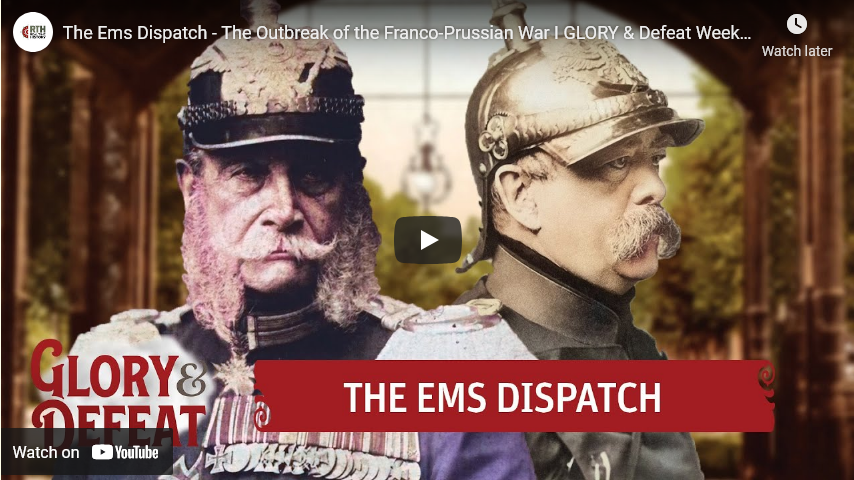
The Ems Dispatch – The Outbreak of the Franco-Prussian War I GLORY & Defeat Week 1
realtimehistory
Published 13 Jul 2021Support Glory & Defeat: https://realtimehistory.net/gloryandd…
French and Prussian animosity have been swelling in the background since the German Wars of Unification started in the 1860s. The French Duc de Gramont hopes that a victory over Prussia could restore French prestige while Prussian Chancellor Bismarck needs a reason to fulfill his dream of German unification from above. When the crisis about the Spanish throne escalates with the Ems Dispatch, the die is cast and the Franco-Prussian War begins.
» OUR PODCAST
https://realtimehistory.net/podcast – interviews with historians and background info for the show.» LITERATURE
Arand, Tobias: 1870/71 – Die Geschichte des Deutsch-Französischen Krieges erzählt in Einzelschicksalen. Hamburg 2018Böhme, Helmut: (Hrsg.): Die Reichs-gründung. dtv-Dokumente. München 1967
Gall, Lothar (Hrsg: Deutschland Archiv). Kaiserreich Bd. I. o.O. 2007
Girard Louis: Napoléon III. Paris 1986
Mährle, Wolfgang (Hrsg.): Nation im Siegesrausch. Württemberg und die Gründung des Deutschen Reiches 1870/71. Stuttgart 2020
Milza, Pierre: L’année terrible. La guerre franco-prussienne septembre 1870 – mars 1871. Paris 2009
» SOURCES
Fontane, Theodor: Der Krieg gegen Frankreich Bd. I. Berlin 1873Louis L. Snyder, ed., Documents of German History. New Brunswick, N.J.: Rutgers University Press, 1958
» OUR STORE
Website: https://realtimehistory.net»CREDITS
Presented by: Jesse Alexander
Written by: Cathérine Pfauth, Dr. Tobias Arand, Jesse Alexander
Director: Toni Steller & Florian Wittig
Director of Photography: Toni Steller
Sound: Above Zero
Editing: Toni Steller
Motion Design: Philipp Appelt
Mixing, Mastering & Sound Design: http://above-zero.com
Maps: Battlefield Design
Research by: Cathérine Pfauth, Prof. Dr. Tobias Arand
Fact checking: Cathérine Pfauth, Prof. Dr. Tobias ArandChannel Design: Battlefield Design
Contains licensed material by getty images
All rights reserved – Real Time History GmbH 2021
QotD: September 1939 was pretty much the optimal moment for Germany to go to war
Demographically German military manpower was at a height in 1940/41 that gave it an advantage over the allies and potentially the Russians, that would quickly evaporate within a few years. (Demographics was an important science between the wars, and many leaders – like Hitler and Stalin – made frequent references to it. The Russians in particular would start having more manpower available starting in 1942 … perhaps not a coincidence that Germany invaded in 1941?)
The Nazi air forces had a temporary superiority over the Allies in 1939 that was already being rapidly undercut as both the British and the French finally started mass production of newer aircraft. (By mid-1940 British aircraft production had overtaken the Germans, even without the French. If the war had not started in 1939, by 1941 the Luftwaffe would have been numerically quite inferior to the combined British and French air forces, even without the surprisingly effective new fighters being brought on line by the Dutch and others.)
German ground forces, while not really ready for war in September 1939 (half of their divisions were still pretty much immobile, and they had only 120,000 vehicles all up compared to 300,000 for the French army alone), were nonetheless in a peak of efficiency considering the Czechs and Poles had been knocked out, and the British and French were struggling to get new equipment into service. The Soviet short-term decision to ally with the Germans to carve up Eastern Europe (Stalin knew this was only a temporary delay to inevitable conflict), also allowed the Germans an easy victory and much greater freedom of action. Again, by 1941 British conscription and production, and French (and Belgian, and Dutch, etc.) upgrades and increases in fortifications, would have come a lot closer to making the German task next to impossible. (Even then it was the collapse of French morale after the loss of Finland — leading to the collapse of the French government – and Norway, that really defeated France, not vastly inferior divisions or equipment.)
A byproduct of an Allied ramp up might also have seen Belgium rejoin the allied camp in 1941, or at least make significant planning preparations to properly add its 22 divisions and strong border fortifications to allied defences if Germany attacked. (Rather than the hopeless mess that happened in 1940 when the allies rushed to rescue the temporary non-ally that had undermined the whole interwar defensive project …) Again, the Germans managed to find a sweet spot in 1939-40 that temporarily undermined long-standing interwar co-operation, and one that was not likely to last very long.
Similarly a delay of war would have allowed allied negotiations with the Balkan states to advance. The same guarantee that was given to Poland had been given to Yugoslavia, Rumania and Greece. (It is usually forgotten that Greece – attacked by Italy – and Yugoslavia – voluntarily – joined the British side at the worst possible moment in 1941. (Only to be crushed by the Germans … but with the interesting by-product of effectively undermining Germany’s chances of defeating the Soviets and occupying Moscow in the same year …)
Nigel Davies, “If the War hadn’t started until December 1941, would it?”, rethinking history, 2021-05-01.
August 4, 2021
Oil – Hitler’s Only Chance to Win the War? – WW2 Special
World War Two
Published 3 Aug 2021Well, we all know by know that the Wehrmacht is driving into the Caucasus to try and take the Soviet oilfields, but how bad is their oil situation, actually? And how will they get it out of the ground if the Soviets sabotage the fields and wells? What exactly is the plan? Let’s find out.
(more…)
August 3, 2021
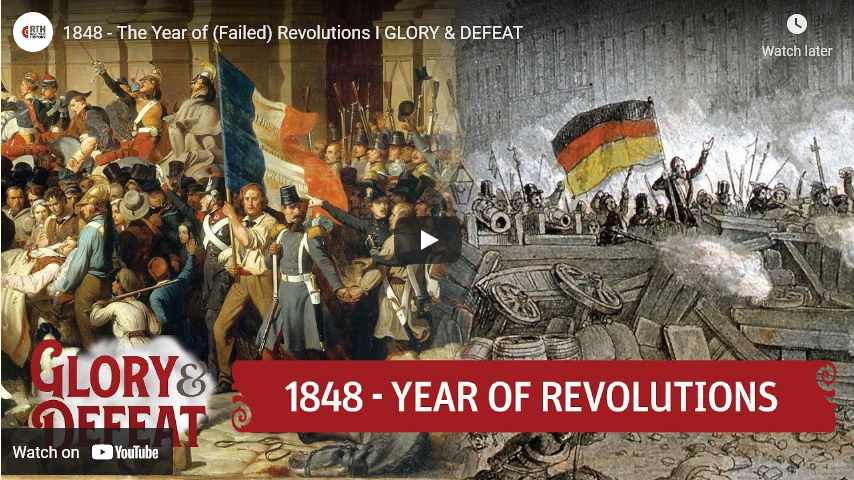
1848 – The Year of (Failed) Revolutions I GLORY & DEFEAT
realtimehistory
Published 7 Jul 2021Support Glory & Defeat: https://realtimehistory.net/gloryandd…
The year 1848 was pivotal in European history. All across the continent revolutionary movements erupted and demanded a new order. This would be no different in France and in the German states.
» OUR PODCAST
https://realtimehistory.net/podcast – interviews with historians and background info for the show.» LITERATURE
Engehausen, Frank: Die Revolution von 1848/49. Paderborn, München 2007Gall, Lothar (Hrsg.): 1848 – Aufbruch zur Freiheit: Ausstellungskatalog zum 150-jährigen Jubiläum der Revolution von 1848/49. Berlin 1998
Gouttman, Alain. La grande défaite de 1870-1871. Paris 2015
Siemann, Wolfram: Die deutsche Revolution von 1848/49. Suhrkamp, Frankfurt am Main 1985
Wollstein, Günter: “Scheitern eines Traumes”. In: Informationen zur politischen Bildung, Heft 265 (2010) o.S.
» SOURCES
Carrey, Émile: Recueil complet des actes du Gouvernement provisoire. Première partie n° 281. Paris 1884Haupt, Hermann (Hrsg.): Quellen und Darstellungen zur Geschichte der Burschenschaft und der deutschen Einheitsbewegung, Band 1, Heidelberg 1910
N.N.: Die Staats-Verträge des Königsreichs Bayern von 1806 – 1858. Regensburg 1860
» OUR STORE
Website: https://realtimehistory.net»CREDITS
Presented by: Jesse Alexander
Written by: Cathérine Pfauth, Prof. Dr. Tobias Arand, Jesse Alexander
Director: Toni Steller & Florian Wittig
Director of Photography: Toni Steller
Sound: Above Zero
Editing: Toni Steller
Motion Design: Philipp Appelt
Mixing, Mastering & Sound Design: http://above-zero.com
Maps: Battlefield Design https://www.battlefield-design.co.uk/
Research by: Cathérine Pfauth, Prof. Dr. Tobias Arand
Fact checking: Cathérine Pfauth, Prof. Dr. Tobias ArandChannel Design: Battlefield Design
Contains licensed material by getty images
All rights reserved – Real Time History GmbH 2021
August 2, 2021
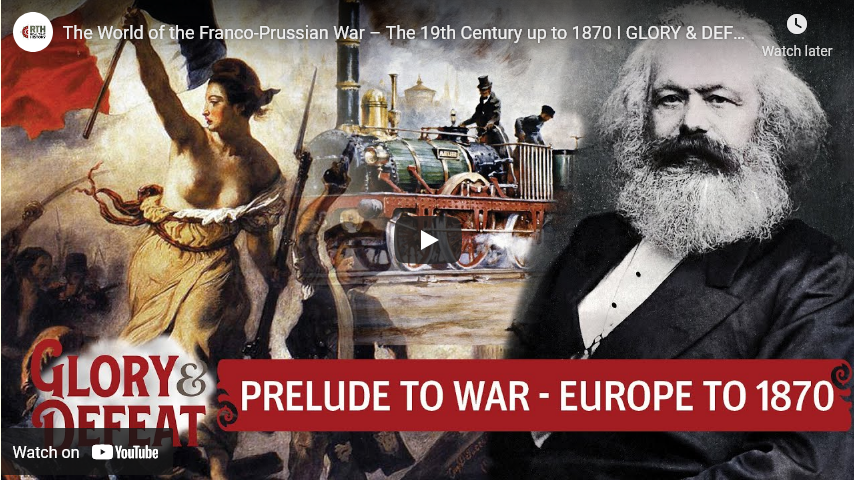
The World of the Franco-Prussian War – The 19th Century up to 1870 I GLORY & DEFEAT
realtimehistory
Published 30 Jun 2021Support Glory & Defeat: https://realtimehistory.net/gloryandd…
Welcome to the first primer episode for Glory & Defeat. In this first primer episode we will take a broad look at the industrial revolution and the emerging new ideologies of the 19th century: Communism and Nationalism.
» OUR PODCAST
https://realtimehistory.net/podcast – interviews with historians and background info for the show.» LITERATURE
Hobsbawm, Eric: The long nineteenth century. 3 Bände. London 1962-1987Kugler, Martin: “Fehleinschätzungen der Menschheit”, in: Die Presse v. 28.2.2010. o.S
Osterhammel, Jürgen: Die Verwandlung der Welt. Eine Geschichte des 19. Jahrhunderts. München 2009
Bruckmüller, Ernst et. al. (ed.): Putzger. Historischer Weltatlas. Berlin 2001
Staas, Christian: “Im Schatten der Schlote”, in: Geo Epoche Nr. 30. Die industrielle Revolution. 2008. S. 72-85
Bischoff, Jürgen: “Vorwärts durch Raum und Zeit”, in: Geo Epoche Nr. 30. Die industrielle Revolution. 2008. S. 56-71
» SOURCES
Engels, Friedrich: Die Lage der arbeitenden Klasse in England. Leipzig 1845» OUR STORE
Website: https://realtimehistory.net»CREDITS
Presented by: Jesse Alexander
Written by: Cathérine Pfauth, Prof. Dr. Tobias Arand, Jesse Alexander
Director: Toni Steller & Florian Wittig
Director of Photography: Toni Steller
Sound: Above Zero
Editing: Toni Steller
Motion Design: Philipp Appelt
Mixing, Mastering & Sound Design: http://above-zero.com
Maps: Battlefield Design https://www.battlefield-design.co.uk/
Research by: Cathérine Pfauth, Prof. Dr. Tobias Arand
Fact checking: Cathérine Pfauth, Prof. Dr. Tobias ArandChannel Design: Battlefield Design
Contains licensed material by getty images
All rights reserved – Real Time History GmbH 2021
August 1, 2021
Not a Step Back! – Wehrmacht Closes in on Stalingrad – WW2 – 153 – July 31, 1942
World War Two
Published 31 Jul 2021Operation Edelweiss opens with a blast, and as the Wehrmacht closes in on Stalingrad, Stalin issues that famous order. There aren’t just big actions in the East, the Japanese have landed in New Guinea, the Allies try one more offensive at El Alamein, and the Americans have locked in on Guadalcanal.
(more…)
Christopher Hitchens on George Orwell
DailyHitchens
Published 22 Jan 2010Aug 7, 2009. Christopher Hitchens talks with EconTalk host Russ Roberts about George Orwell. Drawing on his book Why Orwell Matters, Hitchens talks about Orwell’s opposition to imperialism, fascism, and Stalinism, his moral courage, and his devotion to language. Along the way, Hitchens makes the case for why Orwell matters. For more videos, updates and info on Christopher Hitchens, please visit http://www.dailyhitchens.com
July 30, 2021
The 100 Deadliest Days of the Holocaust Begin… – WAH 039 – July 1942, Pt .2
World War Two
Published 29 Jul 2021The extermination camps of Operation Reinhard are ready to start killing hundreds of thousands of inhabitants of the Warsaw Ghetto, starting the deadliest 100 days of the Holocaust.
(more…)
July 29, 2021
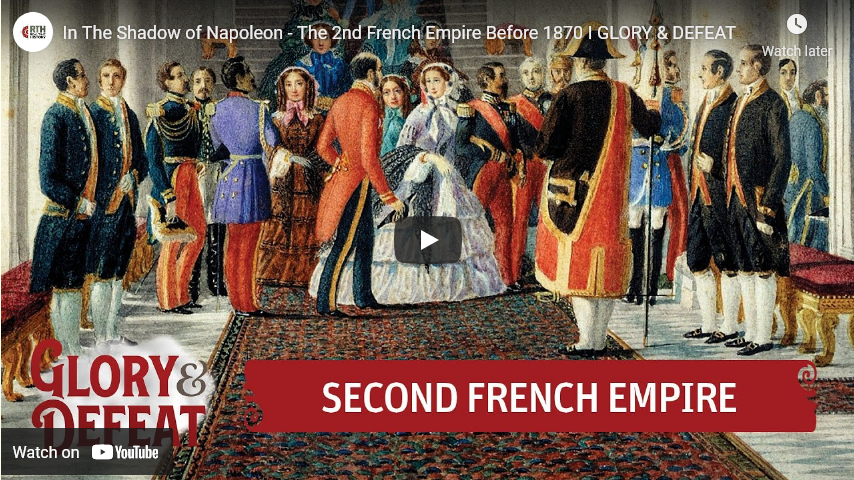
In The Shadow of Napoleon – The 2nd French Empire Before 1870 I GLORY & DEFEAT
realtimehistory
Published 12 Jul 2021Support Glory & Defeat: https://realtimehistory.net/gloryandd…
After Napoleon I had conquered and then lost Europe, France went through multiple revolutions. In 1851, Napoleon’s nephew and French president Louis-Napoléon Bonaparte took control and in 1852 crowned himself Emperor Napoleon III. The new French Empire wanted to regain the glory of Napoleon’s uncle and together with his wife Empress Eugenie he ruled a state known for lavish balls and spending.
» OUR PODCAST
https://realtimehistory.net/podcast – interviews with historians and background info for the show.» LITERATURE
Arand, Tobias: 1870/71. Die Geschichte des Deutsch-Französischen Kriegs erzählt in Einzelschicksalen. Hamburg 2018Arand, Tobias/Bunnenberg, Christian (Hrsg.): Karl Klein. Fröschweiler Chronik. Kriegs- und Friedensbilder aus dem Krieg 1870. Kommentierte Edition. Hamburg 2021
Gouttman, Alain. La grande défaite de 1870-1871. Paris 2015
Herre, Franz: Eugénie. Kaiserin der Franzosen. Stuttgart, München 2000
Rieder, Heinz: Napoleon III. Abenteurer und Imperator. München 1998
» SOURCES
Bonaparte, Prince Napoléon-Louis: Des Idées Napoléoniennes. London 1839Marx, Karl: Der achtzehnte Brumaire des Louis Napoleon. Hamburg 1869
Maupassant, Guy de: Bel-Ami. Paris 1901
N.N. (Hrsg): Fontane, Theodor. Aus den Tagen der Okkupation. Eine Osterreise durch Nordfrankreich und Elsaß-Lothingen 1871. Berlin (Ost) 1984
» OUR STORE
Website: https://realtimehistory.net»CREDITS
Presented by: Jesse Alexander
Written by: Cathérine Pfauth, Dr. Tobias Arand, Jesse Alexander
Director: Toni Steller & Florian Wittig
Director of Photography: Toni Steller
Sound: Above Zero
Editing: Toni Steller
Motion Design: Philipp Appelt
Mixing, Mastering & Sound Design: http://above-zero.com
Maps: Battlefield Design
Research by: Cathérine Pfauth, Prof. Dr. Tobias Arand
Fact checking: Cathérine Pfauth, Prof. Dr. Tobias ArandChannel Design: Battlefield Design
Contains licensed material by getty images
All rights reserved – Real Time History GmbH 2021
July 28, 2021
How Hitler Created the World’s Worst Traffic Jam – WW2 – 152B – July 27, 1942
World War Two
Published 27 Jul 2021“I said DAMN, this traffic jam … How I hate to be late, hurts my motor to go so slow. Time I get home my supper be cold. Damn, this traffic jam.” (James Taylor, the Eastern Front, 1942)
(more…)
July 27, 2021
History Summarized: The Crusades
Overly Sarcastic Productions
Published 11 Jun 2017Making a video exclusively about the crusades? That’s a bold strategy, Blue, let’s see how it pays off.
RELEVANT LINKS:
History Summarized: Islam: https://youtu.be/Uvq59FPgx88
History Summarized: Christianity: https://youtu.be/A86fIELxFds
History Summarized: Judaism: https://youtu.be/aKB6WduDwNE
History Summarized: Christianity, Judaism, and the Muslim Conquest https://wp.me/p2hpV6-gQv
History Summarized: Venice (Part 2): https://youtu.be/byMleAJ5kRs
History Summarized: Byzantine Empire: https://youtu.be/-ucHQVu8Dw0History Summarized: Abrahamic Religious Philosophy: https://youtu.be/B7myRRt0Mn8
PATREON: www.patreon.com/user?u=4664797
MERCH LINKS:
Shirts – https://overlysarcasticproducts.threa…
All the other stuff – http://www.cafepress.com/OverlySarcas…Find us on Twitter @OSPYouTube!
July 26, 2021
Eastern Front Deployments, July 1942 – WW2 Special
World War Two
Published 25 Jul 2021It is what it says it is, the front line deployments of the Axis and Soviet forces in the Southern Part of the Eastern Front in late July 1942. Hitler’s forces invading, and Josef Stalin’s on defense.
(more…)
QotD: British Expeditionary Force (BEF) leadership in France, 1940
Gort was not a lone offender in Alanbrooke’s opinion. The latter believed that most of his fellow senior officers lacked Conceptual Skill. He suggested that the lack of strategic ability amongst British senior commanders was due to the best thinkers of his generation being lost in the Great War. Alanbrooke’s theory is questionable, for the Germans also lost many talented officers in the Great War, yet between the wars, actively promoted intellectual stimulation amongst its officer corps. Amongst the leading thinkers were Heinz Guderian, often regarded as the father of Blitzkrieg, although in his own book, Panzer Leader, is the first to admit that he took British ideas and developed them into something that worked. The British, it seems, were less stimulated by their own initial thinking on modern war.
This does not imply the Germans were unequivocal masters of big thinking. Many German army commanders were as locked into traditional thinking as their Allied opposite numbers. Guderian asserts that the sole reason the BEF was allowed to escape from Dunkirk was because the German Army High Command issued repeated halt orders to Guderian’s panzer corps, allowing the British the breathing space needed to avoid total defeat.
Both sides suffered in this area [interpersonal skills], and the problems arose mainly at senior level. Despite many British commanders speaking good French, the respective commanders on each side of this coalition had radically different opinions of how operations should be conducted and coordinated. There was virtually no attempt to ensure interoperability before May 1940 and the Anglo-French coalition was, at best, a well-mannered but reluctant partnership which did not stand the test of high-tempo operations well.
The lack of trust between the Allies ultimately drove Gort to contradict direct orders and use his last reserves to shore up the BEFs northern flank, rather than fritter them away in a joint counter-attack with the French that was dead in the water before it was launched. By the 25th May, just two weeks after the opening of combat operations, the Anglo-French coalition was crumbling. Bizarrely, this decision by Gort to abandon the French actually testifies to his one great moment of Conceptual Skill. He realised he was essentially committing career suicide when he ordered his troops towards the coast, but he also had the foresight to realise that the battle for France was already lost and that his sole duty from then on was to save Britain’s army.
Andy Johnson, “Dunkirk: Leadership Lessons in a Hard School”, The Wavell Room, 2017-08-01.


