
World War Two
Published 4 Mar 2023The American attacks against the Admiralty Islands are successful, but this causes real tensions between commanders Douglas MacArthur and Chester Nimitz. Much of this week is taken up by planning and meetings on both sides — Adolf Hitler plans the occupation of Hungary, Josef Stalin plans new offensives in Ukraine, and the Allies plan to reconfigure their whole front in Italy. It’s all the prelude to an explosion of action.
(more…)
March 5, 2023
MacArthur and Nimitz Go Head-to-Head – Week 236 – March 4, 1944
Comments Off on MacArthur and Nimitz Go Head-to-Head – Week 236 – March 4, 1944
March 2, 2023
Anti-Tank Chats #6 | The Panzerfaust | The Tank Museum
The Tank Museum
Published 4 Nov 2022Historian Stuart Wheeler is back with another anti-tank chat. In this episode, he is looking at the development and use of the legendary panzerfaust.
(more…)
Comments Off on Anti-Tank Chats #6 | The Panzerfaust | The Tank Museum
March 1, 2023
School Lunch from the Great Depression
Tasting History with Max Miller
Published 28 Feb 2023
(more…)
Comments Off on School Lunch from the Great Depression
Mauser WW1 Flyer’s Rifle: the Flieger Selbstlader Karabiner 1916
Forgotten Weapons
Published 1 Nov 2022Paul Mauser dedicated much of his life to the development of a practical semiauto military rifle, and did manage to have a design that was used in combat by Germany in World War One. It began with the model 06/08, a short-recoil, flap-locked design made in both rifle and pistol form. The short recoil idea was disliked by the military for a shoulder rifle, and so Mauser redesigned it to be inertially locked with a fixed barrel. This was sold in small numbers as a sporting rifle, and tested by the military a few years before the war. Once war began, Mauser once again submitted the design for use in an infantry configuration, but the system was too delicate for infantry combat. A second pattern was made for use by fliers, and this was accepted and used in service for that brief period between the introduction of military aviation and the adoption of aerial machine guns.
Designated the FSK-16 (FliegerSelbstladeKarabiner 1916), it was used primarily by balloon and Zeppelin crews. With a large magazine and self-loading action, it was much better for use in aircraft than the typical bolt action infantry rifles — and there was no mud to get into the action while airborne.
(more…)
Comments Off on Mauser WW1 Flyer’s Rifle: the Flieger Selbstlader Karabiner 1916
February 27, 2023
Luftwaffe Defeated in One Week?! – War Against Humanity 099
World War Two
Published 26 Feb 2023Allied and German Air Forces fight fierce battles over Europe with civilians caught in the crossfire, while Joseph Stalin and Lavrenti Beria deport two entire ethnicities of half a million in just one week.
(more…)
Comments Off on Luftwaffe Defeated in One Week?! – War Against Humanity 099
February 26, 2023
Tojo Takes Control – Week 235 – February 25, 1944
World War Two
Published 25 Feb 2023Now that the Americans have seized the Marshall Islands, they can bypass the Japanese base at Truk. This impels Prime Minister Hideki Tojo to shake up both army and navy command, and he even takes personal control over the Japanese Army. On the Anzio Front, Lucian Truscott replaces John Lucas as Allied Commander. In the field, the Allies win a big victory in Burma, and in Ukraine, the Soviets are still on the move.
(more…)
Comments Off on Tojo Takes Control – Week 235 – February 25, 1944
Ortgies Automatic Pistols: Not as Boring as You Think!
Forgotten Weapons
Published 16 Jun 2016The Ortgies is a pistol whose interesting aspects are often overlooked on the assumption that it is just another identical .32 ACP blowback pistol. Well, it is that — but it is also more.
Mechanically, the Ortgies has a rather unusual grip safety mechanism that is quite different from what we expect to see today. It is also interesting in that the .32 and .380 versions differ only in the easily-interchanged barrel — even the magazines are marked for both calibers.
However, the most interesting part of the Ortgies story (in my opinion) is its production. In less than 5 full years (1919-1923), close to a half million of these guns were made, primarily by an industrial subsidiary of the German government. The guns were in large part a work program, creating export goods which could bring desperately needed hard currency into Germany to counteract the economic devastation of the Versailles treaty.
Have a look at the video and you may come away with a newfound appreciation for the humble Ortgies, like I did!
(more…)
Comments Off on Ortgies Automatic Pistols: Not as Boring as You Think!
February 24, 2023
Up Close and Personal – Mountain Warfare in Italy – WW2 Special
World War Two
Published 23 Feb 2023Thanks to Curiosity Stream for sponsoring today’s video
Even as the Allied and Axis commanders focus on the sweeping warfare of the Eastern Front and the planning for the invasion of Europe, their men continue to fight a grinding war of attrition high in the Italian mountains. It’s a war of merciless terrain, brutal close-quarters combat, and vast quantities of artillery and bombs. They may be playing second fiddle, but the soldiers on the Italian front will never forget these battles.
(more…)
Comments Off on Up Close and Personal – Mountain Warfare in Italy – WW2 Special
February 22, 2023
Mosquito Bombers Bust Out French Resistance – War Against Humanity 098
World War Two
Published 21 Feb 2023Across Europe the anti-Nazi Resistance continues to rise as does the infighting. In France the RAF carry out Operation Jericho to break out captured resistance members held at the prison in Amiens.
(more…)
Comments Off on Mosquito Bombers Bust Out French Resistance – War Against Humanity 098
February 21, 2023
Medieval Mardi Gras
Tasting History with Max Miller
Published 22 Feb 2022
(more…)
Comments Off on Medieval Mardi Gras
February 19, 2023
The Destruction of Monte Cassino – Week 234 – February 18, 1944
World War Two
Published 18 Feb 2023The Allies bomb the monastery atop Monte Cassino in Italy, but just to the Northwest it’s the Germans attacking them at Anzio this week. In the Soviet Union, the Axis break out of the Korsun Pocket, but at great cost, and in the Pacific comes a major Allied raid on the Japanese base at Truk and landings on Eniwetok Atoll.
(more…)
Comments Off on The Destruction of Monte Cassino – Week 234 – February 18, 1944
February 12, 2023
German Desperation in Korsun Pocket – Week 233 – February 11, 1944
World War Two
Published 11 Feb 2023It is crisis mode in the Korsun Pocket this week for the Axis troops surrounded, but they are also losing ground all over the Eastern Front this week, including the big prize of Nikopol. In Italy, it is a different story as the Germans play offense at Anzio, though with only small gains.
(more…)
Comments Off on German Desperation in Korsun Pocket – Week 233 – February 11, 1944
February 10, 2023
Hitler’s Jazz Band – WW2 Documentary Special
World War Two
Published 9 Feb 2023Does Adolf Hitler like Duke Ellington? No, and nor do many National Socialists. But the story of the music in the Third Reich is more complicated than you might think. What if we told you that Joseph Goebbels has tried to create a Nazi-approved swing band tasked with bringing the Jazz War to the Allies?
(more…)
Comments Off on Hitler’s Jazz Band – WW2 Documentary Special
February 8, 2023
The ghastly Thirty Years’ War in Europe
In The Critic, Peter Caddick-Adams outlines the state of Europe four hundred years ago:
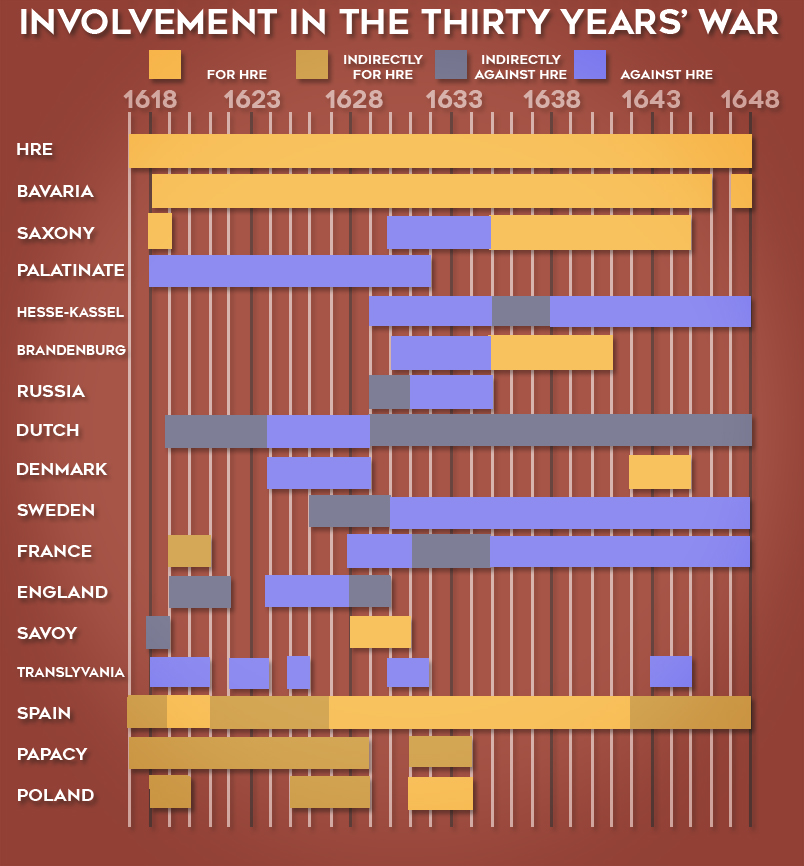
A war as long and as complex requires something like this to help keep the narrative somewhat understandable.
Exactly four hundred years ago, a dark shadow was slithering across mainland Europe. It stretched its bleak, cold presence into each hearth and home. Everything it touched turned to ruin. Musket and rapier, smoke and fire, ruled supreme. Nothing was immune. Animals and children starved to death, mothers and adolescent girls were abused and tortured. The lucky ones died, alongside their brothers and fathers, slain in battle. Possessions were looted, crops destroyed, barns and houses burned. There seemed no end to the evil and pestilence. Sixteen generations ago, many believed the end of the world had arrived.
This was not a tale of Middle Earth. The place was central Europe in the early 17th century. In 1618 the future Holy Roman emperor Ferdinand II, a zealous follower of the Jesuits, had attempted to restore the Catholic Church as the only religion in the Empire and exterminate any form of religious dissent. Protestant nobles in Bohemia and Austria rose up in rebellion. The conflict soon widened, fuelled by the political ambitions of adjacent powers. In Europe’s heartland, three denominations fought it out: Roman Catholicism, Lutheranism and Calvinism.
The result was an interwoven tangle of diplomatic plot twists, temporary alliances and coalitions, as princes, bishops and potentates beseeched outside powers to help. The struggle, which lasted for thirty years, boiled down to the Roman Catholic and Habsburg-led Holy Roman Empire, fighting an incongruous array of Protestant towns and statelets, aided by the anti-Catholic powers of Sweden under Gustavus Adolphus, and the United Netherlands. France and Spain also took advantage of the distractions of war to indulge in their own sub-campaigns. Britain took no formal part but was about to become embroiled in her own civil war.
The principal battleground for this collective contest of arms centred on the towns and principalities of what would become Germany, northern Italy, the Netherlands and the Czech Republic. The war devastated many regions on a scale unseen again until 1944–45. For example, at Magdeburg on the River Elbe, 20,000 of 25,000 inhabitants died, with 1,700 of its 1,900 buildings ruined. In Czech Bohemia, 40 per cent of the population perished, with 100 towns and more than a thousand villages laid waste. At Nordlingen in 1634, around 16,000 soldiers were killed in a single day’s battle. The town took three centuries for its population to return to pre-war levels. Refugees from smaller settlements swelled the many walled cities, increasing hunger and spreading disease.
Too diminutive to defend themselves, all states hired mercenaries, of whom a huge number flourished in the era, enticed by the prospect of quick wealth in exchange for proficiency with sword and musket. Employed by every antagonist, but beholden to no one, these armed brigands — regiments would be too grand a term for the uniformed thugs they were — roamed at will. With their pikes and their muskets, they plundered the countryside in search of booty, food and transport. In their wake, they left burning towns, ruined villages, pillaged farms. Lead was stripped from houses and church roofs for ammunition.
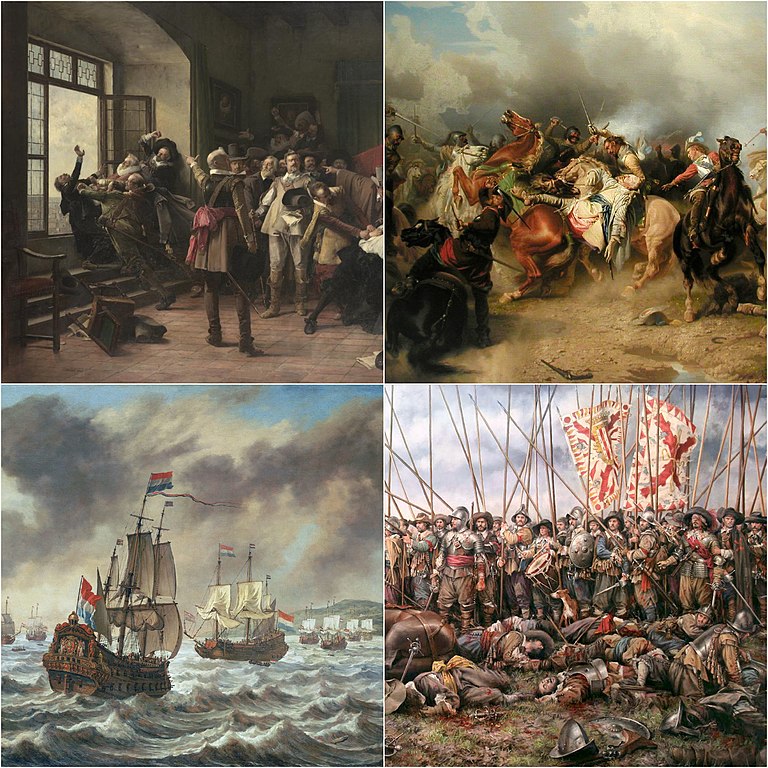
Left to right:
The Defenestration of Prague (23 May, 1618), The death of Gustavus Adolphus at Lützen (16 November, 1632), Dutch warships prior to the Battle of the Downs (21 October, 1639), and The Battle of Rocroi (19 May, 1643).
Collage by David Dijkgraaf via Wikimedia Commons.When in the winter of 1634 Swedish mercenaries were refused food and wine by the inhabitants of Linden, a tiny Bavarian settlement, they raped and looted their way through the village, leaving it uninhabitable. Across Europe, travellers noted the human and animal carcasses that decorated the meadows, streams polluted by the dead and rotting crops, presided over only by ravens and wolves. No respect was shown for the lifeless. Survivors stripped corpses of clothing and valuables; if lucky, the deceased were tossed into unmarked mass graves, since lost to history.
Having triggered the war, Ferdinand predeceased its end. We can never know how many died in Europe’s last major conflagration triggered by religion. Archives perished in the flames, and survivors were not interested in computations. Historians now put the death toll at between 8 and 12 million. Probably 500,000 perished in battle, with the rest, mostly civilians, expiring through starvation and disease. We think these casualties may equate to as much as 20 per cent of mainland Europe’s population and perhaps one-third of those in modern Germany, bringing the Thirty Years’ War a potency similar to the Black Death or either world war. The region did not recover for at least three generations.
Economic activity, land use and ownership altered terminally. When the exhausted powers finally met in October 1648 at Osnabrück and Münster in the German province of Westphalia to end the directionless slaughter, of whom self-serving militias were the only beneficiaries, Europe’s balance of power had shifted tectonically. Fresh rules of conflict and the legitimacy of a new network of 300 sovereign states, independent from a Holy Roman Emperor or a Pope, marked the struggle as a watershed moment, leading to the Enlightenment and an era that disappeared only with Napoleon.
Comments Off on The ghastly Thirty Years’ War in Europe
February 5, 2023
Leningrad: NO STEP BACK! – Week 232 – February 4, 1944
World War Two
Published 4 Feb 2023The Allies begin a new operation in the Pacific this week: assaulting the Marshall Islands. They also make big attacks from their beachhead in Italy at Anzio, but these are called off after only a few days in the face of heavy enemy resistance. However, in the USSR there are several successes against the Axis, as they are pushed back both in the far north and the far south of the front, and still surrounded near Korsun.
(more…)
Comments Off on Leningrad: NO STEP BACK! – Week 232 – February 4, 1944


