
World War Two
Published 2 Feb 2023Poland, occupied, abandoned or even threatened by her allies is left to fight her own war. A war that under the influence of internal and external forces looks more and more like a full blown civil war inside the world war.
(more…)
February 4, 2023
Poland’s Descent into Civil War – War Against Humanity 097
Comments Off on Poland’s Descent into Civil War – War Against Humanity 097
January 31, 2023
The Allied Flying Aces of World War Two – Documentary Special
World War Two
Published 30 Jan 2023Young, daring, and handsome, the Allied fighter aces of World War Two have captivated the public with their thrilling exploits. Join us as we take a look at the top scorers! Thanks to Curiosity Stream for sponsoring today’s video.
(more…)
Comments Off on The Allied Flying Aces of World War Two – Documentary Special
January 29, 2023
Anzio Begins – Allies Already Pinned Down – Week 231 – January 28, 1944
World War Two
Published 28 Jan 2023Some big news is the Allies amphibious offensive to hit the Germans behind their lines at Anzio in Italy, some other big news is that after nearly two and a half years, the Soviets have broken the siege of Leningrad and their twin northern offensives keep pushing back the enemy. Yet more big news is that the Soviets have managed to surround and cut off over 50,000 Axis troops near Korsun. This is one big week of action!
(more…)
Comments Off on Anzio Begins – Allies Already Pinned Down – Week 231 – January 28, 1944
January 26, 2023
Ukraine to receive Challenger II, M1 Abrams, and Leopard 2 tanks … both a solution and a new set of problems
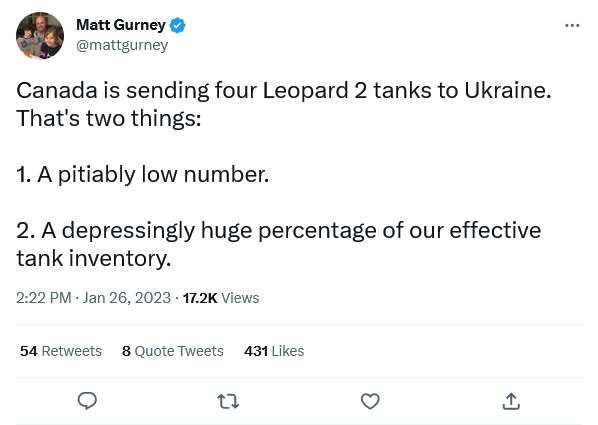
In The Line, Matt Gurney outlines some of the benefits Ukraine will receive with this new transfusion of AFVs … and also the new and exacerbated set of practical problems that goes along with fielding so many different makes and models of tanks:
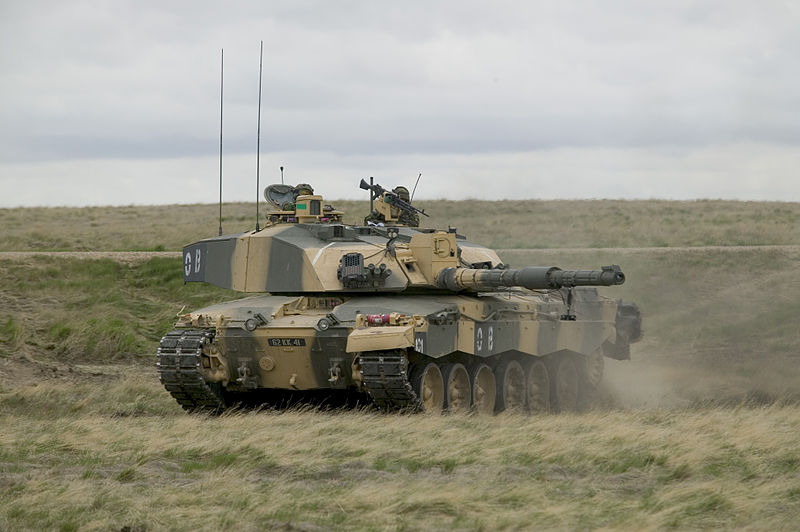
A British army Challenger Main Battle Tank, of 1 Royal Regiment of Fusiliers (1RRF), is shown returning to base after completing a firing mission as part of Exercise MedMan.
1RRF Battle group were based at the British Army Training Unit Suffield (BATUS) in Canada.
MOD photo by Mike Weston via Wikimedia Commons.
A column getting into all the details of why [the German government] were withholding said blessing would be several times longer than this one will be. Suffice it to say this is just the latest manifestation of Germany’s extreme discomfort with this war. Some of it relates to the lingering fallout of Germany’s blood-soaked history. But we would be naïve not to attribute at least some of the reluctance to Russia’s deep influence among some segments of the German ruling elite.
Germany has contributed to the defence of Ukraine, and it would be unfair to deny that. It would not be unfair to note that Germany has typically only done so later than the other allies, and under enormous pressure.
As part of the deals being announced, the United States will be sending several dozen of its M1 Abrams tanks, and Germany will send Leopards. Berlin will also allow other allies to send further Leopards. (Canada hasn’t committed to sending any of ours yet, but our few remaining Leopards are reported to be in poor shape, and are also all the way across an ocean, so we might not even be asked.) The British will send the Challengers. This gives Germany the ability to claim, with a reasonably straight face, that it has not chosen to escalate the conflict. Heavens, no! It’s simply moving in lockstep with its allies! As fig leaves go, it’s a pretty small and transparent one, but for the purposes of diplomacy and maintaining the appearance of allied solidarity, it’ll do.
And this brings us to the problem that the plan is exacerbating. A year ago, the Ukrainian military was largely armed and equipped along Russian lines — both militaries were, after all, descendants of the Soviet Red Army. Since then, much of its original equipment has been destroyed or lost, but this has generally been offset by an influx of Western weapons into the country as the allies empty their arsenals and get their production lines running again. This has allowed Ukraine to keep fighting, far more effectively than the Russians, among many others, expected. Despite huge losses of manpower, the Ukrainian military seems to actually have grown stronger as the war has gone on, thanks to the power of its new weapons.
Sending news is good news to that extent. It will make Ukraine stronger still. But it is also producing a situation where the Ukrainians are armed with an absurdly unwieldy mix of weapon systems. This is laying the groundwork for a future logistics disaster.
Any individual soldier can learn to use any specific piece of equipment. That’s just a matter of training and experience. Soldiers are smart. The longer they serve, the quicker they’ll get at picking up new pieces of equipment and kit. The challenge is more on the backend. The logistics of sustaining an arsenal of completely mixed weapon systems is a nightmare. Not only must Ukraine procure a huge variety of calibers of ammunition, it must also procure, sort, and then distribute a bewildering array of spare parts to keep all these weapons running. It’s not that this is impossible. The fact that Ukraine fights on is proof that it is not. But it adds tremendous cost and complexity, and requires a much larger effort to sustain than would be the case if Ukrainian units were equipped with standard weapons across comparable units.
The numbers of NATO tanks are initially small enough that only a few battalions can be re-equipped with the donated AFVs, but each different “brand” needs its own specialized support in the way of maintenace, repair, and re-supply. Ukraine is going to have to have at least a company-sized, fully trained maintenance unit for each battalion of NATO tanks and the logistics system will have to ensure that the different types of ammunition and ordinary wear-and-tear maintenance spares are delivered quickly enough to keep those battalions combat-ready. Some NATO nations with much better facilities sometimes struggle to do this for a single type of AFV, never mind for several different types.
Update: Can’t help but agree with Matt here.
Comments Off on Ukraine to receive Challenger II, M1 Abrams, and Leopard 2 tanks … both a solution and a new set of problems
January 24, 2023
An alternative theory about German Chancellor Olaf Scholz’s hesitation to allow Ukraine access to Leopard 2 tanks
I’ve been going on the assumption that the German government was terrified of Russian reaction if they allowed some Leopard 2 tanks to be donated to the Ukrainian forces, but eugyppius points out there’s another strong contending explanation:
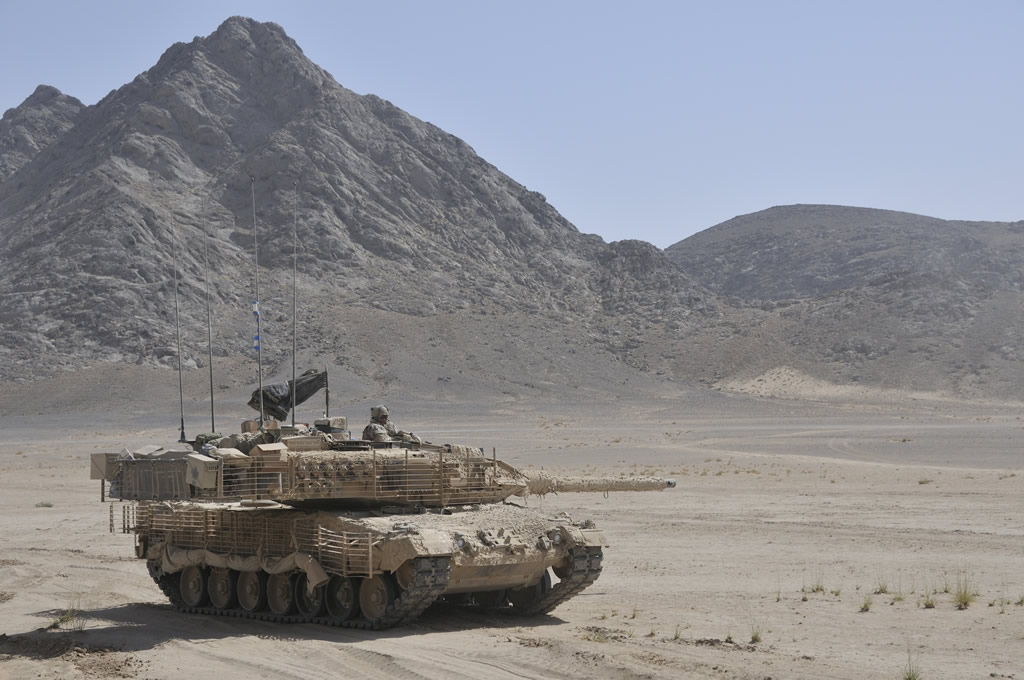
Leopard 2A6M in Afghanistan
Years of peace in Europe, an ageing population and a corresponding focus on expensive social programmes have caused Germany to put its defence industry into near-hibernation. Only a little over 2,000 Leopard 2s have ever seen the light of day. Each one is a hand-built machine that takes two years to make. If Germany permits the export of the European supply of Leopard 2s to Ukraine, the Russians will grind them to nothing within months, and then Europe will have no tanks except the tanks that the Americans sell them:
Defence industry representatives, who wish to remain anonymous, report that the Americans are offering their own used tanks as replacements to [European] countries able to supply Leopard 2s to Ukraine, together with a long-term industrial partnership. Any country that accepts the American offer would be hard to win back for the German tank industry. Berlin’s influence in armament policy would decrease correspondingly.
Tanks are driven by men, who have to be trained in the operation of specific models. Their use moreover requires a whole supply chain of munitions and especially spare parts, which the Americans are eager to offer. The upshot is that, once Europe opts into American armour, it will never switch back, and Germany will be out of the game for good. Nor should we lend much credence to the idea that our very few tanks will make any difference either way for Ukraine’s prospects. The insistence that Scholz release the Leopard 2s is simply an attempt to edge Germany further out of the European arms industry and into a position of lesser political and economic influence in Europe, so that the United States can fill the gap.
Noah Carl, over at the Daily Sceptic, drew attention last week to remarks by the French intellectual Emmanuel Todd that “this war is about Germany“:
After the collapse of the Soviet Union, Zbigniew Brzezinski called Eurasia the new “great chessboard” of world politics … The Russian nationalists and ideologues like Alexander Dugin indeed dream of Eurasia. It is on this “chessboard” that America must defend its supremacy – this is Brzezinski’s doctrine. In other words, it must prevent the rapprochement of Russia and China. The financial crisis of 2008 made it clear that with reunification Germany had become the leading power in Europe and thus also a rival of the United States. Until 1989, it had been a political dwarf. Now Berlin let it be known that it was willing to engage with the Russians. The fight against this rapprochement became a priority of American strategy. The United States had always made it clear that they wanted to torpedo [Nord Stream 2]. The expansion of NATO in Eastern Europe was not primarily directed against Russia, but against Germany. Germany, which had entrusted its security to America, became the Americans’ target [in the destruction of the pipeline]. I feel a great deal of sympathy for Germany. It suffers from this trauma of betrayal by its protective friend — who was also a liberator in 1945.
After the anti-Russian sanctions regime and its clear deindustrialising effects on the German economy, followed by the attack on the Baltic Nord Stream pipelines, and even smaller things, such as the high-profile anti-industry protests by the American-funded activist group Letzte Generation, I am willing to believe many conspiratorial things about the Ukraine war.
Comments Off on An alternative theory about German Chancellor Olaf Scholz’s hesitation to allow Ukraine access to Leopard 2 tanks
January 23, 2023
Monte Cassino, the Battle Begins – Ep 230 – January 21, 1944
World War Two
Published 21 Jan 2023The Allies have reached the linchpin of the German defenses in Italy, but a first attack proves disastrous. It does, though, divert troops from where they soon plan to make landings behind enemy lines. Meanwhile in the USSR, the huge Soviet offensive in the north makes great gains against the stunned Axis forces.
(more…)
Comments Off on Monte Cassino, the Battle Begins – Ep 230 – January 21, 1944
January 22, 2023
Where The British Army Figured Out Tanks: Cambrai 1917
The Great War
Published 20 Jan 2023The Battle of Cambrai in 1917 didn’t have a clear winner, but the conclusions that Germany and Britain drew from it, particularly about the use of the tank (in combination with other arms), would have far reaching consequences in 1918.
(more…)
Comments Off on Where The British Army Figured Out Tanks: Cambrai 1917
January 21, 2023
When the SS Go Too Far – War Against Humanity 096
World War Two
Published 20 Jan 2023The internal conflict between Poland and the other United Nations Allies deepens as Churchill faces them with diplomatic defeat over Soviet land grab. In the Occupied Netherlands and Poland the Nazis continue their atrocities.
(more…)
Comments Off on When the SS Go Too Far – War Against Humanity 096
January 19, 2023
The Partisan War Behind the Frontlines – WW2 Documentary Special
World War Two
Published 18 Jan 2023There is a second war raging on the Eastern Front. From the huge expanses of no man’s land behind the German lines, Moscow’s battle-hardened and well-armed partisan bands are waging a Rail War in support of Red Army offensives. But every successful mission brings down the wrath of the genocidal Axis war machine.
(more…)
Comments Off on The Partisan War Behind the Frontlines – WW2 Documentary Special
January 18, 2023
L’affaire Dreyfus
Robert Zaretsky on an espionage scandal that convulsed the French Third Republic and still has resonance down to today:
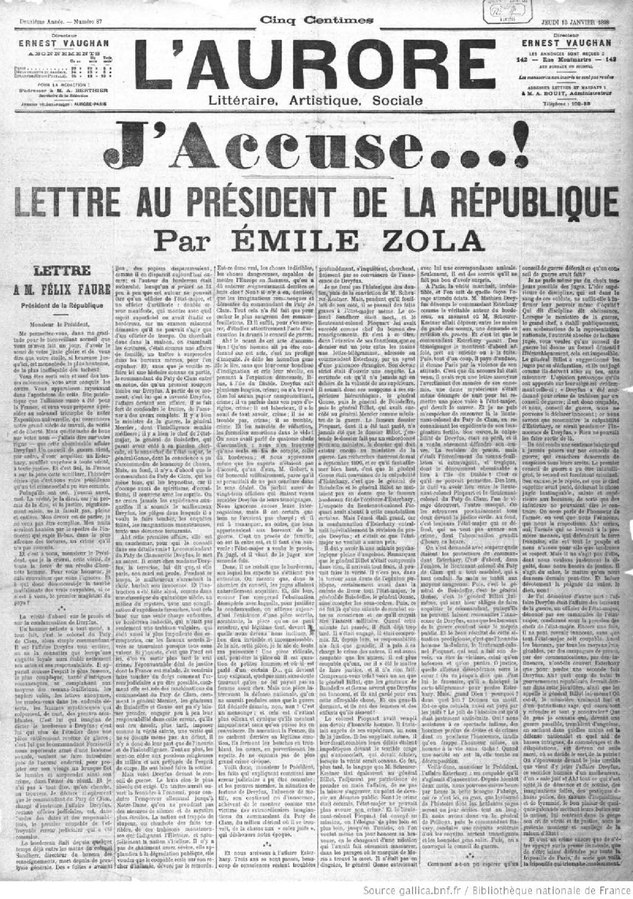
Front page of L’Aurore for 13 January, 1898 with Zola’s J’Accuse headline.
Wikimedia Commons.
On January 13, 1898, Parisians awoke to the chorus of hundreds of news criers who, striding along the grand boulevards and brandishing copies of the newspaper L’Aurore, were shouting passages from the article that sprawled across the front page. It had originally been titled by its author, the novelist Émile Zola, “A Letter to M. Félix Faure, President of the Republique”. But with a flair for the sensational, the newspaper’s editor, Georges Clemenceau, slapped on a punchier headline. Stepping out of a department store or stepping down from a carriage, sitting at a café or standing at an intersection, pedestrians were greeted by two words that continue to resonate 125 years to the day after their first publication: “J’Accuse!”
With this exclamation, Zola’s letter transformed une affaire judiciare into l’affaire Dreyfus or, more simply, the Dreyfus Affair. It catapulted the French novelist onto the world stage at a critical moment in the history of his country, which was reeling from the forces of globalisation and industrialisation and riven by opposing understandings of its revolutionary heritage. It is thus hardly surprising that Zola’s fame rests more heavily on the letter than on his sweeping 20-volume masterpiece of literary realism, the Rougon-Macquart. It took a novelist to heave the facts of this affair into a narrative which, more than a century later, thrums with equal urgency. Moreover, as with the novels of the Rougon-Macquart, the letter thrusts onto centre-stage a lone individual swept up, and all too often swept under, the political and social, irrational and ideological forces of the modern age.
It all began with the contents of a rubbish bin. In September 1894, a cleaning woman at the German Embassy, in the pay of France’s military intelligence service, delivered her nightly harvest to her employers. Buried in the mound of discarded papers was a memorandum, known as the bordereau or note, revealing top secret advances in French artillery technology and tactics. In a frantic scramble to find its author, the war ministry’s suspicion settled on Captain Alfred Dreyfus, an officer in the High Command who stood out for his standoffishness and Jewishness.
Upon being arrested and charged, a bewildered Dreyfus denied the charges, pointing out several things mentioned in the bordereau he could not possibly have known. The seven members of the military tribunal, ignoring these inconsistencies as well as the insistence of their own graphologist that Dreyfus’s handwriting did not match the bordereau‘s, unanimously found him guilty. He was sentenced to life imprisonment in solitary confinement on Devil’s Island, a malarial rock off the coast of French Guyana.
But first came a remarkable ritual of public humiliation. Dreyfus was marched into the courtyard of the École militaire, the renowned military academy a short distance from the recently erected Eiffel Tower. In the shadow of that monument to modernity, an officer preceded to snap Dreyfus’s sword — broken and soldered back together with tin the night before, to make the gesture seem effortless — and tear off his insignia — whose threads were already loosened — while a dense crowd howled with calls for the death of the “Jewish traitor!”
Two years later, as Dreyfus wasted away in solitary confinement, Colonel Georges Picquart, the newly appointed head of military intelligence, found that another missive about French military plans had ended up in the rubbish bin at the German Embassy. Moreover, the handwriting on this new document, which matched that of the bordereau, also matched the hand of Ferdinand Esterhazy, an officer notorious for his womanising and gambling.
Picquart disliked Jews as much as his many of his fellow officers did. But when his commanding officer asked him why it mattered if “this Jew remains on Devil’s Island”, Picquart replied: “Because he is innocent!” The answer earned Picquart a rapid transfer to a desert outpost in North Africa. Before he was packed off, though, Picquart vowed that he would not “carry this secret to my grave”. He then shared what he knew with Auguste Scheurer-Kestner, the leader of Dreyfusards, a small but growing coterie of politicians and writers seeking a retrial for Dreyfus.
In late 1897, Zola met with Scheurer-Kestner, who told him about Picquart’s discovery. As the mesmerised novelist listened, he glimpsed the theatrical as well as moral dimensions of the affair. “It’s thrilling!” he gasped. “It’s frightful! But it is also drama on the grand scale!” It took Zola to scale it to greatness by flipping Oscar Wilde’s sly quip that anyone could make history, but only a great man could write it. Instead, Zola showed, a man becomes truly great only by, in every sense of the word, making history.
Comments Off on L’affaire Dreyfus
Ask Ian: Why No German WW2 50-Cal Machine Guns? (feat. Nick Moran)
Forgotten Weapons
Published 20 Sep 2022From Nathaniel on Patreon:
“Why didn’t Germany or Axis powers have a machine gun similar to the American M2?”Basically, because everyone faced the choice of a .50 caliber machine gun or 20mm (or larger) cannons for anti-aircraft use, and most people chose the cannons — including Germany. There were some .50 caliber machine guns adopted by Axis powers, most notably the Hotchkiss 1930, a magazine-fed 13.2mm gun that was used by both Italy and Japan (among others). However, the use of the .50 caliber M2 by the US was really a logistical holdover form the interwar period. The M2 remained in production because it was adopted by US Coastal Artillery as a water-cooled anti-aircraft gun, and commercial sales by Colt were slim but sufficient to keep the gun in development through the 20s and 30s. It was used as a main armament in early American armor, but obsolete in this role when the war broke out.
However, with the gun in production and no obvious domestic 20mm design, the US chose to simply make an astounding number of M2s and just dump them everywhere, from Jeeps to trucks to halftracks to tanks to self-propelled guns. And that’s not considering the 75% of production that went to coaxial and aircraft versions …
Anyway, back to the question. The German choice for antiaircraft use was the 20mm and 37mm Flak systems, and not a .50 MG on every tank turret. And so, there was really no motive to develop such a gun. The Soviets did choose to go the US route, though, and developed the DShK-38 for the same role as the US M2 — although it was made in only a tiny fraction of the quantity of the M2.
(more…)
Comments Off on Ask Ian: Why No German WW2 50-Cal Machine Guns? (feat. Nick Moran)
January 15, 2023
Time to Liberate Leningrad! – Ep 229 – January 14, 1944
World War Two
Published 14 Jan 2023Three Soviet Fronts launch major offensives to try and finally free Leningrad, under siege for nearly two and a half years now. The Soviets are, in fact, making attacks along most of the Eastern Front. In the South Pacific, the Allies step up their aerial assault to wreck Rabaul’s air power, thus neutralizing it as a base.
(more…)
Comments Off on Time to Liberate Leningrad! – Ep 229 – January 14, 1944
January 13, 2023
Is the French Resistance Defeated by 1944? – War Against Humanity 095
World War Two
Published 12 Jan 2023While the Soviet Union declared they will annex parts of Poland, the Western Allies fear that the broken French Resistance may ruin the plans for D-Day.
(more…)
Comments Off on Is the French Resistance Defeated by 1944? – War Against Humanity 095
January 10, 2023
Catherine the Great & the Volga Germans
Tasting History with Max Miller
Published 16 Aug 2022
(more…)
Comments Off on Catherine the Great & the Volga Germans
January 8, 2023
“Russians 27 miles from Poland!” – Ep 228 – January 7, 1944
World War Two
Published 7 Jan 2023That’s what the headlines say as the Red Army continues its advance in Ukraine. There are also plans afoot for a northern offensive to end the siege of Leningrad. There are also plans afoot for an Allied amphibious attack in Italy at Anzio. Both of these are set to go off within a couple weeks, so January promises to be full of active conflict.
(more…)
Comments Off on “Russians 27 miles from Poland!” – Ep 228 – January 7, 1944


