
What our little farmers generally have […] is labor – they have excess household labor because the household is generally “too large” for its farm. Now keep in mind, they’re not looking to maximize the usage of that labor – farming work is hard and one wants to do as little of it as possible. But a family that is too large for the land (a frequent occurrence) is going to be looking at ways to either get more out of their farmland or out of their labor, or both, especially because they otherwise exist on a razor’s edge of subsistence.
And then just over the way, you have the large manor estate, or the Roman villa, or the lands owned by a monastery (because yes, large landholders were sometimes organizations; in medieval Europe, monasteries filled this function in some places) or even just a very rich, successful peasant household. Something of that sort. They have the capital (plow-teams, manure, storage, processing) to more intensively farm the little land our small farmers have, but also, where the small farmer has more labor than land, the large landholder has more land than labor.
The other basic reality that is going to shape our large farmers is their different goals. By and large our small farmers were subsistence farmers – they were trying to farm enough to survive. Subsistence and a little bit more. But most large landholders are looking to use the surplus from their large holdings to support some other activity – typically the lifestyle of wealthy elites, which in turn require supporting many non-farmers as domestic servants, retainers (including military retainers), merchants and craftsmen (who provide the status-signalling luxuries). They may even need the surplus to support political activities (warfare, electioneering, royal patronage, and so on). Consequently, our large landholders want a lot of surplus, which can be readily converted into other things.
The space for a transactional relationship is pretty obvious, though as we will see, the power imbalances here are extreme, so this relationship tends to be quite exploitative in most cases. Let’s start with the labor component. But the fact that our large landholders are looking mainly to produce a large surplus (they are still not, as a rule, profit maximizing, by the by, because often social status and political ends are more important than raw economic profit for maintaining their position in society) means that instead of having a farm to support a family unit, they are seeking labor to support the farm, trying to tailor their labor to the minimum requirements of their holdings.
[…]
The tricky thing for the large landholder is that labor needs throughout the year are not constant. The window for the planting season is generally very narrow and fairly labor intensive: a lot needs to get done in a fairly short time. But harvest is even narrower and more labor intensive. In between those, there is still a fair lot of work to do, but it is not so urgent nor does it require so much labor.
You can readily imagine then the ideal labor arrangement would be to have a permanent labor supply that meets only the low-ebb labor demands of the off-seasons and then supplement that labor supply during the peak seasons (harvest and to a lesser extent planting) with just temporary labor for those seasons. Roman latifundia may have actually come close to realizing this theory; enslaved workers (put into bondage as part of Rome’s many wars of conquest) composed the villa’s primary year-round work force, but the owner (or more likely the villa’s overseer, the vilicus, who might himself be an enslaved person) could contract in sharecroppers or wage labor to cover the needs of the peak labor periods. Those temporary laborers are going to come from the surrounding rural population (again, households with too much labor and too little land who need more work to survive). Some Roman estates may have actually leased out land to tenant farmers for the purpose of creating that “flexible” local labor supply on marginal parts of the estate’s own grounds. Consequently, the large estates of the very wealthy required the impoverished many subsistence farmers in order to function.
Bret Devereaux, “Collections: Bread, How Did They Make It? Part II: Big Farms”, A Collection of Unmitigated Pedantry, 2020-07-31.
April 10, 2023
QotD: Interaction between “big” farmers and subsistence farmers in pre-modern societies
April 8, 2023
QotD: Rome’s “excess labour” problem
The thing is — as old-school historians would tell you if any were still alive — technology is all about saving labor. Physical labor, mental labor, same deal. Consider the abacus, for instance. It’s a childishly simple device — it’s literally a child’s toy now — but think about actually doing math with it, when the only alternative is scratch paper. How much time do you save, not having to jot things down (remember where you put the jottings, etc.)?
I’m sure you see where this is going. The Romans did NOT lack for labor. They had, in fact, the exact opposite problem: Far, far too much labor. It’s almost a cliché to say that a particular group in the ancient world didn’t qualify as a “civilization” until they started putting up as ginormous a monument as they could figure out. They raised monuments for lots of reasons, of course, but not least among them was the excess-labor problem. What else are you supposed to do with the tribe you just conquered? Unless you want to wipe them out, to the last old man, woman, and child, slavery is the only humane solution.
If that’s true, then the opposite should also hold — technological innovation starts with a labor shortage. Survey says … yep. There’s a reason the Scientific Revolution dates to the Renaissance: The massive labor shortage following the Black Death. That this is also the start of the great age of exploration is also no accident. While the labor (over-)supply was fairly constant in the ancient world, once technological innovation really got going, the labor-supply pendulum started swinging wildly. The under-supply after the Black Death led to over-supply once technological work-arounds were discovered; that over-supply was exported to the colonies, which were grossly under-supplied, etc.
In short: If you want to know what kind of society you’re going to have, look at labor mobility.
Severian, “Excess Labor”, Rotten Chestnuts, 2020-07-28.
April 5, 2023
Justin Trudeau chooses the Argentinian model over the Canadian model
In The Line, Matt Gurney considers the proposition that “Canada is broken”:
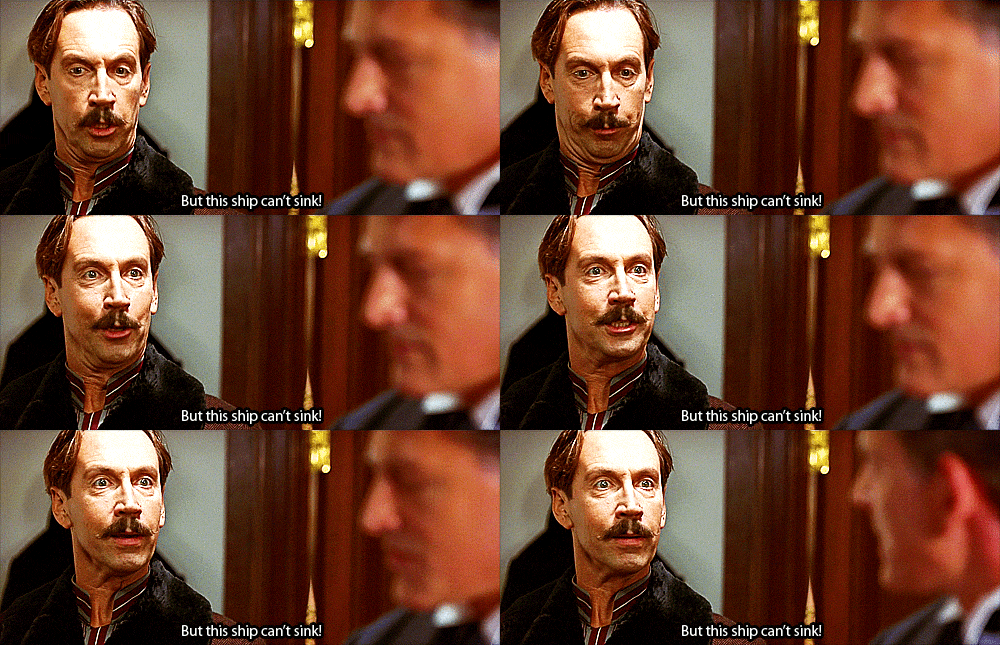
To the growing list of articles grappling with the issue of whether Canada is broken — and how it’s broken, if it is — we can add this one, by the Globe and Mail‘s Tony Keller. I can say with all sincerity that Keller’s is one of the better, more thoughtful examples in this expanding ouevre. Keller takes the issue seriously, which is more than can be said of some Canadian thought leaders, whose response to the question is often akin to the Bruce Ismay character from Titanic after being told the ship is doomed.
(Spoiler: it sank.)
But back to the Globe article. Specifically, Keller writes about how once upon a time, just over a century ago, Canada and Argentina seemed to be on about the same trajectory toward prosperity and stability. If anything, Argentina may have had the edge. Those with much grasp of 20th-century history will recall that that isn’t exactly how things panned out. I hope readers will indulge me a long quote from Keller’s piece, which summarizes the key points:
By the last third of the 20th century, [Argentina] had performed a rare feat: it had gone backward, from one of the most developed countries to what the International Monetary Fund now classifies as a developing country. Argentina’s economic output is today far below Canada’s, and consequently the average Argentinian’s income is far below that of the average Canadian.
Argentina was not flattened by a meteor or depopulated by a plague. It was not ground into rubble by warring armies. What happened to Argentina were bad choices, bad policies and bad government.
It made no difference that these were often politically popular. If anything, it made things worse since the bad decisions – from protectionism to resources wasted on misguided industrial policies to meddling in markets to control prices – were all the more difficult to unwind. Over time the mistakes added up, or rather subtracted down. It was like compound interest in reverse.
And this, Keller warns, might be Canada’s future. As for the claim made by Pierre Poilievre that “Canada is broken”, Keller says this: “It’s not quite right, but it isn’t entirely wrong.”
I disagree with Keller on that, but I suspect that’s because we define “broken” differently. We at The Line have tried to make this point before, and it’s worth repeating here: we think a lot of the pushback against the suggestion that Canada might be broken is because Canada is still prosperous, comfy, generally safe, and all the rest. Many, old enough to live in paid-off homes that are suddenly worth a fortune, may be enjoying the best years of their lives, at least financially speaking. Suggesting that this is “broken” sometimes seems absurd.
But it’s not: it’s possible we are broken but enjoying a lag period, spared from feeling the full effects of the breakdown by our accumulated wealth and social capital. The engines have stopped, so to speak, but we still have enough momentum to keep sailing for a bit. Put more bluntly, “broken” isn’t a synonym for “destroyed”. A country can still be prosperous and stable and also be broken — especially if it was prosperous and stable for long enough before it broke. The question then becomes how long the prosperity and stability will last. Canada is probably rich enough to get away with being broken for a good long while. What’s already in the pantry will keep us fed and happy for years to come.
But not indefinitely.
March 27, 2023
The vicious – not virtuous – circle of green
Elizabeth Nickson thinks that our societal pursuit of green technology will be the undoing of everything we have built:
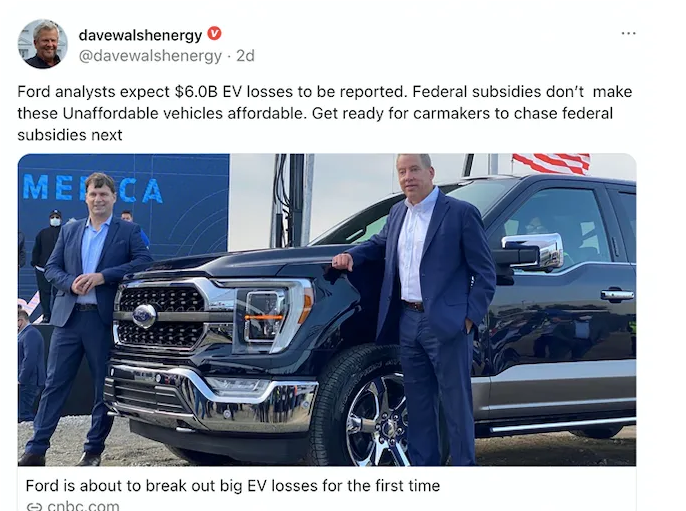
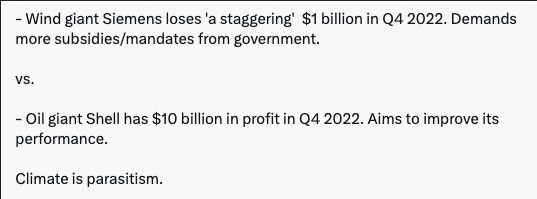
Some of us have been saying this for a very long time: green will bring down the world. Green creates a vicious circle, a term you may remember from Economics 101. It is when the serpent eats itself, no wealth is created and collapse results. That is what we are doing with ESG, with carbon taxes, with the forced adoption of unreliable vertiginously expensive green energy. It has skewed every single market. No one is investing in sound enterprise, and anything once sound is a Jenga tower, unstable, rotting from within. This. This is what threatens to bring down the world.
Green is built on subsidies. And not just government subsidy. Every mutual fund, every hedge fund, every multinational and every local or national corporation has a green monster within preventing innovative investments, sucking profits and growth. Every local, regional and state government leaks millions to green morons promising to “bring sustainable prosperity”. The only prosperity is theirs. They fiddle around in lakes and watercourses, producing “studies”, all of which are hysterical and exaggerated. They muck around in forests, buying as much as possible, shut them down, never visit again, leaving them to desertify. They buy farms and ranches, leaving them to rot. They are termites, eating us alive.
These outfits have burrowed into every level of government and every ministry. They are purely extractive. They do not produce anything of value. They leech. They move in and out of government. When in government, they identify sources of funds to plunder once out of government. In 2015, I did a cross-ministry analysis of just how much money these folks take from the government annually. It is in the hundreds of billions in the US alone. From private foundations they take more billions. All this money is used to shut down economic activity.
[…]
Here is the nasty little secret that lies at the heart of environmentalism. It has been long captured by plutocrats and WEFers, who use it to take resources once thought to belong to the people, to everyone, to use in order to innovate and develop. This freedom and access, and only this was the source of prosperity in the United States. It powered the entire world. It made America the beacon, the lighthouse of the world. It produced strong healthy brilliant young people who performed one feat of innovation, athleticism, and creation after another. All those kids today are working on ever more vicious ways to surveil, control and supress via AI.
And the interior is being cleared of people, businesses, farms, ranches, working forests, mines, and oil and gas installations.
In pursuit of 2030 goals, Biden’s agents are busily acquiring hundreds of millions of acres from private owners, from state and regional land banks, which they will then lock down. Many ranchers, including the heroic Wayne Hage, believe that government is taking that land to use as collateral for its massive debt to the Bank for International Settlements. The only people who will be able to use those resources are multinationals who pay a fee to government and to the BIS to pay down the loans. No citizens will be able to access those resources to make money for themselves, to build families and businesses and towns and cities. The environmental movement has, within 40 years, returned us to serfdom, where we eat what we are told to eat, go where we are told to go, take whatever medicine they want to give us, and eventually, fight when we are told to fight.
The environmental movement is so evil, it has twisted ethical standards to the point where we are able to kill each other with impunity. Their PR is so strong, so invasive, that every school child now believes there are too many people (this is nonsense), and population must be drastically drawn down (a genocide unrivalled in history). Every adult secretly fears this is true. This appalling lie has created a culture of death. What are the effects of this thinking, that life is no longer sacred, but a threat?
March 25, 2023
South Africa – from bad to indescribably worse
John Psmith reviews South Africa’s Brave New World: The Beloved Country Since The End Of Apartheid by R.W. Johnson. It isn’t a pretty picture at all:

The whole world had come to Pretoria to see the inauguration of Nelson Mandela as the first democratically elected South African President. It was the greatest assemblage of heads of state since John F. Kennedy’s funeral … But it was the flight of nine SAAF [South African Air Force] Mirages overhead, dipping their wings in salute, which brought tears to many eyes. It said so many things: the acceptance of, indeed, the deference to, Mandela by the white establishment, the acknowledgement that he was fully President, able to command all the levers of power — and, for many black people in the crowd, it meant that for the first time the Mirages’ awesome power and white pilots were on their side, part of the same nation … All the products of that white power, including South Africa’s sophisticated economy and infrastructure, were being handed over intact.
A little over a decade later and that same South African Air Force was no longer able to fly. It wasn’t for lack of planes: new ones were procured from European arms manufacturers in an astonishingly expensive and legendarily corrupt deal. But once purchased the planes rotted from lack of maintenance and languished in hangers for lack of anybody able to fly them. Most of the qualified pilots and technicians had been purged, and most of the remainder had resigned. The air force did technically still have pilots, after all it would be a bit embarrassing not to, but those pilots were chosen for patronage reasons and didn’t technically have any idea how to fly a fighter jet.
It isn’t just the air force. That whole “sophisticated economy and infrastructure” that got “handed over intact” now by and large no longer exists. Consider something as basic as running water: in 1994, South Africa had some of the most sophisticated water infrastructure on earth, with a whole system of dams, reservoirs, and long-distance inter-basin conduits working together to conquer the geographical challenges of having several major cities and mining centers located on an arid plateau. All of this water was safe, drinkable, and actually came out of the tap when you turned the handle. This picture was marred of course by poor delivery to black rural communities and squatter camps, but in the early 90s the government was making rapid progress towards serving more of those people too.
Like the air force, that water system is now basically non-functional. It’s estimated that something like 10 million people no longer have reliable access to running water. When the water does run, it’s frequently filthy and contaminated with human sewage. South Africa had its first urban cholera outbreak in the year 2000, and they are now a regular occurrence. Again, like the air force, this isn’t for lack of money or effort. The state has spent billions on trying to fix the water problems, and the government’s water bureaucracy has tripled in size since 1994. Something else has gone wrong.
Neither of these examples is cherry-picked. Ask about literally any of the necessities for human life, and the picture is the same: basically first-world quality under the apartheid Nationalist government, and basically post-apocalyptic today. The electric grid is failing, with rolling blackouts consuming the country on a daily basis. The rail network, once one of the finest on earth, is now so degraded that mines in the North of the country prefer to truck their products overland to ports in Mozambique rather than risk the rail journey to Durban. The medical system was once the jewel of Africa and now teeters on the brink of collapse, with qualified doctors and nurses fleeing the country in droves. As for education, one South African author notes: “When Anthony Sampson’s authorized biography of Mandela appeared one of its more embarrassing asides was that all the educational institutions which had nourished Mandela had since collapsed. A Mandela could be produced in colonial times, but no longer.”
Had enough yet? At last count between a third and a half of the population is unemployed. Public order is non-existent outside gated communities and tourist areas patrolled by private security. The murder rate in South Africa exceeds that of many active war zones. Every major city in South Africa is among the most dangerous cities on earth, and the countryside is much worse than the cities. The reported cases of rape alone establish South Africa as the worst country on earth for rape, and the vast majority of cases are likely unreported, since the police have essentially stopped prosecuting this crime.
Something has gone very wrong. What happened? That’s the subject of this book by R.W. Johnson, an ultra-detailed examination of the 10 or so years following the end of apartheid in 1994. Johnson is the right guy to write this book — he’s lived in South Africa since the 1960s, and was active in the movement against apartheid from its earliest days, so he personally knows most of the players who’ve been running the country. And now he has the bittersweet task of writing a book documenting how what happened is “just what white racists predicted and what white radicals like myself scorned”.
March 23, 2023
QotD: “Slave societies” and “societies with slaves”
So, taking the Antebellum South in particular: Could its economy have survived without slavery? Sure. You don’t have to be a historian to see it, either. Some quick back-of-the-envelope math will suffice. An “agricultural laborer” — surely we agree slaves were that? — in 1860 made, on average, 97 cents a day. Round that up to a dollar, multiply by six days a week, and you get $6 a week. Multiply that by 50 (let’s give everyone two weeks’ vacation) and you get $300 per year. A “prime field hand” in 1860 cost $1600, purchase price. Plus all his “maintenance and upkeep,” year-round, for life. It’s grossly inefficient, what with agriculture being a largely seasonal occupation and all. And that’s before you factor in the mechanization trend that was already well underway at the time of the Civil War.***
Could the South have survived culturally without slavery? Of course not. That’s the whole point of Berlin’s distinction. Neither could any other slave society. The Roman Empire, all of it, is inconceivable without slavery. Here’s the proof: There were lots of freedmen in the Roman Empire. The first thing they did, pretty much without exception, is buy as many slaves as they could afford. Even Athens, the “birthplace of democracy”, depended on slave labor.
* Just to placate any field specialists who want to argue that medieval villeinage wasn’t merely slavery by another name.
** With the (admittedly large) exception of Great Britain, which in true British Imperial style managed to profit hugely from slavery without consciously admitting it. See, for example, Eric Williams’ Capitalism and Slavery, which manages the neat trick of being a Marxist polemic that is (mostly) factually accurate and (largely) argued in good faith. Published in 1944, natch, by a scholar way out on Western Civ’s fringes, but such a thing was possible even for White folks back then — see e.g. the work of Christopher Hill). They’re the other “society with slaves”, and since we’re talking about their spiritual descendants in places like Boston and Providence it’s a distinction without a difference.
*** The fact that Antebellum Northerners thought they couldn’t economically compete with slave labor has nothing to do with the economic reality of slave labor. “Free Soil, Free Labor, Free Men” is a nice piece of campaign rhetoric (it was the Republican Party slogan in their first election, 1856), but that’s all it is. And again, you don’t have to be a professional historian to see it. France’s economy was ok after the loss of Saint-Domingue (at one time the most valuable piece of real estate in the world). Great Britain did pretty good, economically, after freeing their slaves in places like Bermuda, Barbados, and Jamaica (again, some of the most valuable real estate in the world in the 18th century).
Severian, “On Slavery”, Rotten Chestnuts, 2020-06-18.
March 5, 2023
QotD: The role of the “big” landowners in pre-modern farming societies
Of course this begins with land. The thing to keep in mind is that prior to the modern period […] the vast majority of economic activity was the production of the land. That meant that land was both the primary form of holding wealth but also the main income-producing asset. Consequently, larger land holdings are the assets that enable the accumulation of all of the other kinds of capital we’re discussing. By having more land – typically much more land – than is required to feed a single household, these larger farmers can […] produce for markets and trade, enabling them to afford to acquire labor, animals, equipment and so on. Our subsistence farmers of the last post, focused on producing for survival, would be hard-pressed to acquire much further in the way of substantial capital.
The next most important category is generally animals, particularly a plow team […] while our small subsistence farmers may keep chickens or pigs on some small part of the pasture they have access to, they probably do not have a complete plow-team for their own farm […]. Oxen and horses are hideously expensive, both to acquire but also to feed and for a family barely surviving one year to the next, they simply cannot afford them. They also do not have herds of animals (because their small farms absolutely cannot support acres of pasturage) and they probably have limited access to herdsmen generally (that is, transhumant pastoralists moving around the countryside) because those fellows will tend to want to interact with the community leaders who are, as noted above, the large landholders. All of which is to say that while the small farmers may keep a few animals, they do not have access to significantly large numbers of animals (or humans), which matters.
The first impact of having a plow-team is fairly obvious: a plow drawn by a couple of oxen is more effective than a plow pushed by a single human. That means that a plow-team lets the same amount of farming labor sow a larger area of land […]. It also allows for a larger, deeper plow, which in turn plows at a greater depth, which can improve yields […]. You can easily see why, for a landholder with a large farm, having a plow-team is so useful: whereas the subsistence farmer struggles by having too much labor (and too many mouths to feed) and too little land, the big landholder has a lot of land they are trying to get farmed with as little labor as possible. And of course, more to the point, the large landholder has the wealth and acreage necessary to buy and then pasture the animals in the plow-team.
The second major impact is manure. Remember that our farmers live before the time of artificial fertilizer. Crops, especially bulk cereal crops, wear out the nutrients in the soil quite rapidly after repeated harvests, which leaves the farmer two options. The first, standard option, is that the farmer can fallow the field (which also has the advantage of disrupting certain pest life-cycles); depending on the farming method, fallowing may mean planting specific plants to renew the soil’s nutrients when those plants are uprooted and left to return to the soil in the field or it may mean simply turning the field over to wild plants with a similar effect. The second option is using fertilizer, which in this case means manure. Quite a lot of it. Aggressive manuring, particularly on rich soils which have good access to moisture (because cropping also dries out the soil; fallowing can restore that moisture) allows the field to be fallowed less frequently and thus farmed more intensively. In some cases it allowed rich farmland to be continuously cropped, with fairly dramatic increases in returns-to-acreage as a result. And by increasing the nutrients in the soil, it also produces higher yields in a given season.
Now the humans in a farming household aren’t going to generate enough manure on their own to make a meaningful contribution to soil fertility. But the larger landholders generally have two advantages in this sense. First, because their landholdings are large, they can afford to turn over marginal farming ground to pasture for horses, cattle, sheep and so on; these animals not only generate animal products (or prestige, in the case of horses), they also eat the grass and generate manure which can be used on the main farm. The second way to get manure is cities; unlike farming households, cities do produce sufficient quantities of human waste for manuring fields. And where small subsistence farmers are unlikely to be able to buy that supply, large landholders are likely to be politically well-connected enough and wealthy enough to arrange for human waste to be used on their lands, especially for market oriented farms close to cities. And if you just stopped and said, “wait – these guys were paying for human waste?” … yes, yes they sometimes did (and not just for farming! Check out how saltpeter was made, or what a fuller did!).
Finally, there’s the question of infrastructure: tools, machines and storage. The large landholder is the one likely to be able to afford to build things like granaries, mills and so on. Now there is, I want to note, a lot of variation from place to place about exactly how this sort of infrastructure is handled. It might be privately owned, it might be owned by the village, but frequently, the “village mill” was actually owned by the large landholder whose big manor overlooked the village (who may also be the local political authority). And while we’re looking at grain, other agricultural products which don’t store as well or as easily might need to be aggregated for transport to market and sale, a process where the large landholder’s storage facilities, political standing and market contacts are likely to make him the ideal middleman. I don’t want to get too in the weeds (pardon the pun) on all the different kinds of infrastructure (mills for grains, presses for olives, casks for wine) except to note that in many cases the large landholder is the one likely to be able to afford these investments and that smaller farmers growing the same crops nearby might well want to use them.
Bret Devereaux, “Collections: Bread, How Did They Make It? Part II: Big Farms”, A Collection of Unmitigated Pedantry, 2020-07-31.
March 4, 2023
Nigel Biggar’s Colonialism: A Moral Reckoning
In The Critic, Robert Lyman reviews a recent book offering a rather more nuanced view of the British empire:

The book is a careful analysis of empire from an ethical perspective, examining a set of moral questions. This includes whether the British Empire was driven by lust or greed; whether it was racist and condoned, supported or encouraged slavery; whether it was based on the conquest of land; whether it entailed genocide and or economic exploitation; whether its lack of democracy made it illegitimate; and whether it was intrinsically or systemically violent.
Biggar’s proposition is simple: that we look at Britain’s history without assuming the zero-sum position that imperialism and colonialism were inherently bad, that motives and agency need to be considered and that good did flow from bad, as well as bad from good.
Whether he succeeds depends on the reader’s willingness to appreciate these moral or ethical propositions, and to re-evaluate accordingly. In my view, he has mounted a coolly dispassionate defence of his proposition, challenging the hysteria of those who suggest that the British Empire was the apotheosis of evil. Biggar’s calm dissection of these inflated claims allows us to see that they say much more about the motivations, assumptions and political ideologies of those who hold these views than they do about what history presents to us as the realities of a morally imperfect past.
He reminds us that British imperialism had no single wellspring. Most of us can easily dismiss the notion that it was a product of an aggressive, buccaneering state keen to enrich itself at the expense of peoples less able to defend themselves. Equally, it is untrue that economic motives drove all imperialist or colonial endeavour, or that economics (business, trade and commerce) was the primary force sustaining the colonial regimes that followed.
As Biggar asserts, both imperialism and colonialism were driven from different motivations at different times. Each ran different journeys, with different outcomes depending on circumstances. The assertion that there is a single defining imperative for each instance of imperial initiative or colonial endeavour simply does not accord with the facts.
Whilst other issues played a part, it was social, religious and political motives which drove the colonial endeavour in the New World from the 1620s: security and religion drove the subjugation of Catholic (and therefore Royalist) Ireland in the 1650s; social and administrative factors led to the settlement in Australia from 1788; and social and religious imperatives drove the colonisation of New Zealand in the 1840s.
In circumstances where trade and the security of trade was the primary motive for imperialism — think of Clive in the 1750s, for example — a wide variety of outcomes ensued. Some occurred as a natural consequence of imperialism. In India, Clive’s defeat of the Nawab Siraj-ud-Daulah in 1757 was in support of a palace coup that put Siraj’s uncle Mir Jafar on the throne of Bengal, thus allowing the East India Company the favoured trading status that Siraj had previously rejected.
This led in time to the Company taking over the administrative functions of the Bengal state (zamindars collected both rents for themselves and taxes for the government). Seeking to protect its new prerogatives, it provided security from both internal (civil disorder and lawlessness) and external threats (the Mahratta raiders, for example). The incremental, almost accidental, accrual of power that began in the early 1600s stepped into colonial administration 150 years later, leading to the transfer of power across a swathe of the sub-continent to the British Crown in 1858.
Biggar’s argument is that, running in parallel with this expansion came a host of other consequences, not all of which can be judged “bad”. We may not like what prompted the colonial enterprise at the outset (not all of which was morally contentious, such as the need to trade), but we cannot deny that good things, as well as bad, followed thereafter.
QotD: Profit margins in the restaurant trade
The table that orders a starter, main and a bottle of wine – that just about breaks even for the restaurant. You can mix and match this a bit. Dessert instead of the starter, that sorta thing. But the costs of the building, the staff, the electricity, the stock that goes off, the cost of capital itself, all those things, mean that the basic restaurant experience just about covers its costs.
It’s the having the one thing extra that makes the money, the profit. A drink before the meal, having both a starter and a dessert to add to the main. The second bottle of wine, or the digestif with the coffee. This is why the waiter is so eager for you to have any one or more of these “extras”. The margin over food costs – food costs usually being around 30% of menu price – on those additions is exactly what provides a profit to the business that is the restaurant.
As to why, well, it’s the same reason that the menu prices of some well known item are going to be roughly the same across restaurants. Competition is fierce in the business. That means headline prices are pushed down to where they only just, if even that, cover costs. On exactly the same basis as Ryanair charging you spit for the seat and then a fortune for the air you breathe onboard. You get the punter in with the £20 for two steak dinners then hope like Hell they order the vanilla soup and also the vegetable ice cream in order to make your nut.
Tim Worstall, “Bar Owner Complains Of People Drinking Tap Water – Oi! Where’s My Profits?”, Continental Telegraph, 2019-05-27.
February 28, 2023
QotD: Politicians respond to different economic incentives than the rest of us
The temptation is to delay the tough times until your successor can carry the can.
Poor old Keynes inadvertently gave politicians the answer they were looking for – the idea that during the downturn, the government should spend money into the economy to keep it going along nicely. Making sure that those lifeguards sacked from the Skegness lido can swiftly get jobs working at a government Skegness lido prevents them claiming the dole, and keeps them in the economy earning and spending until the economy washes out all the malinvestment and starts growing again. At which point the government Skegness lido closes and the lifeguards go to work at a lido somewhere where the biting Easterly wind doesn’t sandblast your skin off. The government has bridged the gap.
There’s one problem.
The government has no money of its own, so where will it get the money for their lido?
Well, Keynes said it should run a surplus during the good times and stash that surplus money away so it can be used during the downturn – a national rainy-day fund, if you will.
But guess what? Politicians don’t run surpluses.
Why would they? Every penny spent making lives better for voters today makes it more likely they will vote for you. And every penny saved against a rainy day makes it possible for your rivals to win votes tomorrow, by doing the same once they are in power.
So politicians don’t ever HAVE a rainy day fund. But that doesn’t stop them wanting to bridge the gap.
So they borrow the money.
And now what they are doing is not Keynesian, or even neo-Keynesian, but pseudo-Keynesian
By bridging the current gap with borrowed money, they simply make sure that the next gap will be costlier to bridge. Because the interest on the borrowing means that the gap will be wider.
But that’s not even the biggest problem – the biggest problem is that the gap is intrinsically important. We NEED it, to give us pause.
Whereas bridging it enables us to carry on being silly and prevents the misallocations from being flushed out – a lido remains operating in Skegness despite having no customers, and the lifeguards continue to work. Their lifesaving skills (which should be fruitfully employed elsewhere) stagnate at a lido with no punters. Their customer service skills deteriorate as the customers disappear, and what they learn instead is how to sit in a chair and stare into space. Their skills are degrading. Hysteresis, technically.
And so by delaying the collapse of the Skegness lido in pursuit of benign conditions for the voters, the government destroys the skills of our workforce.
Sowell was right – the problems we battle today were caused by the government’s interventions yesterday.
Surely using government to solve our problems is like a man quenching his thirst with seawater?
Alex Noble, “Drinking Brine”, Continental Telegraph, 2019-06-14.
February 25, 2023
QotD: Feudalism versus “Manorialism”
Bret Devereaux, “Collections: Bread, How Did They Make It? Part IV: Markets, Merchants and the Tax Man”, A Collection of Unmitigated Pedantry, 2020-08-21.
February 21, 2023
“… sub-replacement fertility is probably an inevitable product of female emancipation”
In Ed West’s weekly round-up, he ends the post on this rather grim (from a demographic viewpoint) note:

In The Guardian, Martha Gill on the great vexation of modern life: people can’t have as many children as they’d like.
OK: so it’s about social structures, then? Lack of childcare, unequal parental leave and career penalties for mothers. Not so – or not primarily. In our fecund recent past, remember, career penalties for mothers were even higher. Mothers still suffer a career penalty almost everywhere, but attempting to remove it doesn’t seem to alter their decisions that much. Since 2008, amid unequalled progress in gender equality and some of the most generous parental support schemes on the planet, birthrates in Sweden, Norway and Iceland have fallen precipitously. Nordic countries are, comparatively, parental utopias, yet birthrates tick along slightly above the EU average and still well below the replacement rate.
I agree with her basic premise. Aside from Georgia, no country has successful brought fertility rates above replacement rates, whatever the childcare incentives, because sub-replacement fertility is probably an inevitable product of female emancipation. In particular the issue is that women don’t tend to marry men with lower education and income levels, so the modern system ensures that a large minority of men are simply unmarriagable.
I’m not convinced by Gill’s solution, since outcomes for the children of single parents are way worse on average, and even with huge state support it’s going to be incredibly hard to raise children alone. Even without grandparental support it’s hard with two parents. I also think this problem is inevitably helping the drive towards poly-acceptance. As Rob Henderson wrote earlier this month:
In a deregulated market, power laws dominate. This is true not only in the economic realm, but in the romantic realm as well. At no point in history have all men in a given society been equally desirable. Today, though, the disparity between men is particularly pronounced. And the gap shows no sign of slowing or closing. The polyamorous movement may be a reaction to shifts in sex ratios among attractive individuals. Many individuals who do not identify as poly are likely practicing some version of it, knowingly or otherwise, as the case of West Elm Caleb demonstrated. The majority desirable young males using dating apps almost certainly have at least three women in their rotation, if not more.
As with so many things, post-Christian society is reverting to pre-Christian norms, in this case the norm where a large proportion of men were thrown onto the romantic scrapheap.
February 20, 2023
Thirteen reasons the Dutch did better financially than the English in the Seventeenth Century
In the latest Age of Invention newsletter, Anton Howes investigates the huge differences between the rival English and Dutch financial markets in the 17th century:
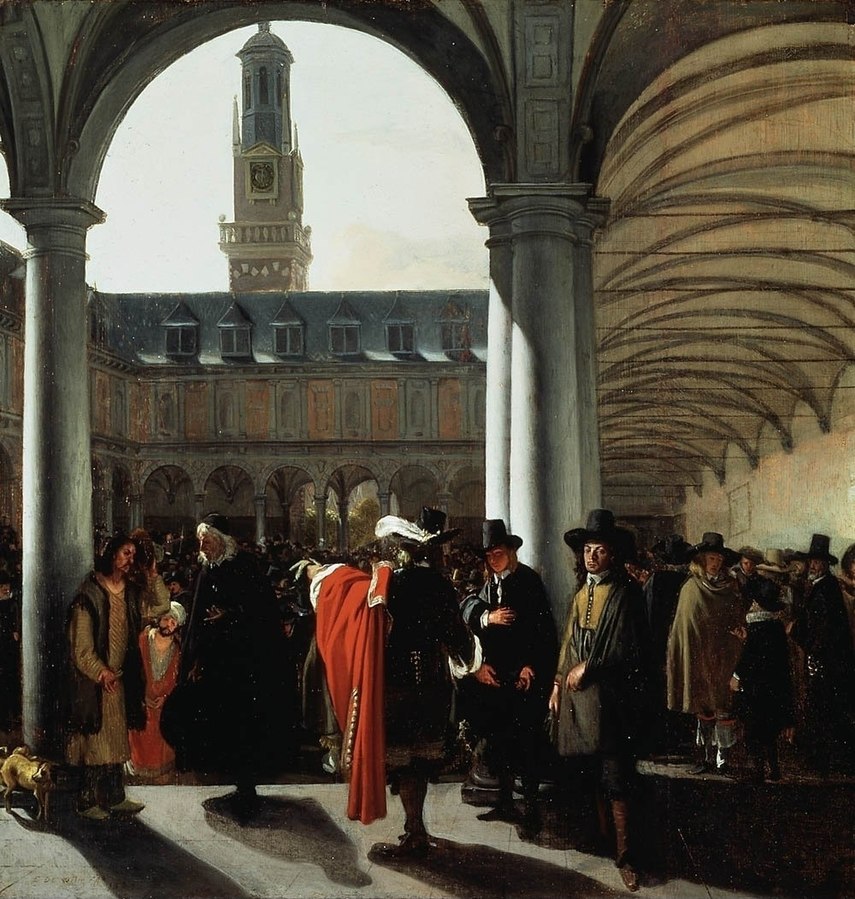
The courtyard of the exchange in Amsterdam (De binnenplaats van de beurs te Amsterdam), 1653.
Oil painting by Emanuel de Witte (1617-1692) from the Museum Boijmans Van Beuningen collection via Wikimedia Commons.
One of the weird things about Britain, despite its being the birthplace of the Industrial Revolution, is that its financial infrastructure was for a long time remarkably backward. Its “Financial Revolution”, by which both people and the state began to borrow at ever lower interest rates, only really took off in the early eighteenth century — long after London’s extraordinary growth in 1550-1650, when it had suddenly expanded eightfold to become one of Europe’s most important commercial hubs. Indeed, even for much of the late seventeenth century, England lacked many of the most basic financial institutions that had been used for decades and decades by their most important rival and trading partner, the Dutch Republic.
I was especially intrigued when I stumbled across a discussion of Dutch policies and customs, written up in around 1665 by the young merchant Josiah Child, and published a few years later: a kind of wishlist of many of the things that made the Dutch so wealthy, and which the English continually failed to emulate:
- The Dutch councils of state and war always included merchants who had experience of trading and living abroad — Child was perhaps just angling for some influence here, but for all that merchants were getting more influential, in England they were not actually in charge.
- Gavel-kind succession laws, whereby all children got an equal share of their parents’ estates, rather than it all going to the eldest. English primogeniture, by contrast, apparently left a lot of gentlemen’s younger sons having to become apprenticed to merchants.
- High regulatory standards for goods. A barrel of Dutch-packed herring or cod would apparently be accepted by buyers just by viewing the marks, without having to open them up to check. English-packed goods, by contrast, were rarely trusted because the fish would turn out to be rotten or even missing — the English regulators’ stamps of approval were reputedly given to anyone who would pay.
- Encouragement for inventors of new products, techniques, and import trades, who received rewards from the state, and not just temporary monopoly patents.
- Ships, called fluyt, which were cheaper to build, required fewer sailors, and were easier to handle. Despite being only very lightly armed, they sailed in fleets for protection, when necessary being convoyed by ships of war. English trading ships, by contrast, were each heavily armed, but with those cannon taking up room and weight that could have been used for carrying merchandise.
- Education of all children, even girls, in arithmetic and keeping accounts. As Child put it, this infused in the Dutch “a strong aptitude, love, and delight” for commerce. It also meant that husbands and wives were real partners in many businesses — something that impressed almost all foreign visitors to the Netherlands.
- Low customs duties, but high consumption taxes. Very low customs duties, on both imports and exports, meant that it was often very profitable to trade with the Netherlands. The Dutch were famed for their many ships, and for their granaries bursting with grain, despite growing hardly any trees or crops themselves. To fund their state, they instead overwhelmingly relied on the gemene middelen — taxes on the sale of wine, beer, meat, fuel, candles, salt, soap, flour, cloth, and a host of other goods, with many of the higher rates reserved for expensive luxuries. Much like modern value-added taxes, these taxes on consumption raised revenue while preserving the all-important incentive to save and invest.
- Thrifty living — which, come to think of it, was probably related to the high consumption taxes, although Childs doesn’t seem to have noticed the connection. Dutch thrift was thought by the English to be especially useful because it allowed wage costs to be kept low — essential for maintaining competitiveness in international markets — while preventing the country having a trade deficit. The English always worried they were sending too much of their silver abroad to pay for French wines and other luxuries, but the Dutch appeared to have prevented this without resorting to import tariffs that might annoy trading partners and prompt retaliation.
- Religious toleration, which attracted all sorts of industrious immigrants to bring their families and wealth. (Incidentally, as I’ve mentioned before, this was also one of the key attractions of Livorno, set up by the Medici Dukes of Tuscany to be a major trading hub.)
- The use of the Law-Merchant, which meant that all controversies between merchants and tradesmen were decided in just 3 or 4 days’ time. England, rather strangely for such an increasingly commercial nation, did not develop merchant courts with a specific jurisdiction or a distinct body of merchant law — disputes instead had to be resolved in the royal common-law or equity courts, in the Admiralty court, or else abroad. The English courts, however, were often slow. Child complained that cases often took half a year, and often much longer. (Incidentally, slow and rotten justice in the Court of Chancery, the key equity court used by merchants in England, was one of the reasons Francis Bacon was impeached by Parliament and sacked as Lord Chancellor.)
- Transferrable bills of exchange — in other words, the circulation of credit notes as a currency. These were not properly supported by English laws, but allowed Dutch merchants to trade a lot more frequently. English merchants often had to wait some six months to a year before receiving all the coin from selling their foreign goods in London, so as to purchase goods again to make fresh trades. They spent much of their time chasing shopkeepers for payment. But the Dutch, by being able to easily buy and sell their credit notes, could “turn their stocks twice or thrice in trade”, immediately settling their accounts and making fresh purchases. (I intend to look into this in a lot more detail soon, as finding a way to bills of exchange transferrable in England appears to have been a major project for many of the mid-seventeenth-century inventors and improvers — after just a cursory glance, transferability was only secured in law as late as 1704.)
- Banks. Or rather, as Child actually put it, “BANKS”. In England many of the functions of banks gradually evolved from the practices of individual goldsmiths and the scriveners — legal clerks who specialised in property transfers and mortgages. There was certainly nothing so secure as the municipal Wisselbank of Amsterdam, established in 1609, which had various monopoly powers as a clearing-house for bills of exchange and was backed by a vault full of bullion. Nor the municipal Bank van Lening, established in 1614, which was a pawnbroker modelled on the Italian Monte di Pietà, or mounts of piety, designed to make small and low-cost loans to the poor.
- “PUBLIC REGISTERS” — again capitalised by Child — of all lands and houses sold or mortgaged. This item on the policy wishlist would not be ticked off for England until two centuries later, but the key advantage was to prevent lawsuits over land titles — still cited as a major problem even in the 1690s — and so make land more genuinely secure for mortgages.
Finally, the result of many of these policies was the Dutch had significantly lower interest rates — often just 3-4% when the English were still lending and borrowing at 6-8%. Indeed, this list was made because of a long-standing English policy debate I’ve been researching, on whether to lower the legal maximum rate of interest.
February 15, 2023
Refuting The End of History and the Last Man
Freddie deBoer responds to a recent commentary defending the thesis of Francis Fukuyama’s The End of History and the Last Man:

… Ned Resnikoff critiques a recent podcast by Hobbes and defends Francis Fukuyama’s concept of “the end of history”. In another case of strange bedfellows, the liberal Resnikoff echoes conservative Richard Hanania in his defense of Fukuyama — echoes not merely in the fact that he defends Fukuyama too, but in many of the specific terms and arguments of Hanania’s defense. And both make the same essential mistake, failing to understand the merciless advance of history and how it ceaselessly grinds up humanity’s feeble attempts at macrohistoric understanding. And, yes, to answer Resnikoff’s complaint, I’ve read the book, though it’s been a long time.
The big problem with The End of History and the Last Man is that history is long, and changes to the human condition are so extreme that the terms we come up with to define that condition are inevitably too contextual and limited to survive the passage of time. We’re forever foolishly deciding that our current condition is the way things will always be. For 300,000 years human beings existed as hunter-gatherers, a vastly longer period of time than we’ve had agriculture and civilization. Indeed, if aliens were to take stock of the basic truth of the human condition, they would likely define us as much by that hunter-gatherer past as our technological present; after all, that was our reality for far longer. Either way – those hunter-gatherers would have assumed that their system wasn’t going to change, couldn’t comprehend it changing, didn’t see it as a system at all, and for 3000 centuries, they would have been right. But things changed.
And for thousands of years, people living at the height of human civilization thought that there was no such thing as an economy without slavery; it’s not just that they had a moral defense of slavery, it’s that they literally could not conceive of the daily functioning of society without slavery. But things changed. For most humans for most of modern history, the idea of dynastic rule and hereditary aristocracy was so intrinsic and universal that few could imagine an alternative. But things changed. And for hundreds of years, people living under feudalism could not conceive of an economy that was not fundamentally based on the division between lord and serf, and in fact typically talked about that arrangement as being literally ordained by God. But things changed. For most of human history, almost no one questioned the inherent and unalterable second-class status of women. Civilization is maybe 12,000 years old; while there’s proto-feminist ideas to be found throughout history, the first wave of organized feminism is generally defined as only a couple hundred years old. It took so long because most saw the subordination of women as a reflection of inherent biological reality. But women lead countries now. You see, things change.
And what Fukuyama and Resnikoff and Hanania etc are telling you is that they’re so wise that they know that “but then things changed” can never happen again. Not at the level of the abstract social system. They have pierced the veil and see a real permanence where humans of the past only ever saw a false one. I find this … unlikely. Resnikoff writes “Maybe you think post-liberalism is coming; it just has yet to be born. I guess that’s possible.” Possible? The entire sweep of human experience tells us that change isn’t just possible, it’s inevitable; not just change at the level of details, but changes to the basic fabric of the system.
The fact of the matter is that, at some point in the future, human life will be so different from what it’s like now, terms like liberal democracy will have no meaning. In 200 years, human beings might be fitted with cybernetic implants in utero by robots and jacked into a virtual reality that we live in permanently, while artificial intelligence takes care of managing the material world. In that virtual reality we experience only a variety of pleasures that are produced through direct stimulation of the nervous system. There is no interaction with other human beings as traditionally conceived. What sense would the term “liberal democracy” even make under those conditions? There are scientifically-plausible futures that completely undermine our basic sense of what it means to operate as human beings. Is one of those worlds going to emerge? I don’t know! But then, Fukuyama doesn’t know either, and yet one of us is making claims of immense certainty about the future of humanity. And for the record, after the future that we can’t imagine comes an even more distant future we can’t conceive of.
People tend to say, but the future you describe is so fanciful, so far off. To which I say, first, human technological change over the last two hundred years dwarfs that of the previous two thousand, so maybe it’s not so far off, and second, this is what you invite when you discuss the teleological endpoint of human progress! You started the conversation! If you define your project as concerning the final evolution of human social systems, you necessarily include the far future and its immense possibilities. Resnikoff says, “the label ‘post-liberalism’ is something of an intellectual IOU” and offers similar complaints that no one’s yet defined what a post-liberal order would look like. But from the standpoint of history, this is a strange criticism. An 11th-century Andalusian shepherd had no conception of liberal democracy, and yet here we are in the 21st century, talking about liberal democracy as “the object of history”. How could his limited understanding of the future constrain the enormous breadth of human possibility? How could ours? To buy “the end of history”, you have to believe that we are now at a place where we can accurately predict the future where millennia of human thinkers could not. And it’s hard to see that as anything other than a kind of chauvinism, arrogance.
Fukuyama and “the end of history” are contingent products of a moment, blips in history, just like me. That’s all any of us gets to be, blips. The challenge is to have humility enough to recognize ourselves as blips. The alternative is acts of historical chauvinism like The End of History.
February 14, 2023
You need a tailor. And a cobbler.
At least, that’s Tom Knighton‘s take:
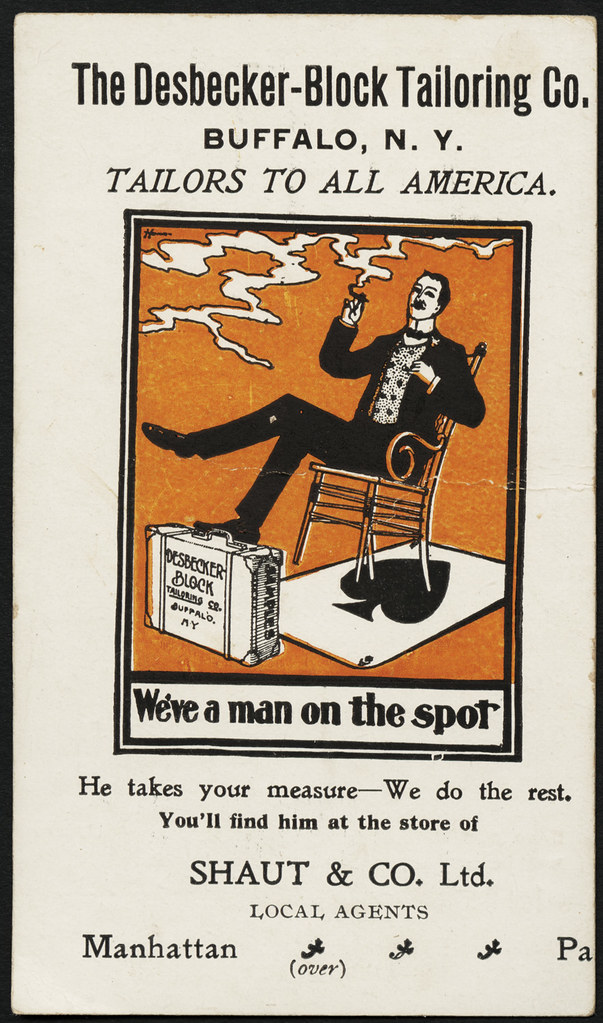
“The Desbecker-Block Tailoring Co. Buffalo, N. Y. Tailors to all America. We’ve a man on the spot. He takes your measure – we do the rest.” by Boston Public Library is licensed under CC BY 2.0 
 .
.
I’m now of the opinion that every man needs a tailor and a cobbler to go along with their barber.
Why? Because quality has a quantity all its own.
Yeah, I know that phrase usually goes the other way around, but we’re not talking about warfare where you need a lot of tanks and airplanes. We’re talking about clothes and accouterments. You can only wear one suit and one pair of shoes at a time. You’ve only got one head to wear a hat on. You don’t need 500 of each to have a well-rounded wardrobe.
So why do we? Why do we, as a society, insist on buying so much so cheaply?
What’s more, are you someone who supports those in the trades while simultaneously engaging in activity that threatens some of them?
Look, I get that not everyone can drop $500 for shoes or $5,000 for suits. I sure can’t, after all, so there’s no way I’d expect anyone else to. In fact, no one has to do any such thing.
However, what they can do is buy the best quality they can find, particularly in a grade that can be repaired and/or altered if needed.
We can start utilizing these tradesmen, hopefully needing them more often than our plumbers or auto mechanics. Not only will we dress better, but we’ll also show more young people there are other ways to go forward in life without spending tens of thousands of dollars to get a college degree that qualifies them for little more than to ask, “Do you want fries with that?”
I’m certainly in agreement with Tom on where the needle should rest on the quality-quantity meter, in that I’ve always preferred to buy higher quality whenever I could afford it rather than cheaper but lower quality items. It’s mostly paid off for me, although others in my family were of the other persuasion, where “more now” was better than “lasts longer”.
In a later post, he quotes Sam Vimes and again, I largely agree:
Despite that, I can buy quality. I may have to pay a bit more upfront, but it’s like the Vimes theory of boots written by Sir Terry Pratchett that’s been talked about here a couple of times:
The reason that the rich were so rich, Vimes reasoned, was because they managed to spend less money. Take boots, for example. He earned thirty-eight dollars a month plus allowances. A really good pair of leather boots cost fifty dollars. But an affordable pair of boots, which were sort of OK for a season or two and then leaked like hell when the cardboard gave out, cost about ten dollars. Those were the kind of boots Vimes always bought, and wore until the soles were so thin that he could tell where he was in Ankh-Morpork on a foggy night by the feel of the cobbles. But the thing was that good boots lasted for years and years. A man who could afford fifty dollars had a pair of boots that’d still be keeping his feet dry in ten years’ time, while a poor man who could only afford cheap boots would have spent a hundred dollars on boots in the same time and would still have wet feet. This was the Captain Samuel Vimes “Boots” theory of socioeconomic unfairness.
So, spend the money on the leather boots and skip having to spend it later.
As a result, though, that’s kind of luxurious.


