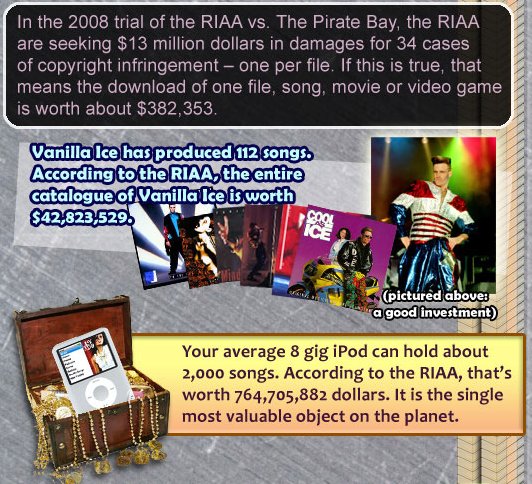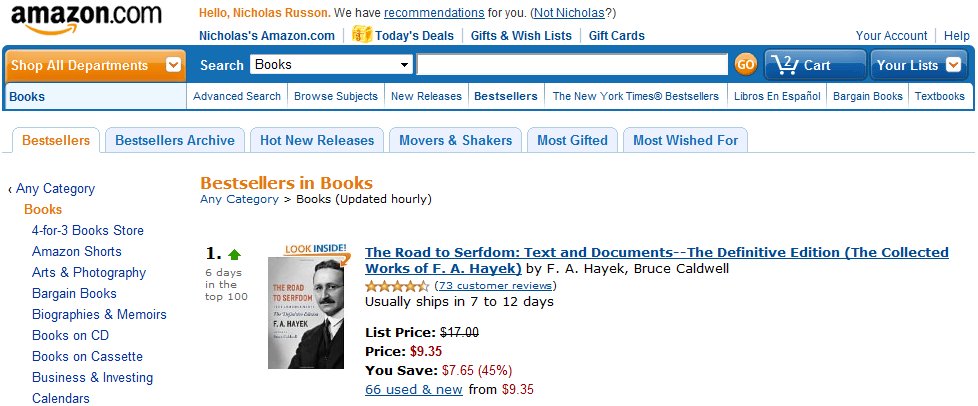
Admittedly, this is an updated and supplemented version of the original text, but it’s still impressive to see it selling so well.
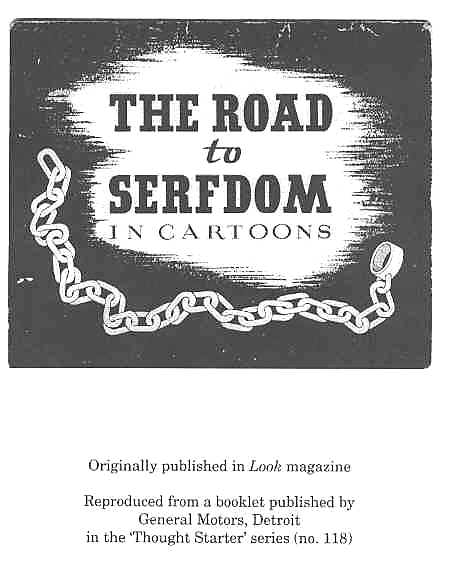
Update: American Digest has pages from the picture book version:

Admittedly, this is an updated and supplemented version of the original text, but it’s still impressive to see it selling so well.
Update: American Digest has pages from the picture book version:
Daniel Klein surveyed nearly 5,000 voting-age Americans on their basic comprehension of the political trade-offs on economic issues. He also asked them to identify themselves on the political spectrum. There were some interesting correlations:
Consider one of the economic propositions in the December 2008 poll: “Restrictions on housing development make housing less affordable.” People were asked if they: 1) strongly agree; 2) somewhat agree; 3) somewhat disagree; 4) strongly disagree; 5) are not sure.
Basic economics acknowledges that whatever redeeming features a restriction may have, it increases the cost of production and exchange, making goods and services less affordable. There may be exceptions to the general case, but they would be atypical.
Therefore, we counted as incorrect responses of “somewhat disagree” and “strongly disagree.” This treatment gives leeway for those who think the question is ambiguous or half right and half wrong. They would likely answer “not sure,” which we do not count as incorrect.
In this case, percentage of conservatives answering incorrectly was 22.3%, very conservatives 17.6% and libertarians 15.7%. But the percentage of progressive/very liberals answering incorrectly was 67.6% and liberals 60.1%. The pattern was not an anomaly.
[. . .]
The other questions were: 1) Mandatory licensing of professional services increases the prices of those services (unenlightened answer: disagree). 2) Overall, the standard of living is higher today than it was 30 years ago (unenlightened answer: disagree). 3) Rent control leads to housing shortages (unenlightened answer: disagree). 4) A company with the largest market share is a monopoly (unenlightened answer: agree). 5) Third World workers working for American companies overseas are being exploited (unenlightened answer: agree). 6) Free trade leads to unemployment (unenlightened answer: agree). 7) Minimum wage laws raise unemployment (unenlightened answer: disagree).
H/T to Ghost of a Flea.
The more I read of Maxime Bernier’s thoughts, the more I wonder how long it’ll be before he’s drummed out of Stephen Harper’s party: he’s far too sensible. Here, for example, he outlines what it is that central banks do to your money, and why it’s a bad deal for ordinary Canadians:
All this guessing about setting rates has nothing to do with capitalism and free markets; it has more to do with central planning and government control of the money supply. In a monetary free market, the interest rate would be determined by the demand for credit and the supply of savings, just like any other price in the economy.
Government control over money has serious consequences that few people seem to be aware of.
One of them is that central banks are continually increasing the quantity of money that is circulating in the economy. In Canada for example, if we use the strictest definition of money supply, it has increased by 6 to 14% annually during the past dozen years. The situation is about the same everywhere.
The effects of constantly creating new money out of thin air have been a debasement of our money and a dramatic increase in prices. The reason why overall prices go up is not because businesses are greedy, or because wages go up, or because the price of oil goes up. Ultimately, only the central bank is responsible for creating the conditions for prices to rise by printing more and more money.
With all this, it’s surprising that he has (so far) managed to stay in the Conservative party, which doesn’t appear to actually believe in anything much anymore . . . other than the need to stay in power.
Update, 9 June: His speech (from which the article linked above was drawn) gets positive reviews.
Or, in a demonstration of individual rationality, doesn’t follow the script where consumers sacrifice themselves and go even deeper in debt to spark further economic recovery:
While some pundits out there might have you believe that the US economic recovery remains solidly on track, Friday’s May jobs report threw a spanner into those notions, and the latest reading on consumer credit offers little evidence that the crucial consumer intends to share with Uncle Sam the burden of bolstering the economy.
The Federal Reserve’s report on April consumer credit today shows total credit outstanding rose a little less than $1 billion, following a revised $5.4 billion drop in March; March credit was originally reported up $2 billion.
Within the details, the item that jumps out most is the decrease in revolving credit, which fell at a 12% annual rate and declined for the 19th straight month. Revolving credit outstanding has fallen 14%, or roughly $138 billion, since autumn of 2008. Non-revolving is roughly flat since late ‘08.
It would help if the pundits would settle on one of the two diametrically opposed roles that consumers are “supposed to” assume. At an individual level, consumers are being lashed for their profligate spending and borrowing habits, and excoriated for their unprecedented levels of personal debt. This is bad, the pundits say (and I don’t disagree): individuals and families should not be taking on so much debt and efforts to reduce outstanding debt are praised. However, consumers as a group are expected to spend, spend, spend in order to help pull the retail sector back into healthy growth.
So if they do the right thing as individuals, they’re doing the wrong thing for the economy as a whole? Perhaps the emphasis on consumer-led recovery is mistaken, especially given the levels of debt that consumers have already taken on.
When companies make money, we assume they are well-managed. That perception is reinforced by the CEOs of those companies who are happy to tell you all the clever things they did to make it happen. The problem with relying on this source of information is that CEOs are highly skilled in a special form of lying called leadership. Leadership involves convincing employees and investors that the CEO has something called a vision, a type of optimistic hallucination that can come true only in an environment in which the CEO is massively overcompensated and the employees have learned to be less selfish.
Scott Adams, “Betting on the Bad Guys”, Wall Street Journal, 2010-06-07
IMAO_ (Frank J. Fleming): You can’t watch “It’s a Wonderful Life” these days without thinking how much sense Mr. Potter is making about irresponsible lending.
[S]timulus spending is the Pascal’s Wager of economics. Seventeenth century philosopher Blaise Pascal couldn’t prove God existed, but figured he might as well be devout since, if there is a God, he’s saved from damnation. If there wasn’t, well, no harm in trying. Politicians see stimulus spending the same way. They can’t prove it works, but if they sit on their hands during a downturn, they know they’ll be blamed for inaction should things turn worse. If and when the economy recovers, as it has here, the government’s happy to take credit. And if more misery comes? They can at least claim to have staved off larger calamity — which is how it’s gone in the U.S., where they’re now spending their third stimulus package in two years.
Politicians are only acting rationally. Last year, they were convinced they faced another Great Depression. [. . .]
Get used to this. Since the narrative that stimulus spending pulled us back from the abyss works for Ottawa, it virtually guarantees that, when dark economic clouds are again sighted from Parliament Hill, we’ll see this routine recur: Dire recession warnings from politicians, followed by stimulus as insurance to cover political hides from any economic blame. As long as future taxpayers get the bill, via future debt payments, it’s as risk-free a gambit as Pascal’s: The latest stimulus added tens of billions in national red ink with little political distress for the Tories.
Kevin Libin, “The Stimulus Bluff: There’s Mounting Evidence That Government Spending Has Had No Impact On The Economic Recovery. Too Bad Politicians Aren’t Listening”, National Post, 2010-06-01
Empires, indeed governments generally, tend to be good things at first and bad things the longer they last. First they improve society’s ability to flourish by providing central services and removing impediments to trade and specialisation; thus, even Genghis Khan’s Pax Mongolica lubricated Asia’s overland trade by exterminating brigands along the Silk Road, thus lowering the cost of oriental goods in European parlours. But then, as Peter Turchin argues following the lead of the medieval geographer Ibn Khaldun, governments gradually employ more and more ambitious elites who capture a greater and greater share of the society’s income by interfering more and more in people’s lives as they give themselves more and more rules to enforce, until they kill the goose that lays the golden eggs. There is a lesson for today. Economists are quick to speak of “market failure”, and rightly so, but a greater threat comes from “government failure”. Because it is a monopoly, government brings inefficiency and stagnation to most things it runs; government agencies pursue the inflation of their budgets rather than the service of the customers; pressure groups form an unholy alliance with agencies to extract more money from taxpayers for their members. Yet despite all this, most clever people still call for government to run more things and assume that if it did so, it would somehow be more perfect, more selfless, next time.
Matt Ridley, The Rational Optimist: How Prosperity Evolves, p. 182
. . . the plundering, the lack of invention, the barbarians and above all Diocletian’s red tape did for Rome in the end. As the empire disintegrated under this bureaucratic burden, at least in the west, money lending at interest stopped and coins ceased to circulate so freely. In the Dark Ages that followed, because free trade became impossible, cities shrank, markets atrophied, merchants disappeared, literacy declined and — crudely speaking — once Goth, Hun and Vandal plundering had run its course, everybody had to go back to being self-sufficient again. Europe de-urbanised. Even Rome and Constantinople fell to a fraction of their former populations. Trade with Egypt and India largely dried up, especially once the Arabs took control of Alexandria, so that not only did oriental imports such as papyrus, spices and silk cease to appear, but those export-oriented plantations in Campania became the plots of subsistence farmers instead. In that sense, the decline of the Roman Empire turned consumer traders back into subsistence peasants. The Dark Ages were a massive experiment in the back-to-the-land hippy lifestyle (without the trust fund): you ground your own corn, sheared your own sheep, cured your own leather and cut your own wood. Any pathetic surplus you generated was confiscated to support a monk, or maybe you could occasionally sell something to buy a metal tool off a part-time blacksmith. Otherwise, subsistence replaced specialization.
Matt Ridley, The Rational Optimist: How Prosperity Evolves, p. 175
Chris Selley rounds up the (almost unanimous) pundits’ opinions about the billion-dollar-boondoggle-summit-set:
Is it too late to cancel the G8 and G20 summits?
The National Post‘s Don Martin for the win: “No amount of righteous government bluster about living in post-9/11 protection paranoia, last week’s bank firebombing in Ottawa or the precedent of hosting two back-to-back summits can explain how an $18-million security tab for the G20 in Pittsburgh last September, which involved 4,000 police, must balloon to a billion dollars in Toronto requiring 10,000 cops on the ground.” Yup. It’s outrageous, and the government seems very oddly . . . proud of it. We can hardly wait for the Auditor-General and Parliamentary Budget Officer to find out just where this money went. Especially in a climate where Canadians are thoroughly cheesed off about government spending in the first place, it’s not too much of a stretch to say this is the sort of issue that might bring down a government.
“A case of bureaucracy gone wild,” is Jeffrey Simpson‘s uncontroversial verdict in The Globe and Mail, “or planning gone crazy, of fear sinking itself into every official’s and security person’s heart.” Imagine what we could have bought with that $1-billion! A bunch more Canada Research Chairs, or a whack of “clean-energy projects,” or assistance for “cultural groups” — so sleepy — or, hey, now we’re talking, a massive injection of cash for infrastructure on aboriginal reserves. Or, as Simpson says, “whatever.” Almost literally anything would be better. We’d arguably be better off flushing the $1-billion down the john.
For those of you looking forward to suffering through the event, here’s the official map of the restricted area around the Metro Convention Centre:
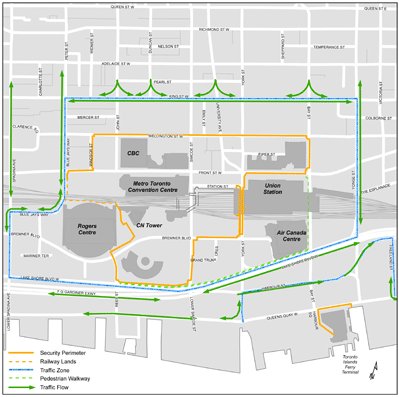
The best advice — unless you’re hoping for a run-in with the police — is to avoid Toronto for that weekend (plus a few days in either direction).
Hard to disagree with anything Rex Murphy says here:
Summits are useless, expensive and potentially dangerous anachronisms.
Let’s take the G20 summit, which will be held June 26-27 in Toronto. No one from the general public will be meeting with the world leaders — summits are not for mingling. So why are the leaders gathering in the middle of Canada’s most populous city when the very idea of interacting with any of the city’s population is absolutely impossible?
Once inside the summit venue the leaders — and their insanely bloated retinues — will be almost antiseptically sealed off from every other bit of Toronto. It’s all fortified meeting rooms and security-proofed hotels for them. Effectively, they will come to Toronto, stay behind a shield of impassable security and talk to leaders they’ve already met. It makes zero sense.
If you’re of a Toronto-centric, anti-Stephen Harper mindset (that would be most Toronto voters), you might attribute it to Harper recreating the famous pacification policy of Henry II: imposing the costs of supporting the royal court by visiting the powerful nobles (that is, the victim can’t refuse the honour of hosting the King, and then has no money or time to plot or scheme against same).
Update: Kelly McParland makes another good point:
Hard as it is to fathom, the Conservatives appear to have successfully created a bigger waste of money than the Liberal gun registry. It took a long time — they’ve had 15 years to study how the Liberals went about wasting so much money on an agency that costs a lot and doesn’t work — but they’ve managed.
In doing so, they’ve disqualified themselves from ever complaining again about money-wasting Liberal schemes, or the gun registry itself for that matter. If Tories can blow a billion forcing everyone in Toronto to find somewhere else to spend the weekend of June 26-27, Liberals can force farmers to get shotgun licences.
I knew that individual Canadians did well out of supplying booze to thirsty Americans during the period of Prohibition, but I didn’t realize how well:
. . . Prohibition — perhaps the maddest of mad American dreams [NR: in a dead heat with the current War on Drugs, I think] — did pretty well by our nation from 1920 to 1933. As American writer Daniel Okrent points out in his fine social history of the era, Last Call, the rivers of Canadian booze that flowed south enriched not only the Bronfman liquor empire, but our federal government. Canadians did make and smuggle illegal liquor, evading both Canadian taxes and American law, but we also made millions of litres of the legal, taxed stuff, the ultimate destination of which was of no concern to Ottawa. The amount of alcohol subject to excise tax — most of which went south one way or another — went from 36,000 litres in 1920 to five million 10 years later, and the excise tax on it rose to a fifth of federal revenue, twice as much as income tax.
Few in Canada had the slightest inclination to aid the American government in cracking down on alcohol use. When a U.S. Coast Guard cutter in pursuit of a Lake Erie rum-runner ran aground near Port Colborne, Ont., locals looted the vessel, then filled its engines with sand. About the only Canadians Okrent could unearth who thought the Dominion should help Uncle Sam seal his border were those making a fortune selling alcohol to American visitors. One way or another, most Canadians agreed with the smug satisfaction of CNR president Sir Henry Thornton, whose railway was growing fat off liquor tourism: “The dryer the U.S. is,” opined Sir Henry, “the better it will be for us.”
If there was an upside to what was known — at first, without a trace of irony — as “The Noble Experiment” in the U.S. itself, Okrent is hard-pressed to find it. America had always been awash in alcohol. (Johnny Appleseed’s fruit was inedible, but Americans still embraced his trees — virtually every homestead kept a barrel of hard cider by the door for visitors.) During the sodden 19th century, adult Americans downed 27 litres of pure alcohol each annually. That kind of demand wasn’t going to disappear no matter what the law said.
And yet the lesson has been forgotten. When drug prohibition finally comes to an end, historians will have a field day drawing the obvious comparison between the War on Drugs and the “Noble Experiment”. The theses practically write themselves . . .
The theory is that these coins were created to ease language barriers between non-Latin speaking customers in brothels and the (often non-Latin speaking) prostitutes:
This is a spintria. They were used in ancient Rome to request and pay for different “services” in brothels and from prostitutes on the street. Since there were a lot of foreigners coming to the city that did not speak the language and most of the prostitutes were slaves captured from other places the coins made the transactions easy and efficient. One side of these coins showed what the buyer wanted and the other showed the amount of money to be paid for the act.
[. . .]
They may have been used to pay prostitutes, who at times spoke a different language. While this is subject to argument, the numbers on them line up with known prices for Roman prostitutes (University of Queensland reference). Some theorize them gaming tokens, and they may have been produced for only a short period, probably in the 1st century A.D.
So, either an innovative solution to an ongoing economic problem, or the Roman equivalent to the nudie card decks of the 1940s and 50s.
Images at the link. H/T to Radley Balko for the URL.
Megan McArdle points out another key difference between “ordinary” pensions and US state government pensions:
Public employees rack up overtime in their last year of work, with the active encouragement of their supervisors and even local politicians, then they retire with inflated pensions that can be greater than their base salary.
New York is the understandable focus, but these problems are hardly unique to my home state. In fact, New York is among the better states on funding of pensions, because they actually have to do some. Other states kinda sorta haven’t really bothered — at least not at anywhere near the levels that would be needed. New York’s problem is notable only because its public sector unions are unusually powerful.
The problem is that these things are nearly impossible to change. People have worked for twenty years or more under the expectation of pensions that were calculated this way; you can’t just wait until they’re 58 and say “Ha, ha, just foolin’.”
<sarcasm>Of course, the money will always be there, right? No reason for anyone to change their expectations.</sarcasm>



Powered by WordPress