
James Delingpole is a bestselling British author and blogger who helped expose the Climategate scandal back in 2009. Reason.tv caught up with Delingpole in Los Angeles recently to learn more about his entertaining and provocative new book Watermelons: The Green Movement’s True Colors. At its very roots, argues Delingpole, climate change is an ideological battle, not a scientific one. In other words, it’s green on the outside and red on the inside. At the end of the day, according to Delingpole, the “watermelons” of the modern environmental movement do not want to save the world. They want to rule it.
September 27, 2011
ReasonTV: ManBearPig, Climategate, and Watermelons
Comments Off on ReasonTV: ManBearPig, Climategate, and Watermelons
September 26, 2011
Why are gold and silver down in this market?
It’s a question I’ve been asking too (my miniscule portfolio is taking a beating in both equities and in precious metals). Mike “Mish” Shedlock offers some likely answers:
1. Fed Did Far Less than Expected
The Fed did not do what everyone thought, which is to say something far more than “Operation Twist”. [. . .] In short, the Fed did not print, or even threaten to print. Moreover the Fed committed to a strategy not through the end of this year, but all the way through June of 2012. Perhaps the Fed does more in the interim, perhaps not. [. . .]2. Mutual Fund Redemptions
Mutual fund cash levels are at or near record lows. In general, mutual funds were not prepared for the market selloff and sell orders came in. Rather than sell garbage like Bank of America at $6, mutual funds unloaded stuff like gold, taking profits.3. Margin Calls at Hedge Funds
Hedge funds unloaded gold and silver for the same reasons as mutual funds, but also because they mistimed the play and what Bernanke would do. Leverage works both ways.4. China Growth Story Fading
Commodities in general have been clobbered along with currencies of commodity producing countries because the global economy is slowing rapidly.
Comments Off on Why are gold and silver down in this market?
Mark Steyn: It really is the end of the world as we know it
Feeling too optimistic? Mark Steyn has a solution for that:
Headline from CNBC: “Global Meltdown: Investors Are Dumping Nearly Everything.” I assumed “Nearly Everything” was the cute name of a bankrupt, worthless, planet-saving green-jobs start-up backed by Obama bundlers and funded with a gazillion dollars of stimulus payback. But apparently it’s “Nearly Everything” in the sense of the entire global economy. Headline from the Daily Telegraph of London: “David Cameron: Euro Debt ‘Threatens World Stability.’” But, if you’re not in the general vicinity of the world, you should be okay. Headline from the Wall Street Journal: “World Bank’s Zoellick: World In ‘Danger Zone.’” But, if you’re not in the general vicinity of . . . no, wait, I did that gag with the last headline.
I mentioned in this space a few weeks ago the IMF’s calculation that China will become the planet’s leading economic power by the year 2016. And I added that, if that proves correct, it means the fellow elected next November will be the last president of the United States to preside over the world’s dominant economy. I thought that line might catch on. After all, we’re always told that every election is the most critical consequential watershed election of all time, but this one actually would be: For the first time since Grover Cleveland’s first term, America would be electing a global also-ran. But there’s not a lot of sense of America’s looming date with destiny in these presidential debates. I don’t mean so much from the candidates as from their media interrogators — which is more revealing of where the meter on our political conversation is likely to be during the general election. On Thursday night, there was a question on gays in the military but none on the accelerating European debt crisis. It is certainly important to establish whether a would-be president is sufficiently non-homophobic to authorize a crack team of lesbian paratroopers to rappel into the Chinese treasury, break the safe, and burn all our IOUs. But the curious complacency about the bigger questions is disturbing.
Comments Off on Mark Steyn: It really is the end of the world as we know it
September 23, 2011
The cliché-meister strikes again
Andrew Ferguson reviews the book That Used To Be Us by Thomas L. Friedman and Michael Mandelbaum. He didn’t find it a pleasant read:
Mr. Friedman can turn a phrase into cliché faster than any Madison Avenue jingle writer. He announces that “America declared war on math and physics.” Three paragraphs later, we learn that we’re “waging war on math and physics.” Three sentences later: “We went to war against math and physics.” And onto the next page: “We need a systemic response to both our math and physics challenges, not a war on both.” Three sentences later: We must “reverse the damage we have done by making war on both math and physics,” because, we learn two sentences later, soon the war on terror “won’t seem nearly as important as the wars we waged against physics and math.” He must think we’re idiots.
The slovenliness of our language, George Orwell wrote, makes it easier to have foolish thoughts, and while Mr. Friedman’s language has been tidied up a bit, the thinking remains what it has always been. The authors call themselves “frustrated optimists.” Their frustration is owing to the depredations of the last decade, which they call (Mr. Mandelbaum nods) the Terrible Twos. But self-contradiction is also part of the Friedman brand. In many other passages, the authors specifically trace the American slide to the end of the Cold War — though still elsewhere they remark that the 1990s were “positive for America.” It doesn’t help their argument, such as it is, that the evidence of decline they cite — crumbling infrastructure, a failing public-education system — predates both 2001 and 1989 by a long stretch. Our potholes and schools have been favorites of declinists for generations.
If the authors’ frustration is unoriginal and ill-defined, their optimism is terrifying. America will rebound — we will become the us that we used to be again, you might say and Mr. Friedman does — when we regain our ability to do “big things” through “collective action.” Collective action is a phrase that means “the federal government.” Among the big things that we will do are rework American industry, through regulation and taxation, to drastically cut carbon emissions. Another one of our big things is a big increase in the gasoline tax. We will also impose on us a new big carbon tax. We will use revenues to create a “clean energy” industry with millions of “green jobs” like the ones that were eliminated earlier this month at Solyndra. Readers will wonder, like the early environmentalist Tonto, “What do you mean ‘we,’ kemo sabe?”
H/T to Jon, my former virtual landlord, for the link.
Comments Off on The cliché-meister strikes again
Mexico to try market solution to drug wars
Jesse Kline reports on the sudden conversion to drug legalization on the part of the Mexican government:
The United States imports a majority of it’s cocaine from Mexico, which has been embroiled in a brutal war among rival gangs for control of the lucrative trade.
Over 42,000 people have been killed in Mexico as a result of gang violence since President Felipe Calderon took office in 2006. Not a moment too soon, it appears the President is starting to recognize that the current approach to dealing with illicit drugs is not working.
“We must do everything to reduce demand for drugs. But if the consumption of drugs cannot be limited, then decision-makers must seek more solutions — including market alternatives — in order to reduce the astronomical earnings of criminal organizations,” Calderon said in a speech in New York.
Using the term “market alternatives” is a key choice of words. The reason organized crime has so successfully dominated the trade is the blanket prohibition on drugs, forcing the market underground. The same thing happened in the United States when alcohol was made illegal during Prohibition.
The solution to removing the criminal element from the drug trade is the same one that solved the problem with booze: legalize it. Allow drugs to be produced by private industry in a regulated environment. After all, gang violence has become more deadly than the substances they’re peddling. And we don’t see beer companies shooting each other for control of distribution networks.
Comments Off on Mexico to try market solution to drug wars
Solyndra: “They doubled down, just like some chump who lost his stake at the Vegas blackjack tables”
Megan McArdle tries to figure out how Solyndra managed to spend nearly a billion dollars in two years:
By my count, Since September 2009, they borrowed $535 million from us to get their second fab up and running, raised $219 million in a private equity offering, got $175 million from issuing convertible promissory notes after their IPO was pulled, received $75 million in the last-ditch round where the DOE allowed their seniority to be subordinated, and maybe got a loan from a different bank. By the time they filed bankruptcy in August, my understanding is that they were basically out of cash.
The Washington Post‘s rather scathing new account, full of employees saying that post-loan, Solyndra started spending money like it was about to be discontinued, says the new facility for which we loaned them all that money cost $344 million to build. So it seems that in the space of two years, Solyndra managed to spend $344 million building a factory and $660 million . . . doing what?
Comments Off on Solyndra: “They doubled down, just like some chump who lost his stake at the Vegas blackjack tables”
September 22, 2011
BT is worth negative £30bn
The British telecoms firm is actually worth much less than the scrap value of its copper wire network:
British Telecom is, as a telecoms company, worth minus £30bn. Yes, that’s a negative number there. And yet it is literally sitting on top of billions in assets.
[. . .]
Ten pairs of copper cabling weighs around 132kg per mile. Which by the miracle of multiplication can be seen to be about 10 million tonnes of copper. Which, at current LME prices of just over £5,000 a tonne, is £50bn.
BT’s current market capitalisation is just north of £20bn. So, as an operating telecoms company they’re worth £30bn less than the mountain of copper they’re sitting upon: that is, they’re worth less than the physical assets or they have, as a telecoms company not a mountain of scrap copper, a negative value.
Comments Off on BT is worth negative £30bn
Telegraph: The great euro swindle
This is an interesting summary of the path to the Euro, and how some predicted the current situation at the very start of the project:
The field is theirs. They were not merely right about the single currency, the greatest economic issue of our age — they were right for the right reasons. They foresaw with lucid, prophetic accuracy exactly how and why the euro would bring with it financial devastation and social collapse.
Meanwhile, the pro-Europeans find themselves in the same situation as appeasers in 1940, or communists after the fall of the Berlin Wall. They are utterly busted. [. . .]
The central historical error of the modern Financial Times concerns the euro. The FT flung itself headlong into the pro-euro camp, embracing the cause with an almost religious passion. Doubts were dismissed. Here is the paper’s Lex column on January 8, 2001, on the subject of Greek entry to the eurozone: “With Greece now trading in euros,” reflected Lex, “few will mourn the death of the drachma. Membership of the eurozone offers the prospect of long-term economic stability.” The FT offered a similarly warm welcome to Ireland.
The paper waged a vendetta against those who warned that the euro would not work. Its chief political columnist, Philip Stephens, consistently mocked the Eurosceptics. “Immaturity is the kind explanation,” sneered Stephens as Tory leader William Hague came out against the single currency.
[. . .]
Now let’s turn to the BBC. In our Centre for Policy Studies pamphlet, Guilty Men, we expose in detail how the BBC betrayed its charter commitment and became a partisan player in a great national debate — all the more insidious because of its pretence at neutrality.
For example, in the nine weeks leading to July 21, 2000, when the argument over the euro was at its height, the Today programme featured 121 speakers on the topic. Some 87 were pro-euro compared with 34 who were anti. BBC broadcasters tended to present the pro-euro position itself as centre ground, thus defining even moderately Eurosceptic voices as extreme.
H/T to Tim Harford for the link.
Comments Off on Telegraph: The great euro swindle
September 21, 2011
“Our existing income tax structure is nothing short of crazy”
That’s Kevin Milligan in the Globe and Mail talking about the Canadian tax structure:
Here are five nuggets of information Canadians should keep in mind as the high income taxation discussion unfolds. [. . .]
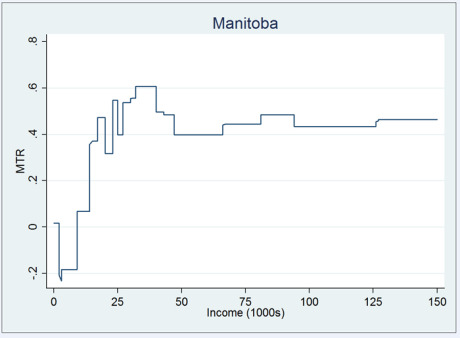
Second, our existing income tax structure is nothing short of crazy. The graph shows the marginal tax rate (the tax owed on the last dollar earned) across different income levels for a two-child family in Manitoba in 2010, the clawback of both federal and provincial refundable tax credits. (Similar graphs for more provinces are here.) What redistributive goal is such a bizarre tax structure designed to achieve? A strong argument can be made that we should improve and reform our existing income tax structure before slapping more confusion on top of it.
Third, the threshold at which one reaches the highest tax bracket is exceedingly low in Canada compared to other countries. In the United Kingdom, one reaches the highest tax bracket of 50 per cent at the Canadian dollar equivalent of $234,000. In the United States, currently the highest federal rate of 35 per cent is reached at incomes of $379,150 (U.S.). In Canada, the highest federal rate is 29 per cent, reached only at $128,800. Just to reach the level of income tax progressivity observed in the United States under President George W. Bush, Canada would need to increase this high income threshold dramatically.
Comments Off on “Our existing income tax structure is nothing short of crazy”
September 20, 2011
China’s local and regional governments may be sitting on massive hidden debts
As with the US or Canadian government’s debt, not all debt is held at the federal level. It may take some digging to discover what the actual debt levels might be, but it’s possible. In China, however, as local governments are forbidden to issue bonds or to borrow from banks, they’ve had to become extremely creative in finding ways to borrow money for their pet projects. Not just creative — at least in some cases — legally dubious:
About 85% of Liaoning province’s 184 financing companies defaulted on debt service payments in 2010 according to a report from the province’s Audit Office. The report also noted that 120 of these borrowers, de facto government agencies, operated at a loss last year.
Since 1994, provinces and lower-tier governments have not been permitted to issue bonds or borrow from banks. Despite the strict prohibition, their debt has skyrocketed as local officials incurred obligations through LGFVs, local government finance vehicles. The central government’s National Audit Office said these companies, at the end of last year, had taken on 10.7 trillion yuan of debt. No one, however, knows the true amount of LGFV indebtedness, and some have calculated the real amount to be more than double the official figure.
Why the disagreement as to the amount of debt? Local governments have gone out of their way to hide borrowings, perhaps in part because of their doubtful legality. As famed economic journalist Hu Shuli points out, new local officials sometimes do not know the extent of obligations left by their predecessors. There have been a number of stratagems employed, from the issuance of illegal government guarantees to the transfer of funds in roundabout routes.
H/T to Jon, my former virtual landlord, for the link.
Comments Off on China’s local and regional governments may be sitting on massive hidden debts
September 18, 2011
The Pentagon’s current big fear: the sequester
George F. Will explains why Leon Panetta, the secretary of defense, is very worried about the outcome of the “supercommittee” deliberations:
This would take from military budgets nearly $500 billion, in addition to a minimum of $350 billion cuts already scheduled. An almost trillion-dollar trimming, Panetta says flatly, “cannot take place.” Actually, he knows it can: “The gun to the head could really go off.” Even without a sequester, the military “is going to be a smaller force.” And with a sequester? The 1.5 million active-duty members of the armed services and 700,000 civilian employees of the Defense Department depend on an industrial base of more than 3.8 million persons. According to the Pentagon, a sequester would substantially shrink those three numbers, perhaps adding a point to the nation’s unemployment rate. The cuts would leave the smallest Army and Marine Corps in more than a decade and the smallest tactical Air Force since this service became independent of the Army in 1947. The Navy has already shrunk almost to its smallest fleet size since World War I.
Time was, when Democrats looked at the defense budget with a skeptical squint, Republicans rallied ’round it. No more. Few tea partyers remember Washington’s hawk-versus-dove dramas. They live to slow spending, period. They are constitutionalists but insufficiently attentive to the fact that defense is something the federal government does that it actually should do. And when they are told that particular military expenditures are crucial to force projection, they say: As in Libya? Been there, don’t want to do that.
Much of the defense budget is consumed by pay and health care for uniformed personnel, who have been abused enough by repeated deployments. The priciest new weapon, the stealthy F-35 Joint Strike Fighter (at least $90 million per plane), is vital for the continued salience of aircraft carriers, which are the basis of the U.S. strategic presence in the Western Pacific. Inferring China’s geopolitical intentions from its military purchases is difficult, but Panetta says guardedly that in five years China’s force projection will be “much better.” The Marines, with their smaller carriers, need a short-takeoff model F-35. Cut the number of planes built, the cost per plane rises, and the ability to recoup costs through sales to allies declines.
Comments Off on The Pentagon’s current big fear: the sequester
September 16, 2011
Ontario’s clean energy Potemkin village
John Ivison reports on a recent photo op by Premier Dalton McGuinty:
The solar energy company touted this week by Ontario Premier Dalton McGuinty as a flagship of the province’s clean energy economy has halted production because of slow demand.
Mr. McGuinty was flanked by Eclipsall Energy Corp.’s workforce when he visited its Scarborough solar panel plant Tuesday, but there was no mention that the production line is temporarily shut down. When my colleague Tamsin McMahon visited the plant she found the reception desk was empty, the cafeteria was closed and only a handful of employees milling around inside the sparsely furnished building.
Leo Mednik, Eclipsall’s chief financial officer, said the production line halt is because the company has already completed its current order book. “It’s no secret that the market is slow and there have been delays. That’s part of it — part of it is logistics. Our production team went through our purchased inventory a lot quicker than expected,” he said.
Not only is the plant not working to capacity: it’s only working at all because of government subsidies:
The Liberal government’s efforts have created jobs — though the 20,000 number touted by Mr. McGuinty seems highly questionable, far less the 50,000 he says will be created by the end of next year. In addition, they are hardly high wage, high skilled jobs the Premier claims (Eclipsall pays 20% over minimum wage to its workers, who assemble glass and solar cells imported from Asia, thereby qualifying for the Liberal Green Energy Act’s 60% domestic content rule).
The question is: how sustainable are these jobs? Mr. Mednik admitted that if the domestic content rule was removed, Eclipsall and other Ontario manufacturers would not be able to survive. “Frankly, it would be very difficult for any start-up to compete” against cheaper Chinese producers, he said.
He said it is a question of when, rather than if, the 60% threshold is removed. Both the European Union and Japan have taken the FIT program to the World Trade Organization and want the local content requirements removed. They claim this Buy Ontario provision is a prohibited subsidy. The FIT program might also soon become subject to a NAFTA dispute case, after American renewable company Mesa Power Group said it would file a complaint.
Comments Off on Ontario’s clean energy Potemkin village
September 14, 2011
September 12, 2011
What is “the biggest European policy mistake since Britain and France let Hitler have the Sudetenland”?
For the record, I don’t actually think Europe would be better off with a single federal government, but Walter Russell Mead thinks the big mistake was attempting an economic union without a political union to match:
What is worrying investors worldwide is the evident intellectual and political bankruptcy of Europe. The Europeans are not stupider than other people, but they face deep structural economic and political problems that their institutions are hopelessly inadequate to solve. Creating a monetary union without a true federal government is looking more and more like the biggest European policy mistake since Britain and France let Hitler have the Sudetenland.
The current crisis is the result of a decade of policy failure. Greece should never have been allowed into the euro; prudent leaders would have checked its statistics, discovered the blatant frauds with which the Greeks sought to conceal the true state of their affairs, and told the country politely but firmly to come back when it was ready. Following that initial blunder, Europe failed to take note in any serious way of the serious distortions that were caused by suddenly reducing interest rates in Greece and other peripherals to near-German levels. Beyond that, alarm bells should have been ringing as it became clear that Greece and a number of other countries were treating their suddenly lower interest costs as found money. They were spending the windfall rather than taking advantage of the once in a lifetime opportunity to reform their economies in preparation for life under a monetary union with countries like Germany. If Europe’s institutions were up to the job, the warning signs would have been noticed and corrective steps taken years ago.
Comments Off on What is “the biggest European policy mistake since Britain and France let Hitler have the Sudetenland”?


