
Science may be the noblest endeavor of the human mind, but I believe (though I cannot prove) that the most crippling and dangerous kind of ignorance in the modern West is ignorance of economics, the way markets work, and the ways non-market allocation mechanisms are doomed to fail. Such economic ignorance is toxic, because it leads to insane politics and the empowerment of those whose rhetoric is altruist but whose true agenda is coercive control.
Eric S. Raymond, “What Do You Believe That You Cannot Prove?”, Armed and Dangerous, 2005-01-06.
June 1, 2017
QotD: Economics
Comments Off on QotD: Economics
May 31, 2017
Introduction to Consumer Choice
Published on 30 May 2017
Everyday, you make tons of decisions about consumption. Your choices about what and how much of a good to buy are influenced by the laws of supply and demand. These choices are nearly endless. For example, at Starbucks, each drink is highly customizable. In fact, they offer over 80,000 combinations!
When you buy a good or make a decision about how to use your time, you’re getting some sort of value, like a sense of happiness or satisfaction, out of it – economists call this “utility.” The increase in that value from buying an additional unit of a good or service is its marginal utility. When you make these decisions, you’re thinking at the margin, even if you don’t realize it.
Think about how wonderful a shot of espresso, or your beverage of choice, is first thing in the morning. You probably derive quite a bit of utility! But how about a second, third, or even fourth shot of espresso? With each extra shot, you probably get a little less utility. At some point, the cost will outweigh the marginal utility.
When you add up the satisfaction you get out of all of the shots of espresso, that is your total utility. Since each additional shot of espresso has a little less utility, economists refer to this concept as diminishing marginal utility.
This is true for all goods and activities, but the amount of utility and marginal utility depends on the individual. For example, let’s say that Starbucks drops the price of shot of espresso. This can change the quantity demanded on aggregate because for some people, the drop in price will make the marginal utility they derive from an extra shot now worth the cost. But perhaps that’s not true for you and your consumption will not change.
Are you starting to see how you instinctively think and act at the margin in your daily life?
Up next, we’ll explore other factors beyond price that affect your habits as a consumer, such as preferences and income.
Comments Off on Introduction to Consumer Choice
QotD: Capitalism
Queen Elizabeth owned silk stockings. The capitalist achievement does not typically consist in providing more silk stockings for queens but in bringing them within the reach of factory girls in return for steadily decreasing amounts of effort…. [T]he capitalist process, not by coincidence but by virtue of its mechanism, progressively raises the standard of life of the masses.
Joseph Schumpeter, Capitalism, Socialism, and Democracy, 1942.
Comments Off on QotD: Capitalism
May 26, 2017
Puzzle of Growth: Rich Countries and Poor Countries
Published on 16 Feb 2016
Throughout this section of the course, we’ve been trying to solve a complicated economic puzzle — why are some countries rich and others poor?
There are various factors at play, interacting in a dynamic, and changing environment. And the final answer to the puzzle differs depending on the perspective you’re looking from. In this video, you’ll examine different pieces of the wealth puzzle, and learn about how they fit.
The first piece of the puzzle, is about productivity.
You’ll learn how physical capital, human capital, technological knowledge, and entrepreneurs all fit together to spur higher productivity in a population. From this perspective, you’ll see economic growth as a function of a country’s factors of production. You’ll also learn what investments can be made to improve and increase these production factors.
Still, even that is too simplistic to explain everything.
So we’ll also introduce you to another piece of the puzzle: incentives.
In previous videos, you learned about the incentives presented by different economic, cultural, and political models. In this video, we’ll stay on that track, showing how different incentives produce different results.
As an example, you’ll learn why something as simple as agriculture isn’t nearly so simple at all. We’ll put you in the shoes of a hypothetical farmer, for a bit. In those shoes, you’ll see how incentives can mean the difference between getting to keep a whole bag of potatoes from your farm, or just a hundredth of a bag from a collective farm.
(Trust us, the potatoes explain a lot.)
Potatoes aside, you’re also going to see how different incentives shaped China’s economic landscape during the “Great Leap Forward” of the 1950s and 60s. With incentives as a lens, you’ll see why China’s supposed leap forward ended in starvation for tens of millions.
Hold on — incentives still aren’t the end of it. After all, incentives have to come from somewhere.
That “somewhere” is institutions.
As we showed you before, institutions dictate incentives. Things like property rights, cultural norms, honest governments, dependable laws, and political stability, all create incentives of different kinds. Remember our hypothetical farmer? Through that farmer, you’ll learn how different institutions affect all of us. You’ll see how institutions help dictate how hard a person works, and how likely he or she is to invest in the economy, beyond that work.
Then, once you understand the full effect of institutions, you’ll go beyond that, to the final piece of the wealth puzzle. And it’s the most mysterious piece, too.
Why?
Because the final piece of the puzzle is the amorphous combination of a country’s history, ideas, culture, geography, and even a little luck. These things aren’t as direct as the previous pieces, but they matter all the same.
You’ll see why the US constitution is the way it is, and you’ll learn about people like Adam Smith and John Locke, whose ideas helped inform it.
And if all this talk of pieces makes you think that the wealth puzzle is a complex one, you’d be right.
Because the truth is, the question of “what creates wealth?” really is complex. Even the puzzle pieces you’ll learn about don’t constitute every variable at play. And as we mentioned earlier, not only are the factors complex, but they’re also constantly changing as they bump against each other.
Luckily, while the quest to finish the wealth puzzle isn’t over, at least we have some of the pieces in hand.
So take the time to dive in and listen to this video and let us know if you have questions along the way. After that, we’ll soon head into a new section of the course: we’ll tackle the factors of production so we can further explore what leads to economic growth.
Comments Off on Puzzle of Growth: Rich Countries and Poor Countries
May 25, 2017
Words & Numbers: Government Can’t Stop Creative Destruction
Published on 24 May 2017
Technology doesn’t just change things, it utterly destroys things. And that’s just fine. It happens so often that people barely even notice when it does. Think about all the new services that have come to market just over the past few years: Uber, Airbnb, Redbox … the list goes on and on.
But that’s only half the story. In turn, the list of services replaced by these new ones is similarly long: taxis, hotels, Blockbuster, etc. And workers in these industries often lose their jobs in the line of creative destruction. We generally accept this as the price of innovation, but many people try to use the government to stop this by blocking the new services.
Today we’re seeing this with more politically well-connected industries like taxis and hotels. Pressure is put on Uber and Airbnb, respectively, to “protect” the established industries they are upending.
This week, Ant and James talk about why this is always a mistake.
Learn More:
https://fee.org/articles/government-cant-stop-creative-destruction/
Comments Off on Words & Numbers: Government Can’t Stop Creative Destruction
May 23, 2017
QotD: The dangers of career “dualization”
This concept [of dualization] applies much more broadly than just drugs and colleges. I sometimes compare my own career path, medicine, to that of my friends in computer programming. Medicine is very clearly dual – of the millions of pre-med students, some become doctors and at that moment have an almost-guaranteed good career, others can’t make it to that MD and have no relevant whatsoever in the industry. Computer science is very clearly non-dual; if you’re a crappy programmer, you’ll get a crappy job at a crappy company; if you’re a slightly better programmer, you’ll get a slightly better job at a slightly better company; if you’re a great programmer, you’ll get a great job at a great company (ideally). There’s no single bottleneck in computer programming where if you pass you’re set for life but if you fail you might as well find some other career path.
My first instinct is to think of non-dualized fields as healthy and dualized fields as messed up, for a couple of reasons.
First, in the dualized fields, you’re putting in a lot more risk. Sometimes this risk is handled well. For example, in medicine, most pre-med students don’t make it to doctor, but the bottleneck is early – acceptance to medical school. That means they fail fast and can start making alternate career plans. All they’ve lost is whatever time they put into taking pre-med classes in college. In Britain and Ireland, the system’s even better – you apply to med school right out of high school, so if you don’t get in you’ve got your whole college career to pivot to a focus on English or Engineering or whatever. But other fields handle this risk less well. For example, as I understand Law, you go to law school, and if all goes well a big firm offers to hire you around the time you graduate. If no big firm offers to hire you, your options are more limited. Problem is, you’ve sunk three years of your life and a lot of debt into learning that you’re not wanted. So the cost of dualization is littering the streets with the corpses of people who invested a lot of their resources into trying for the higher tier but never made it.
Second, dualized fields offer an inherent opportunity for oppression. We all know the stories of the adjunct professors shuttling between two or three colleges and barely making it on food stamps despite being very intelligent people who ought to be making it into high-paying industries. Likewise, medical residents can be worked 80 hour weeks, and I’ve heard that beginning lawyers have it little better. Because your entire career is concentrated on the hope of making it into the higher-tier, and the idea of not making it into the higher tier is too horrible to contemplate, and your superiors control whether you will make it into the higher tier or not, you will do whatever the heck your superiors say. A computer programmer who was asked to work 80 hour weeks could just say “thanks but no thanks” and find another company with saner policies.
(except in startups, but those bear a lot of the hallmarks of a dualized field with binary outcomes, including the promise of massive wealth for success)
Third, dualized fields are a lot more likely to become politicized. The limited high-tier positions are seen as spoils to be distributed, in contrast to the non-dual fields where good jobs are seen as opportunities to attract the most useful and skilled people.
Scott Alexander, “Non-Dual Awareness”, Slate Star Codex, 2015-07-28.
Comments Off on QotD: The dangers of career “dualization”
May 22, 2017
Why Do We Have Grass Lawns
Published on 17 Apr 2017
In this video:
Maintaining the perfect lawn takes a lot of work. There’s mowing, fertilizing, aerating, and watering. Having a trimmed green field leading up to your front door is something of a status symbol, and in some cases having a messy front lawn can get you into trouble with your more obsessive neighbours.
Want the text version?: http://www.todayifoundout.com/index.php/2014/03/grass-lawns-2/
Comments Off on Why Do We Have Grass Lawns
May 18, 2017
You Can’t Trust Employment Statistics
Published on 17 May 2017
There is no truly good way to measure unemployment, which makes it pretty easy for successive administrations to claim that unemployment is consistently improving. But when we do our level best to include all of the unemployed in the numbers, what we learn is that unemployment levels now are higher than they were at the beginning of the Great Recession. That’s the bad news. The good news is that things actually have been getting better over time. In this week’s episode, James and Antony take a look at the actual unemployment numbers to get to the bottom of what they really mean.
Get the facts here:
https://fee.org/articles/you-cant-trust-unemployment-statistics/
Comments Off on You Can’t Trust Employment Statistics
May 17, 2017
QotD: Britain’s post-Brexit access to the single market
You see, they think they are granting us a privilege by allowing us to sell them things. This is ludicrous of course, it is imports which make us richer, not exports. But let us humour their delusion for a little. The standard EU position is that if the companies and people of a country are to gain access to the Single Market then they must pay for that privilege. This cannot be about the imports that those people gain from the Single Market of course because that is always under their own domestic control. No, the EU’s insistence really is that if Switzerland gets to sell cuckoo clocks into the EU, Norway can ship fermented sharks heads and the like, then this is a privilege. And that access to the Single Market means that Switzerland and Norway must pay the EU for that privilege. And they do.
[…]
If you get to sell things in Europe then you’ve got to pay the tithe to the EU itself. Reminds me rather of Fat Tony and friends running a nice little protection racket but then much of the EU reminds me of that.
OK. But who should be paying that tithe?
Well, actually, the first question is whether that tithe is worth paying. As up above, it’s imports that make us all generally richer and that’s all under our control anyway. Exports do make some people richer – the people who profit from making exports of course. And that’s not us in general, that’s not Britain, nor the British, and it’s most certainly not the taxpayers who are made richer by exports. So, obviously, it should not be the taxpayers paying the tithe in order to gain access to that market for those exports which don’t profit them.
The people who should be paying the tithe are the people who profit from the tithe having been paid. Those very exporters. Which gives us the solution to who should be paying the tithe. And an interesting side effect of this will be that we will find out whether it’s worth paying at all.
The people who should be paying the tithe are the people who profit from the tithe having been paid. Those very exporters. Which gives us the solution to who should be paying the tithe. And an interesting side effect of this will be that we will find out whether it’s worth paying at all.
Actually, we could in fact argue that a payment into the EU budget in return for Single Market access is illegal state aid. And thus not allowed under the usual rules of trade with the EU. Because it is state aid. Exporters will face tariffs if the payment is not made. The payment thus benefits exporters. But the payment is made by taxpayers, this is thus aid from taxpayers to exporters. It’s a subsidy for exports – something that isn’t allowed.
[…]
The crucial point is that the benefits, as far as the UK is concerned, of Single Market access lie with those making the exports. Thus those making the exports should be those paying the cost of Single Market access. If those who benefit think it not worth the cost then no one should be paying such
bribesillegal state aidaccess fees. And simply by applying the costs, correctly, to those who benefit we find out which is the truth.It’s very difficult indeed, nay impossible, to see the down side of this suggestion. If exporters want Single Market access then exporters can pay for it, not taxpayers. If they won’t pay it then it’s not worth it, is it?
Tim Worstall, “Absurd But It Works – Ensure EU Single Market Access Post-Brexit With Export Taxes”, Forbes, 2016-06-27.
Comments Off on QotD: Britain’s post-Brexit access to the single market
May 16, 2017
How service companies might respond to a mandated increase in the minimum wage
At Coyote Blog, Warren Meyer discusses how real world service companies that employ a lot of minimum wage workers are likely to respond when the minimum wage is raised:
When I discuss this with folks, they will say that the increase could still come out of profitability — a 5% margin could be reduced to 3% say. When I get comments like this, it makes me realize that people don’t understand the basic economics of a service firm, so a concrete example should help. Imagine a service business that relies mainly on minimum wage employees in which wages and other labor related costs (payroll taxes, workers compensation, etc) constitute about 50% of the company’s revenues. Imagine another 45% of company revenues going towards covering fixed costs, leaving 5% of revenues as profit. This is a very typical cost breakdown, and in fact is close to that of my own business. The 5% profit margin is likely the minimum required to support capital spending and to keep the owners of the company interested in retaining their investment in this business.
Now, imagine that the required minimum wage rises from $10 to $15 (exactly the increase we are in the middle of in California). This will, all things equal, increase our example company’s total wage bill by 50%. With the higher minimum wage, the company will be paying not 50% but 75% of its revenues to wages. Fixed costs will still be 45% of revenues, so now profits have shifted from 5% of revenues to a loss of 20% of revenues. This is why I tell folks the math of absorbing the wage increase in profits is often not even close. Even if the company were to choose to become a non-profit charity outfit and work for no profit, barely a fifth of this minimum wage increase in this case could be absorbed. Something else has to give — it is simply math.
The absolute best case scenario for the business is that it can raise its prices 25% without any loss in volume. With this price increase, it will return to the same, minimum acceptable profit it was making before the regulation changed (profit in this case in absolute dollars — the actual profit margin will be lowered to 4%). But note that this is a huge price increase. It is likely that some customers will stop buying, or buy less, at the new higher prices. If we assume the company loses 1% of unit volume for every 2% price increase, we find that the company now will have to raise prices 36% to stay even both of the minimum wage increase and lost volume. Under this scenario, the company would lose 18% of its unit sales and is assumed to reduce employee hours by the same amount. In the short term, just for the company to survive, this minimum wage increase leads to a substantial price increase and a layoff of nearly 20% of the workers. Of course, in real life there are other choices. For example, rather than raise prices this much, companies may execute stealth price increases by laying off workers and reducing service levels for the same price (e.g. cleaning the bathroom less frequently in a restaurant). In the long-term, a 50% increase in wage rates will suddenly make a lot of labor-saving capital investments more viable, and companies will likely substitute capital for labor, reducing employment even further but keeping prices more stable for consumers.
As you can see, in our example we don’t need to know anything about bargaining power and the fairness of wages. Simple math tells us that the typical low-margin service business that employs low-skill workers is going to have to respond with a combination of price increases and job reductions.
Comments Off on How service companies might respond to a mandated increase in the minimum wage
May 15, 2017
Geography and Economic Growth
Published on 9 Feb 2016
If you look at the African continent, perhaps the first word to come to mind is “enormous.” And that’s true. You could fit most of the United States, China, India, and a lot of Europe, into Africa. But if you compare Africa to Europe, Europe has two to three times the length of coastline that Africa has.
But what does coastline length have to do with anything?
Well, coasts mean access to water.
As benign as water might seem, it’s a major driver of economic growth. Adam Smith, the father of modern economics, argued that access to water reduced the cost of trade, and gave merchants access to larger markets. These larger markets incentivized specialization and innovation.
These twin processes ultimately spurred trade activity, and consequently, economic growth.
As an end result, civilization tended to grow wherever trade was easiest.
If you want proof of this, think of a few major cities.
Look at Istanbul, New York, Venice, Hong Kong, London, and similar areas. What do they all have in common? They all sit near a major coast or a major river. In contrast, look at some of the poorest areas in the world—places like Kampala, or Pointe-Noire. These places are all landlocked. Since goods are easier to transport over water than over land, trade in landlocked areas is more expensive.
And what happens when trade is more expensive?
It becomes harder to spark economic growth.
What this all means is economic growth is not only affected by a country’s rules and institutions, but by a country’s natural blessings, or natural hindrances, too. The effects of geography on growth cannot be discounted.
Comments Off on Geography and Economic Growth
May 14, 2017
The earliest lesson in economics
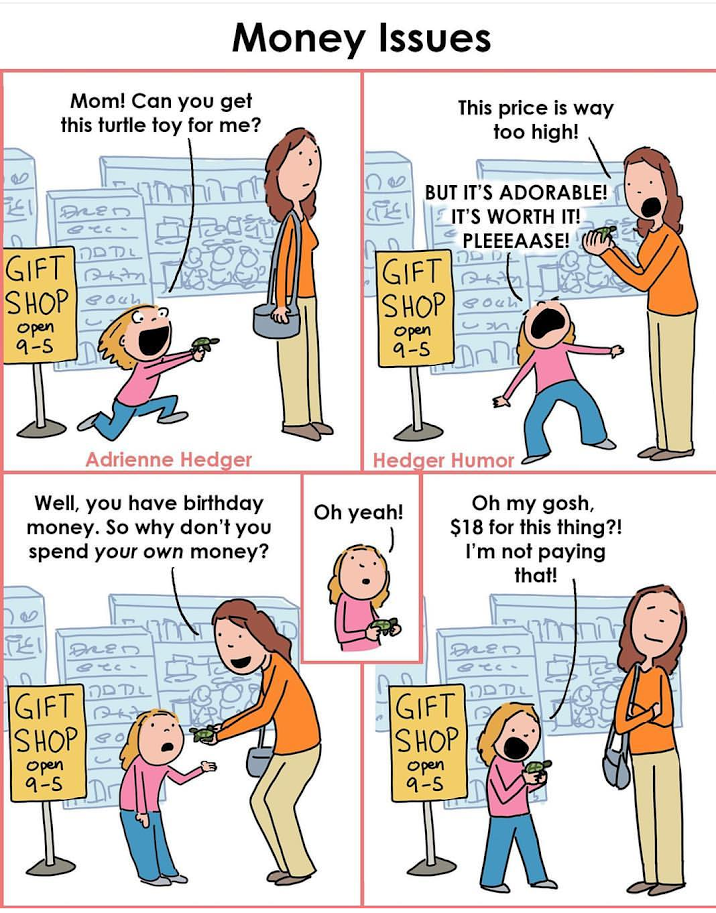
Steve Kates posted this at Catallaxy Files, saying it was everything you need to know about public spending:
Comments Off on The earliest lesson in economics
QotD: Big business, crony capitalism and regulatory capture
Now, Pope Francis has the beginnings of a point about large “private corporations” (note the oxymoron), which in their wealth may grow (though only temporarily) to a size rivalling the smaller national governments. And I would add, they become nearly as centralized and monopolistic (through “regulatory capture”), and faceless and bureaucratic as the agencies of State. Whenupon, unlike the self-perpetuating agencies of the State, they begin to disintegrate from their own lack of enterprise.
It is not enough, as the libertarians suppose, to leave them to their fate, in the knowledge that if they are inefficient they’ll be gone tomorrow. For new large corporations rise to take their place, and at every moment the great majority of people are reduced to wage-slaves of one large corporation or another. Indeed, part of the power of large corporations comes from their scale as employers. A democratic government which tries to stand up to them will quickly relent, and switch to subsidies instead, when they threaten to create mass unemployment.
The question must be asked: What makes vast, morally obtuse, centralized corporations possible? And the answer should be easy to see. It is vast, morally obtuse, centralized governments, which command regulatory regimes that are consistent over huge areas. That has actually become our model for global “free trade”: making regulations and taxation consistent not only across nations, but across continents. This creates an order which large corporations, and only large corporations, are well-equipped to exploit.
Imagine instead they were to face different regulatory regimes, parish by parish. They could still operate, but would have to adapt each franchise to local conditions, as defined by the sovereign local authority. This immediately flips the onus, and gives the local merchant or producer the advantage over his multinational competitor, in being on the spot. It reduces that competitor’s economy of scale, while also imposing upon him a new model of corporate governance, as network, that must of necessity become decentralized and responsive (just as creatures in nature) to every single environmental niche.
The re-focusing on what is local, and what is doable locally, would have tremendous ramifications on “the environment” at large — overwhelmingly positive, given some time. Yet it would also have the happy effect of disempowering the ecological whack cases.
David Warren, “Five thousand max”, Essays in Idleness, 2015-06-19.
Comments Off on QotD: Big business, crony capitalism and regulatory capture
May 11, 2017
Words & Numbers: The Minimum Wage Conspiracy
Published on 10 May 2017
This week, James & Antony tackle minimum wage laws and present some hard facts that might surprise a lot of people.
See the YouTube description for a long list of links related to this discussion.
Comments Off on Words & Numbers: The Minimum Wage Conspiracy


