Quotulatiousness

February 6, 2014

He’d have gotten away with it, except for those pesky girls

Filed under: Cancon, Randomness — Tags: , , , , — Nicholas @ 07:56

Being shy can be a handicap for certain kinds of activities. It can prevent you from doing things you might otherwise want to do. Shockingly, however, the Ontario Human Rights Tribunal doesn’t think that you should get special treatment just because you’re afraid to be the only guy in a class full of women:

Sexual politics have erupted again in Toronto’s ivory tower as another male student has lost a bid to be excused from a class with women without losing marks, this time because he’s shy.

The Ontario Human Rights Tribunal has dismissed a complaint by University of Toronto student Wongene Daniel Kim, who accused his professor of discriminating against him as a male when she docked him marks for not coming to class because he was too shy to be the only guy.

The second-year health science major arrived at the opening of a Women and Gender Studies course for which he had signed up in the fall of 2012 — “It had spaces left and fit into my timetable” — only to discover a room full of women and nary a man in sight.

“I felt anxiety; I didn’t expect it would be all women and it was a small classroom and about 40 women were sort of sitting in a semicircle and the thought of spending two hours every week sitting there for the next four months was overwhelming,” said Kim, 20, adding he manages a part-time job with women because there are also other men.

[…]

However the tribunal ruled his complaint did not warrant a hearing.

“The applicant has not satisfied me that his claimed discomfort in a classroom of women requires accommodation under the (Ontario Human Rights) Code,” wrote adjudicator Mary Truemner. “He admitted that his discomfort is based on his own ‘individual preference’ as a shy person … and stated he thought they (the women) would not be willing to interact with him because of his gender.”

This was “merely speculation as he never gave the class, or the women, a chance,” wrote Truemner, vice-chair of the tribunal.

Kim had no evidence of being “excluded, disadvantaged or treated unequally on the basis of” his gender, she said.

H/T to Joey DeVilla who posted on Facebook, “Way to perpetuate the feckless Asian nerd stereotype, Kim. After all the work I did dispelling it!”.

February 5, 2014

Battlefield mobility for Canadian infantry in the Cold War

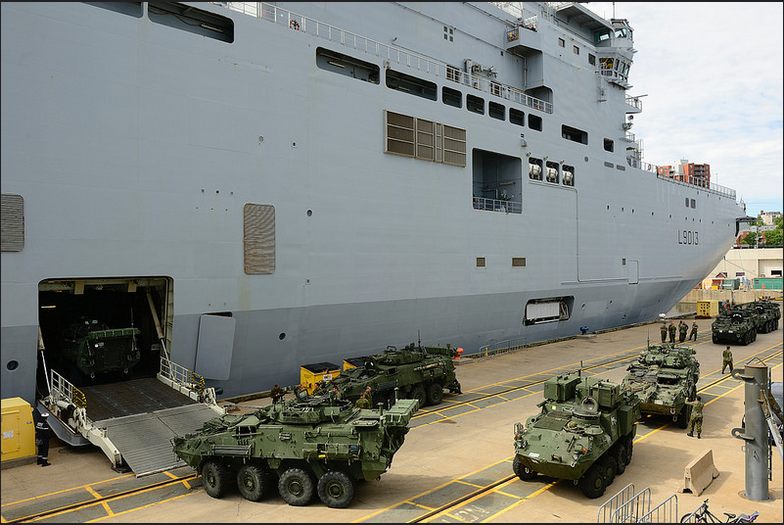
An interesting post by Frank Maas at the LCMSDS website looks at the story of the Canadian army’s attempts during the 1980s to get modern armoured vehicles for infantry support and battlefield mobility:

The Militia, the traditional mobilization base for the Canadian army, withered during the Cold War. Its ranks were flushed with Second World War veterans in the 1950s and there was money for new tanks and vehicles, but morale declined as the Militia’s role became civil defence in the late 1950s, and it languished in the 1960s and 1970s as defence budgets shrank. The Militia reached a nadir of 15,000 by the late 1970s, but ironically, there was a false dawn at the end of the Cold War. In the 1987 Defence White Paper, Challenge and Commitment, the Mulroney government announced that the strength of the Reserves would skyrocket to 90,000, and would complement Regular units and allow Canada to better meet commitments to NATO and continental defence. This increase in strength would be complemented by a package of improvements to bases and new equipment purchases. One of these was for a purchase of 200 armoured personnel carriers, and here the story begins.

Back then, Colonel Romeo Dallaire was head of the army’s department for assessing armoured vehicles. Dallaire was intent on purchasing the venerable and ubiquitous M113, which first entered service in the 1960s, and is one of the most numerous armoured vehicles in the world. (The Canadian army had purchased more than 900 in the 1960s, and fielded up-armoured M113s in Afghanistan). The original plan was to buy 200 M113s from the American manufacturer and have some components licence-built in Canada to fulfill requirements for Canadian content.

At the same time, however, Canada’s only manufacturer of armoured vehicles, Diesel Division General Motors (DDGM), in London Ontario, was nearly out of work. It was approaching completion of a United States Marine Corps order for 758 vehicles, and although some sales to Saudi Arabia were on the horizon for the early 1990s, the company was facing a year with empty production lines. Some salesmen and engineers at DDGM began to think they could scoop up the contract for two hundred APCs by substituting their vehicle, the Piranha Light Armoured Vehicle (LAV), and bridge the gap between the contracts.

Comparing the interiors of the LAV-25 (left) and M113 (right)

Comparing the interiors of the LAV-25 (left) and M113 (right)

There were some significant differences between the Piranha LAV and the M113 that would complicate DDGM’s plan. First, the LAV was wheeled, and the M113 was tracked. Wheeled vehicles were easier to maintain, but tracked vehicles had better off-road mobility. Second, the sides of the LAV’s troop compartment sloped sharply inward, which improved ballistic protection, but reduced internal space. Finally, the LAV had doors at the back for soldiers to deploy from, while the M113 had a ramp which made it much easier for soldiers to run out of the back of the vehicle. DDGM’s engineers could not do much about putting tracks on the LAV-25, although a wheeled vehicle would be better-suited for service with the Reserves because it would be cheaper to operate and soldiers could drive it on roads. (There are prohibitions against driving tracked vehicles on roads). DDGM could reconfigure its vehicle to look more like a M113 from the back to convince the army to accept the LAV-25 as a substitute, but this would require a significant reconfiguration of the vehicle.

Back in the late 1970s, my militia unit got some familiarization training with the then-new Grizzly AVGP, which was based on an earlier model than the LAV. While it was neat to be given the chance to try working with (and in) new equipment, we found that getting in and out of the back of the vehicle was awkward and much slower than we (well, actually our NCOs) had hoped. Practicing a dismount with a full infantry section on board was … less than tactically brilliant. The small doors tended to snag any of our equipment as we squeezed through, so you had to move more slowly to get through successfully.

Here’s a look at the rear of the Cougar AVGP from the same vehicle family as the Grizzly:

A right rear view of a Canadian army Cougar wheeled fire support vehicle that is being used as an observation post by soldiers standing watch during the combined U.S./Canadian NATO Exercise Rendezvous '83. Location: Camp Wainright, AB

A right rear view of a Canadian army Cougar wheeled fire support vehicle that is being used as an observation post by soldiers standing watch during the combined U.S./Canadian NATO Exercise Rendezvous ’83. Location: Camp Wainright, AB

February 4, 2014

“Chateau” generals

Filed under: Britain, Cancon, History, Military, USA, WW1, WW2 — Tags: , , , , — Nicholas @ 12:41

Nigel Davies has written a long post about the British and American standard of generalship in the two world wars, which won’t win him very many American (or Canadian) fans. That being said, he’s certainly right about the Canadian generals of WW2:

Contention: American senior generals in World War II were as bad, and for the same reason, as British senior generals in World War I.

[…] the politicians (and I will include Kitchener here, as he was by this time a politician with a military background rather than a real general), had based their recruiting campaign on a trendy ‘new model’ citizens army, rather than use the well developed existing territorial reserve system that would have done a far better job. They new enthusiastic troops were considered incapable of the traditional fire and movement approach of professional troops (the type that the Germans reintroduced in 1918 with their ‘commando units’, and the British army was able to copy soon after with properly trained and combat experienced personnel). Instead the enthusiastic amateurs were considered too badly trained to do more than advance in long straight lines… straight into the meat grinder.

Having said that the generals blame for the results should be at the very least shared with their political masters, I am still willing to express dissatisfaction with the approach of Haig and many of his senior commanders. They were Chateau Generals in approach and in attitude. They drew lines on maps without adequately considering the terrain, issued impossible instructions without looking at the state of the ground, and ran completely inadequate communications that were far from capable of keeping track of, or controlling, a modern battlefield.

[…]

It was noticeable later in the war that the more successful armies were commanded by competent and imaginative officers who insisted on detailed planning; intensive and specific tactical planning and operational training (down to practicing assaults on purpose built life size models); and very close control of operations to ensure success. They had usually learned the hard way, and had matured as experienced and pro-active leaders.

Of course some of this improvement was simply advances in technology. Tanks to breakthrough; better artillery fire plans to support and reduce casualties; air observation to enhance control and assess responses; better communications (including radio’s) to facilitate flexibility on the ground; and a generally better trained and more experienced soldier; with much more skilled officers. It all helped. But a lot came down to the attitude of the generals who believed that you got up front, found out the truth, stayed in close contact, and reacted to changed circumstances as immediately as possible.

However, as the American army was late to the battlefront, Davies contends that the leaders merely recapitulated the first stages of the bloody learning experience as their British counterparts, but didn’t produce the innovative leadership to match the Germans:

The Americans arrived on the Western Front when the war was already won. Only a few thousand were there for the last big German push, and by the time the Allies were moving to their final offensives with real American numbers involved, the German army was a broken reed. Which means that most American officers had only a few weeks of combat experience, and almost all of it against a failing army which had little resilience left to offer the type of resistance that might have caused the inexperienced American officers to have to reconsider their theories from their quicky officer training courses. Even the professional military officers received, at best, only a couple of hints that their ideas might not be inevitably effective against a stronger opponent. Certainly not enough time to learn how to analyse and adapt to circumstances in serious combat.

Which is why the majority of highly recognised American higher commanders in World War II appear to be chateau generals.

[…]

Eisenhower’s mistakes in theatre commands in Italy and France were possibly no worse in results than Wilson’s ongoing problems with Greece (he led the ‘forlorn hopes’ of both 1941 and 1944 there), but Eisenhower failed far more spectacularly with the Italian surrender, the Broad Front strategy, and the Bulge, than Wilson ever did with far inferior resources. MacArthur’s failures are more readily compared with Percival than the successes of a man like Leese, and Nimitz is often referred to as one of the great captains of history, for defeating a navy that repeatedly sabotaged its own efforts in the Pacific theatre. (Often by people who haven’t seemed to have ever heard of Max Horton’s much harder victory against the ruthlessly efficient U-boat campaign in the Atlantic theatre).

Similarly it is fair to say that the American front line commanders most people have never heard of were hardly inferior to their famous British contemporaries. Eichelberger was as good a commander, and as good a co-operator in Allied operations, as Alexander ever was. Truscott was probably at least the equal of Montgomery, given the opportunity. (I suspect possibly even better actually, but who can say?) Simpson, in his brief few months at the front, impressed many British officers who had served for years under men as good as Slim. And Ridgway showed in his few months of active operations a level of skill and competence (not necessarily the same thing) that far more experienced men like O’Connor did not surpass.

Why do we hear about the American chateau generals in preference to their front line leaders? And why do we hear about the British front line leaders in preference to their back office superiors. I would say it is because the British had been through a learning process in WWI that the Americans had not.

And the Canadian angle? As I’ve noted before, the First Canadian Army (scroll down to the item on John A. English’s book) was not as combat-effective in WW2 as the Canadian Corps had been in the First World War. One of the most obvious failings was in the advance to Antwerp:

Note that the equivalent British debacle during that campaign was when the Canadian Army took Antwerp undamaged, but then stopped for a rest before cutting off the retreating Germans. The Germans quickly fortified the riverbanks leading to the port, keeping it out of use for months. This was a clear example of the Canadian generals inexperience, and Montgomery is at fault here for being too involved in the last attempt to break the Germans before Christmas — Market Garden — and not paying close enough attention to one of his Army commanders, who was not supervising his Corps commander, who was not chasing his divisional commander adequately. (No one is imune from such glitches in a fast moving campaign. Inexperience any where down the chain can cause big problems. But it is noticeable that Crerar’s failure did not get him the public acclaim Patton has enjoyed?) Crerar was a ‘political appointment’ by the Canadians (an ‘able administrator’, but militarily ‘mediocre’ according to most) who Montgomery considered to be as inferior in experience and attitude as many of the American ‘chateau leaders’ he would have put in the same basket. By contrast Monty was delighted when the more competent front line leaders – the Canadian Simonds and the American Simpson – were assigned to him instead. As in the cases of the Australian General Morshead or the Polish General Anders, Montgomery only cared about ability, not nationality. But as was the case with the Americans, all too many generals in most armies, including the British and German armies, lacked experience or ability.

Update, 13 February: Mark Collins linked to an earlier post that helpfully describes some of the problems with Canadian generalship in Europe:

The Canadian command style in WW II was even more stuck in the mud than the American. With a few exceptions (McNaughton, Burns, Crerar) most Canadian generals had little or no General Staff experience, and those that did were practitioners of a successful, for the earlier WW I time and place, doctrine based on set piece battles founded on the systematic and intensive use of artillery.

One virtue of the German system is that it allowed officers to make mistakes: it did not allow them to sit on their butts waiting for orders; it encouraged risk taking which often worked but sometimes ended in bloody disaster (indeed it’s amazing it didn’t in France in 1940).

Indeed comparing the Canadian Army in WWII with the German is very difficult. Both had to expand from a tiny base to their war-time peak, but the Germans began in 1933 (actually even before then); we didn’t really begin until 1940. The Germans lost the Great War and the Reichswehr gave serious thought to how to do better next time.

One thing underlying the British set piece battle approach and limited freedom for commanders – the one the Canadian Army followed – seems to have been their realization in the late 1930s that the British Army was simply not as good as its 1914 ancestor. That was partly because of the losses of promising junior officers who never made general [though that affected the Germans too], partly because of indifference to defence at the governmental level, and partly because the military lapsed all too happily back into “real soldiering” in the 20’s.

February 3, 2014

Rick Mercer visits the West Coast Railway Heritage Park

Filed under: Cancon, Humour, Media, Railways — Tags: , — Nicholas @ 14:38

Rick travels to Squamish, BC to ride and restore historic locomotives.

January 31, 2014

The maple-flavoured NSA used airport Wi-Fi to track travellers

Filed under: Cancon, Government, Technology — Tags: , , , — Nicholas @ 09:17

With so much talk about the NSA and GCHQ using every electronic means at their disposal, it was inevitable that some of the documents being released by Edward Snowden would implicate Canadian intelligence in similar activities:

A top secret document retrieved by U.S. whistleblower Edward Snowden and obtained by CBC News shows that Canada’s electronic spy agency used information from the free internet service at a major Canadian airport to track the wireless devices of thousands of ordinary airline passengers for days after they left the terminal.

After reviewing the document, one of Canada’s foremost authorities on cyber-security says the clandestine operation by the Communications Security Establishment Canada (CSEC) was almost certainly illegal.

Ronald Deibert told CBC News: “I can’t see any circumstance in which this would not be unlawful, under current Canadian law, under our Charter, under CSEC’s mandates.”

The spy agency is supposed to be collecting primarily foreign intelligence by intercepting overseas phone and internet traffic, and is prohibited by law from targeting Canadians or anyone in Canada without a judicial warrant.

As CSEC chief John Forster recently stated: “I can tell you that we do not target Canadians at home or abroad in our foreign intelligence activities, nor do we target anyone in Canada.

“In fact, it’s prohibited by law. Protecting the privacy of Canadians is our most important principle.”

But security experts who have been apprised of the document point out the airline passengers in a Canadian airport were clearly in Canada.

CSEC said in a written statement to CBC News that it is “mandated to collect foreign signals intelligence to protect Canada and Canadians. And in order to fulfill that key foreign intelligence role for the country, CSEC is legally authorized to collect and analyze metadata.”

Metadata reveals a trove of information including, for example, the location and telephone numbers of all calls a person makes and receives — but not the content of the call, which would legally be considered a private communication and cannot be intercepted without a warrant.

“No Canadian communications were (or are) targeted, collected or used,” the agency says.

In the case of the airport tracking operation, the metadata apparently identified travelers’ wireless devices, but not the content of calls made or emails sent from them.

January 29, 2014

Justin Trudeau and the senate’s (now former-) Liberal caucus

Filed under: Cancon, Politics — Tags: , , — Nicholas @ 13:03

Anyone clear on what is going on within the federal Liberals at this moment? Here’s Paul Wells reporting on this morning’s contretemps:

The reporters lined up outside a meeting room in the basement of Parliament’s Centre Block were confused. I mean, maybe more than usual.

The Liberal Senate Caucus, as it then was, had walked into the room earlier this morning. Then Justin Trudeau had walked out to say he had ejected the lot of them from the Liberal Caucus. “There are no more Liberal senators,” Trudeau, who theoretically should know whether such a thing is true, had told reporters.

The (ex?-)Liberal Senate Caucus continued to meet long after Trudeau’s departure, then long after their weekly meeting’s scheduled end. Not that this was a problem, suddenly, because the normal reason for such a meeting’s end — Senators must troop upstairs to the slightly-later weekly meeting of the National Liberal Caucus — was now moot. From inside the black box of their meeting, little escaped.

I spotted a staffer for one of the senators. Did you have any advance word on this, I asked? “Nobody had a f—kin’ clue!” she said cheerfully.

January 28, 2014

CETA provisions still secret, even though the deal is agreed

Filed under: Cancon, Economics, Europe — Tags: , , , , — Nicholas @ 10:13

It’s an odd day that I find myself in full agreement with anything the Council of Canadians pushes, but as Glyn Moody explains, this is not the way to get Canadians to buy in to a new trade deal:

Back in November, we reported that the EU and Canada were claiming that “a political agreement” on the key elements of the Canada-EU trade agreement, CETA, had been reached. One of the supposed reasons why the negotiations were being conducted in secret was that it was “obviously” not possible to release texts while talks were still going on — even though that is precisely how WIPO operates. So, now that key parts of the CETA have been agreed upon, presumably the public will finally get to see at least those sections of the text, right? Apparently not, as the Council of Canadians found when it put in a freedom of information request to the Canadian government:

    The federal government has denied an access to information request from the Council of Canadians for the working text of the Canada-European Union Comprehensive Economic and Trade Agreement (CETA). The grassroots public advocacy organization is accusing the Conservative government of unnecessarily depriving Canadians of the information they need to pass judgement on CETA, and of any opportunity to alter the deal before it is signed.

    “It’s a new year, but we’re seeing the same old secrecy from the Harper government. How is anyone expected to say yes or no to this EU deal if Ottawa is not prepared to release it publicly before CETA is signed, sealed and delivered?” asks Stuart Trew, trade campaigner with the Council of Canadians. “The Prime Minister is misleading Canadians by claiming the CETA negotiations are the most transparent in Canadian history. A fully redacted copy of the text would be more transparent than this.”

This exposes nicely the dishonesty of governments around the world when they claim that regrettably they “have” to keep texts secret, but will release them just as soon as they can. Here, we have major parts of CETA that have been agreed upon and where there is no need to keep them secret — apart, that is, from the real reason why there is no transparency: because the governments concerned know that once the public find out how they have been let down by their representatives, there will be widespread outrage. In a blatant attempt to stifle democratic debate, it has become standard practice with these trade agreements only to release the texts after they have been passed, and there’s nothing that can be done about it.

January 24, 2014

The “charter of Quebec values” is starting to look like an election winner for Marois

Filed under: Cancon, Politics, Religion — Tags: , , , — Nicholas @ 10:22

Paul Wells initially dismissed the proposed charter of Quebec values as unlikely to appeal to the majority of Quebec voters. He now admits that he may have been wrong, as the minority PQ government has been gaining support since introducing the charter proposal and if the trend continues, we might expect to see Premier Pauline Marois a snap election. He attributes this to a few key elements in Quebec politics and culture:

A secular imperative. I have friends who disagree with the PQ on just about everything — but who applaud the notion that it should be impossible to tell a person’s religion by looking at him or her. These people tend to be atheists who view religion as inevitably backward and retrograde. They tend to keep books by Christopher Hitchens and Richard Dawkins on the nightstand. They’d sooner everyone got over religion altogether. In the meantime they don’t want to have to look at evidence of religion.

[…]

The suggestive power of government. Canadians, including Quebecers, tend to trust and listen to their governments. Governments can lead opinion, and often do. I know all this sounds crazy. And the people least likely to notice the willingness of the public to be led are those who consider themselves full-time opponents of any given party in power. But it’s one reason why highly ideological politicians seek power: not for its own sake, but because it gives leaders the hope of being followed.

Islamic fundamentalism. Does anybody believe the PQ would be on this — what’s the word? — this crusade today, if 9/11 had never happened? Is anyone surprised that so many witnesses at public consultations on the PQ charter focus exclusively on Islam that government officials are left pleading with witnesses to mention other religions at least once in a while?

[…]

The moral collapse of the Quebec Liberal Party. These days you can’t find the Liberals’ new leader, Philippe Couillard, with a dog and a flashlight. I wish this were more of a surprise. The notion that diversity is a strength and that there are different ways of being Québécois is on trial. That notion has animated the Quebec Liberal Party, on its better days, for more than a century. But the Liberals decided 40 years ago that there’s room for only one party with any convictions in Quebec, and that’s the PQ. Couillard represents the third consecutive case — after Daniel Johnson and Jean Charest — where the party chose the most viscerally federalist leadership candidate on offer, then surrounded him with advisers who systematically advise him not to say what he believes. The results are predictable. The PQ sets the debate’s terms, the Liberals hide under the coffee table.

January 21, 2014

Jean Chrétien’s long service award

Filed under: Cancon, Politics — Tags: , , — Nicholas @ 10:02

The former PM is being honoured (in Toronto, of all places) for 50 years of public service. I wasn’t a fan (to say the least) while he was in power, but as an old Mark Steyn column points out, he was a much more talented political survivor than his successor:

Back in the early eighties, during the back-and-forth over patriating the Constitution, Jean Chrétien is said to have walked into Buckingham Palace and been greeted by the Queen with a cheery “You again!”

Him again! Who’d have thought we’d miss him? You can thank Paul Martin for that. It took Mister Competent, the genius budget-balancer, the supposed real brains of the operation, smoothly urbanely fluent in at least two more official languages than his predecessor, to reveal da liddle guy as a towering colossus. Mr. Martin, so ruthless and efficient in plotting and manoeuvring to seize the crown, never gave a thought to what he would do with it once it was on his head. In the final chapter of his new book, M. Chrétien reveals that, with Sheila Fraser’s report on the sponsorship scandal looming, he offered to stay on a few weeks and take the hit for it on his watch. But Martin was in a hurry, and wanted the old man gone. And so he came roaring in, and all the stuff that never stuck to the wily Shawinigan ward-heeler stuck to King Paul like dog mess on his coronation robes – Adscam, Flagscam, Earnscam, Crownscam, Alphonso Scammiano, the Royal Scamadian Mounted Police — until the new broom swept himself into a corner and wound up running against the legacy he’d spent the previous decade claiming credit for.

What would Chrétien have done? He’d have said, “Waal, da scam is da scam and, when you got da good scam, dat da scam. Me, I like da scam-and-eggs wid da home fries at da Auberge Grand-Mère every Sunday morning. And Aline, she always spray da pepper on it. Like Popeye say, I scam what I scam. Don’ make me give you da ol’ Shawiniscam handshake …” Etc., etc., until it all dribbled away into a fog of artfully constructed incoherence, and the heads of the last two journalists following the story exploded, and he won his fourth term. If you follow the headlines, Chrétien’s memoir supposedly “blames” Martin and “rips” Martin and “blasts” Martin. But, of course, ripping and blasting isn’t the Chrétien style, and this amiable book could use a bit more of it. Telling the tale from election night in 1993 in his A-frame on Lac des Piles to his final walk from the Governor General’s office through the grounds of Rideau Hall and into private life, My Years As Prime Minister is a rewarding read if you’re prepared to do a bit of decoding. Thus, throughout the text, his preferred designation for his successor is “my successor” (“Unfortunately, when my successor took too long to make up his mind …”, etc.). In Britain, Edward Heath used to refer to Margaret Thatcher as such, because her very name used to stick in his craw. So the formulation, intended as condescension, sounded merely pathetic: Mrs. T. was the consequential figure and Sir Ted was merely the flop warm-up act. By contrast, Chrétien pulls the condescension off brilliantly. It’s a cool sneer — and, for a successor distinguished only by his conspicuous lack of success, wholly deserved: say what you like about Kim Campbell, but she didn’t spend her entire adult life scheming for the role of designated fall guy.

[…]

Is he a nice guy? I like to think not. I’m a nasty piece of work myself, and I always had a sneaking affection for the rare public glimpse of Chrétienite viciousness — the moment when he seized that Toronto Star reporter by the wrist and snarled “Get outta da way!” (I believe, after two months waiting for wrist surgery, the journalist was eventually treated in Buffalo, and, after a federal retraining course, now works happily as a tour guide at the Museum of Canadian Literature in Shawinigan.) But that’s the p’tit gars: he got everyone outta da way — Martin, Mulroney, Campbell, Manning, Day, Clark, Charest, Bouchard, Parizeau … No one will remember NEPAD or any of the other acronymic global-summit-fillers he claims credit for, but he kept the Liberal show on the road, which, as “my successor” discovered, is a lot harder than it looks. In his own autobiography, Paul Martin would be ill-advised to try to respond in kind.

January 18, 2014

British army unit diaries from WW1 now online

Filed under: Britain, Cancon, France, History, Military, WW1 — Tags: , , — Nicholas @ 12:07

Rather than the diaries of individual soldiers (as the original title of the video suggests), these are the formal day-to-day action records of battalions and regiments of the British army. A proportion of the diaries from the First World War have been digitized and are available on the internet:

Published on 15 Jan 2014

Diaries describing life during the First World War by British soldiers have been digitised and can be read online.

As part of the organisations centenary programme the National Archives is publishing the first batch of unit diaries from France and Flanders.

One soldier from the 4th Division, 1 Battalion Somerset Light Infantry in 1917 describes one occasion of gunfire: “The Germans quickly got their artillery into position, and a considerable amount of shelling was experienced. Our casualties in this engagement were slight.”

Another entry by Captain CJ Paterson, one of the First Battalion’s soldiers describes the horrendous reality of life in the trenches:

“As I say all should be nice and peaceful and pretty. What it actually is is beyond description.

“Trenches, bits of equipment, clothing (probably blood-stained), ammunition, tools, caps, etc., etc., everywhere.

“Poor fellows shot dead are lying in all directions. Some of ours.”

“Everywhere the same hard, grim, pitiless sign of battle and war. I have had a belly full of it.”

Maria Miller, Culture Secretary, Maria Miller, said: “The National Archives’ digitised First World War unit diaries will allow us to hear the voices of those that sacrificed their lives and is even more poignant now there are no living veterans who can speak directly about the events of the war. This new online vehicle gives a very public voice to some of these soldiers, through which we will be able to hear their thoughts and feelings.”

You can read the online war diaries on the National Archive website here: www.nationalarchives.gov.uk/first-world-­war

Records for the Canadian Corps (which fought as part of the British army) are in the process of being digitized, according to the Library and Archives Canada website.

War diaries are a day-to-day description of unit activities for army units in active service, and contain information about unit location and the military operations in which it may be involved. The diaries rarely mention individuals by name, with the exception of some references to officers.

[…]

War diaries for the Army in the First World War (RG 9 IIID3) are being digitized and can be viewed online by using the Advanced Archives Search. Records not yet digitized are available on microfilm.

  • Select Finding Aid Number in the pull down menu, and enter: 9-52
  • Enter a keyword, for example, the unit name or battalion number: “102nd” or “Royal Canadian Dragoons”

January 14, 2014

2014 Economic Freedom Rankings

Filed under: Cancon, Economics, Liberty — Tags: , , — Nicholas @ 10:51

The Heritage Foundation has posted their 2014 economic freedom rankings. Here’s a slideshow of the top ten countries by Heritage’s ranking formula:

The United States missed the top ten, coming in at #12. Canada ranked number six:

Canada’s economic freedom score is 80.2, making its economy the 6th freest in the 2014 Index. Its overall score is 0.8 point better than last year, reflecting improvements in investment freedom, the management of government spending, and monetary freedom. Canada continues to be the freest economy in the North America region.

Over the 20-year history of the Index, Canada has advanced its economic freedom score by 10.7 points, the third biggest improvement among developed economies. Substantial score increases in seven of the 10 economic freedoms, including investment freedom, fiscal freedom, and the management of public spending, have enabled Canada to elevate its economic freedom status from “moderately free” 20 years ago to “free” today.

A transparent and stable business climate makes Canada one of the world’s most attractive investment destinations. Openness to global trade and commerce is firmly institutionalized, and the economy has rebounded relatively quickly from the global recession. The financial system has remained stable, and prudent regulations have allowed banks to withstand the global financial turmoil with little disruption.

January 13, 2014

Zombies coming? Here, take this.

Filed under: Cancon, Technology, Weapons — Tags: , , — Nicholas @ 15:03

My very old friend Darrell Markewitz is offering a course on “Building a ZOMBIE KILLER” at The Wareham Forge north of Orangeville this summer:

Wareham Force - Build a ZOMBIE KILLER

This two day, 16 hour session is for FUN, FUNCTION – and PREPARATION.
Learn the basics of building a simple forge, improvising an anvil and other tools, all while making your own bladed weapons for the Upcoming Zombie Apocalypse!
Projects include a spear head and single edged cleaver to add to your bug out kit.

You Will Make a Big Stickin’ Spear Head
Wareham Forge - Zombie spear

a Small Practice Knife
Wareham Force - Zombie knife

a Massive Cutting Cleaver
Wareham Force - Zombie cleaver

This program does not require any previous metalworking experience, and is of interest to anyone wanting to be truly prepared!
Course fee of $325 (+HST) includes coffee and materials.

As well as the projects above, this course covers:

Building a simple forge,
Improvised anvils,
Tools in a pinch,
Scrounging materials from the Ruins,
How to hammer like you Mean It,
Basics of Heat Treating
Getting the Point (and sharpening to an edge)

The book burnings – “Ottawa is not quite 15th-century Florence or Nazi-era Berlin”

Filed under: Books, Cancon, Government, Science — Tags: — Nicholas @ 09:46

Even the Toronto Star — never a friend of Stephen Harper or his government — expresses some skepticism about the widely discussed “book burnings”:

Rumours of book burnings in Ottawa have been greatly exaggerated. And the unfortunate effect has been to distract from real concerns about the preservation of our scientific heritage.

The hyperbole seems to have grown out of early reports on the ongoing closure of seven of the Department of Fisheries and Oceans’ 11 libraries. At least one scientist, concerned that rare and valuable literature would be lost, likened the move to the book-burnings of totalitarian European governments of the 1930s. This comparison was literalized in later stories, which had DFO employees actually burning manuscripts from the dismantled collections.

But the government denies that any books have been incinerated; there are no eye-witness accounts; and, frankly, the story lacks the ring of truth. What government with a modicum of sense would choose to dispose of books in such a cartoonishly fascistic manner?

Yet while Ottawa is not quite 15th-century Florence or Nazi-era Berlin, the government’s approach to the closures does raise disquieting questions.

The decision to shut the libraries may make sense. The physical collections in question received an average of 5 to 12 in-person visits last year, and the department says consolidation will save roughly $440,000. But many scientists are rightly concerned that some of the hundreds of thousands of documents in DFO’s collection – many of them rare, some one-of-a-kind – will not be preserved. “It’s not clear what will be kept and what will be lost,” Jeff Hutchings, a renowned marine biologist, told the CBC.

H/T to Colby Cosh, who commented:

January 10, 2014

Weekend weather forecast

Filed under: Cancon, Environment, Humour — Tags: , — Nicholas @ 09:27

Scott Feschuk on the weather situation we should expect to encounter this weekend:

On Saturday, the snow and record cold will continue as a trilogy of all-seeing, all-knowing fronts moves in from Mordor and tracks across the region, covering all the lands in darkness, conferring the power of speech on trees and generally lasting about twice as long as it needs to. Although daytime temperatures are expected to hover around -37°, it is forecast that your teenager will nevertheless insist on going out in sneakers and a windbreaker. As if the cold were not depressing enough, Environment Canada also forecasts the imminent end of the limited-time return of the McRib.

Looking ahead to Sunday, the long-term forecast calls for the moon to become as blood, and the sun as black as sackcloth of hair, and lo shall the earth quake and skies part and every mountain and island move out of their places. In addition, Environment Canada forecasts an 80 per cent chance of every star of heaven falling unto the Earth, for the time of Mother Nature’s wrath will be upon us, and who shall be able to stand? Especially with all this freezing rain.

January 9, 2014

Selling Ontario wine at a farmer’s market? Must be a by-election in wine country coming up

Filed under: Business, Cancon, Wine — Tags: , , , , — Nicholas @ 10:34

Michael Pinkus on the Ontario government’s latest cynical ploy to shore up electoral support in a wine-producing riding just in time for a by-election:

There was a certain amount of optimism over the holidays coming out of the wineries of Ontario as the Wynne Liberals, who lead this province, announced a new initiative to get Ontario wines into the hands of more Ontarians … or at least that’s how they are selling it.

In case you missed it, Kathleen Wynne and the Corrupt Liberals (sounds like a great 90’s band) have released their latest McGuffin on the land, an announcement that Ontario VQA wine is to be sold at farmer’s markets throughout the province. It’s all part of their 75 million dollar plan to support the local wineries and help them grow. The timing couldn’t be better, for them anyway; this announcement comes just before a soon-to-be scheduled by-election in Niagara. Funny, how it is only now the Premier and her troops have decided to finally help the wineries of Ontario … seems rather convenient. I starting to experience a little déjà vu about this though; didn’t they use this same technique to grab a couple of seats in the last election?

Now, before you accuse me of being anti-Liberal, I’m not. Before this government completely let me down I would have counted myself among them, but my personal politics aside, I’m not anti-Liberal, I’m pro-Ontario Winery — and anything that can help these hard working, passionate folks get their wines into more hands of the Ontario populace, the happier I am.

[…]

If they truly want to help the wine industry in this province stop handcuffing them as to where they can sell their wines. Give them actual retail space like the Wine Shoppes and Wine Rack stores that Peller and Vincor hold onto like gold (because they are). Let them sell their wines not just at Farmers’ Markets but at festivals and events where you can sample the wine before you buy. Nothing makes attendees of festivals more annoyed than our prohibition era laws, that keep them from buying bottles of their favourite wines tasted at expos, festivals or events. It’s mind boggling and baffling to any who have attended wine shows in other countries. Let wineries actually sell their wines at these events … I promise, no one is going to open the bottle in their car on the way home; no more so than they would after purchasing it at an LCBO store.

And so that it’s not just my voice of dissension you hear, allow me to bring winery owner Daniel Lenko into the conversation, as he posted his thoughts on Facebook: “Ok, this could get long winded. I think in general wine producers in Niagara are supportive of this olive branch being offered. Why not? This is the start of something, and anything is better than nothing. Here are the pitfalls: 1) You can’t sample wine before 11am legally, and farmers markets primarily occur in the early morning hours. 2) Can I have a stand-alone store in the “PATH” and call it “The Farmers Market”. I will offer produce as well. Or is this too civil? 3) I can’t warehouse anything offsite so that means that I must drive pallets of wine back and forth daily to Niagara, how environmentally irresponsible. 4) And hold on a second … Why is it that [Cellared in Canada] wines can be sold ANYWHERE in private stores and wines grown and vinified in Ontario can only now, 25 years later, be available at farmers markets. It really feels like I am a second class citizen here”.

« Newer PostsOlder Posts »

Powered by WordPress