
Clamavi De Profundis
Published on 31 Mar 2018Here is our version of J.R.R. Tolkien’s poem, “The Lament for the Rohirrim!” We hope you enjoy it:)
A note on our interpretation:
We approached this piece more “organically”. The melody was composed by singing the lyrics, seeking to be true to the notion of vocal folk tradition. Therefore, the feel of this song is more rhythmically free and more focused on simply dwelling on the questions and answers of the text. There are two sections of the piece: the melody is sung first in a “contemplative” setting, and then repeated in a more “epic” setting, to explore varying sentiments drawn from this beautiful text.
We hope you enjoy this as much as we did creating it! Thanks very much for listening and for your support!
We are unable to get permission to sell this song so we are posting it here free for your enjoyment. If you want a copy of the mp3, we are offering it to those who support us on Patreon!
My brother composed and arranged the piece. My family sang it.
Please no bad language in the comments. We want this to be family friendly:)
Lyrics:
Where now the horse and the rider?
Where is the horn that was blowing?
Where is the helm and the hauberk,
And the bright hair flowing?
Where is the hand on the harpstring,
And the red fire glowing?
Where is the spring and the harvest
And the tall corn growing?
They have passed like rain on the mountain,
Like a wind in the meadow;
The days have gone down in the West behind the hills into shadow.
Who shall gather the smoke of the dead wood burning,
Or behold the flowing years from the Sea returning?
April 22, 2018
The Lament for the Rohirrim – Lord of the Rings – Clamavi De Profundis
April 19, 2018
Lord Dunsany – The History of Sci Fi – Extra Sci Fi – #6
Extra Credits
Published on 17 Apr 2018Dunsany is arguably the “father of fantasy,” bringing to life the classic worldbuilding tropes that inspired so many authors, from H.P. Lovecraft to Ursula K. Le Guin. But his short stories and novels have sadly fallen out of memory…
April 17, 2018
Storm of Steel – Author And Officer Ernst Jünger I WHO DID WHAT IN WW1?
The Great War
Published on 16 Apr 2018Storm of Steel (In Stahlgewittern) by Ernst Jünger is one of the most harrowing German accounts of World War 1. The author was an officer on the Western Front and fought with the assault troops and stormtroopers until summer 1918.
April 16, 2018
Mass extinction or mass genesis? “The net result is that many more species are arriving than are dying out”
We often hear laments for the addition of another species to the endangered list, but that’s not the whole story as evolutionary biologist Chris Thomas explains:
Animals and plants are seemingly disappearing faster than at any time since the dinosaurs died out, 66m years ago. The death knell tolls for life on Earth. Rhinos will soon be gone unless we defend them, Mexico’s final few Vaquita porpoises are drowning in fishing nets, and in America, Franklin trees survive only in parks and gardens.
Yet the survivors are taking advantage of new opportunities created by humans. Many are spreading into new parts of the world, adapting to new conditions, and even evolving into new species. In some respects, diversity is actually increasing in the human epoch, the Anthropocene. It is these biological gains that I contemplate in a new book, Inheritors of the Earth: How Nature is Thriving in an Age of Extinction, in which I argue that it is no longer credible for us to take a loss-only view of the world’s biodiversity.
The beneficiaries surround us all. Glancing out of my study window, I see poppies and camomile plants sprouting in the margins of the adjacent barley field. These plants are southern European “weeds” taking advantage of a new human-created habitat. When I visit London, I see pigeons nesting on human-built cliffs (their ancestors nested on sea cliffs) and I listen out for the cries of skyscraper-dwelling peregrine falcons which hunt them.
Climate change has brought tree bumblebees from continental Europe to my Yorkshire garden in recent years. They are joined by an influx of world travellers, moved by humans as ornamental garden plants, pets, crops, and livestock, or simply by accident, before they escaped into the wild. Neither the hares nor the rabbits in my field are “native” to Britain.
April 14, 2018
QotD: Plato’s ideal society
This [controlling the poor to protect the wealthy] is a problem addressed by Plato in at least two of his works — The Republic and The Laws. The first is his description of an ideal state, the second of a state less than ideal but still worth working towards. I do not claim to be an expert on Plato, though am dubious of many of the claims made against him. However, his general solution to the problem was to stop the enlightenment and to reconstruct society as a totalitarian oligarchy.
His ideal society would be one in which democracy and any degree of accountability would have been abolished, together with married life and the family and private property. Poetry was to be abolished. All other art and music were to be controlled. There was to be a division of society into orders at the head of which was to be a class of guardians. These would strictly control all thought and action.
His workable society would be one in which some property and some accountability would be allowed to remain. Even so, there was to be the same attempt at controlling thought and action.
The stability of these systems was to be maintained by a new theology. A single divine being would take the place of the quarrelling, scandalous gods of mythology and the Homeric poems. The common people could be left with a purified version of the old cults. But these gods would be increasingly aligned with the secondary spirits through which the One God directed His Creation.
People were to be taught that the Platonic system was not a human construct, but that it reflected the Will of Heaven. Rebellion or disobedience would be punished by the direct intervention of God through His Secondary Spirits. Before then, though, it would be punished by the state as heresy. At the end of the fifth century, Anaxagoras had been exiled from Athens for claiming that the sun was a ball of glowing rock. This had been an occasional persecution — indeed, it is hard to think of other instances. In the Platonic system, there was to be a regular inquisition that would punish nonconformity with imprisonment or death.
Thus there is at the heart of the Platonic system a “noble lie” — though Plato may have believed much of it himself. This is of a religion that looks into the most secret places of the mind, and dispenses rewards and punishments according to what is found there. In the old theology, Poseidon had no power beyond on land. Apollo had none in the dark. Zeus had no idea who was thinking what. The Platonic God was just like ours. No sin against His Wishes could go undetected or unpunished.
And so the people were to be kept in line by fear of hellfire, or by fear of everything short of that.
Sean Gabb, “Epicurus: Father of the Englightenment”, speaking to the 6/20 Club in London, 2007-09-06.
April 13, 2018
“…it is possible to complete an entire degree in anthropology without hearing any criticism of Margaret Mead’s Coming of Age in Samoa“
Margaret Mead’s reputation has run the gamut over the last nearly 100 years after her career-making visit to Samoa in the mid-1920s:
… my journey did leave me with a newfound and abiding respect for the anthropologist Margaret Mead. At the same young age of 23, Mead travelled to the Samoan Islands to the east of the Vanuatu in the South Pacific Ocean to study the islands’ Polynesian people. On a cloudy Samoan day in August of 1925, she stepped off the S.S. Sonoma in Pago Pago Bay, Tuttuila, and began her research. By the end of her career, she was celebrated as the mother of anthropology, both revered and despised for the image of humanity she presented to the world, and for her conclusions about the Samoan people, in particular.
At first, her conversations with the Samoans did not go especially well:
Mead: When a chief’s son is tattooed they build a special house, don’t they?
Asuegi: No, no special house.
Mead: Are you sure they never build a house?
Asuegi: Yes. Well, sometimes they build a small house of sticks and leaves.
Mead: Was that house sacred?
Asuegi: No, not sacred.
Mead: Could you take food into it?
Asuegi: Oh no. That was forbidden.
Mead: Smoke in there?
Asuegi: Oh no, very sacred.
Mead: Could anybody go into the house who wished?
Asuegi: Yes, anybody.
Mead: No one was forbidden to go in?
Asuegi: No.
Mead: Could the boy’s sister go in?
Asuegi: Oh no. That was forbidden.Mead later recalled that she could have “screamed with impatience.” To make matters worse, the native Samoans would often take her belongings and redistribute them according to ceremonial obligations. But, eventually, she began to make progress. Mead developed close friendships with a small and dedicated group of young girls who became her chief informants. She was made a taupou, a ceremonial virgin, despite having a husband back in the United States. Before long, Mead was considered a respected honorary member of the society, and her research project blossomed. A few months and a tropical hurricane later, Mead returned to the United States, and in 1928, she published the results of her research, Coming of Age in Samoa: A Psychological Study of Primitive Youth for Western Civilization.
Her work was widely accepted and praised but by the 1960s, there were some signs challenging her research and conclusions, especially the research of New Zealand anthropologist Derek Freeman. Although he held back the publication of his work until after her death, she was aware of his criticisms and received one of the chapters of his book in advance:
Countless readers had formed a romantic image of the Samoan people from Coming Of Age in Samoa, but now Freeman had broken the spell. The people most blindsided by Freeman’s book were those anthropologists who had stood in front of lecture audiences and fed students Mead’s image of Samoa. Some of them immediately attacked the book. Anthropologist Laura Nader, sister of independent US politician Ralph Nader, called Freeman’s book a “Right-wing political backlash” for questioning the influence of culture on human behavior, and a vote by American Anthropological Association condemned the book as unscientific.
Over the next few decades, Mead’s reputation hung precariously in the balance as anthropologists and evolutionary psychologists battled it out in the nature-nurture controversy. However, the cruelest blow to Mead would come from anthropologists themselves.
It turned out that the young girls Mead apparently depended upon for many of her concepts about Samoan life were far from truthful about their lives:
Unlike the American anthropologists who preached Mead’s findings, Samoans themselves tended to look upon Mead’s work negatively. Some of the Samoan elders burned copies of Coming of Age in Samoa when they realized what Mead had written, and for some time libraries in Samoa didn’t stock the book. Samoan anthropologist Unasa L. F. Va’a called it “one of the worst books of the twentieth century.”3 One of the questions that preoccupied Freeman was how Mead arrived at the erroneous conclusions she drew in her book. He decided that Mead’s own research came mostly from interviews with women, particularly young women, who are hardly the best informants when it comes to matters of historical warfare and violence. On the subject of promiscuity, Freeman conjectured that Mead was the victim of a hoax by her young female informants: “All the indications are that the young Margaret Mead was, as a kind of joke, deliberately misled by her adolescent informants.” In 1987, a few years after Margaret Mead and Samoa was published, it was discovered that one of Mead’s close informers in 1926, Fa’apua’a Fa’amu, was still alive, and wished to swear on the Bible to clear the record on what she had told Mead all those years ago about sexual relations among the Samoans:
We said that we were out all night with the boys; she failed to realize that we were just joking and must have been taken in by our pretenses… She must have taken it seriously but I was only joking. As you know, Samoan girls are terrific liars when it comes to joking. But Margaret accepted our trumped up stories as though they were true.…Yes, we just lied and lied to her.
But was she totally wrong? Doubts exist here, too:
Although Mead’s analysis is obviously highly questionable, the degree to which her work misrepresented Samoan society remains an open question. In 2009, the anthropologist Paul Shankman published his book The Trashing of Margaret Mead in which he reconsiders the evidence. Shankman describes Freeman as an unruly character marked by mental instability, a vindictive desire to ruin the careers of other anthropologists, and plain rudeness (Shankman recalled a nightmare experience when he gave a lecture at ANU and Freeman sat behind him opening and reading his mail so loudly that Shankman had to ask him to stop). This ad hominem attack on Freeman might seem like a desperate effort to evade his refutation of Mead, or to seek revenge on Freeman, but Shankman does succeed in raising some important questions. For example, although virginity is prized in Samoa, it is much more prized among the taupou, the ceremonial virgins of higher status who go on to marry the chiefs. Among the lower status girls, sexual mores were more relaxed and some of these girls did sleep with men before marriage as even Freeman’s data found. Other aspects of Shankman’s belated defense of Mead are more contentious. For example he dismisses Fa’apua’a Fa’amu’s testimony about lying to Mead as irrelevant due to her advanced age and sometimes contradictory statements. He also speculates that Fa’apua’a Fa’amu’s testimony was probably not influential on Mead’s wider conclusions because she was only one of 25 informants. These are important qualifications to what is often presented as Freeman’s decisive refutation of Mead’s work.
April 12, 2018
“Bernier was accused, variously, of naivete, hypocrisy, vanity, divisiveness and sour grapes”
Andrew Coyne covers the “revelations” (that anybody who’d been paying attention already knew) about how the federal Conservative leadership race was won and lost from Maxime Bernier’s upcoming book, Doing Politics Differently: My Vision for Canada.
You would think this would be something of a scandal. The leadership race was hijacked by members of a vested interest who not only had no prior involvement with the party, but most likely wished it ill: what in civilized countries are called “entryists.” The winner of the race, the party’s current leader, sold himself and the party, not just to the highest bidder, but to a particularly venal bidder at that, with a direct financial interest in the outcome.
The result was to leave the party hitched to what is widely acknowledged as an indefensible policy, one that takes food off the table of the country’s poorest families for the benefit of a dwindling number of wealthy quota-owners. That the policy — combining internal supply quotas, sky-high external tariffs, and heavy doses of government regulation — makes a mockery of every principle for which the party allegedly stands is probably worth mentioning as well.
So naturally the response of party supporters, on being lately reminded of all this, was fury … at the guy who pointed it out.
That would be Bernier. In his forthcoming book, the plangently titled Doing Politics Differently: My Vision for Canada, a chapter of which was released this week, the former industry minister recalls how Scheer’s campaign courted the dairy industry’s “fake Conservatives,” who were “only interested in blocking my candidacy and protecting their privileges.” He notes the ballooning of party membership in Quebec just before the vote, from 6,000 to 16,000, and its collapse back to 6,000 shortly afterward.
And that’s about it. He does not attribute his defeat solely to his stand on supply management: indeed he thinks he won more votes than he lost over it. Neither does he question the legitimacy of Scheer’s victory — indeed he acknowledges that Scheer’s tactic is “fair game in a democratic system.” He merely points out that this sort of squalid trading of votes for favours is “why so many people are so cynical about politics.”
April 10, 2018
New Year’s Day in 2019 will be a big day for works finally entering public domain
The US government messed around with the copyright laws so that from 1998 until the end of this year, very little material was allowed to slip out of copyright protection and into the public domain. (Many people point their fingers at the Disney corporate lawyers and their pliable friends in Washington DC for this oddity.) In The Atlantic, Glenn Fleishman explains some of the legal issues that will finally begin to allow works to enter public domain status in the US normally next year:
The Great American Novel enters the public domain on January 1, 2019 — quite literally. Not the concept, but the book by William Carlos Williams. It will be joined by hundreds of thousands of other books, musical scores, and films first published in the United States during 1923. It’s the first time since 1998 for a mass shift to the public domain of material protected under copyright. It’s also the beginning of a new annual tradition: For several decades from 2019 onward, each New Year’s Day will unleash a full year’s worth of works published 95 years earlier.
This coming January, Charlie Chaplin’s film The Pilgrim and Cecil B. DeMille’s The 10 Commandments will slip the shackles of ownership, allowing any individual or company to release them freely, mash them up with other work, or sell them with no restriction. This will be true also for some compositions by Bela Bartok, Aldous Huxley’s Antic Hay, Winston Churchill’s The World Crisis, Carl Sandburg’s Rootabaga Pigeons, e.e. cummings’s Tulips and Chimneys, Noël Coward’s London Calling! musical, Edith Wharton’s A Son at the Front, many stories by P.G. Wodehouse, and hosts upon hosts of forgotten works, according to research by the Duke University School of Law’s Center for the Study of the Public Domain.
Throughout the 20th century, changes in copyright law led to longer periods of protection for works that had been created decades earlier, which altered a pattern of relatively brief copyright protection that dates back to the founding of the nation. This came from two separate impetuses. First, the United States had long stood alone in defining copyright as a fixed period of time instead of using an author’s life plus a certain number of years following it, which most of the world had agreed to in 1886. Second, the ever-increasing value of intellectual property could be exploited with a longer term.
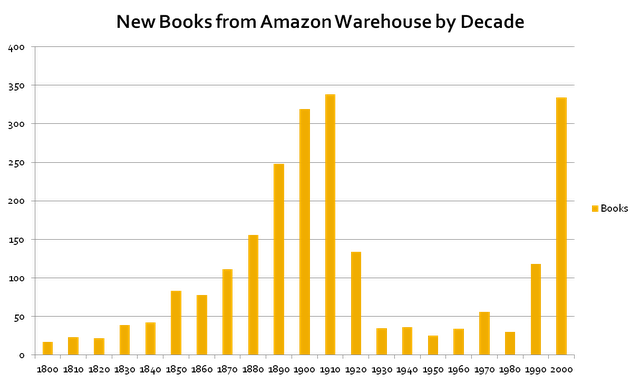
Here’s a graphical representation of how the copyright laws interact with Amazon’s ability/interest in stocking or otherwise making available older still-in-copyright works (graphic from 2015):
So, what’s the Disney connection?
The details of copyright law get complicated fast, but they date back to the original grant in the Constitution that gives Congress the right to bestow exclusive rights to a creator for “limited times.” In the first copyright act in 1790, that was 14 years, with the option to apply for an automatically granted 14-year renewal. By 1909, both terms had grown to 28 years. In 1976, the law was radically changed to harmonize with the Berne Convention, an international agreement originally signed in 1886. This switched expiration to an author’s life plus 50 years. In 1998, an act named for Sonny Bono, recently deceased and a defender of Hollywood’s expansive rights, bumped that to 70 years.
The Sonny Bono Act was widely seen as a way to keep Disney’s Steamboat Willie from slipping into the public domain, which would allow that first appearance of Mickey Mouse in 1928 from being freely copied and distributed. By tweaking the law, Mickey got another 20-year reprieve. When that expires, Steamboat Willie can be given away, sold, remixed, turned pornographic, or anything else. (Mickey himself doesn’t lose protection as such, but his graphical appearance, his dialog, and any specific behavior in Steamboat Willie — his character traits — become likewise freely available. This was decided in a case involving Sherlock Holmes in 2014.)
The reason that New Year’s Day 2019 has special significance arises from the 1976 changes in copyright law’s retroactive extensions. First, the 1976 law extended the 56-year period (28 plus an equal renewal) to 75 years. That meant work through 1922 was protected until 1998. Then, in 1998, the Sonny Bono Act also fixed a period of 95 years for anything placed under copyright from 1923 to 1977, after which the measure isn’t fixed, but based on when an author perishes. Hence the long gap from 1998 until now, and why the drought’s about to end.
April 5, 2018
The Forgotten Foundations Part 2 – The History of Sci Fi – Extra Sci Fi – #5
Extra Credits
Published on 3 Apr 2018We’re gonna dive into the TRULY wacky and wild stories of early science fiction, including a Czech play that invented the word “robot.”
March 31, 2018
If anybody could be described as Machiavellian, it’d surely be Machiavelli, right?
At the Foundation for Economic Education, Paul Meany tries to rescue the reputation of Niccolò Machiavelli:
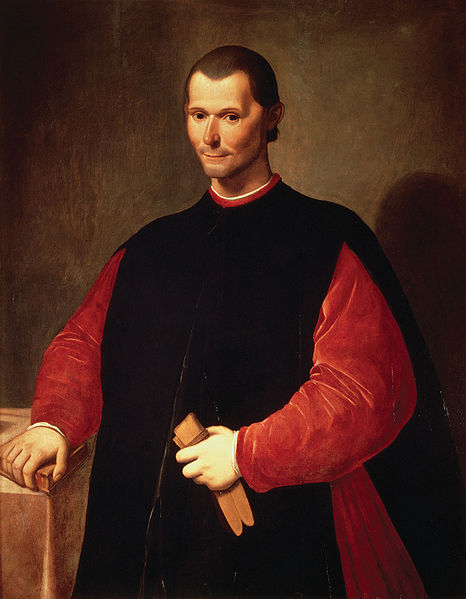
Portrait of Niccolò Machiavelli by Santi di Tito (1536-1603)
Via Wikimedia Commons.If you have ever studied Shakespeare, you might have heard your teacher use the word “Machiavellian” to describe amoral characters such as Iago from Othello or Edmund from King Lear. “Machiavellian” denotes a person or action that disregards morality and is wholly self-serving. The origin of the word derives from the famous Florentine politician and writer Niccoló Machiavelli.
[…]
Published posthumously, The Prince left Machiavelli with an infamous reputation as an amoral, atheistic, and cynical writer. In 1559, the Catholic Church put Machiavelli’s works on the Index of Prohibited Books. In the play The Jew of Malta by Christopher Marlowe, written in 1589, Machiavelli appears in the prologue, boldly exclaiming, “I count religion but a childish toy, and hold there is no sin but ignorance.”
Machiavelli came to be associated with an Elizabethan term, “Old Nick,” used to denote the devil. There is a subject of modern psychology, known as the “dark triad,” which focuses on three malevolent personality traits: narcissism, psychopathy, and Machiavellianism.
However, this deeply negative image of Machiavelli did not always exist. In the 17th and 18th centuries, a more positive view of Machiavelli emerged, with authors such as the Republican James Harrington referring to Machiavelli as “the prince of politicians.” During the Italian Renaissance, humanist Giovanni Battista Busini fondly described Machiavelli as “a most extraordinary lover of liberty.”
This praise might seem confusing; after all, the word “Machiavellian” denotes someone who is cunning and unscrupulous. How could a man so devious and pragmatic be called a lover of liberty? The answer lies with Machiavelli’s other book, known as Discourses on Livy, which presents a very different image of his political beliefs.
[…]
The stark differences between Machiavelli’s Discourses on Livy and The Prince come from the nature of the aims of each book. The Prince aims to refine the conduct of a single prince, while Discourses on Livy offers guidance for the entire citizen body. The Prince was written to address a unique political opportunity that quickly evaporated, whereas Discourses on Livy was written to articulate the principles required by republics that sought longevity, liberty, and prosperity.
To this day, there still remains a huge debate over the intricacies and contradictions that characterize Machiavelli’s writings. Machiavelli was an extremely nuanced and original thinker whose reputation should not exclusively be that of an evil schemer. He argued for a republic whose liberty is safeguarded by the common person, in which free, unhindered debate provides the best course of action, and where compromises between opposing groups create harmony. Discourses on Livy reveals another side of Machiavelli, a man committed to the ideals of freedom through the means of representative government.
March 29, 2018
The Forgotten Foundations Part 1 – The History of Sci Fi – Extra Sci Fi – #4
Extra Credits
Published on 27 Mar 2018This week, we explore the obscure authors from the turn of the 20th century whose weird and wacky stories impacted our modern-day sci fi consciousness and inspired works from authors like H.P. Lovecraft and Terry Pratchett.
Update: Fixed broken link. No idea why YouTube changed it.
March 27, 2018
Metrics are merely a tool. Like any tool they can be misused.
A big problem with depending on metrics is finding things to count that are actually useful measurements of whatever you’re tracking. A lot of bad management decisions can be traced to poorly chosen metrics. As a general rule, just because something can be measured doesn’t automatically mean that measurement will be useful. Tim Harford reviews a recent book on metrics:
Jerry Z Muller’s latest book is 220 pages long, not including the front matter. The average chapter is 10.18 pages long and contains 17.76 endnotes. There are four cover endorsements and the book weighs 421 grammes. These numbers tell us nothing, of course. If you want to understand the strengths and weaknesses of The Tyranny of Metrics you will need to read it — or trust the opinion of someone who has.
Professor Muller’s argument is that we keep forgetting this obvious point. Rather than rely on the informed judgment of people familiar with the situation, we gather meaningless numbers at great cost. We then use them to guide our actions, predictably causing unintended damage.
A famous example is the obsession, during the Vietnam war, with the “body count” metric embraced by US defence secretary Robert McNamara. The more of the enemy you kill, reasoned McNamara, the closer you are to winning. This was always a dubious idea, but the body count quickly became an informal metric for ranking units and handing out promotions, and was therefore often exaggerated. Counting bodies became a risky military objective in itself.
This episode symbolises the mindless, fruitless drive to count things. But it also shows us why metrics are so often used: McNamara was trying to understand and control a distant situation using the skills of a generalist, not a general. Muller shows that metrics are often used as a substitute for relevant experience, by managers with generic rather than specific expertise.
Muller does not claim that metrics are always useless, but that we expect too much from them as a tool of management. For example, if a group of doctors collect and analyse data on clinical outcomes, they are likely to learn something together. If bonuses and promotions are tied to the numbers, the exercise will teach nobody anything and may end up killing patients. Several studies have found evidence of cardiac surgeons refusing to operate on the sickest patients for fear of lowering their reported success rates.
March 26, 2018
Rick McGinnis on Jordan Peterson’s 12 Rules For Life: An Antidote to Chaos
Peterson’s book and lecture series has been much in the news lately, so Rick McGinnis shares his thoughts, particularly about the message and intended audience for 12 Rules for Life:
It was probably inevitable that this sudden notoriety would create a demand for a book-length statement of principles from Peterson, and he obliged earlier this year with 12 Rules For Life: An Antidote to Chaos. Deceptively packaged as a self-help tome, the book expands on a series of postings Peterson made on Quora, a crowdsourcing website that, instead of asking for money, invites its readers to contribute answers to questions posed by other readers.
The book’s structure is straightforward; after sketching in the origin of the dozen precepts, he states them at the outset of each chapter, explains them in varying degrees of complexity with examples from his practice as a clinical psychologist, anecdotes from his own life or – and this is proving to be most tantalizing – ruminations on quotes from history, philosophy, mythology or (most often of all) the Bible.
On the surface, Peterson’s edicts for a good life are self-evident: Stand straight; Obey the Golden Rule; Choose your friends wisely; Set yourself reasonable expectations; Raise your children well; Don’t be a hypocrite; Cherish meaning; Don’t lie; Listen before you speak; Choose your words carefully; Let children fail so they learn to succeed; Be kind to animals.
But lest you think that short paragraph should save anyone the price of the book, it has to be understood that we are at least a generation, perhaps several, from the point where these commonsensical statements were known, understood or accepted by any sane adult. We are, at the end of a century of phenomenal technological advances and cataclysmic history, sorely in need of a book-length exposition on phrases that you’d once expect to find on needlework samplers.
Early on and quite often, Peterson comes across with butt-clenching dread as the smartest-man-in-the-room, laying out the stories behind the facts, culled from his years of reading and research, with the force and volume of a firehose. He relies heavily on evolutionary biology to explain our hardwired need to create and find our place in hierarchies, with examples that distill our endlessly troubling social responses to bluff, authority, and even violence down to chemical and neurological mechanisms set in place way back in time with far less complex creatures (a scenario that’s easily satirized as “we are all lobsters”).
It’s been observed – and confirmed by Peterson – that the ideal audience for his book is young people in general and young men in particular. As a former young man, I can attest that being told by a wise older man, clearly on your side but unwilling to sugar coat the facts, that the bully and the big-man-on-campus are better armed than you are to jockey for status and fulfillment – the alpha lobsters, waving their claws around to appreciable effect – is very much less than comforting. Peterson’s ideal audience will have to endure the climb up a very steep hill of biological determinism to reach the far more hospitable plateau beyond.
I’m not saying Peterson is wrong. From the perspective of an older man, I’ve seen this lobster battle played out too many times to deny its plausibility. But I’d be remiss if I didn’t suggest that the ideologies that he decries, imagining that there is no biological determinism – not even the binary division of gender – or even a landscape governed by measurable standards or objective truth, is far more appealing to young people raised to believe in an ever-expanding entitlement of “rights” and a pursuit of “justice” that needs to triumph above history or biology.
It’s when Peterson tries to explain the philosophical and even theological roots of our cultural systems that things might be rewarding, for both young and older readers. He has a core group of texts that he relies upon, with particular emphasis on Dostoyevsky and Solzhenitsyn on the modern side, and while he will evoke ancient mythology – the gods of Egypt make several appearances, though even he can’t overcome the essential strangeness of their myths – he reaps more rewardingly from the Bible, especially in one passage where he analyzes the difference between the Old and New Testament God.
March 21, 2018
The History of Science Fiction – Pseudo-Science – Extra Sci Fi – #3
Extra Credits
Published on 20 Mar 2018The turn of the 20th century brought a lot of new ideas and inventions to the world. Suddenly, nature’s laws were not quite what they seemed. Thus, many folks drifted into explorations of the occult, which directly influenced 19th and 20th century science fiction.


