Quotulatiousness

February 14, 2018

George Orwell’s 1984 in 5 mins – Animated

Filed under: Books, Liberty — Tags: — Nicholas @ 02:00

Shaun McKinnon
Published on 8 Jan 2014

A Happy Orwellian 2014 to you all!
Winston Smith’s adventure animated in cartoon form.
Check out George Orwell’s 1984 Video: Synopsis, analysis, and discussion of major characters and themes in the novel.
Doublethink. Thought Police. Big Brother is Watching You. Julia. Ministry of Truth.
Nineteen Eighty-Four. Room 101.
Obama. NSA. Snowden.
SparkNote Documentary. Audiobook.
Made by Shaun McKinnon in Australia.

February 13, 2018

Elon Musk as Heinlein’s Delos D. Harriman – “Selling the moon is just what Musk is doing”

Filed under: Books, Business, Space — Tags: , , , , — Nicholas @ 06:00

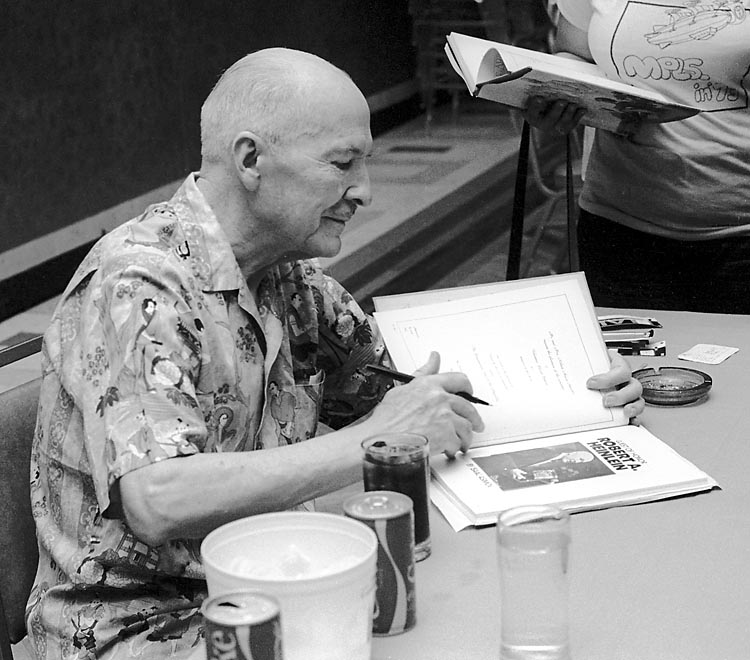
I suspect I’d recognize a lot of the books in Colby Cosh‘s collection, as we’re both clearly Robert Heinlein fans. In a column yesterday, he pointed out the strong parallels between Heinlein’s fictional “Man Who Sold the Moon” and his closest counterpart in our timeline, Elon Musk:

Written between 1939 and 1950 for quickie publication in pulp magazines, the Future History is a series of snapshots of what is now an alternate human future — one that features atomic energy, solar system imperialism, and the first steps to deep space, all within a Spenglerian choreography of social progress and occasional resurgent barbarity. It stands with Isaac Asimov’s Foundation trilogy as a monument of golden-age science fiction.

[…]

The result, in the key story of the Future History, is an uncannily accurate description of the design and launch of a Saturn V rocket. (Written before 1950, remember.) But because Heinlein happened not to be interested in electronic computers, all the spacefaring in his books is done with the aid of slide rules or Marchant-style mechanical calculators (which, in non-Heinlein history, had to become obsolete before humans could go to Luna at all). Heinlein sends people to colonize the moon, but nobody there has internet, or is conscious of its absence.

Given that his ideas about computers were from the pre-computer era and even the head of IBM thought there’d be a worldwide demand for a very small number of his company’s devices, that’s not surprising at all. In one of his best novels, a single computer runs almost all of the life support, heat, light, transportation and communication systems on Luna … and is self-aware, but lonely. In later works where computers appear, they tend to be individual personalities or even minor characters, but they’re anything but ubiquitous: powerful, but rare.

I suspect the lack of an internet-equivalent derives both from the nature of his conception of how computing would progress and a form of the Star Trek transporter problem – it solves too many plot issues that could otherwise be usefully woven into stories.

The “key story” I just mentioned is called “The Man Who Sold The Moon.” And if you’re one of the people who has been polarized by the promotional legerdemain of Elon Musk — whether you have been antagonized into loathing him, or lured into his explorer-hero cult — you probably need to make a special point of reading that story.

The shock of recognition will, I promise, flip your lid. The story is, inarguably, Musk’s playbook. Its protagonist, the idealistic business tycoon D.D. Harriman, is what Musk sees when he looks in the mirror.

“The Man Who Sold The Moon” is the story of how Harriman makes the first moon landing happen. Engineers and astronauts are present as peripheral characters, but it is a business romance. Harriman is a sophisticated sort of “Mary Sue” — an older chap whose backstory encompasses the youthful interests of the creators of classic pulp science fiction, but who is given a great fortune, built on terrestrial transport and housing, for the purposes of the story.

February 10, 2018

When cinematography wins out over reality

Filed under: Books, Media, Space — Tags: , , , , — Nicholas @ 05:00

Earlier this month, Charles Stross talked about why he’s been reading less and less science fiction lately, and touched on SF movies and (for example) why George Lucas chose to model space combat on World War 1 aircraft battles:

When George Lucas was choreographing the dogfights in Star Wars, he took his visual references from film of first world war dogfights over the trenches in western Europe. With aircraft flying at 100-200 km/h in large formations, the cinema screen could frame multiple aircraft maneuvering in proximity, close enough to be visually distinguishable. The second world war wasn’t cinematic: with aircraft engaging at speeds of 400-800 km/h, the cinematographer would have had a choice between framing dots dancing in the distance, or zooming in on one or two aircraft. (While some movies depict second world war air engagements, they’re not visually captivating: either you see multiple aircraft cruising in close formation, or a sudden flash of disruptive motion — see for example the bomber formation in Memphis Belle, or the final attack on the U-boat pen in Das Boot.) Trying to accurately depict an engagement between modern jet fighters, with missiles launched from beyond visual range and a knife-fight with guns takes place in a fraction of a second at a range of multiple kilometres, is cinematically futile: the required visual context of a battle between massed forces evaporates in front of the camera … which is why in Independence Day we see vast formations of F/A-18s (a supersonic jet) maneuvering as if they’re Sopwith Camels. (You can take that movie as a perfect example of the triumph of spectacle over plausibility at just about every level.)

… So for a couple of generations now, the generic vision of a space battle is modelled on an air battle, and not just any air battle, but one plucked from a very specific period that was compatible with a film director’s desire to show massed fighter-on-fighter action at close enough range that the audience could identify the good guys and bad guys by eye.

Let me have another go at George Lucas (I’m sure if he feels picked on he can sob himself to sleep on a mattress stuffed with $500 bills). Take the asteroid field scene from The Empire Strikes Back: here in the real world, we know that the average distance between asteroids over 1km in diameter in the asteroid belt is on the order of 3 million kilometers, or about eight times the distance between the Earth and the Moon. This is of course utterly useless to a storyteller who wants an exciting game of hide-and-seek: so Lucas ignored it to give us an exciting game of …

Unfortunately, we get this regurgitated in one goddamned space opera after another: spectacle in place of insight, decolorized and pixellated by authors who haven’t bothered to re-think their assumptions and instead simply cut and paste Lucas’s cinematic vision. Let me say it here: when you fuck with the underlying consistency of your universe, you are cheating your readers. You may think that this isn’t actually central to your work: you’re trying to tell a story about human relationships, why get worked up about the average spacing of asteroids when the real purpose of the asteroid belt is to give your protagonists a tense situation to survive and a shared experience to bond over? But the effects of internal inconsistency are insidious. If you play fast and loose with distance and time scale factors, then you undermine travel times. If your travel times are rubberized, you implicitly kneecapped the economics of trade in your futurescape. Which in turn affects your protagonist’s lifestyle, caste, trade, job, and social context. And, thereby, their human, emotional relationships. The people you’re writing the story of live in a (metaphorical) house the size of a galaxy. Undermine part of the foundations and the rest of the house of cards is liable to crumble, crushing your characters under a burden of inconsistencies. (And if you wanted that goddamn Lucasian asteroid belt experience why not set your story aboard a sailing ship trying to avoid running aground in a storm? Where the scale factor fits.)

Whatever you do, don’t go asking him about Han Solo’s claimed Kessel Run in less than 12 parsecs…

February 8, 2018

Dilbert’s Scott Adams Explains How He Knew Trump Would ‘Win Bigly’

Filed under: Books, Media, Politics, USA — Tags: , — Nicholas @ 06:00

ReasonTV
Published on 7 Feb 2018

The cartoonist-turned-political-prognisticator talks about Trump, “master persuaders,” and winning arguments in a “world where facts don’t matter.”

—————-

In 2015, Scott Adams, the cartoonist behind the massively popular comic strip Dilbert, boldly predicted that Donald Trump would win the 2016 presidential election.

“The reason I can see it coming is because I have studied this field of persuasion,” says Adams. “I saw this Trump character and he had the full tool set.” The 60-year-old Bay Area resident doesn’t agree with Trump on many political issues, but his prediction was enough for his to receive death threats from embittered Hillary Clinton supporters.

Adam’s new book, Win Bigly: Persuasion in a World Where Facts Don’t Matter, is both a detailed analysis of how Trump reframed political rhetoric during the 2016 campaign and a guide to how all of us can communicate more effectively and persuasively.

Adams sat down with Reason‘s Nick Gillespie in front of a live audience in San Francisco to talk about his book, his “extreme liberal” views, the popularity of his live broadcasts with followers via Twitter, and why Trump is a “master persuader.”

Cameras by Zach Weismueller, Paul Detrick, and Justin Monticello. Edited by Ian Keyser.

February 7, 2018

The Martian Chronicles – Too Human – Extra Sci Fi – #12

Filed under: Books — Tags: , — Nicholas @ 04:00

Extra Credits
Published on 6 Feb 2018

The second half of Ray Bradbury’s Martian Chronicles can be described as “the human cycle” — a reflection on humanity’s seemingly insatiable need to conquer and consume every last bit of our own culture.

February 2, 2018

Trump Diminishes the Power of the State in Our Heads: Wired Co-Founder Louis Rossetto

Filed under: Books, Liberty, Technology, USA — Tags: , , , — Nicholas @ 06:00

ReasonTV
Published on 1 Feb 2018

Louis Rossetto, co-founder of Wired magazine, on politics, the dot-com bubble, and his new novel, Change Is Good: A Story of the Heroic Era of the Internet.
—————-
“Trump is a refreshing reminder that the guy that’s in the White House is another human being,” says Louis Rossetto, the co-founder of Wired and author of the new book Change Is Good: A Story of the Heroic Era of the Internet. “The power of the state is way too exalted [and] bringing that power back to human scale is an important part of what needs to be done to correct the insanity that’s been going on in the post-war era.”

In 2013, Rossetto was the co-recipient of Reason‘s very first Lanny Friedlander Prize, an award named after the magazine’s founder that’s handed out annually to an individual or group who has created a publication, medium, or distribution platform that vastly expands human freedom. Rossetto is also a longtime libertarian who knew Friedlander personally.

While still an undergraduate at Columbia University, Rossetto co-authored a 1971 cover story in the New York Times Magazine titled “The New Right Credo — Libertarianism,” writing that “[l]iberalism, conservatism, and leftist radicalism are all bankrupt philosophies,” and “refugees from the Old Right, the Old Left and the New Left, they are organizing independently under the New Right banner of libertarianism.”

Reason‘s Nick Gillespie sat down with Rossetto to talk about his new book (the paper version was lavishly designed and crowdfunded on Kickstarter), the 1990s tech boom, and why Trump “diminishes the power of the state” in our heads.

Interview by Nick Gillespie. Edited by Ian Keyser. Cameras by Paul Detrick, Justin Monticello, Zach Weissmueller.
Machinery by Kai Engel is used under a Creative Commons license.
Photo Credits: Chris Kleponis/ZUMA Press/Newscom – Jonathan Ernst/Reuters/Newscom – Abaca Press/Douliery Olivier/Abaca/Sipa USA/Newscom

February 1, 2018

The Martian Chronicles – A Dying Race – Extra Sci Fi – #11

Filed under: Books — Tags: , , , — Nicholas @ 04:00

Extra Credits
Published on 30 Jan 2018

We’re diving into Ray Bradbury’s short stories about life on Mars — and how that life reacts when it encounters human life, and what *their* reaction says about American society in the Cold War era.

January 29, 2018

A new collection of H.L. Mencken’s “The Free Lance” columns

Filed under: Books, History, Liberty, Media, USA — Tags: , , , , — Nicholas @ 05:00

In Reason, Bill Kauffman reviews S.T. Joshi’s new selection from H.L. Mencken’s Baltimore Evening Sun essays:

The longtime Baltimore Evening Sun columnist, American Mercury editor, and rumbustiously splenetic critic, who graced this orb from 1880 to 1956, would not be published in any major newspaper today. The reasons he foresaw over a century ago, when he decried the “cheap bullying and cheaper moralizing” whose purpose was the extirpation, the annihilation, of anything resembling a robust exchange of ideas. Two beliefs puffed up the righteous censor, according to Mencken: first, “that any man who dissents from the prevailing platitudes is a hireling of the devil,” and second, “that he should be silenced and destroyed forthwith. Down with free speech; up with the uplift!”

Plus ça change and all that.

S.T. Joshi, who has chosen his primary scholarly interests — Mencken, H.P. Lovecraft, and Ambrose Bierce — with a fine eye for readability over reputation, has assembled a selection of Mencken’s Evening Sun “Free Lance” columns of 1911–1915 into a book called A Saturnalia of Bunk and contributed an informative introduction to it.

Henry Louis Mencken churned out six of these 1,200-word meringues every week, a vertiginous pace that makes Joyce Carol Oates look like Harper Lee.

Logorrheic bloggers aside, does anyone really have that much to say about the controversies of the day? Mencken once nicked Bierce for reprinting his early work, which was “filled with epigrams against frauds long dead and forgotten, and echoes of old and puerile newspaper controversies.” Is A Saturnalia of Bunk similarly irrelevant?

Happily, no. Although Mencken’s fusillades against, say, blue laws have grown fusty, his rousing conclusions — “the militant moralist tries to steal liberty and self-respect, and the man who has lost both is a man who has lost everything that separates a civilized freeman from a convict in a chain-gang” — have lost none of their punch.

These columns, composed while their author was on the shy side of middle age, afford, says Joshi, “a nearly complete view of Mencken’s political, religious, social, and cultural philosophy as it had evolved up to this point” — and this philosophy would largely remain constant for the rest of his rooted life. (Mencken, a dyed-in-the-wool third-generation Baltimorean, a sardonic citizen of his place, made his home in the house in which he grew up.)

QotD: Churchill’s drinking habits

Filed under: Books, Britain, Politics, Quotations — Tags: , , , — Nicholas @ 01:00

In the not so distant past around the sodden precincts of Westminster you were as likely to spot a yeti as a sober politician. The level of drinking that went on among MPs and their leeches for most of the last century was prodigious and was by and large expected. It was, as Ben Wright describes in his breezy, anecdote-rich and instructive survey of booze and politics, part of a culture which was tolerated and, to a degree, encouraged.

It was not without justification, for instance, that Adolf Hitler, who might have been a nicer fellow had he not been a teetotaller, described Winston Churchill as an “insane drunkard”, a “garrulous drunkard”, and “whisky-happy”.

If Order, Order! has a star it is undoubtedly Churchill who rarely let a day go by able to pass a breathalyser test. On occasion he would have a glass of wine at breakfast followed by a liquid lunch which invariably included Champagne and brandy. At tea-time he would progress to whisky. Then he would wash down dinner with more Champagne and brandy after which he had at least another whisky. According to one loyal aide who may have been sight impaired he was never the worse for wear for this intake and he “never felt the slightest ill-effects in the morning”.

Alan Taylor, “Lush tales of our political classes’ drinking exploits”, The National, 2016-06-20.

January 26, 2018

Ursula K. Le Guin, RIP

Filed under: Books — Tags: , , — Nicholas @ 05:00

I’m sorry to say that I’ve never read any of her work, but this obituary by Jude Karabus (especially this section) makes me think I missed out:

A lot of her work – like that of all the literary greats – had to do with thought experiments: What if the relationship between power and gender were different; what if you didn’t – for good or for bad – have to think about whether you wanted to have sex with someone when you interacted with them? What of the profit motive and humankind’s uneasy relationship with war, the environment and its own nature. Her work was, of course, unflinchingly feminist, humanist also.

There is a yellowed, slightly dog-eared copy of 1974’s The Dispossessed, complete with art nouveau-style illustration, on the shelf of the William Morris Gallery in London. It has a placard beneath it that reads something like: “This is the type of thing Morris was banging on about”. (Morris was a 19th-century English textile designer and social activist who brought art to the ‘lower’ classes by mass-producing tiles, wallpaper and other fine furnishings.)

It seems an odd choice by the curator; it’s the only book in the display that wasn’t literally written by a Morris compatriot or a known influence on him, and she was born years after he died. They were certainly of similar political bent, wanted to make art affordable etc, but only if you squint a little. The book was also written before I was born. There’s probably a connection I didn’t understand; perhaps the cover art was “a Morris” (he also painted and wrote poetry) – the terse note propped up against it doesn’t make it clear. But I like to think the curator was grabbed by the throat by her prose, like I was, and was simply looking for any excuse to say: “Here. Sit down. Read this! No really. Read this.”

A quick overview of the life and work of William Morris here.

QotD: Britain’s boozy parliamentarians

Filed under: Books, Britain, Politics, Quotations — Tags: , , , , — Nicholas @ 01:00

It is Wright’s contention [in his book Order! Order!] that alcohol has as many benefits as it does drawbacks. Not only does it help loosen ties and tongues it also boosts confidence and dilutes stress. Most prime ministers drank, many to excess. Herbert Asquith went by the nickname “Squiffy Asquith” and regularly appeared in the Commons three sheets to the wind. Margaret Thatcher did her best to promote the whisky industry, the uncapping of a bottle of Bell’s marking the end of the working day. She believed that whisky rather than gin was good for you because “it will give you energy”, which I fear could be a hard fact to prove scientifically.

Tony Blair, whose reign ushered in an era of 24-hour drinking, thought his relatively modest drinking was getting out of control because he calculated it exceeded the government’s weekly recommended limit. This did not impress Dr John Reid, Bellshill’s finest, who once drank like a navvy. “Where I come from,” Reid told GMTV, “a gin and tonic, two glasses of wine, you wouldn’t give that to a budgie.” Blair, of course, did not have to look further than next door to find an explanation why his consumption increased over the years. Gordon Brown, his nemesis, was fond of Champagne – Möet & Chandon no less – which he did not nurse but washed down in a gulp. “He was like the cookie monster,” recalled one aide. “Down in one, whoosh!” Drinking is of course one of those areas in which we Scots have long punched above our weight and Wright’s pages are replete with examples of intoxicated Jocks carousing nights away and causing mayhem. Former Labour leader John Smith was one such. Occasionally I encountered him on the overnight train that carried Scottish MPs home from Westminster on a Thursday night. Known as “the sleeper of death”, it was a mobile pub that never closed until it reached Waverley, whereupon politicians were disgorged red-eyed and pie-eyed among bemused early morning commuters.

Alan Taylor, “Lush tales of our political classes’ drinking exploits”, The National, 2016-06-20.

January 25, 2018

The Canals of Mars – Eye of the Beholder – Extra Sci Fi – #10

Filed under: Books, History, Space — Tags: , , — Nicholas @ 04:00

Extra Credits
Published on 23 Jan 2018

The Canals of Mars ignited so many imaginations, especially in science fiction stories, but they never really existed. What made us believe in them? And why did so many writers keep dreaming about them even after the theory had been disproved?

January 24, 2018

Charles Stross on Heinlein’s “Crazy Years” notion

Filed under: Books, Media, Randomness — Tags: , , , — Nicholas @ 05:00

Heinlein called it, back in the 1940s, and Charles Stross provides a few more data points to prove he was quite right:

Many, many years ago, in the introduction to my first short story collection, I kvetched about how science fictional futures obsolesce, and the futures we expect look quaint and dated by the time the reality rolls round.

Around the time I published “Toast” (the title an ironic reference to the way near-future SF gets burned by reality) I was writing the stories that later became Accelerando. I hadn’t really mastered the full repertoire of fiction techniques at that point (arguably, I still haven’t: I’ll stop learning when I die), but I played to my strengths — and one technique that suited me well back then was to take a fire-hose of ideas and spray them at the reader until they drowned. Nothing gives you a sense of an immersive future like having the entire world dumped on your head simultaneously, after all.

Now we are living in 2018, round the time I envisaged “Lobsters” taking place when I was writing that novelette, and the joke’s on me: reality is outstripping my own ability to keep coming up with insane shit to provide texture to my fiction.

Just in the past 24 hours, the breaking news from Saudi Arabia is that twelve camels have been disqualified from a beauty pageant because their handlers used Botox to make them more handsome. (The street finds its uses for tech, including medicine, but come on, camel beauty pageant botox should not be a viable Google search term in any plausible time line.) Meanwhile, home in Edinburgh, eight vehicles have been discovered trapped in an abandoned robot car park during demolition work. This is pure J. G. Ballard/William Gibson mashup territory, and it’s about half a kilometre from my front door. The world’s top 1% earned 82% of all wealth generated in 2017 — I’m fairly sure this wasn’t what Adam Smith had in mind — and South Korea has such a high suicide rate that the government intends to make organising a suicide pact a criminal offence.

Go home, 2018, you’re drunk. (Or, as Robert Heinlein might have put it: these are the crazy years, and they’re not over yet.)

January 21, 2018

Sun Tzu – The Art of War l HISTORY OF CHINA

Filed under: Books, China, History, Military — Tags: , — Nicholas @ 02:00

IT’S HISTORY
Published on 8 Aug 2015

Sun Tzu’s The Art of War is a book on military strategies written around 500 BC, between the collapse of the Zhou dynasty and the rise of the first emperor of imperial China. Today Tzu’s guidelines are still as applicable as ever. They are still being read by military commanders, politicians and businesspeople all over the world. Also known as “Master Sun’s Military Methods”, the book explains basics like the “Strategy of Attack”, “Moving the Army” and even “Employing Spies” in 13 short chapters, restricting itself to general principles rather than detailed instructions of strategy and tactics. Learn all about this timeless and influential military masterpiece on IT’S HISTORY.

January 11, 2018

William Gibson: The Gernsback Continuum – Semiotic Ghosts – #8

Filed under: Books — Tags: , , — Nicholas @ 18:51

Extra Credits
Published on Jan 9, 2018

Ways that we dream about the world sometimes create a shared vision that we start to believe is real. When William Gibson first explored these “semiotic ghosts” of a pristine American future in the Gernsback Continuum, he showed how these visions of modern technology can separate us from our own reality and the personal meaning our world should hold for us.

« Newer PostsOlder Posts »

Powered by WordPress