Even with an American ad agency working for them, the market wasn’t ready for this in 1969:
September 9, 2010
Ever wonder why Japanese cars didn’t become popular at first
September 1, 2010
Another coping strategy for the aging demographics of Japan?
I don’t normally like to point my finger and sneer at others, but it’s hard to avoid an overwhelming feeling to do that here:
Since the marriage rate among Japan’s shrinking population is falling and with many of the country’s remaining lovebirds heading for Hawaii or Australia’s Gold Coast, Atami had to do something. It is trying to attract single men — and their handheld devices.
In the first month of the city’s promotional campaign launched July 10, more than 1,500 male fans of the Japanese dating-simulation game LovePlus+ have flocked to Atami for a romantic date with their videogame character girlfriends.
The men are real. The girls are cartoon characters on a screen. The trips are actual, can be expensive and aim to re-create the virtual weekend outing featured in the game, a product of Konami Corp. played on Nintendo Co.’s DS videogame system.
That part is disturbing enough, but it gets more creepy:
“Atami has always been a romantic place, but it is now a romantic place for a modern generation,” says Sakae Saito, Atami’s mayor.
Love Plus+ re-creates the experience of an adolescent romance. The goal isn’t just to get the girl but to maintain a relationship with her.
After choosing one of three female characters — goodie-goodie Manaka, sassy Rinko or big-sister type Nene — to be a steady girlfriend, the player taps a stylus on the DS touch-screen in order to walk hand-in-hand to school, exchange flirtatious text messages and even meet in the school courtyard for a little afternoon kiss. Using the device’s built-in microphone, the player can carry on sweet, albeit mundane, conversations.
This will really boost Japan’s chances of retaining the “Weirdest country on Earth” title again for 2010. Korea will really have to work hard to overtake this new Japanese initiative.
August 6, 2010
QotD: Nuclear weapons
Sixty-five years ago today: “On Monday, August 6, 1945, the nuclear weapon Little Boy was dropped on Hiroshima by the crew of the American B-29 bomber Enola Gay, directly killing an estimated 80,000 people. By the end of the year, injury and radiation brought total casualties to 90,000-140,000. Approximately 69% of the city’s buildings were completely destroyed, and 6.6% severely damaged.” – Hiroshima
“Little Boy,” the aptly named 16 kiloton bomb that took out Hiroshima, was — in comparison to the nuclear devices in the world’s arsenals — sort of a light field artillery shell. There was, at the time, a second bomb called “Fat Man.” Weighing in at 21 kilotons it would put paid to Nagasaki on August 9, 1945. With the erasure of Nagasaki, the world was fresh out of nuclear weapons. It was only a temporary lapse. Today we’ve got about 25,000 of these little items of discipline scattered about.
The largest nuclear bomb ever detonated in the atmosphere was The Soviet Tsar Bomba , or “Big Ivan” which at 50 Megatons was very harmful to every living think on Novaya Zemlya Island (located above the arctic circle in the Arctic Sea) in October of 1971. Whatever else you might think about them, you can’t deny those Soviets dreamed BIG dreams.
Gerard Vanderleun, “Nukes: Time for a Live Demo”, American Digest, 2010-07-06
August 3, 2010
Japan’s centenarians are going missing
After the discovery that the oldest man in Tokyo had actually been dead for years, it should come as no surprise that the oldest woman in Tokyo has apparently been missing for decades:
Fusa Furuya, aged 113, had been registered as living with her daughter.
But the daughter says she has not seen her mother since the 1980s.
According to government data, there are more than 40,000 centenarians in Japan. But the discoveries in Tokyo have cast doubt on the accuracy of the figures.
Despite being reputed to be Tokyo’s oldest woman, it appears no-one had bothered to check that Mrs Furuya was still alive — until now.
Local council officials have been visiting the very elderly after the body of Sogen Kato, thought to be Tokyo’s oldest man, was found last week.
The police believe he had been dead for more than 30 years.
When officials went to Ms Furuya’s home, they discovered that she had been missing for decades.
Unlike the earlier case, where the man’s family had continued to collect his pension, the family of Fusa Furuya don’t appear to have been involved in pension fraud . . . although you do wonder why they hadn’t noticed her being missing all this time.
June 4, 2010
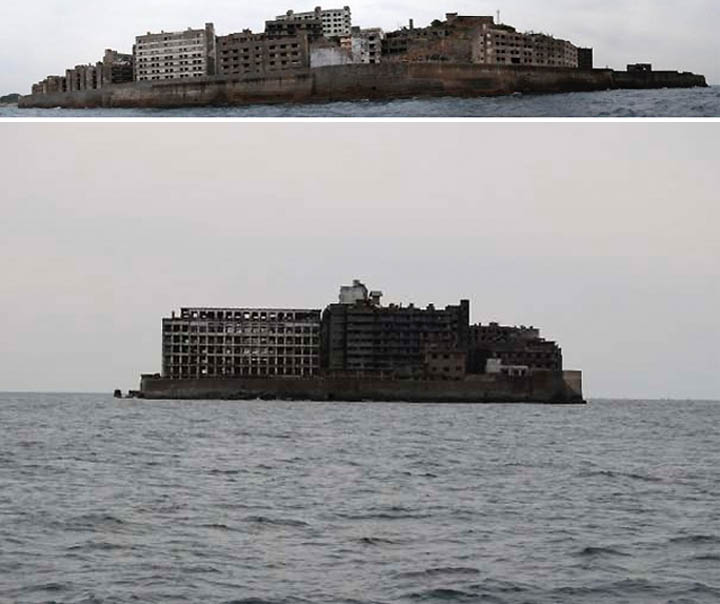
Detroit has no monopoly on post-apocalyptic urban scenery
For example, check the images from Battleship Island (Gunkanjima) in Japan:

What’s now decay and rot once was bright and brilliantly full of hope: Who lived here? What were their lives like? What happened? How did it all come apart? How did it all crumble to almost nothing?
In the case of Hashima Island, or Battleship Island (Gunkanjima in Japanese) as it’s often called, hope and optimism became dust and decay because one black resource (coal) was replaced by a cheaper black resource (oil). Populated first in 1887, the island — which is 15 kilometers from Nagasaki — only began to really, and phenomenally, become populated much later, in 1959.
Even the nickname “Battleship Island” has a bit of history behind it.
H/T to Ace of Spades for the original link.
April 15, 2010
Uninhabited islands could be flashpoint in Sino-Japanese conflict
A group of uninhabited islands south of Okinawa have the potential to increase tensions between China and Japan. The Senkaku island group is subject to overlapping claims from China, Taiwan, and Japan:
Japan reports that, for the third time in the past 18 months, Chinese warships have been spotted south of the Japanese Island of Okinawa. This time, it was two Chinese submarines, running on the surface. That had never been seen before, in the area near the Senkaku islands (which are claimed by China, Taiwan and Japan). The Senkakus are eight uninhabited islands, which in the past were only used occasionally by fishermen. The Senkakus are 220 kilometers from Taiwan, 360 kilometers from China and 360 kilometers from Okinawa (which is part of Japan).
[. . .]
Five years ago, a Chinese oil drilling platform, in disputed waters halfway between China and the Japanese island of Okinawa, began producing natural gas, despite ongoing negotiations over who owns what in that patch of ocean. The Chinese spent two years building that platform, in waters claimed by Japan. A second platform was later built, as well as an underwater oil pipeline for both platforms. China regularly sends groups of warships to patrol the area, to underline their belief that this bit of water is under Chinese control. Japan would probably win any naval war with China, but since China has nuclear weapons, and Japan does not (at least not right now), such a war could go seriously against Japan. This has been brought up in Japan before, and it is feared that the issue may lead to Japan secretly, or openly, building nuclear weapons (which it could certainly do, and quite quickly.)
I’m certainly hoping that this is just speculation on the part of Strategy Page (the bit about nuclear weapons), as territorial disputes over islands do have a way of getting out of hand (see Falkland Islands, for example).
February 5, 2010
China ramps up submarine activity
Strategy Page reports on increased activity around China’s maritime periphery:
Recently, the Taiwanese Navy detected an unidentified submarine outside one of its major naval bases. Ships and helicopters pursued the contact, but the suspected submarine left the area. A Chinese boat was suspected, mainly because for the last decade, Chinese subs have increasingly been showing up close to Japan and South Korea as well.
[. . .]
Chinese Song class diesel electric and Han class nuclear powered boats have been detected and tracked with increasing frequency over the last few years. In that time, one of each of these was spotted stalking the American carrier USS George Washington, as it headed to South Korea for a visit.
China is rapidly acquiring advanced submarine building capabilities, and providing money (for fuel and spare parts) to send its subs to sea more often. Moreover, new classes of boats are constantly appearing. The new Type 39A, or Yuan class, looks just like the Russian Kilo class. In the late 1990s, the Chinese began ordering Russian Kilo class subs, then one of the latest diesel-electric design available. Russia was selling new Kilos for about $200 million each, which is about half the price other Western nations sell similar boats for. The Kilos weigh 2,300 tons (surface displacement), have six torpedo tubes and a crew of 57. They are quiet, and can travel about 700 kilometers under water at a quiet speed of about five kilometers an hour. Kilos carry 18 torpedoes or SS-N-27 anti-ship missiles (with a range of 300 kilometers and launched underwater from the torpedo tubes.) The combination of quietness and cruise missiles makes Kilo very dangerous to American carriers. North Korea and Iran have also bought Kilos.
February 1, 2010
October 23, 2009
Worst. Promotion. Ever.
Behold the culinary crime that Microsoft is committing in Japan:
Microsoft is celebrating the release of Windows 7 in Japan with a Burger King promotion for the Windows 7 Whopper: Seven patties stacked on top of one another in one sandwich. Given that Microsoft has been criticized for releasing top-heavy, bloated operating systems, this could be one of its worst promotional ideas ever.
The Windows 7 Whopper weighs in with about 1,000 calories, and likely packs enough cholesterol to require immediate surgery for anyone foolhardy enough to try eating one. It’s a full five inches thick, and costs the equivalent of $8.50.