Quotulatiousness

March 12, 2011

Earthquake, tsunami, and worse

Filed under: Environment, Japan, Pacific — Tags: , , , , — Nicholas @ 12:04

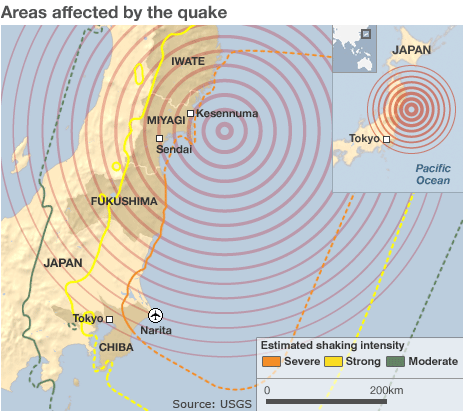
The earthquake by itself was one of the biggest ever recorded, and then the tsunami compounded the quake damage and will make relief and rescue efforts that much harder. Kevin Voigt has more:

The powerful earthquake that unleashed a devastating tsunami Friday appears to have moved the main island of Japan by 8 feet (2.4 meters) and shifted the Earth on its axis.

“At this point, we know that one GPS station moved (8 feet), and we have seen a map from GSI (Geospatial Information Authority) in Japan showing the pattern of shift over a large area is consistent with about that much shift of the land mass,” said Kenneth Hudnut, a geophysicist with the U.S. Geological Survey (USGS).

Reports from the National Institute of Geophysics and Volcanology in Italy estimated the 8.9-magnitude quake shifted the planet on its axis by nearly 4 inches (10 centimeters).

The temblor, which struck Friday afternoon near the east coast of Japan, killed hundreds of people, caused the formation of 30-foot walls of water that swept across rice fields, engulfed entire towns, dragged houses onto highways, and tossed cars and boats like toys. Some waves reached six miles (10 kilometers) inland in Miyagi Prefecture on Japan’s east coast.

Another major concern is the ongoing struggle to regain control of one of the reactors at the Fukushima Daiichi nuclear power plant:

An explosion at an earthquake-struck nuclear plant was not caused by damage to the nuclear reactor but by a pumping system that failed as crews tried to bring the reactor’s temperature down, Chief Cabinet Secretary Yukio Edano said Saturday.

Workers at the Fukushima Daiichi plant have begun flooding the reactor containment structure with sea water to bring the reactor’s temperature down to safe levels, he said. The effort is expected to take two days.

Radiation levels have fallen since the explosion and there is no immediate danger, Edano said. But authorities were nevertheless expanding the evacuation to include a radius of 20 kilometers (about 12.5 miles) around the plant. The evacuation previously reached out to 10 kilometers.

H/T to Chris Taylor for the link.

March 11, 2011

Massive earthquake in northern Japan

Filed under: Environment, Japan, Pacific — Tags: — Nicholas @ 08:27

The largest earthquake since records began hit northern Japan at about quarter to three local time, just as the rush hour was about to start. BBC News has ongoing live coverage.

The tremor, measured at 8.9 by the US Geological Survey, hit at 1446 local time (0546 GMT) at a depth of about 24km.

A tsunami warning was extended across the Pacific to North and South America.

The Red Cross in Geneva warned that the tsunami waves could be higher than some Pacific islands, Reuters news agency said.

Coastal areas in the Philippines, Hawaii and other Pacific islands were evacuated ahead of the tsunami’s expected arrival.

New Zealand later downgraded its alert to a marine threat, meaning strong and unusual currents were expected.

March 7, 2011

Bullet train sports big nose to cure big noise

Filed under: Japan, Railways, Technology — Tags: — Nicholas @ 10:02

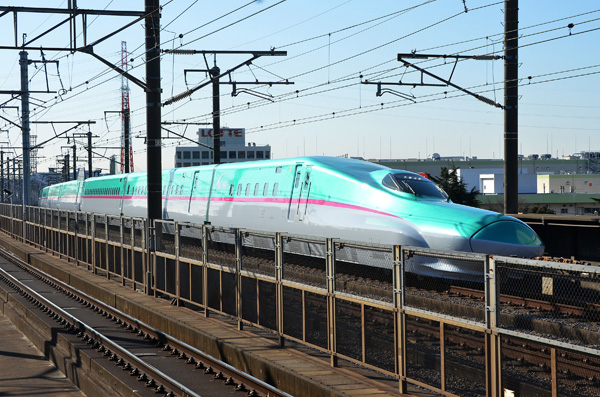
It looks rather odd, but there’s method to its ugliness:

The nose of the E5 Series, at 15 metres, is a massive 9 metres longer than the previous incarnation of the bullet train (shinkansen), the E2 Series. This, according to its designers at JR East, will help eliminate the phenomena of “tunnel boom”.

Japan’s rail tunnels are somewhat narrower than their European counterparts, so when the shinkansen enters a tunnel at speeds above 200 kilometres per hour, the sudden increase in air pressure can cause a loud “boom” at the other end of the tunnel. In some cases, such shock waves are thought to have damaged tunnels in Japan, ripping chunks of material from tunnel ceilings.

The shape of the front car has evolved gradually to combat this danger, and the striking “Long Nose” design of the E5 Series is the result.

January 26, 2011

QotD: The elephant in the living world

Filed under: Economics, Japan, Quotations — Tags: , , , — Nicholas @ 12:56

Here in peaceful and progressive Canada, it is so easy to feel smug towards larger countries that get their hands dirty in the world arena. Especially that one country built on the conquest and near eradication of its peaceful natives who have received hardly any compensation or even an apology. You know, the one founded on belligerent exceptionalism and manifest superiority over other cultures that was turned into a national religion that has historically led to imperialist conquest and mass slaughter. This country still has an actual federal law that requires all foreigners to carry their papers with them at all times, or risk being deported by any policeman who can, simply on a whim, question and detain them. The country so primitive and barbaric that it actively uses the death penalty, shrugging off international protests about it just as coldly as it does in important environmental issues. Its provincial masses bitterly cling to their traditional values while their media feeds them a constant diet of mindless pap and actively hushes up embarrassing facts. They rarely travel abroad, being not just obsessed with ethnic purity and deeply suspicious, even afraid, of anything foreign, but also unapologetically sexist and classist, especially towards this one minority they consider dirty, criminal and less evolved. We can only sigh in relief that sun is finally setting on the once so unstoppable economic juggernaut… of Japan.

Ilkka, “The elephant in the living world”, The Fourth Checkraise, 2011-01-20

January 18, 2011

Singapore diplomats caught speaking very undiplomatically

Filed under: Asia, China, India, Japan — Tags: , , , , — Nicholas @ 08:15

Sometimes, the information in the various WikiLeaks releases shocks and surprises. Other times, it merely confirms common beliefs:

Singaporean officials are putting up a brave face after highly embarrassing Wikileaks’ disclosures. They have rubbished the leaked cables as “cocktail talk” and accused the media of blowing the casual remarks out of context. Singapore-specific cables have shown that diplomats and officials of this tiny but prosperous city state have scant regard for leaders of neighboring countries and have insulted their neighbors with disparaging remarks.

[. . .]

Tommy Koh, a senior diplomat of Singapore, took pot shots at Japan and said that Japan was “the big fat loser” in the larger strategic matrix as China’s relations with ASEAN nations continued to improve. This is not insulting had Koh stopped at that only. However, the Singaporean diplomat blabbed on and blamed Japan’s “stupidity, bad leadership, and lack of vision.” Koh dragged in the Indians as well and called India “stupid” for being “half-in, half-out” of ASEAN.

Another leaked cable quotes Peter Ho, Singapore’s former Minister of Foreign Affairs and Permanent Secretary, telling a U.S. official in March 2008 that Malaysian Prime Minister Najib Razak was an “opportunist”. Another Singapore diplomat remarked senior colleague in Singapore’s foreign ministry, Bilahari Kausikan, told US Deputy Secretary of Defence for South that ousted Thailand leader Thaksin Shinawatra was ‘corrupt’, along with “everyone else, including the opposition.”

The art of diplomacy is saying in public what your government wants everyone to believe, while saying to your government what is really happening.

December 16, 2010

Japan tries to restrict adult-oriented manga

Filed under: Economics, Japan, Media — Tags: , , , , — Nicholas @ 09:51

Having solved all other problems, the Japanese government is now attempting to impose stricter controls on the thriving Manga book industry:

A battle has erupted between the normally placid manga community and Tokyo’s conservative governor over a new law that heavily restricts sales in the city of manga comic books with what the ordinance calls “extreme” depictions of sex.

The brouhaha has become so big that even Prime Minister Naoto Kan is attempting to bridge the divide between the industry, producer of one of Japan’s most cherished cultural exports, and Tokyo’s metropolitan government. A group of manga artists and publishers has said it will boycott Tokyo’s massive International Anime Fair in March.

That threat could hobble sales of the country’s beloved comic books. As Japan’s economic star continues to be eclipsed by China, cultural exports remain one of Japan’s few globally robust sectors.

Of course, there’s more to the story than the headlines indicate, as not all manga produced finds markets overseas:

The vast majority of manga in Japan aren’t pornographic, with internationally known titles such as “Dragon Ball,” “Naruto” and “Sailor Moon” attracting global readers of all ages.

But what sets Japan apart from much of the West is that here it is considered socially acceptable to read manga depicting sexually explicit acts. It is common to sit next to a suit-wearing Japanese commuter who is nonchalantly paging through cartoon sex scenes. Pornographic magazines with women dressed as Japanese schoolgirls on the cover are available at convenience stores around Tokyo, without anything obscuring the cover.

The only concession is that such publications are labeled “adult-only” and sealed shut, preventing browsers from peeking inside.

November 25, 2010

Even China may not be able to afford their High Speed Rail network

Filed under: China, Economics, Japan, Railways, Technology — Tags: , — Nicholas @ 00:24

By way of Hit and Run, a brief note of caution about the headlong pace of construction of China’s High Speed Rail:

The Chinese Academy of Sciences (CAS) reported to the State Council recently, urging the large-scale high-speed railway construction projects in China to be re-evaluated. The CAS worries that China may not be able to afford such a large-scale construction of high-speed rail, and such a large scale high-speed rail network may not be practical.

[. . .] Under the current plan, the central government has approved to build, by 2020, 16,000 km of high speed rail providing access to about 90% of the Chinese population.

[. . .]

The report submitted by the Chinese Academy of Sciences said China’s high-speed rail construction has caused debt that has already reached unsustainable levels; particularly since the end of 2008, the government introduced a stimulus plan to fight the global economic crisis and the size of local government borrowing is already very high

As Ronald Bailey points out, China is now occupying the same position in American thoughts that Japan did thirty years ago — the economic juggernaut that is poised to crush weak and defenceless American business. The recent gushing about how wonderful China’s HSR system is and how America should build one too are really just echoes of the 1980’s lament on how Japan’s economic model worked so much better than messy US mixed-market capitalism.

Back in the 1980s, I was a producer for a national weekly PBS foreign policy show called American Interests. We ran a lot of nifty programs on various aspects of the Cold War. Another abiding obsession of the chattering classes was the coming triumph of Japan Inc. over a hapless America. We regularly broadcast shows featuring the likes of Robert Reich, Chalmers Johnson (see H&R obit from yesterday), and Clyde Prestowitz predicting that the wise bureaucrats at the helm of Japan’s Ministry of International Trade and Industry deftly deploying their industrial policy jujitsu would soon bury us Yanks. As evidence, critics of undirected American capitalism pointed out that Japan’s economy was growing at 6 to 8 percent per year. Japan was exporting its way to prosperity and the U.S. was running a huge trade deficit with the East Asian powerhouse. Japan could do no wrong and America could do no right. Then the Japanese bubble burst.

Twenty years later, the new meme of would-be industrial policy mavens is China Inc. Promoters include Thomas Friedman and Clyde Prestowitz. China is growing at a blistering pace of 10 percent per year and exporting its way to prosperity. Once again, we are told that East Asian capitalism directed from the top by wise bureaucrats is going to outcompete the United States and toss us into the dustbin of histoy.

September 10, 2010

Japan now admits it can’t find over 230,000 elderly citizens

Filed under: Bureaucracy, Health, Japan — Tags: , , — Nicholas @ 12:50

Remember that post from a while back about some Japanese families concealing the death of elderly relatives to scam their pensions? It appears to be a much more widespread problem than they first thought:

More than 230,000 elderly people in Japan who are listed as being aged 100 or over are unaccounted for, officials said following a nationwide inquiry.

An audit of family registries was launched last month after the remains of the man thought to be Tokyo’s oldest were found at his family home.

Relatives are accused of fraudulently receiving his pension for decades.

Officials have found that hundreds of the missing would be at least 150 years old if still alive.

September 9, 2010

Ever wonder why Japanese cars didn’t become popular at first

Filed under: Economics, Japan, Technology — Tags: , , — Nicholas @ 00:09

Even with an American ad agency working for them, the market wasn’t ready for this in 1969:

September 1, 2010

Another coping strategy for the aging demographics of Japan?

Filed under: Japan, Randomness — Tags: — Nicholas @ 09:20

I don’t normally like to point my finger and sneer at others, but it’s hard to avoid an overwhelming feeling to do that here:

Since the marriage rate among Japan’s shrinking population is falling and with many of the country’s remaining lovebirds heading for Hawaii or Australia’s Gold Coast, Atami had to do something. It is trying to attract single men — and their handheld devices.

In the first month of the city’s promotional campaign launched July 10, more than 1,500 male fans of the Japanese dating-simulation game LovePlus+ have flocked to Atami for a romantic date with their videogame character girlfriends.

The men are real. The girls are cartoon characters on a screen. The trips are actual, can be expensive and aim to re-create the virtual weekend outing featured in the game, a product of Konami Corp. played on Nintendo Co.’s DS videogame system.

That part is disturbing enough, but it gets more creepy:

“Atami has always been a romantic place, but it is now a romantic place for a modern generation,” says Sakae Saito, Atami’s mayor.

Love Plus+ re-creates the experience of an adolescent romance. The goal isn’t just to get the girl but to maintain a relationship with her.

After choosing one of three female characters — goodie-goodie Manaka, sassy Rinko or big-sister type Nene — to be a steady girlfriend, the player taps a stylus on the DS touch-screen in order to walk hand-in-hand to school, exchange flirtatious text messages and even meet in the school courtyard for a little afternoon kiss. Using the device’s built-in microphone, the player can carry on sweet, albeit mundane, conversations.

This will really boost Japan’s chances of retaining the “Weirdest country on Earth” title again for 2010. Korea will really have to work hard to overtake this new Japanese initiative.

August 6, 2010

QotD: Nuclear weapons

Filed under: History, Japan, Military, Quotations, WW2 — Tags: , — Nicholas @ 12:05

Sixty-five years ago today: “On Monday, August 6, 1945, the nuclear weapon Little Boy was dropped on Hiroshima by the crew of the American B-29 bomber Enola Gay, directly killing an estimated 80,000 people. By the end of the year, injury and radiation brought total casualties to 90,000-140,000. Approximately 69% of the city’s buildings were completely destroyed, and 6.6% severely damaged.” – Hiroshima

“Little Boy,” the aptly named 16 kiloton bomb that took out Hiroshima, was — in comparison to the nuclear devices in the world’s arsenals — sort of a light field artillery shell. There was, at the time, a second bomb called “Fat Man.” Weighing in at 21 kilotons it would put paid to Nagasaki on August 9, 1945. With the erasure of Nagasaki, the world was fresh out of nuclear weapons. It was only a temporary lapse. Today we’ve got about 25,000 of these little items of discipline scattered about.

The largest nuclear bomb ever detonated in the atmosphere was The Soviet Tsar Bomba , or “Big Ivan” which at 50 Megatons was very harmful to every living think on Novaya Zemlya Island (located above the arctic circle in the Arctic Sea) in October of 1971. Whatever else you might think about them, you can’t deny those Soviets dreamed BIG dreams.

Gerard Vanderleun, “Nukes: Time for a Live Demo”, American Digest, 2010-07-06

August 3, 2010

Japan’s centenarians are going missing

Filed under: Bureaucracy, Health, Japan — Tags: — Nicholas @ 07:36

After the discovery that the oldest man in Tokyo had actually been dead for years, it should come as no surprise that the oldest woman in Tokyo has apparently been missing for decades:

Fusa Furuya, aged 113, had been registered as living with her daughter.

But the daughter says she has not seen her mother since the 1980s.

According to government data, there are more than 40,000 centenarians in Japan. But the discoveries in Tokyo have cast doubt on the accuracy of the figures.

Despite being reputed to be Tokyo’s oldest woman, it appears no-one had bothered to check that Mrs Furuya was still alive — until now.

Local council officials have been visiting the very elderly after the body of Sogen Kato, thought to be Tokyo’s oldest man, was found last week.

The police believe he had been dead for more than 30 years.

When officials went to Ms Furuya’s home, they discovered that she had been missing for decades.

Unlike the earlier case, where the man’s family had continued to collect his pension, the family of Fusa Furuya don’t appear to have been involved in pension fraud . . . although you do wonder why they hadn’t noticed her being missing all this time.

June 4, 2010

Detroit has no monopoly on post-apocalyptic urban scenery

Filed under: Asia, China, History, Japan — Tags: , , — Nicholas @ 21:56

For example, check the images from Battleship Island (Gunkanjima) in Japan:

What’s now decay and rot once was bright and brilliantly full of hope: Who lived here? What were their lives like? What happened? How did it all come apart? How did it all crumble to almost nothing?

In the case of Hashima Island, or Battleship Island (Gunkanjima in Japanese) as it’s often called, hope and optimism became dust and decay because one black resource (coal) was replaced by a cheaper black resource (oil). Populated first in 1887, the island — which is 15 kilometers from Nagasaki — only began to really, and phenomenally, become populated much later, in 1959.

Even the nickname “Battleship Island” has a bit of history behind it.

H/T to Ace of Spades for the original link.

April 15, 2010

Uninhabited islands could be flashpoint in Sino-Japanese conflict

Filed under: China, Japan, Military — Tags: , , , — Nicholas @ 07:35

A group of uninhabited islands south of Okinawa have the potential to increase tensions between China and Japan. The Senkaku island group is subject to overlapping claims from China, Taiwan, and Japan:

Japan reports that, for the third time in the past 18 months, Chinese warships have been spotted south of the Japanese Island of Okinawa. This time, it was two Chinese submarines, running on the surface. That had never been seen before, in the area near the Senkaku islands (which are claimed by China, Taiwan and Japan). The Senkakus are eight uninhabited islands, which in the past were only used occasionally by fishermen. The Senkakus are 220 kilometers from Taiwan, 360 kilometers from China and 360 kilometers from Okinawa (which is part of Japan).

[. . .]

Five years ago, a Chinese oil drilling platform, in disputed waters halfway between China and the Japanese island of Okinawa, began producing natural gas, despite ongoing negotiations over who owns what in that patch of ocean. The Chinese spent two years building that platform, in waters claimed by Japan. A second platform was later built, as well as an underwater oil pipeline for both platforms. China regularly sends groups of warships to patrol the area, to underline their belief that this bit of water is under Chinese control. Japan would probably win any naval war with China, but since China has nuclear weapons, and Japan does not (at least not right now), such a war could go seriously against Japan. This has been brought up in Japan before, and it is feared that the issue may lead to Japan secretly, or openly, building nuclear weapons (which it could certainly do, and quite quickly.)

I’m certainly hoping that this is just speculation on the part of Strategy Page (the bit about nuclear weapons), as territorial disputes over islands do have a way of getting out of hand (see Falkland Islands, for example).

February 5, 2010

China ramps up submarine activity

Filed under: China, Japan, Military — Tags: , , , — Nicholas @ 12:39

Strategy Page reports on increased activity around China’s maritime periphery:

Recently, the Taiwanese Navy detected an unidentified submarine outside one of its major naval bases. Ships and helicopters pursued the contact, but the suspected submarine left the area. A Chinese boat was suspected, mainly because for the last decade, Chinese subs have increasingly been showing up close to Japan and South Korea as well.

[. . .]

Chinese Song class diesel electric and Han class nuclear powered boats have been detected and tracked with increasing frequency over the last few years. In that time, one of each of these was spotted stalking the American carrier USS George Washington, as it headed to South Korea for a visit.

China is rapidly acquiring advanced submarine building capabilities, and providing money (for fuel and spare parts) to send its subs to sea more often. Moreover, new classes of boats are constantly appearing. The new Type 39A, or Yuan class, looks just like the Russian Kilo class. In the late 1990s, the Chinese began ordering Russian Kilo class subs, then one of the latest diesel-electric design available. Russia was selling new Kilos for about $200 million each, which is about half the price other Western nations sell similar boats for. The Kilos weigh 2,300 tons (surface displacement), have six torpedo tubes and a crew of 57. They are quiet, and can travel about 700 kilometers under water at a quiet speed of about five kilometers an hour. Kilos carry 18 torpedoes or SS-N-27 anti-ship missiles (with a range of 300 kilometers and launched underwater from the torpedo tubes.) The combination of quietness and cruise missiles makes Kilo very dangerous to American carriers. North Korea and Iran have also bought Kilos.

« Newer PostsOlder Posts »

Powered by WordPress