
Published on Dec 10, 2016
Failure had taught Simón Bolívar one important lesson: no single state in Spanish South America could win independence alone. To succeed, he needed to form one great state, united and able to stand up to the might of Spain.
January 25, 2017
Simón Bolívar – IV: Defeat is Not Surrender – Extra History
Comments Off on Simón Bolívar – IV: Defeat is Not Surrender – Extra History
January 22, 2017
Simón Bolívar – III: Leavings and Returns – Extra History
Published on Dec 3, 2016
The failure of his first attempted revolution in Venezuela only fanned the flames of Simón Bolívar’s determination to end Spanish reign over South America. Convinced that he needed to unite the entire continent in freedom, he gathered troops and set out with a new purpose. But his ferocity threatened to overwhelm his ideals.
Comments Off on Simón Bolívar – III: Leavings and Returns – Extra History
January 19, 2017
Simón Bolívar – II: Francisco de Miranda – Extra History
Published on Nov 26, 2016
When Napoleon conquered Spain, the Spanish colonies no longer had a clear leader to follow. Bolívar seized on this opportunity to promote his dreams of Venezuelan independence, but he stumbled from lack of experience. A man named Francisco de Miranda took control instead.
Comments Off on Simón Bolívar – II: Francisco de Miranda – Extra History
January 16, 2017
100 years ago today
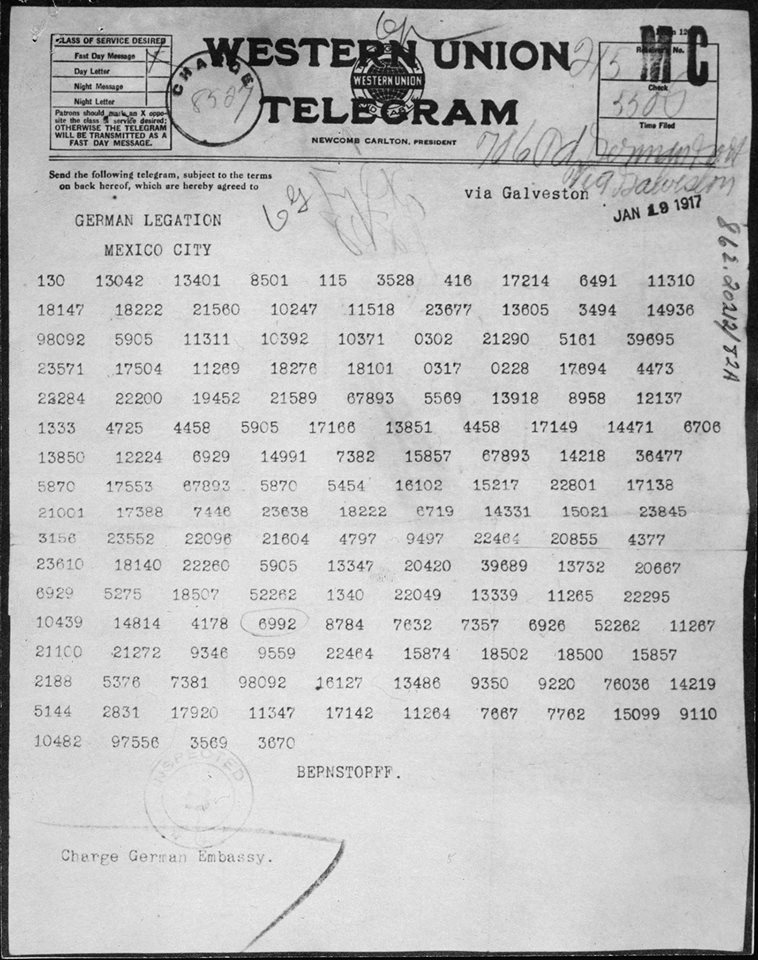
From the Facebook page of The Great War:
On this day 100 years ago, a coded telegram was sent by German foreign secretary Arthur Zimmermann to German Ambassador to Mexico, Heinrich von Eckardt. In this telegram, Zimmermann instructed von Eckardt to offer Mexico a military alliance and financial support against the United States should they not remain neutral. This was a possibility since Germany was about to unleash unrestricted submarine warfare by February 1, 1917.
To understand this telegram, it is important to understand that talks about military cooperation and even a military alliance between Mexico and the German Empire had been going on since 1915 already.
The telegram was sent via the American undersea cable since the German cable was interrupted by the British when the war broke out. US President Woodrow Wilson had offered the Germans to use their cable for diplomatic correspondence. What neither Wilson nor the Germans knew: The cable was monitored by the British intelligence at a relay station in England. Furthermore, the British codebreakers of Room 40 had already cracked the German encryption.
The biggest challenge for the British now was to reveal the content of this telegram without admitting that they were monitoring the cable while ensuring it had the desired impact.
Comments Off on 100 years ago today
January 6, 2017
January 2, 2017
Simón Bolívar – I: Reverberations – Extra History
Published on 19 Nov 2016
Born to one of the wealthiest families in Venezuela, Simón Bolívar imbibed the ideals of revolution from a tutor who inspired him to travel to Europe as a young man. What he saw and learned, he would one day bring back to foment revolution in the Spanish colonies of Latin America.
Comments Off on Simón Bolívar – I: Reverberations – Extra History
November 29, 2016
Justin Trudeau’s 15 minutes of internet fame
In his statement on the death of Cuban dictator Fidel Castro, Prime Minister Justin Trudeau went unexpectedly viral and his phrasing was turned into a hilarious Twitter hashtag: #TrudeauEuologies. In the National Post, Colby Cosh sums up the responses:
The Prime Minister has received a thousand-bomber raid’s worth of invective for his formal statement on the death of Fidel Castro, the communist dictator of Cuba who was an old friend of the Trudeau family. You probably need no reminding of the first sentence of the press release, already lampooned worldwide as a triumph of putrid euphemism: “While a controversial figure, both Mr. Castro’s supporters and detractors recognized his tremendous dedication and love for the Cuban people who had a deep and lasting affection for ‘el Comandante’.”
Habitual readers will know that when I see a thousand people gathering stones to throw at one, I try to see things from the side of the one. So my first impulse was to search for even a half-satisfactory justification of the PM’s statement. Alas, nothing came to hand. Just more rocks.
There is the “diplomacy is the art of lying about terrible things” defence: the idea that the interests of Canada might demand that Justin Trudeau use the opportunity presented by Fidel’s demise to suck up to his family and inner circle. This seems to me like an upside-down understanding of diplomacy. The Canadian government may sometimes be obliged to take, and even defend, morally ambiguous actions in the name of state interests. Merely telling sweet-sounding falsehoods about individuals is rarely involved. Like Trudeau’s acknowledgment that Castro was a “Comandante” — a pompous sadist who turned a beautiful country into a giant barracks — the diplomacy defence tacitly confesses the truth: Cuban government is lawless personal rule — as of now, the rule of a restless ghost who must be placated.
The statement might even be taken as a cryptic critique of the Castro regime, but there is no evidence the Prime Minister’s friendship with Castro was anything but genuine. When Trudeau writes “I know my father was very proud to call (Castro) a friend” he is stating fact. If the younger Trudeau does not believe that Castro was just a superhuman social reformer, and he really sees Cuba’s generations of exiles and political prisoners as more than hazy abstractions, then his family’s sucking up to Castro is fully conscious, fairy-tale evil, rather than the aftertaste of Fidel’s long-standing glamour cult among halfwit intellectuals.
Update: In Maclean’s, Terry Glavin twists the knife:
It was bound to happen sooner or later.
Ever since his election as Canada’s Prime Minister last October, Justin Trudeau has revelled in global tributes, raves and swoons. He’s the Disney prince with the trippy dance moves, the groovy Haida tattoo and the gender-balanced cabinet. He’s the last best hope for globalization, the star attraction at the Pride parades, the hero of the Paris Climate Summit, the guy everyone wants a selfie with.
Trudeau made himself synonymous with Canada. He made Canada cool again. It was fun while it lasted.
By the early hours of Saturday morning, Havana time, Trudeau was an international laughingstock. Canada’s “brand,” so carefully constructed in Vogue photo essays and Economist magazine cover features, seemed to suddenly implode into a bonspiel of the vanities, with humiliating headlines streaming from the Washington Post to the Guardian, and from Huffington Post to USA Today.
It was Trudeau’s maudlin panegyric on the death of Fidel Castro that kicked it off, and there is a strangely operatic quality to the sequence of events that brings us to this juncture. When Trudeau made his public debut in fashionable society 16 years ago, with his “Je t’aime, papa!” encomium at the gala funeral of his father in Montreal, Fidel Castro himself was there among the celebrities, as an honorary pallbearer, lending a kind of radical frisson to the event. Now it’s all come full circle.
Comments Off on Justin Trudeau’s 15 minutes of internet fame
November 19, 2016
Guardians Of The South Atlantic: UK Forces In The Falklands
Published on Sep 27, 2016
There are penguins on your doorstep, spectacular scenery, and, of course, a place that’s rich in history. That’s a good side of the unusual British forces posting to the Falkland islands. The bad side is the icy gale-force winds, freezing conditions, and limited roads and connectivity. For more, visit http://frces.tv/B2P3uR.
H/T to Ghost of a Flea for the link.
Comments Off on Guardians Of The South Atlantic: UK Forces In The Falklands
September 29, 2016
Hiawatha – II: Government for the People – Extra History
Published on 1 Sep 2016
After getting the Seneca to join the Great Law of Peace, Hiawatha came up with a plan to convince Tadodaho. But it took Jigonsaseh to confront him and make him become a true leader. Now united, the Five Nations created a participatory democracy rooted in the Peacemaker’s ideals, one that still lives on today.
____________Three nations had united under the Great Law of Peace, but the Seneca and Onondaga remained outside it. Both nations relied on war for their power – but also for their safety. Hiawatha and the Peacemaker came to the Seneca expecting an argument, but Jigonsaseh had already convinced them since she was Seneca herself. All but two of the chiefs were ready, but those two chiefs feared what would happen if other nations brought war to their borders. The Peacemaker called a council to discuss their concern, but it quickly dissolved into in-fighting and arguments. To solve it, he established a bicameral legislature where each tribe had a turn to speak. Hiawatha joined the Mohawk and helped legislate a solution, putting the Mohawk and Seneca in charge of the borders with the authority to call the tribes together in war if outsiders threatened the confederacy. The envoys also agreed to follow his plan for Tadodaho. They returned to the Onondaga nation and offered to make Tadodaho their leader, with veto powers over every law. He immediately saw the potential to grow his power, but Jigonsaseh confronted him for his greed and cruelty and convinced him to use his power responsibly. With him, the Onondaga joined the Great Law of Peace. Now Jigonsaseh sat with the women’s councils and selected the League representatives, for the women owned the council positions and chose the men who served in them. Those representatives met the Peacemaker on the shores of Onondaga Lake, where he demonstrated how a bundle of five arrows, like the five nations, could not be broken. Then he had them bury their weapons under a white pine tree guarded by an eagle. Those symbols would later be adopted by the United States, whose Founding Fathers studied the Great Law of Peace and adopted many of its principles into their own Constitution. The original Haudenosaunee League drafted laws based on the Peacemaker’s teachings, creating a government that served the will of the people. Hiawatha commemorated each of these laws with a series of wampum belts, most notably the Hiawatha Belt which symbolized the five nations coming together in peace. The government they created has lasted for centuries, making it one of the longest lasting participatory democracies in the world.
Comments Off on Hiawatha – II: Government for the People – Extra History
September 24, 2016
Hiawatha – I: The Great Law of Peace – Extra History
Published on 25 Aug 2016
Hiawatha wanted peace, but a more powerful chief named Tadodaho opposed him. So he joined forces with a man called the Peacemaker and a woman named Jigonsaseh, who dreamed of uniting the five Haudenosaunee (Iroquois) nations under one Great Law of Peace.
CORRECTION: Art for this series was incorrectly credited. This art was done by Lilienne Chan.
____________Long before Europeans arrived in North America, five nations formed a confederacy guided by a Constitution called the Great Law of Peace. Though they are often called Iroquois, their name for themselves is Haudenosaunee, People of the Long House. One of the founders of their confederacy was Hiawatha, an Onondaga chief who lived under the thumb of a brutal war chief named Tadodaho. Hiawatha attempted to convince all the other Onondaga that they should embrace peace, the way their neighbors the Mohawks recently had, but Tadodaho thwarted his efforts. Hiawatha left his home to travel to Mohawk territory and meet a man called the Peacemaker, who had brought peace to the Mohawk. He gave the Peacemaker a string of wampum beads to symbolize his desire for peace, and it soon became clear that they were kindred spirits. The Peacemaker wanted to bring the Five Nations, who had once been brothers, together in peace, and he joined forces with Hiawatha to make it happen. Their first goal: to recrut Jigonsaseh, a Seneca woman already famed for her efforts to establish small, local peace agreements between the warriors who frequented her long house. The Peacemaker described to her his plans for a government where women like her, as clan mothers, played an important role, and she embraced his message. Together they traveled to the Oneida to recruit their first ally. The Oneida debated the wisdom of accepting peace for a full year, but the Peacemaker’s passion convinced them and at last they joined. Hiawatha hoped that this alliance would impress Tadodaho enough to get him to join the peace as well, but when they returned to Onondaga territory, Tadodaho made it clear that he still had no interest in their peace. The Peacemaker encouraged Hiawatha to keep thinking about this problem, and meanwhile they traveled to recruit the Cayuga nation. As “little brothers” of the Onondaga, they had suffered greatly from Tadodaho’s demands, and an alliance with two other nations struck them as the perfect way to free themselves from him and create a new path for their people. Now only two tribes remained to recruit: the Seneca and the Onondaga.
Comments Off on Hiawatha – I: The Great Law of Peace – Extra History
July 26, 2016
July 12, 2016
Mexico in WW1 – The Mexican Revolution I THE GREAT WAR Special
Published on 11 Jul 2016
The full text of the Zimmerman Telegram: https://en.wikipedia.org/wiki/Zimmerm…
Mexico was mainly focussing on internal struggles and the Mexican Revolution during World War 1. But Germany’s stance against the USA actually brought the country into the international spotlight. After the decoding of the Zimmerman Telegram, sent by the Germans to Mexico, was decoded it was clear that Germany wanted to bring Mexico into the war – against the United States.
Comments Off on Mexico in WW1 – The Mexican Revolution I THE GREAT WAR Special
June 27, 2016
December 7, 2015
If not amnesty, then what?
At Coyote Blog, Warren Meyer cuts to the chase on the whole amnesty “debate” in US politics:
Mickey Kaus wonders why the GOP elite is still “clinging to amnesty” for illegal immigrants. I have the same thought every time I hear someone rail against “amensty”: What the f*ck else are we going to do? Put 12 million people in jail for violating immigration laws? Are we really talking about deporting 12 million people? Do you have any idea how ugly this will be? I don’t want to commit a Godwin’s Law violation, but rousting people — whole families — out of their homes at gunpoint and loading them up on trucks and trains to be shipped en mass somewhere else — does this sound like any other 20th century event to you? If you wanted to find some other precedent for this that was not the German shipping of Jews to Poland, what would even be close?
Looked at another way, the disastrous government and civil war in Syria has created, by UN estimates, 4 million refugees. At a stroke, do Republicans really want to create 12 million refugees?
Comments Off on If not amnesty, then what?
October 29, 2015
For a change, a sensible trademark ruling
Timothy Geigner on a remarkably sensible trademark judgement from a BC court:
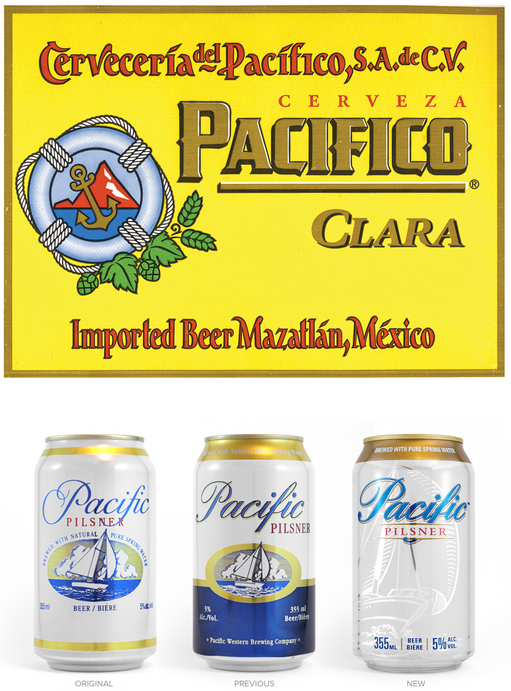
For this, we travel up to Canada, where a Federal Court judge presided over a trademark dispute between Pacific Western Brewing and Cerveceria del Pacifico over the branding of their brews. At issue was the labels on packaging for PWB’s Pacific Pilsner and Cerveceria’s Pacifico Clara. PWB argued at court that the branding and language was too similar and would confuse customers. Here are samples of each beer’s branding.
So, yeah, other than roughly similar uses of the word “Pacific”, there’s not a whole lot of similarity here. Normally, this is about when we’d hold our collective breaths and wait to see if the court comes down with a sensible ruling based on the likelihood of customer confusion, or if the court instead chooses the over-protectionist route, focusing on the common language and nothing else. In this case, Justice Luc Martineau appears to have gotten every last bit of it right.
Martineau said the first impression given by the label Cerveceria uses for its Pacifico brand “is of its obviously foreign origin” and that it’s “highly stylized, with many distinctive design elements, including strong and contrasting colours and font in red, gold, blue, green and yellow.” He further said the label “differs visually, phonetically, and semantically” from all of the marks PWB uses for its Pacific brands of beers.
Martineau also dismissed as without merit PWB’s argument that contrary to a statement on the register, Cerveceria del Pacifico was not first sold in Canada as early as April 1986. He noted that an affidavit from Cerveceria stating the beer was introduced at Expo ’86, where it was sold at a Mexican restaurant called Ole Cantina, was not challenged by PWB counsel. By December 1989, Pacifico was listed with the B.C. Liquor Distribution branch and in August 1990, a registration protecting the mark was issued.
“The delay of almost 25 years before attempting to invalidate the registration weighs heavily against a finding of confusion,” Martineau said of PWB’s action.
Comments Off on For a change, a sensible trademark ruling


