Quotulatiousness

February 21, 2020

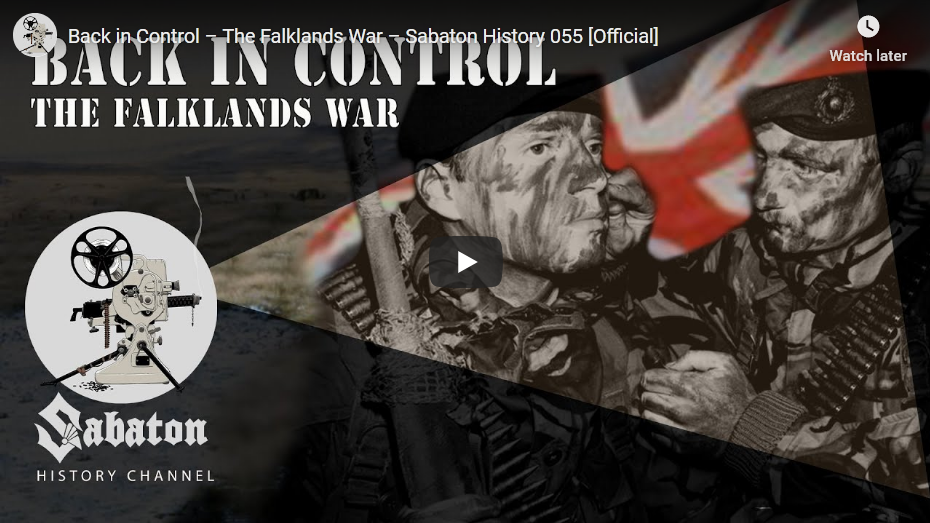
“Back in Control” – The Falklands War – Sabaton History 055 [Official]

Sabaton History
Published 20 Feb 2020

1982, on a group of islands far, far away from Great Britain. After the military junta of Argentinian Army General Leopoldo Galtieri had publicly declared that the Falkland Islands (Malvinas) were rightfully part of Argentinian territory, an invasion force succeeded in wrestling control away from their British owners. However Great Britain would not simply stand by and give the Falklands up. Instead a British task-force would make its way down to the Falklands, in an attempt to take back control of the islands by force. What followed was an undeclared war of 10 weeks, where British carriers and commandos fought against the entrenched Argentinian ground-forces for the ownership of the islands.

Support Sabaton History on Patreon: https://www.patreon.com/sabatonhistory

Listen to “Back in Control” on the album Attero Dominatus:
CD: http://bit.ly/AtteroDominatusStore
Spotify: http://bit.ly/AtteroDominatusSpotify
Apple Music: http://bit.ly/AtteroDominatusAppleMusic
iTunes: http://bit.ly/AtteroDominatusiTunes
Amazon: http://bit.ly/AtteroDominatusAmzn
Google Play: http://bit.ly/AtteroDominatusGooglePlay

Check out the trailer for Sabaton’s new album ‘The Great War’ right here: https://www.youtube.com/watch?v=HCZP1…

Watch more videos on the Sabaton YouTube channel: https://www.youtube.com/user/Sabaton?…
Listen to Sabaton on Spotify: http://smarturl.it/SabatonSpotify
Official Sabaton Merchandise Shop: http://bit.ly/SabatonOfficialShop

Hosted by: Indy Neidell
Written by: Markus Linke and Indy Neidell
Directed by: Astrid Deinhard and Wieke Kapteijns
Produced by: Pär Sundström, Astrid Deinhard and Spartacus Olsson
Creative Producer: Joram Appel
Executive Producers: Pär Sundström, Joakim Broden, Tomas Sunmo, Indy Neidell, Astrid Deinhard, and Spartacus Olsson
Post-Production Director: Wieke Kapteijns
Edited by: Iryna Dulka
Sound Editing by: Marek Kaminski
Maps by: Eastory – https://www.youtube.com/c/eastory

Archive by: Reuters/Screenocean https://www.screenocean.com
Music by Sabaton.

Sources:
– Casa Rosada (Argentina Presidency of the Nation)
– Gobierno de Argentina (Government of Argentina) – Argentina.gob.ar
– Ken Griffiths from Wikimedia Commons
– Armada Argentina on Flickr
HMS Invincible in 1980, HMS Hermes in 1977, credit: Hugh Llewelyn on Flickr
– IWM: FKD 186, FKD 357, FKD 677, IWM FKD 138, FKD 185, FKD 2743, FKD 168, FKD 435, FKD 182, FKD 319, FKD 2744, FKD 71, FKD 217, FKD 107, FKD 321, FKD 349, FKD 345, FKD 2755, FKD 108, FKD 2028, FKD 2750, FKD 2051, FKD 2040, FKD 176, FKD 314, FKD 427
– IWM ART: 15530 33, 15530 56, 15530 10, 15530 10
– National Army Museum: 164752, 107649

An OnLion Entertainment GmbH and Raging Beaver Publishing AB co-Production.

© Raging Beaver Publishing AB, 2019 – all rights reserved.

January 24, 2020

From a Canadian perspective, “NORAD … is more important than NATO”

Filed under: Americas, Cancon, History, Military, Space, USA — Tags: , , , , , , — Nicholas @ 05:00

The American government has once again expressed a strong desire to update the 1957 North American Air Defence Commmand arrangement between the US and Canada for defence of the North American continent. It’s a Cold War relic to some (particularly some in the Prime Minister’s Office and cabinet), but it has a very real value to Canada, as Ted Campbell explains:

In 1957 Canada and the USA agreed to create the North American Air Defense Command. It is a “combined” command, American and Canadian people, civilian and military, work together, in combined headquarters, to conduct an active aerospace defence effort over the continent we share. Americans and Canadians work side-by-side managing the airspace, detecting intruders and identifying and intercepting them and so on.

NORAD, I would argue, is more important than NATO.

First, it is about defending our own homeland.

Second, it is about defending the US strategic deterrent, which has, arguably, done more to keep global peace than all the efforts of the United Nations, combined.

NORAD modernization and expansion should be at the top of Canada’s defence policy agenda. Specifically:

  • First, billions of dollars, likely tens of billions of dollars are going to be needed to upgrade the surveillance and warning system. We need new radars, terrestrial and space-based, and upgraded control systems to do the job properly;
  • Second, Canada needs to buy enough (85+ is just the very barest of bare minimums) of the right new fighter jet; and
  • Third, Canada needs to join the American ballistic missile defence system.

I believe that this issue: the shared defence of our, shared, continent and, therefore, the defence of the American heartland and of America’s strategic deterrent is a key, perhaps even the key element in our most important foreign relationship. […] The knowledge that Canada is doing a full and fair share of defending our shared continent, of defending America, is not lost on admirals and generals, diplomats and senior civil servants, representatives and senators in the US Congress, pundits and political leaders in waiting in the think-tanks and senior staff in the White House, even if Donald J Trump is not impressed … IF we are doing a full and fair share.

Right now, we are not.

An orbital analyst tracks the Kosmos 1402 spy satellite in orbit in the Space Defense Operations Computation Center, North American Aerospace Defense Command (NORAD) on 18 February, 1983.
NORAD photo by Master Sergeant Hiyashi via Wikimedia Commons.

January 22, 2020

QotD: National “wealth”

Filed under: Americas, Economics, Liberty, Quotations — Tags: , , — Nicholas @ 01:00

All the wealth we’ve accumulated is ultimately between our ears.

While working on my book, I read all these different accounts of where capitalism comes from. I was amazed by how many of them start from the assumption that wealth is … stuff. Depending on which Marxist you’re talking to, capitalism is the ill-gotten-booty of the Industrial Revolution, slavery, imperialism, and the rest. I don’t want to get into all of that here — there will be plenty of time when the book comes out.

But all of these assumptions are based on the idea that having stuff makes you rich. Now, in fairness, that’s true for individuals. But it doesn’t really work that way for societies. Writing about Venezuela earlier this week is what got this in my head. Venezuela is poor and getting poorer by the minute: Babies are dying from starvation.

Meanwhile, Venezuela has the largest proven oil reserves in the world. According to lots of people, not just Marxists, this should make no sense. Oil is valuable. If you have more of it than anyone else, you should be able to make money. For a decade, the American Left loved Hugo Chávez and then Nicolás Maduro because they allegedly redistributed all of the country’s wealth from the rich to the poor. These dictators were using The Peoples’ resources for the common good. Blah blah blah.

It turns out that the greatest resource a country has is its institutions. In economics, an institution is just a rule, which is why the rule of law in general and property rights in particular are the most important institutions there are, with the exception of the family. Take away the rule of law in any country, anywhere and that country will get very poor, very fast. Stop protecting the fruits of someone’s labor, enforcing legal contracts, guarding against theft from the state or the mob (a distinction without a difference in Venezuela’s case) and wealth starts to evaporate.

But even that is too complicated. Oil is worthless on its own. If you went back in time to the Arabian Peninsula before oil became a valuable commodity, you wouldn’t look at the squabbling nomads and call them rich, even though they were playing polo with a goat’s head above billions of barrels of oil. Go get lost in the Amazon by yourself. What would you rather have, a map or big-ass diamond? The diamond only has value once you get out of the jungle, but you can’t get out without the map.

Jonah Goldberg, “America and the ‘Original Position'”, National Review, 2017-12-22.

January 11, 2020

The bubbly 1720s

Filed under: Americas, Britain, Business, Economics, France, Government, History — Tags: , , , , , — Nicholas @ 03:00

In the latest Age of Invention newsletter, Anton Howes looks at Britain’s volatile financial scene in the 1720s:

William Hogarth – The South Sea Scheme, 1721. In the bottom left corner are Protestant, Catholic, and Jewish figures gambling, while in the middle there is a huge machine, like a merry-go-round, which people are boarding. At the top is a goat, written below which is “Who’l Ride”. The people are scattered around the picture with a sense of disorder, while the progress of the well-dressed people towards the ride in the middle represents the foolishness of the crowd in buying stock in the South Sea Company, which spent more time issuing stock than anything else.
Scanned from The genius of William Hogarth or Hogarth’s Graphical Works via Wikimedia Commons.

Over in France, a Scottish banker named John Law had in the late 1710s overseen an ambitious scheme to reorganise the government’s finances. He ran the Mississippi Company, one of the many companies with monopolies on France’s international trade. His scheme was for the company to acquire all of the other similar monopolies, so that it could have a monopoly on all of the country’s intercontinental trade routes. By 1719, the Mississippi Company had swelled into a Company of the Indies, which in turn had purchased the right to collect French taxes, from which it took took its own cut. In exchange for acquiring these monopolies, Law’s new super-monopoly would buy up the French government’s accumulated war debts, allowing repayment on more generous terms. By allowing the state to borrow more cheaply, the scheme was to be a key plank in improving French military might.

Meanwhile, in Britain, a very similar project was afoot. Following the War of the Spanish Succession, one of the things Britain won from France was the asiento – the monopoly on supplying African slaves to Spain’s colonies in America. The asiento was given to the South Sea Company, which had the monopoly on British trade with South America, and which in 1720 began to follow a scheme similar to Law’s. Given developments in France, it would not do for the British state to be left behind in terms of its capacity to take on more debt for war. Thus, with political support, the South Sea Company began to buy up the government’s debt, persuading its creditors to exchange that debt for increasingly valuable company shares.

In 1720, both schemes came crashing down. In the case of Law’s scheme, he had printed paper currency with which people could buy his company’s shares, but in 1720 discovered he had printed too much. When he prudently tried to devalue the company’s shares to match the quantity of paper notes, the devaluation spun out of control. In the case of the South Sea Company, the causes of the crash were a little more mysterious, perhaps even verging on the mundane. One explanation is that too many wealthy investors simply tried to sell their shares so that they would have ready cash to spend on holidaying in Europe, precipitating a minor fall in the share price which then led to a more widespread panic. Regardless, it did not end well. The company itself continued for many years thereafter — it even got involved with whaling off the coast of Greenland — but the collapse of its share price ended its chance to restructure the government’s debts.

December 18, 2019

Ballester-Molina Pistols from German Pocket Battleship Armor?

Forgotten Weapons
Published 17 Dec 2019

http://www.patreon.com/ForgottenWeapons

Cool Forgotten Weapons merch! http://shop.bbtv.com/collections/forg…

There is an old gun shop tale that Argentine Ballester-Molina pistols were made form the salvaged armor plate of the pocket battleship Admiral Graf Spee. The Graf Spee was scuttled in the Rio de la Plata estuary in December 1939, only a few miles from the HAFDASA factory in Buenos Aires, and Argentina did not have the domestic steel reserves to make enough pistols…

See Michael Parker’s full article on this, including the exact results of his metallurgical analysis, here:

https://www.americanrifleman.org/arti…

Contact:
Forgotten Weapons
6281 N. Oracle #36270
Tucson, AZ 85704

November 5, 2019

Dragons – The Origin of Dragons – Extra Mythology

Filed under: Americas, Australia, China, Europe, History — Tags: , — Nicholas @ 04:00

Extra Credits
Published 4 Nov 2019

Check out MinuteEarth’s video on the biology of dragons! https://www.youtube.com/watch?v=3n1DC…

Dragons are one of the most popular creatures of myth and legend and for good reason! These guys are everywhere! Almost every culture has some form of dragon tale. From the wicked wyrms of western Europe, the benevolent Lung dragons of China, the feathered serpent Quetzalcoatl, to the Rainbow Serpent of Aboriginal myth, dragon like figures take on many different forms and roles. But how and why do these serpentine beasts and gods appear in so many different legends? Gather round the campfire and let’s chat!

Join the Extra Mythology Patreon! https://www.patreon.com/extramythology

October 5, 2019

Legends Summarized: El Dorado

Overly Sarcastic Productions
Published 4 Oct 2019

El Dorado! A shining golden city packed with promises of wealth, power and everlasting glory. An unspoiled paradise deep in the jungle, the PERFECT destination for treasure-hunters and anthropologists alike. Something that perfect is something EVERYONE wants to be real.

Aaaaand that’s the trick, isn’t it? Wanting something that badly isn’t healthy. Just ask the conquistadors!
(Oh wait, we can’t – because so many of them died on fruitless quests for El Dorado. And also it’s been five hundred years and they’d all be dead anyway)

PATREON: https://www.Patreon.com/OSP

MERCH LINKS: https://www.redbubble.com/people/OSPY…

OUR WEBSITE: https://www.OverlySarcasticProductions.com
Find us on Twitter https://www.Twitter.com/OSPYouTube
Find us on Reddit https://www.Reddit.com/r/OSP/

October 1, 2019

Charles Darwin – The Voyage of the Beagle – Extra History

Filed under: Americas, Britain, History, Pacific, Science — Tags: , — Nicholas @ 04:00

Extra Credits
Published 29 Sep 2019

The 1830s were an exciting time for science. All throughout Europe, there was a great movement to explore, map, and classify the world. And it was this expanding world that young Charles Darwin graduated into … albeit with the wrong degree. Because although he would one day be known as “the Father of Modern Biology,” Darwin’s father was set on his son following in his footsteps — as a doctor.

September 30, 2019

Ten Minute History – The Early British Empire

Filed under: Americas, Britain, History, India, Military — Tags: , , , , , , — Nicholas @ 02:00

History Matters
Published on 26 Sep 2016

Twitter: https://twitter.com/Tenminhistory
Patreon: https://www.patreon.com/user?u=4973164

This episode of Ten Minute History (like a documentary, only shorter) covers the birth and rise of the British Empire from the reign of Henry VII all the way to the American Revolution. The first part deals with the Tudors and their response to empire in Spain (as well as the Spanish Armada). The second part deals with England’s (and later Britain’s) establishment of its own empire in North America and India. It then concludes with the Seven Years’ War and the American Revolution.

Ten Minute History is a series of short, ten minute animated narrative documentaries that are designed as revision refreshers or simple introductions to a topic. Please note that these are not meant to be comprehensive and there’s a lot of stuff I couldn’t fit into the episodes that I would have liked to. Thank you for watching, though, it’s always appreciated.

September 29, 2019

History Summarized: Mexico

Overly Sarcastic Productions
Published 27 Sep 2019

Go to https://NordVPN.com/overlysarcastic and use code OVERLYSARCASTIC to get 70% off a 3-year plan and an extra month for free. Protect yourself online today!

This video is quite serendipitous in timing — by complete coincidence, this is going live on September 27, the day of Mexico’s true political independence under the First Mexican Empire. This is the 11 year sequel to the more traditional Mexican Independence celebrations of September 16th, which marks Miguel Hidalgo’s proclamation of the “Cry of Dolores” and the start of the Mexican War of Independence. No joke, I only realized this when I was partway through researching the video. I do so much ancient history I’m not used to events having dates we can track to the day.

ANYWAY enjoy this look at Mexican History, here broken into three main acts, the Aztec Empire, the Colony of New Spain, and the Independent nation of Mexico.

“Santianna” By The Longest Johns: https://thelongestjohns.bandcamp.com/…

PATREON: https://www.Patreon.com/OSP

DISCORD: https://discord.gg/sS5K4R3

September 22, 2019

The Inca Empire – A God Taken Hostage – Extra History – #5

Filed under: Americas, Europe, History, Military, Religion — Tags: , , , , , — Nicholas @ 06:00

Extra Credits
Published on 21 Sep 2019

Join us on Patreon! http://bit.ly/EHPatreon

Atahualpa vs. Francisco Pizarro. The Incas had never seen horses before, and it wasn’t long before the Spanish had captured Atahualpa as a hostage for gold and silver. But Atahualpa had a plan. He found a way to use this situation to his own political advantage — and Pizarro eventually destroyed himself through his greed and violent carelessness that appalled the Spanish government, eventually allowing the Incas to thrive again.

Follow us on Instagram: http://bit.ly/ECisonInstagram

September 16, 2019

The Inca Empire – Andean Apocalypse – Extra History – #4

Filed under: Americas, History, Military — Tags: , , , , , , — Nicholas @ 06:00

Extra Credits
Published on 14 Sep 2019

Join us on Patreon! http://bit.ly/EHPatreon

Disease — likely, smallpox or measles — had arrived in the Inca empire, and it was ruthless. Two of the (now dead) Emperor Huayna Capac’s sons, Atahualpa and Huáscar, decided that a civil war over who should be Sapa Inca was perfect to do right now — nevermind the fact that Francisco Pizarro and his conquistadores had just showed up.

September 9, 2019

The Inca Empire – Life of a Dead Emperor – Extra History – #3

Filed under: Americas, History, Religion — Tags: , , , , — Nicholas @ 04:00

Extra Credits
Published on 7 Sep 2019

Join us on Patreon! http://bit.ly/EHPatreon

To understand daily life in the Inca Empire, we travel from Cusco to Quito (located in modern-day Ecuador), where Thupa Inca wanted to establish a second capital city. From efficiently designed work assignments, to elaborate death rituals, life was neatly organized, masking rising tensions.

September 8, 2019

Miscellaneous Myths: Animal Brides

Filed under: Americas, Europe, History — Tags: , , , — Nicholas @ 04:00

Overly Sarcastic Productions
Published on 6 Sep 2019

Yes, it really is as weird as it sounds. Sorry!

This video (specifically the Inuit myth) was requested by patron Richard Frederick Schubert III!

PATREON: https://www.Patreon.com/OSP

MERCH LINKS: https://www.redbubble.com/people/OSPY…

OUR WEBSITE: https://www.OverlySarcasticProductions.com
Find us on Twitter https://www.Twitter.com/OSPYouTube
Find us on Reddit https://www.Reddit.com/r/OSP/

September 2, 2019

The Inca Empire – Earth-Shaker – Extra History – #2

Filed under: Americas, History, Military — Tags: , , , — Nicholas @ 04:00

Extra Credits
Published on 31 Aug 2019

Join us on Patreon! http://bit.ly/EHPatreon

Pachacuti, the Earth-Shaker, was the ninth leader of the Inca and the one who took the ambitions of the city of Cusco into an all-out military campaign to expand the empire — alongside bribing and engineering and negotiating their way to expansion.

Pachacuti turned out to be a good name for this ninth ruler of the Inca, because while the name did mean “earth-shaker” it was also a philosophical concept. In Quechua, the Inca’s primary language, a pachacuti was a historic event, a cataclysm that overturns space and time, remaking the world. It was a good title for the man who would forge the Kingdom of Cusco into an empire.

« Newer PostsOlder Posts »

Powered by WordPress