
At SteynOnline, Tal Bachman continues his look at all things Machiavelli, including Prussian king Frederick the Great’s polemic against the author of The Prince:
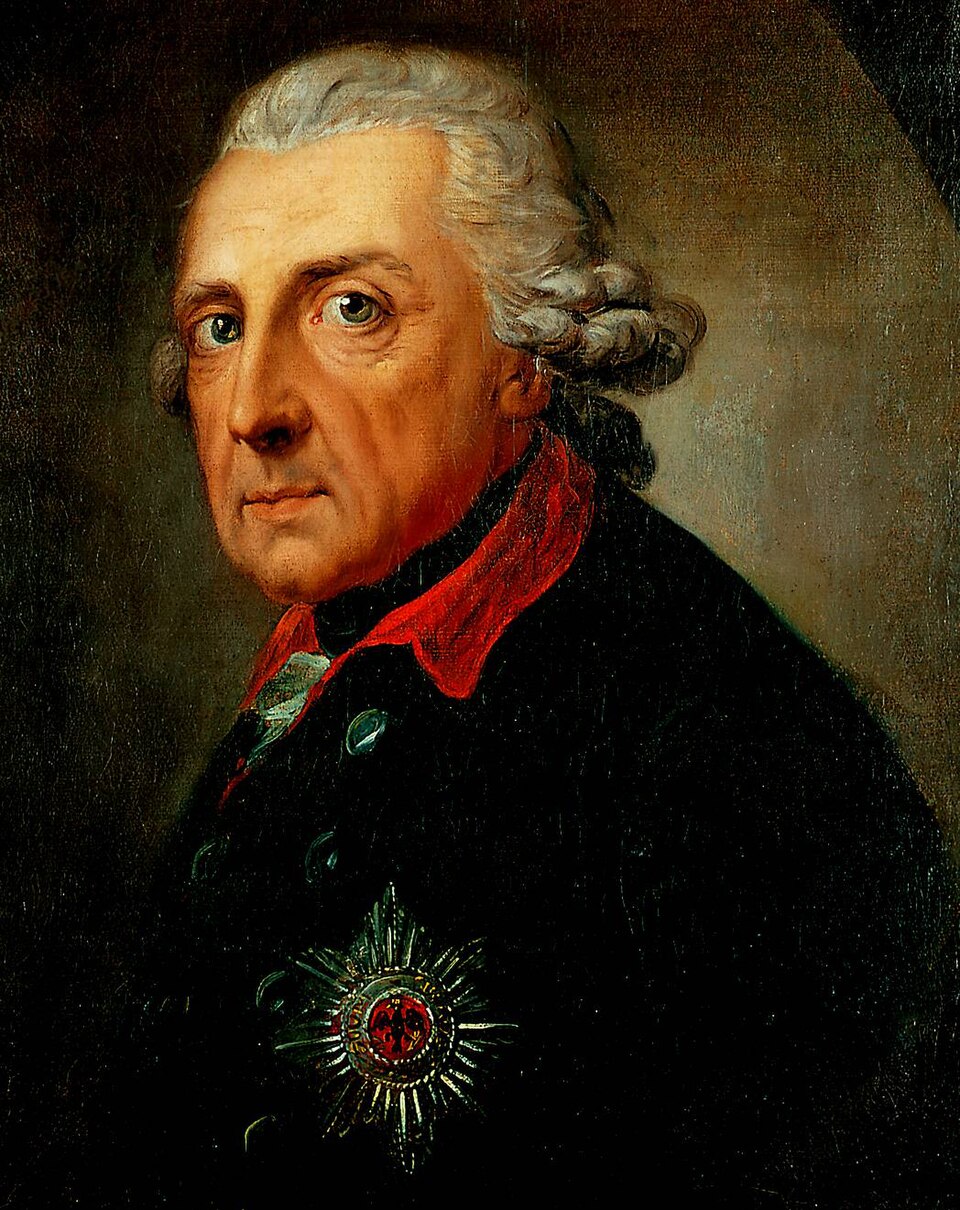
Frederick the Great, 1781
Oil portrait by Anton Graff (1736-1813) in the Sanssouci Palace collection via Wikimedia Commons.
Maybe Machiavelli’s teachings have no relevance in any remotely civilized political system. Maybe they’re far worse than irrelevant: maybe they’re all entirely evil (as they appear), and in addition, would prove the ruin of both the people and their ruler.
This was, as it happens, the view espoused by one important ruler: the Prussian king Frederick the Great. In his 1741 book, The Anti-Machiavel, he claims Machiavelli’s book is “one of the most dangerous that ever appeared in the world”, in that the political crimes it encourages would impose “a lasting misery upon whole nations”. Truly great rulers, says Frederick, aren’t the avaricious, amoral, self-serving, shape-shifting demons that Machiavelli describes. Rather, they are those “whose business it is to administer justice, and to set examples of justice to their subjects; and who, by their magnanimity, mercy, and goodness, ought to be the living images of Deity”. Thus, Frederick sees his rebuttal as “a defense of humanity against a monster who would destroy it”; it is “an antidote to poison”.
Frederick ruled Prussia for nearly 50 years. Most historians rate him a success. On the face of things, he seems like the kind of critic who knows what he’s talking about.
But Machiavelli would say, not so fast. What did Frederick do almost immediately after assuming power? Without any provocation, he launched a war to seize the large, prosperous, populous province of Silesia (now in southwestern Poland) from the Habsburg Monarchy. And he did so on a convoluted, centuries-old dynastic claim which sounded as unconvincing to his contemporaries as it does to us now. In the three Silesian wars which followed (the third turning into the Seven Years War), well over a million soldiers died fighting. Millions more wound up maimed, psychologically scarred, or otherwise ruined. Of course, millions of non-combatants also suffered: wives lost husbands, mothers and fathers lost sons, children lost fathers and uncles and brothers. Those non-combatants also suffered displacement, terror, deprivation, and injury. Over two decades, Frederick’s wars — particularly the Seven Years War — convulsed Europe. Frederick gained 30% more territory and 50% more citizens, but the cost was losing 10% of the Prussian population to combat or disease (the modern equivalent of 35 million Americans, 6 million English, or 3 million Australians). The point is: if his actions are anything to go by, Frederick didn’t oppose Machiavellian power moves as much as he professed, if at all. Machiavelli might even argue that in taking pains to proclaim his opposition to Machiavelli even as his wars of acquisition injured and killed millions, he was doing exactly what Machiavelli had advised: seeming to be good even as he was doing whatever the hell he wanted, for his own purposes. Most people will buy the act anyway, says Machiavelli, so why not?
This brings me back to Machiavelli’s claims about how rulers do in fact act, and how they must act to avoid ruin. And that in turn brings me back to the original wording of The Prince, and what real-world credibility Machiavelli might have as a political commentator.
As it happens, Machiavelli was no armchair quarterback. Even if he hadn’t spent nearly fifteen years at the highest levels of Florentine government (which he did), he might well have qualified as a political expert just by virtue of growing up in the tumultuous time and place he did. Between the jockeying Italian states, the myriad (and ever-changing) foreign alliances and enemies and designs, the political influence of the papacy, and Florence’s own internal politics, Machiavelli’s home city furnished more than enough lessons in how the political world could, and often did, operate.


