Quotulatiousness

October 10, 2025

A POSWID analysis of the contention that “Canada is broken”

It’s my strong opinion that Canada is indeed “broken”, and much but not all the blame for that goes to former Prime Minister Justin Trudeau and increasingly to current PM Mark Carney. It hasn’t all been the direct action or deliberate inaction of the Liberal party and their bureaucratic minions in the civil service, but their fingerprints are on a lot of the damage. Eberhard Englebrecht analyzes Canada using POSWID framing and concludes that “the Purpose Of Canada is What It Does”:

Now, one of the core criticisms made of POSWID by its opponents is that it leans heavily on a consequentialist interpretation of events, completely discarding the roles human intention, error, and agency play in how things transpire.

However, these critiques only hold validity if you take POSWID and make it your singular mode of analysis — something that I don’t encourage, nor intend on doing myself. Rather, POSWID should be understood and used as a specific tool with a specific purpose — that is, to peel back the noxious platitudes, gaslighting, and wishful thinking that envelop our politics, and hinder our ability to view our present situation with clarity and honesty.

And, unfortunately for the citizenry of Canada, Canadian politics is — and has been for some time — a domain chock full of the misguided idealism and obfuscation that POSWID seeks to erase.

It is why many Canadians — despite their country having experienced a precipitous decline in both general prosperity and the integrity of the common social fabric — remain willfully blind to such an absurd degree.

POSWID, as I will be applying it, can tackle many of the polite pleasantries and mindless incantations that have become embedded in Canada’s “consensus” of acceptable political discourse, exposing them as misaligned with reality. This will take one of two forms: the first is to demonstrate that a common belief in the trope in question has led to results contrary to the intentions of those who originally pushed the trope; the second is that the trope was always purely abstract and aspirational, never described reality, and any attempts to align reality with said trope have failed miserably.

Many of these tropes are sacred cows of Canada’s political establishment — ideas that they would insist define “what it means to be Canadian” or are things that “we all believe”. Going against them, or merely questioning their validity or suitability, would be considered “UnCanadian”. These tropes have, in many cases, dictated the direction of Canadian society since the 1960s and created the foundations for the paradigms that currently define Canadian politics. Therefore, the deconstruction of these tropes constitutes the deconstruction of these paradigms — something that would have cascading ramifications for our country.

It is worth noting, however, that my intention in writing this piece is not to make granular policy prescriptions. My job is merely to provide a clear-eyed account of how three of the values and policy programmes of Canada’s chattering class (you could substitute “chattering class” with “professional-managerial class” or “Laurentian Elite”) are out of step with how this country actually exists — a reality felt and experienced at an intuitive level by many, but rarely articulated in public.

The federal government’s gun “buyback” program pilot in Nova Scotia

Filed under: Bureaucracy, Cancon, Government, Politics, Weapons — Tags: , , , , — Nicholas @ 03:00

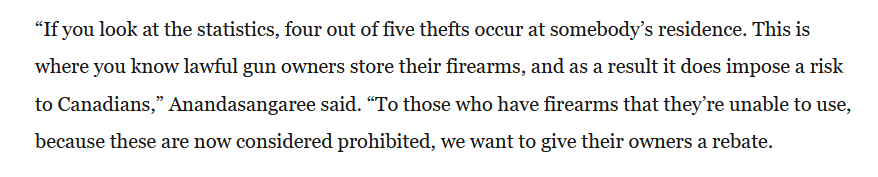
On the social media site formerly known as Twitter, Tim Thurley responds to a report about the gun “buyback” pilot program:

This reads like a government flailing for a message. We know this is incorrect, the Minister knows it is incorrect, and we know the Minister knows it is incorrect, and yet.

(The “Ensure…” section is also painful to read, but that’s another matter.)

https://www.saltwire.com/cape-breton/federal-minister-denies-political-motivation-in-choosing-cape-breton-to-pilot-gun-buyback-program


He’s suggesting the risk is posed by stolen firearms. Not only do we know this is a small portion of risk — and easily substituted by other sources — but to say we must confiscate your property because someone else might misuse it sounds an awful lot like victim blaming.


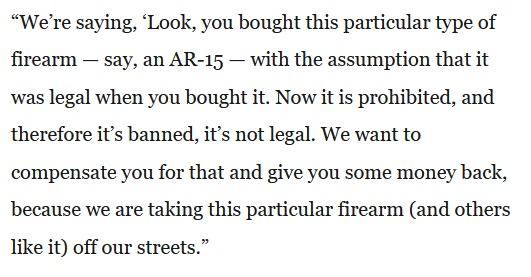
Nobody bought an AR-15 under the assumption it was legal when they bought it (unless FRT banned, then it gets complex).

If a licensed user bought and registered it pre-OIC (or just bought if non-restricted) then it was legal when they bought it, period. No assumptions needed.


A rebate is also incorrect. A rebate is something a customer gets back after purchase.

They get to keep both the rebate and the product.


The part about only getting some money back is at least accurate.

The government is not offering full compensation for many users based on the list prices, and has reiterated that it does not plan to offer further compensation once the initial pot runs out.

Feeding the Papal Conclave

Filed under: Food, History, Italy, Religion — Tags: , , , , , — Nicholas @ 02:00

Tasting History with Max Miller
Published 6 May 2025

Marinated baby back ribs served with a garlic and sapa sauce and roasted onions

City/Region: Italy
Time Period: 1570

We actually know a fair bit about what was served at the 1549 papal conclave thanks to one of the first celebrity chefs, Bartolomeo Scappi, who was in charge of the food. In his incredible book, Opera dell’arte del cucinare, or Opera di Bartolomeo Scappi, he includes not only recipes that would have been served to the cardinals, but illustrations showing the many steps for preparing and transporting the food.

Dishes like these ribs would have been tested for poison, inspected for secret messages, put in special containers, and delivered via a sort of turntable.

A lot of hassle, but these ribs would be worth it. They’re so tender and the flavors of the rub and sauce are complex and delicious. It’s not as sweet as a modern barbecue sauce, but strikes a lovely balance between the sweetness of the sapa (reduced grape must) and the sharp and savory flavors of the vinegar, garlic, and coriander seeds. You could certainly make more sauce, but I think this amount is really nice.

    Different ways to cook the back ribs of a domestic pig
    If the pig is young, the ribs can be roasted on the spit with the rind, or without, and with onions split in the pan, which are cooked with the fat that drips from the meat as it cooks … and before it is put on the spit, it is sprinkled with salt and ground coriander seed. You could also let the ribs stand in a marinade of vinegar, grape must syrup, garlic cloves and coriander, and then cook it on the spit in the above way, serving it hot with a sauce on top made of the same seasoning …”
    Opera di Bartolomeo Scappi, 1570

(more…)

QotD: Cleopatra’s reign in Egypt

… I think the interesting question is not about Cleopatra’s parentage or even her cultural presentation (though the latter will come up again as it connects to the next topic); rather the question I find interesting is this: “What sort of ruler was Cleopatra? Did she rule well?” And I think we can ask that in two ways: was Cleopatra a good ruler for Egypt, that is, did she try to rule for the good of Egyptians and if so, did she succeed (and to what extent)? And on the other hand, was Cleopatra a good steward of the Ptolemaic dynasty?

These are related but disconnected questions. While we’ll get to the evidence for Cleopatra’s relationship with the people of Egypt, the broader legacy of the Ptolemies itself is very clear: the Ptolemaic dynasty and the Greek-speaking settlers it brought were an ethnically distinct ruling strata installed above native Egyptian society, an occupying force. None of Cleopatra’s royal ancestors, none of them had ever even bothered to learn the language of the people they ruled, whose taxes sustained their endless wars (initially foreign, later civil). Top administrative posts remained restricted to ethnic Greeks (though the positions just below them, often very important ones, might be held by Egyptians), citizenship in Alexandria, the capital, remained largely (but not entirely) restricted to Greeks and so on. It’s clear these designations were not entirely impermeable and I don’t want to suggest that they were, but it is also clear that the Greek/Macedonian and Egyptian elite classes don’t begin really fusing together until the Roman period (when they were both equally under the Roman boot, rather than one being under the boot of the other).

Consequently, the interest of the Ptolemaic dynasty could be quite a different thing from the interests of Egypt.

And I won’t bury the lede here: Cleopatra, it seems to me, chose the interests of her dynasty (and her own personal power) over those of Egypt whenever there was a choice and then failed to secure either of those things. Remember, we don’t have a lot in the way of sketches of Cleopatra’s character (and what we have is often hostile); apart from a predilection to learn languages and to value education, it’s hard to know what Cleopatra liked. But we can see her strategic decisions, and I think those speak to a ruler who evidently was unwilling or unable to reform Egypt’s ailing internal governance (admittedly ruined by generations of relatively poor rule), but who shoveled the resources she had into risky gambles for greater power outside of Egypt, all of which failed. That doesn’t necessarily make Cleopatra a terrible ruler, or even the worst Ptolemaic ruler, but I think it does, on balance, make her a fairly poor ruler, or at best a mediocre one.

But before we jump into all of that, I think both a brief explanation of the structure of this kingdom and brief timeline of Cleopatra’s life would be good just so we’re clear on what happens when.

For the structure of the kingdom, we need to break up, to a degree, the peoples in Egypt. Ptolemaic Egypt was not even remotely an ethnically uniform place. Most of the rural population remained ethnically Egyptian but there were substantial areas of “Macedonian” settlement. Ptolemaic subjects were categorized by ethne, but these ethnic classifications themselves are tricky. At the bottom were the Egyptians and at the top were the “Macedonians” (understood to include not just ethnic Macedonians but a wide-range of Greeks). The lines between these groups were not entirely impermeable; we see for instance a fictive ethnic grouping of “Persians” who appear to be Hellenized Egyptians serving in the military. At some point, this group is seems to be simply rolled into the larger group of “Macedonians”. nevertheless it seems like, even into the late period the “Macedonians” were mostly ethnic Greeks who migrated into Egypt and we don’t see the Egyptian and Macedonian elites begin to fuse until the Roman period (when they both shared an equal place under the Roman hobnailed boot). Nevertheless, this was a status hierarchy; “Macedonian” soldiers got paid more, their military settlers got estates several times larger than what their native Egyptian equivalents (the machimoi) got, the tippy-top government posts were restricted to Macedonians (though the posts just below them were often held by Egyptian elites) and so on. And while there was some movement in the hierarchy, for the most part these two groups did not mix; one ruled, the other was ruled.

To which we must then add Alexandria, the capital, built by Alexander, which had a special status in the kingdom unlike any other place. Alexandria was structured as a polis, which of course means it had politai; our evidence is quite clear that all of the original politai were Greek and that new admission to the politai did happen but was very infrequent. Consequently the citizen populace of Alexandria was overwhelmingly Greek and retained a distinctive Greek character. But Alexandria was more than just the politai: it was a huge, cosmopolitan city with large numbers of non-Greek residents. The largest such group will have been Egyptians, but we know it also had a large Jewish community and substantial numbers of people from basically everywhere. So while there were, according to Polybius, three major groups of people (Greek citizens, Egyptian non-citizens and large numbers of mercenaries in service to the king, Polyb. 34.14), there were also lots of other people there too. I do want to stress this: Alexandria was easily one of the most cosmopolitan cities in the ancient world; but for the most part only the Greeks (and not even all of them) were citizens there.

That’s in many ways a shamefully reductive summary of a very complex kingdom, but for this already overlong essay, it will have to do. On to the timeline.

Cleopatra was born in 69 BC, the middle of three daughters of Ptolemy XII Auletes, then ruler of Egypt (he also had two sons, both younger than Cleopatra). In 58 BC (Cleopatra is 11) her father, by all accounts an incompetent ruler, was briefly overthrown and his eldest daughter (Berenice IV) made queen; Cleopatra went into exile with her father. In 55 BC, with Roman support, Ptolemy XII returned to power and executed Berenice. Ptolemy XII then died in 51, leaving two sons (Ptolemy XIII and XIV, 11 and 9 years old respectively) and his two daughters; his will made Cleopatra queen as joint ruler-wife with Ptolemy XIII (a normal enough arrangement for the Ptolemies).

Before the year was out, Cleopatra and Ptolemy XIII (or perhaps more correctly, his court advisors) were at odds, both trying to assert themselves as sole monarch, though by 49 Ptolemy XIII’s faction (again, it seems to mostly have been his advisors running it) had largely sidelined Cleopatra in what had become a civil war. Cleopatra travels to Syria to gather an army and invades Egypt with it in 48, but this effort fails. She is able, however, to ally with Julius Caesar (lately arrived looking for Pompey, who supporters of Ptolemy XIII had killed, to Caesar’s great irritation). Caesar’s army – Cleopatra’s military force is clearly a non-factor by this point – defeats Ptolemy XIII in 47. Caesar appoints Cleopatra as joint ruler with her youngest brother, Ptolemy XIV (he’s 12) and Cleopatra bears Caesar’s son, Ptolemy XV Caesar in 47, who we generally call “Caesarion”.

Cleopatra then journeys to Rome late in 46 and seems to have stayed in Rome until after Caesar’s assassination (March, 44) and the reading of Caesar’s will (April, 44). Ptolemy XIV (the brother) also dies in this year and Cleopatra then co-rules with her son, Caesarion. Cleopatra returns to Egypt, attempts to dispatch troops to aid the Caesarian cause against Brutus and Cassius, but fails and loses all of the troops in 43. She is saved from being almost certainly steamrolled by Brutus and Cassius by their defeat in 42 at Philippi. Cleopatra meets with Marcus Antonius in 41 and they form an alliance, as well as (at some point) a romantic relationship. Cleopatra has three children by Antonius: Cleopatra Selene and Alexander Helios (twins, born in 40) and Ptolemy Philadelphus (born in 36).

With Cleopatra’s resources, Antonius launches an invasion of Parthia in 38 BC which goes extremely poorly, with him retreating back to Roman territory by 36 having lost quite a fair portion of his army (Cleopatra is back in Egypt ruling). In 34, Antonius embarks on a massive reorganization of the Roman East, handing over massive portions of Rome’s eastern territory – in name at least – to Cleopatra’s children, a move which infuriated the Roman public and cleared the way politically for Octavian to move against him. Through 33 and 32, both sides prepare for war which breaks out in 31. Cleopatra opts to go with Antonius’ combined land-sea military force and on the 2nd of September 31 BC, solidly outmaneuvered at Actium, she and Antonius are soundly defeated. They flee back to Egypt but don’t raise a new army and both die by suicide when Octavian invades in the following year. Octavian reorganizes Egypt into a Roman province governed by an equestrian prefect. Octavian and subsequent Roman emperors never really adopted the title of pharaoh, though the Egyptian priesthood continued to recognize the Roman emperors as pharaohs into the early fourth century – doubtless in part because the religion required a pharaoh, though Roman emperors could never be bothered to actually do the religious aspects of the role and few ever even traveled to Egypt.

So ended the 21-year reign of Cleopatra, the last heir of Alexander.1

Bret Devereaux, “Collections: On the Reign of Cleopatra”, A Collection of Unmitigated Pedantry, 2023-05-26.


  1. Except not really, as Cleopatra’s three children by Antonius survived their mother (though the two boys vanish from our sources fairly quickly, though we’re told they were spared by Octavian) and Cleopatra Selene actually ended up a queen herself, of the kingdom of Mauretania. There’s a recent book on what we know of her life, J. Draycott, Cleopatra’s Daughter: From Roman Prisoner to African Queen which I have not yet had a chance to read.

October 9, 2025

Freedom Convoy 2022 – “… proving once again the Liberal mastery of combining high drama with low farce”

Filed under: Cancon, Government, Media, Politics — Tags: , , , , , — Nicholas @ 05:00

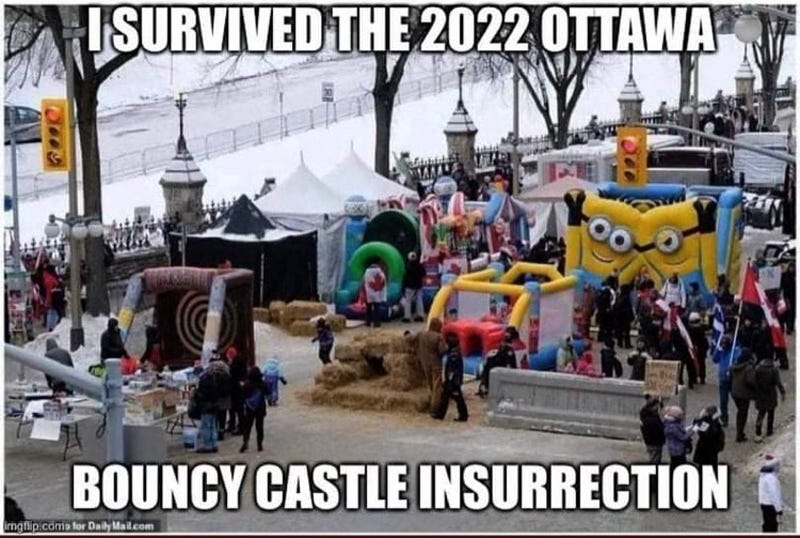
In the National Post, Michael Higgins states the obvious fact that Tamara Lich, Chris Barber, and the rest of the Freedom Convoy protesters were never insurrectionists. Trudeau had decided in advance that the convoy was a maple-flavoured January 6th attempt to overthrow the government — if not an attempt to re-stage the storming of the Winter Palace — and merely waited for the violence to break out and/or the Parliament buildings to be stormed. But nobody other than a few particularly glowy federal provocateurs was interested … because they were there to protest government policy not to start a revolution:

Marco Mendicino, the public safety minister of the day, portrayed them as extremists intent on overthrowing the government.

“This so-called ‘freedom convoy’ called for the overthrow of the government. They called for the Governor General to unilaterally remove the Prime Minister from office,” Mendicino told a Commons parliamentary committee.

Indeed, the Office of the Secretary to the Governor General was inundated with calls and emails by protesters demanding then prime minister Justin Trudeau be fired.

But since the Governor General can’t just decide to sack a prime minister, these email-writing anarchists were particularly inept as well as being constitutionally illiterate.

It was Shakespearean farce, but Liberals like Mendicino were happy to play politics and paint the convoy protesters as lawless subversives bent on destroying democracy.

Although, to be fair, Trudeau only said they were a “small fringe minority” with “unacceptable views” — more retrogrades than revolutionaries.

Meanwhile, Ottawa’s Keystone Kops had all the laws, rules and regulations needed to disband the convoy, they just lacked the leadership.

Days into the occupation, Ottawa Police Services chief, Peter Sloly, appeared to have thrown up his hands in resignation, stating, “There may not be a policing solution” to the crisis. Two weeks later, he quit.

In his report, the public inquiry commissioner Paul Rouleau would later criticize the “serious dysfunction within the OPS’s leadership”.

The government theatrics escalated with the imposition of the Emergencies Act, proving once again the Liberal mastery of combining high drama with low farce. Within days, police had cleared the convoy and several other blockades without incident.

This was less the power of the Emergencies Act and more to do with getting the police to just act.

Enoch Powell: The Father of Brexit?

Filed under: Britain, History, Politics — Tags: , , , , , , — Nicholas @ 04:00

The Rest Is History
Published 6 Oct 2025

Who was Enoch Powell, the deeply controversial British conservative politician? Why is he the father of Brexit, and possibly even Reform? And, how did he come to make his inflammatory “Rivers of Blood speech”, in 1968?

00:00 Intro
00:23 Hive
01:46 Introducing Enoch Powell
07:41 A very peculiar childhood
09:19 The least clubbable man in Cambridge
13:30 War years
14:48 An imperial dream thwarted
17:02 An eccentric MP
23:26 The anti-American
24:53 Immigration in post-war Britain
31:09 Smethwick 1964: campaign, slogan, shock result
33:34 Uber
34:14 Mid-60s Britain
35:59 Powell pivots to immigration
41:44 English identity in Powell’s mind (“united people in an island home”)
44:12 Politics & ambition: differentiating from Heath
45:03 The role of US race riots in Powell’s evolving opinions
46:24 Kenyan Asians crisis; Labour’s response
49:47 Race Relations Bill setup: Powell prepares the speech
50:59 The “Rivers of Blood” speech
56:07 Immediate fallout: sacking, friends’ reactions
57:42 Public opinion divides
1:00:04 His legacy
1:04:02 Was Powell racist?
1:08:12 Long-term legacy: why politicians avoided the topic

Join Dominic and Tom as they discuss Enoch Powell — one of the most incendiary and contentious figures in all of British political history — and his enduring shadow today.
(more…)

Britain is only a few steps further than Canada in the war on free speech

In The Line, Peter Menzies looks at the worsening situation for freedom of speech and freedom of expression in Britain, noting that what’s happening over in Blighty is our immediate future with current Liberal bills before Parliament to give government bureaucrats more power to silence us:

Everyone may know, for instance, that Kimmel got suspended by ABC for a week following statements made in the wake of the assassination of Charlie Kirk. But not a lot of people consuming Canadian media know that in the U.K., comedians weren’t just getting one-week suspensions. Nope. Last month they were getting arrested.

Right-wing icon Katie Hopkins, best known for her Batshit Bonkers Britain clips and Silly Cow tour, hadn’t been charged at the time of writing, but was arrested and, as they say in Blighty, “interviewed under caution”. Previously, Graham Linehan was arrested upon his return from the United States by five armed police officers at Heathrow Airport. At issue were posts he had made on X in April.

“If a trans-identified male is in a female-only space,” one Linehan post declared, “he is committing a violent, abusive act. Make a scene, call the cops and if all else fails, punch him in the balls.”

Currently on bail, Linehan returns to court on Oct. 29. The charges are harassment, criminal damage and suspicion of inciting hatred.

The merits of the cases can be debated, but my point today is that when it comes to digital policy and policing you, and the internet, Canadians and their media should be paying a lot more attention to the U.K.

Because it is there that the true illiberalism of modern Western so-called liberalism is most menacingly embraced. Even prior to the U.K.’s Online Safety Act coming into effect, pre-existing British legislation had been used to, for instance, convict six retired police officers for making comments “deemed to be offensive” within their private WhatsApp chat group. Following the Southport mass stabbing murders of little girls, at least two women with no prior history with police were given prison sentences — one for 15 months for a Facebook post calling for a mosque to be blown up, another 31 months for a tweet calling for hotels full of migrants to be burned. While their comments were certainly worthy of vigorous condemnation, the intervention of the state into private, closed conversations and the involvement of police, courts and the penal system has taken matters in the U.K. to a level inconsistent with liberal traditions.

Now that the Online Safety Act has supplemented those laws, hundreds of people have been arrested and dozens so far convicted for social media posts. The government calls the act a “new set of laws that protect children and adults online” in much the same way Justin Trudeau explained Canada’s own Online Harms Act. It’s all about “safety”.

Online Harms may have died when Parliament was prorogued last winter, but a successor is anticipated and, given Prime Minister Mark Carney’s obvious Anglophilia, it’s easy to speculate — fear is a better word — that he is taking inspiration from the Brits. After all, up until a few months ago, he was one of them.

Fighting back in the U.K. is, among others, Lord Toby Young, the Conservative peer, associate editor of The Spectator and founder of the Free Speech Union, which now has a Canadian branch featuring, among others, journalist Jonathan Kay. Young has protested that criminalizing disinformation hands governments the power to determine truth. Nevertheless, while Prime Minister Sir Keir Starmer has muttered that maybe the police have more important things to do, he shows — despite the meteoric rise in the polls of Nigel Farage’s Reform Party — no inclination to order a digital retreat.

In fact, Starmer just doubled down with the introduction of legislation imposing mandatory digital IDs. A petition opposing it and the potential to enable mass surveillance and state control has already gathered close to three million signatures.

There’s a good chance the Canadian Free Speech Union will be similarly engaged in the years ahead. The Trudeau government’s instincts when it came to digital legislation were not as extreme as Britain’s. And there are very real differences in the legal structure of free-speech rights in Canada and the U.K. — we have the Charter, and the British don’t. So our laws would be enacted and enforced differently here than they can be the the U.K.

Russia’s Great Retreat 1915

The Great War
Published 9 May 2025

In May 1915, the Central Powers launched one of the greatest offensive operations of the First World War. The armies of Germany and Austria-Hungary planned to smash their way through Russia lines and tip the strategic balance in their favor. The result was one of the biggest and bloodiest campaigns of the war, known today as the Great Russian Retreat.
(more…)

QotD: Ontario and the Loyalists

Filed under: Cancon, History, Quotations, USA — Tags: , , , , , , — Nicholas @ 01:00

The Province of Ontario is the most populous province in Canada, home to 38.5% of Canada’s national population as of the 2021 census. Located in Central Canada, it is the political, economic, and cultural heart of the country. Its capital, Toronto, is the nation’s largest city and financial centre, while Ottawa, the national capital, lies along Ontario’s eastern edge. Ontario is bordered by Quebec to the east and northeast, Manitoba to the west, Hudson Bay and James Bay to the north, and five U.S. states to the south — Minnesota, Michigan, Ohio, Pennsylvania, and New York — mostly along a 2,700 km (1,700 mi) boundary formed by rivers and lakes in the Great Lakes–St. Lawrence drainage system. Though Ontario is the second-largest province by total area after Quebec, the vast majority of its people and arable land are concentrated in the warmer, more developed south, where agriculture and manufacturing dominate. Northern Ontario, in contrast, is colder, heavily forested, and sparsely populated, with mining and forestry serving as the region’s primary industries. But Ontario is more than just a province; it is the crucible of English-speaking Canada.

In 1784, after the American Revolution, Loyalist settlers arrived with intention, bringing with them the legal traditions, religious institutions, and steadfast allegiance to the Crown that had shaped their former world. They sought to uphold a civilisational order rooted in monarchy, Church, and Law, and to establish a society founded on duty, hierarchy, and restraint. From these early Loyalist settlements, beginning at Kingston, a distinct political and cultural tradition emerged. It was neither British nor American. It became the foundation of a new people.

Today, the descendants of these settlers form the core of an ethnocultural identity known as Anglo-Canadian. Numbering over ten million across the country, and more than six million in Ontario, Anglo-Canadians are known for their enduring institutions: constitutional monarchy, common law, Protestant-rooted civic morality, and a national ethos shaped by loyalty and order. This cultural framework shaped Ontario’s development across every sphere of life.

Loyalists built the province’s schools, banks, and legal systems. They established its early industries, including agriculture, forestry, mining, and railroads, and later came to dominate the professional sectors of law, education, public administration, and finance. Their shining city, Toronto the Good, became the centre of Canadian banking and corporate life, while small towns across the province were anchored by courthouses, parish churches, and grain elevators.

Language and schooling played a central role in shaping the Anglo-Canadian character. Ontario’s education system, from common schools to universities, was built to transmit British values, civic order, and the English language. Protestant denominational schools and later public grammar schools taught the children of settlers to read scripture, study British history, and speak in the elite formal register of English Canada. Institutions such as Upper Canada College, Queen’s University, and the University of Toronto became pillars of elite formation, producing the clergy, lawyers, teachers, and administrators who carried the culture forward.

Culturally, Anglo-Canadians preserved a rhythm of domestic and seasonal life rooted in British tradition but adapted to the northern landscape. Autumn fairs, apple bobbing, and harvest suppers marked the calendar in rural communities. Roast beef, butter tarts, mincemeat pies, and tea with milk became the everyday fare of farmhouses and urban kitchens alike. Sunday observance, cenotaph ceremonies, school uniforms, and service clubs reflected a moral seriousness and civic sense inherited from the Loyalist project. It is this tradition that formed the structural spine of its political and cultural development.

Fortissax, “Loyal she Began, Loyal she Remains”, Fortissax is Typing, 2025-07-07.

October 8, 2025

History of Britain IX: New Arrivals in the British Dark Age: Angles, Saxons, and Jutes

Filed under: Britain, History — Tags: , , , — Nicholas @ 09:30

Thersites the Historian
Published 31 Mar 2025

In this episode, we look at the invasion and overrun of most of southern Britain by newcomers from the European mainland, who set the stage for the transformation of that region into the Kingdom of England. We also explore the thorny issue of what a dark age is and why the label fits in the case of Britain.

Sentenced for their role in the largest peaceful demonstration in Canadian history

Filed under: Cancon, Government, Law, Liberty, Media, Politics — Tags: , , , — Nicholas @ 05:00

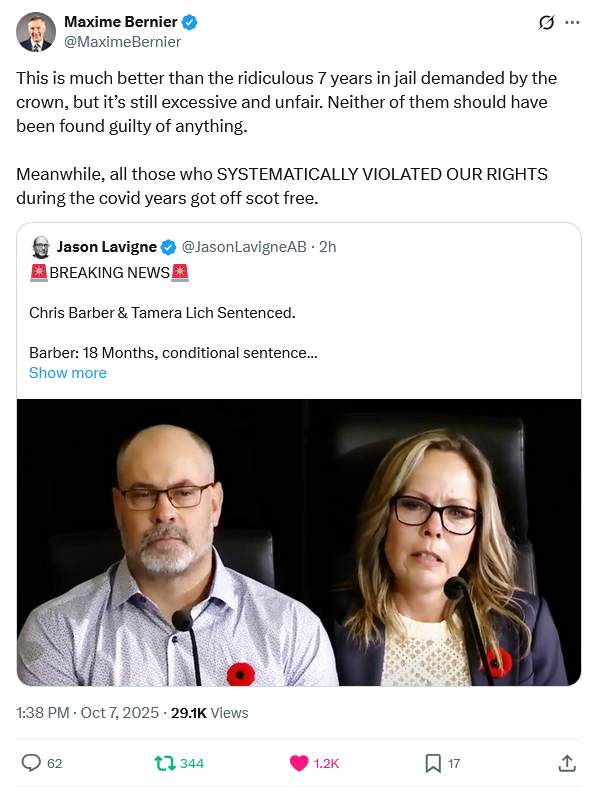
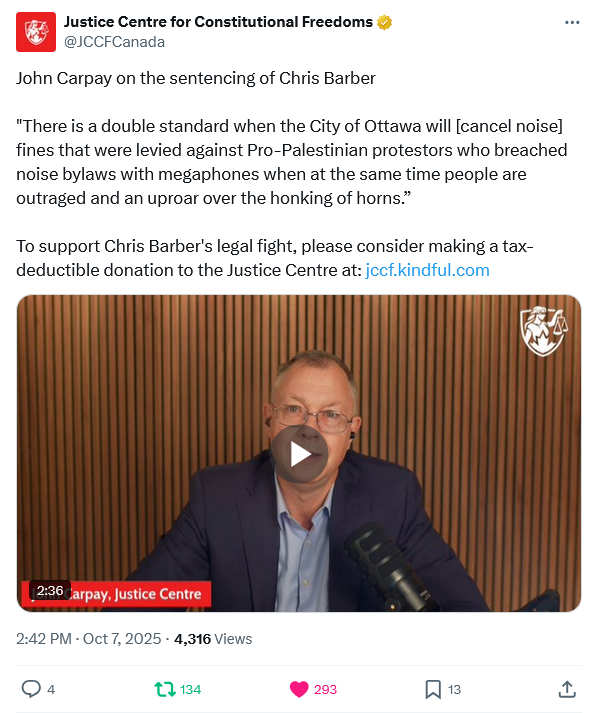
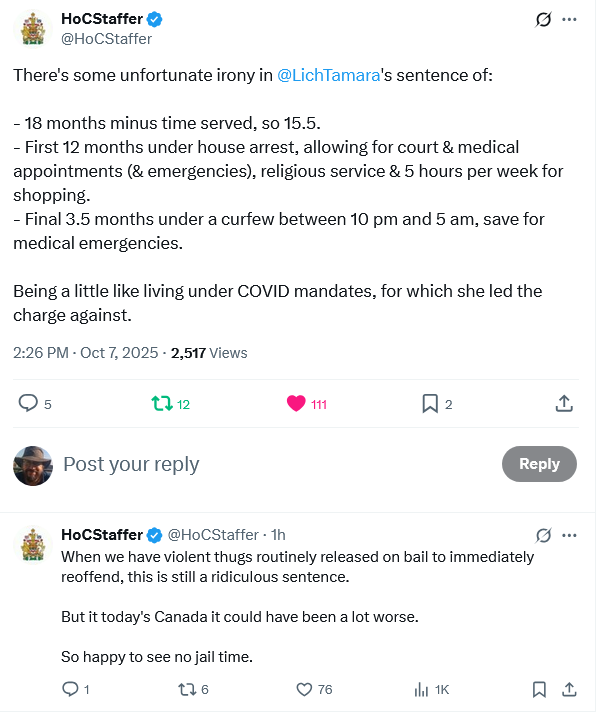
The longest “mischief” trial in Canadian history finally concluded on Tuesday with Chris Barber and Tamara Lich receiving much lighter sentences than the crown had asked for, but in my opinion, far harsher than justice demanded:

One of the readers at Small Dead Animals got a clanker to summarize this: “Regarding the convictions of Tamara Lich and Chris Barber, compare their trials and sentences to leftwing protesters who have openly and violently broken laws in Canada.”

In comparison, left-wing protesters in Canada involved in violent or disruptive actions — such as anti-pipeline blockades (often tied to environmental and Indigenous rights causes) or Black Lives Matter (BLM) demonstrations against racism and police violence — have typically faced shorter trials and lighter sentences for similar or more destructive offenses. These cases often involve civil disobedience escalating to property damage, blockades, or clashes with police, but convictions emphasize non-violent intent or police misconduct, leading to minimal incarceration.

Overall, Lich and Barber’s cases drew unusually aggressive prosecution (e.g., multi-year sentences sought) despite no violence, contrasting with lighter outcomes for left-wing actions involving property destruction or direct confrontations. This disparity has fueled debates on selective enforcement, though courts in both contexts prioritize deterrence while considering protest motivations.

Unlike a lot of clanker slop, that is pretty fair. More reactions on the social media site formerly known as Twitter:

In the Toronto Sun, Joe Warmington accurately calls it a “show trial of sorts”:

Even though this is far better than making these two go to prison or jail, these are still stiff sentencing considering neither were violent during the Convoy and both worked with police to tone things down during the three week protest that came to an end when the Trudeau government invoked the Emergencies Act.

But this was a show trial of sorts, and Lich and Barber were political prisoners. Remember, both of these people have had the hardship of waiting 1,328 days through the longest mischief trial in Canadian history to get to this point. They had their bank accounts frozen during the convoy, Lich lost her job and Barber’s business is at risk of going under. A hearing is scheduled for next month in an effort to seize his famous “Big Red” truck.

It’s also lost on few that so many criminals with far more serious crimes have received far less in terms of length of trial, effort of the Crown and sentencing.

These are certainly stiffer sentences than some parliamentarians have received. For example, in 2021, Former Liberal Kitchener South-Hespeler MP Marwan Tabbara was handed a conditional discharge and put on probation for three years after his guilty plea was entered for two charges of assault on a man and a woman in Guelph. He also pleaded guilty to the amended charge of “unlawfully” being “in a dwelling” or home.

Conservative Sen. Patrick Brazeau was given an absolute discharge in 2015 on his guilty plea to assault and narcotics counts, which allowed him not to serve time or gain a criminal record. But while they did avoid jail time, Lich and Barber did get the book thrown at them harder than most.

Update, 9 October: Welcome, Instapundit readers! Please do have a look around at some of my other posts you may find of interest. I send out a daily summary of posts here through my Substackhttps://substack.com/@nicholasrusson that you can subscribe to if you’d like to be informed of new posts in the future.

The Korean War Week 68: Aussies Take the Lead In Operation Commando – October 7, 1951

The Korean War by Indy Neidell
Published 7 Oct 2025

Omar Bradley, Chairman of the Joint Chiefs, arrives in Korea to see the war for himself. At the same time, UN forces launch new offensives — Operation Touchdown at Heartbreak Ridge and Operation Commando to the west. Both promise heavy fighting, but can they finally break the stalemate?

#KoreanWar #HeartbreakRidge #OperationCommando #OmarBradley

Chapters
00:00 Intro
00:54 Recap
01:16 Bradley and Bohlen
02:17 Operation Touchdown
05:07 Heartbreak Ridge
08:44 Operation Commando
11:20 The Cavalry Attacks
14:49 The Commonwealth Division
16:03 Summary
16:18 Conclusion
(more…)

Rush returns – Geddy Lee and Alex Lifeson announce new tour for 2026

Filed under: Cancon, Media — Tags: , , — Nicholas @ 03:00

The announcement video popped up yesterday on YouTube, as Lee and Lifeson announce the decision to bring Rush back after a decade of retirement (triggered by the death of Neil Peart in 2015). In the National Post, Colby Cosh discusses the much-anticipated return:

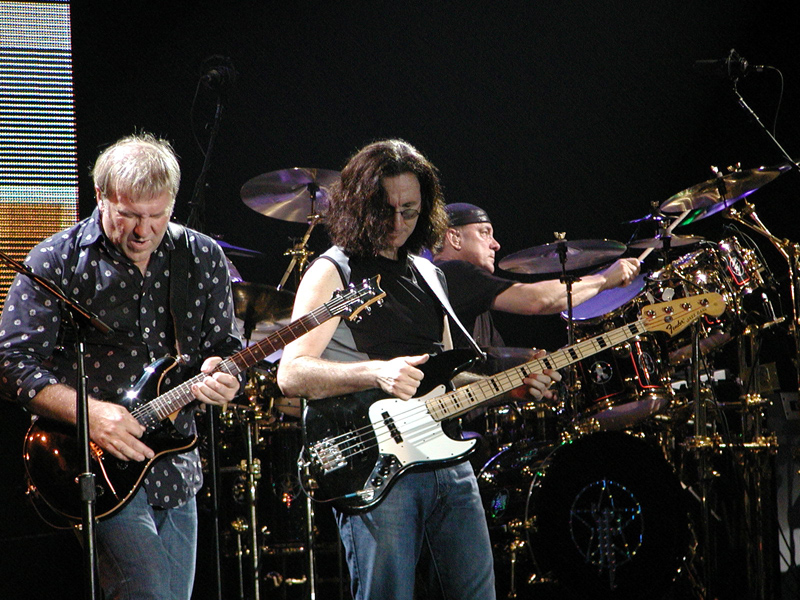
Rush in concert, Milan 2004.
Photo by Enrico Frangi, via Wikimedia Commons

The inevitable has happened: Geddy Lee and Alex Lifeson, the living members of the legendary Canadian band Rush, have announced that they will go on a brief concert tour in 2026. They will, perhaps controversially, go out on the road as Rush rather than adopting some sort of “Lifeson and Lee and Friends” branding. The circumstances of the announcement are familiar ones: Rush had a spectacular farewell tour in 2015, with their renowned drummer Neil Peart increasingly overwhelmed by his own phenomenally intricate parts and his remorseless perfectionism. Peart died of glioblastoma in 2020, which seemed to put a permanent seal on the group.

Over the years, eleventy thousand rock bands have mourned (or just fired) a drummer and moved on, but Neil Peart was NEIL PEART. If you ever watched the crowd at a classic Rush concert, fans doing air-drumming always outnumbered the ones doing air guitar about a hundred to one. Rush in its heyday was an austere three-piece that eschewed sidemen, guest performers, and cover versions on stage almost to the point of dogmatism. They will inevitably feel incomplete or weird with a stand-in for Peart. But Lifeson and Lee say they have been playing Rush songs together privately, and that they are in good health.

They are at the apex of their own individual professions as players, especially Geddy, and … well, a looser, more open, less thoroughly programmed live Rush is something some of us have always wished for, or at least thought about. Variety‘s coverage of the announcement, delivered on Sunday at the Rock & Roll Hall of Fame in Cleveland, Ohio, reveals something almost as surprising as a Peartless Rush: they’re going to tour with a keyboard player! (Other papers are breaking the news as you read this, but Variety had the advance scoop, and has the most extensive coverage of the prospective tour.)

The question on the mind of every Rush fan, of course, is who could possibly step into the shoes (and drum kit) of Neil Peart? That would be a daunting task for any drummer, but Lee and Lifeson think that Anika Nilles will be up to the challenge. I hope she will.

If skeptics visit her YouTube channel and click randomly, they won’t need more than a few seconds to spot her technical credentials for playing Rush songs: she’s inhumanly precise and seems positively allergic to playing in 4/4. Don’t look down, Anika.

QotD: Porn is always in the vanguard of new technologies

Filed under: Books, History, Humour, Quotations, Technology — Tags: , , — Nicholas @ 01:00

    I remember seeing something years ago that commented on how soon after the development of photography we got pictures of naked women.

5 Florins says after Gutenberg invented the printing press and mass printed the Bible, guys were buying presses and cranking out copies of Thee Hornee Shepard and Thee Shye But Readye Milkmaide. 😍

(“T’would say it be a bodice ripper, but we’ve not invented bodices yet” – Johannes of Cologne, Ye Cologne Courier Newspapere)

mmack, commenting on “Why the Internet Stinks Now”, Founding Questions, 2025-07-03.

Update, 9 October: Welcome, Instapundit readers! Please do have a look around at some of my other posts you may find of interest. I send out a daily summary of posts here through my Substackhttps://substack.com/@nicholasrusson that you can subscribe to if you’d like to be informed of new posts in the future.

October 7, 2025

Antifa and the “propaganda of the deed”

Filed under: Politics, Quotations, USA — Tags: , , , , — Nicholas @ 11:30

On the social media site formerly known as Twitter, ESR examines the irrational behaviour of Antifa as an inheritance from their chosen historical models:

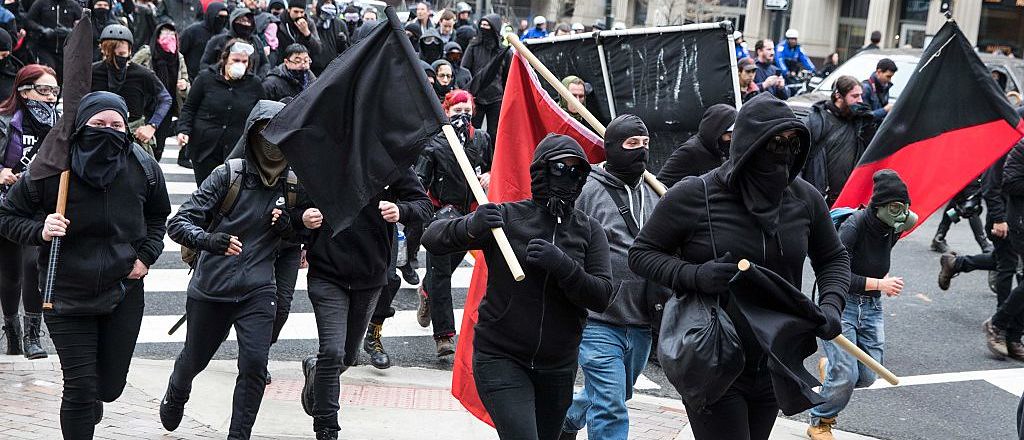
“antifa 8973ag” by cantfightthetendies is licensed under CC BY 2.0

An important concept for understanding why the behavior of Antifa is not strategically rational is “propaganda of the deed”.

This is a concept with a long pedigree in left-anarchist theory, transmitted to Antifa via its minority “black flag” left anarchist faction

19th-century romantic anarchists viewed the state and capitalism as powerful illusions that could be shattered by bold, exemplary acts, thereby proving their vulnerability and offering hope to the oppressed. These deeds were intended to ignite the spirit of revolt by alerting the masses to the possibility of revolution, much like a spark that could set off a larger fire — thus, the emphasis on symbolic targets over objectively effective ones.

This kind of political communication could be effective if a majority of society, or at least a critical minority, are seething cauldrons of resentment just begging to be triggered against their oppressors. It also assumes that the revolutionary rage of the masses can, once unleashed, be effectively directed against Antifa’s enemies.

Both assumptions are highly questionable, but the important thing to understand for purposes of predicting Antifa’s behavior is that (a) Antifa behaves as though it still believes them, and (b) Antifa’s aboveground allies don’t have the capacity to restrain its behavior in detail.

The Gramscian infiltrators in the U.S.’s institutions need to keep their links to overt terrorism deniable, so they manage it mostly by raising or lowering the temperature of public propaganda. For example, when a Democratic politician says “Abolish ICE”, describes government actions as “fascism”, or wishes death on the children of a political opponent, this is raising the temperature. The effect, the intended effect, is to license increased propaganda of the deed by Antifa.

Reminder: unceasing damnation of conservatives as fascists and Nazis constituted instructions to stochastic terrorists like Tyler Robinson that the time had come to do something like shooting Charlie Kirk through the neck.

One problem with this is that because of Antifa’s psychology and doctrine, raising the temperature is easy, but lowering it is hard. Thus, it’s not a process the Gramscians want to start unless they believe either that they have escalation dominance over their opponents, or their political position is deteriorating so rapidly that they’ll never get a better chance to induce a legitimacy collapse.

It is out of scope for this essay to analyze to what extent those conditions are true. The point is, we are in a situation where the limited control Antifa’s aboveground allies can exert is all directed towards escalation, and Antifa’s belief in “propaganda of the deed” makes this very difficult to reverse.

Antifa has probably lost sight of the fact that escalating to insurrectionary violence is premature — it doesn’t have an army or a sufficiently powerful and nearby state sponsor for that.

Thus, absent serious degradation of Antifa’s capacity by law enforcement, expect increasing violence. Including, but not limited to, the deliberate murders of law enforcement personnel and opposing politicians.

« Newer PostsOlder Posts »

Powered by WordPress