Quotulatiousness

July 28, 2025

Ontario Premier Doug Ford – threat or menace?

Filed under: Bureaucracy, Cancon, Government — Tags: , , , , — Nicholas @ 03:00

In many ways, Ontario’s Doug Ford is a 21st century version of former Ontario Premier Bill Davis … a virtuoso performer of the “talk Conservative, govern Liberal” style that urban Ontario voters really seem to love. It works well for the Laurentian Elite to have a Liberal government in Ottawa and a “Conservative” government in Toronto, as they can argue in public about all sorts of marginal issues, but when it comes down to legislation and regulation, they’re almost indistinguishable from one another aside from party colours.

Last week, Ford announced a plan to hand out provincial work permits to a huge number of “asylum seekers” as the feds seem to be making motions to reduce their support of such irregular immigrants:

One step forward, two steps back? As a card-carrying, self-appointed board member of Team “Please stop making everything worse on purpose,” there are some hard-earned wins and faint movements back towards normal, and then there’s the ongoing screw-jobs that threaten any/all progress.

As we have bemoaned time, and time, and time again around these parts, Ontario has a premier problem. But now, all of Canada has a Doug Ford problem.

I’ve been part of an effort to drag urgent immigration reform into the spotlight, and even into a feature position in the waning days of that ‘first ministers’ meeting in Muskoka, but a certain conservative-in-name-only threatens to make historic problems of immigration and unemployment worse, rather than better.

Conservatives in Canada are about to find themselves in a tricky position with Ford, who has the unique potential to remain one of the last vestiges of the failed Trudeau years — even more so than Carney. And the latter may need defending.

Ford and his deeply conflicted and unethical inner circle may wish to grant provincial work permits to a supply of fake students turned fake asylum claimants, but ordinary folk, concerned parents, our proud immigrant communities who made the grade and never cut corners, and our abandoned workers have other ideas.

On the social media site formerly known as Twitter, @HOCStaffer tries to provide some context:

Asylum seekers, refugees, illegals, whatever you want to call them.

They are filling up hotels, getting money, & doing basically nothing, all the while waiting upwards of 2 years for their application to be approved/denied.

I mean, it’s better than where they came from, which is why they are here.

There’s a massive financial burden to the govt & a huge pool of labour doing nothing which could be serving you your coffee instead of a Temp Foreign Worker.

So Ford’s argument — which I have had made to me in person by hotel, tourism, & restaurant lobbyists — is that why don’t we use these people to do the shit jobs?

***** Especially if we are reducing TFWs.

There is a pretty good logic to it.

“May as well have them do something while they are here waiting.” Right?

But I still disagree with the idea.

Most of these people aren’t refugees. They are economic migrants from terrible places. They came here illegally, often under false pretences, & most should be deported.

The longer they stay the more likely they are to have kids here, to potentially marry a Canadian, and to establish links to the country.

Giving them a job furthers that connection.

The last thing we need is the local Tims owner arguing to keep Abdul in the country because he is the only one who will sling shit coffee on the night shift for shit wages.

Giving illegals jobs just rewards the business owners who take advantage of TFWs with a new pool of labour to exploit.

I get that these are businesses and real people have money and time invested in them.

But if you cannot operate without indentured servants then perhaps we don’t really need your business?

A bunch of Tims will close. McD’s too. Maybe some hotels & other businesses too. It’s sad. No one wants to see that.

But we also can’t keep importing people — and thereby affecting much of the rest of society — in order to keep these businesses open.

So yeah, there’s a sound argument to what Ford is saying.

But what he should be saying is that we need a stronger border, faster processing, less appeals and quicker deportations.

That would save his govt real money.

Claudius: The Disabled Emperor Who Conquered Britain

Filed under: Britain, Europe, History, Military — Tags: , , , , , , , — Nicholas @ 02:00

The Rest Is History
Published 27 January 2025

This is part 4 of our series on Suetonius and the Emperors of Rome.

00:00 The rebirth of the republic?
10:05 Who is Claudius
15:18 The relationship between Augustus and Claudius
16:20 The scholar emperor
21:12 Claudius’ relationship with Caligula
28:53 Claudius’ rule as emperor
45:50 The problem he had with his wives
56:40 The rise of Nero
58:40 Was he poisoned?
59:51 The lack of sources in Ancient history

Producer: Theo Young-Smith
Assistant Producer: Tabby Syrett
Executive Producers: Jack Davenport + Tony Pastor

QotD: The technology ecosystem

Filed under: Books, Business, Quotations, Technology, USA — Tags: , , , — Nicholas @ 01:00

A lot of thinkfluencers will describe technology as an “ecosystem” without grappling with the full implications of that term. Most often when they say it they’re referring to a cluster of consumer-facing businesses that rent space or other capabilities from a “platform” provider, like apps on an App Store. But that isn’t an ecosystem, that’s a shopping mall. Real ecosystems have energy and nutrient flow both up and down the food chain, as well as laterally; they have vast swarms of bottom feeders, fungi, and other detritivores that recycle matter through decomposition and make its constituents bioavailable once more; they also have a constant source of energy input (usually the sun) to make up for the constant entropic drag that would otherwise grind things to a halt. One of the great discoveries of modern ecology is that apex predators, macrofauna, the plants and animals we notice and admire are perched precariously atop a vast network of invisible supports. A tiger is the temporary result of too many worms gathering in one place.

Technology is also an ecosystem, not the way bluechecks talk about it, but in this more profound sense. A Boeing or a Google is like a tiger: the highly-visible culmination of a vast subterranean drama. Turn over a spade and you’ll find them — the suppliers and subcontractors, investor networks, tooling manufacturers, feeder universities, advisors, researchers, shipping and packaging experts, friendly bankers and government officials, producers of upstream technological inputs, and a vast collection of lower-tier companies in related markets that act like an economic flywheel, absorbing and releasing excess labor as the economy shudders through its fits and starts.

In nature, it’s energy and nutrients that move through the food webs. Here their analogues are capital and knowledge. It’s hard to miss the money sloshing back and forth — world-changing companies are nurtured through their awkward adolescence by sophisticated and patient pools of capital, and the high-flying champions of those companies become the next generation’s venture investors after cashing out. Harder to see but even more influential is the vast economic dark matter made up of professionals who struck it rich enough to live comfortably but not rich enough to fly private. These unobtrusive capitalists are the first to hear through professional whispernets that so-and-so has quit his job to work on such-and-such. Since they’re still in the rat-race, they can have an informed opinion on the caliber both of the idea and of the team around it, and are usually the early champions of the most unusual and speculative ventures. And finally, money sloshes around between the companies themselves through a complicated network of deals, joint ventures, and strategic investments.

The money is more visible, but the way knowledge moves is more important. Part of it is academic, propositional knowledge or technical data whose discovery is accelerated when a dozen different teams are on its scent, sometimes racing each other to the prize, sometimes egging each other on and celebrating each others’ victories. But the bulk of what makes this ecosystem hum, the true currency that drives nearly every barter or exchange, is practical, process knowledge of the sort that 莊子 first described and Michael Oakeshott later re-popularized for our benighted and ignorant age. What makes process knowledge unusual is that by its very nature it cannot be separated from people, cannot be digitized or divorced or attached to an email. It is at once the nous of a technological ecosystem and the thing that makes it fundamentally illegible — an immaterial, intangible essence that inheres only in individuals, like a mind or a soul.

John Psmith, “REVIEW: Flying Blind by Peter Robison”, Mr. and Mrs. Psmith’s Bookshelf, 2023-02-06.

July 27, 2025

“[T]he wonderful warm kind progressives, the Maple Leaf edition of “‘hate has no home here'”

Filed under: Cancon, Health, Media, Politics — Tags: , , , , — Nicholas @ 05:00

Chris Bray looks at the kind of people who supported the lockdowns during the pandemic and heartily condemned those lesser folks whose careers and livelihoods were threatened and how they hope for examples to be made of the “leaders” of the Freedom Convoy back in 2022:

Let’s start with a comparison to the good people in Canada, the wonderful warm kind progressives, the Maple Leaf edition of “hate has no home here”. Cheri DiNovo is, let me put this very gently, an instantly recognizable social type, “one of Canada’s best-known and most ardent queer ministers and an Ontario politician who would help pass some of the province’s most integral LGBTQ2S+ policy”. You already know her by her facial expression:

slay, girlboss

As the leaders of the Freedom Convoy face sentencing in court, DiNovo has this to say about their monstrous cruelty:

The Freedom Convoy: white supremacist homophobes who harassed and brutalized LGBTQ+ people and immigrants and the disabled, lashing out in a stunning wave of public cruelty. It was like a NUREMBERG RALLY with trucks, obviously. Here, look at some of the monstrous acts of public brutality committed at this mass expression of hate and rage:

YOU KNOW WHO ELSE DANCED TOGETHER THINK ABOUT IT

Rupa Subramanya, a journalist who uses the old and mostly forgotten technique of talking to people, wandered the crowds in Ottawa (in her own neighborhood) and reported that Freedom Convoy protesters mostly talked about their desire to recover a sense of hope. Their grievances were clear, thoroughly explained, and entirely defensible. Here’s a sample paragraph, a discussion with one of the VICIOUS WHITE SUPREMACISTS:

    Kamal Pannu, 33, is a Sikh immigrant and trucker from Montreal. He doesn’t believe in vaccinations; he believes in natural immunity. He had joined the convoy because the Covid restrictions in the surrounding province of Quebec had become too much to bear. He said that he and his wife used to do their grocery shopping at Costco, until the government decreed that the unvaxxed would be barred from big-box stores. Since then, their monthly grocery bill had jumped by $200. “Before,” he said, “we didn’t look at the price of what we were buying. Now, we sometimes put items back because we don’t have that much money.”

See this clearly against Cheri DiNovo’s framing, and remember it:

The white supremacist protesters who hate immigrants; for example, Kamal Pannu, a Sikh immigrant and trucker.

In fact, Sikhs make up a substantial share of the trucking industry in Canada, and so had a significant presence at the Freedom Convoy:

See the WHITE SUPREMACISTS saying that they HATE IMMIGRANTS!?!?!? Because Cheri DiNovo does. She thinks categorically: good people who support the Liberal Party, Literally Adolf Hitler who doesn’t. She has no capacity for seeing the thing itself, as it was on the ground, in physical reality. Literally nothing, no evidence or substance of any kind, could ever have prevented her from saying that a protest against Justin Trudeau’s government was white supremacist and homophobic. She’s out of her fucking mind. She has no connection to any form of reality, at all, in any way, ever. She doesn’t see anything. She doesn’t know anything. She’s ignorant noise and infinite sanctimony, with a pair of legs to carry it around.

This is “left” politics in the Anglosphere. Symbol symbol symbol, you NAZI! It doesn’t connect. It’s all chanting and performance and status-signaling, and it never leaves the house. It left reality behind ten years ago, and now it’s out there sailing past Pluto. For adherents of the Manichean religion of wokeism, categorical thinking covers all bases. People who don’t get mRNA injections are misogynistic racist bigots, obviously.

Update: Fixed broken link.

Day Nine – Hitler’s Halt Order and Tragedy at La Ferté – Ten Days in Sedan

Filed under: France, Germany, History, Military, WW2 — Tags: , , , , , — Nicholas @ 04:00

World War Two
Published 26 Jul 2025

May 18, 1940. Our coverage of the German blitzkrieg in France continues. Today, we take a break from the panzers for a spot of old-fashioned siege warfare. At Ouvrage La Ferté, a small garrison of French troops makes a doomed last stand against overwhelming German firepower. We follow their final hours, the decisions that sealed their fate, and what their sacrifice meant for the collapsing French front.
(more…)

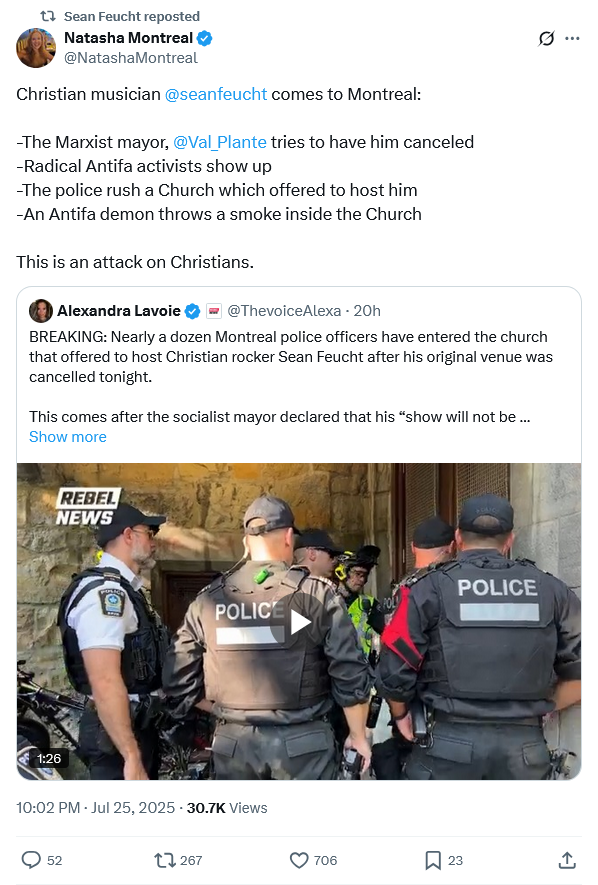
I’m sure I would never have heard of Sean Feucht until they tried to silence him

Filed under: Cancon, Government, Media, Politics, Religion, USA — Tags: , , , , , , — Nicholas @ 03:00

It’s hard to believe how Canadian municipal and provincial authorities deal so gently with disruptive pro-Hamas protests that regularly threaten the lives and property of Canadian Jews compared with the positively authoritarian way they are reacting to “MAGA” Christian performer Sean Feucht‘s concerts:

Shooting a .276 Pedersen PB Rifle

Filed under: History, Military, USA, Weapons — Tags: , , , , — Nicholas @ 02:00

Forgotten Weapons
Published 11 Aug 2015

Thanks to Alex C. at TheFirearmBlog, I recently had an opportunity to do some shooting with a .276 caliber Vickers-Pedersen model PB rifle. This was one of the very first rifles Vickers built when they thought the Pedersen would be adopted by the US military and could be further marketed worldwide — after only about 16 PB rifles they made some changes and started making the improved PA model instead (the two main improvements being the use of a reversible clip and the addition of a mechanism to allow ejection of a partially-full clip).

Anyway, in addition to Alex and myself, we were joined by Nathaniel F (a TFB writer) and Patrick R (from the TFBTV video channel). Between us we put about 60 rounds of original 1920s wax-lubricated Frankfort Arsenal .276 Pedersen ammo through the rifle.

QotD: London coffeehouses and Paris salons of the Ancien Régime

Marie Antoinette arrived in Paris at the end of this era of strict censorship, which helps explain why her honeymoon with French public opinion was short-lived. The official press, notably the Mercure and Gazette, continued churning out fawning snippets of society news about the royal couple. But the scandal-mongering libelles and pamphlets had their own paragraph men, called nouvellistes, who picked up “news” from well-informed sources posted on benches in the Tuileries, Luxembourg Gardens, and, of course, under the tree of Cracow. Police efforts to repress nouvellistes‘ gossip proved futile in the face of high demand. One famous libelle of the era, Le Gazetier cuirassé promised “scandalous anecdotes about the French court”. (It was printed in London, out of reach of official French censors.) Another publication printed in London starting in the 1760s was the famous Mémoires secrets, an anonymous chronicle of insider gossip and anecdotes from Parisian high society. A scurrilous book about Louis XV’s mistress, Madame du Barry, also appeared as a collection of gossip that nouvellistes had picked up around Paris.

Despite the libelles circulating in Paris, the Bourbon monarchy was still relatively protected compared with the hurly-burly across the channel in London, where coffeehouses buzzed with political innuendo and intrigue. Some French philosophes, it is true, attempted to replicate London’s coffeehouse culture at Parisian cafés, such as the Procope on the Left Bank. (Voltaire frequented the place, where he liked to add chocolate to his coffee.) Other regulars at the Procope — named after the Byzantine writer Procopius, famous for his Secret History — were Rousseau, Danton, and Robespierre, as well as Americans Benjamin Franklin and Thomas Jefferson.

The Parisian equivalent of the coffeehouse was the salon, which differed from London coffeehouses in both ambience and function. Whereas London coffeehouses were boisterously public, salons were essentially closed spaces, usually held in private homes. Most were by invitation only. Many were hosted by women, usually titled or wealthy ladies with an interest in culture and politics — such as Madame de Rambouillet, Madame Necker, Madame Geoffrin, and Mademoiselle Lespinasse. There was also the Marquise du Deffand, a friend to Voltaire and the English man of letters Horace Walpole, to whom she bequeathed not only her papers, but also her pet dog, Tonton.

As access to these rarefied spaces increasingly became a symbol of social success, admission got more tightly controlled. (Madame Geoffrin expelled Diderot from her salon because she found his conversation “quite beyond control”.) Still, those who frequented salons represented a great diversity within the elites — from rising young writers and established authors to powerful politicians and eccentric aristocrats. The tacit rule was, as in London coffeehouses, that wit was more important than rank. Many great French writers launched their careers thanks to their admittance. One was the philosopher Montesquieu, who found success at the salon of Madame Lambert.

Matthew Fraser, “Marie Antoinette: Figure of Myth, Magnet for Lies”, Quillette, 2020-06-24.

July 26, 2025

The desperate narcissism of the “Cool Professor”

Filed under: Education — Tags: , , — Nicholas @ 05:00

Freddie deBoer on the pathetic academic specimen sometimes known as “Bob” or “Biff” or “Lizzie” — the dreaded self-imagined “cool professor”:

“heh, probably never expected to have a professor with full sleeve tattoos, huh? well, that’s not the last time your mind’s gonna be blown this semester …”
Image and caption from Freddie deBoer’s Substack

Let me tell you about the saddest figures in the American university. They wear black jeans and Chuck Taylors to class, except maybe on the first day, when they stroll in wearing semi-ironic suits designed to contrast with their ample tattoos. Their syllabuses are printed in Helvetica. They mention Chappell Roan in the first fifteen minutes of the first day of class. They tell their students, with a wink, that they don’t believe in grades — why, who are they to judge their students! They encourage everyone in class to call them by their first names, or perhaps a contrived nickname. They hope to blow everyone’s minds when they theatrically announce that in their classes, students pick the readings, because the students are the ones who really know what’s worthy of their time. They describe themselves as “friends” or “guides” or “partners”, not as teachers or professors. They disdainfully invoke the words “rigor” and “standards” only with ironic scare quotes and want you to know that they don’t believe in deadlines. They subtweet the provost on BlueSky. They are the Cool Professors. And they are frauds.

The Cool Professor fundamentally does not want to teach, as teaching requires the teacher to sometimes be the bad guy. The Cool Professor can’t stand to be the bad guy, chafes at the very idea. That’s the core of all of this. The posture, the cultivated aesthetic of rejection, the performance of cool — none of it’s about students, even though Cool Professors will not shut the fuck up about how they run a “student-centered classroom”. Their affect isn’t about pedagogy. It’s about insecurity and narcissism, their desperate need to be perceived as the rare exception, the rogue academic, the anti-institutional rebel. Cool Professors aren’t trying to liberate students. They’re trying to be loved, and in being loved by students stave off their horror about growing old. And if that means letting students drift intellectually, if that means mistaking chaos for creativity, if that means failing to ever give anyone a hard but necessary lesson, then so be it. Because the thing the Cool Professor wants to avoid at all costs is being perceived as an authority figure, and that is precisely what students most need them to be.

It’s a common misunderstanding, particularly among faculty who feel alienated from the bureaucracy of the university or who fancy themselves transgressive thinkers, that teaching should never be hierarchical. The idea is that it’s somehow oppressive to know more than your students or to presume to evaluate their performance; that knowing more than your students and evaluating their performance are publicly understood to be core parts of being a teacher typically goes ignored. Many who consider themselves modern or progressive in the academy insist that education should be horizontal, an equal exchange between learner and guide, that the classroom is a site of resistance or liberation. But these ideas, while maybe flattering to the professor’s ego and superficially appealing to a certain kind of idealist, are incoherent. They’re built on a fundamental category error: mistaking the classroom for a club meeting, or a dinner party, or a DSA breakout session. The classroom is none of those things. It’s a site of instruction, and in a site of instruction one party knows more than the other; one party evaluates the other; one party is, necessarily, in charge.

(And, for the record, the fundamental dictate of critical pedagogy is always and forever self-defeating: if you inspire your students to rebel against your authority in your own classroom, they’re still following your lead and thus not rebelling at all. The ubiquitous goal of prompting students to resist top-down education, whatever that means, is unachievable, because if you do prompt them to resist, they’re actually complying with your desires, not resisting them. It’s a good old fashioned paradox and not one you can bluff your way out of with abstruse academic vocabulary.)

The plain fact that a teacher must necessarily have some sort of control over the classroom space that the students do not makes people uncomfortable. Authority always does. But then, the job of a teacher is not to minimize discomfort; indeed, a good teacher will necessarily make their students uncomfortable, on occasion, as it’s often only in the space of genuine discomfort that we’re inspired to achieve our deepest growth. The professor’s job to be responsible for the intellectual development of students, which inevitably involves making judgments: what is true, what is false, what is well argued, what is sloppy, what is insightful, what is clichéd. If you aren’t willing to say those things, if you shrink from judgment, you’re abandoning the role you signed up for, you’re copping out. You’re indulging yourself, and your own flattering self-mythology, at the expense of the people you’re supposed to be teaching.

The unaffordable luxury of a second-best army

Filed under: Europe, France, History, Military — Tags: , , , , — Nicholas @ 04:00

At History Does You, Secretary of Defense Rock considers the downfall of Prussia’s vaunted army at the hands of Napoleon in a blink-of-the-eye campaign in 1806:

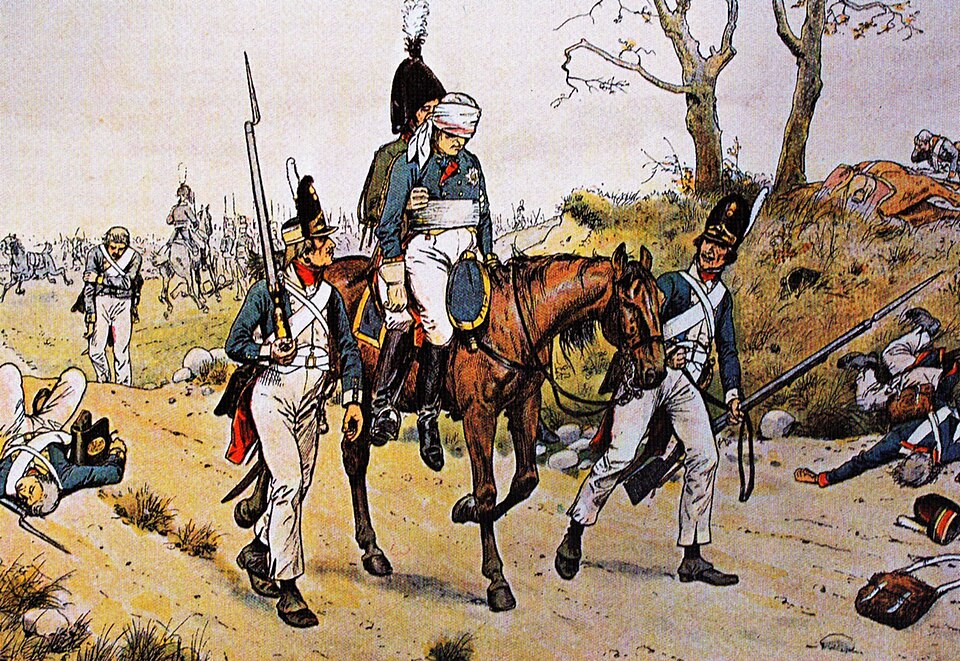
“Prussian wounded and stragglers leaving battle [after the battles of Jena and Auerstadt]. The mortally wounded Duke of Brunswick is the prominent figure in the painting.”
Painting by Richard Knötel (1857–1914) via Wikimedia Commons.

    A vain, immoderate faith in these institutions made it possible to overlook the fact that their vitality was gone. The machine could still be heard clattering along, so no one asked if it was still doing its job.1
    – Carl von Clausewitz on Prussia in 1806

In the autumn of 1806, the Kingdom of Prussia, “The Iron Kingdom”, suffered one of the most rapid and humiliating military defeats in modern European history.2 The twin battles of Jena and Auerstedt shattered not only its army but the myth of invincibility that had surrounded the legacy of Frederick the Great. For the young Carl von Clausewitz, then a junior officer in the collapsing Prussian forces, this moment marked a personal and national catastrophe that would shape his life’s work. Clausewitz would come to see the defeat not simply as a failure of generalship or tactics, but as the exposure of a more profound institutional and societal crisis; one in which a state had grown complacent, a military rendered obsolete, and a society stripped of civic vitality falling apart during “the most decisive conflict in which they would ever have to fight”.3 In that collapse and Clausewitz’s later reflections, one finds an unsettling parallel to present-day America, a powerful nation outwardly strong, yet increasingly vulnerable to the same internal rot.

Prussia’s disaster in 1806 was the formative experience for the author of On War. How the armies of Frederick the Great and the state that he painstakingly built collapsed like a house of cards was a question that bothered Clausewitz for many years.4 It was a comprehensive disintegration of a system that had, since the mid-eighteenth century, claimed a position of prominence in European military affairs based on its discipline, linear tactics, and centralized command. Yet by the turn of the nineteenth century, these very strengths had calcified into weaknesses. Clausewitz foresaw disaster. Even as a young lieutenant, he was already warning of the Prussian army’s growing detachment from reality. In his early writings, he criticized military exercises as highly scripted performances, lacking genuine tactical challenge, unpredictability, and creativity.5 The number of steps marched in a minute of the cadence, what awards should be placed on a uniform, how a rifle should be cleaned for parade, all of this he feared, was cultivating a “lassitude of tradition and detail”.6 Clausewitz understood that rehearsing war under artificial constraints produced not readiness but ritual. Even though he later wrote, “no general can accustom an army to war”, he worried, presciently, that when confronted by a real enemy operating under real conditions, the army would collapse, and in 1806, it did.7

Whatever reservations he may have held, Clausewitz fulfilled his duty. He led a battalion of grenadiers at the battle of Auerstedt and managed to withdraw with most of his men intact in the chaotic aftermath of defeat. His escape was short-lived; however, he was captured on October 28, 1806, and subsequently marched into captivity in France, where he would spend the next year as a prisoner.8 Napoleon’s campaigns revealed that war had been transformed: faster, larger, and fundamentally political. Clausewitz wrote, “War was returned to the people, who to some extent had been separated from it by the professional standing armies; war cast off its shackles and crossed the bounds of what had once seemed possible”.9 The levée en masse and the corps system shattered the static paradigms of eighteenth-century warfare. Yet the Prussian high command, clinging to the geometries of the past, failed to respond with imagination or speed with any kind of seriousness.

Clausewitz’s later concept of friction — the unpredictable resistance that disrupts even the best plans — emerged directly from this experience.10 The Prussian army collapsed not for lack of courage, but because its institutional mindset could not withstand the volatility of an age that demanded adaptability, political intelligence, and creative command.


    1. Carl von Clausewitz, Historical and Political Writings, ed. and trans. Peter Paret and Daniel Moran (Princeton, NJ: Princeton University Press, 1992), 32.

    2. Christopher Clark, Iron Kingdom: The Rise and Downfall of Prussia, 1600–1947 (Cambridge: Belknap Press, 2006).

    3. Clausewitz, Historical and Political Writings, 81.

    4. Frederick the Great ruled from 1740-1786 and is usually credited as turning Prussia from a regional power to a continental power.

    5. Peter Paret, Clausewitz and the State (Oxford: Oxford University Press, 1976), 92-93.

    6. Clausewitz, Historical and Political Writings, 36.

    7. Carl von Clausewitz, On War, trans. Michael Howard and Peter Paret (Princeton: Princeton University Press, 1984), 122.

    8. Partet, 126.

    9. Clausewitz, Historical and Political Writings, 287.

    10. Clausewitz discusses this concept in Chapter 7 in On War, 119-121.

VIA Rail’s premier passenger train, The Canadian

Filed under: Cancon, History, Railways — Tags: , , , , — Nicholas @ 03:00

In the National Post, Raymond J. de Souza discovers the aging crown jewel of VIA Rail’s passenger services, The Canadian, which VIA inherited from Canadian Pacific Railway when the country’s long-distance and intercity rail passenger services were merged into a single Crown Corporation in the 1970s:

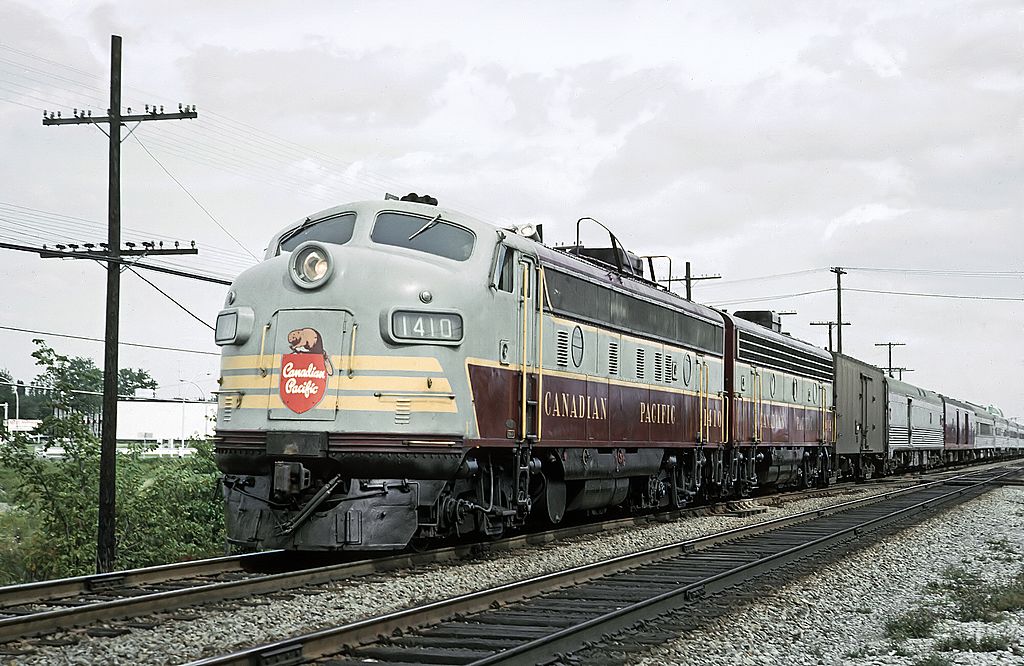
Canadian Pacific FP7 locomotive 1410 at the head of The Canadian stopped at Dorval, Quebec on 6 September, 1965. The Canadian was Canadian Pacific’s premier passenger train before VIA Rail was formed.
Photo by Roger Puta via Wikimedia Commons.

What did I learn after four days and four nights, some 4,500 kilometres, from Vancouver to Toronto on board Via Rail’s The Canadian? Many things, as it happens.

I learned that The Canadian attracts train aficionados the world over for one of the last great rail journeys on one of the last great trains. The stainless steel rolling stock is 70 years old, the cars having been upgraded along the way, but still rolling as a living part of railway history.

Part of the cultural history Via Rail preserves is superlative meals thrice daily, served in fine style in the dining cars. Four dinners: rack of lamb, beef tenderloin, AAA prime rib, bone-in pork chop. Delicious desserts. Canadian wines and craft beers. Fish eaters and vegans also had options. The question arises ineluctably: Why is the Via Rail food between Montreal and Toronto so horrible?

Perhaps it would be too expensive; The Canadian in sleeper class certainly is. Expense was really the question in the 1870s.

“Could a country of three and a half million people afford an expenditure of one hundred million dollars at time when a labourer’s wage was a dollar a day?” asked Pierre Berton in his 1970 chronicle of that decision, The National Dream.

The cost of not building was greater, argued Sir John A. Macdonald. It was the price of remaining a sovereign continental country. Part of the financing was creative; the Hudson’s Bay Company gave Rupert’s Land to Canada, and Canada paid the contractors partly in free land.

Growing up in Calgary, I presumed that the greatest challenge was putting the Canadian Pacific Railway (CPR) through the mountains. And it is true that the most spectacular scenery on the route is the Fraser Canyon and the mountains of the Yellowhead Pass. (The Canadian now travels the northern route of the Canadian National (CN) Railway, not the original southern route of the CPR.)

Yet it was the Canadian Shield, thousands of lakes and muskeg atop the hardest rock on earth, that was the real obstacle. John Palliser, one of the 1860s expeditioners between Thunder Bay and the Rockies, reported back that while getting through the mountain passes could be done, the impenetrable land north of Lake Superior was the insuperable problem. And without getting around the Shield, Canada would be constrained, cooped up, with the prairies and mountains and west coast inaccessible.

VIA dome observation car on The Canadian in 2007. The best views are available from the domed seating on the upper level.
Photo by Savannah Grandfather via Wikimedia.

I’d always hoped to travel The Canadian at some point, but I was never able to afford the tickets at the same time that I had available time to travel, and there’s no hope I’ll ever be able to scrape up the money these days. According to VIA Rail’s website, the trip from Toronto to Vancouver would be between C$5860 to $9460 per person.

The Julio-Claudians – The Conquered and the Proud 15

Adrian Goldsworthy. Historian and Novelist
Published 26 Feb 2025

This time we take a look at the reigns of Augustus’ successors — Tiberius, Gaius Caligula, Claudius and Nero, referred to collectively by scholars as the Julio-Claudian dynasty. We think about the whole question of the succession, and trace how each diverged from Augustus when it came to the style of governing.

QotD: The accumulated friction of bureaucratic growth

Bureaucracies all succumb very quickly to some kind of “Malthusian progression”. I’m not sure what to call it, I suck at naming stuff (please take your shot in the comments), but you all know what I mean: A bureaucracy’s tasks increase arithmetically, but the amount of effort each task requires increases geometrically.

[…] In the early Republic, raising a legion was as simple as a patrician calling his clients to service, or the Senate issuing a conscription decree. One task: the summoning of free men, with their own equipment, and there you go — Legio I Hypothetica.

By the late Empire, though, all those freeholds had been turned into slave-worked Latifundia, so the effort of raising a legion increased enormously. Now the bureaucracy had to go out and hire freemen (if it could even find them), equip them at State expense, train them (again at State expense), and so on. In itself, the number of tasks isn’t that large — we’ve identified three — and they only increase at the rate of n+1.

But the effort each task requires increases to the power of n, such that if you could somehow express the effort expended in physical terms — joules or kilowatts or whatever — you’d see that the creation of Legio I Hypothetica under Scipio Africanus took 10 kilowatts, while raising the same legion under Diocletian took 10,000,000.

This isn’t (just) corruption. Sure, everyone at every level of the Imperial Bureaucracy was getting his beak wet, that goes without saying, but it’s the nature of bureaucracy itself that’s most to blame.

Severian, “Collapse II”, Founding Questions, 2021-12-09.

July 25, 2025

The Royal Canadian Navy announces eight of the Kingston-class ships will be retired this year

Filed under: Cancon, Military — Tags: , , — Nicholas @ 05:00

The Kingston-class Maritime Coastal Defence Vessel (MCDV) has been in RCN service starting in the mid-1990s and they’ve apparently done well for the navy in their intended role. Unfortunately, naval ships have a normal working life expectancy of 20-30 years, and the Kingstons are at the upper end of that range, so it’s not surprising that they will be taken out of service. It is a bit of a surprise that the announcement came on Thursday and two-thirds of the class will be paid off this fall, without a direct successor class of ships on the slipways:

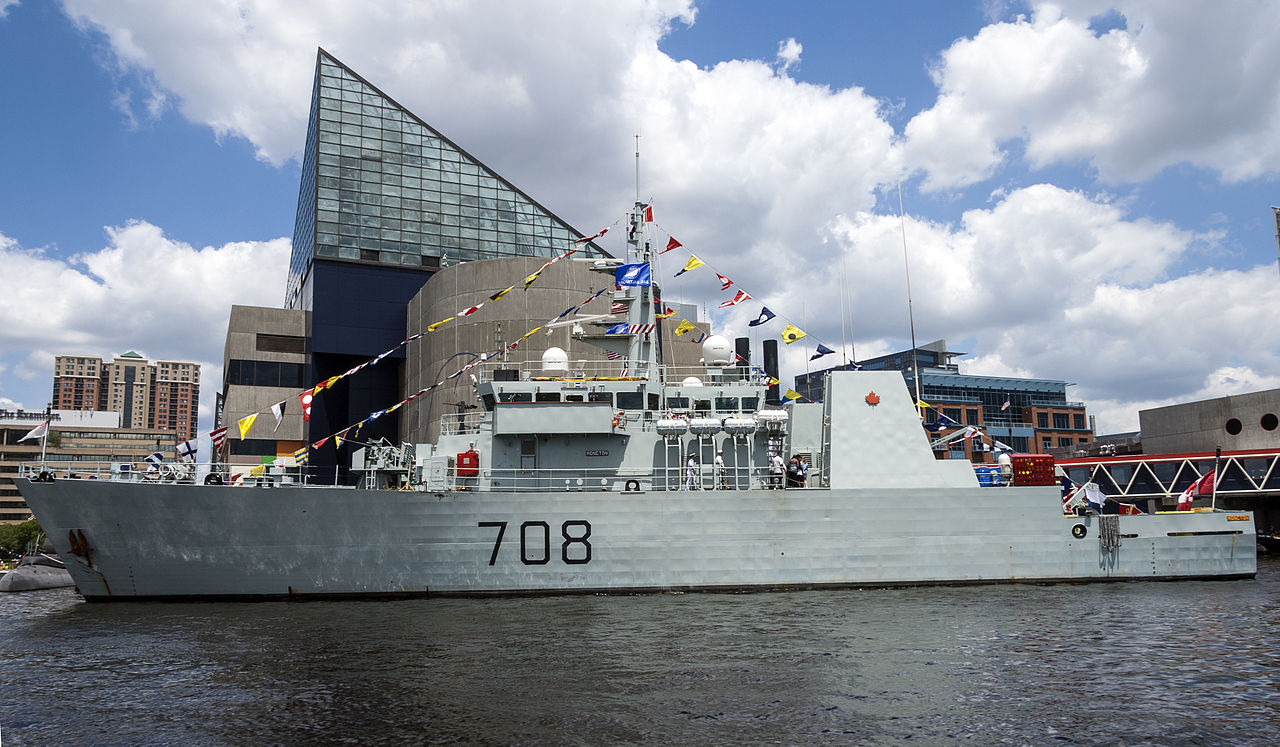
The Kingston-class Maritme Coastal Defence Vessel (MCDV) HMCS Moncton in Baltimore harbour for Sailabration 2012.
Photo by Acroterion via Wikimedia Commons.

Starting this fall the Royal Canadian Navy will begin divesting of the Kingston-class vessels. Eight of the Kingston will be divested while four, Moncton, Yellowknife, Edmonton, and Nanaimo will remain in service for the time being.

Formal ceremonies will take place in Halifax for Shawinigan, Summerside, Goose Bay, Glace Bay and Kingston. Ceremonies in Esquimalt, B.C. will be held for Saskatoon, Whitehorse and Brandon.

The remaining four will be divested over the next three years:

  • Yellowknife in 2026
  • Edmonton in 2027
  • Moncton and Nanaimo in 2028.

The duties of the Kingstons will be transferred to other vessels in the fleet. The AOPS have already taken over the OP CARRIBE and Patrol roles the last few years, while training duties will be moved fully to the Orca [class].

The new Remote Minehunting and Disposal Systems, being containerized can theoretically be deployed on any available vessel, and will be another role taken by the AOPS and the Kingston divest. They’ve already been doing MCM testing so that shouldn’t be a surprise to anyone.

The remaining four Kingstons will likely continue to participate on things like OP REASSURANCE, which Yellowknife and Edmonton are currently deployed on until October as part of SNMCMG1.

In basic terms the AOPS will be taking over a majority of the Kingston‘s tasks, which they have been slowly adding to their belt already. To say there hasn’t been a slow transition would be ignorant of me.

Nor is this surprising. We knew this was coming. Its been an open discussion for a while. I expected we would hear something this year about the divestment plan, however I didn’t expect eight to be paid off right away.

That comes as a surprise to me, also dropping it out of the blue. I wasn’t expecting this to come at this time, so this is a rare moment of genuine shock for me. Of course the Kingston fleet isn’t in the greatest of shape.

Several haven’t sailed in years (I believe Whitehorse is on almost five?) and the decision to not do another refit was basically the death blow to the class as a whole.

Things get harder before they get better. It is better to divest now and have people available for the platforms that are working and in greater need than it is to try and stretch the Kingstons for a few extra years, nor was it deemed worth the ever-increasing cost to keep them in service.

The Kingstons will be replaced by the future Continental Defence Corvette. I expect as the fall comes that we will be hearing more publicly about the project. I was a bit surprised they didn’t bring it up in the Press Release given it’s not exactly a secret, although it was teased a bit.

Arctic Offshore Patrol Ship (AOPS) HMCS Harry DeWolf shortly after launch in 2018. The ship was commissioned into the Royal Canadian Navy in June, 2021.

Autism, then and now

Filed under: Education, Health, Media — Tags: , , , , — Nicholas @ 04:00

At Psychobabble, Hannah Spier traces the rise of autism from its first formal definition to something that 1 in 36 kids is diagnosed with:

When Leo Kanner first defined autism in 1943, it was estimated that 4 to 5 children per 10,000 were affected. Today, the CDC puts that number at 1 in 36, almost one child in every classroom. If any other medical condition, blindness, epilepsy or paralysis showed a spike like this, it would trigger a pandemic-level outcry. But with autism, we see at best a curious murmuring as to what this is, and at worst, a growing chorus of people insisting, they too, belong in the group.

From experts, instead of raised alarms or calls for serious public health investigation (as would be expected for any other childhood disorder) we get calls for inclusivity and a self-congratulatory attitude toward their advancement in diagnostic understanding and tools. Another example of ideological capture of psychiatry by cultural sentiment.

Characters like Sheldon Cooper and Sherlock Holmes have helped turn the image of autism into a badge of honour. It means you’re socially odd, intellectually superior, and emotionally detached in an edgy and endearing way. For many, especially mothers with narcissistic tendencies hungry for a narrative of exceptionalism, this offered a seductive reframing of their child’s misbehaviour and non-conformity as evidence of giftedness. She could thus become the one who gave birth to the quirky but special genius. She alone saw the hidden brilliance beneath the “weird” behaviour. She became the martyr and the insider to an elite subculture. It’s Munchausen by proxy, 2025 edition.

People with narcissism and psychopathic traits exploit wherever they can, we know this. And yet again, psychiatry, the ones who should be the best at recognizing these, made it easy pickings by flinging the diagnostic gates wide open. Longtime readers will recognize the pattern: I’ve written before about the diagnostic creep in trauma, expanding definitions that blur the line between disorder and ordinary variation. The same diagnostic creep has unfolded here. Autism, once narrowly defined, was steadily loosened through each revision of the DSM.

The Great Diagnostic Expansion

Originally, Kanner’s autism was unmistakable: nonverbal children, socially disconnected, cognitively impaired, often with seizures. These were not quirky introverts. These were children who required full-time care and specialized schooling. In the DSM-III of the 1980s, it was called infantile autism. The criteria required clear onset before 30 months, marked language delays, gross deficits in social interaction, and repetitive behaviours. These were developmental dysfunctions, not misunderstood personalities. And neither clinicians nor parents had a problem naming them as such.

Then came the DSM-III-R in 1987, which introduced pervasive developmental disorder not otherwise specified (PDD-NOS) and broadened the field significantly. Suddenly, language delay and intellectual disability were no longer central. Subclinical cases were included. Asperger’s Syndrome followed in the DSM-IV in 1994, adding high-IQ individuals with no language delays but poor social functioning. A child who spoke on time but didn’t understand jokes, had poor eye contact, and rigid routines was now also autistic.

But the most dramatic change came with DSM-5 in 2013. The subtypes were eliminated. Autism became one spectrum. The criteria were thinned down to two domains: social communication difficulties and restrictive, repetitive behaviours. A person needed to meet just six out of twelve traits, spread across these two clusters. Language and cognitive delay? Optional. Even the requirement for early onset was removed. A diagnosis could now be given based on historical symptoms. Questionnaires like the Autism Spectrum Quotient (AQ) are so broad and subjective they can be easily gamed. This made it possible for 30-year-olds to recall feeling “socially overwhelmed” in school and not liking itchy clothing to receive the same diagnosis as a nonverbal child requiring lifelong care.

The diagnostic category has become a black hole, pulling in people with no clinical resemblance, collapsing distinction into sameness. From what I’ve observed, three distinct autism “patients” now account for much of the increased prevalence, none of whom would have qualified under the original criteria.

« Newer PostsOlder Posts »

Powered by WordPress