
Jill Bearup
Published 23 Jun 2025Listen, nobody asked for a history of fanfiction but here we are regardless. From Helen of Troy fix-it fic to Holmes fans unsubscribing en masse when the detective was killed in The Final Problem, fandom has always been this chaotic, and fanfiction has always been with us. In one form or another.
00:00 Did you ask for this? Nah.
01:20 Ancient authors ripping off other ancient authors
03:06 Virgil was a Homer fanboy
04:10 Dante was a Virgil fanboy
05:18 Don Quixote and the Case of the Unauthorised Sequel
08:01 The Statute of Anne
12:35 Gulliver’s Travels NSFW fanart
14:40 Geniuses and Originality
16:51 The Berne Convention
17:20 Character Vibes are not Copyrightable
20:46 The First Modern Fandoms (were Genuinely Unhinged)Link to Der Spiegel article on copyright and innovation: https://www.spiegel.de/international/…
June 24, 2025
Fandom Has Always Been UNHINGED
“Britain’s bill for Caribbean slavery comes to £19 trillion – fifteen times the current annual budget of the UK government”
The demands for reparations for historic wrongs will continue to grow, but the chances of any of the hustlers making the demands are remarkably slim, and thank goodness for that, because if the principle ever gets established we’ll be on a never-ending beggar-my-neighbour jag:
Britain’s bill for Caribbean slavery comes to £19 trillion — fifteen times the current annual budget of the UK government — according to the 2023 Brattle Report. And if the “Glasgow — City of Empire” display at the Kelvingrove Museum is anything to go by, Scotland owns a large share of that, since Glasgow was “one of the major port cities” involved in the slave-trade, whose profits played “a crucial role” in its economic development and prosperity.
The Tall Ship in Glasgow Harbour
The debt-collectors are already knocking at the door. In March 2023, Clive Lewis, MP and shadow Foreign Secretary under Jeremy Corbyn, called for the UK government to start “meaningful negotiations” over reparations with Caribbean countries. The following autumn, Lewis’s parliamentary office became the centre of a reparations-campaign, funded by Irish billionaire Denis O’Brien. And in April this year, Sir Keir Starmer received the Prime Minister of Barbados, Mia Mottley, into No. 10. “We’ve known each other many years as good colleagues and now as leaders who think alike”, said Starmer. Mottley has stated that Britain owes Barbados £3.9 trillion and it was she who pushed for reparations onto the agenda of the Commonwealth Heads of Government summit last year.
But the case for reparations doesn’t add up. Yes, some Britons were involved in inhumane slave-trading and slavery, mainly from about 1650 to the early 1800s, when they transported over 3.2 million slaves from Africa to the Americas. Yet, while campaigners portray British involvement as uniquely dreadful. It wasn’t.
Up until the end of the 18th century AD slavery and slave-trading were universal institutions, practised since the dawn of time on every continent by peoples of every skin colour. In North America, indigenous societies in the Pacific North-West were built on slave-labour, since subsistence required the rapid processing of salmon, and the quantity of work outstripped the supply of female labour. So, raiding for slaves was endemic. Thousands of miles to the south, the Comanche ran “the largest slave economy” in the 1700s — according to Oxford’s Pekka Hämäläinen. Meanwhile, on the other side of the Atlantic, Arabs had been busy slave-raiding and -trading since at least the 7th century AD. According to one authority, the Muslim trade transported 17 million slaves mainly from Africa, but also from Europe, to the southern and eastern coasts of the Mediterranean. This is one context out of which reparations-advocates like to abstract British slavery.
Another is African complicity. British slave-ships off the coast of West Africa didn’t have to raid inland to obtain their slaves. They just waited on the coast for them to be brought. Africans had been busy enslaving and trading other Africans for centuries, first to the Romans, then to the Arabs, and finally to the Europeans. As early as 1550 the Kingdom of the Kongo was exporting up to 8,000 African slaves annually to the Portuguese.
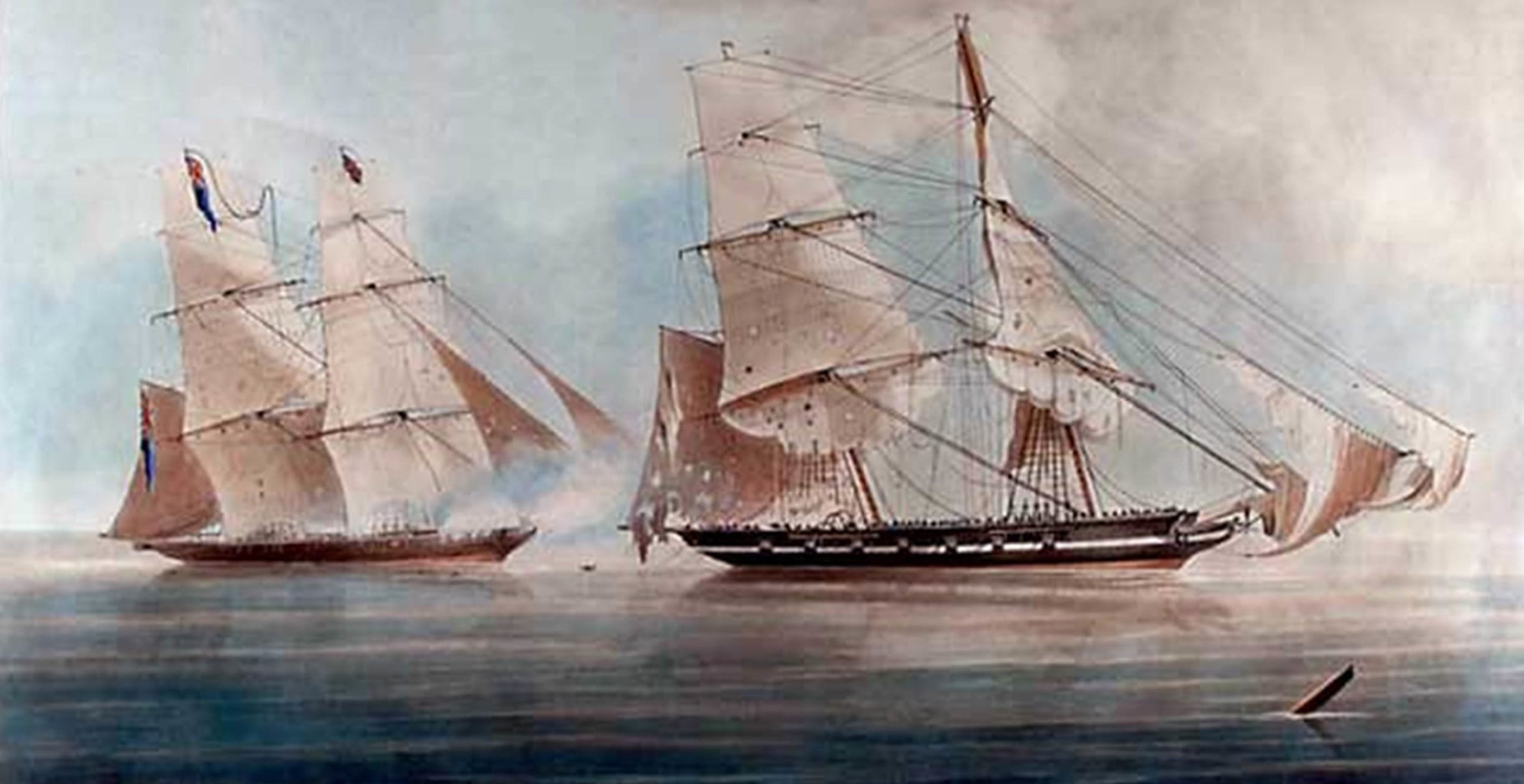
The final context that campaigners studiously ignore is the fact that Britain was among the first states in the history of the world to abolish slave-trading (in 1807) and slavery (in 1833) throughout its territories. It then used its dominant power to suppress both slave-trading and slavery from Brazil, across Africa and India, to New Zealand for the second half of the British Empire’s life. In the 1820s and ’30s, the Slave Trade Department was the Foreign Office’s largest unit. By mid-century the Royal Navy was devoting over 13 per cent of its total manpower to stopping transatlantic slave-trading. The cost of this alone to British taxpayers was at least the equivalent of up to £1.74 billion today or 12.7 per cent of the UK’s current expenditure on development aid — for half a century. According to the eminent historian, David Eltis, the nineteenth-century costs of slavery-suppression exceeded the eighteenth-century benefits.
The West Africa Squadron, which freed 150,000 African slaves.

Praga I-23: Prototype Belt-Fed Predecessor of the ZB26
Forgotten Weapons
Published 3 Feb 2025Vaclav Holek’s first machine gun design for the Czech military was the Praga I, built in 1922 and based heavily on the Vickers/Maxim system. However, it became clear that the military wanted something lighter and more portable, and so the next year he heavily updated the design to this, the Praga I-23 (for 1923). It remains a belt-fed weapon chambered for the 8mm Mauser cartridge, but the locking system has been much simplified into a tilting bolt arrangement. The recoil operation from the earlier model is also gone, now replaced by a long stroke gas piston. Some elements of the Maxim remain in the belt feeding elements, but the overall gun is much more a light machine gun than the mounted heavy machine gun that was his first design.
A total of 40 of the Praga I-23 were ordered by the Czechoslovak military, and they were tested in 1924 (only 20 examples were actually delivered of the 40). The I-23 performed well, but it was again clear that it wasn’t quite what the military really wanted. Holek revised the design again to the model 1924, using a box magazine instead of a belt feed — and that is the gun that continued the path to the ZB-26.
Video on the Praga I machine gun that came immediately before this model: Praga I: A Blow-Forward Bullpup Semi-…
Many thanks to the VHU — the Czech Military History Institute — for giving me access to this fantastic prototype to film for you. The Army Museum Žižkov is a part of the Institute, and they have a three-story museum full of cool exhibits open to the public in Prague. If you have a chance to visit, it’s definitely worth the time! You can find all of their details (including their aviation and armor museums) here:
QotD: Trade-offs
Among the oddments that sometimes appear in opinion polls are questions like, “Would you accept a lower standard of living in exchange for” … whatever policy is currently on offer. That policy might range from a climate-change shutdown of all carbon-based energy production, to reduced levels of immigration and foreign trade.
In principle, I approve this recognition of policy trade-offs, and every acknowledgement that, in the red-pilled world beyond political phantasy, “you can’t have your diamond-studded hand-sculptured fondant wedding cake, and eat it, too”. Or in the more modest, Yorkshire form of this important cliché: “You can’t have the penny and the bun”.
Any concession towards what I remember as reality is welcome at the present day, to me. As a non-economist, however, I regret that the trade-offs are only expressed in money. They apply also, and frequently instead, to things the modern world doesn’t count, because they are intangibles.
David Warren, “On juvenile delinquency”, Essays in Idleness, 2020-05-22.
June 23, 2025
80% of top-grossing movies are prequels, sequels, spin-offs, remakes or reboots
Ted Gioia on the death of creativity in the movie business, which also seems to be tracking almost exactly with the trend in music business profits:
I’m not shocked when I look in the mirror. Yeah, the Honest Broker isn’t getting any younger. But that’s the human condition.
Maybe I should start using a moisturizer. What do y’all think?
Nah. I’ll just let this aging thing play out.
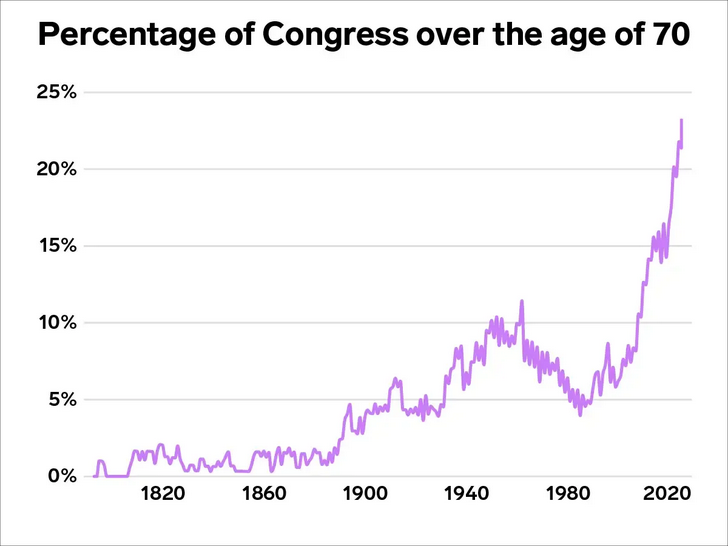
On the other hand, I’m dumbfounded at everything in public life getting older — even older than me! Consider the current political landscape.
With each passing year, the US Congress looks more like the College of Cardinals (average age =78) or the Rolling Stones (average age = also 78).
We’re gonna need a lot of moisturizer.
But Congress is young and spry compared to Hollywood.
Back in 2000, 80% of movie revenues came from original ideas. But this has now totally flip-flopped.
Today 80% of the movie business is built on old ideas — remakes, and spin-offs, and various other brand extensions. And we went from 80% new to 80% old in just a few years.
Source: Experimental History
[…]
Look at music — and you see the same thing.
The share of old songs on streaming will soon reach 80%. It’s not quite there yet — the latest figures are 73%. But it was at 63% back in 2019. So it’s just a matter of time.
In 2000, streaming didn’t exist, so we looked to the Billboard chart to gauge a song’s success. And new music made up more than 80% of charted songs. So here — just like the movies — we’re flip-flopping from 80% new to 80% old over the course of a few years.
I don’t have good figures on publishing. But I’m pretty sure that AI-generated books and articles will soon represent 80% of the marketplace. Maybe we’ve already reached that threshold.
AI is deliberately designed to cut-and-paste, rehashing past work as its modus operandi. And it will do this to every field — replacing originality with repetition and regurgitation.
This is the new 80% rule.
Just imagine if traditional businesses operated this way.
- “Welcome to our restaurant, 80% of the food is leftovers.”
- “Welcome to our boutique, 80% of clothing is secondhand.”
- “Welcome to our dating service, 80% of the choices are your ex-girlfriends (or ex-boyfriends).”
None of that sounds very appetizing.


How Sex in War Breeds Boys – W2W 33
TimeGhost History
Published 22 Jun 2025That prolonged war triggers an increase in male baby births had been ordered since at least 250 years. This “returning soldier effect” happens again during WW2 and right after. How this happens is a mystery, but research in the past decades might provide some answers.
(more…)
US strikes against Iranian nuclear facilities
One of the most frustrating aspects of internet culture today is the need for instantaneous “analysis” of military events. We all understand the desire for such insight, but the accuracy of information available in the immediate aftermath of any event is highly variable. Between the need to control the narrative on the part of the participant powers, the propaganda value of being “first” to report, and the impossibility of accurate damage assessment, it’s a wise move to discount almost everything you hear about a big event for some time. Chris Bray suggests that the old “72 hours rule” may be insufficient for something like the US bunker busting strikes against Iranian nuclear research facilities:

First, wait a while. Sean Hannity just announced that “a source” told him the attack was a complete success, and all of Iran’s nuclear sites were fully destroyed. I’d hesitate to believe that, is the gentle way to put it. I’d also hesitate to believe the stories being told from the other direction, and don’t forget that Trump’s attack on Qasem Soleimani produced a full week of OH NO WORLD WAR III JUST BEGAN stories in the establishment media. The likelihood is that none of what you’re hearing this week is fully true. Wait and watch. I hope that Iran and the US are backchanneling while engaging in belligerent public posturing, but by definition we’re not going to see the backchanneling. We’ll see. The 72 Hour Rule is in effect, here, at the very least.
Second, the ludicrous story in which Trump is violating law and political norms with unilateral military action is, as always, a deliberate performance of political amnesia. These are our political norms, for crying out loud.
We should probably fix that. But the people who tolerated an American war in Libya without direct congressional authorization, and who tolerated an American war in Yemen without direct congressional authorization, and who tolerated an American war in Syria without direct congressional authorization, aren’t actually going to impeach a president over military strikes in the Middle East undertaken without direct congressional authorization. It’s a show. The More Than a Week Rule requires us to view this action in the longer and generally quite unfortunate context of American foreign policy, and the politicians who are outraged by unilateral military action in the Middle East have zero standing on that score.
Third, and related, the 2001 Authorization to Use Military Force is still in effect, and still being stretched and massaged beyond its intent and meaning, but note that Congress still hasn’t repealed it. A Congress that wished to restrain presidential military action in the Middle East would probably start there, and they haven’t.
Glenn “Instapundit” Reynolds has a few thoughts on the matter:
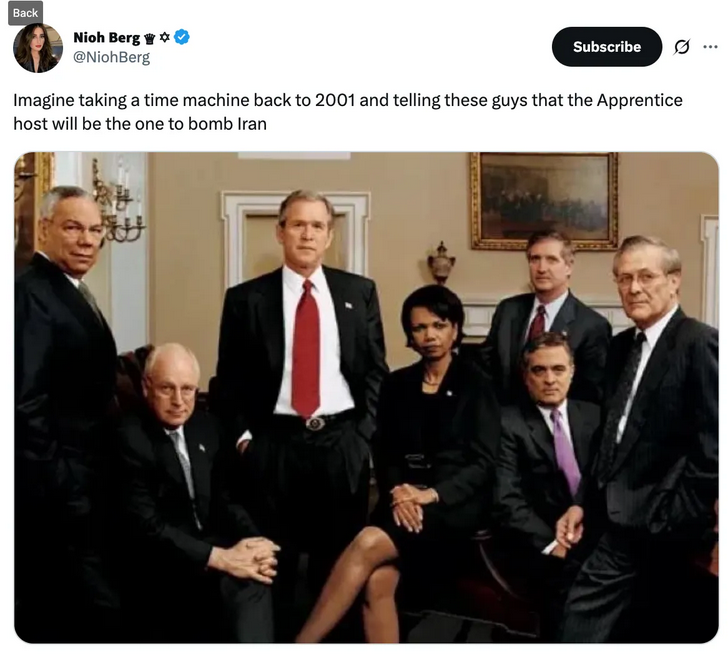
People have been singing about it since 1980, but yesterday’s bombing raids on Iranian nuclear facilities were the first bombing attack since the 1979 hostage seizure.
Despite numerous calls for action against the Islamic Republic, Operation Midnight Hammer was the first U.S. military action against important Iranian assets on Iranian territory. The bombs fell less than 24 hours ago, but here are a few preliminary takes.
Competence. The most striking thing about the attacks was the extreme competence displayed by the Air Force, the Defense Department under Secretary Pete Hegseth, the various intelligence assets involved, the State Department, and the entire administration. There were no leaks. (How did they avoid leaks? Basically, they didn’t tell any Democrats what was coming. Take note.)
Not only were there no leaks, but President Trump and the diplomatic apparatus kept the Iranians in the dark, giving the impression of waffling in the White House even as things were being lined up. They received unintentional help in this from Sen. Charles Schumer, who had been for some time pushing the “TACO” acronym — Trump Always Chickens Out — in the service of a storyline that Trump was all bluster and no follow-through. The Iranians, apparently dumb enough to believe Democrats and the mainstream news media (but I repeat myself) were snookered.
New Diplomacy: In dealing with the Iranians in the 1980s, Donald Regan told President Reagan that America had been repeatedly “snookered” by a bunch of “rug merchants”. The Iranians were in fact very good at leading Americans down the garden path, invoking (often imaginary) splits between “hard-line” and “moderate” Islamists in their government as excuses for delay and backtracking.
In truth, as Henry Kissinger once said, “An Iranian moderate is one who has run out of ammunition“. After these raids, and the many Israeli attacks that led up to them, all of Iran is out of ammunition.
Augustus and the empire – The Conquered and the Proud 14
Adrian Goldsworthy. Historian and Novelist
Published 15 Jan 2025This time we look at Augustus, the empire and the army. The man who built the Altar of Augustan Peace in Rome was also the last of the great conquerors, who added more territory to the Roman Empire than any other individual leader. How he did this, and how he kept the army under control, is the theme of this video.
QotD: Recruiting and organization under the “Marian reforms”
Sallust reports that Marius, “after he saw that the spirits of the plebs were aroused, he swiftly loaded ships with supplies, pay, weapons and other requirements; with them he ordered Aulus Manlius, his legate, to set out. Meanwhile himself he enrolled soldiers, not according to the mos maiorum [‘the customs of the ancestors’] from the census classes, but making use of whoever wished to go, mostly the capite censi [‘those counted by heads’ = the propertyless poor or proletarii]” (Sall. Iug. 86.1-2, trans mine). Plutarch repeats this report, that Marius violated custom by enrolling men who didn’t meet the property qualification for military service (Plut. Mar. 9.1).
There are a few oddities here to start, though. First, Sallust quickly notes that this resulted in Marius having an army rather larger than what the Senate had actually authorized (Sall. Iug. 86.4) and that’s actually quite a neat detail that may explain part of what’s going on here because this has, in a way, happened before. In 134, Scipio Aemilianus was elected consul for the second time (illegally, again) with a mandate to end the frustrating Roman war against the Celtiberian stronghold of Numantia in Spain. The Senate, however, denied Scipio authorization to raise fresh troops, to which Scipio responded by enlisting some 4,000 volunteers to replenish his legion; Appian says this was done with the consent of the Senate, but Plutarch’s brief note on it sure implies Scipio Aemilianus is end-running around Senatorial efforts to stifle him (App. Hisp. 84; Plut. Mor. 201A-B). And this too was hardly the first time for this sort of end-run; Scipio Africanus (what is it with Scipiones!?) back in 205 agitated for his invasion of Africa to end the Second Punic War and was given the province of Sicily with authorization to go to Africa if he thought it necessary, but the Senate registered its displeasure by refusing to let him levy troops, at which point – wait for it – Scipio took volunteers, equipping and financing his force through the socii and even building a fleet that way (Liv. 28.45.9-12).
In short, the Senate sometimes tried to trim the sails of generals it was displeased with – and Marius reportedly had gotten elected on a campaign platform of “to hell with the Senate” (Sall. Iug. 84.1) – by limiting the size of their armies or refusing to allow them to conduct a levy. And since 205 (a century before Marius), popular generals had occasionally juked this effort by the Senate by instead calling for volunteers, which the Senate could not stop. Marius is not doing something new in taking volunteers to supplement an army through the levy.
He also doesn’t keep doing it. After Marius wins in Africa with his volunteer-supplemented army (the bulk of which of course were still recruited through the dilectus under Metellus), he returns to Italy to take over the war against the Cimbri and Teutones but he doesn’t keep up the volunteer force, instead taking command of his predecessor Rutilius Rufus’ normally levied army (Front. Strat. 4.2.2). In practice, Marius probably took volunteers in part for that first army because the Senate was diverting available levy manpower towards the early phases of the Cimbric War (or at least that was a convenient excuse to kneecap him) – a series of costly military disasters for Rome which likely soaked up much of the manpower the Senate was willing to raise. Once Marius has access to that “primary” stream of manpower generated through the dilectus, he uses it and seems to stop using volunteers.
But what of recruiting the capite censi? Well, that isn’t quite new either, although it surely wasn’t typical. For one, it wasn’t that the poor absolutely never served; Polybius notes that the capite censi served in the fleet (Polyb. 6.19.2). But we also see non-assidui (assidui being the term for those wealthy enough to be liable for normal conscription) in a range of other emergencies. Livy reports in 329 a “crowd of sellularii [men who work sedentary trades, literally, ‘stoolsmen’], a type least suited for military service, were called into the army” (Livy 8.20.4), though the historicity of this report is questionable given the early date. In 296, Etruscan entrance into the Third Samnite War causes a draft of “not only the freeborn or the iuniores took the oath, but cohorts were made of seniores and centuries of freedmen” (Livy 10.21.4). Gellius (16.10.1) quotes Ennius reporting the proletarii were pulled into the armies in 280, presumably in response to Pyrrhus’ victory at Heraclea. And during the Second Punic War the Romans pulled out all of the stops, recruiting debtors and men convicted of capital crimes (Livy 23.14.3), enrolling slaves into the army (called the volones; you free them first and then draft them, Livy 27.38 and 28.10, Val. Max. 7.6.1) and as noted above, taking volunteers more generally.
As an aside, if you are wondering why the Romans seem in some of these to skip recruiting freeborn capite censi and go straight to freedmen and enslaved people, I think there are two answers here for this period. First, many of the available freeborn poor are probably already in service in the fleet. Second, there probably aren’t that many of them. Recall our chart of Roman social classes – the capite censi in the third century is quite small, almost certainly outnumbered by enslaved persons in Italy. But the population of Italy was rising over the third and especially second century and without adding new farmland, those new freeborn Romans may have swelled the ranks of the capite censi, leading to a much larger propertyless class by the late second century or the first century.1 Consequently, there may have been a lot more capite censi worth recruiting by Marius’ day, when Rome no longer needed to keep a large navy at sea (not facing any naval powers in its wars) and the number of capite censi having risen.
Finally, Marius does not mark the end of the Roman dilectus! Evidently Roman conscription persisted at least to the end of the Roman civil wars, as Suetonius reports Augustus (perhaps when he was still Octavian) inflicting the traditional penalty of being sold into slavery for draft-dodging on a Roman eques who cut the fingers off of his two sons to make them ineligible for military service (Suet. Aug. 24.1). Indeed we have attestations of the dilectus in 55, 52, 50, 49, AD 6 and AD 9.2 Even once the army is fairly clearly primarily a volunteer force, at least notionally the ability to hold a levy when necessary to fill the ranks remained “on the books” and Trajan (r. 98-117 AD) holds at least one levy because he punishes a father for the same reason Augustus had done (Dig. 49.16.4.12). So the traditional dilectus remained a thing Roman leaders could do well into the empire. In practice it seems safe to assume the system by the mid-first century is substantially ad hoc, as the census straight up doesn’t happen from 69 BC to 28 BC, which would make it hard to actually enforce the property requirements. But the process doesn’t stop in 107 and there’s no reason to suppose from 107 to 69, with the census being regularly conducted, that most annual levies were not conducted along traditional property lines.3
So the most we might say is that a one-time crisis expedient in earlier periods slowly becomes a standard way to supplement legions and then the standard way to recruit them, with the old normal method of the dilectus instead becoming the unusual way to supplement in a crisis. It’s unclear exactly when that shift-over point happens, but it sure isn’t in the career of Gaius Marius, who sits clearly in the “volunteers as a crisis response” side of the issue.
And what of the notion that Gaius Marius introduced both citizenship as a reward for service as a regular bonus and also that he instituted the paying of soldiers at the completion of a campaign to render them loyal? Well on the latter point, the Romans had been distributing spoils to the soldiers at the end of a campaign as a lump-sum payment since the beginning. This is exceedingly well reflected in Livy’s accounting of the years from 201 to 167 (where we have a nice continuous burst of Livy), see for instance Livy ::deep breath:: 30.45, 31.20, 33.23, 33.37, 34.46, 34.52, 36.40, 37.59, 39.5, 39.7, 40.34, 40.43, 40.59, 41.7, 41.13, 45.40, 45.43.4 And the idea that Roman victories might seize land which would then be settled as Roman coloniae, creating new land for Roman settlers was also not new (Wikipedia has a convenient list of Roman coloniae). So Marius is simply promising to do a thing Roman commanders regularly did, essentially saying, “serve with me, because I’m going to win and victory will make us rich”. Which is exactly the reason volunteers rushed to serve with Scipio Africanus and Scipio Aemilianus: they anticipated a lucrative victory for such well-regarded commanders.
And by now you may well be asking, “but wait, then when does the system change?” Because after all, I said that by the early empire, we can pretty clearly see an army primarily composed of professional, long-service volunteers who receive substantial retirement bonuses and are permanently stationed on the frontiers. Who is responsible for that? And in response, I give you, this guy.
It’s Augustus. It was always Augustus. Or at least I should say that is my view, given the evidence. Older scholarship – I think here of Keppie (1984) in particular – tended to assume that because most of the big changes happened with Marius (but we’ve seen they don’t) that Octavian/Augustus probably made only minimal changes to the military system he inherited from Julius Caesar. I don’t think that’s correct. I think if we look at the evidence in more detail it becomes clear that Augustus is the “break” (though not a clean break by any means) and that in fact we need to start regarding Augustus as a military reformer of some significant scale rather than merely the codifier of a Caesarian military system (though he probably does that too).
Augustus, after all, institutes regular bonuses for discharge, establishing a treasury funded by a regular tax to meet the expense rather than simply promising that he would win a lot and so soldiers would get rich off of their share of the booty (Res Gestae 17). And it’s not hard to see the problem he’s responding to – the massive military buildup of the Roman civil wars had left Octavian, as the victor, with the red-hot potato of hundreds of thousands of soldiers who were promised the spoils of victory, including large numbers of men who didn’t win but who, if not settled down somehow would disrupt the state (RG 3). Earlier in the civil wars, Octavian had used proscriptions and land confiscations to solve this problem but as emperor, he needed a permanent solution, thus the establishment of the aerarium militare and its discharge bonuses (praemia). Before that, you simply had generals promising to feast their soldiers off of the property of the vanquished; the civil wars had only changed that in that the vanquished were now Romans. It also establishes a standard length of service, creating that professional, long-service army.
There’s a related issue which is the fate of the citizen equites and the velites. Caesar’s armies in Gaul seem to have neither, so the assumption was that the shift to recruiting proletarii meant that these wealth-based distinctions (the richest Romans serve as equites, the poorest as velites) dropped away, leaving a uniform heavy infantry legion. And in a schematic it makes sense: both roles are absorbed by the auxilia and indeed Caesar makes use of a lot of Gallic cavalry auxiliaries. But as François Gauthier recently pointed out,5 it’s not all clear that the velites really did vanish in the late-second/early-first century. Cicero still refers to to them writing in the 40s (Cic. Fam. 9.20; Brut., 271) and their apparent absence in Caesar’s writing may well just be an accident of Caesar’s avoidance of technical language. Caesar doesn’t generally talk about hastati or triarii much either; he prefers milites (“soldiers”). Likewise, it’s clear the citizen cavalry – the equites – survived Marius; as Jeremiah McCall notes, we have good evidence for citizen equites at least as late as the 90s BC and suggests the citizen cavalry probably vanished in the 80s as a result of the Social War and Sulla‘s Civil War.6 It surely did not happen in 107 or 104.
Meanwhile the auxilia as a mature part of the Roman army really only emerge under Augustus, and not even right at the beginning of his reign either. Roman armies needed cavalry and light infantry to function, so once again we may not be looking at a clean break but rather a period of transition as a result of some generals preference for (non-Italian) allied or auxiliary cavalry and light infantry and the formalization of that system not in 107 with Marius but again in 27 with Augustus.
Marius is also sometimes credited with the idea of extending citizenship to non-citizens who served, which is a catastrophic misreading of one episode in his career. For one, this gets read as meaning that Marius extended citizenship to all of the Italians in his army or that he made it standard to do so. Note for instance this line pulled from Wikipedia:
Finally, Marius granted citizens of the Italian allies (Etruria, Picenum, etc.) full Roman citizenship if they fought for Rome and completed a period of service in the Roman army.
[Dated] 6/25/2023, specified in the hope this page changes to be less wrong.
And that’s very much not right either. We have evidence for only a handful of citizenship extensions by Marius. In particular, of his army he extended citizenship to just two cohorts (c. 1,000 men) from Camerinum (Plut. Mor. 202D, Cic. Pro Balbo 46.). I can only assume this gets misunderstood because some writers don’t know their unit sizes, but Marius had 32,000 men in his army at Vercellae (101 BC), probably something like half of which were socii. These two cohorts were a comparatively tiny fraction. Marius also seems to have selected a very small number of his other socii veterans for citizenship (Cic. Pro Balbo 48), but there was no blanket grant of citizenship. Of course there wasn’t, this issue remained substantially unsolved until the Social War (91-87BC); if Roman levies had been calmly minting new citizens out of thousands of Italians through the 90s, there would hardly have been a cause for the Social War.
Instead, citizenship as a reward for service is an artifact of the imperial period and the auxilia. The Roman use of non-Roman, non-socii troops to supplement their armies was not new, but it emerged as a formalized, permanent part of the Roman army not during the civil wars – where such units where both ad hoc but also not nearly so numerous – but under the reign of Augustus, coming to form about half of the army by the end of his reign (Tac. Ann. 4.5; on the emergence of the auxilia, see I. Haynes, Blood of the Provinces (2013)). Indeed, as Haynes notes (op. cit. 49), it is actually only under Tiberius (r. 14-37) that we get direct evidence of citizenship grants to auxilia and the practice even then seems at least somewhat irregular (though it comes to be regularized).
In short that, the notion that Gaius Marius instituted the pattern of granting citizenship to serving non-citizens on discharge is simply wrong; that’s not in our sources. That doesn’t become consistent until Tiberius well over a century later. Gaius Marius did recruit volunteer capite censi into his army once but didn’t make a habit of it and as such isn’t a major reformer so much as a key step in a slow process of change which reaches its decisive point probably under Augustus, more than half a century after Gaius Marius died. He wasn’t the first to do either thing, whatever our sources say.
Bret Devereaux, “Collections: The Marian Reforms Weren’t a Thing”, A Collection of Unmitigated Pedantry, 2023-06-30.
1. For more on the dynamics of this, see N. Rosenstein, Rome at War (2004), as this is part of his central argument.
2. For textual references, see Brunt, Italian Manpower (1971), 636-7.
3. We do not know how that process would have accounted for the massive expansion of the Roman citizen class due to the Social War. But evidently it did!
4. These were happily already compiled by Brunt, op. cit., 394.
5. “Did velites Really Disappear in the Late Roman Republic?” Historia 70 (2021).
6. J.B. McCall, The Cavalry of the Roman Republic (2002), 100-113..
June 22, 2025
Day Four – The Meuse Must Hold! – Ten Days in Sedan
World War Two
Published 21 Jun 2025May 13, 1940: In today’s episode of our WW2 documentary, Ten Days in Sedan, the German Blitzkrieg reaches its climax. Guderian’s Panzers launch a daring river assault as the Luftwaffe pounds French lines into chaos. Away from Sedan itself, Rommel and Reinhardt strike further north, opening new fronts. France scrambles to counterattack, but the German bridgeheads are growing fast.
00:00 Intro
00:48 French Defences, German Air Assault
04:13 Guderian Crosses The Meuse
08:25 Hartlieb’s Houx Crossing
11:28 Rommel Crosses At Dinant
16:04 Einhardt Crosses At Monthermé
19:15 Summary & Conclusion
(more…)
Delaying Mark Carney’s next book
In the latest SHuSH newsletter, Ken Whyte outlines the various oddities of Mark Carney’s next book to market:

Three years ago, long before he declared himself a politician, Mark Carney published Value(s), his attempt at solving some of the world’s biggest problems: income inequality, climate change, systemic racism, etc. The book was reasonably well received. It sold well. A sequel was in order.
Announced last year, The Hinge: Time to Build an Even Better Canada was ostensibly Carney’s attempt to address Canada’s biggest issues, and perhaps to position himself as our future leader. The book was set for release in May 2025. Events interceded and Carney was elected prime minister on a far tighter timeline than anyone, including his publisher, could have imagined. Publication of The Hinge was delayed. An anonymous source told the Toronto Star Carney was too busy politicking to finish the final edits on the book. I heard the delay had more to do with campaign finance rules that would consider a book publicized or released in election season as political advertising. Anyway, a new release date was set for July 1. Amazon now has The Hinge coming next January.
Carney’s political opponents have been enjoying the delay. Critics both left and right have attributed it to the difficulty of squaring positions taken by Carney a year or two ago with positions he espoused during the campaign and, more recently, as prime minister.
I don’t doubt that Carney’s politics have moved over the last six months. And I wouldn’t be surprised if his second book is being rewritten in whole or in part. I don’t have a problem with that. Much has happened, both in Canada and south of the border. We’ve all been reconsidering our positions.
My problem with Carney’s conduct is not that he’s revising his manuscript, if he is, but that he’s not revising his publishing contract.
The Hinge is set to be published by Signal. Signal is a division of McClelland & Stewart. M&S is a division of Penguin Random House Canada. PRHC is a division of Penguin Random House LLC, corporate headquarters at 1745 Broadway, 3rd Floor, New York, New York, 10019.
Penguin Random House LLC is owned by Bertelsmann, a media conglomerate in Gütersloh, Germany, but legally and operationally, it is a US company. Its executive leadership, including CEO Nihar Malaviya, works out of the above address. Strategy and publishing priorities are set in New York, and profits in PRH’s many far-flung international divisions flow to New York. So the prime minister of Canada is publishing his book with the Canadian branch plant of a US company.
Other recent prime ministers have done the same. Justin Trudeau published Common Ground with HarperCollins. Steven Harper published Right Here, Right Now with Signal, and his forthcoming memoir sits there, too. Jean Chretien released My Stories, My Time with Random House Canada. Most of our politicians have published with branch plants of American firms.
I should add that many of our best writers publish at these same branch plants, if not directly with US publishers. (Even middling scribblers like me have published directly in the US.)
But, again, the world has changed. To quote no less an authority than Mark Carney, Canada’s old relationship with the US, “based on deepening integration of our economies and tight security and military cooperation, is over”. We need to “fundamentally reimagine our economy”, “retool” our industry, and enhance our self-sufficiency.
He sees our cultural relationship with the US as part of this project. From the Liberal platform: “In this time of crisis, protecting Canada means protecting our culture, our journalism, our perspectives. The Americans have threatened our sovereignty and issued inflammatory statements about our economy; we need to be able to tell a story that fights back.”
Right under the cultural section of the platform was a “Buy Canadian” plank. “At a time when our economy is under threat, consumers want to do their part as patriotic Canadians, buying things that are truly made here.” Team Carney promised to make it easier to determine what is and isn’t a Canadian product and prioritize made-in-Canada suppliers in every sector of the economy, limiting bidders from foreign suppliers, and so on.
So it’s “eLbOwS uP!” for the voters, but carry on publishing your next book through a US-owned subsidiary, eh? You have to admit they wear their hypocrisy proudly.
Ljungman Updates: the AG-42 vs AG-42B
Forgotten Weapons
Published 31 Jan 2025In 1953, the Swedish military launched a program to refurbish and refit all of the Ag m/42 rifles in inventory. Aside from replacing broken parts and worn barrels, the program also made a number of improvements to the rifles:
- Auxiliary front magazine catch added
- Large gripping lugs added to bolt cover
- Rubber case deflector added
- Single-piece cleaning rod to replace the two-part original
- Rear sight geometry modified
- Rear sight range dial modified
- Dual-wire recoil spring in place of the original single wire type
These updates were made to virtually all rifles then in existence, and it is very rare to find original pattern Ag m/42 rifles today.
(more…)
QotD: “Autism stolen valor”
The very concept that anyone would ever claim to be autistic as a status move would have seemed incomprehensibly bizarre to me when I was growing up.
I get it, though. In the intervening decades, somehow a lot of people have developed the notion that anybody above the middle range of IQ must be autistic-spectrum.
It’s not true. I’ve met enough autists, brights and super-brights to know differently. I’ve read a fair bit of the literature on psychometrics and MBD syndromes. And I’ve been a guest for faculty tea at the Institute for Advanced Study, which is very illuminating if you’re even a little bit observant about people.
Here’s what I think I know:
Many autists are seriously damaged and non-functional, to the point where they need to be institutionalized or have semi-institutional special care. Few people outside the mental-health profession know this. The “autists” we encounter in daily life are a selected high-functioning group.
HFAs (high functioning autists) have one advantage over average-IQ neurotypicals: they can really concentrate on things that aren’t social-status games or sexual maneuvers.
Average-IQ neurotypicals can only just barely manage that, so it’s difficult for them to compete with HFAs in fields where you have to be able to concentrate for long periods in order to do decent work.
Like, say, writing software. The upper reaches of software engineering are stiff with HFAs. This has become well known.
This doesn’t mean your typical HFA is actually brighter than a median average-IQ neurotypical. In fact, if you put a whole bunch of HFAs through a psychometric battery you’ll find their average IQ is lower than for neurotypicals, not higher.
HFA is actually a drag on general intelligence that HFAs overcome by being obsessive — grinding really hard on intelligent-people stuff.
The result is that HFAs as a population excel over average-IQ neurotypicals, compete fairly evenly with bright neurotypicals, but top out lower than super-bright neurotypicals do.
This is hard to notice because there are so few super-brights that many people never meet one at all. Very few people have observed enough super-brights to make valid generalizations about them. And of the few people who have a large enough observational sample, still fewer are themselves bright enough to comprehend what they see.
But I have been to faculty tea at the IAS. (I had been an invited speaker that day.)
Most of my friends and peers are people in the tippy-top end of the HFA cohort. Top 1% software engineers and people like that. So at the IAS, people-watching a bunch of Nobel laureates and people bright enough to work with Nobel laureates day-to-day, my jaw dropped open.
Because compared to who I usually hang out with, these people are mostly *normal*. Neurotypical. As near as I can tell, the people in the crowd showing HFA tells are the slow ones.
Imagine if you can being so natively intelligent that even though your brain is constantly trying to distract you into playing monkey socio-sexual status games, you can still think rings around 99.9% of the people in the world.
That’s what actual super-brights are like. They’re not brain-damaged. They’re not obsessive or compulsive or neurotic. They don’t have sensory disabilities. And they leave high-functioning autists in their dust.
Because I know this, I find the concept of people faking being autists amusing. They think they’re positioning themselves as the superior, smartest people. They are hilariously wrong.
Eric S. Raymond, Twitter, 2024-05-27.
June 21, 2025
Cheese Gnocchi from Medieval Italy
Tasting History with Max Miller
Published 21 Jan 2025Groove-less cheese-based gnocchi from before potatoes were introduced
City/Region: Italy
Time Period: 14th CenturyGnocchi has been around for hundreds of years, and unsurprisingly, the gnocchi of the 14th century was quite a bit different from what we’re used to today. Before the potato was even a twinkle in Italy’s eye, cheese was a common base for the dough.
The first mention of grooves on gnocchi isn’t until 1570 when Bartolomeo Scappi writes about them, so this gnocchi is groove-less. The texture is very different from modern versions. It’s more crumbly, but that could depend on the kind of cheese that you use. Whatever you use, make sure it’s a cheese that you like, because this is essentially boiled cheese held together with some flour and egg. I may not eat a whole bowl of this, but it’s still quite nice.
If you want gnocchi. Take fresh cheese and pound it; then take flour and mix it with egg yolk in the manner of migliacci. Put a pot filled with water on the fire and when it boils, put the mixture on a board and spoon it off into the pot, and when they are cooked, place them on dishes and sprinkle on plenty of grated cheese.
— Fragment of a book on cooking from the 14th century
QotD: The camera lies, but the photographer doesn’t always realize it
Tom Paine, “Where we are and what we see”, The Last Ditch, 2020-05-20.


