
The Great War
Published 11 Apr 2025For more than three long months in 1917, Allied and German soldiers fought tooth and nail over a battlefield churned into a sea of sucking mud and shellholes by the guns. Hundreds of thousands were killed and wounded, some of them drowning in the soupy ground — for Allied gains of just a few kilometers. So why did the Battle of Passchendaele happen at all, and was it the most pointless battle of the First World War? (more…)
April 13, 2025
The Most Pointless Battle of WW1? – Passchendaele 1917
Comments Off on The Most Pointless Battle of WW1? – Passchendaele 1917
They really are trying to shut down “wrong” speech on the internet
I’ve always been a huge fan of free speech, which has been under continuous and escalating threat by many governments both in person and online. A side-note in the ongoing Canadian federal election has been Liberal leader Mark Carney’s commitment to addressing “online harm” as he defines it:

At a campaign rally in Hamilton, Ontario, Liberal leader Mark Carney unveiled what can only be described as a coordinated assault on digital freedom in Canada. Behind the slogans, applause lines, and empty rhetoric about unity, one portion of Carney’s remarks stood out for its implications: a bold, unapologetic commitment to controlling online speech under the guise of “safety” and “misinformation”.
We announced a series of measures with respect to online harm … a sea of misogyny, anti-Semitism, hatred, conspiracy theories — the sort of pollution that’s online that washes over our virtual borders from the United States.
He then made clear his intention to act:
My government, if we are elected, will be taking action on those American giants who come across [our] border.
The former central banker, who now postures as a man of the people, made it clear that if the Liberals are re-elected, the federal government will intensify efforts to regulate what Canadians are allowed to see, say, and share online. His language was deliberate. Carney condemned what he called a “sea of misogyny, anti-Semitism, hatred, conspiracy theories” polluting Canada’s internet space — language borrowed directly from the Trudeau-era playbook. But this wasn’t just a moral denunciation. It was a legislative preview.
Carney spoke of a future Liberal government taking “action on those American giants who come across our borders”. Translation: he wants to bring Big Tech platforms under federal control, or at least force them to play the role of speech enforcers for the Canadian state. He blamed the United States for exporting “hate” into Canada, reinforcing the bizarre Liberal narrative that the greatest threat to national unity isn’t foreign actors like the CCP or radical Islamists — it’s Facebook memes and American podcasts.
But the most revealing moment came when Carney linked online speech directly to violence. He asserted that digital “pollution” affects how Canadians behave in real life, specifically pointing to conjugal violence, antisemitism, and drug abuse. This is how the ground is prepared for censorship: first by tying speech to harm, then by criminalizing what the state deems harmful.
What Carney didn’t say is just as important. He made no distinction between actual criminal incitement and political dissent. He offered no assurance that free expression — a right enshrined in Canada’s Charter of Rights and Freedoms — would be respected. He provided no definition of what constitutes a “conspiracy theory” or who gets to make that determination. Under this framework, any criticism of government policy, of global institutions, or of the new technocratic order could be flagged, throttled, and punished.
And that’s the point.
Mark Carney isn’t interested in dialogue. He wants obedience. He doesn’t trust Canadians to discern truth from fiction. He believes it’s the job of government — his government — to curate the national conversation, to protect citizens from wrongthink, to act as referee over what is and isn’t acceptable discourse. In short, he wants Ottawa to become the Ministry of Truth.
In Britain, their equivalent to Canada’s “online harms” legislation has induced Bitchute to discontinue service to users in the UK:

A READER alerted us to this statement posted on the Bitchute homepage, visible to geolocated UK users:
After careful review and ongoing evaluation of the regulatory landscape in the United Kingdom, we regret to inform you that BitChute will be discontinuing its video sharing service for UK residents.
The introduction of the UK Online Safety Act of 2023 has brought about significant changes in the regulatory framework governing online content and community interactions. Notably, the Act contains sweeping provisions and onerous corrective measures with respect to content moderation and enforcement. In particular, the broad enforcement powers granted to the regulator of communication services, Ofcom, have raised concerns regarding the open-ended and unpredictable nature of regulatory compliance for our platform.
The BitChute platform has always operated on principles of freedom of speech, expression and association, and strived to foster an open and inclusive environment for content creators and audiences alike. However, the evolving regulatory pressures — including strict enforcement mechanisms and potential liabilities — have created an operational landscape in which continuing to serve the UK market exposes our company to unacceptable legal and compliance risks. Despite our best efforts to navigate these challenges, the uncertainty surrounding the OSA’s enforcement by Ofcom and its far-reaching implications leaves us no viable alternative but to cease normal operations in the UK.
Therefore, effective immediately, BitChute platform users in the UK will no longer be available to view content produced by any other BitChute user. Because the OSA’s primary concern is that members of the public will view content deemed unsafe, however, we will permit UK BitChute users to continue to post content. The significant change will be that this UK user-posted content will not be viewable by any other UK user, but will be visible to other users outside of the UK. Users outside the UK may comment on that content, which the creator will continue to be able to read, delete, block, reply and flag. Users outside the UK may share UK-user produced content to other users outside of the UK as normal. In other words, for users in the UK, including content creators, the BitChute platform is no longer a user-to-UK user video sharing service.
This is the exactly the kind of consequence we at TCW feared a result of the overly restrictive and poorly written Online Safety Act 2023, which has now come into force.
The way the technology works is that websites can use a geolocation service to analyse the IP address your internet service provider has given your service, and use this to determine where you are. Google does this to tailor ads to you, Amazon does this to get you the most convenient version of their website.
Now Bitchute are using this service to protect themselves from the UK Government’s overreach.
The good news: there is a way round this.
Comments Off on They really are trying to shut down “wrong” speech on the internet
History Hit Expert BLEW My MIND On Ancient Roman History
Metatron
Published 14 Dec 2024Link to the original video
• Historian Answers Google’s Most Popul…
Pompaia, on the River Sarnus — a river which both takes the cargoes inland and sends them out to sea — is the port-town of Nola, Nuceria, and Acherrae.
Strabone, Geografia, IV, 81 – Factors in the Establishment of Pompeii. Let’s begin by well what we know. How did it all start? Like many cities of the classical world, Pompeii also has its founding myth: according to Servius, the city was supposedly founded by none other than the demigod Hercules, and its name would have originated from “a Pompa Herculis”, meaning “from the triumph of Hercules”. However, the most recent archaeological discoveries confirm a foundation dating back to around the 8th century BC by the Oscan people, an Italic tribe, corroborating what Strabo reported in his Geography. The Oscans were part of the large linguistic family of Umbro-Sabellian or Osco-Umbrian peoples, distinct from the Latins, who probably arrived in Italy in the 12th century BC. While some Hellenists have proposed that the etymology of Pompeii should be sought in the Greek Πεμπo (Pempo), meaning “to send”, due to the thriving commercial activity, the original linguistic root is likely this Oscan word “pumpè“, from which comes the archaic name Pumpàiia. The Oscan “pumpè“, analogous to the Greek “penta” and Latin “quinque“, means “five”, and most likely refers to a proto-urban reality formed by the progressive fusion of five distinct residential centers, five small Oscan villages that were scattered on the southern slopes of mount Vesuvius, next to the course of the Sarno river.
2. Natural resources: Volcanic areas often provide access to valuable resources like obsidian, sulfur, and various minerals used in ancient crafts and trade.
3. Lack of geological understanding: Ancient people didn’t fully understand the mechanisms of volcanic eruptions or their potential for catastrophic destruction. The last major eruption of Vesuvius before 79 AD was likely prehistoric, so there was no living memory of its danger.
4. Infrequent eruptions: Many volcanoes, including Vesuvius, can remain dormant for long periods. This can create a false sense of security among nearby populations.
5. Strategic location: Pompeii was located in a prime spot for trade, with access to the sea and inland routes. The benefits of this location may have outweighed perceived risks.
6. Religious and cultural significance: Volcanoes were often seen as sacred in ancient cultures, associated with deities or supernatural forces. This could make living near them culturally desirable.
7. Limited mobility: Ancient societies were less mobile than modern ones. Once established, it was difficult to relocate entire cities, even if dangers became apparent.
8. Economic investments: As cities grew and prospered, the economic and social costs of abandoning them became increasingly high.
9. Adaptation and mitigation: Over time, societies living near volcanoes often developed strategies to cope with minor volcanic activity, like earthquakes or ash falls.
10. Lack of alternatives: In some regions, volcanic areas might have been among the best available locations for settlement, despite the risks.
It’s worth noting that while the destruction of Pompeii was catastrophic, the city had thrived for centuries before the eruption of 79 AD. From the perspective of the ancient inhabitants, the benefits of their location likely seemed to outweigh the potential for a disaster that might never occur in their lifetimes. This balance of risk and reward in choosing settlement locations is not unique to ancient times. Even today, many major cities are located in areas prone to natural disasters, demonstrating that humans often prioritize immediate benefits over long-term, uncertain risks
#pompeii #ancientrome #documentary
Comments Off on History Hit Expert BLEW My MIND On Ancient Roman History
QotD: The 15-minute city
Take, for example, the 15-minute city, which is a radical proposal that people should be able to get pretty much anywhere they need to go within fifteen minutes and ideally without needing a car. It’s a lovely idea, and the parts of residential America that are like that — most of them former suburbs — are insanely desirable and therefore insanely expensive. If it were easy to make more of them, you’d think the market would have figured out how! And if I had any confidence whatsoever that anyone involved in municipal planning could produce more neighborhoods like that — leafy green places full of parks, libraries, schools, and shops — or even that they wanted to have safe, clean, and reliable transit options, I’d be all for it. But these are the same people who are gutting public safety in the cities while failing to maintain or enforce order on existing transit. These are the same people who imposed draconian Covid mitigation policies like Zoom kindergarten, padlocked churches, and old people dying alone with nothing but a glove full of warm water to mimic human touch, all of which were meant to buy time for … something (human challenge trials? nationalized N95 production?) that never happened. It’s easy to ban things; it’s hard to do things. So you’ll excuse my doubts about their ability to build a 15-minute city that looks like Jane Jacobs’s ideal mixed-use development, with safe, orderly streets and a neighborhood feel. One rather suspects they would find it far more within their wheelhouse to simply abolish single-family zoning or imposing restrictions on who can go where, when.
Jane Psmith, “REVIEW: The Wizard and the Prophet, by Charles C. Mann”, Mr. and Mrs. Psmith’s Bookshelf, 2024-01-22.
Comments Off on QotD: The 15-minute city
April 12, 2025
Carney’s Liberals promise to do something that’s been part of the legal code for decades
Among the Conservative and Liberal mis-steps of the election campaign this week, the promise by Liberal leader Mark Carney to pass legislation to boldly and courageously do something that has been part of the firearms laws for over 40 years deserves calling out:
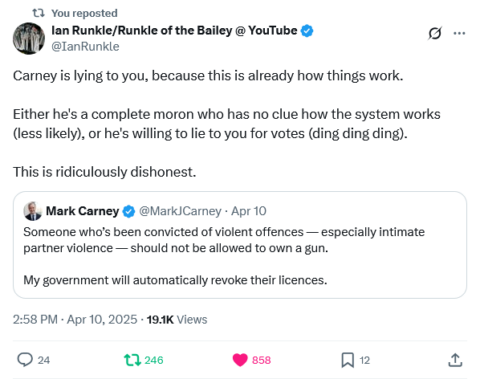
Your Line editors knew that guns were going to come into the campaign eventually. It’s one of the eternal issues for the Red Team, and while they seemed to have shied away from it a bit after some pretty brutal fumbling in Justin Trudeau’s later years, we figured it would be back eventually. And so it was on Thursday, when Liberal leader Mark Carney announced, as part of a package of crime policy proposals, that a re-elected Liberal government would make sure that guns were automatically taken from anyone convicted of a violent crime, including intimate partner violence.
*pulls hard on chain, activating bullshit klaxon*
See, here’s the thing, friends. First of all, to take Carney at his word here would require us accepting, even just for a moment, that this didn’t already happen. That up until Thursday of this week, the Liberals were hunky dory with people convicted of violent crimes, including intimate partner violence, keeping whatever guns they may own or wish to acquire.
That is, we suspect readers know, utter bullshit. Removing guns is already required in those circumstances, and it doesn’t even require a conviction. Police officers can seize any weapon of any type if it isn’t in the safety interest of any person, even without a warrant, and revoke any license they hold immediately.
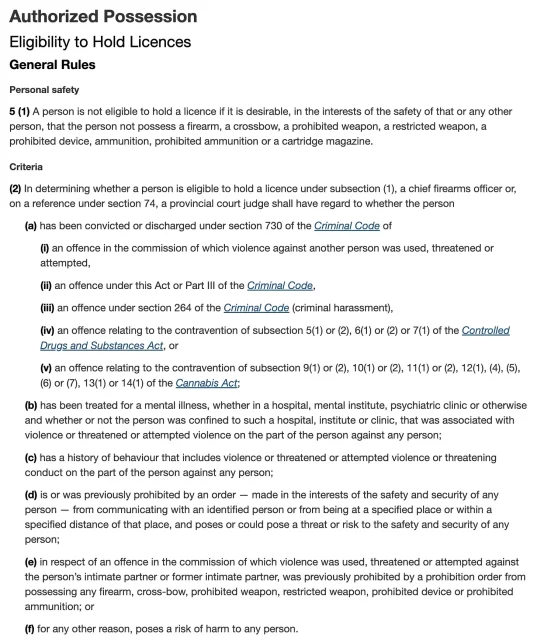
Nobody is eligible to hold a license if it isn’t in the safety interest of a person — that’s literally the first eligibility criterion in the Firearms Act. Issuing a license requires the issuer to consider all past convictions, mental illnesses, history of violent behaviour, previous prohibitions, any potential intimate partner violence, and any potential harm to any person before they issue it. That is checked through a process called Continuous Eligibility Screening, where license holders are checked for “hits” against police systems every single day to determine whether they are still able to hold a license.
This is something almost no one outside Canada’s firearms-owning community understands, and The Line wants to underline this point — anyone with a firearms licence is automatically checked for any new legal issues that might render them unable to own firearms every single day. If you happen to find yourself hanging out with someone with a firearms licence, they were checked out by law enforcement within the last 24 hours. This includes your friends at The Line. The day you’re reading this is a day they passed another screening.
A conviction for a violent crime, it hardly need be said — well, actually, check that, apparently it does need saying — would render one rather ineligible! Not only is this already the law, but there are so many overlapping laws to deal with that exact scenario that it takes real effort to be ignorant of them. Weapon prohibition orders on conviction for violent offences? Already a thing at the federal and provincial levels. Prohibitions while on bail? Already a thing. Firearm seizures during divorces? Not automatic, but common, sometimes even where there is no history of violence or reasonable belief that violence is likely.
The Liberals know all this, especially since it was the Liberals who last changed these laws — though not to add the removal provisions, which largely already existed, but to remove any discretion or ability for rehabilitation.
Every party is fine with keeping guns away from domestic violence perpetrators. Carney making this an issue is bullshit. He’s counting on the public to not know enough to call him out on it.
It’ll probably work.
Oh, and by the way. If you don’t want to take our word for any of the above, you can just read the Firearms Act yourself. Relevant section, below.
Comments Off on Carney’s Liberals promise to do something that’s been part of the legal code for decades
President Trump … or any president … shouldn’t have the unilateral power to levy tariffs
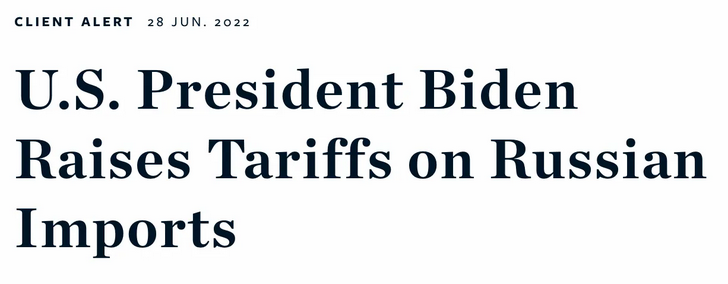
Love him or hate him — and there are lots of people in both camps — President Donald Trump has the power to randomly throw spanners into the international trade arena … because Congress ceded that power to the presidency long before Trump began his political career:
In response to Donald Trump’s tariff maneuvers, Senator Rand Paul has been arguing that presidents shouldn’t have the power to raise tariffs themselves. Taxing power belongs to Congress, and that’s where tariffs should be born. Trump’s tariffs result from the use of emergency power that Congress gave to the POTUS, and we shouldn’t normalize emergency rule. You can watch him say all of that here.
Every word of that is completely right. I don’t disagree with a single breath of it. I respect Rand Paul, and I’m inordinately fond of his dad. But it misses the point about how we got here, and why, starting with the fact that Congress gave away its taxing authority.
- Congress delegated its authority;
- Donald Trump used the authority that Congress gave him;
- Therefore, Donald Trump is very bad, and what he’s doing is wrong.
The core sickness at the heart of the American republic is Congress, and we keep discussing that sickness by saying that Trump sucks. He’s doing what you gave him the power to do, and he’s not the first.
See also my recent post in which I described a time when Congress made something illegal, than asked the administrative agencies to explain to them what they had just banned. Congress has delegated its authority, over and over again, and the resulting political vacuum is a serious problem. But anyway, TRUMP TRUMP TRUMP.
American political discourse keeps taking a wide range of political pathologies and assigning them to the same account. Orange Man Bad, Orange Man Bad, Orange Man Bad, they explained, with drool running down their chins. Donald Trump is our deflector object, our national excuse. [Problem name here]; OH NO WHY IS TRUMP DOING THIS TO US.
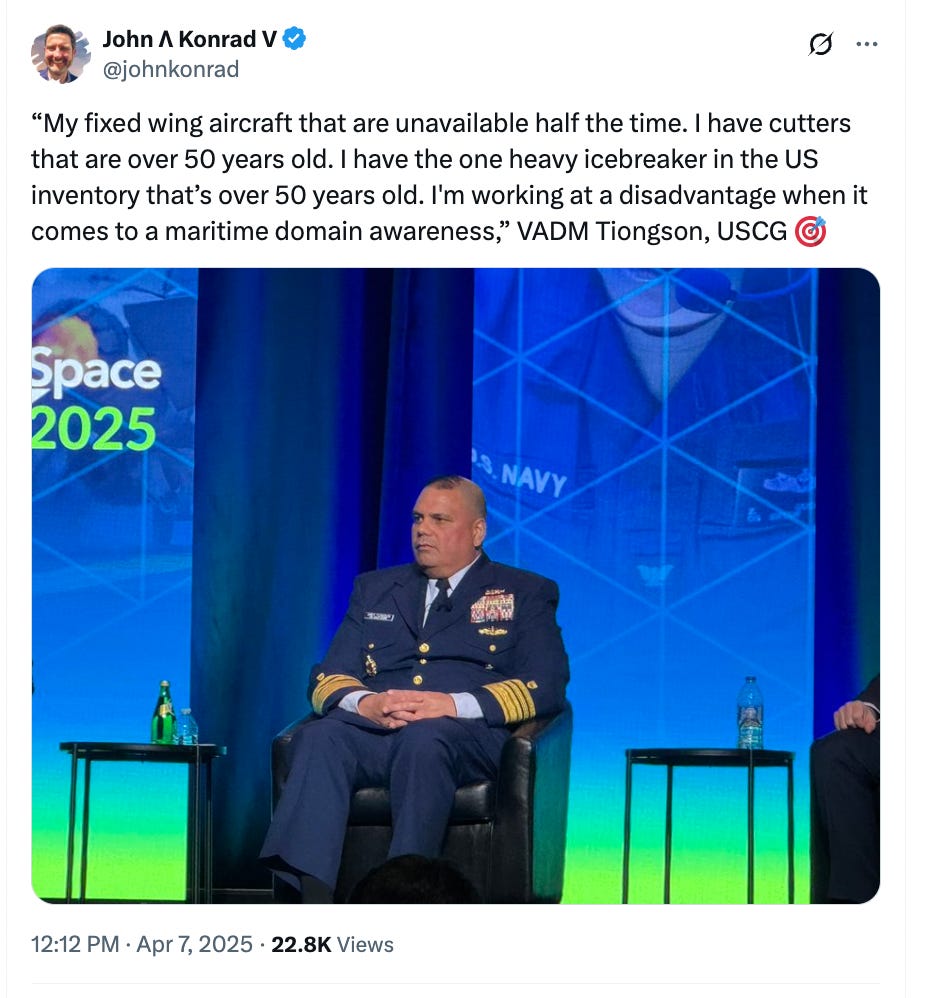
The commandant of the United States Coast Guard spoke at a maritime conference, a few days ago, and he said that the organization he runs wakes up every day and tries to keep the doors from falling off: “The US Coast Guard is less ready today than any other time since World War II. We are on a readiness spiral. Today our fleet of cutters are in significant decline. We are in repair failure mode … No ship today gets underway without cannibalizing others for parts.”
See also, from one of his subordinates:
Serious question: Did all of those problems begin at noon on January 20, 2025?
Comments Off on President Trump … or any president … shouldn’t have the unilateral power to levy tariffs
A Basic Introduction To The Ancient Roman Political System
MoAn Inc.
Published 12 Dec 2024
(more…)
Comments Off on A Basic Introduction To The Ancient Roman Political System
QotD: The changed role of the Dictatorship in the late Roman Republic
Now, precisely because we are now talking about the irregular dictatorship, there really is no way to lay out its features except to go through its uses. Fortunately, there aren’t that many.
In the spring of 83 BC, Sulla, who had been notionally serving in a proconsular command in the East to fight Mithridates, landed in Italy with his army; Rome had effectively come under the control of a military junta initially led by Gaius Marius (cos.107, 104-100, 86) and after his death by L. Cornelius Cinna, Gn. Papirius Carbo and Gaius Marius the younger (son of the former). Sulla openly fought the consuls of 83 (Gaius Norbanus and L. Cornelius Scipio), pushing towards Rome. As the year shifted over into 82, Carbo and Marius the Younger had themselves elected consuls. Marius was killed in 82 during the siege of Praeneste; Carbo fled to Sicily after Sulla took Rome (where he’d eventually be captured and killed by Pompey in 81).
Now this posed a problem, constitutionally: there were always to be two consuls and consular elections had to be presided over by a consul … but one consul was dead and the other fled. The customary solution to this problem was the appointment of an interrex, a five-day-long office which essentially only had the authority to hold elections for new consuls in the absence of consuls or an already appointed dictator. Prior to 82, the last confirmed interrex we know of was in 216, but there may have been another in 208, in either case this also a long-unused office. All the interrex is supposed to do is hold an assembly of the comitia centuriata which can elect new consuls; they did not have any further authority.
Sulla, sweeping into Rome, convened the Senate and directed them to select an interrex; one wonders if this was the same meeting of the Senate Sulla convened within hearing distance of his soldiers in the process of butchering six thousand captured Romans who had sided against him, in case the Senate imagined they were being given a choice (Plut. Sulla 30.1-3). In any event, the Senate selected Lucius Valerius Flaccus (its oldest member, App. BCiv 1.98) on the assumption he would hold elections; instead, Sulla directed him (with the obvious threat of violence) to instead convene the comitia centuriata and instead of holding elections, propose a law (the lex Valeria) to make Sulla dictator with the remit of rei publicae constituendae causa, “for reforming the constitution of the Republic” – an entirely new causa never used before. Of course with Sulla’s army butchering literally thousands of his political opponents, the assembly knew how they were to vote.
This is, to be clear, a thing that customarily the interrex cannot do. This is also not, customarily, how dictators are selected. The appointment of a dictator had not been recommended by the Senate and in any case has also chosen the wrong voting assembly (the comitia centuriata instead of the comitia curiata) and also the interrex doesn’t have the authority to nominate a dictator or propose a law that nominates a dictator. You may begin to see why I see this as a new political innovation and not a clear extrapolation from previous practice. None of this is how the customary dictatorship had ever worked.
The law also gave Sulla a lot of powers, which was important because most of these powers were not things that customarily a dictator could do. He could legislate by fiat without an assembly, something dictators could not do before. He was given the ability to alter the number of senators as well as choose new senators and expel current senators; a dictator had once been named, Fabius Buteo in 216, to enroll new senators, but had (according to Livy) openly noted he did not consider himself to have the authority to remove senators enrolled by the previous Censors (Liv. 23.23). Sulla rendered his authority immune to the acts of the tribunes, whereas that office had previously been the only office to exist outside of the dictator’s authority. Finally, his appointment had no time limit set to it, whereas previously all dictators had six months and no more.
What Sulla has done here is used new legislation (remember, Rome has no written constitution which could invalidate any new law) to create what was is effectively an entirely new office, which shared neither an appointment procedure, term limit, or set of authorities and powers with the previous version.
Sulla then made a lot of very reactionary changes to the Roman Republic we need not get into here, got himself elected consul in 80, and then resigned his dictatorship (after rather a lot longer than six months, making Sulla, by the traditional criteria, the worst dictator Rome had up until that point, though I doubt he saw it that way), and after that retired from public life. Sulla seems to have imagined the office he created out of thin air in 82 would be a thing sui generis, a unique office to him only, to that moment only. Which was incredibly foolish because of course once you’ve created the precedent for that kind of office, you can’t then legislate away your own example.
And so Caesar utilized the same procedure. M. Aemilius Lepidus (later to be triumvir with Octavian and Antony), the praetor in 49, put forward the legislative measure – once again, proposed as a law rather than through the normal process – to make Caesar dictator for that year (Dio 41.36.1-3), with the same sweeping powers to legislate by fiat that Sulla had. One of the first things Caesar did was openly threaten the tribunes with violence if they interfered with him; as noted the tribune’s powers were not at the discretion of the dictator in the customary system and tribunes were held to be sacrosanct and thus legally immune to any kind of coercion by other magistrates, so this too represented a continuation of Sulla’s massive increase in the dictator’s absolute authority (App. BCiv 2.41, Plut. Caes. 35.6-11).
Caesar’s dictatorship, rather than initially being without time limit, was renewed, presumably every six months, from 49 through February 44, when Caesar had himself instead appointed dictator perpetuo rei publicae constieundae causa, “Dictator forever for the reformation of the Republic”, at this point (if not earlier) reusing Sulla’s made-up causa and now making explicit his intention to hold the office for life. He was assassinated a month later, on March 15, 44 BC, so perpetuo turned out to not be so perpetual.
As an aside, Julius Caesar is sometimes given a rosy glow in modern teaching materials, in part because he got such a glow from the ancient sources (one could hardly do otherwise writing under the reign of his grand-nephew, Augustus, who had him deified). That glow was often reinforced by (early) modern writers writing with one eye towards their monarch – Shakespeare, for instance. This may be a topic for another time, but I think a fair assessment of Caesar strips away most of this glow (especially his “man of the people” reputation), except for his reputation as a gifted general, which is beyond dispute. Julius Caesar’s career was a net negative for nearly everyone he encountered, with the lone exception of Augustus.
Bret Devereaux, “Collections: The Roman Dictatorship: How Did It Work? Did It Work?”, A Collection of Unmitigated Pedantry, 2022-03-18.
Comments Off on QotD: The changed role of the Dictatorship in the late Roman Republic
April 11, 2025
Nazis and Communists Unite Against Weimar – Rise of Hitler 14, February 1931
World War Two
Published 10 Apr 2025February 1931 sees unprecedented chaos in Germany’s parliament as Nazis and Communists stage a dramatic walkout, ironically enabling democratic parties to pass reforms unopposed. Meanwhile, Hitler pushes eastward expansion, Berlin bans extremist newspapers — including Goebbels’ Der Angriff — and Röhm militarizes the Nazi SA. With democracy under strain and political extremes emboldened, what’s next for the Weimar Republic?
(more…)
Comments Off on Nazis and Communists Unite Against Weimar – Rise of Hitler 14, February 1931
Critical Trade Theory
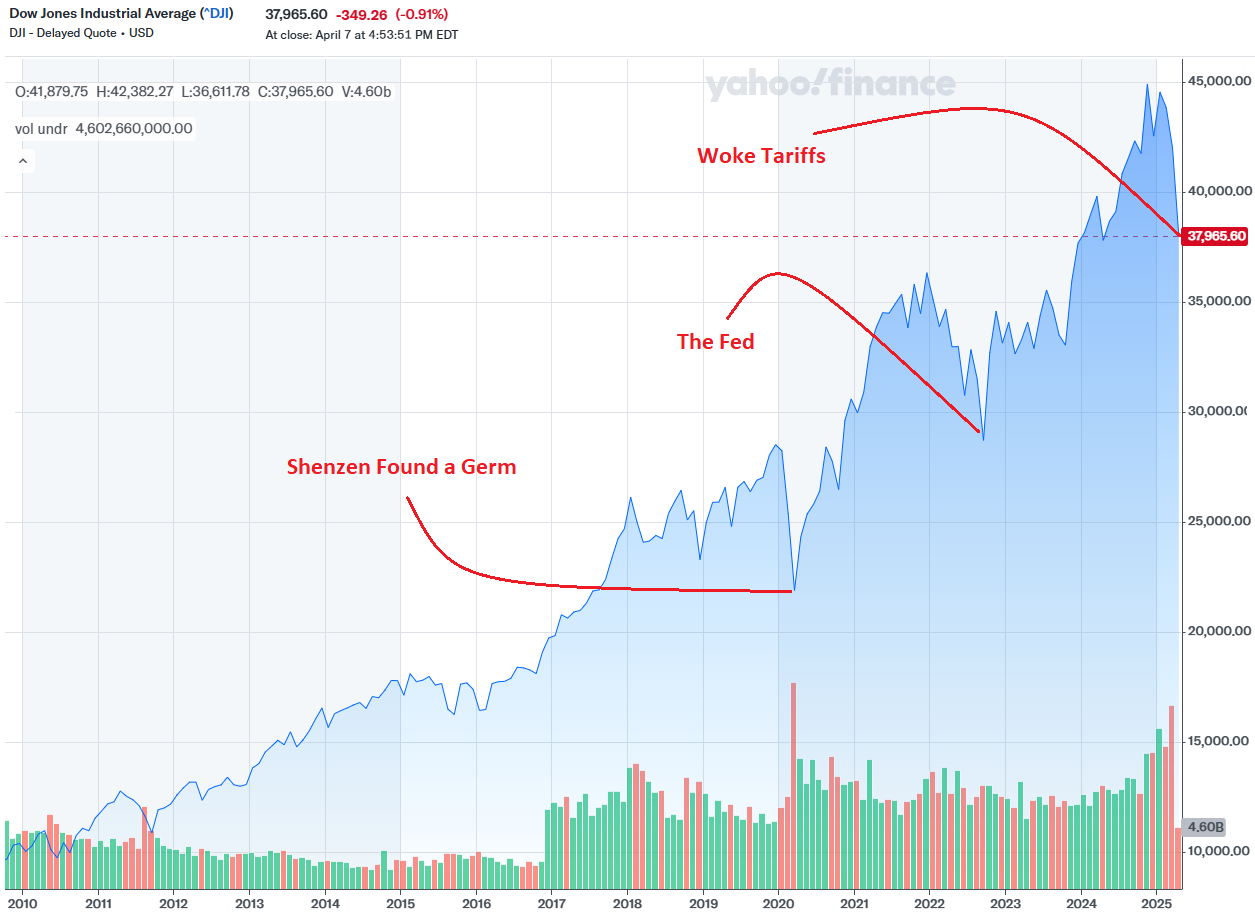
A discussion at the amusingly named Handwaving Freakoutery on the ongoing wave of tariff activity under the Trump II administration, characterizing them as “woke” tariffs:

The great argument playing out in the media right now about the relative value and ethical implications of reciprocal tariffs is not relevant. It is not relevant because these tariffs are not reciprocal tariffs in any measurable way. They aren’t reciprocal, they aren’t sensible, and the justification for them is Woke in every sense of the word. Let’s take a close look at what we might call Critical Trade Theory, back our way into an understanding of what a woke tariff is and how this is definitely that, and close with a quick word about how political realignments portend doom for the left even though the right is really screwing this up. Then we’ll all buy mop handle futures.
Awokening
The Great Awokening of the prior decade was founded in part on the False Cause Fallacy. Our major institutions for the better part of the last ten years were operated by wokerists, who used an Intersectional Matrix of Culturally Encouraged Race and Gender Prejudice to counteract what they viewed as hidden unmeasurable forces such as “systemic racism”. They couldn’t point to the systemic racism, but they knew it must be there because of the imbalance in socioeconomic metrics, and they denied any other possible explanation for the imbalance. Once the False Cause was in place, the devout wokerist was forced to fight the hidden prejudice with overt reverse prejudice, because they couldn’t conceive any other cause.
For example, if black folks have a hard time getting into Harvard or UNC, it must be because society is systemically racist against black people, and no other reason, therefore we should redirect admission slots from Asians who earned them to blacks who didn’t, for race balancing.
Harvard did exactly that, for exactly that reason, and admitted it, and it was sent to the Supreme Court, and the Supreme Court banned it, and then Harvard kept doing it and is still doing it using different words.
Some of our other institutions are still running this wokery program, although the Trump Administration purged much of it from the halls of federal power this year under their DEI ban, and many other institutions used Trump as cover to independently purge it from theirs. But this same smooth-brained thinking wiggled its way right into Trump’s tariff plan last week, through an equation that looks fancy but is something my middle school son could figure out.
[…]
The media thinks these woke tariffs are going to bomb the economy back to the stone age, but when I make the abhorrent choice to read the graphs myself it looks more like January 2024. A 20% tariff on Chinese goods is rough. Adding 34% more to it is rougher. But a 54% tariff on Chinese goods is nothing compared to Shenzhen closing its entire manufacturing sector down because they found a germ, and probably not significantly worse than the Fed turning off the free money spigot in 2022.
These tariffs are going to do goofy shit to the economy. I don’t like the goofy shit they’re likely to do. I think that trade balancing through tariffs is an idea so stupid that only Rust Belt union workers could come up with it, which is why they probably did come up with it, and also probably why Trump won the election by flipping the Rust Belt.
Comments Off on Critical Trade Theory
Beretta 93R: The Best Machine Pistol?
Forgotten Weapons
Published 13 Dec 2024The Beretta 93R (“Raffica”) was developed in the 1970s by Beretta engineer Paolo Parola at the request of Italian military special forces. It took the basic Beretta 92 pistol design and added a well-thought-out burst mechanism under the right-side grip panel. It does not have a plain full-auto setting, but only semiauto and 3-round burst. To help keep the gun controllable, it has a heavier slide to reduce cyclic rate, a detachable shoulder stock, and a folding front grip to help control the muzzle. It uses extended 20-round magazines and is actually remarkably controllable (or so I am told; I have not had a chance to shoot one myself).
(more…)
Comments Off on Beretta 93R: The Best Machine Pistol?
QotD: Teaching in modern universities
In two sentences, Leys has pinned, like a butterfly to an entomologist’s board, the bureaucratic sickness that has overtaken our institutions of higher learning (and not only those institutions). There is no madness more difficult to treat than that which believes itself sane, and there is no irrationality greater than that which believes itself perfect. It is no surprise that Leys retired early from his university chair because the university no longer bore any resemblance to what it had once been and misled students and the rest of society into believing it still was. A community of scholars had become an organization of foremen on a production line.
Theodore Dalrymple, “Rare and Common Sense”, First Things, 2017-11.
Comments Off on QotD: Teaching in modern universities
April 10, 2025
Late onset Trump Derangement Syndrome
Ed West diagnoses himself with a raging case of late onset TDS:
What has caused this late-onset TDS, however, is not Trump’s behaviour, but the relative silence of his critics. During Trump’s first term, everyone in the American establishment seemed to be calling him the next Hitler, and this included not just the usual academics and journalists but many major corporations; companies like Nike, Heineken and Airbnb were at the forefront of the “resistance” against the president, a trend labelled “CEO Activism”. It was quite obviously self-interested and performative, because if everyone in your country is calling its leader a fascist dictator, then you probably don’t live in a fascist dictatorship.
I have no idea where I saw this meme, but it makes me laugh
That is not the case this time around, and that is more troubling. I recall from my time volunteering for first aid training that, when you arrive at the scene of an accident, you don’t go to the person screaming in pain, but the individual lying on the ground in stony silence. Similarly, the fact that people working for large corporations now keep quiet about Trump, even as he embarks on the most reckless economic policy in recent years, should probably concern us. The reason they keep quiet — and this is something I have heard from the horse’s mouth — is because they feel that there is a real risk of punitive action if they speak out.

One of the things more moderate folks used to warn the far left activists about using any and all tools to “get” their enemies is that it can — and in this case has — unleashed exactly the same kind of retribution when their former target now has the power to do so. “Muh norms!” indeed.
The constant evocation of fascism is not just mistaken in my view, but neurotic. Western civilisation is emotionally scarred by the violent racial supremacism of the Nazi regime and in particular the Holocaust, the worst crime in history, yet people have a tendency to fight the last war and this isn’t the danger that Trump represents. He is not a white supremacist and not especially motivated by ethnic nationalism. He is, however, authoritarian in nature, prone to be vengeful to those who cross him while also surrounding himself with yes-men, and he does seem to have territorial ambitions, even if they concern a frozen wasteland. Those things are all bad enough in themselves.
Rather than being a new Hitler, a more realistic concern is that Trump represents the 19th century spectre of Caesarism, a man who uses democracy in order to establish himself as an imperial figure. The fear of a Caesar always haunted the founders of the Republic, obsessed with Roman history as they were and sceptical of democracy and mobs.
Trump as a modern Louis Napoleon? A case could certainly be made for it.
Caesars do not come out of nowhere, and the progressivism of the last few years has been deeply illiberal, hostile to freedom of speech and even more so to freedom of association. Jonathan Haidt talked of “decentralized totalitarianism” and it was the chaotic nature of woke progressivism that made it so disconcerting and caused many people, including those same corporate leaders, to stay silent.
Many of the things Trump is now doing are not entirely dissimilar to what radical progressives did when the opportunity arose, in particular the determination that institutions are cleared of their opponents. It is bitterly ironic, for instance, to have the Left accuse Trump of “rewriting history” for ideological reasons (gosh, imagine!). Yet there is something quite different about people scared of online mobs and being scared of the government. Activists, though loud and hysterical, could be ignored if people only had the courage to face them (which they usually didn’t); the state can make your life very difficult indeed. Already the Trump regime has punished law firms which oppose their leader; foreign nationals who’ve expressed criticism of the regime have been detained. These are not good signs.
I’ve sneered at the American critics who worked themselves up into hysterical rages about Trump, not just because of their puritanical piety but because of the lack of awareness about their own behaviour, in particular the conspiracies about Russia and the dishonest, partisan nature of American journalism (Trump is probably the most dishonest president in US history, but it may also be true that he is the most lied about). In the modern liberal imagination, in part because so many people read far more fiction than history, Trumpian figures tend to be opposed by a courageous “resistance”, whereas in reality most dictatorial leaders arise because there are no moderate alternatives, and the opposition is similarly extreme and unpalatable. There were no real goodies in the Spanish Civil War, nor in Syria, nor even in much of central-eastern Europe in the mid-20th century, where fascists fought communists for control of the streets.
Comments Off on Late onset Trump Derangement Syndrome
Too much free speech is bad for German democracy
eugyppius notes that criticizing German politicians for their lack of commitment to the principles of free speech can land you in prison if you’re not careful:
David Bendels, the chief editor of the AfD-adjacent Deutschland Kurier, has been threatened with prison time and sentenced to seven months of probation for a Twitter meme. It is the harshest sentence ever handed down to a journalist for a speech crime in the Federal Republic of Germany.
This is the illegal tweet, which Bendels posted via the official Deutschland Kurier X account on 28 February 2024:
It shows German Interior Minister Nancy Faeser holding a sign that has been manipulated to read “I hate freedom of speech!” Bendels posted the image to satirise Faeser’s disturbing plans to restrict the speech, travel and economic activity of political dissidents in Germany, which she had announced at a press conference a few weeks earlier.
Faeser personally filed criminal charges against Bendels for defamation after Bamberg police brought the meme to her attention. Last November, the Bamberg District Court summarily ordered Bendels to pay an enormous fine for this speech crime “against a person in political life”. This is yet another prosecution that proceeds from our lèse-majesté statute, or section 188 of the German Criminal Code, which provides stiffened penalties for those who slander or insult politicians, because politicians are special people and more important than the rest of us.
The same Bamberg prosecutor’s office and the same Bamberg District Court had previously pursued the German pensioner Stefan Neihoff for the crime of posting another meme implying that German Economics Minister Robert Habeck might be a moron. That case, too, seems to have been brought to Habeck’s attention by Bamberg police, who requested that Habeck file charges. The Bamberg police apparently have very little to do beyond trawling the internet for political memes and protecting democracy by suppressing democratic freedoms.
Bendels appealed his summary penalty, and so the Bamberg District Court put him on trial. Yesterday the judges found him guilty and sentenced him to seven months in prison, which they suspended in favour of probation. The judges claimed that Bendels was guilty because he had distributed a “factual claim about the Minister of the Interior, Ms Faeser … that was not recognisably … inauthentic”, and judged that his meme was “likely to significantly impair [Faeser’s] public image”. The presiding judge demanded that Bendels submit a written apology to the Interior Minister for having so egregiously slandered her.

Comments Off on Too much free speech is bad for German democracy
Canadian political aspirations to being “very mid” on the world stage
In The Line, Matt Gurney reflects on a recent statement by caretaker prime minister Mark Carney about Canada taking a “leadership role” on the international stage and supplanting the United States under President Trump:
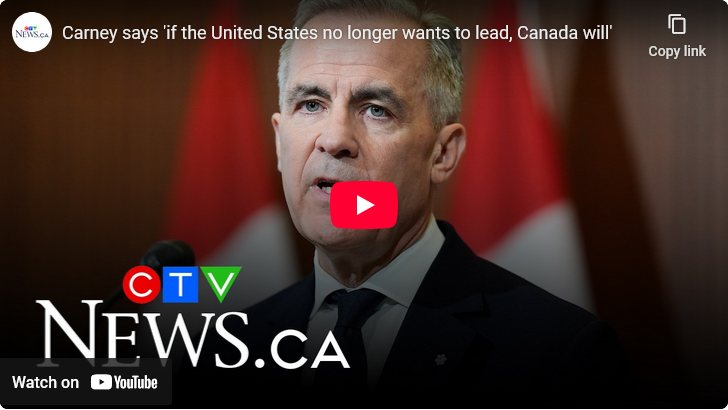
Oh, we will, eh?
Don’t get me wrong, I like the sound of it. He’s certainly manifesting that elbows-up spirit that seems to be so impressing Canadians.
But, like — Carney knows which country he’s in, right? Canada? The one full of Canadians? Because as I heard him say what Canada would do in response to the accelerating American withdrawal from global affairs, I couldn’t help but note that there is a problem here.
Canada isn’t a leader. Canada doesn’t lead.
Even as I write this, I know it’s going to be a fraught statement. Canadian patriotism is a bit supercharged right now. It’s nice to see. But a lot of stupidity gets overlooked — or even caused — by patriotic outbursts. Internal dissent becomes a lot less popular when everybody is sewing the Maple Leaf onto their backpack. So I want to make my point respectfully and politely, largely to spare myself the agony of wading through idiotic replies for a few days. So here goes: many Canadians do indeed lead in their fields, and there is nothing inherent about Canada that makes us incapable of exercising leadership. If Mark Carney remains prime minister — or if someone with similar ambitions should replace him and make a point of pursuing a policy of broad-based Canadian global leadership — I don’t write that off as a doomed proposition.
There is more that we could choose to do. There are practical constraints that would bind us, and we’ll talk about those in a minute, but just to get into the spirit of the moment: sure. We could choose to exercise global leadership.
But we would first have to start with the recognition that it has been generations since we have actually tried to do that. This is not a moral judgment on Canada or Canadians. It is simply a recognition of the historical record. This country has not pursued a national policy — or even a series of smaller policies that take on a greater form in the aggregate — that sought to establish this country as a leader in the world.
If we’re being honest, we’ve typically pursued almost the opposite policy, and deliberately. I’m not saying we’re slavish followers. But this is a country that for generations has been quite comfortable thinking of itself as an overachieving middle power, nestled comfortably in a supporting role for allied countries that do seek to lead. Usually the Americans. Maybe sometimes the British or French. Or something like the UN or NATO. We’ve never claimed to land the hardest punches, or tried to. We’d settle for punching above our weight. We haven’t tried to conquer or command or even compel. In the words of a member of the incumbent government, our aspiration largely maxed out at wishing to convene.
But, of course, as we’re learning these days, Canadian politicians of almost all parties (Maxime Bernier is the only exception I’m aware of) consider the beneficiaries of our trade-distorting supply management system to be the only ones whose interests they always champion:
The most interesting field of international relations, though, and the most germane to what Carney said on Liberation Day, is in the field of trade. Canada definitely likes trade. I’ll even give some credit here to both Liberals and Conservatives. It has been broadly understood that Canada thrives when we have access to markets all over the world. The pursuit of expanded trading relationships has been a bipartisan priority for Liberals and Conservatives alike … so long as it doesn’t cost us anything on the domestic political front.
And yes, I’m talking about dairy. Some other things, too. But mostly the milk and eggs.Seriously. Scroll up a bit. Look at that big quote I dropped in at the top from Carney. Watch the CTV feed again. Canada is going to pursue a role of leadership in defending liberalized free trade?
Really? Forgive me for squinting. I’m struggling with my middle-aged eyes to find the tiny text appended to Carney’s pledge that notes that “conditions apply”. Because that very same Mark Carney has already gone out of his way to say that protecting Canada’s supply-managed dairy and egg producers is an absolute, unbendable priority for him and his party.
So yes. Let’s all pledge ourselves to a new era of Canadian leadership in defence of free trade and unfettered market access, right up until the moment some weirdo foreigner gets it into their pathetic little brain that they should be allowed to sell me a stick of butter. Because that ain’t on, friends. Let’s get our elbows up, and bury them deep into this wheel of filthy xenocheddar.

Comments Off on Canadian political aspirations to being “very mid” on the world stage


