
I want to start with the observation I offer whenever I am asked (and being a Romanist, this happens frequently) “why did Rome fall?” which is to note that in asking that question we are essentially asking the wrong question or at least a less interesting one. This will, I promise, come back to our core question about diversity and the fall of Rome but first we need to frame this issue correctly, because Rome fell for the same reason all empires fall: gravity.
An analogy, if you will. Imagine I were to build a bridge over a stream and for twenty years the bridge stays up and then one day, quite unexpectedly, the bridge collapses. We can ask why the bridge fell down, but the fundamental force of gravity which caused its collapse was always working on the bridge. As we all know from our physics classes, the force of gravity was always active on the bridge and so some other set of forces, channeled through structural elements was needed to be continually resisting that downward pressure. What we really want to know is “what force which was keeping the bridge up in such an unnaturally elevated position stopped?” Perhaps some key support rotted away? Perhaps rain and weather shifted the ground so that what once was a stable position twenty years ago was no longer stable? Or perhaps the steady work of gravity itself slowly strained the materials, imperceptibly at first, until material fatigue finally collapse the bridge. Whatever the cause, we need to begin by conceding that, as normal as they may seem to us, bridges are not generally some natural construction, but rather a deeply unnatural one, which must be held up and maintained through continual effort; such a thing may fail even if no one actively destroys it, merely by lack of maintenance or changing conditions.
Large, prosperous and successful states are always and everywhere like that bridge: they are unnatural social organizations, elevated above the misery and fragmentation that is the natural state of humankind only by great effort; gravity ever tugs them downward. Of course when states collapse there are often many external factors that play a role, like external threats, climate shifts or economic changes, though in many cases these are pressures that the state in question has long endured. Consequently, the more useful question is not why they fall, but why they stay up at all.
And that question is even more pointed for the Roman Empire than most. While not the largest empire of antiquity, the Roman empire was very large (Walter Scheidel figures that, as a percentage of the world’s population at the time, the Roman Empire was the fifth largest ever, rare company indeed); while not the longest lasting empire of antiquity, it did last an uncommonly long time at that size. It was also geographically positioned in a space that doesn’t seem particularly well-suited for building empires in. While the Mediterranean’s vast maritime-highway made the Roman Empire possible, the geography of the Mediterranean has historically encouraged quite a lot of fragmentation, particularly (but not exclusively) in Europe. Despite repeated attempts, no subsequent empire has managed to recreate Rome’s frontiers (the Ottomans got the closest, effectively occupying the Roman empire’s eastern half – with a bit more besides – but missing most of the west).
The Roman Empire was also, for its time, uncommonly prosperous. As we’ll see, there is at this quite a lot of evidence to suggest that the territory of the Roman Empire enjoyed a meaningfully higher standard of living and a more prosperous economy during the period of Roman control than it did either in the centuries directly before or directly after (though we should not overstate this to the point of assuming that Rome was more prosperous than any point during the Middle Ages). And while the process of creating the Roman empire was extremely violent and traumatic (again, a recommendation for G. Baker, Spare No One: Mass Violence in Roman Warfare (2021) for a sense of just how violent), subsequent to that, the evidence strongly suggests that life in the interior Roman Empire was remarkably peaceful during that period, with conflicts pushed out of the interior to the frontiers (though I would argue this almost certainly reflects an overall decrease in the total amount of military conflict, not merely a displacement of it).
The Roman Empire was thus a deeply unnatural, deeply unusual creature, a hot-house flower blooming untended on a rocky hillside. The question is not why the Roman empire eventually failed – all states do, if one takes a long enough time-horizon – but why it lasted so long in such a difficult position. Of course this isn’t the place to recount all of the reasons why the Roman Empire held together for so long, but we can focus on a few which are immediately relevant to our question about diversity in the empire.
Bret Devereaux, “Collections: The Queen’s Latin or Who Were the Romans, Part V: Saving and Losing and Empire”, A Collection of Unmitigated Pedantry, 2021-07-30.
December 4, 2024
QotD: What caused the (western) Roman Empire to fall?
December 3, 2024
“Granting more sovereign rights to others surprisingly means that these groups will pursue their own interests. Who could have seen this coming?”
In his weekend round-up, Niccolo Soldo pokes a bit of fun at Justin Trudeau’s federal government for apparently being surprised that First Nations are looking to deal directly with China for their natural resources, rather than through the feds:
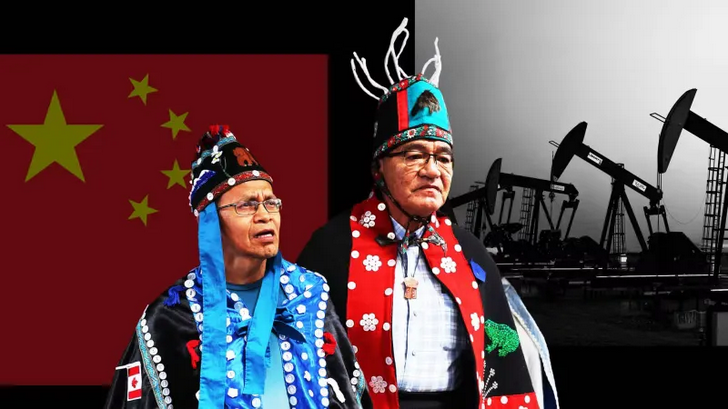
Canada continues to be unintentionally hilarious, all thanks to Prime Minister Justin Trudeau and his government.
The Great White North was forever a boring place politically, but the arrival of Trudeau Jr. on the scene shook things up. One of the first things that he and his government committed themselves to was to work to improve the country’s relations with its Native tribes, both politically and especially economically. The Trudeau government invented a genocide narrative based around residential schools.1 Canada too wanted a dark aspect to its own history, so that it could share in the self-flagellation that has coloured the recent history of its neighbour to its immediate south.
Maybe the intention here was to show these Native communities that Canada really, really did care and that by doing this, everything bad that had happened would be forgiven and forgotten? I dunno … what I do know is that Native bands are now seeking to directly do business with China, whereby they would sell natural resources under their control to Beijing:
Canada’s indigenous communities are seeking deals with China that could give Beijing access to the country’s natural resources, despite warnings from Canadian security services over doing business with Xi Jinping’s government.
This week the Canada China Business Council indigenous trade mission is in Beijing to discuss potential energy and other business deals in a trip that could put Canada’s national “reconciliation” with its First Nation communities at odds with its national security priorities.
Karen Ogen, the trade mission’s co-chair and chief executive of the First Nations Liquefied Natural Gas Alliance, said her goal on the trip, which starts on Wednesday, was to sell LNG for the benefit of the Wet’suwet’en communities in Canada’s western province of British Columbia.
“We’ve been oppressed and repressed by our own government,” she said. “I know the history with China is not good but we have an understanding of what we need and what they need.”
Canada purposely degraded its own national sovereignty in parts of its own country in the name of “reconciliation”. Granting more sovereign rights to others surprisingly means that these groups will pursue their own interests. Who could have seen this coming?
Clever Chinese:
China has spotted an opportunity in the sometimes fraught relations between Canada’s national and provincial governments and indigenous groups.
In 2021, shortly after Canada imposed sanctions on Beijing over the treatment of its Uyghur population, Chinese officials began to object to the “systemic violations of Indigenous people’s rights by the US, Canada and Australia” at the UN’s Human Rights Council.
“The PRC tries to undermine trust between Indigenous communities and Canada’s government by advancing a narrative that the PRC understands and empathises with the struggles of Indigenous communities stemming from colonialism and racism,” said a spokesperson for Canada’s security intelligence service.
A 2023 CSIS report accused China’s government of employing “grey zone, deceptive and clandestine means” to influence Canadian policymaking, including Indigenous communities.
“China knows how sensitive Indigenous reconciliation is to the Trudeau government,” said Phil Gurski, a former CSIS intelligence analyst.
A lot of these First Nations (Native bands) reside in the west of the country. Coincidentally, Canada’s third-largest city, Vancouver (located in Canada’s west), is roughly one-third Chinese in composition.
First Nations will continue to pursue these deals with the Chinese:
But CSIS remains concerned over Beijing’s possible access to resource-rich areas or geopolitically important waterways and regions such as the Arctic through First Nations groups.
“It not only undermines the government but is a way to potentially embarrass them on Canada’s past,” said Gurski.
But Matt Vickers, from Sechelt Nations land in Canada’s western province of British Columbia, who first visited China in the 1990s and is part of the CCBC delegation heading to Beijing this week, rejected the concerns of the security services.
“China now understands that for any major project to receive approval in Canada, you need First Nation consent, and not only consent but the First Nations require a majority equity play in those projects,” he said.
The CCBC is a bipartisan organisation consisting of Canada’s biggest companies, including Power Corp, which is the main sponsor of the Indigenous event.
This week’s trip marks the third time a group of Indigenous officials has travelled with the council to China in an effort to identify export markets, sources of capital and potential tourism projects.
“These missions have been developed in the spirit of reconciliation and collaboration, to help delegates better understand how China’s economy and economic development influences its desire for imports and investment opportunities,” said Sarah Kutulakos, executive director of the CCBC.
It gets even funnier:
Deteriorating relations between Ottawa and Beijing meant this year’s CCBC meeting would likely be “sombre”, said former Canadian ambassador to China Guy Saint-Jacques.
First Nations leaders should have “very limited expectations” from the trip. “I don’t expect big business coming out of it,” he said.
But Ogen, of the First Nations LNG Alliance, said she would put the controversy surrounding the trip to Beijing aside. “I … look at the global energy sector, China’s need for our gas, and how I can make the best deal for my people,” she said.
Trudeau scored an own-goal.
1. From wiki (because I am lazy): “The Canadian Indian residential school system was a network of boarding schools for Indigenous peoples. The network was funded by the Canadian government’s Department of Indian Affairs and administered by various Christian churches. The school system was created to isolate Indigenous children from the influence of their own culture and religion in order to assimilate them into the dominant Euro-Canadian culture.”

Canadian Armed Forces: Can the RCN Really Stop Russia and China in the Arctic?
Esprit de Corps Canadian Military Magazine
Published 2 Dec 2024Vice Admiral Angus Topshee recently told the National Post that the Canadian Navy is able to defend our Arctic waterways against China or Russia … without help from our allies (aka the US Navy). It is time to target just what the heck the Admiral is talking about!
David Starkey’s view of history
At the Daily Sceptic, James Alexander summarizes how historian David Starkey’s views of history — British history specifically — provide a useful way to analyze British political issues today:
David Starkey, 2004.
Screenshot via IMDB.com
What David Starkey is trying to do is deliver to the British (or English) public a jeremiad informed not by moral posturing or theoretical commitment but by a sense of history. This is so valuable it should almost come without criticism. I think that Starkey’s vision of history is so arresting it deserves to be expressed in short form and so I will attempt a summary of the position. Starkey is an admirably entertaining speaker, and offers a vision that is several dimensions more complicated than we hear from anyone else at the moment. He is full of prepared lines, and has a ready mind: “Niall Ferguson, the good Niall Ferguson, not the bad Neil Ferguson …”; “All bad ideas begin with the French”; “The Union of England and Scotland made the modern world”; “The monarch changes religion as he crosses the border: he begins Anglican, and becomes Presbyterian”; “The Labour party is the equivalent of the Nomenklatura of Soviet Russia: a privileged class”; etc.
I have some criticisms. But first, his vision of our history.
Let me begin by summarising Starkey’s view of history as it conditions the present. He argues the following:
1. On the nature and relevance of history. History is fundamental. We cannot understand ourselves using theory. Avoid abstraction. Use history instead. It is concrete. He suggests that we have always studied history for the sake of the present, though in recent centuries we have also studied it for its own sake. He adds that we should make analogies between past and present.
2. On English history. Starkey says that we were first part of Greater Scandinavia, then, from 1066, were part of an Anglo-French order. The third stage of our history began with the Reformation. Starkey likens the Latin Christendom of the Papacy to the European Union: and so calls Henry VIII the first Brexiteer. The consequence of the Reformation was that Britain and Europe become antagonists. For the first time the sea was reconfigured as a barrier, defended by the navy: and this happened at the same time that energies were thrown outward to the rest of the world. What the English managed to do, along with the Scots, was build something out of the strong language that rises from Chaucer to Shakespeare: the two home countries united to make it impossible to be invaded; they united to make an empire in the world; and they united to make use of remarkable innovations in finance and later industry.
One of Starkey’s great themes is this Union of England and Scotland: first by King in 1603 and second by Parliament in 1707. Starkey says England is not a nation. It lacks a ridiculous national dress (since its national dress, of coat and trousers with tie, was given to the world as universal official dress). And the Union was wholly original, as it subjugated Scotland to England’s Parliament, abolishing the Scottish Parliament, while leaving Scottish law, religion, military tradition and heraldry alone. England and Scotland are politically united, but only politically united. Starkey’s point about all this is that it was never about “identity”. There was no such thing as a “Briton”. There was no national system of education. So there was no nonsense of any modern-style post-French Revolution nationalism. Instead, we were natural liberals, able to take in immigrants without difficulty. However, throughout all this England is politically dominant in Great Britain and in the Empire.
3. On the present time. Starkey has two points of reference. One is the 1970s, when things went wrong, with a short reversal under Thatcher, and in the 1990s, when things went even more wrong, and perhaps permanently wrong, because constitutionally wrong. The 1970s was the culmination of the Labour politics of welfare, accepted weakly by Macmillan and Heath, but the 1990s was worse because political and constitutional. Labour took things in the wrong direction by making the Bank of England independent and by enabling a new Scottish Parliament to emerge: also by bringing about the Equality Act of 2010 (actually an innovation of Gordon Brown); also by creating a Supreme Court. Then, finally, Charles III removed Parliament from the Coronation, and there was no mention of politics: whereas, since 1688, the Coronation had been a political act. Political power has been fragmented and dispersed from the King-in-Parliament to the quangos, to the Bank of England, to the lawyers. The principle of balance is lost, as every institution has become an interest group, pursuing single issues: an entire raft of Anti-Corn Law Leagues.
Starkey suggests that England will remain an idea, much as the idea of Rome survived the decline and fall of the Roman Empire. This is pessimistic judgement. His optimistic judgement, or hope, is that some sort of “restoration”, like the Glorious Revolution, can be enacted. As far as I have heard, he has not yet sketched the form of his restoration, though it has been promised.
Is this clear? Henry VIII broke the monasteries, threw out the Papists, built Oxford and Cambridge in new form, fortified the coast and began the story of Greater England. If we fill the gaps, there were difficulties with the consequences, religious and political, through the reigns of Mary, Elizabeth, James and Charles, but these were resolved in 1688 and then 1707. Then Great Britain became a great power. This remarkable creation was politically and constitutionally destroyed by the theorists and politicians of the late 20th century, since they demoted England within Britain, unleashed petty nationalisms in political form, and, in passing, did not do enough to restrain the welfare state or, we might add, enough to prevent English tolerance being twisted to accommodate net immigration of 700,000 people of fairly antagonistic cultures per year. Britain is now ruled not by Government-in-Parliament but by delegated arbitrary powers and influences which offer sops to partial interests and mean that nothing can be done. No one has an adequate conception of the entire state.
Evolution of Airborne Armour
The Tank Museum
Published Jul 19, 2024Lightly armed airborne troops are at a huge disadvantage when faced with regular troops with heavy weapons and armour. In World War II this led to huge losses for paratroops on Crete and at Arnhem. Since then, many attempts have been made to level the playing field, to give airborne soldiers a fighting chance.
From the Hamilcar gliders of World War II to the C17 Globemaster, we look at how to make a tank fly.
00:00 | Intro
00:47 | The Origins of Airbourne Operations
02:34 | Gliders
07:20 | A Tank Light Enough to Fly?
09:02 | Success & Failure
14:24 | Post-War Solutions
17:41 | Better Aircraft – Better Tanks?
20:15 | Strategic Deployment
21:39 | ConclusionThis video features archive footage courtesy of British Pathé. This video features imagery courtesy of http://www.hamilcar.co.uk/
#tankmuseum
QotD: Old fashioned communists
Theodore Dalrymple, “A Matter of Respect”, Taki’s Magazine, 2019-12-31.
December 2, 2024
“I think we’re moving out of the ‘FA’ stage into the ‘FO’ era on that one, friends”
In a rare sighting of a Matt Gurney column from The Line outside the paywall, he shares some of his thoughts after attending this year’s Halifax International Security Forum in Nova Scotia:

For those who don’t know, the “Forum”, or HISF, is an annual gathering of military leaders, defence and intelligence experts, and others whose work relates to defence and security issues, from across NATO and the Western alliance broadly. Funded by NATO, the Canadian government and private-sector sponsors, it is something of a jewel in Canada’s defence crown, a chance to bring some very powerful and influential people to a gorgeous Canadian city to wine and dine them, in hopes that they don’t realize our military is a disaster that is largely incapable of contributing to our collective defence. The agenda is always divided into a mix of free time for social networking, off-the-record chats (which are generally the most interesting) and also a series of on-the-record events that can be quoted from, and which are broadcast live online.
[…]
In our latest episode of The Line Podcast, we discussed this at length, in the context of the ICC issuing arrest warrants for Israeli prime minister Benjamin Netanyahu and his now-former defence minister. I quipped on the pod that the “rules-based international order” is a lot like the “sanctity of marriage”. It’s something we talk about as if it exists, and we’d all like it to exist, but it really doesn’t. It just doesn’t. It’s an ideal worth striving for, but not actually a thing that exists and can be counted on. The Line had also previously written about our belief that there is no rules-based international order in a prior dispatch, and then ran a counterpoint to that perspective by a reader who disagreed. It was a good counterpoint! It didn’t change my mind.
Shearer tackled the question directly, and so perfectly that I think his answer has changed my view of the situation. It hasn’t changed my opinion, but it has changed how I’m going to describe it. Here’s what Shearer said (I’ve tidied up the quote a tiny bit for clarity, but you can watch the whole thing around the 39-minute mark of this video). For context, the panel was about the so-called “CRINKS” — China, Russia, Iran and North Korea, and the challenge they are posing to the Western alliance. I’ll include Coomarasamy’s question, and then show you what Shearer said that made me go “Huh”.
Coomarasamy: Are we in a world now where we can’t really talk about a rules-based international order, but two separate, competing ones?
Shearer: That’s a big question. I think the rules-based order, frankly, turns out to have been, in hindsight, a power-based order. It was unchallenged U.S. military power that made possible the liberal order of the last 50 years. With all its benefits for so many countries. Was the U.S. always a perfect hegemon within that system? Occasionally not. It would shift its weight around, and there were consequences from that. But overall, it worked because the United States was a relatively benign hegemon.
That’s it. That’s exactly it. That’s exactly what I have intuitively felt in the last few years, and haven’t done a good enough job explaining. I grasped it in a big-picture intellectual sense, but I hadn’t been able to shrink it down into a single sentence like that. When Shearer said that the rules-based order was, actually, a U.S. military power-based order, it clicked in my brain. That’s the way to articulate it.
For the last few decades, we thought we were living in a rules-based-international order, and planned our lives around that. But what we were actually living in was a global order led by a relatively benign global superpower and preserved by its astonishing military power.
And that world is ending.
The question of our era
At PJ Media, Athena Thorne asks the most pertinent, relevant question of our times:
Is Donald Trump the Long-Awaited Messiah of the Band ‘Rush’ Era?
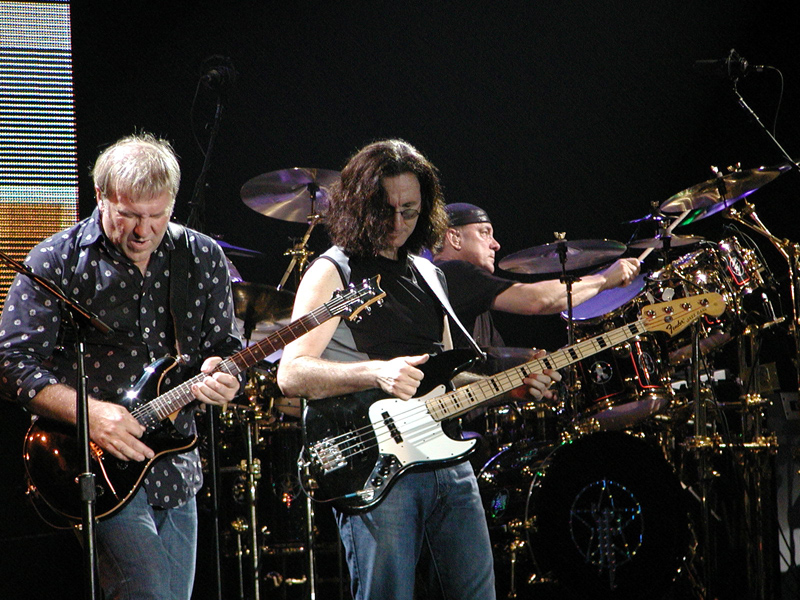
Rush in concert, Milan 2004.
Photo by Enrico Frangi, via Wikimedia Commons
Greetings, PJ readers! I hope you all had a wonderful Thanksgiving and are still feeling lazy and slovenly. In that vein, here is a tasty morsel of a column from a friend and fellow reader, Kato the Elder. He makes an excellent argument — one with which I heartily agree — that President-elect Donald Trump is the small-L libertarian hero of our time. Enjoy!
In a particular moment during my precocious, autodidact pre-teen years, I stumbled upon a copy of Ayn Rand’s novel Atlas Shrugged at an estate sale in an old New England barn. There, in a hay-covered stall, I found that dense brick of a book that seemed, in a creepy sort of way, to be waiting for me to pick it up and take it home — consequences be damned. It was like Guy Clark’s song about a haunted guitar, found in a pawn shop, with the name of the next victim to pick it up already written on the case. And, like Guy Clark’s guitar, Atlas Shrugged is one of those cultural objects that once picked up cannot be put down. Who could ever forget, on page 455, where it is asked, “What advice would you give Atlas if he became weary of holding up the world? Shrug.” A libertarian is born. I quickly worked my way through the remainder of Rand’s parables and then the essays.
Rand’s novella “Anthem” led to my discovery of the Canadian rock band Rush, which had adapted “Anthem” as the rock opera entitled 2112. It’s the story of a man who suffers under the autocratic rule of the Priests of the Temple of Syrinx, progressives who use computers to create a scientific, expert-driven utopia that does not recognize the value of the individual or the right to think and create and dissent. In “Anthem”, it is the protagonist’s discovery of an ancient incandescent light bulb that leads to the discovery of an earlier and freer society and puts the hero on a collision course with the collectivists. In the Rush version, the long-lost incandescent light bulb is replaced with a guitar, but of course it would be, because what kind of crazy government would take away someone’s light bulbs?
A very strong Randian libertarianism runs through Rush’s music; the heroes of many Rush songs are those individuals struggling, of course, against a government that is determined to pound the individualism and free thought out of its subjects, whether that individual is Tom Sawyer or teenagers living in subdivisions or the teen boy awaiting the world’s applause or the community suffering from mob violence and witch hunts. But Rush, and Rand, are not rejecting the Eisenhower-era type of corporate conformity, but rather the conformity of counter-culture which has taken power and proven the deficiency of the government-expert-knows-best mindset. The epitome of that strain of Randian libertarianism comes in the song “Red Barchetta”, a power ballad about a boy who, in conspiracy with his uncle, escapes to the countryside to race a classic, gas-powered Ferrari against a bland EV car of some kind that has supplanted the freedom and adrenalin rush of gas-powered freedom. Because what kind of crazy government would take away someone’s choice of car?
I saw Rush in concert at least 12 times, and every concert was full of people who looked like me, dressed like me, and sounded like me. We sang along with Rush at the top of our lungs about the freedom of music and the individualism which is closer to the heart. As we all grew older and grayer and our American society became less tolerant of dissent and more dependent on corporate/government cronyism, we could only wonder whether we would find our Howard Rourke, the nonconformist New York developer and architect of Rand’s novel The Fountainhead, who would lead us to the promised land.
Mars? Yes, Mars.
At Postcards From Barsoom, John Carter discusses the pros and cons of colonizing Mars:
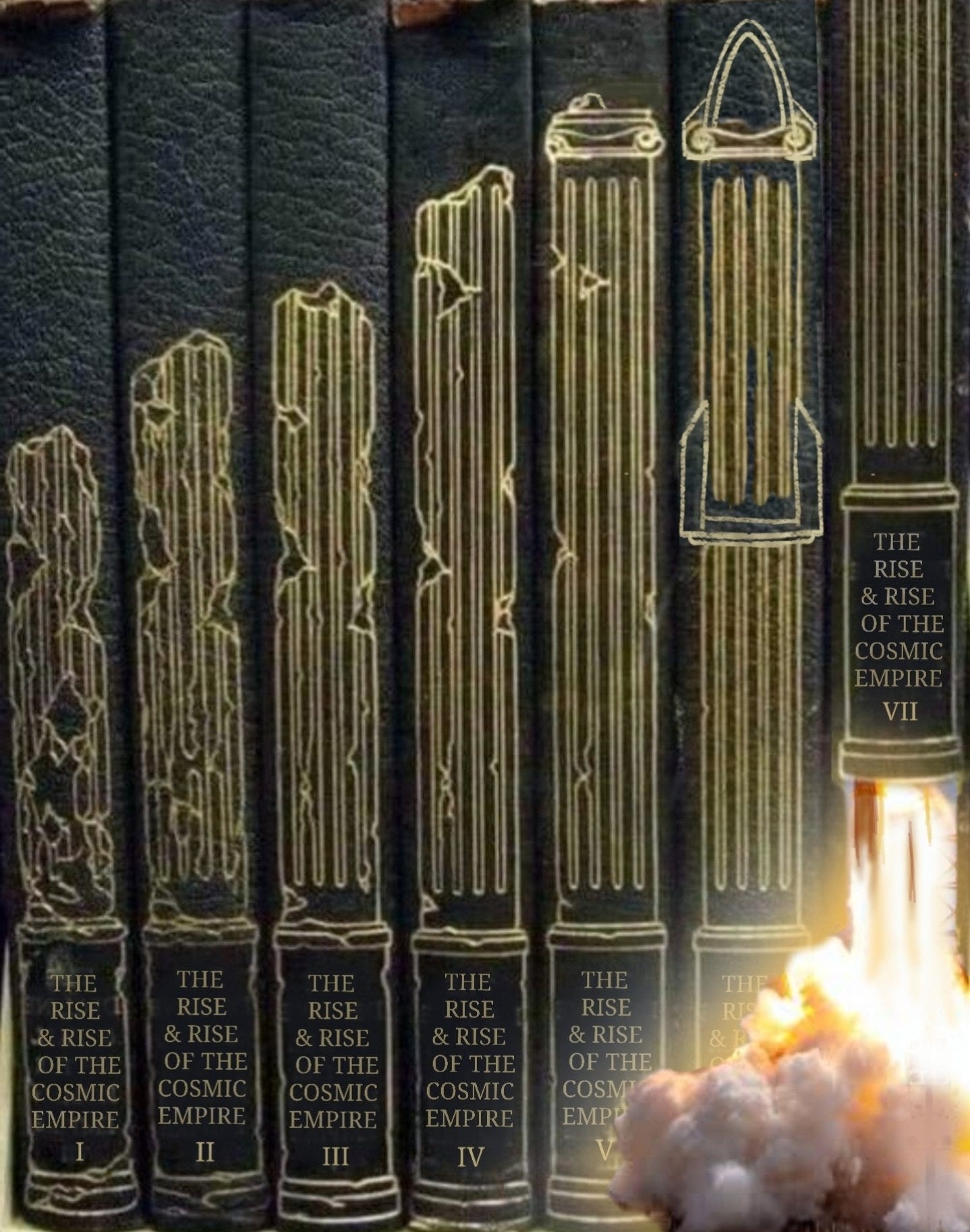
… we’re on the good timeline now.
Not everyone appreciates the good timeline. A persistent current of discourse holds that we shouldn’t go to Mars, that it is a misbegotten ambition, unrealistic, unprofitable, and even counterproductive. “Antarctica would be easier”, they say, “We should start there if we start anywhere”. Mars is too difficult; the technology doesn’t exist; it’s fantastically expensive, with no conceivable profit to be derived from a frigid desert littered with dead rocks, where the clouds themselves are made of red dust, where the air is too thin and toxic to breathe, where nothing can possibly grow. Therefore, they pronounce, we shouldn’t go. We shouldn’t even try to go. We should use our limited resources to solve our pressing problems down here on Earth – climate change, poverty, racism, the gender pay gap, the refusal of the chuds to use the correct pronouns.
Leave aside that if Europeans had waited to solve Europe’s problems, they never would have left.
Leave aside that “we” aren’t doing anything. Some people will use their resources to try this audacious thing; others will use their resources to do other things. The oft-heard phrasing of “we” presupposes that “our” resources are a collective property, their usage to be decided on the basis of utilitarian calculations carried out, presumably, by panels of self-selected technocratic experts. That collective ownership and central planning has been calamitous every time it has been applied in earnest is no barrier to the appeal of the idea over a great many minds.
Leave aside also the economic case for Martian settlement. That case has been made, and made well, by Devon Eriksen in his essay “The Trillionaires of Mars“.
Briefly, Mars is valuable because its shallow gravity well and proximity to the asteroid belt provides an ideal planetary surface on which to build the industrial infrastructure necessary to refine asteroids into useful metals and finished manufactured products, which can then be sent back to the terrestrial market (or shipped elsewhere in the solar system). As to the comparisons to Antarctica, planetary scientist Peter Hague
has addressed this in detail.As Hague points out, Antarctica’s geography means that it receives a vanishingly small amount of solar radiation (and during the winter, none at all). In contrast, while Mars’ greater distance from the Sun (an average of 1.5 Astronomical Units) means that it only gets about 44% of Earth’s irradiance, this is still a lot more than Antarctica. Growing crops is a lot easier on Mars than it is on Antarctica, where it can only be done hydroponically. Setting up shop on Mars means that we can use this solar energy not only to generate electricity, but also for agriculture. On Mars, in principle, one merely mixes human waste with the regolith (after removing the perchlorates) to turn it into topsoil, puts it in a transparent dome, fills the dome with air, and plants the potatoes.
Mars is certainly the easiest extraterrestrial body in the solar system to settle, occupying a sweet spot with its combination of proximity to the Earth, low gravity, an atmosphere, and abundant local resources. It therefore makes perfect sense that it would be prioritized for colonization. It’s Level 1 in the game of becoming multiplanetary. Other bodies may offer much richer prizes in the long run, but they’re also far more challenging.
Still, pace Devon, it’s unlikely that Mars will be profitable in the short run. Even asteroid mining will, at least initially, be far more useful for in situ space manufacturing than it will be for the terrestrial market. As Eriksen points out, correctly, if you strip-mine a quadrillion-dollar asteroid of nickel, iron, and platinum group metals and ship them back to Earth all at once, you’ll just crash the value of those metals. Supply and demand 101. Then again, as Eriksen also points out, raw materials aren’t just numbers on a commodity exchange: they’re actual, physical stuff that you can use to build things, and when society has more of it, society is wealthier in real terms … something that we often forget in our hypothecated financial economy. This is a point I’ve made myself, in the context of a wider discussion about why we should fix our gaze upon the heavens, and ignore those who demand that we wallow perpetually in the mud.
USS Constitution – “Old Ironsides” – 1950’s newsreel
Charlie Dean Archives
Published Jan 1, 2014USS Constitution is a wooden-hulled, three-masted heavy frigate of the United States Navy. Named by President George Washington after the Constitution of the United States of America, she is the world’s oldest floating commissioned naval vessel. Launched in 1797, Constitution was one of six original frigates authorized for construction by the Naval Act of 1794. Joshua Humphreys designed the frigates to be the young Navy’s capital ships, and so Constitution and her sisters were larger and more heavily armed and built than standard frigates of the period. Built in Boston, Massachusetts at Edmund Hartt’s shipyard, her first duties with the newly formed United States Navy were to provide protection for American merchant shipping during the Quasi-War with France and to defeat the Barbary pirates in the First Barbary War.
Source: http://en.wikipedia.org/wiki/USS_Cons…
CharlieDeanArchives – Archive footage from the 20th century making history come alive!
QotD: Intersectionality on campus
Perhaps the most pernicious consequence of intersectionality, however, is its effect on the culture of elite college campuses. Some claims about “campuses-gone-crazy” are surely overblown. For instance, judging from my experience at Columbia, nobody believes there are 63 genders, and hardly anyone loves Soviet-style communism. (That said, the few communists on campus tend to despise intersectionality with an unusual passion.) But one thing is certainly not exaggerated: intersectionality dominates the day-to-day culture. It operates as a master formula by which social status is doled out. Being black and queer is better than just being black or queer, being Muslim and gender non-binary is better than being either one on its own, and so forth. By “better”, I mean that people are more excited to meet you, you’re spoken of more highly behind your back, and your friends enjoy an elevated social status for being associated with you.
In this way, intersectionality creates a perverse social incentive structure. If you’re cis, straight, and white, you start at the bottom of the social hierarchy — especially if you’re a man, but also if you’re a woman. For such students, there is a strong incentive to create an identity that will help them attain a modicum of status. Some do this by becoming gender non-binary; others do it by experimenting with their sexuality under the catch-all label “queer”. In part, this is healthy college-aged exploration — finding oneself, as it were. But much of it amounts to needless confusion and pain imposed on hapless young people by the bizarre tenets of a new faith.
Coleman Hughes, “Reflections on Intersectionality”, Quillette, 2020-01-13.
December 1, 2024
“Huntziger must be shot!” – WW2 Commentary 1939-1940
World War Two
Published 30 Nov 2024Today Indy and Spartacus sit down to answer all kinds of questions about the first year of WW2. How phony was the Phony War? How do you go around the Maginot Line? And much more! Also, Indy sings a song about Charles Huntziger.
(more…)
“Fellow Canadians, forget your dire financial plight … it’s only a ‘vibecession'”
Tristin Hopper imagines what Chrystia Freeland might be confiding to her diary after she blithely assured struggling Canadians that no, really, everything’s just fine and dandy and you’re being deceived by “bad vibes”:
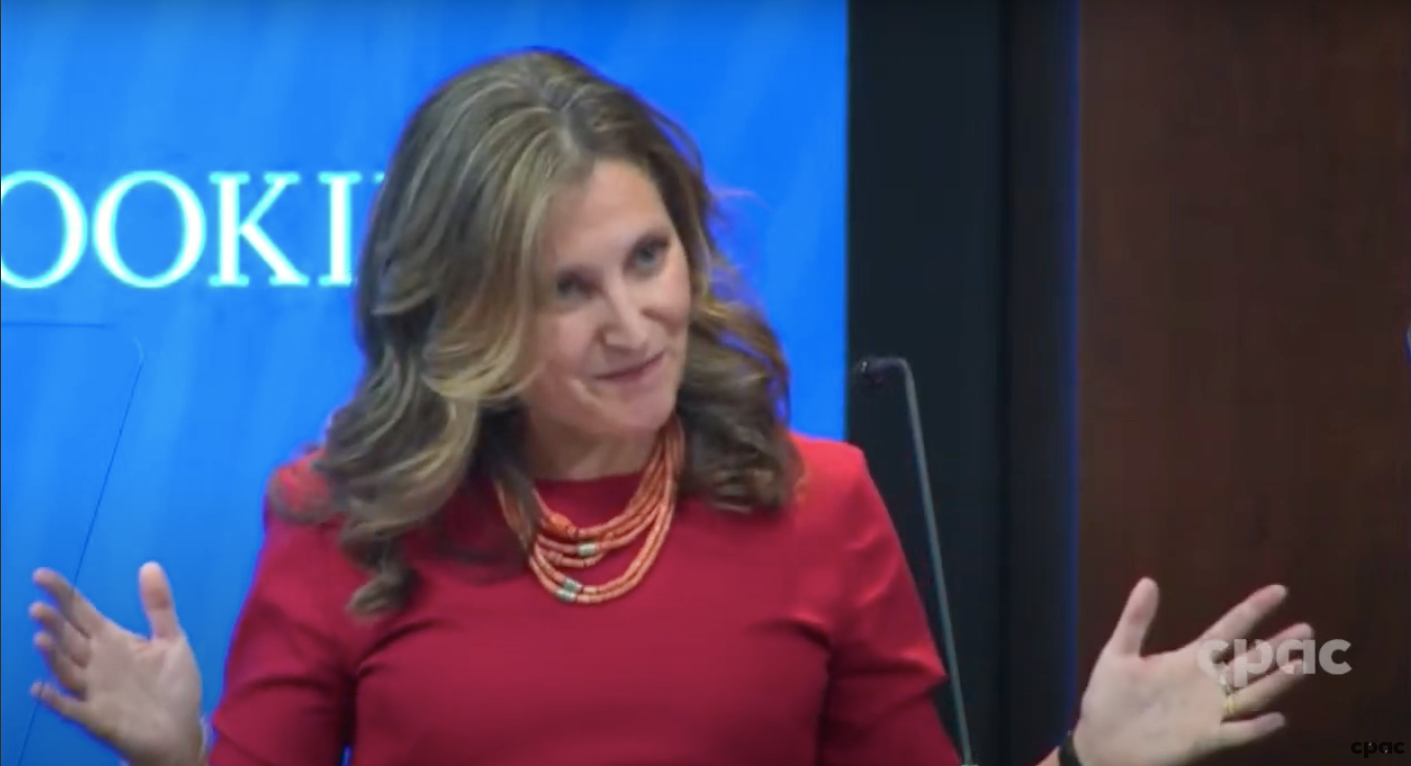
Screencap from a CPAC video of Chrystia Freeland speaking.
Monday
As a former journalist, I am fully aware of the awesome power of the press to distort and pervert reality. Here we all are in 2024 Canada. There is food. There is shelter. There is breathable air. The vast majority of us will go through the rest of the fiscal year without being stabbed on public transit.
And yet, to hear the misinformation and disinformation trafficked by the media, you would think we live in some kind of violent, economically depressed hellscape.
Well, this kind of mendacity has consequences: A nationwide hysteria of bad feelings and negative energy. A fanatical devotion to bad vibes in the face of all evidence to the contrary. I don’t purport to know how to cure such irrational malaise, but I will be very surprised if $250 each and some tax-free liquor and Christmas shopping doesn’t do it.
Tuesday
Donald Trump’s threat of 25 per cent tariffs is easily the most serious challenge I have faced as Canadian finance minister. The United States is our largest trading partner, and the suspension of free trade across our shared border would invite economic ruin the likes of which we’ve never seen.
Worse, Trump is immune to our usual strategies. We suggested sending his tariff threat to committee, or having it reviewed by a Crown inquiry, but neither offer was accepted. Rather, they want us to stem the tide of illegal migrants using Canada as a base to enter the United States. They are under the impression — let’s call it “bad vibes” — that this is a problem.
But let nobody say that the integrity of our trade flows are not my department’s top priority. As such, we are immediately introducing a one-time bursary of between $150 and $240 paid to any resident of Canada who can prove they have not attempted illegal entry of the United States within the past 12 months.
Retrofitting Aluminium Clamps | Paul Sellers
Paul Sellers
Published Jul 26, 2024Aluminium clamps are lightweight and ideal for 99% of woodworking.
I have tried almost all of them and been disappointed because they can look the same on the outside, but it’s the thickness of the walls of the box section that counts. This is how I retrofit all of my ‘U’ shaped rectangular bar sash clamps.
It takes only a few minutes to do each one, but what a difference it makes when you do. Lightweight but with great strength; once done, my clamps are up there with the best of the best.
(more…)
QotD: Recording and codifying the land that William conquered
[…]
In brief, Scott argues that the process of making a society “legible” to government officials obscures social reality, to the point where the government’s maps and charts and graphs take on a life of their own. It’s recursive, such that those well-intentioned schemes end up first measuring, then manipulating, the wrong thing in the wrong way, to the point that the social “problem” the process was supposed to address drops out entirely — all you have, at the end, is powerpoint girls critiquing spreadsheet boys because their spreadsheets don’t have enough animation, and vice versa.
Scott doesn’t use the Domesday Book as an example (IIRC from a graduate school class 20-odd years ago, anyway), but it’s one we’re probably all familiar with. The first thing William the Conqueror needed to know is: what, exactly, have I conquered? So he sent out the high-medieval version of spreadsheet boys to take a comprehensive survey of the kingdom. Turns out the Duke of Earl’s demense runs from this creek to that rock. He has five underlings, and their domains run from etc.
The point of all this, of course, was so that Billy C. could call the Duke of Earl on the carpet, point to the spreadsheet, and say “You owe me a cow, three chickens, and two months in the saddle as back taxes.” It worked great, except when — as, it seems, is inevitable — the high-medieval equivalent of the spreadsheet boys did the high-medieval version of “ctrl-c”; just copying and pasting the information over. Eventually the tax situation got way out of whack, as it did for most every pre-modern government running a similar system — one of the reasons declining Chinese dynasties had such fiscal problems, for instance, is that the tax surveys only got updated every two centuries or so, such that a major provincial lord was still only paying 20 silver pieces in taxes, when he should’ve been paying 20,000 (and his peasants were all paying 20 when all they could afford was 2).
In other words: unless the spreadsheet boys periodically go out and check that the numbers on their spreadsheets actually correspond in some systematic, more-or-less representative way to some underlying social reality, government policy is being set by make-believe.
Severian, “The Finger is Not the Moon”, Rotten Chestnuts, 2021-09-14.


