
Finally, Game of Thrones. I think it’s the same deal here, the same faux world weary cynicism. I’ve only seen one or two episodes of the show, but I read the first two or three books, up to the point where I realized two things: 1) he has no idea how he’s going to finish the story, and 2) it’s yet more tedious PoMo “deconstruction”.
Again, I guess I can forgive my colleagues, under-sexed little closet cases that they are, for being distracted by the boob cornucopia up on screen, but in the books, anyway, this comes through plain as day: Everyone in Westeros is either a psychopathic scumbag, or dead. In the very best PoMo style, the author is rubbing our faces in his belief that, since it’s extremely difficult to be heroic — or, all too often, merely decent — everyone who even thinks about trying is a fool, and deserves all the awful shit that happens to him. I’m told that back in the 18th century, a fun topic of debate at salons is whether a society of atheists could endure. Martin’s entire oeuvre seems dedicated to proving that life — mere, grubby, eating-shitting-sleeping existence — will continue in a society composed entirely of scumbags … but he has no idea why.
I have no idea why this idea (if that’s the right word) is so deeply appealing to academics, but evidently it is … and these are the people who are teaching your children.
Severian, “The One Pop Culture Thing”, Rotten Chestnuts, 2021-09-16.
December 7, 2024
QotD: Game of Thrones as PoMo “deconstructionism”
December 6, 2024
Victoria’s Canada through the eyes of British visitors
In UnHerd, Michael Ledger-Lomas considers what earlier British visitors to Canada after Confederation wrote about their experiences:
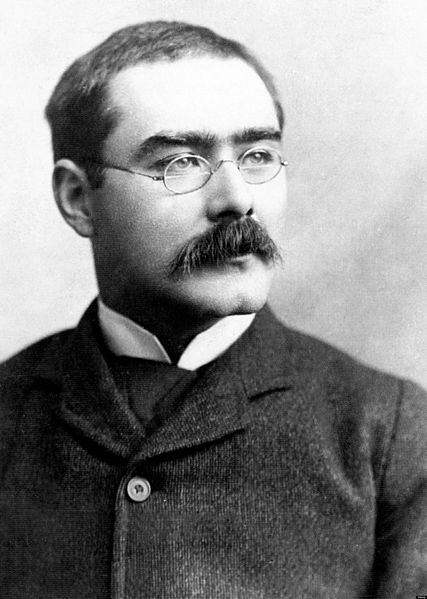
Portrait of Rudyard Kipling from the biography Rudyard Kipling by John Palmer, 1895.
Photo via Wikimedia Commons.
… The re-election of Donald Trump, who has already daydreamed about turning Canada into his 51st state, might even rekindle Tory patriotism. After all, their Victorian ancestors created the dominion of Canada in 1867 to keep British North America from the clutches of the United States.
A longer view shows that Canada has allured but also vexed British observers ever since its creation. The Edwardian era produced an especially rich crop of writings on Canada. In 1887, the year of Queen Victoria’s Golden Jubilee, the first train from Montreal pulled into Vancouver. This completion of the Canadian Pacific Railway (CPR) had persuaded the Crown colony of British Columbia to join in the new federation. In expanding Canada, the CPR also made it easier for British people to see the country. Having crossed from Liverpool to Montreal on a fast liner, they could visit most of its major cities, which were found on or near the railway.
Literary celebrities did so in enviable conditions. The CPR’s bosses loaned the poet Rudyard Kipling his own carriage in 1907, so he could travel in comfort and at his own speed. His impressions, which appeared in newspapers and then as Letters to the Family (1908), make for particularly resonant reading today. Although a man of strong prejudices, he had seen the country up close, rather than merely retweeting allegations about it, and was prepared to be surprised as well as disappointed by it.
Kipling’s contemporaries travelled with heavier and very different ideological baggage than we carry today. It was not wokery that worried them, but irreligion and greed, two poisons that had crept north from America. When the clergyman Hensley Henson steamed into Vancouver, in July 1909, he was horrified to see its beaches plastered with “vulgar advertisements”. The further [East] he travelled, the worse things became. The Anglican clergy were “weaklings” who made no dent on a materialistic society. Winnipeg was given over to “graft”. Young people in Ontario spoke like gum-chewing Yankees. Quebeckers were despoiling their province by setting up hydroelectric dams on its waterfalls.
Kipling did not share Henson’s churchy desire to scold his Canadian hosts. He was a cheerful freethinker who considered materialism a necessary part of nation-building. Canada had “big skies, and the big chances”: he admired its railway workers and lumberjacks for their insouciant and sometimes drunken swagger. Boom towns like Winnipeg excited him: he loved to see office blocks rise and streets flare with natural gas lamps; he lost considerable sums speculating on Vancouver real estate.
What worried him was rather Canada’s fading strategic commitment to the Empire. The modern Right understands Canada as a battleground for the values of “the West”. Kipling, who had married an American and lived for some years in Vermont, naturally believed in and did much to formulate the fervent if vague sense that English-speaking peoples share a civilisation. Yet this did not weaken his overriding concern for the political cohesion of the British Empire. Canada’s failure to join as enthusiastically in Britain’s recent war against the rebellious Dutch Boers of South Africa as he would have liked weighed on him — so much so that he kept calling the prairie the “veldt”. Kipling regarded the scepticism of Liberals and Socialists at home about whether the Empire offered value for money as a “blight”: now this “rot” seemed to be spreading like Bubonic plague, “with every steamer” to Canada.
The way to draw the dominion back to the motherland was to fill it with English settlers who shared his distaste for domestic Socialism. The dilution of English Canada worried Kipling. He allowed the Francophone Catholics of Quebec their differences — he found their basilicas romantic — but the policy of settling the prairies with hardy Slavs from the Habsburg and Russian Empires appalled him. These “beady-eyed, muddy-skinned, aproned women, with handkerchiefs on their heads and Oriental bundles in their hands” could never assimilate to English Canada. Nor did he care that many were fleeing oppression: people who renounce their country have “broken the rules of the game”.
Hegseth is clearly unfit to be Secretary of Defense because LOOK! A SQUIRREL!
I don’t recall having heard Pete Hegseth’s name before Trump nominated him to be the next Secretary of Defense, but Chris Bray clearly thinks the accusations are purely partisan:
Pete Hegseth is being Kavanaughed. And the only people dumb enough to fall for it are Republican senators.
I was willing to hear arguments that Hegseth wasn’t the best choice for Secretary of Defense. In his 40s, he’s on his third marriage, and while the rape allegation from his visit to a conservative conference in Monterey is clearly false, I was wide open to the argument that his actions demonstrated poor judgment. I was prepared to hear an argument. Like many combat veterans, Hegseth had some post-war chaos in his life. Discussion was merited.
But the more these arguments have been made, the dumber they’ve become. We’ve seen this play, and we know the third act: more heat, less light, the descent into completely irrational ranting.
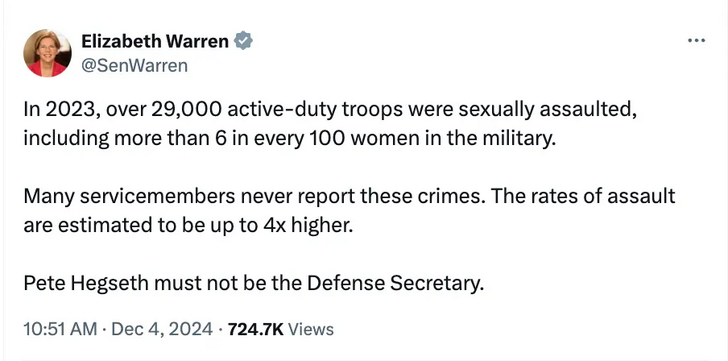
Let’s pretend to take this number at face value, for the sake of argument, though Warren is egregiously misrepresenting the estimate about unreported assaults. Let’s just look at the structure of the claim: In 2023, while Lloyd Austin was the Secretary of Defense, 29,000 troops were sexually assaulted. Therefore, Pete Hegseth must never become the Secretary of Defense.
This is the kind of argument people make when they’re piling on, in an atmosphere of hysteria. It has no logic or order to it, and it does the opposite of the thing it’s intended to do: It depicts current leadership as failures, while arguing against a course correction. Bob punched me in the face, which proves that John is very bad. This is currently the logical structure of half the “news”.
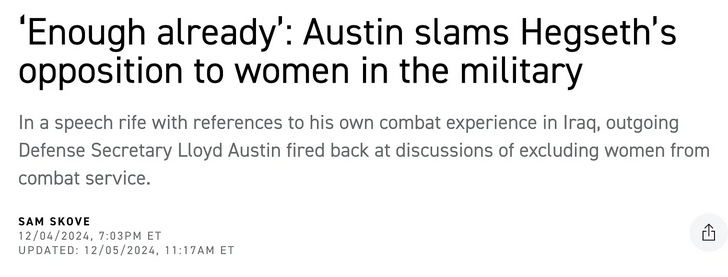
In another Martha-do-you-hear-yourself moment, Lloyd Austin himself recently attacked Hegseth for arguing that women shouldn’t serve in the combat arms:
But read this carefully, and look for the own-goal:
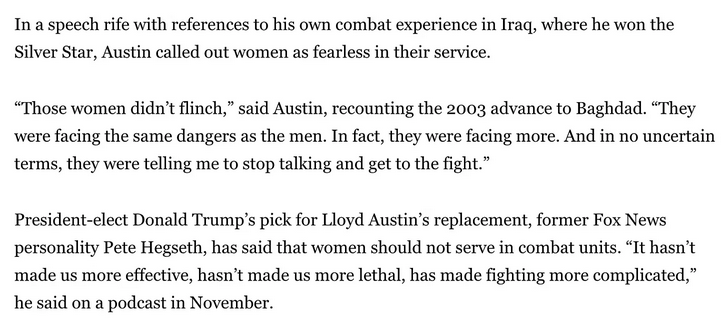
Women serving in combat are facing more danger than men, Austin said.
Therefore, women should serve in combat. Explain the logic, Lloyd. Amazingly, the journalist who reported Austin’s comments missed the implications, mindlessly typing up the claim that women in combat are in more danger than men, then — next paragraph! — framing that statement as a rebuke to someone who warned that the service of women in combat “made fighting more complicated.” We’re not discussing; we’re ritually lining up behind our teams.
Liberal cabinet minister accepts “free” Taylor Swift tickets
I’ve often joked that it isn’t surprising that politicians can be bought … what is surprising is just how little it can take. This situation isn’t quite as clear-cut as that, but it looks bad to everyone except Liberal Party insiders:
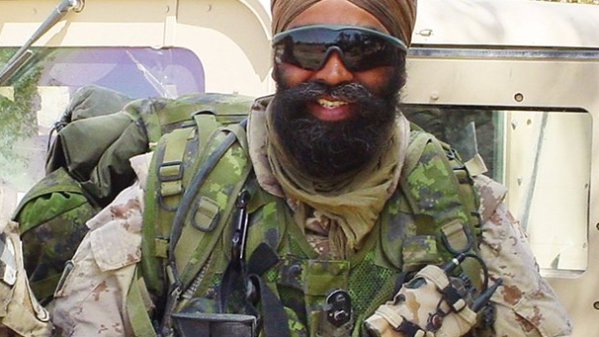
Former Canadian Defence Minister Harjit Sajjan in happier times (yeah, it’s the only picture I have of the minister).
On Tuesday we learned that federal Liberal cabinet minister Harjit Sajjan will be attending a Taylor Swift concert at BC Place in Vancouver, in a private suite, courtesy of PavCo, the Crown corporation that operates the stadium. The federal government partially funds PavCo, including $116 million earlier this year for improvements to the stadium in advance of the 2026 World Cup.
It’s a textbook conflict of interest. Open and shut. Dead to rights. So much for Sajjan’s political career. Only … not. The only people who seem to disagree that it’s a conflict are federal Liberals and, sorry to say, the office of the Conflict of Interest and Ethics Commissioner — because Sajjan donated $1,500 to a food bank as a gesture to compensate for the coveted opportunity.
“If an item is paid for through a charitable donation, then it would not be considered a gift,” a spokesperson for the commissioner said in response to questions from National Post. “In the case of Minister Sajjan, for example, the original market value of a ticket to a Taylor Swift concert in Vancouver was roughly $600.”
Where do we even begin with this nonsense?
PavCo offered private-box seats to various dignitaries on the understanding they would donate some appropriate amount of money to good causes. Sajjan says he’s proud to have participated.
But you can’t “pay for” a free concert ticket — to use the commissioner spokesperson’s term — by giving money to a food bank. That’s like The Keg offering you a free dinner so long as you pay for it at Montana’s … except food-bank donations, unlike steak dinners, come with tax receipts.
The Halifax Explosion | A Short Documentary | Fascinating Horror
Fascinating Horror
Published Feb 23, 2021“On the 6th of December 1917 two ships collided in the mouth of Halifax Harbour in Nova Scotia, Canada …”
► Suggestions: hello@fascinatinghorror.co.uk
MUSIC:
► “Glass Pond” by Public Memory#Documentary #History #TrueStories
QotD: Herbert Hoover in the Harding and Coolidge years
Hoover bungles it. He plays hard-to-get by pretending he doesn’t want the Presidency, but potential supporters interpret this as him just literally not wanting the Presidency. He refuses to identify as either a Democrat or Republican, intending to make a gesture of above-the-fray non-partisanship, but this prevents either party from rallying around him. Also, he might be the worst public speaker in the history of politics.
Warren D. Harding, a nondescript Senator from Ohio, wins the Republican nomination and the Presidency. Hoover follows his usual strategy of playing hard-to-get by proclaiming he doesn’t want any Cabinet positions. This time it works, but not well: Harding offers him Secretary of Commerce, widely considered a powerless “dud” position. Hoover accepts.
Harding is famous for promising “return to normalcy”, in particular a winding down of the massive expansion of government that marked WWI and the Wilson Administration. Hoover had a better idea – use the newly-muscular government to centralize and rationalize American In his first few years in Commerce – hitherto a meaningless portfolio for people who wanted to say vaguely pro-prosperity things and then go off and play golf – Hoover instituted/invented housing standards, traffic safety standards, industrial standards, zoning standards, standardized electrical sockets, standardized screws, standardized bricks, standardized boards, and standardized hundreds of other things. He founded the FAA to standardize air traffic, and the FCC to standardize communications. In order to learn how his standards were affecting the economy, he founded the NBER to standardize government statistics.
But that isn’t enough! He mediates a conflict between states over water rights to the Colorado River, even though that would normally be a Department of the Interior job. He solves railroad strikes, over the protests of the Department of Labor. “Much to the annoyance of the State Department, Hoover fielded his own foreign service.” He proposes to transfer 16 agencies from other Cabinet departments to the Department of Commerce, and when other Secretaries shot him down, he does all their jobs anyway. The press dub him “Secretary of Commerce and Undersecretary Of Everything Else”.
Hoover’s greatest political test comes when the market crashes in the Panic of 1921. The federal government has previously ignored these financial panics. Pre-Wilson, it was small and limited to its constitutional duties – plus nobody knows how to solve a financial panic anyway. Hoover jumps into action, calling a conference of top economists and moving forward large spending projects. More important, he is one of the first government officials to realize that financial panics have a psychological aspect, so he immediately puts out lots of press releases saying that economists agree everything is fine and the panic is definitely over. He takes the opportunity to write letters saying that Herbert Hoover has solved the financial panic and is a great guy, then sign President Harding’s name to them. Whether or not Hoover deserves credit, the panic is short and mild, and his reputation grows.
While everyone else obsesses over his recession-busting, Hoover’s own pet project is saving the Soviet Union. Several years of civil war, communism, and crop failure have produced mass famine. Most of the world refuses to help, angry that the USSR is refusing to pay Czarist Russia’s debts and also pretty peeved over the whole Communism thing. Hoover finds $20 million to spend on food aid for Russia, over everyone else’s objection […]
So passed the early 1920s. Warren Harding died of a stroke, and was succeeded by Vice-President “Silent Cal” Coolidge, a man famous for having no opinions and never talking. Coolidge won re-election easily in 1924. Hoover continued shepherding the economy (average incomes will rise 30% over his eight years in Commerce), but also works on promoting Hooverism, his political philosophy. It has grown from just “benevolent engineers oversee everything” to something kind of like a precursor modern neoliberalism:
Hoover’s plan amounted to a complete refit of America’s single gigantic plant, and a radical shift in Washington’s economic priorities. Newsmen were fascinated by is talk of a “third alternative” between “the unrestrained capitalism of Adam Smith” and the new strain of socialism rooting in Europe. Laissez-faire was finished, Hoover declared, pointing to antitrust laws and the growth of public utilities as evidence. Socialism, on the other hand, was a dead end, providing no stimulus to individual initiative, the engine of progress. The new Commerce Department was seeking what one reporter summarized as a balance between fairly intelligent business and intelligently fair government. If that were achieved, said Hoover, “we should have given a priceless gift to the twentieth century.”
Scott Alexander, “Book Review: Hoover”, Slate Star Codex, 2020-03-17.
December 5, 2024
Mélanie Joly in Halifax, demonstrated her belief that “communication” is much more important than “action”
In The Line, Matt Gurney continues his report from the recent Halifax International Security Forum, where the Trudeau government’s representatives were Foreign Affairs Minister Mélanie Joly and Bill Blair, the Minister of National Defence:

Whoo boy. Mélanie Joly has got to go. Now. Today, if possible. Because we’ve got problems enough without, uh, well … maybe I should just explain what happened.
Joly is, of course, our foreign affairs minister. She and Bill Blair, the national defence minister, constituted the “star power” the Trudeau government sent to the Halifax International Security Forum, which I attended late last month. Joly would have, no doubt, taken part in many direct meetings with allied counterparts and various stakeholders behind closed doors during the three-day event. I can’t tell you what happened there. I can tell you, though, what happened during her public, on the record appearances. One of them in particular. And I can tell you what happened after it.
It wasn’t good.
I covered a bit of the basics about the Forum itself — what it is, who funds it, who shows up — in my last column about this year’s event, so I’ll skip the recap this time. Except for this: the event schedule is divided up into on-the-record panel discussions, off-the-record sessions (generally, those are the more interesting ones), and just lots of slack time for networking and gabbing over coffee and routinely excellent food. Joly took part in two of the on-the-record sessions. In one, she gave introductory remarks. They were about what you’d expect. The other time, she was a panelist. And that’s the one where things went wrong for Joly.
Joly was on a panel titled “Era of Unity: Victory for Ukraine”, moderated by Russian political dissident and chess grandmaster (uh oh) Garry Kasparov. Kasparov can be an aggressive moderator, and he and Joly sparred about the value of the United Nations. (I’m more of Kasparov’s view on the value of the UN, to put it mildly, but Joly more or less held her own under his questioning.) Kasparov followed up with a question about tangible support by Canada for Ukraine. He set it up as a hypothetical — he alluded to the recent re-election of Donald Trump, and noted that there are many who’d be happy to sell out Ukraine to secure some kind of peace with Russia. “Will Canada step in … will Canada play a bigger role? Canada is an important country, as you said,” Kasparov put to Joly. “When you have free time from diplomatic victories at the United Nations,” he asked, a bit mockingly, “can you help Ukraine win?”
Oh dear, I thought. This could be bad.
And it was. And then it got worse.
To Kasparov’s specific question — would Canada help Ukraine win? Would Canada step up and do more? — Joly replied at length about how much she believes in defence. And collaboration. And working together with allies. And why we need an Arctic strategy. And the value of deterrence. And the need for a stronger security architecture in the Indo-Pacific. And then some stuff about North Korean missiles. And then a nice bit about Canada’s long friendship with Ukraine. And how Canada, even though we’re smaller than the U.S., will always advocate for Ukraine at the NATO table.
I haven’t quoted directly from what the minister said. I am conscious about not wanting this entire column to become long quotes. You can see the entire exchange between Kasparov and Joly here, starting at around the 37 minute mark. What I can tell you as someone who watched it in person was that there was a real vibe shift — see, I can talk about vibes, too! — in the room as Joly spoke. Kasparov had asked a straightforward question and he’d gotten an answer that seemed as if Joly was envisioning a globe in her head, and spinning it, and just commenting on everything that came to mind as a different region came into view. Oh! There’s the Indian Ocean! Say something about the Indo-Pacific!
It was bad. Everyone in the room knew it was bad, with the possible exception of Joly.
But Joly hadn’t hit bottom yet.
Ontario’s housing market squeezed by the 35.6% combined tax rate on new builds
The housing situation in Toronto and the rest of the province has been very tight for years. Lots of would-be buyers chasing the proportionally smaller number of new houses being built. This drives prices higher, but no matter how much of the final price is the builder’s profit margin, the government gets nearly four times as much on every new house sale:

The National Post previously reported that at least a third of a new home’s sticker price in Ontario was comprised of taxes, but an updated report, courtesy of the Canadian Centre for Economic Analysis (CANCEA), now puts the figure at 35.6 per cent.
(It gets even better when it comes to affordable housing — but more on that later.)
The Increasing Tax Burden on New Ontario Homes: 2024, which was commissioned by the Residential Construction Council of Ontario and released by CANCEA on Tuesday, is eye-opening for reasons beyond the fact that a compendium of largely superfluous taxes and production levies has reached 35.1 per cent of the final purchase price of a new home in the city of Toronto. It’s 35.5 per cent in the outlying 905 region, and 34.5 per cent in Ottawa.
The report needed only 16 pages to elucidate how bureaucratic machinations aren’t just gouging prospective homebuyers, but homeowners, too — especially the estimated 1.2 million whose mortgages, according to the Canada Mortgage and Housing Corporation, are due for renewal in 2025.
Read closely enough, CANCEA’s report makes a strong argument that, effectively, Canadians work for the government rather the other way around.
For example, CANCEA’s report demonstrates that 70 per cent of aforesaid taxes on new homes “consist of direct fees on the home, such as DC (development charges) and other fees”.
“For homes priced at $450,000,” which aligns with median income, “… the tax burden rises sharply to 45.2 per cent,” says the report, which also notes that economics often force developers to build smaller units that are insufficient for families.
We must always trust the experts, say the experts and their journalistic fart-catchers
Glenn Reynolds (aka the “Instapundit”) welcomes Nate Silver to the expert-doubting party:

Well. I was writing about this stuff long before Nate got hip. Back in 2017, just as Donald Trump began his first term, I wrote “The Suicide of Expertise”, by way of responding to Tom Nichols’ book, The Death of Expertise. Nichols’ thesis was that the experts were expert, but that ignorant, superstitious Americans rejected their advice out of insecurity and an unwillingness to be proven wrong. My response was that the experts’ actual track record wasn’t looking so good:
Well, it’s certainly true that the “experts” don’t have the kind of authority that they possessed in the decade or two following World War II. Back then, the experts had given us vaccines, antibiotics, jet airplanes, nuclear power and space flight. The idea that they might really know best seemed pretty plausible.
But it also seems pretty plausible that Americans might look back on the last 50 years and say, “What have experts done for us lately?” Not only have the experts failed to deliver on the moon bases and flying cars they promised back in the day, but their track record in general is looking a lot spottier than it was in, say, 1965.
It was the experts — characterized in terms of their self-image by David Halberstam in The Best and the Brightest — who brought us the twin debacles of the Vietnam War, which we lost, and the War On Poverty, where we spent trillions and certainly didn’t win. In both cases, confident assertions by highly credentialed authorities foundered upon reality, at a dramatic cost in blood and treasure. Mostly other people’s blood and treasure.
And these are not isolated failures. The history of government nutritional advice from the 1960s to the present is an appalling one: The advice of “experts” was frequently wrong, and sometimes bought-and-paid-for by special interests, but always delivered with an air of unchallengeable certainty …
On Syria, experts in Barack Obama’s administration produced a policy that led to countless deaths, millions of refugees flooding Europe, a new haven for Islamic terrorists, and the upending of established power relations in the mideast. In Libya, the experts urged a war, waged without the approval of Congress, to topple strongman Moammar Gadhafi, only to see — again — countless deaths, huge numbers of refugees and another haven for Islamist terror.
It was experts who brought us the housing bubble and the subprime crisis. It was experts who botched the Obamacare rollout. And, of course, the experts didn’t see Brexit coming, and seem to have responded mostly with injured pride and assaults on the intelligence of the electorate, rather than with constructive solutions.
And this was long before the experts’ ne plus ultra of failure, the bungled, dishonest, and downright self-serving response to the Covid pandemic. The pandemic stemmed from experts’ arrogance, in the form of illegal “gain of function” research funded by the U.S. and laundered through Chinese labs, was met with ass-covering “wet market” lies to try to conceal that origin, and then with public health measures, such as lockdowns and social distancing and masking rules, that were backed by no actual science at all, and that were cheerfully flouted by those propounding them whenever it suited their purposes. The final nail in the experts’ authority-coffin, though, was when, after all the lockdown hysteria, they approved massive public marches by Black Lives Matter because, we were told, racism was a public health problem.
Well, so are STDs, but they weren’t encouraging anyone to march against gonorrhea.
Rather they were (ab)using their position to promote the leftist cause du jour. Everyone saw through it, and their stock collapsed.
So. Welcome to the party, pal. Nate’s noticing just how far things have gone downhill.
Look at Life – The City’s for Living In (1968)
Classic Vehicle Channel
Published Apr 19, 2020Traffic was still an issue in the 60’s. Residents discuss how they can divert to traffic from the city. This film features great archive of city traffic in the late 60s
QotD: Oscar Wilde
H.L. Mencken, “Portrait of a Tragic Comedian”, The Smart Set, 1916-09.
December 4, 2024
Facing the Sphinx
Andrew Doyle provides a bit of historical context for the question currently convulsing Britain’s supreme court:

Bonaparte Before the Sphinx, 1886, by Jean-Léon Gérôme (1824–1904).
Painting from the Hearst Castle collection (Accession number 529-9-5092) via Wikimedia Commons.
It was known as the sphinx: a terrifying hybrid with a lion’s body and a human head. According to the legend, the sphinx was sent to guard the city of Thebes by the goddess Hera who wanted to punish the citizens for some ancient crime. It perched on a nearby mountain, and whenever anyone attempted to enter or leave the city it would pose a riddle. If the traveller failed to answer, he or she would be devoured, but the riddle was so confounding, so esoteric, so abstruse, that even the greatest intellectuals of the day soon found themselves reduced to snacks for the mighty sphinx.
And what was this riddle? What was the question that foxed even the sharpest of minds? It was simply: “what is a woman?”
And now, a hearing at the UK’s supreme court has taken place to solve the sphinx’s riddle once and for all. The campaign group For Women Scotland raised the case in order to challenge the Scottish government’s contention that the word “sex” in the Equality Act includes men who identify as female and hold a Gender Recognition Certificate. We can expect the results of this hearing over the next few months.
And yet I’m sure most of you are thinking to yourselves: “How will these judges possibly answer such a metaphysical conundrum?” And you’re not alone. Many valiant and learned individuals have fallen in the attempt.
[…]
Inevitably, activists tend to frame the entire question of “what is a woman?” as some kind of “gotcha”. Or they claim that to even broach the question of sex differences is “transphobic” and “hateful”, a means to bully the most marginalised. But of course, the transgender lobby wields incredible power in our society; it can see people silenced, harassed and even arrested for speaking truth, and all in the name of “progress”. Genuinely marginalised groups do not enjoy this kind of clout.
Others will say that all of this is a distraction from the “real issues”. But gender identity ideology has a deleterious impact on everyone, and has proved to be a major factor in political change. In its post-election analysis in November 2024, entitled “How Trump won, and how Harris lost”, the New York Times singled out an advertising campaign by Trump’s team which drew attention to Kamala Harris’s statement that all prison inmates identifying as transgender ought to have access to surgery. The tagline was: “Kamala is for they/them. President Trump is for you”.
Although the New York Times considered this a “seemingly obscure topic”, its writers were forced to admit its efficacy. Even Trump’s aides had been astonished at how popular the campaign had proven. According to the political action committee Future Forward, a group established to support the Democratic Party, this advertisement actuated a 2.7 point shift in favour of Trump among those who saw it. Inevitably, the New York Times misclassified the message as “anti-trans”, a ploy guaranteed to exacerbate the very resentment that made the campaign so effective in the first place.
To ask a politician the question “what is a woman?” isn’t some kind of cruel test. It’s a way to ensure that those in power are being honest with us. We know that they know the answer. And they know that we know that they know the answer. It isn’t that they can’t define it, it’s that they are too frightened to do so. It’s one thing for politicians to lie and hope they get away with it, but quite another for them to lie when they know that we are all fully aware that they are lying. It suggests a degree of contempt for the electorate that is unlikely to translate to success at the ballot box. And it hasn’t escaped the attention of feminists that the question “what is a man?” mysteriously never seems to be asked.
The Korean War Week 024 – Marines Attacked at Chosin Reservoir – December 3, 1950
The Korean War by Indy Neidell
Published 3 Dec 2024On and around the frozen waters of the Chosin Reservoir, the US Marines and the Chinese Communist forces fight out a brutal battle. In the west, the Chinese offensive continues. For the UN forces, there is no chance of victory, but living to fight another day may yet be possible.
Chapters
00:00 Intro
00:48 Recap
01:11 Chosin Reservoir Prelude
03:58 Yudam-ni
06:32 Task Force Faith
08:25 Hagaru
12:58 The Aftermath of Chosin
14:49 The Tokyo Conference
15:56 Wawon and Kunu-ri
20:30 Summary
20:42 Conclusion
(more…)
Admirals belatedly realize it might be useful to be able to reload those fancy missiles at sea
CDR Salamander has been banging this drum for a long, long time, but it appears that the US Navy is finally acknowledging that being able to reload the (many) Vertical Launch System (VLS) missile cells on ships somewhere other than a fully functional naval base would be more than a nice-to-have capability:

Reloading a VLS cell on a US Navy ship in port.
Photo attributed to defunct website defense-aerospace.com.
If you have made the horrible error of not reading every post here, over at the OG Blog and listening to every Midrats, then you may be new to the issue of being able to reload our warships’ VLS cells forward.
Slowly … a bit too slowly … Big Navy has decided that those people in the 1970s (who still remembered fighting a contested war at sea) might have been right all along. With SECNAV Del Toro’s encouragement, we continue to try to find a way to get the surface force a capability to reload forward.
There is plenty of room on the bandwagon and we’re glad to hoist everyone onboard the reload/rearm party-bus. If you need to catch up, the issue continues to break above the background noise, and WSJ has a very well produced article on it that requires your attention.
However, I got a little bit of an eye twitch at this pull-quote:
Until recently, the Navy didn’t feel much need for speed in rearming its biggest missile-firing warships. They only occasionally launched large numbers of Tomahawk cruise missiles or other pricey projectiles.
Now, Pentagon strategists worry that if fighting broke out in the western Pacific — potentially 5,000 miles from a secure Navy base — destroyers, cruisers and other big warships would run out of vital ammunition within days, or maybe hours.
Seeking to plug that supply gap, Del Toro tasked commanders and engineers with finding ways to reload the fleet’s launch systems at remote ports or even on the high seas. Otherwise, U.S. ships might need to sail back to bases in Hawaii or California to do so — putting them out of action for weeks.
Yes, I am going to do this, and you’re coming along for the ride.
In the name of great Neptune’s trident … THIS IS NOT A NEW REQUIREMENT!!!
My first “… shit, we need to be able to do this …” was during the DESERT FOX strikes against Iraq in 1998. I cannot remember if it were USS Stout (DDG 55) or USS Gonzalez (DDG 66) that we put Winchester on TLAM by the third day … but except for the ships we left on the other side of the Suez (who we would put to good use later), the rest of our TLAM ships and submarines were about done.
The fact we threw away an ability to reload/rearm forward was an old story inside the surface Navy when I picked it up in the last years of the previous century. We had a clunky erector set like contraption that was hard to use and took up VLS cell space, but instead of finding a better way, we just chunked the whole idea, slid in our Jesus Jones CD, and figured we had ownership of the seas until the crack of doom.
There is nothing “until recently” about this. Not to get off topic, but the real story here is why time and again this century’s senior leadership decided it was “too hard” or “too dangerous” while they were in full knowledge not just of the operational experience demanding this capability, but what we discovered over and over again in wargames.
The Disturbing Origins of Kellogg’s Corn Flakes
Tasting History with Max Miller
Published Jul 30, 2024A bowl of the original Corn Flakes made with only corn.
City/Region: Battle Creek, Michigan
Time Period: 1895Dr. John Kellogg was all about health, and when his brother, William (the financial brains of the operation), wanted to add sugar to the very bland original Corn Flakes, he flat out refused. Eventually, William bought the rights to Corn Flakes, changed the recipe, and the rest is history.
I don’t have the industrial rollers that the original recipe for Corn Flakes used, so I made a dough. The flakes turned out nice and crispy, but they are very bland. I would recommend using stone-ground cornmeal and adding some sugar and salt to make the whole process easier and the end product tastier.
Excerpt from Patent No. 558,393 [for] Flaked Cereals and Process of Preparing Same.
First. Soak the grain for some hours — say eight to twelve — in water at a temperature which is either between 40° and 60° Fahrenheit or 110° and 140° Fahrenheit, thus securing a preliminary digestion by aid of cerealin, a starch-digesting organic ferment contained in the hull of the grain or just beneath it. The temperature must be either so low or so high as to prevent actual fermentation while promoting the activity of the ferment. This digestion adds to the sweetness and flavor of the product.
Second. Cook the grain thoroughly. For this purpose it should be boiled in water for about an hour, and if steamed a longer time will be required. My process is distinctive in this step—that is to say, that the cooking is carried to the stage when all the starch is hydrated. If not thus thoroughly cooked, the product is unfit for digestion and practically worthless for immediate consumption.
Third. After steaming the grain is cooled and partially dried, then passed through cold rollers, from which it is removed by means of carefully-adjusted scrapers. The purpose of this process of rolling is to flatten the grain into extremely thin flakes in the shape of translucent films, whereby the bran covering (or the cellulose portions thereof) is disintegrated or broken into small particles, and the constituents of the grain are made readily accessible to the cooking process to which it is to be subsequently subjected and to the action of the digestive fluids when eaten.
Fourth. After rolling the compressed grain or flakes having been received upon suitable trays is subjected to a steaming process, whereby it is thoroughly cooked and is then baked or roasted in an oven until dry and crisp.
— John Harvey Kellogg. United States Patent Office, 1895


