
There is no more evanescent quality than modernity, a rather obvious or even banal observation whose import those who take pride in their own modernity nevertheless contrive to ignore. Having reached the pinnacle of human achievement by living in the present rather than in the past, they assume that nothing will change after them; and they also assume that the latest is the best. It is difficult to think of a shallower outlook.
Of course, in certain fields the latest is inclined to be best. For example, no one would wish to be treated surgically using the methods of Sir Astley Cooper: but if we want modern treatment, it is not because it is modern but because it better as gauged by pretty obvious criteria. If it were worse (as very occasionally it is), we should not want it, however modern it were.
Alas, the idea of progress has infected important spheres in which it has no proper application, particularly the arts. It is difficult to overestimate the damage that the gimcrack notion of teleology inhering in artistic endeavour has inflicted on all the arts, exemplified by the use of the term avant-garde: as if artists were, or ought to be, soldiers marching in unison to a predetermined destination. If I had the power to expunge a single expression from the vocabulary art criticism, it would be avant-garde.
Theodore Dalrymple, “Architectural Dystopia: A Book Review”, New English Review, 2018-10-04.
January 16, 2023
QotD: The avant-garde
January 15, 2023
One last dance for Davos?
Elizabeth Nickson on the “walls closing in” but this time it isn’t “on Trump”, but it might be “on the World Economic Forum” and their enablers:
Klaus and his gang were in full egomaniacal flight last week in Davos. I wonder how secretly scared they were, swanning around in their $30,000 Loro Piana topcoats dreaming of what … a nice quiet prison? Their liability for this latest attempt to escape the whirlwind through forced pharmaceuticals and the construction of the Biomedical Security State, must be dawning on them. It was always a possibility, but they figured the populace — thanks to their equally witless behaviourists — were so dumb they’d consent to being permanently damaged and think it was the fault of the extreme right. And climate change.
[…]
In Australia, the more Covid shots you’ve had, the more Covid you get and the more you die. The unvaccinated sail by relatively unperturbed.
Did you know that Big Pharma takes between $8 to $10 Trillion out of the US economy every year? GDP is only $23 Trillion. That’s a lot of money to claw back by every injured person, every family who lost a wage earner, a mother, a treasured child. This is a profit center for the great unwashed unmatched in human history. A massive transfer of wealth from the .01% to us.
They are all liable: every executive, every celebrity, every film producer, every hospital chief, every newspaper publisher, every television station owner, every multinational media company, every medical center, every university, every employer, every politician who forced and bullied people. Their wealth is about to become ours.


Time to Liberate Leningrad! – Ep 229 – January 14, 1944
World War Two
Published 14 Jan 2023Three Soviet Fronts launch major offensives to try and finally free Leningrad, under siege for nearly two and a half years now. The Soviets are, in fact, making attacks along most of the Eastern Front. In the South Pacific, the Allies step up their aerial assault to wreck Rabaul’s air power, thus neutralizing it as a base.
(more…)
“Zoomers and Millennials are further to the left to begin with and, more critically, don’t seem to be moving rightward as they age”
Andrew Sullivan on the significant leftward orientation of younger Millennials and Gen Z’ers which does not track to historical models of political belief:

“Millennials” by EpicTop10.com is licensed under CC BY 2.0

It’s dawning on many on the political center and right that the current younger generation in America is not like previous younger generations. They’re immaturing with age. Zoomers and Millennials are further to the left to begin with and, more critically, don’t seem to be moving rightward as they age. A recent, viral piece in the FT added a new spark to the conversation, arguing that if Millennials matured like previous generations, then by the age of 35, they
should be around five points less conservative than the national average, and can be relied upon to gradually become more conservative. In fact, they’re more like 15 points less conservative, and in both Britain and the US are by far the least conservative 35-year-olds in recorded history … millennials have developed different values to previous generations, shaped by experiences unique to them, and they do not feel conservatives share these.
And the key experiences, it seems to me, are: entering the job market in the wake of the financial crisis; being poorer than your parents when they were the same age; lacking access to affordable housing and childcare; growing up in a far more multiracial and multicultural world than anyone before them; seeing gay equality come to marriage and the military; experiencing the first black president and nearly the first woman; and the psychological and cultural impact of Trump and Brexit.
These are all 21st century phenomena — and simply not experienced by the generations immediately before them. Socially and culturally more diverse, the young are also understandably down on the catastrophic success of neoliberal economics. So of course they are going to be different. When it was their turn on the wealth escalator, it essentially stopped.
Sometimes we forget that these deep factors are what are most seriously in play. And the biggest mistake many of us on the center or right tend to make is assuming that all of the young’s stickier leftiness — especially the most irritating varieties of it — are entirely a function of woke brainwashing, and not related to genuinely unique challenges. A lot is — the indoctrination is real and relentless — but a lot isn’t. And it’s vital to distinguish the two.
The left’s advantage is that they have directly addressed this generation’s challenges, and the right simply hasn’t. The woke, however misguided, are addressing the inevitable cultural and social challenges of a majority-minority generation; and the socialists have long been addressing the soaring inequality that neoliberalism has created. Meanwhile, the right has too often ducked these substantive issues or rested on cheap culture-war populism as a diversionary response. I don’t believe that the young are inherently as left as they currently are. It’s just that the right hasn’t offered them an appealing enough alternative that is actually relevant to them.
That doesn’t mean cringe pandering. It means smarter policies. Some obvious options: encourage much more house-building with YIMBY-style deregulation; expand access to childcare for young, struggling families; tout entrepreneurial and scientific innovation to tackle climate change; expand maternity and paternity leave; redistribute wealth from the super-rich to working Americans to stabilize society and prevent capitalism from undoing itself; and, above all, celebrate a diverse society — and the unique individuals and interactions that make it so dynamic and life-giving.
How Lea & Perrins Makes Worcestershire Sauce Using A 185-Year-Old Recipe | Regional Eats
Food Insider
Published 25 Dec 2019We visited Lea & Perrins factory in Worcester to see how they produce their ever-popular Worcestershire sauce.
(more…)
QotD: The uncertain “certainties” of war in space
What I found most striking though was a relative confidence in how space battles would be waged in general, which I’ve seen both a little bit here in the comments and frequently more broadly in the hard-sci-fi community. The assumptions run very roughly that, without some form of magic-tech (like shields), space battles would be fought at extreme range, with devastating hyper-accurate weapons against which there could be no real defense, leading to relatively “thin-skinned” spacecraft. Evasion is typically dismissed as a possibility and with it smaller craft (like fighters) with potentially more favorable thrust-to-mass ratios. It’s actually handy for encapsulating this view of space combat that The Expanse essentially reproduces this model.
And, to be clear, I am not suggesting that this vision of future combat is wrong in any particular way. It may be right! But I find the relative confidence with which this model is often offered as more than a little bit misleading. The problem isn’t the model; it’s the false certainty with which it gets presented.
[…]
Coming back around to spaceships: if multiple national navies stocked with dozens of experts with decades of experience and training aren’t fully confident they know what a naval war in 2035 will look like, I find myself with sincere doubts that science fiction writers who are at best amateur engineers and military theorists have a good sense of what warfare in 2350 (much less the Grim Darkness of the Future Where There is Only War) will look like. This isn’t to trash on any given science fiction property mind you. At best, what someone right now can do is essentially game out, flow-chart style, probable fighting systems based on plausible technological systems, understanding that even small changes can radically change the picture. For just one example, consider the question “at what range can one space warship resolve an accurate target solution against another with the stealth systems and electronics warfare available?” Different answers to that question, predicated on different sensor, weapons and electronics warfare capabilities produce wildly different combat systems.
(As an aside: I am sure someone is already dashing down in the comments preparing to write “there is no stealth in space“. To a degree, that is true – the kind of Star Trek-esque cloaking device of complete invisibility is impossible in space, because a ship’s waste heat has to go somewhere and that is going to make the craft detectable. But detectable and detected are not the same: the sky is big, there are lots of sources of electromagnetic radiation in it. There are as yet undiscovered large asteroids in the solar-system; the idea of a ship designed to radiate waste heat away from enemies and pretend to be one more undocumented large rock (or escape notice entirely, since an enemy may not be able to track everything in the sky) long enough to escape detection or close to ideal range doesn’t seem outlandish to me. Likewise, once detected, the idea of a ship using something like chaff to introduce just enough noise into an opponent’s targeting system so that they can’t determine velocity and heading with enough precision to put a hit on target at 100,000 miles away doesn’t seem insane either. Or none of that might work, leading to extreme-range exchanges. Again, the question is all about the interaction of detection, targeting and counter-measure technology, which we can’t really predict at all.)
And that uncertainty attaches to almost every sort of technological interaction. Sensors and targeting against electronics warfare and stealth, but also missiles and projectiles against point-defense and CIWS, or any kind of weapon against armor (there is often an assumption, for instance, that armor is entirely useless against nuclear strikes, which is not the case) and on and on. Layered on top of that is what future technologies will even prove practical – if heat dissipation problems for lasers or capacitor limitations on railguns be solved problems, for instance. If we can’t quite be sure how known technologies will interact in an environment (our own planet’s seas) that we are intimately familiar with, we should be careful expressing confidence about how future technology will work in space. Consequently, while a science fiction setting can certainly generate a plausible model of future space combat, I think the certainty with which those models and their assumptions are sometimes presented is misplaced.
Bret Devereaux, “Fireside Friday: August 14th, 2020”, A Collection of Unmitigated Pedantry, 2020-08-14.
January 14, 2023
More on the Barnes & Noble turnaround
In the latest SHuSH newsletter, Ken Whyte looks at the Barnes & Noble recovery story (discussed a couple of weeks back):

“Barnes & Noble Book Store” by JeepersMedia is licensed under CC BY 2.0 
 .
.
Back in 2018, the bookselling chain was losing $18 million a year. It had just fired 1,800 full-time employees. About 150 stores had been closed, leaving the company with 600. It had lost its fourth CEO in five years, this one to a sexual-harassment charge. The firm’s big digital initiative, the Nook e-reader, was a flop. The share price was down 80 percent.
Not only was the business failing: it was demoralized. As the writer Ted Gioia noted in a recent newsletter, B&N had lost faith in the public’s willingness to buy books from anyone but Amazon. Its leadership “shifted a huge portion of its floorspace to peddling toys, greeting cards, calendars, and various tchotchkes”. It doubled down on in-store cafes and even tried launching freestanding Barnes & Noble restaurants.
Just when it seemed B&N was certain to follow the path of its former competitor, the Borders chain, which closed in 2011, it was purchased for $638 million (US) by Elliott Advisors, a hedge fund.
SHuSH has been skeptical about the record of hedge funds in the cultural space. We are also skeptical of hedge funds in the retail space where they have a well-established record of buying chains, slashing costs, and driving them into the ground: Sears, Toys R Us, Payless Shoes, Radio Shack, Aeropostale, Sports Authority, etc.
Elliott Advisors is an exception.
The UK based-firm has a demonstrated commitment to bookselling (at least in the medium term — more on this later). It bought the Waterstones chain in 2018. Waterstones and its 283 stores had been rescued from near-bankruptcy in 2011 by lifelong bookseller James Daunt and a Russian backer. Elliott kept Daunt at the helm and a year later bought Barnes & Noble and added this second chain to his responsibilities.
Daunt acknowledged that Barnes & Noble was in rough shape when acquired by Elliott. Its stores were “crucifyingly boring”. But he was confident the chain could be turned around. There was no template or magic ingredient, he said. It was a simple matter of “running really nice bookshops”. To that end, he gives his stores unusual autonomy to develop their own personalities and tailor their stock to the interests of their communities.
Barnes & Noble stores have since dropped most of their crap: they no longer look like big-box flea markets. They’ve quit accepting payments from the major publishers to put their books on display, a practice that brought B&N revenue but left publishers in charge of what customers saw when they walked into stores. Local managers now decide how their books are presented based on what they think will appeal to their customers.
The company used the COVID lockdown to freshen up its dowdy stores. Managers were instructed to take every single book off the shelves and “weed out the rubbish”. Walls were painted, aged carpet replaced, furnishings upgraded. The result is a much improved browsing experience. Readers like to browse.
There were hard decisions, too. Daunt cut the B&N head office staff in half and shed about 5,000 of 30,000 employees.
All in all, it worked. Last spring, The New York Times reported that sales were up and costs were down at Barnes & Noble and that “the same people who for decades saw the superchain as a supervillain are celebrating its success. In the past, the book-selling empire, with 600 outposts across all 50 states, was seen by many readers, writers and book lovers as strong-arming publishers and gobbling up independent stores in its quest for market share … Today, virtually the entire publishing industry is rooting for Barnes & Noble — including most independent booksellers. Its unique role in the book ecosystem, where it helps readers discover new titles and publishers stay invested in physical stores, makes it an essential anchor in a world upended by online sales and a much larger player: Amazon.”
There are not a lot of reliable financial numbers available on Barnes & Noble because it is no longer a public company, but it reports that its 2021 sales in were up 3 percent over pre-pandemic times. Most importantly, sales of books were up 14 percent.
Colonial History on the Mississippi River
Scenic Routes to the Past
Published 13 Jan 2023This video explores the surprising traces of French and American colonial history along the 150 miles of Mississippi River between St. Louis and Cairo, Illinois.
(more…)
Of course the Egyptologists would deny it – Great Pyramid conspiracy theories
At Astral Codex Ten, Scott Alexander looks at one of the persistent Great Pyramid conspiracy theories:

The Great Pyramid of Khufu (Cheops) in Giza, Egypt, the oldest of the Seven Wonders of the Ancient World.
Photo by Nian Aldin Thune via Wikimedia Commons.
Some conspiracy theories center on finding anomalies in a narrative. For example, Oswald couldn’t have shot Kennedy, because the bullet came from the wrong direction. Or: the Egyptians couldn’t have built the Pyramids, because they required XYZ advanced technology. I like these because they feel straightforwardly about styles of processing evidence
(Remember, I use the word “evidence” in a broad sense that includes bad evidence. By saying that some conspiracy theory has “evidence”, I’m not suggesting it’s justifiable, just that someone somewhere has asserted that they believe it for some particular reason. For example, someone might say they believe in alien abductions because of eyewitnesses who claim to have been abducted; I’ll be calling the eyewitnesses “evidence” without meaning to assert it is any good.)
Consider the pseudohistory claims I discuss in The Pyramid And The Garden. The Great Pyramid’s latitude in standard notation equals, to within seven decimal places, the speed of light in tens of millions of meters per second. In a strict sense, this is a one-in-a-million chance, although the post tries to explain why this might be less impressive than it sounds.
So the evidence in favor of “aliens who knew the speed of light built the Great Pyramid” is that it would explain this otherwise baffling coincidence. The evidence against is everything else we know about history, archaeology, architecture, and common sense. Why would superadvanced aliens have visited Earth, created one primitive stone structure, and left without doing anything else? Why does the Great Pyramid look so much like other Egyptian pyramids, and fit into our narrative of Egyptian history so well? What about marks on the Great Pyramid suggesting it was made with primitive tools? Et cetera.
You can sort of see how someone with weird evidence-processing styles might get this wrong. The fact on the right is compact, simple, and quantifiable (the two numbers match to about six digits, so it’s a one-in-a-million coincidence). The facts on the left are vague and holistic.
The mainstream archaeologist has to explain away the evidence on the right. Maybe “has to” is a strong phrase — they can just say “that’s weird, but the common sense evidence is so great that I choose to dismiss it as coincidence”. But it’s an awkward hole in their theory. I talk about how you might go about explaining it away here.
But the conspiracy theorist has to explain away the evidence on the left. This is a harder task. Sometimes you can just stretch a lot of things to make it work — I’ve seen people argue that the supposed mentions in Egyptian texts are less definitive than imagined. But one very strong explanation would be “archaeologists are so invested in protecting the mainstream narrative that they cover up all the evidence that would prove me right”, ie a conspiracy. This neatly sweeps aside a lot of the problem.

Star Megastar: Spain’s Massive 10mm Autopistol
Forgotten Weapons
Published 19 Sep 2022In the late 1980s, the Spanish gun maker Star decided to join the new hot trend of 10mm semiauto pistols. The cartridge was getting a lot of press, and Star saw this as an opportunity to ride the wave and also the get a pistol on the market that would attract IPSC competitors. Unlike some companies adapting existing .45ACP designs to 10mm, Star decided to start from scratch to build a pistol that was massive and durable; able to handle the power of the cartridge without any worries.
Star engineer Eduardo Zamacola (who had previously designed the M38/30/31 series for Star) had the first prototypes ready in 1990, in both 10mm Auto and .45 ACP. The design took cues from the Petter designs of France and SIG, with full-length internal slide rails and a removable modular fire control system. It offered 12 round capacity in .45 and 14 rounds in 10mm.
The pistol was quite massive and heavy (1.4kg / 3.1 lb), and failed to sell well from the start. The 10mm craze flared out rather quickly — it remains a niche cartridge to this day, despite periodic releases of new 10mm pistols (the SIG 320 in 10mm being the most recent). What really killed the Megastar, though, was the 1994 Assault Weapons Ban in the US. This prohibited new magazines holding more than 10 rounds, and the whole point of the bulk of the Megastar was to allow larger double-stack magazines. With those no longer available, there was really not much reason to get a Megastar instead of something like a 1911. In total, just 978 were made in 10mm and 5,424 in .45ACP, with production ending in 1995.
(more…)
QotD: What would it be like to always believe you’re right?
This is not because I’m such a humble guy. If anything, it’s the reverse — it’s because “being right” is such an important part of my self-concept that if I’m going to put my reputation on the line, I need to really BE right. And as we all know, 99% of being right comes from acknowledging all the times you were wrong. Admitting I don’t know when I really don’t know is painless. Admitting I was wrong when I thought I was right stings, but it doesn’t hurt nearly as bad as my own inner self-knowledge of being wrong. That really stings, and so I’d rather take the pain of admitting I was wrong any number of times to the much greater pain of actually being wrong on something fundamental.
To the Leftist, none of that computes. They’re always right. About everything. They literally can’t be wrong. And if what they were right about yesterday is 180 degrees from what they’re right about today, well, that’s just Reality reconfiguring itself. The Earth is stable; it’s the sun and stars that are moving around it. And if that leaves you with deferents and epicycles and retrograde motion and all that, well, so be it. See above, re: the physical impossibility of them being wrong …
… at least as individuals. But get them in a group, and all of a sudden a whole roomful of sort-of-Gods turns into a persecuted minority, even when everyone in the group agrees with everyone else. Even when the group, collectively, controls everything. If you think it’s bad in politics, y’all, go to a faculty meeting at the nearest college. To hear them tell it, the wolf is always at the door. Donald Trump and his jackbooted stormtroopers really are lurking behind every bush, waiting to jump out and pour bleach on them while yelling “This is MAGA country, bitch!” They’re afraid of their own students, because they just know those kids are out there thinking Unapproved Thoughts, and somehow those Unapproved Thoughts can physically harm them … even though they control the grade book, and can — and of course do — punish Unapproved Thought with extreme prejudice.
[…]
If I’m reading Zorost correctly, the answer might be as simple as: They can’t abstract, so they’re literally physically incapable of Reality-testing their heuristics. The Experts have given them the TORAH (that’s The One Right Answer, H8rz!), and since they can only evaluate individual cases as they come into view — they can only micro-focus on each parked car in the lot, to return to the earlier metaphor — they can’t draw the really-obvious-to-non-autists conclusion that they are not a persecuted minority, but in fact control everything.
Severian, “Why Are They Always Underdogs?”, Founding Questions, 2022-09-07.
January 13, 2023
“Forced teaming”
In Quillette, Jonathan Kay provides us with our new term of the week:

Two people at EuroPride 2019 in Vienna holding an LGBTQ+ pride rainbow flag featuring a design by Daniel Quasar; this variation of the rainbow flag was initially promoted as “Progress” a PRIDE Flag Reboot.
Photo by Bojan Cvetanović via Wikimedia Commons.
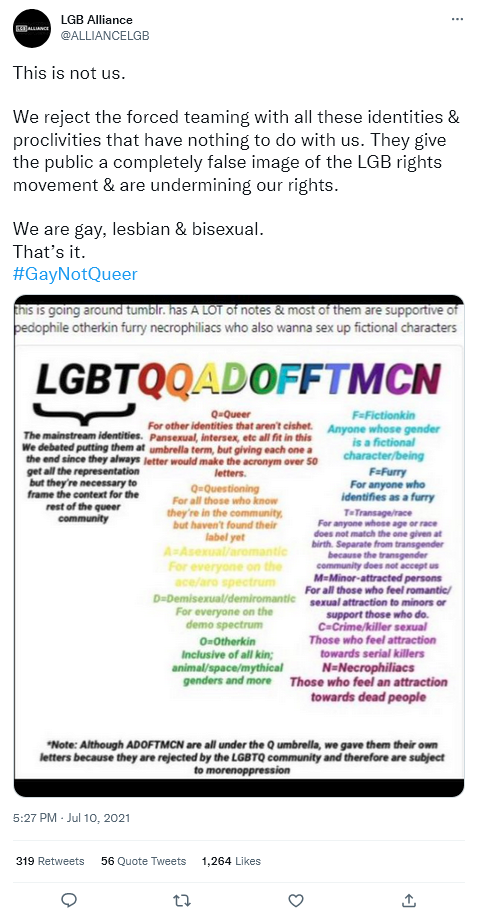
I learned a new term this week: “Forced teaming“. It describes what happens when a group of people — say, gay men and lesbian women — are forbidden from breaking ranks with some larger constituency, such as (in this case) the LGBT movement.
The example I’m discussing here is one that Quillette writers have been exploring for several years now. As author Allan Stratton noted last year, the central ideological fixation of many transgender-rights activists is the negation of biological sex as a meaningful marker of human identity. The true source of sexual attraction, they will insist, isn’t the reality of sexed male and female bodies; but rather an abstract gender spirit lodged within our souls, which somehow broadcasts itself in a way that prospective romantic partners are able to sense and interpret. As Stratton notes, this mythology isn’t just flagrantly wrong. It’s also homophobic to such extent that it denies the sexually defined nature of gay identity. Moreover, this homophobic element can’t be excised from gender ideology without fatally undercutting the (typically unspoken) mission of many biologically male trans activists, since giving up this claim “would be to admit that a lesbian isn’t going to be attracted to a male body, no matter how many times she is assured that the body in question belongs to someone who identifies as a woman.”
On Wednesday, Montreal-based Substacker Eliza Mondegreen provided an eyewitness report that helps illustrate what the “forced teaming” of ideologically non-compliant LGB men and women now looks like. The Centre for Human Rights and Legal Pluralism (CHRLP) at McGill University had planned to host a January 9th talk about the tension between sex and gender identity, to be delivered by Robert Wintemute, a professor of Human Rights Law at King’s College London. According to the event page, he was to discuss “whether or not the law should be changed to make it easier for a transgender individual to change their legal sex from their birth sex, and about exceptional situations, such as women-only spaces and sports, in which the individual’s birth sex should take priority over their gender identity, regardless of their legal sex.”
Though Wintemute seems the furthest thing from a bigot (or even a conservative), he is loathed by many trans activists due to what they see as an act of unforgivable apostasy. In 2006, Wintemute co-authored something called the “Yogyakarta Principles“, an international manifesto demanding that unfettered self-identification be recognized as the one and only means of distinguishing men from women. But he later recanted, declaring that “a key factor in my change of opinion has been listening to women”. Needless to say, many of Wintemute’s former activist friends then began treating him like Lord Voldemort. And Montreal’s Gazette newspaper, echoing such denunciations, darkly warned readers that the visiting human-rights professor had “ties to LGB Alliance, an advocacy group described by various LGBTQ2+ organizations and activists as a transphobic hate group”. (In truth, the LGB Alliance is simply a British charity that, as its name suggests, signal-boosts lesbian, gay, and bisexual individuals who believe that the interests of L, G, and B are now sometimes at cross-purposes with T.)
British feminists, who by now are well used to progressive mobs shutting down speaking events in the name of trans solidarity, may guess the rough contours of what happened next. A self-described “transfeminist sapphic activist” named Celeste Trianon compared Wintemute to a “cannibal”, and announced a protest, suggesting that followers should “bring out the pitchforks”.
Is the French Resistance Defeated by 1944? – War Against Humanity 095
World War Two
Published 12 Jan 2023While the Soviet Union declared they will annex parts of Poland, the Western Allies fear that the broken French Resistance may ruin the plans for D-Day.
(more…)
In a surprising bit of news, Canadian defence companies still don’t know what the government plans to acquire
On the CBC News website, Murray Brewster explains why Canadian defence industries haven’t gone to anything like a “war footing” because the federal government hasn’t told them what they plan to purchase or when, despite pleas that they “get with the program”:

The association representing Canada’s defence contractors says it’s going to take a lot more than talk to put the industry on a so-called “war footing.”
In a bluntly-worded opinion piece published online Wednesday, Christyn Cianfarani, executive director of the Canadian Association of Defence and Security Industries, said that Canada — unlike its allies — has not put in place a framework to ramp up production to meet the demand triggered by the Russian invasion of Ukraine.
Instead, Cianfarani wrote, the industry has heard “vague pleas” from the Liberal government “for companies to get with the program,” without any clear sense of which items of equipment are needed and what the long-term expectations might be.
“Canadian defence companies can and would step up if they knew exactly what, and how much, to step up with,” she wrote.
In an interview with CBC News last summer, Defence Minister Anita Anand described the enlistment of weapons manufacturers in the struggle to save Ukraine as a “moral imperative.” Gen. Wayne Eyre, the country’s top military commander, also publicly urged the defence industry to get on a “war footing” in response to the crisis.
“No one in industry has a clue what government will require from companies to achieve that end, or even what ‘wartime footing’ means to government in the modern context,” wrote Cianfarani, adding that the last time the country’s defence industry was on a war footing was during the Second World War.
“No firm will take vague exhortations to ‘increase their production lines’ seriously without meaningful and systematic commitment from the government. No respectable CEO is going to take the risk of ordering tens of millions of dollars worth of parts to then see them sitting on a shelf awaiting integration, while simultaneously telling investors to trust them that a buyer will materialize in this highly managed protectionist market.”
The greatest conspiracy in ancient art
BBC Reel
Published 7 Sep 2022Do we have a bias against colour in classical art?
Matt Wilson explores prejudices that have built up over centuries – leading to what has been labelled ‘chromophobia’, the subject of an exhibition at New York’s Metropolitan Museum of Art.
Wilson finds out why we don’t value colour, questioning a centuries-old misunderstanding. As Chroma’s curator Sarah Lepinski tells him: “It’s important that audiences come to understand the way they see ancient Greek and Roman sculpture isn’t the way it was first created.”
(more…)


