
Misogyny played no significant role whatever in Hillary Clinton’s two defeats as a presidential candidate. This claim is such a crock! What a gross exploitation of feminism — in the service of an unaccomplished woman whose entire career was spent attached to her husband’s coat tails. Hillary was handed job after job but produced no tangible results in any of them — except of course for her destabilization of North Africa during her rocky tenure as secretary of state. And for all her lip service to women and children, what program serving their needs did Hillary ever conceive and promote? She routinely signed on to other people’s programs or legislative bills but spent the bulk of her time in fundraising and networking for her own personal ambitions. Beyond that, I fail to see how authentic feminism can ever be ascribed to a woman who turned a blind eye to the victims of her husband’s serial abuse and workplace seductions. The hypocrisy of feminist leaders was on full display during the Monica Lewinsky scandal, which incontrovertibly demonstrated Bill Clinton’s gross violation of basic sexual harassment policy. Although I had voted for him twice, I was the only feminist at the time who publicly condemned Clinton for his squalid and unethical behavior with an intern whose life (it is now clear) he ruined. Gloria Steinem’s slick casuistry during that shocking episode did severe damage to feminism, from which it has never fully recovered.
Camille Paglia, “Prominent Democratic Feminist Camille Paglia Says Hillary Clinton ‘Exploits Feminism’”, Washington Free Beacon, 2017-05-15.
January 13, 2023
QotD: Hillary Clinton
January 12, 2023
Early royal “spares” in English history
Ed West considers the time-honoured Ottoman habit of strangling the new Sultan’s half-brothers on his accession to the throne and notes that after the practice was discontinued, many notables in the empire thought it also marked a down-turn in the quality of later Sultans. The British crown never had such a formal tradition, although brotherly love seems to have been in very short supply a thousand years ago:
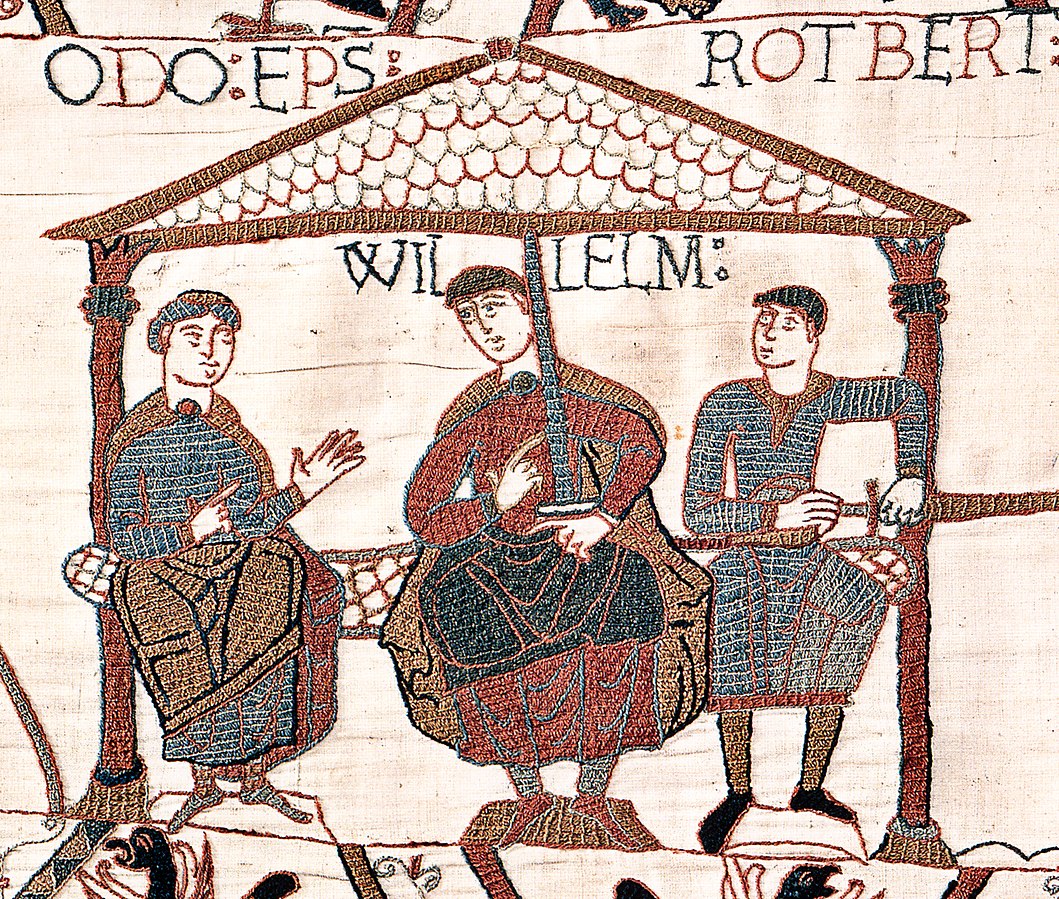
Panel from the Bayeux Tapestry – this one depicts Bishop Odo of Bayeux, Duke William, and Count Robert of Mortain.
Scan from Lucien Musset’s The Bayeux Tapestry via Wikimedia Commons.
Tales of royal brothers at war are a common theme, a staple of Norse sagas in particular, a recent example being the television series Vikings, and the brothers Ragnar and Rollo. William and Harry’s own family story in England begins with a tale told in one 14th century Icelandic saga, Hemings þáttr, which draws on older Norwegian stories to recall two royal brothers who became deadly rivals, Harold and Tostig.
Harold, as Earl of Wessex and the second most powerful man in England, had had his brother installed as Earl of Northumbria, where he had made himself immensely unpopular and provoked an uprising. When in 1065 Harold did a deal with the northerners to remove his sibling — presumably in exchange for the Northumbrians supporting his claim to the throne when the ailing King Edward passed away — Tostig fled abroad, embittered and determined to get revenge. Later accounts suggest that Harold and Tostig were rivals from an early age, one story having the young brothers fighting at the royal court as youngsters. Who knows, maybe Harold got the bigger room.
Tostig, now an exile, travelled around the North Sea looking for someone to help him invade England, finally finding his man with the terrifying Norwegian giant Harald Hardraada. Tostig had told all the Norwegians he was popular back home, but when they arrived in York they found that their English ally was in fact widely despised, and that not a single person came out to greet the former earl.
Tostig was killed soon after, in battle with his brother, having first (supposedly) exchanged words in this legendary meeting.
Harold himself would follow soon, victim of the English aristocracy’s great forefather William the Conqueror, whose success is illustrated by the naming patterns that followed. Harold’s brothers were Sweyn, Tostig, Gyrth, Leofwine and Wulfnoth; the Conqueror’s sons Robert, Richard, William and Henry. We haven’t had any Prince Wulfnoths recently.
The Conqueror’s son Richard having died in a hunting accident, the surviving Norman brothers had similarly fallen out, by one account the feud starting with a practical joke where William and Henry had poured a bucket of urine over eldest brother Robert. But mainly it was over land and power: after their father’s death Robert was made Duke of Normandy, the middle brother became William II of England, while Henry had to make do with just a cash payment.
Yet when William died in a mysterious hunting accident in the New Forest in 1100, Henry was conveniently close enough to reach the Treasury at Winchester within an hour to claim the crown. Six years later he invaded Normandy, with a partly English army, and captured his surviving brother, keeping Robert imprisoned for the rest of his life.
Henry I ruled for 35 years, but his long reign was followed by a civil war between his daughter Matilda and nephew Stephen, resulting in the rise of a new dynasty, the House of Anjou, or Plantagenets — so defined by internal conflict that Francis Bacon called them “a race much dipped in their own blood”.
Matilda’s husband Geoffrey Plantagenet had his brother Elias imprisoned, and Geoffrey’s son, King Henry II, had also gone to war with his younger brother, also Geoffrey. Even Geoffrey Plantagenet’s grandfather Fulk “the Quarreller” had spent over 30 years fighting for control of the county with his older brother, yet another Geoffrey.
Henry II in contrast fought his four sons and, after his death, his heir Richard I would also face rebellion from his younger brother John. When the Lionheart returned from crusade to deal with his deeply unlovable sibling he was remarkably forgiving, telling him: “Think no more of it, brother: you are but a child who has had evil counsellors.” This was despite John being 27 at the time.
More than two centuries later the House of Plantagenet came crashing down with a war pitting cousin against cousin, although brothers also fell out in the form of Edward IV and George, Duke of Clarence.
Both men were tall, blond and handsome, and both had a cruel and violent streak, but here the younger brother was impulsive, vain and foolish. He lacked maturity or self-control, was easily flattered and tempted into unwise decisions. He had been given vast estates and a lavish household but resented his older brother, who had also blocked his marriage to the daughter of the country’s largest landowner.
So Clarence had joined in the overthrow of Edward in 1470, while the youngest brother Richard, Duke of Gloucester, had remained loyal. However, when Edward returned to England the following March and Clarence led 4,000 men out to fight him, he was talked into changing sides again.
Clarence was forgiven, but the two brothers looked upon each other “with no very fraternal eyes”, and five years later he seems to have lost his mind after his wife died during childbirth. He accused the king of “necromancy” and of poisoning his subjects, and when brought before his brother made things much worse by claiming that Edward was a bastard. He was put to death.
Apparently, a soothsayer had also told King Edward that “G” would take his crown, and this must have fuelled his paranoia about George; after all, his other brother, the loyal Richard of Gloucester, would never do such a thing.
Such fraternal feuding ended with the rise of the Tudors and the conflicts between the House of Stuart and Parliament. There would be no more point in younger brothers threatening the monarch because the monarch no longer really had power; the royal family had evolved into a business, “the firm”, one in which hierarchies were clear and immovable, and the fortunes of family members were clearly joined.
The Early Emperors, Part 10 – The Year of the Four Emperors
seangabb
Published 27 Dec 2022This is a video record of a lecture given by Sean Gabb, in which he discusses the three Emperors who followed in swift succession between the fall of Nero and the accession of Vespasian — Galba, Otho, and Vitellius.
The Roman Empire was the last and the greatest of the ancient empires. It is the origin from which springs the history of Western Europe and those nations that descend from Western Europe.
(more…)
How the New York Times describes the Congressional Republican dissidents
It’s not the news, it’s the substitution of opinion for reporting:
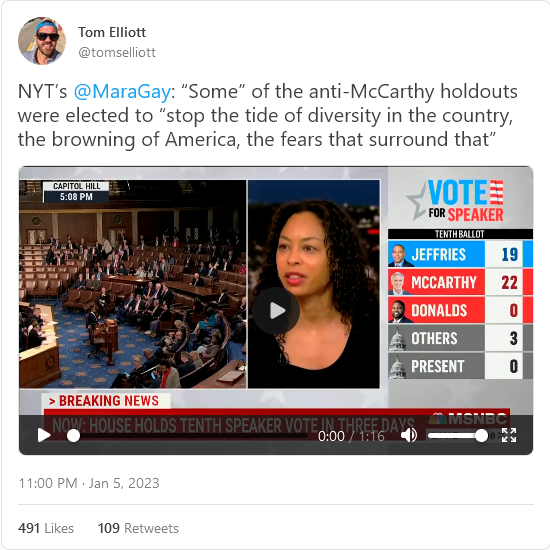
Here’s the political journalist Mara Gay — currently of the New York Times, formerly of the Wall Street Journal and The Atlantic — explaining what the twenty Republican holdouts were up to in their maneuvering over the selection of a Speaker of the House:
It’s leftie Twitter in human form, with all of the slogans. Angry, hateful voters, disturbed by “diversity”, sent some dumb atavists to represent them in D.C., because they hate government and want to “burn it to the ground”. (“And really, that’s what these people were sent to do.”)
Time magazine, which apparently still exists, comes to much the same conclusion, in a piece that I tragically can’t read in full without creating an account, which I wouldn’t do for a free steak dinner or a blanket future pardon from the governor of my choice:
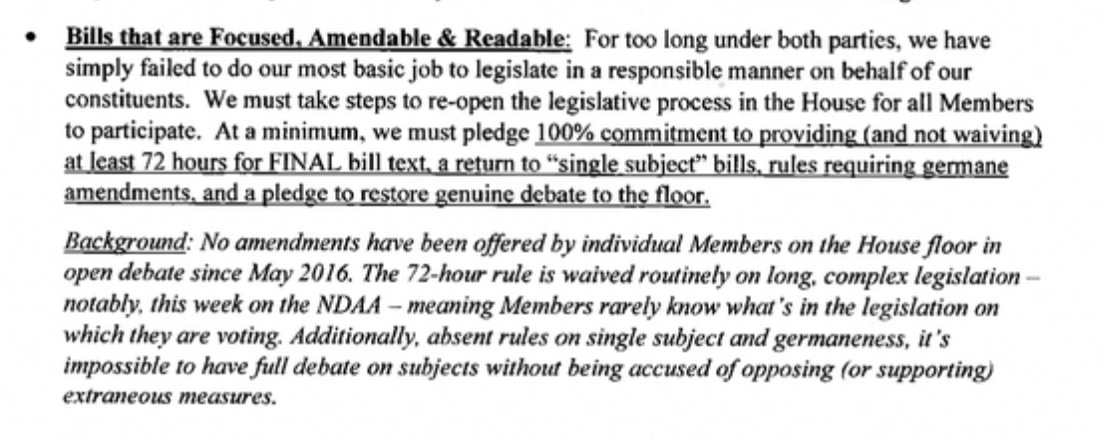
So the twenty GOP holdouts hate government and want to sow chaos and burn democratic norms to the ground, mainstream political journalists calmly explain. Now, via RedState, here’s a letter from seven of the holdouts listing their actual demands as conditions for their vote. Sample demand:
So the monsters who hate government and want to burn it all down were demanding clearly written legislation that every legislator has time to read and fully debate before casting their vote on it.
Subject of Journalism: We want bills that are focused and readable
Journalist: They want to destroy all government because of racism
It’s not even sort of an interpretation or an argument about the thing being discussed — it’s just a wholesale invention, completely severed from the thing that’s allegedly being analyzed. It’s like you ordered a tuna melt, so the waitress broke into your house and mailed your couch to Finland. “There’s your tuna melt,” she says, handing you the receipt from the post office. It’s so aggressive a non-sequitur that it would usually suggest the need for a neurology consult. Have you recently suffered a serious fall, Ms. Gay? Have you experienced dizziness or unexplained nause— oh, wait, I see from your chart that you’re just a political journalist.

Tank Chats #163 | Scorpion & Sabre | The Tank Museum
The Tank Museum
Published 9 Sep 2022In this episode of Tank Chats, David Fletcher details Scorpion and Sabre from the CVRT collection.
(more…)
QotD: Describing the CBC to Americans
an audience of any size has yet to be found
So far so CBC, then.
I’m not sure how to describe the CBC to American viewers. The BBC routinely produces content that’s quite entertaining (deliberately, I mean) so it’s not a good analogy. I suppose the best analog would be if NPR and PBS merged and were run by the CPUSA with $20 billion dollars of taxpayer money, and still managed to produce nothing anyone wanted to watch.
Daniel Ream, commenting on David Thompson, “The Giant Testicles Told Me”, DavidThompson, 2022-10-10.
January 11, 2023
“The PM and the public safety minister were lying to the public. That should matter.”
The editors of The Line regretfully return from holidays to start a new year, and the federal government’s gun confiscation bill (not called that, of course) gets both barrels:
The first item worth mentioning: remember how back in November and December the prime minister and the public safety minister, Messrs. Trudeau and Mendicino, were dismissing any suggestion that they were banning hunting rifles as hype? Or Conservation misinformation? When they were saying that the suggestions were false, and those making them were sowing confusion?
Well! Funny thing happened over the break. The PM, in his year-end interviews, is now admitting that the suggestions were, in fact, right.
Take this, for example, from his sit down with CTV News (our emphasis added):
“Our focus now is on saying okay, there are some guns, yes, that we’re going to have to take away from people who were using them to hunt,” Trudeau said. “But, we’re going to also make sure that you’re able to buy other guns from a long list of guns that are accepted that are fine for hunting, whether it’s rifles or shotguns. We’re not going at the right to hunt in this country. We are going at some of the guns used to do it that are too dangerous in other contexts.”
We’ll skip much analysis here. We think this is dumb policy, and we’ve explained why before, but it’s at least an acknowledgement of what their policy actually is, and very obviously was since the very time it was announced back in November. There’s no room for any confusion or doubt here. The Liberals spent weeks crying LIES! and MISINFORMATION! at people who were accurately describing what they were doing.
You can support the policy being proposed — again, we don’t, but that’s fine — but you can’t excuse this. The PM and the public safety minister were lying to the public. That should matter.
We’ll have more to say on this later. But for now, that’s the update: The Liberals now admit they’re trying to do the dumb thing they spent weeks insisting they weren’t doing.
This is, incredibly, a kind of progress.
Related somewhat to the above: a smart friend of The Line, who cannot be named as this stuff is their day job, told us weeks ago to watch for a schism in the NDP over this issue. For the Liberals, their dumb policy proposal still makes political sense. Well, it probably does — we have some suspicion that the LPC has maxed out the electoral utility of hammering on guns, and may now face more blowback than benefit, but time will tell. Still, the proposal may make sense for the Liberals: they are utterly dependent on urban and suburban women to survive, and the dumb gun proposal apparently resonates with them. And that’s true for part of the NDP’s base, too, but, critically, our friend reminded us, not for all of it.
The federal NDP of today is a strange creature. It’s partly very much a party of the deepest, wokest downtown ridings, but there’s also a big contingent of Dipper MPs from places like northern Ontario and rural parts of Manitoba and British Columbia. Cracking down on guns just plays differently there. When the policy was first announced, this division among NDP MPs didn’t take long to come into public view. Jagmeet Singh, himself very much of the NDP’s woke urban contingent, was quiet for a few days before very clearly and obviously pivoting to oppose the proposed expansion of the banned firearms. The Liberals can afford to write off their last remaining rural, non-urban MPs. The NDP simply can’t.
And, our friend told us — again, this was weeks ago, right at the outset — if Singh didn’t get the message pronto, the party would fracture over this … and that Wab Kinew, leader of the Manitoba NDP, would be the leader of the rebels.
We aren’t experts on Kinew, or in internal NDP power dynamics, so we simply thanked our friend for the tip and analysis, and assured them we’d keep an eye on it. And we did.
And wouldja look at that.
Interesting, eh?
Anyway. As of now the Liberals are still talking tough on the amendment. But they need at least one party to work with them to push it forward. We can’t say for sure, but we wonder if the Liberals are comfortable talking tough about it because they now accept they can’t push it forward — at least not any time soon. The Bloc seems wary of getting saddled with this and the NDP, indeed, might split over this issue if Singh were to try.
So we’ll keep watching this, and particularly Mr. Kinew, who may indeed covet Mr. Singh’s job.
To our friend: you were right. Thanks for the tip.

Al Capone’s Soup Kitchen
Tasting History with Max Miller
Published 10 Jan 2023
(more…)
“[T]o the ordinary American, those values [diversity, equity, and inclusion] sound virtuous and unobjectionable”
John Sailer writes in The Free Press on the rapid rise of the “diversity, equity, and inclusion” bureaucracy in American higher education:
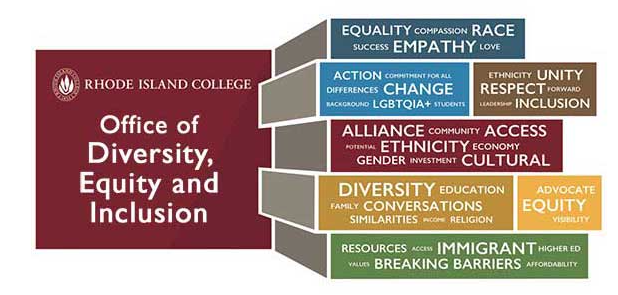
Graphic for Rhode Island College’s Office of Diversity, Equity and Inclusion.
The principles commonly known as “diversity, equity, and inclusion” (DEI) are meant to sound like a promise to provide welcome and opportunity to all on campus. And to the ordinary American, those values sound virtuous and unobjectionable.
But many working in academia increasingly understand that they instead imply a set of controversial political and social views. And that in order to advance in their careers, they must demonstrate fealty to vague and ever-expanding DEI demands and to the people who enforce them. Failing to comply, or expressing doubt or concern, means risking career ruin.
In a short time, DEI imperatives have spawned a growing bureaucracy that holds enormous power within universities. The ranks of DEI vice presidents, deans, and officers are ever-growing — Princeton has more than 70 administrators devoted to DEI; Ohio State has 132. They now take part in dictating things like hiring, promotion, tenure, and research funding.
More significantly, the concepts of DEI have become guiding principles in higher education, valued as equal to or even more important than the basic function of the university: the rigorous pursuit of truth. Summarizing its hiring practices, for example, UC Berkeley’s College of Engineering declared that “excellence in advancing equity and inclusion must be considered on par with excellence in research and teaching”. Likewise, in an article describing their “cultural change initiative”, several deans at Mount Sinai’s Icahn School of Medicine declared: “There is no priority in medical education that is more important than addressing and eliminating racism and bias.”
DEI has also become a priority for many of the organizations that accredit universities. Last year, the Council for Higher Education Accreditation, along with several other university accrediting bodies, adopted its own DEI statement, proclaiming that “the rich values of diversity, equity and inclusion are inextricably linked to quality assurance in higher education”. These accreditors, in turn, pressure universities and schools into adopting DEI measures.
Much of this happened by fiat, with little discussion. While interviewing more than two dozen professors for this article, I was told repeatedly that few within academia dare express their skepticism about DEI. Many professors who are privately critical of DEI declined to speak even anonymously for fear of professional consequences.
The Invention of DEI
How has this fundamental shift taken place? Gradually, then all at once.
For decades, university administrators have emphasized their commitment to racial diversity. In 1978, Supreme Court Justice Lewis Powell delivered the court’s opinion in Regents of the University of California v. Bakke, taking up the question of racial preferences in higher education. Powell argued that racial preferences in admissions — in other words, affirmative action — could be justified on the basis of diversity, broadly defined. Colleges and universities were happy to adopt his reasoning, and by the 1980s, diversity was a popular rallying cry among university administrators.
By the 2010s, as the number of college administrators ballooned, this commitment to diversity was often backed by bureaucracies that bore such titles as “Inclusive Excellence” or “Diversity and Belonging”. Around 2013, the University of California system — which governs six of the nation’s top 50 ranked universities — began to experiment with mandatory diversity statements in hiring. Diversity statements became a standard requirement in the system by the end of the decade. The University of Texas at Austin in 2018 published a University Diversity and Inclusion Action Plan, which began to embed diversity committees throughout the university.
Then came the Black Lives Matter demonstrations of 2020. The response on campus was a virtual Cambrian explosion of DEI policies. Any institution that hadn’t previously been on board was pressured to make large-scale commitments to DEI. Those already committed redoubled their efforts. UT Austin created a Strategic Plan for Faculty Diversity, Equity, and Inclusivity, calling for consideration of faculty members’ contributions to DEI when considering merit raises and promotion.
White Coats For Black Lives, a medical student organization that calls for the dismantling of prisons, police, capitalism, and patent law, successfully petitioned medical schools around the country to adopt similar plans, including at UNC–Chapel Hill, Oregon Health & Science University, and Columbia University. In some cases, administrators even asked White Coats For Black Lives members to help craft the new plans.
All at once, policies that previously seemed extreme — like DEI requirements for tenure and mandatory education in Critical Race Theory — became widespread.
Repurposing Obsolete Rifles: The Lebel R35 Carbine
Forgotten Weapons
Published 19 Dec 2017The French military had investigated the possibility of a Lebel carbine in the 1880s, but by the 1930s a different set of priorities was in place. In an effort to make some use of the vast stockpiles of obsolete Lebel rifles France had, a plan was put in place to shorten then into carbines for auxiliary troops like artillery crews and engineers. These men needed some sort of rifle or carbine, but they did not need the best and newest weapons. By giving them shortened Lebel carbines, it would free up more modern rifles like the M34 Berthiers in 7.5mm and the new MAS-36 rifles to go to the front line infantry who needed them most.
The R35 conversion was developed by the Tulle arsenal and adopted in January of 1936. The French government ordered 100,000 to be made, and deliveries began in April of 1937. Production would accelerate and continue right up to the spring of 1940, with a total of about 45,000 being actually delivered before the armistice with Germany. The conversions were all assembled at Tulle, but four other factories manufactured barrels for them: Chatellerault (MAC), St Etienne (MAS), Société Alsacienne de Constructions Mécaniques (SACM), and Manufacture d’Armes de Paris (MAP). These barrels were 450mm long (17.7 inches), and with the similarly shortened magazine tube, the R35 carbines held just 3 rounds. Production would not continue after the liberation of France in 1944.
(more…)
QotD: “Little” gods in the ancient world
That is not to say that these gods did not receive cult from the common folk. If you are a regular sailor on a merchant ship, some private devotion to Poseidon is in order; if you are a husband wishing for more children, some observance of Ishtar may help; if you are a farmer praying for rain, Jupiter may be your guy. But these are big gods, whose vast powers are unlimited in geographic scope and their right observance is, at least in part, a job for important people who act on behalf of the entire community. Such gods are necessarily somewhat distant and unapproachable; it may be difficult to get their attention for your particular issue.
Fortunately, the world is full up of smaller and more personal gods. The most pervasive of these are household gods – god associated with either the physical home, or the hearth (the fireplace), or the household/family as a social unit. The Romans had several of these, chiefly the Lares and Penates, two sets of gods who presided over the home. The Lares seem to have originally been hearth guardians associated with the family, while the Penates may have begun as the guardians of the house’s storeroom – an important place in an agricultural society! Such figures are common in other polytheisms too – the fantasy tropes of brownies, hobs, kobolds and the like began as similar household spirits, propitiated by the family for the services they provide.
(As an aside, the Lares and Penates provide an excellent example on how practice was valued more than belief or orthodoxy in ancient religion: when I say that they “seem” or “may have originally been”, that is because it was not entirely clear to the Romans, exactly what the distinction between the Lares and Penates were; ancient authors try to reconstruct exactly what the Penates are about from etymologies (e.g. Cic. De Natura Deorum 2.68) and don’t always agree! But of course, the exact origins of the Lares or the Penates didn’t matter so much as the power they held, how they ought to be appeased, and what they might do to you!)
Household gods also illuminate the distinctly communal nature of even smaller religious observances. The rituals in a Roman household for the Lares and Penates were carried out by the heads of the household (mostly the paterfamilias although the matron of the household had a significant role – at some point, we can talk about the hierarchy of Roman households, but now I just want to note that these two positions in the Roman family are not co-equal) on behalf of the entire family unit, which we should remember might well be multi-generational, including adult children with their own children – in just the same way that important magistrates (or in monarchies, the king or his delegates) might carry out rituals on behalf of the community as a whole.
There were other forms of little gods – gods of places, for instance. The distinction between a place and the god of that same place is often not strong – when Achilles enrages the god of the river Scamander (Iliad 20), the river itself rises up against him; both the river and the god share a name. The Romans cover many small gods under the idea of the genius (pronounced gen-e-us, with the “g” hard like the g in gadget); a genius might protect an individual or family […] or even a place (called a genius locus). Water spirits, governing bodies of water great and humble, are particularly common – the fifty Nereids of Greek practice, or the Germanic Nixe or Neck.
Other gods might not be particular to a place, but to a very specific activity, or even moment. Thus (these are all Roman examples) Arculus, the god of strongboxes, or Vagitanus who gives the newborn its first cry or Forculus, god of doors (distinct from Janus and Limentinus who oversaw thresholds and Cardea, who oversaw hinges). All of these are what I tend to call small gods: gods with small powers over small domains, because – just as there are hierarchies of humans, there are hierarchies of gods.
Fortunately for the practitioner, bargaining for the aid of these smaller gods was often quite a lot cheaper than the big ones. A Jupiter or Neptune might demand sacrifices in things like bulls or the dedication of grand temples – prohibitively expensive animals for any common Roman or Greek – but the Lares and Penates might be befriended with only a regular gift of grain or a libation of wine. A small treat, like a bowl of milk, is enough to propitiate a brownie. Many rituals to gods of small places amount to little more than acknowledging them and their authority, and paying the proper respect.
Bret Devereaux, “Collections: Practical Polytheism, Part IV: Little Gods and Big People”, A Collection of Unmitigated Pedantry, 2019-11-15.
January 10, 2023
Repent, wrongthinker!
Neeraja Deshpande outlines the demands of the College of Psychologists of Ontario to send heretic wrongthinker Jordan Peterson to the re-education camp:

Jordan Peterson speaking at an event in Dallas, Texas on 15 June, 2018.
Detail of a photo by Gage Skidmore via Wikimedia Commons.
Have you seen the “men will literally do X instead of going to therapy” meme? It’s funny: Men will literally join 10 improv teams instead of going to therapy. Men will literally teach you how to open a can of beans for 6 hours instead of going to therapy. You get the drift.
Canada’s most famous public intellectual, Jordan Peterson, brought that meme to real life this week when he announced he’d rather never work again than be forced onto the couch.
I don’t blame him.
The College of Psychologists of Ontario has told Peterson that if he doesn’t go to therapy — sorry, a board-mandated “Coaching Program” with a board-issued therapist — it may revoke his license to practice psychology.
What warranted this ultimatum? A few tweets and a podcast.
According to Peterson, about “a dozen people” from around the world complained to the college about comments he had made on Twitter and on Joe Rogan’s podcast, claiming that those statements had caused “harm”.
In March, the college began investigating these complaints. Then, in November, the college informed Peterson: “The comments at issue appear to undermine the public trust in the profession as a whole, and raise questions about your ability to carry out your responsibilities as a psychologist.”
Among those comments: Calling an advisor to Prime Minister Justin Trudeau a “prik”. Snarking at environmentalists for promoting energy policies that hurt children in developing countries. Using female pronouns in reference to the transgender actor Elliot Page. Declaring a plus-sized model on the cover of Sports Illustrated “not beautiful”. (This Wall Street Journal editorial has a good rundown.)
With perhaps one exception — a comment Peterson made calling a former, unnamed client “vindictive” — the public statements that triggered this whole affair are political snipes that have nothing to do with his capacity as a psychologist. Nevertheless, the College is demanding that Peterson not only go through a re-education program, but also that he sign off on the following statement: “I may have lacked professionalism in public statements and during a January 25, 2022 podcast appearance.”
Now, no one who has followed Peterson — presumably including the higher-ups at the College of Psychologists of Ontario — seriously believes he would agree to such a request. He has confirmed as much on Twitter. (This is a guy who burst onto the scene in 2016 after refusing to use gender-neutral pronouns.) And Peterson is famous enough at this point to be inoculated against the financial consequences of refusing to submit, which the college must know.
The college’s statement, then, is not a message to Peterson, but a message to other would-be dissenters: Comply with our politics, or risk losing your livelihood.
The Early Emperors, Part 9 – Nero: Can We Trust the Sources?
seangabb
Published 25 Dec 2022This is a video record of a lecture given by Sean Gabb, in which he discusses the reasons for the black reputation possessed by the Emperor Nero.
The Roman Empire was the last and the greatest of the ancient empires. It is the origin from which springs the history of Western Europe and those nations that descend from Western Europe.
(more…)
Persuading women not to have families because it “helps the GDP”
In The Critic, Niall Gooch stands up for family life despite the regular hand-wringing articles pointing out just how “expensive” children are and how much money women forego in the working world to take time off and have a family, as if no other economic decisions in life have opportunity costs attached:
Every so often, a publication called something like Bosses Quarterly or Money Patrol will report a new study investigating the financial costs of having children. “Average child now costs £200,000”, they breathlessly inform us, or perhaps “Women Who Become Mothers Lose £400,000 In Earnings Over Their Lifetime”.
I have no idea how they generate these figures. Presumably they have at least some basis in proper empirical research. It doesn’t seem inherently implausible that middle-class parents in Britain spend well into six figures on their children one way and another, when you factor in childcare, holidays, clothes, food, transportation, birthday parties and university attendance. Raising children is undoubtedly costly, from a financial perspective, even if you are frugal. If my wife and I did not have children, our lifestyle would be considerably more affluent than it is at present. The “motherhood penalty” in lifetime wages does seem to be a real phenomenon – although it is one that many women are willing to accept.
But the accuracy or otherwise of the calculations is beside the point. There is something profoundly wrong-headed about the whole endeavour of trying to evaluate the good of family life in economic terms, or to treat the raising of children as simply one option among many in the great lifestyle marketplace. And yet many people persist with doing so. Sam Freedman, the policy analyst and writer, claimed on Twitter earlier this week, in defence of expanding subsidies for nurseries, that “it’s a lot cheaper for one person to look after several children than each parent to look after their own and not work”. This person noted “the long term impact on (nearly always) women’s career prospects which has a big effect on GDP”. He also argued against replacing subsidies to nurseries with direct payments to parents, noting that “giving money direct to parents would encourage people to leave the workforce when we need the opposite to happen”.
Even on its own terms, this is dubious. Low birth rates are a significant drag on economic growth, and making it harder for women to spend more time at home with their children is hardly conducive to increasing the birth rate. Besides which, there are big socio-economic problems connected to the modern norm of two parents working more or less full-time — house-price inflation for example, or the decline of communal organisations and lack of time for family caring responsibilities.
Catherine the Great & the Volga Germans
Tasting History with Max Miller
Published 16 Aug 2022
(more…)


