Quotulatiousness

August 12, 2020

Defending Sir John A.

In his latest post for The Dominion, Ben Woodfinden attempt to defend that horrible racist, sexist, homophobe, transphobe, non-intersectional, dead, white, cis-gendered male monster, Sir John A. Macdonald:
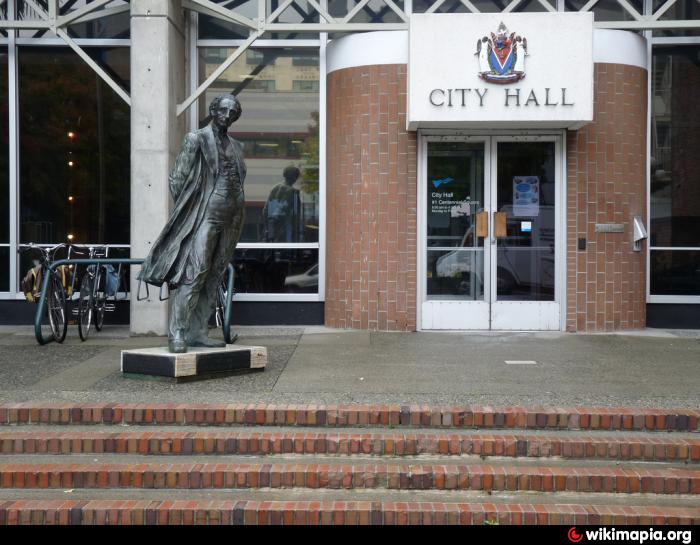
Statue of Sir John A. Macdonald that formerly stood in front of City Hall in Victoria, British Columbia.
Wikimedia Commons.

The way you’re supposed to begin a piece like this is with a sort of penitential act. I should begin a discussion of Sir John A. Macdonald with a confession of his various sins and crimes, before offering an apology, and a reluctant defence of our first prime minister that essentially boils down to “history matters,” without actually explaining what that history is or why it matters.

If you do this you’ve already lost the historical fight, because you’ve willingly ceded the narrative to Macdonald’s detractors, and fallen back to a defence of history in some abstract sense, instead of a defence of Macdonald himself. This kind of Girondin impulse is far too common amongst many liberals and conservatives now, especially in elites institutions and fields like journalism and academia.

[…]

No one, including me, claims that Macdonald was a saint, and Canada’s treatment of Indigenous people and migrants in the early days of Confederation was racist, and wrong. I doubt any serious person would deny this. But even on these questions, Macdonald’s record is complex. Tristin Hopper, wrote an excellent and accessible piece in the National Post simultaneously laying out both the bad things Macdonald was responsible for, and also Macdonald’s paradoxically ahead of his times views on Indigenous voting rights, and recognition of the terrible plight of Indigenous peoples.

But this is only part of the story of Macdonald, and the crucial role he played in our history. Too often this is all that gets discussed, ceding the narrative to Macdonald’s detractors and dooming him to inevitable damnatio memoriae. This is why, in the name of defending our history, we cannot simply defend capital H History, we have to defend the substance of our actual history.

Macdonald’s central role as the key architect of Confederation, and our country, is not well known because Canadian history, especially the history that led to confederation, is not well known by Canadians. It’s a national embarrassment, and in this vacuum it is easy to build incomplete and partial narratives about what Canada is and what Canada means.

Macdonald is best described as “the indispensable politician.” Confederation was not inevitable, it took adept figures like Macdonald to make it happen. Macdonald was not an ideologue, and his political career was defined by his masterful ability to forge coalitions and working compromises between seemingly intractable groups. He was an important political figure in the United Province of Canada (the union of Upper and Lower Canada), and proved adept at balancing and forging coalitions with the warring and disparate factions from Upper and Lower Canada forced into an uncomfortable union. He resisted, but worked and ultimately partnered with uncompromising reformers in the province like George Brown, while ultimately laying the groundworks for constitutional reform that Brown, though principled, could almost certainly never have achieved.


I Bet You Don’t Know At Least ONE Of These Blue Tape Tricks

Filed under: Woodworking — Tags: — Nicholas @ 02:00

Inspire Woodcraft
Published 29 Jan 2019

What CAN”T this stuff be used for? Today we’re talking thirteen ways to make blue painters tape do more work for you in the shop.

TOOLS SPECIFIC TO THIS VIDEO:
My Favorite Blue Tape (Single Roll)- https://amzn.to/3e5GFc6
Blue Tape SIX-PACK (I personally buy it like this because it’s less expensive overall)- https://amzn.to/2Rcja7i

ALL MY HAND TOOLS, POWER TOOLS, CAMERA GEAR AND MORE:
https://www.amazon.com/shop/inspirewo…

QotD: The circle of recycled life

Filed under: Business, Economics, Environment, Quotations, USA — Tags: , — Nicholas @ 01:00

1. Somewhere in this great land, a concerned and responsible corporation is having their twice-weekly colorful and compelling advertising supplement printed on 100% recycled paper.

2. As soon as they are completed millions of these colorful and compelling 100% recyclable advertising supplements are shipped by truck to the various regional receiving centers of the U.S. Post Office.

3. From those centers, any number of allocated pallets of these colorful and compelling 100% recyclable advertising supplements are broken out, put on U.S. Post Office trucks and delivered to local postal carrier destinations inside northern California.

4. My personal Paradise postal carrier and hundreds of others report for work at local postal carrier centers throughout northern California and load up their vans with enough of these colorful and compelling 100% recyclable advertising supplements to deliver one or more to each and every house on their route.

5. My very polite personal Paradise postal carrier parks her van at the end of my block and loads her sack with these colorful and compelling 100% recyclable advertising supplements.

6. She comes up my walk, up the porch stairs, and deposits my full share of these colorful and compelling 100% recyclable advertising supplements into my mailbox with a clang every day between one and three in the afternoon.

7. Hearing the clang I sigh and wend my weary way to the front door and open my mailbox and pluck out said colorful and compelling 100% recyclable advertising supplements.

8. With a heavier sigh I go back in, trudge through my house, out my back door to the alley, and place the colorful and compelling 100% recyclable advertising supplements into my Recycling bin with the rest of the week’s mound.

9. Tomorrow the huge, lumbering Paradise Waste Management Recycling garbage truck will stop and empty my Recycling bin into its maw and haul all the colorful and compelling 100% recyclable advertising supplements off to the Chico California Recycling and Brand New Mountain of Garbage center.

10. The collected colorful and compelling 100% recyclable advertising supplements will then be shipped, by truck, to the center for turning recyclable paper into … recycled paper which will then be used by a concerned and responsible corporation for their twice-weekly colorful and compelling advertising supplements printed on 100% recycled paper.

Wash. Rinse. Repeat. Next year, as sure as spring brings septic system failures to Paradise, postage will increase because the U.S. Postal Colorful and compelling 100% recyclable advertising supplements “Service” will need more money to keep The Recycled Circle of life going.

Gerard VanderLeun, “The Circle of Recycled Life”, American Digest, 2018-06-01.

August 11, 2020

The Vanishing Aral Sea

The History Guy: History Deserves to Be Remembered
Published 22 May 2017

The History Guy examines the Aral Sea and the confluence of geography and history.

The History Guy uses images that are in the Public Domain. As photographs of actual events are often not available, I will sometimes use photographs of similar events or objects for illustration.

Patreon: https://www.patreon.com/TheHistoryGuy

The History Guy: Five Minutes of History is the place to find short snippets of forgotten history from five to fifteen minutes long. If you like history too, this is the channel for you.

Awesome The History Guy merchandise is available at:
teespring.com/stores/the-history-guy

The episode is intended for educational purposes. All events are presented in historical context.

#history #thehistoryguy #worldhistory

David Warren offers an unusually contrarian view of the Bronze Age collapse

Filed under: History, Humour, Middle East, Science — Tags: , , , , , — Nicholas @ 05:00

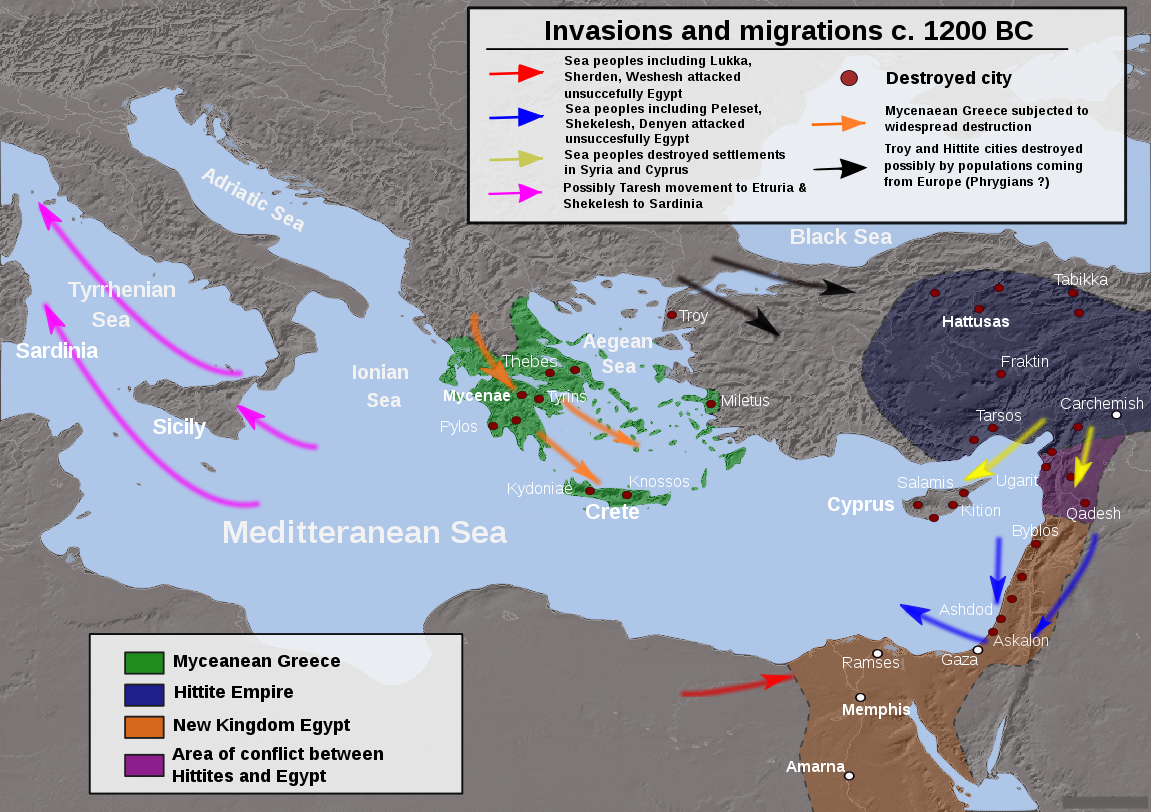
Sea Peoples? Faugh, Mr. Warren isn’t buying any of that old rope. It wasn’t earthquakes, famine, plagues, or even multiple waves of heavily armed undocumented immigrants landing on the shores … it was mere “progress”:

Migrations, invasions and destructions during the end of the Bronze Age (c. 1200 BC), based on public domain information from DEMIS Mapserver.
Map by Alexikoua via Wikimedia Commons.

When did the Bronze Age end, and the Iron Age begin? The ages of plastic, silicon, and graphene may have succeeded even the latter, but I’m still not comfortable with iron. Neither were the Cypriots, nor the Egyptians, incidentally — some thirty-something centuries back. Before even that, iron was freely available in a globalized world. I once took a modified fishing boat from Cyprus to Mersin; I wouldn’t encourage swimming it. But the voyage is not far, and too quick with a motor. Even in a row boat, it would have been easy to smuggle ferrous materials, either way.

Yet for centuries, such “highly sophisticated” societies as those of Cyprus and Egypt, stuck with copper and bronze; with gold and silver adornments. The rest of the world might have been with the progressive agenda, but they were not. I speculate that they didn’t like the way iron rusts; there’s something cheap about it. But whatever the objection, they stood their ground. There are old iron objects to be found in both places, but few.

Much later, when the “lifestyle” advocates for the new fashionable metal had won out, and the tide of iron was flooding, it is interesting that the craftsmanship of objects is relaxed. Even ceramics become dull, boring, repetitious; skills are forgotten. We have craftsmen who obviously don’t give a damn any more, just like today. We have the encroaching realm of “productivity,” quantity. Soon these places are easy to knock over, by the conquering savages always lurking about.

We have conservative societies, overwhelmed by technology; and no longer trading on their own terms. In the larger Minoan sphere, we have barbarization. Dynastic Egypt will survive only in Coptic fragments. Greeks, Romans, and finally Arabs will be trashing the place. Ancient civilizations fall.

I regret “progress.” We should resist it heart and soul.

Egypt’s Colonial and Zionist Troubles | The Suez Crisis | Prelude 1

TimeGhost History
Published 10 Aug 2020

Recently independent Egypt, under President Gamal Abdel Nasser, navigates the turbulent waters of the Cold War, seeking national autonomy, while negotiating its relations with the British Empire, United States, and the Soviet Union. The question is, how will Egypt realize its self-determination with these powers vying for dominance in the region?

Join us on Patreon: https://www.patreon.com/TimeGhostHistory

Hosted by: Indy Neidell
Written by: Joram Appel and Francis van Berkel
Director: Astrid Deinhard
Producers: Astrid Deinhard and Spartacus Olsson
Executive Producers: Astrid Deinhard, Indy Neidell, Spartacus Olsson, Bodo Rittenauer
Creative Producer: Joram Appel
Post-Production Director: Wieke Kapteijns
Research by: Joram Appel
Image Research: Ian Irungu, Shaun Harrison & Karolina Dołęga
Edited by: Karolina Dołęga
Sound design: Marek Kamiński

Colorizations:
Mikolaj Uchman

Visual Sources:
National Archives NARA
Library of Congress Geography and Maps Department
Tropenmuseum
Wellcome Images
National Army Museum of New Zealand
Imperial War Museum: HU70788,
National Photo Collection of Israel
Fortepan – ID 32790
Bibliotheca Alexandrina

Music:
“Descending Mount Everest” – Trailer Worx
“Dreamless Nights” – The New Fools
“March Of The Brave 10” – Rannar Sillard
“Break Free” – Fabien Tell
“The Unexplored” – Philip Ayers
“It’s Not a Game” – Philip Ayers
“Foreign Signs” – Philip Ayers

Archive by Screenocean/Reuters https://www.screenocean.com.

A TimeGhost chronological documentary produced by OnLion Entertainment GmbH.

From the comments:

TimeGhost History
1 hour ago (edited)
Welcome to the first episode of our series on the Suez Crisis! It’s a 7-episode wild ride through secretive international collusion, clashing nations, and imperial anxieties. It’s a watershed moment in a variety of entangled histories: decolonization, the Arab-Israel Conflict, the rise of America as a superpower, the growing power of the UN, and much much more. It’s a lot to take in, but we hope that we’ve made this series as digestible (and enjoyable!) as possible. Thanks to our TimeGhost Army members for choosing this series. Want to be part of the effort that makes stuff like this happen? Join us at patreon.com/timeghosthistory or https://timeghost.tv.

Cheers,

Francis.

Orwell’s “Notes on Nationalism”

Filed under: Books, Britain, History, Media, Politics, WW2 — Tags: , , , , , , — Nicholas @ 03:00

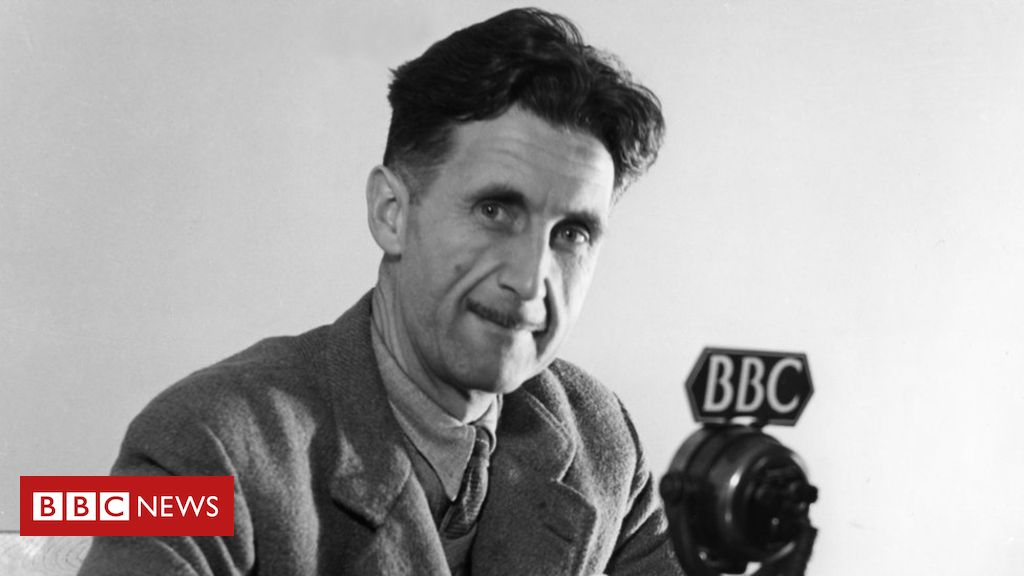
In Quillette, Adam Wakeling discusses George Orwell’s essay in the postwar magazine Polemic:

In the bleak post-war Britain of October 1945, an essay by George Orwell appeared in the first edition of Polemic. Edited by abstract artist and ex-Communist Hugh Slater, the new journal was marketed as a “magazine of philosophy, psychology, and aesthetics.” Orwell was not yet famous — Animal Farm had only just started appearing on shelves — but he had a high enough profile for his name to be a boon to a new publication. His contribution to the October 1945 Polemic was “Notes on Nationalism,” one of his best and most important pieces of writing. Amidst the de-Nazification of Germany, the alarmingly rapid slide into the Cold War, and the trials of German and Japanese war criminals, Orwell set out to answer a question which had occupied his mind for most of the past seven years — why do otherwise rational people embrace irrational or even contradictory beliefs about politics?

As a junior colonial official in Burma, the young Eric Blair (he had not yet adopted the name by which he would be known to posterity) had been disgusted by his peers and superiors talking up the British liberty of Magna Carta and Rule Britannia while excusing acts of repression like the massacre of Indian protestors at Amritsar in 1919. As a committed socialist in the late 1930s, he openly ridiculed those who claimed to be champions of the working class while holding actual working-class people in open contempt. And he had watched the British Communist Party insist that the Second World War was nothing more than an imperialist adventure right up until the moment when the first German soldier crossed the Soviet frontier, at which point it instantly became a noble struggle for human freedom.

Orwell’s most personally searing experience, though, had come in Barcelona in 1937. The previous year, he had travelled to Spain to fight in the Civil War on the Republican side. His poor relationship with the British Communist Party led him to enlist in the militia of an anti-Stalinist socialist party, the POUM (Partido Obrero de Unificación Marxista, or Workers’ Party of Marxist Unification). Even while it was fighting a bitter winter campaign in the Aragon mountains, the POUM was subject to a relentless propaganda campaign by pro-Soviet Republicans who insisted it was a secret front for fascism.

Over May and June 1937, the POUM and the other independent left-wing organisations in Barcelona were brutally suppressed by the Republican Government and Soviet-backed Communists. Orwell saw his friends and comrades smeared, arrested, and in some cases shot. He only made a narrow escape back into France himself. Upon his return to Britain, he found the British Communist Party resolute in its line that the POUM was a fascist party. Admitting that there could be a difference of opinion among left-wing groups with respect to the Soviet Union, or that the Spanish Communists could have acted unjustly, was unacceptable. And when Orwell published his own account of the events in Spain, Homage to Catalonia, few were interested in reading it. The betrayal of the POUM weighed on Orwell’s mind through the Second World War, and Animal Farm provided an outlet for his anger. But those bloody spring days in Barcelona also informed “Notes on Nationalism.”

“Notes on Nationalism” is not an ideal title, as Orwell was not talking only about loyalty to country. Rather, he used nationalism as a short-hand for any type of group loyalty — to a country, but also to a religion, a political party, or an ideology itself. A nationalist may be defined by his membership of a group, or by his opposition to one, which Orwell called “negative” nationalism. Orwell used anti-Semites as an example of the latter, as well as the “minority of intellectual pacifists whose real though unadmitted motive appears to be hatred of Western democracy and admiration of totalitarianism.” He then set out to explain how everyone — no matter how reasoned and level-headed — is capable of irrational and biased thinking when our sense of group identity is challenged.

He identified three characteristics of “‘nationalistic’ thinking.” First, obsession — the ideologue’s need to filter everything through an ideological lens. Entertainment is not entertaining unless it is orthodox. Second, instability — the ability of the ideologue to go from believing one thing to quickly believing another to follow the party line. And thirdly, indifference to reality. One of the most interesting aspects of “Notes on Nationalism” is the “inadmissible fact” — something which can be proven to be true and is generally accepted but cannot be admitted by the adherents of a particular ideology. Or, if the fact is admitted, it is explained away or dismissed as unimportant.

The ideas explored in “Notes on Nationalism” run through much of Orwell’s writing, most obviously his anti-totalitarianism and hatred of hypocritical pieties. But central to his argument is how nationalistic thinking exposes our inescapable biases. “The Liberal News Chronicle,” he wrote, “published, as an example of shocking barbarity, photographs of Russians hanged by the Germans, and then a year or two later published with warm approval almost exactly similar photographs of Germans hanged by the Russians.” This anticipated the doublethink of Nineteen Eighty-Four, in which atrocities “are looked upon as normal, and, when they are committed by one’s own side and not by the enemy, meritorious.” The first step down the deceptively short road to totalitarianism is believing that our political enemies pose such a grave threat that defeating them takes precedence over truth, consistency, or common sense.

Napoleon’s greatest foe

Filed under: Britain, Europe, France, History, Middle East, Military — Tags: , , , , , , , — Nicholas @ 02:00

Lindybeige
Published 18 Jan 2018

Support me on Patreon: https://www.patreon.com/Lindybeige

Possibly I did too much research for this one. Trying to stay on-topic when the subject is so vast and so interesting was not easy, hence the rather long video. I didn’t mean to say quite so much about what an utter £$%&*! Napoleon was, but he was so thoroughly vile that it proved impossible not to include some details about the man who won his promotion in the army by mowing down civilian protesters in the streets of Paris with grapeshot from his artillery batteries. Anyway, here are tales of bravery and virtue, as well as horrendous some of brutality, lies, and death.

Correction: The battle against the Russian fleet is called Svensksund (Swedish sound, as in channel), not Svenksund. I missed out an S in my haste.

Buy the music – the music played at the end of my videos is now available here: https://lindybeige.bandcamp.com/track…

Lindybeige: a channel of archaeology, ancient and medieval warfare, rants, swing dance, travelogues, evolution, and whatever else occurs to me to make.

▼ Follow me…

Twitter: https://twitter.com/Lindybeige I may have some drivel to contribute to the Twittersphere, plus you get notice of uploads.

website: http://www.LloydianAspects.co.uk

QotD: Our culture shapes what we can see

One of the things I keep trying to explain to my “woke” colleagues, when they stand tall and righteous and put their shoulders back and say that Heinlein was racisthomophobicsexist or that great authors of the past should have been better than to follow the prejudices of their time, is that when you’re immersed in your time, you don’t see the prejudices and the blind spots.

I have a little more insight into how culture shapes what’s possible to think, because I changed my culture as an adult. While this can be done (obviously) and immigrants should be encouraged to do it, (or go home), the acculturation is never complete. What happens is that you acquire a sort of cultural double vision. Depending on how far your acculturation goes, you’ll see the defects in thought or at least the unquestioned assumptions in one of the countries better, but also have a strong feeling of being outside enough to see some flaws in your dominant culture. In my case, for instance, I see the flaws in Portugal very clearly, like the obsession with speed over diligence or being decisive over being right, but I still see some in the US which is why sometimes I say “what people born and raised here don’t see.”

I have, of course, even more insight, due to being a conservative in the US, in a culture and profession (the arts/publishing) that is not only majority left, but majority extreme left. For many years, the only way to stay at least plausibly under cover was to see what they were seeing, and what they expected.

But without that, most people are blind to the … ah, unconscious or unthinking parts of their culture. Heck, even with what I’ve been through, I still tend to accept a lot of things unconsciously, unless I step back and go “Now wait a minute.”

Sarah Hoyt, “Slouching Into Shackles”, According to Hoyt, 2018-04-27.

August 10, 2020

The Rise of Carthage

Invicta
Published 13 Mar 2020

Support the channel by downloading Rise of Kingdoms: http://patron.me/Invicta, New users can use the code seyfpw6fxu and claim these prizes: GEM 200, Silver Key x2, 50000 Food x2, 50000 Wood x2

Today Carthage is remembered only in the context of its dramatic fall at the end of the Punic Wars between Rome and Carthage. We all know about Hannibal and the Battle of Cannae but how about the daily life of Carthage. There is much more to this ancient civilization than the dust and ashes left to us by history. Today we will be exploring the Rise of Carthage and dive into the fascinating details of their civilization.

The history documentary begins by covering the ancient Phoenicians who planted colonies across the Mediterranean. Carthage emerged from this trade network to become the leader of the Phoenicians in the west and eventually come to forge an empire when its mother colony Tyre declined. The history documentary then turns to cover the government, economy, culture, and military of ancient Carthage.

Sources and Suggested Reading:
Carthage: A History by Serge Lancel
The Carthaginians by Dexter Hoyos
Carthage’s Other Wars by Dexter Hoyos
Carthage Must be Destroyed by Richard Miles

#History
#Documentary
#Carthage

Russia in Asia (for now)

Filed under: Asia, China, Government, History, Russia — Tags: , , , — Nicholas @ 05:00

Ted Campbell looks at some long-frozen geopolitical forces that may become more active in coming years:

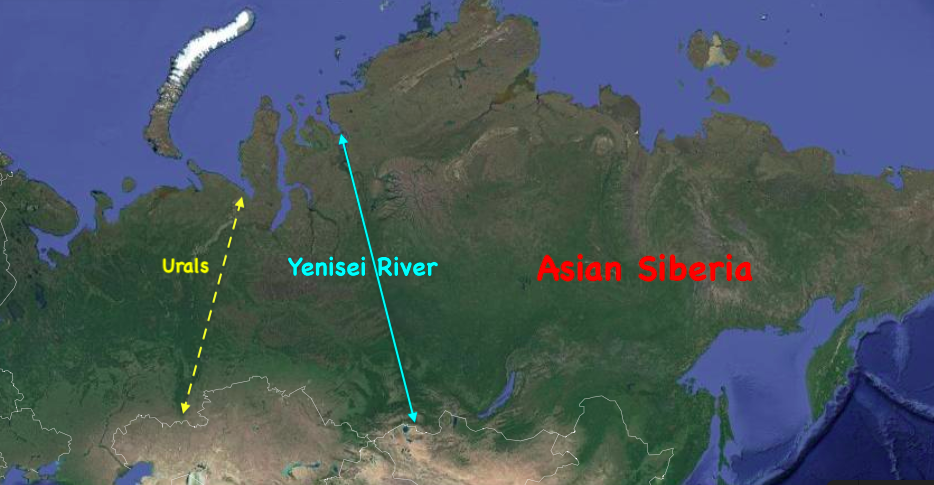
The Jamestown Foundation, which some experts describe as mainly non-partisan and relatively unbiased, has published an interesting article by Paul Goble in which he reminds us that “Russia east of the Urals comprises more than two-thirds of the Russian Federation but has only about one-fifth of that country’s population. It is where most of Russia’s natural resources are to be found, though the earnings from their extraction largely go to Moscow and not to local people. The region is located three to ten time zones east of Moscow and is linked to the center by few roads or rail lines. Its people are far closer to China and other Pacific rim countries — including the United States — than to the core of the Russian Federation. Because of their roots in explorers, those fleeing oppression, and those sent there by the state for punishment, eastern Russians have always been more independent minded and entrepreneurial than Russians in central and western Russia. Perhaps the most important measure of this cultural divide is that Protestant faiths dominate the religious scene there, not the Russian Orthodox Church of the Moscow Patriarchate.”

It is related to something I have been saying for a long time: Siberia (essentially everything East of the Yenisei River (some say everything East of the Urals) is Asia …

… while Russia, per se, is an Eastern European country.

[…]

A few years ago a couple of middle-ranked Chinese officials suggested to me that one of China’s long-term strategic plans was (and I’m guessing still is) to encourage separatist movements in Siberia which, they hoped, will succeed in creating three or four (maybe even five or six) “autonomous” states in Siberia which will, like Mongolia, look, primarily to China for trade and support.

China covets needs the resources, including water, that Siberia has. I have, in the past, forecast a Sino-Russian “Water War” in Siberia. But, speaking broadly and generally, the Chinese don’t like wars: they are expensive and unpredictable. They would much rather play a modest, behind the scenes role in creating a handful of weak, independent Siberian states with which they can trade to their advantage. They do not, I was told, wish to annex Siberia ~ some Chinese feel that the Qing Dynasty (1644 to 1912) went too far when it annexed what is now the Xinjiang Uyghur Autonomous Region (新疆维吾尔自治区) in 18th century.

(Tibet is a different matter and most of the Chinese people I know who might wish that Xinjiang was a more autonomous place, more like Kyrgyzstan, for example, believe that Tibetans are Chinese (and Uighurs are not) and Tibet is a “natural” part of China.)

I said a couple of days ago, that “Russia is a pariah state that is flailing about as it withers and dies.” But Putin is flailing about in the wrong directions. The Chinese are, I believe, cultivating and fertilizing Siberian separatist movements with a view to dismembering Russia and “liberating” Siberia. When that happens, and I’m confident that it is NOT an IF, the world will be a much different place.

Donald MacLean: The First of the Cambridge Five

The Cold War
Published 22 Jun 2020

Our historical documentary series on the history of the Cold War continues with a video on the famous Cambridge Five and Donald Maclean in particular — a real Cold War-era spy story

Support us on Patreon: https://www.patreon.com/thecoldwar or Paypal: http://paypal.me/TheColdWar

✔ Merch store ► https://teespring.com/stores/thecoldwar
✔ Instagram ► http://www.instagram.com/thecoldwartv

#ColdWar #Maclean #CambridgeFive

FDR’s “New Deal” and the Great Depression

The Great Depression began with the collapse of the stock market in 1929 and was made worse by the frantic attempts of President Hoover to fix the problem. Despite the commonly asserted gibe that Hoover tried laissez faire methods to address the economic crisis, he was a dyed-in-the-wool progressive and a life-long control freak (the Smoot-Hawley Tariff Act which devasted world trade was passed in 1930). Franklin D. Roosevelt won the 1932 election by promising to undo Hoover’s economic interventions, yet once in office he turned out to be even more of a control freak than Hoover. His economic and political plans made Hoover’s efforts seem merely a pale shadow.

For newcomers to this issue, “New Deal” is the term used to describe the various policies to expand the size and scope of the federal government adopted by President Franklin Delano Roosevelt (a.k.a., FDR) during the 1930s.

And I’ve previously cited many experts to show that his policies undermined prosperity. Indeed, one of my main complaints is that he doubled down on many of the bad policies adopted by his predecessor, Herbert Hoover.

Let’s revisit the issue today by seeing what some other scholars have written about the New Deal. Let’s start with some analysis from Robert Higgs, a highly regarded economic historian.

    … as many observers claimed at the time, the New Deal did prolong the depression. … FDR and Congress, especially during the congressional sessions of 1933 and 1935, embraced interventionist policies on a wide front. With its bewildering, incoherent mass of new expenditures, taxes, subsidies, regulations, and direct government participation in productive activities, the New Deal created so much confusion, fear, uncertainty, and hostility among businessmen and investors that private investment, and hence overall private economic activity, never recovered enough to restore the high levels of production and employment enjoyed in the 1920s. … the American economy between 1930 and 1940 failed to add anything to its capital stock: net private investment for that eleven-year period totaled minus $3.1 billion. Without capital accumulation, no economy can grow. … If demagoguery were a powerful means of creating prosperity, then FDR might have lifted the country out of the depression in short order. But in 1939, ten years after its onset and six years after the commencement of the New Deal, 9.5 million persons, or 17.2 percent of the labor force, remained officially unemployed.

Writing for the American Institute for Economic Research, Professor Vincent Geloso also finds that FDR’s New Deal hurt rather than helped.

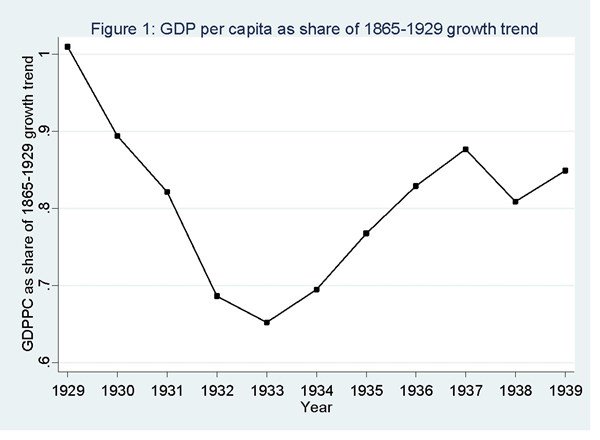
    … let us state clearly what is at stake: did the New Deal halt the slump or did it prolong the Great Depression? … The issue that macroeconomists tend to consider is whether the rebound was fast enough to return to the trendline. … The … figure below shows the observed GDP per capita between 1929 and 1939 expressed as the ratio of what GDP per capita would have been like had it continued at the trend of growth between 1865 and 1929. On that graph, a ratio of 1 implies that actual GDP is equal to what the trend line predicts. … As can be seen, by 1939, the United States was nowhere near the trendline. … Most of the economic historians who have written on the topic agree that the recovery was weak by all standards and paled in comparison with what was observed elsewhere. … there is also a wide level of agreement that other policies lengthened the depression. The one to receive the most flak from economic historians is the National Industrial Recovery Act (NIRA). … In essence, it constituted a piece of legislation that encouraged cartelization. By definition, this would reduce output and increase prices. As such, it is often accused of having delayed recovery. … other sets of policies (such as the Agricultural Adjustment Act, the National Labor Relations Act and the National Industrial Recovery Act) … were very probably counterproductive.

Here’s one of the charts from his article, which shows that the economy never recovered lost output during the 1930s.

How to Safely Unload & Clear the Four Most Common Rifles

Filed under: Military, Weapons — Tags: , — Nicholas @ 02:00

Forgotten Weapons
Published 10 Sep 2016

http://www.armamentresearch.com

This is a basic instructional video on unloading and clearing the four most common types of rifles that will be encountered by journalists, aid workers, and other non-combatants in conflict zones today.

Armament Research Services (ARES) is a specialist technical intelligence consultancy, offering expertise and analysis to a range of government and non-government entities in the arms and munitions field. ARES fills a critical market gap, and offers unique technical support to other actors operating in the sector. Drawing on the extensive experience and broad-ranging skillsets of our staff and contractors, ARES delivers full-spectrum research & analysis, technical review, training, and project support services. Our services are often delivered in support of national, regional, and international initiatives, and can be conducted in both permissive and non-permissive environments.

ARES is an apolitical, policy-neutral organisation, providing technical assessments to legitimate customers. We reserve the right to decline any engagement we deem ethically problematic.

United Nations Global Marketplace (UNGM) number: 358103

QotD: Gandhi’s legacy

Filed under: History, India, Quotations, Religion — Tags: , , , — Nicholas @ 01:00

Some Indians feel that after the early 1930s, Gandhi, although by now world-famous, was in fact in sharp decline. Did he at least “get the British out of India”? Some say no. India, in the last days of the British Raj, was already largely governed by Indians (a fact one would never suspect from this movie), and it is a common view that without this irrational, wildly erratic holy man the transition to full independence might have gone both more smoothly and more swiftly. There is much evidence that in his last years Gandhi was in a kind of spiritual retreat and, with all his endless praying and fasting, was no longer pursuing (the very words seem strange in a Hindu context) “the public good.” What he was pursuing, in a strict reversion to Hindu tradition, was his personal holiness. In earlier days he had scoffed at the title accorded him, Mahatma (literally “great soul”). But toward the end, during the hideous paroxysms that accompanied independence, with some of the most unspeakable massacres taking place in Calcutta, he declared, “And if … the whole of Calcutta swims in blood, it will not dismay me. For it will be a willing offering of innocent blood.” And in his last days, after there had already been one attempt on his life, he was heard to say, “I am a true Mahatma.”

We can only wonder, furthermore, at a public figure who lectures half his life about the necessity of abolishing modern industry and returning India to its ancient primitiveness, and then picks a Fabian socialist, already drawing up Five-Year Plans, as the country’s first Prime Minister. Audacious as it may seem to contest the views of such heavy thinkers as Margaret Bourke-White, Ralph Nader, and J.K. Galbraith (who found the film’s Gandhi “true to the original” and endorsed the movie wholeheartedly), we have a right to reservations about such a figure as a public man.

I should not be surprised if Gandhi’s greatest real humanitarian achievement was an improvement in the treatment of Untouchables — an area where his efforts were not only assiduous, but actually bore fruit. In this, of course, he ranks well behind the British, who abolished suttee — over ferocious Hindu opposition — in 1829. The ritual immolation by fire of widows on their husbands’ funeral pyres, suttee had the full sanction of the Hindu religion, although it might perhaps be wrong to overrate its importance. Scholars remind us that it was never universal, only “usual.” And there was, after all, a rather extensive range of choice. In southern India the widow was flung into her husband’s fire-pit. In the valley of the Ganges she was placed on the pyre when it was already aflame. In western India, she supported the head of the corpse with her right hand, while, torch in her left, she was allowed the honor of setting the whole thing on fire herself. In the north, where perhaps women were more impious, the widow’s body was constrained on the burning pyre by long poles pressed down by her relatives, just in case, screaming in terror and choking and burning to death, she might forget her dharma. So, yes, ladies, members of the National Council of Churches, believers in the one God, mourners for that holy India before it was despoiled by those brutish British, remember suttee, that interesting, exotic practice in which Hindus, over the centuries, burned to death countless millions of helpless women in a spirit of pious devotion, crying for all I know, Hai Rama! Hai Rama!

Richard Grenier, “The Gandhi Nobody Knows”, Commentary, 1983-03-01.

« Newer PostsOlder Posts »

Powered by WordPress