
People tend to underestimate how influential intellectual movements can be, as they rarely get outside attention until they’re deeply entrenched in the university system. The Frankfurt School‘s damage record is unmatched by any other intellectual movement of the era:
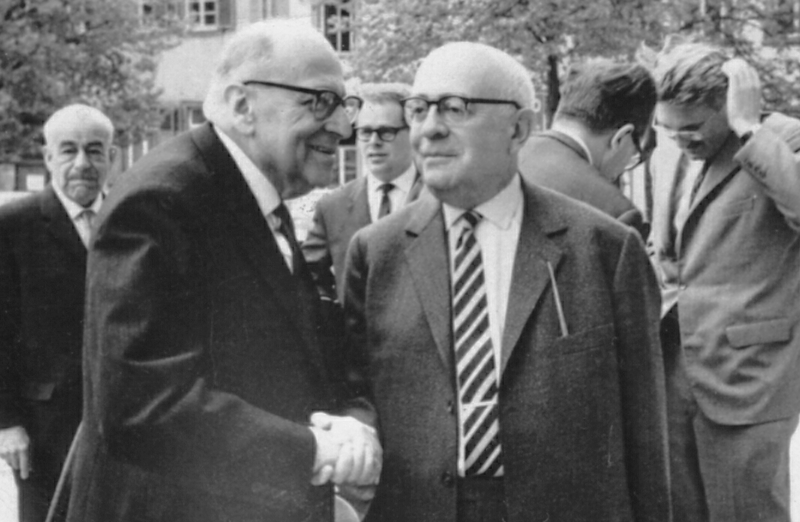
Notable members of the Frankfurt School in Heidelberg, April 1964 at the Max Weber-Soziologentag. Max Horkheimer is front left, Theodor W. Adorno front right, and Jürgen Habermas is in the background, right, running his hand through his hair. Siegfried Landshut is in the background left.
Photograph by Jeremy J. Shapiro via Wikimedia Commons.
The Most Destructive Intellectual Project of the Twentieth Century.
The Frankfurt School. You should know what it was, what it built, and why you are still living inside it.
1. The Institute for Social Research was founded in Frankfurt in 1923 and relocated to Columbia University in 1934 when Hitler came to power. The civilization they had decided to dismantle gave them refuge when another tried to kill them. They spent the next five decades producing the theoretical infrastructure for that dismantling. Western civilization itself was the problem: reason, the Enlightenment, the family, tradition, authority. Not reformed. Dismantled.
2. They called it Critical Theory – and the name is the program. Everything is to be criticized; nothing is to be built. In The Dialectic of Enlightenment (1944), Adorno and Horkheimer argued that Western reason — the reason that produced Newton and the rule of law — contained the seeds of Auschwitz. Not that reason had been misused, but that reason itself, taken to its conclusion, produces the death camp. This was not a critique of institutions. It was an indictment of the civilization itself.
3. Adorno gave them the psychological weapon. The Authoritarian Personality (1950) classified conservatism, religious faith, patriotism, and the traditional family not as political positions but as symptoms of a proto-fascist personality. If you believe in the nation or the father’s authority, you are pre-fascist. The opponent was no longer wrong – he was sick. You don’t argue with a pathology. You treat it. This made dialogue impossible. You don’t persuade someone who is wrong; you diagnose someone who is sick. Politics becomes therapy, and disagreement becomes pathology.
4. Marcuse gave them the political weapon. Repressive Tolerance (1965) argued that tolerating wrong ideas is itself oppression. True tolerance therefore requires suppressing intolerant ideas. The left decides which ideas are intolerant. Everyone else is silenced – not despite tolerance, but “in its name”. Censorship dressed in the vocabulary of liberation.
5. The generation that read Marcuse at Columbia, Berkeley, and Yale went on to run universities, media, foundations, NGOs, content moderation departments, and the EU regulatory apparatus. They implemented the argument sincerely because they had been taught it as philosophy. This was the Frankfurt School’s greatest achievement: it produced true believers.
6. French Theory picked up the tools and made them aesthetic. Foucault made the critique of power literary. Derrida made the critique of meaning philosophical. Deleuze made the critique of identity elegant. A political program became a cultural sensibility. You can argue with a program. A sensibility is in the air you breathe. By the time these ideas reached the American campus through the French conduit, they were no longer ideology. They were the water. The fish did not know they were wet.
7. A civilization stands on three pillars: truth exists and is accessible to reason; good is distinguishable from evil; and there is an inheritance worth transmitting. The Frankfurt School attacked all three – systematically and with considerable intellectual sophistication. It produced a generation that knows how to deconstruct and has forgotten how to build. That sees power everywhere and beauty nowhere. The ultimate achievement was to make destruction feel like progress. Every inherited institution became suspect; every constraint became oppression; every act of preservation became reactionary. Deconstruction became the default, while construction became something that needed to justify itself.
The answer is not another theory. It is the thing the Frankfurt School most feared: the builder who simply builds, the scientist who follows the evidence, the father who transmits what was transmitted to him.
The deconstruction machine runs on the assumption that nothing is worth building.
Prove it wrong.
Tell the truth, have courage, and build.


