
Which brings us to a discussion about romances, yesterday. Like apparently most people who read Regencies I’ve become aware of a tendency for them to read more and more like modern romances than like something set in that time.
Someone nailed it for me by pointing out that female characters have been getting more modern. For instance, they will do things like not want to marry UNTIL they have sexual experience, so they’ll be engaged and go out to find someone to sleep with them: in a time without either contraceptives or antibiotics and in a time when a unwed pregnancy would ruin not only the woman but all her relatives.
Or they rebel against being the one who was supposed to marry to make the family fortunes. I’m not saying a woman might not wish to marry someone else rather than make the family fortunes, but it would present in her own mind not as resentment to lifting the family out of debt, but as “I’m madly in love with the stable boy.” or whatever. And if a woman was thoroughly opposed to [being] married, it often manifested (at least in Catholic countries, granted, not England) as a “vocation.” What it didn’t manifest as was “I want to pursue a career.” Women married, or if they were unmarried stayed around the house helping with the nephews and the running of the house. If they had the means they might set up household with a companion. But only the poor worked, (even for men “having to” work was a downcheck on status.) If you were a governess or a nurse, it wasn’t for a “career” but because you were desperate.
Oh, and please save me from all the women running philanthropic organizations. While there were of course a number of these run by women, it wasn’t every other woman as seems to be in today’s regency romances. And charities for unmarried mothers would be very heavy on the preaching and getting them to give the baby up for adoption. Not telling them they’ve done nothing wrong and “affirming” their choices. Again, no contraceptives, no antibiotics. Sex and its consequences were serious business PARTICULARLY for women who make more of an investment in reproduction.
Sarah A. Hoyt, “What Has Gone Before Us”, According to Hoyt, 2015-08-03.
July 21, 2017
QotD: Anachronistic “Regency” romances
July 15, 2017
QotD: Ancient beliefs and modern ones
It is, I suppose, very attractive to the modern mind, with its idea that every Jack and Jill (but mostly Jill) needs a role model that matches his or her external or cultural characteristics that they assume worship of any sort of fertility goddess would mean a great respect for women.
Do I need to tell you this is poppycock?
I shouldn’t need to. We know almost every ancient religion worshiped at least one (often more) female deities, and we know that compared to us in the present so called “patriarchy” women were not only not respected, but were often used in strictly utilitarian ways as in “Mother, caretaker, etc.”
I see absolutely no reason to imagine that primitive humans were better than that, particularly since we do have archaeological evidence (scant, so non-conclusive) to back up the sort of hard scrabble/winner take all existence the great apes bands have, where the word “family” and “harem” are basically equivalent and the alpha male takes all.
In fact the evidence from modern day primitives, whether or not the worship of a female goddess is present, often leads one to conclude that the presence of a female goddess implies stronger patriarchy.
Sarah A. Hoyt, “Inventing the Past — The Great Divorce”, According to Hoyt, 2015-09-23.
July 11, 2017
Maria Bochkareva and the 1st Russian Women’s Battalion of Death I WHO DID WHAT IN WW1?
Published on 10 Jul 2017
Maria Bochkareva was one of several Russian women who volunteered to fight in the name of the Tsar in 1914. She fought with distinction on the Eastern Front until the Russian Revolution. To set an example against the falling morale in the post-revolutionary Russian Army, she requested to train and lead the first Russian Women’s Death Battalion – ready to die for their country. During the Kerensky Offensive they went over the top and suffered heavy casualties. Ultimately, Bochkareva was executed by the Bolsheviks during the turmoil of the Russian Civil War.
June 30, 2017
Russia’s New Offensive – The Russian Women’s Battalion of Death I THE GREAT WAR Week 153
Published on 29 Jun 2017
After the Russian Revolution, fresh optimism is gripping the troops at the front line and another offensive is planned. The first American troops arrive in France and Greece officially joins the Entente.
“No one is bending over backwards to be fair to McEnroe here, and — well, he is John McEnroe”
Colby Cosh on the tempest-in-a-teapot over John McEnroe’s rating of Serena Williams’ tennis skills:
McEnroe is in a familiar, mostly consequence-free sort of trouble for an interview he gave to National Public Radio that aired this past Sunday. McEnroe is flogging a book, and NPR’s Lulu Garcia-Navarro read a quote from it, asking him why he had described Serena Williams as “the best female player” ever. Maybe, Garcia-Navarro suggested, Serena is just “the best player in the world.” “Why say female player?”
McEnroe immediately answered that if Williams played tennis on the men’s tour “she’d be, like, (number) 700 in the world.” He added that “That doesn’t mean I don’t think Serena is an incredible player: I do.” He specified that “700” was not an exact guess — “perhaps it’d be a little higher, perhaps it’d be a little lower.” And he noted that Williams’s supreme mental rigour would enable unexpected victories over male pros.
[…]
It so happens that when Serena was 16 and participating in the 1998 Australian Open, she and her sister Venus boasted that they could probably beat the 200th-best men’s player in the world. A German named Karsten Braasch, once number 38 in the men’s ranking, but by then a bit dissipated, stood 203rd at that moment. He got word of the Williams challenge. Indulging in his trademark habit of smoking cigarettes during breaks in play, Braasch beat Serena 6-1 and Venus 6-2.
The sisters revised their claim to superiority over men outside the top 350 before deciding not to speak of the match again, nor to repeat it with a different male opponent. Braasch was quoted as saying “500 and above: no chance.”
It might be objected that Serena was “only” 16 at the time, assuming anyone had dared to mention Karsten Braasch at all this week, but female tennis players seem to experience pretty much the earliest chronological peak of playing ability outside gymnastics or thoroughbred horseracing. Being 35 years old, as Serena is now, doesn’t help anybody win in a sport involving strength and speed. McEnroe has clear justification for his belief that Serena would not be one of the 500 best players in a world of wide-open, all-genders tennis.
Megan McArdle agrees it takes nothing at all away from Serena Williams to say she’s not the best tennis player in the world:
“Best” is a relative value of course, not an absolute; Tyrannosaurus rex was one of the best in its field, 65 million years ago, but when conditions changed, poor T. rex went from industry leader to the ash heap of history. When we say that someone or something is “the best,” we always have to acknowledge that this judgment is highly dependent on the criteria we’re using to define excellence.
This is approximately the argument many of McEnroe’s critics seem to be making. Unable to refute his core point — that Serena Williams could not be a world champion if she were regularly competing against men — instead they’re asking why he would make that the standard for judging whether she’s the world’s best tennis player.
This leaves me just as confused as McEnroe was when the NPR interviewer asked him essentially the same question. Tennis, after all, is a court, a moderate amount of equipment, and some highly detailed rules for determining who wins. The best tennis player is the person who can most regularly defeat the other players under those rules. Unless some sort of terrible plague wipes out hundreds of top men’s tennis players, that person will never be Serena Williams.
[…]
We should all applaud Serena Williams for becoming the world’s best female tennis player. That’s a stunning achievement — a testament to her physical gifts and how hard she has worked to develop as a player. Williams has earned her titles, her money and her fame, and she deserves to bask in all of it. It is a compliment, and a true statement, to call her the best female tennis player. We won’t add anything to her achievement by subtracting “female” and turning the true accolade into false flattery.
June 11, 2017
QotD: The role of women in pre-modern society
Traditional societies more often than not have less room for the individual than the Western society, which means that projecting our idealized intent onto such societies, and viewing deviation from our norm as “tolerance” is an act of provincial stupidity.
The truth is it has been the Judeo-Christian tradition, flowering into the enlightenment coupled with the material wealth fostered by the industrial revolution and, yes, capitalism (in however small measure it is allowed even in the west) that has allowed our society to develop ideas of self fulfillment, of “pursuit of happiness” which would be considered downright strange in the past.
Note, I’m not implying that we’re perfect. Being human, we can’t be perfect. And if we don’t get lost looking for an imaginary past, our grandchildren might look upon us as intolerant barbarians.
HOWEVER I’m implying looking for lessons in the distant and the primitive does nothing for us here and now, particularly when most of those lessons are crazy made-up stuff.
For instance, what good is it saying that women were revered in pre-history, when we know that more than likely women in pre-contraceptive days and particularly in poor times and places were sort of a baby factory whose life was limited and confined by their biological function? What does it teach women? That merely letting go and daydreaming about a past that never was will make them superior to men?
Is this what we want?
Sarah A. Hoyt, “Inventing the Past — The Great Divorce”, According to Hoyt, 2015-09-23.
June 5, 2017
Camille Paglia on Angela Merkel as “the best model for aspiring women politicians”
An interview with Camille Paglia about her latest book, Free Women, Free Men: Sex, Gender, and Feminism, Angela Merkel as a role model for female politicians, and other topics:
DW: In one of your essays for Time magazine, you described Angela Merkel as “the best model for aspiring women politicians.” What did you mean by that?
Camille Paglia: What I have always admired about Angela Merkel is her ability to project confident leadership while also maintaining her naturalness and spontaneity as a real person with a rich personal life. She gardens, she cooks, she loves both sports and opera!
The contrast to Hillary Clinton as a public figure is immense. Hillary lives like a darkly brooding Marie Antoinette, barricaded behind her wealth and security guards. She seems to have no hobbies and few interests, aside from her pursuit of money and power.
Every public appearance is carefully scripted in advance for maximum publicity. She is stiff and guarded, incapable of improvisation, which is why she held virtually no press conferences at all during her presidential campaign.
Everything she does or says is researched and poll-tested by an army of hired sycophants. A recent book, Shattered: Inside Hillary Clinton’s Doomed Campaign, has revealed that even the top managers of Hillary’s own presidential campaign were often unable to speak to her directly. Everyone had to go through her chic courtier and major-domo, Huma Abedin.
I love the way that Angela Merkel is completely content to look exactly her age. She has a relaxation, a comfort within her own skin, without all the glamorous, artificial interventions of Hillary’s fancy cosmetics, luxury hair styling, and expensive designer clothing. I regard Merkel as an important role model not simply as a politician but as a mature woman of the world.
It must be emphasized that I am not in any way evaluating Angela Merkel’s policy decisions, where there is reason for controversy, notably about immigration. However, in my view, Merkel has achieved the most successful persona yet for a modern woman politician: She is steely and pugnacious in conflict, yet she exudes warmth and humor, an ease with ordinary human life.
[…]
Where do your viewpoints come from?
As an adolescent in the early 1960s, I was directly inspired by first-wave feminism, the 19th-century protest movement that led to American women winning the right to vote in 1920.
I learned about feminism through my obsession with the aviatrix Amelia Earhart, whom I read about in a 1961 newspaper article. For the next three years, I obsessively pursued a research project into Earhart and her era. No one was talking about feminism at the time, but I was drawn to the subject because of my own aggressive, outspoken personality, which did not conform to standard definitions of femininity during that period.
By the time second-wave feminism was born in the late 1960s, I came into fierce conflict with the new feminists over many issues – above all their neurotic hatred of men and their puritanical hostility to sexual images in art history and Hollywood movies.
I was 16 years old and had just read Simone de Beauvoir’s The Second Sex. Valentina Tereshkova, a Soviet cosmonaut, had just become the first woman launched into space. Newsweek published my letter to the editor, along with a photo of Amelia Earhart: I invoked Earhart’s precedent in protesting the exclusion of women from the American space program. I explicitly demanded “equal opportunity” for American women – and that remains my ultimate principle.
June 3, 2017
The Government Hates Boobs
Published on 2 Jun 2017
From nipple censorship to breast milk regulation, the government is making it hard to have breasts. The FCC maintains oversight of how much and what kind of breasts can grace public airwaves. Its decisions have ripple effects, since cable broadcasters often voluntarily comply with FCC guidelines.
A more dire issue than strategic anatomical censorship is the issue of breast milk. Between one and five percent of American women aren’t able to produce breast milk, and some babies can’t drink formula. When the two overlap the demand for breast milk is life or death. But acquiring breast milk from donation-based milk banks can be difficult and prohibitively expensive. So some women buy their breast milk on an online “gray market” that stifles suppliers.
In this week’s Mostly Weekly Andrew Heaton explains why the government should get its hands off our boobs.
Performed by Andrew Heaton
Written by Sarah Rose Siskind with writing assistance from Andrew Heaton and David Fried.
Edited by Austin Bragg and Sarah Rose Siskind.
Produced by Meredith and Austin Bragg.
May 26, 2017
QotD: The coming of the sexbots
Recently I saw online a documentary on sex robots. The reporteress, a short-haired woman seething with quiet indignation, Viewed With Alarm the very idea. Progress is rapid on these love assistants, she said. They move. Some do, anyway. They talk, but not too much. Before long they will have skin-temperature silicone. Today we have all those deplorable men sitting home, lonely and isolated, choking their chickens and pondering suicide. Soon they will instead be rocking and rolling with Robo-Barbie. This worried her. She said.
If this be true, then why, one wonders, do men want sexbots? Aren’t there already women all over the place at skin temperature? Sez me, it’s because women have lived too long in a monopoly economy and so let down quality. It used to be that men had jobs and money, and women had that, so they married to let each get some of what the other had. The woman had to be agreeable as a selling point. Now women have jobs and don’t need men, or to be pleasant. Some are nice anyway, but it’s no longer a design feature. Of course they often end up old and alone with a cat somewhere on upper Connecticut Avenue, but they don’t figure this out until too late. Anyway, they stopped being agreeable. They learned from feminists that everything wrong in their lives was the fault of men.
It is a real problem: American women are inoculated from birth with angry misandry insisting that men are dolts, loutish, irresponsible, and only want sex. (To which a response might be, “Uh…What else have you got?”)
[…]
OK, back to sexbots. The short-aired reporteress wondered why men could be interested in such confections instead of real women, the tone being one of elevated moralism and horror. Beneath the usual factitious objectivity one could hear, “How could…what is wrong with….?” and so on.
In the documentary, the short-haired reporteress talked to an ugly anti-sexbot crusader woman who said testily that using sexbots “objectified women.” (To me it sounded more like womanizing objects, but never mind.) These two dragons continued to the effect that sex was about intimacy and closeness and bonding. I wondered how they knew. But understand: They weren’t worried about competition. Oh no. They wanted to preserve intimacy and bonding. They were worried about those poor miserable men.
Uh…yeah.
In modern America I see no sign that women are concerned about masculine misery, and indeed that most of them rather like the idea.
Fred Reed, “Sally Cone Hits the Dating Scene”, The Unz Review, 2017-05-11.
April 21, 2017
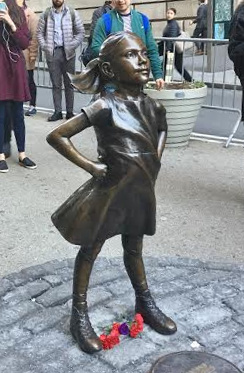
The oddly appropriate subtext to New York’s “Fearless Girl” statue
In the New York Post, Nicole Gelinas points out that Mayor De Blasio has set a precedent that might well come back to bite the city (the example she cites would be “Black Lives Matter protesters want a statue of police brutalizing a black man in front of One Police Plaza”. She also explains why the statue highlights an uncomfortable detail about the role of women on Wall Street:
But the bigger problem with Fearless Girl is that it casts stereotypes in bronze: Men do important things, and women get in the way.The “Fearless Girl” statue faces the Arturo Di Modica “Charging Bull” on Wall Street (Wikipedia)
The bull is the primary actor: He is charging. The girl’s job is to impede him. This is how Wall Street has long worked — and it’s changing, but slowly.
Take the management committee of State Street’s parent company. Of its 14 members, two are women. One, the chief administrative officer, is a top regulatory official. The other is the human-resources chief and “citizenship officer.”
On Goldman Sachs’ 33-member management committee, five of our women — at least four of whom are in similar, growth-restraining positions.
Yes, growth-restraining: These are great jobs and require deep skill. But they’re bureaucratic rather than entrepreneurial. If a department head — a man — wants to start up a new unit, it’s the regulatory experts who will say, no, you can’t.
Similarly, a trading head may want to hire someone — but the human-resources chief nixes it.
Indeed, the area of “compliance” — which sounds like an S&M activity but has to do with ensuring that the bank and its employees don’t launder money, steal or do other bad things — is where women have done well.
[…]
This work is necessary. A company can’t grow if it’s convicted of money-laundering or if its employees are thieves (in theory).
But it’s also the depressing age-old relationship: A man wants to do something fun and cool, like take the children paragliding before they’ve had a proper breakfast. His wife says, “But honey, the kids have band practice today, and maybe we should save the money for the mortgage.”
Fearless Girl fails in another way. It’s terrific to have courage and fight important battles. But it’s not a good idea — for men, women or children — to be recklessly fearless.
Fear is a good thing. If a bull is charging you, according to the farming manuals, the best thing to do is what you instinctively do: get out of the way. If you don’t pick your battles, you’ll lose them.
April 12, 2017
Why wasn’t Lucy Maud Montgomery considered for inclusion on a banknote?
Colby Cosh uncharacteristically praises-to-the-skies Lucy Maud Montgomery as even a shortlist candidate to appear on a Canadian banknote:
The choice of Viola Desmond came at the end of a formal search for historic women to put on a banknote, and I am still baffled by the absence of one name from the shortlist: that of the novelist L.M. Montgomery. If you think about the global noteworthiness standard, there are not many Canadians of any race or gender who can meet it. In its highest form it would exclude, for example, Wayne Gretzky, who must be one of the two or three most famous Canadians: there are too many places on Earth that know or care nothing of ice hockey.
They play Bach on keyboard instruments everywhere, so you could put Glenn Gould on a banknote under this rule. I start running out of names pretty damn fast after that, which may suggest a truth about our country that we do not like to confront. But Lucy Maud Montgomery is surely near the top of any such list.
Think what an extraordinary thing it is that we are still arguing about the merits of new adaptations of (and posters for) Anne of Green Gables. Those books are literature of a type that almost revels in its ephemerality. They were meant to be affordable components of a homogenous literary diet for the young. Montgomery could never have imagined that she would end up as the most enduring, best-travelled Canadian fiction author of all.
But how many cycles of fashion has Anne outlived; how many avant-garde authors and poets of her time has she seen off into oblivion? There is something about her that has unfailingly charmed readers of 1960 and 1990 and 2017. Nothing about this phenomenon is insincere or contrived, and it seems to transcend the English-speaking world with ease. Progressives and feminists are not reluctant to give the Anne books to their children. There has been no attack that I know of on Montgomery’s political bona fides. Her intellectual ambitions were small, and confined to an out-of-the-way place, yet her imagination conquered a world.
All of which does not even take into account the merely commercial argument for a banknote with Anne of Green Gables and/or her creator on it: the Japanese would hoard it like treasure. Then again, maybe that is what the Bank of Canada is afraid of — unpredictable monetary effects from an important currency denomination being too popular as a collectible. But I cannot see any other reason for them to keep missing this layup. Maybe they are prudently keeping Anne in reserve for the advent of the five-dollar coin, in order that the annie might join the loonie and the toonie?
April 10, 2017
QotD: Noblesse Oblige, pre-teens, and teenagers
This – ah – female privilege of course established “the way girls fight” usually underhanded, and without the adult noticing. Pinches, kicks to the ankle (my poor male friends in middle school) and also gossip and character destruction and other, less physical means of retaliation.
Because women are still human and will still fight.
But by middle school, we had it well established. A boy understood he would take whatever the girl dished out physically, if a girl were so uncouth as to hit him, and treat it as a joke. (And by that time they were that much stronger – thanks to testosterone – that they could do that, in most cases.) The girl in turn knew if she’d hit a boy, short of self-defense in a dark classroom, where he ambushed her, thereby putting himself beyond the protection of social rules, she’d committed a social sin and broken a major unspoken rule.
This kept fist fights between the sexes from happening. And most girls, though they might character assassinate one another, had learned to keep the boys out of it, because they weren’t adroit in the art and therefore were as vulnerable to that type of war as women to punches.
Or to put it another way, as the good professor says, “Chivalry imposed obligations upon both sexes.” And it can’t continue when one breaks the compact. The same way that other imbalances of power in society can’t continue unless both parts play by the rules.
When one part forgets the rules, they don’t leave the peasants enough to live on, and the peasants chop their necks off.
Look, I’m a libertarian and in the US. I believe all men and women should be equal under the law. But you can’t eliminate imbalances of power unless you stop being human. Communism fails, in large measure, because it wants to eliminate imbalances of power completely by making humans into something different. They believe they can shape a social ape into something more like ants or bees (don’t argue. Yeah, they do want to have rulers. One ruler over faceless millions. Because someone has to enforce equality. Yes, I know about the myth of the vanishing state.) Hence the myth of the homo Sovieticus, the selfless, perfectly acting man who would emerge once the distortions of capitalism were removed from the “natural” man who was of course a Rousseaunian noble savage. No, I don’t believe it. No one should believe it. The rejects of that culling program have filled a hundred million graves and bid fair to fill more. Because Rousseau was wrong and the mythology of communism is a hot and sticky repulsive mess.
Some people will always be taller, larger, stronger. Some will be smarter. Some will, for whatever reason like “my ancestors got here earlier” have the advantage of a better adaption to the society they live in.
I, for instance, got both sides of the noblesse oblige speech because I was taller than most of my male teachers by 13, and probably stronger too. It took. Sort of. I knew how to subdue a badly acting male without hitting him by the time I was 20, and only psychopaths did not respond. (And for those there was hitting, hence the weaponized umbrella.)
Because I WAS a walking imbalance of power, frankly.
Noblesse oblige is needed to keep things from coming to extremes.
Sarah Hoyt, “Noblesse Oblige and Mare’s Nests”, According to Hoyt, 2015-05-05.
April 3, 2017
QotD: Female “pacifism”
I’m really bad at fighting. Oh, not physical fighting, though I suppose I’m bad at that too at this point, since I haven’t been exercising like I used to and I’m not twenty anymore.
And I don’t mean I’m not good at landing metaphorical blows. No. The part I’m bad at is staying angry.
It’s funny, as much as we get accused of “hating” the only things and people I’ve hated are historical people and regimes that have killed millions of their citizens. Yeah, yeah, I hate red and black fascism, aka Nazism and Communism like I hate hell, all Capulets and … well. Not thee. The other things I hate are more things I strongly dislike: Licorice, bad, preachy books, teachers who don’t do their job, cold days. I don’t spend my time sitting around and going “I hate you snow, I do.” I just mumble disconsolately about not being able to walk and my fingers hurting with cold even while inside.
There is on the left this certainty that women are more peaceful than men that I think comes from two things: first the empathy which women have, or at least display more, which is part of raising infants; two women’s inability to stay burning at peak flame and the ability to find excuses for even the worst misdeeds, in order to keep their “tribe” together. What my mom called “Mothers always love the worst child the best.” (I never asked whether this was an admission I’m her favorite.)
This doesn’t mean, mind you, that women are not capable of aggression and war. I’ve said before that having attended an all-girl high school I could tell these people something about women and fighting.
It’s just that when women are bad, they’re very, very bad. They tend to fight in an underhanded way that leaves plausible deniability and the ability to pose as an angel before the world.
Sarah A. Hoyt, “Weaponized Empathy”, According to Hoyt, 2015-09-06.
March 22, 2017
QotD: Sharia and women’s rights
As a moral and legal code, Sharia law is demeaning and degrading to women. It requires women to be placed under the care of male guardians; it views a woman’s testimony in court as worth half that of a man’s; and it permits a husband to beat his wife. It’s not only women’s legal and sexual freedoms that are curtailed under Sharia but their economic freedoms as well. Women generally inherit half of the amount that men inherit, and their male guardian must consent to their choosing education, work, or travel.
In Saudi Arabia, Iran, Sudan, and parts of Nigeria, where Sharia law underpins the judicial system, women’s rights suffer greatly.
There is a growing trend among some feminists to make excuses for Sharia law and claim it is nothing more than a personal moral guide, and therefore consistent with American constitutional liberties. Yet the rules that such “Sharia-lite feminists” voluntarily choose to follow are also invoked to oppress women — to marry them off, to constrain their economic and human rights, and to limit their freedom of expression — who have not consented to them. The moral conflict between Sharia and universal human rights should not be dismissed as a misunderstanding, but openly discussed.
Many Western feminists struggle to embrace universal women’s rights. Decades ago, Germaine Greer argued that attempts to outlaw female genital mutilation amounted to “an attack on cultural identity.” That type of deference to traditional practices, in the name of cultural sensitivity, hurts vulnerable women. These days, relativism remains strong. Too many feminists in the West are reluctant to condemn cultural practices that clearly harm women — female genital mutilation, polygamy, child marriage, marital rape, and honor violence, particularly in non-Western societies. Women’s rights are universal, and such practices cannot be accepted.
Ayaan Hirsi Ali, “On This ‘Day Without a Woman,’ Don’t Leave Women Oppressed by Sharia Law Behind”, The Daily Beast, 2017-03-08.


