
This demonization of masculinity conflicts with the reality that any boy can see with his own two eyes: The cutest girls in school are attracted to the most masculine boys, and masculine not just in terms of physical traits, but also in terms of personality traits — confidence, assertiveness, “swagger”. Here we see a problem with what Rational Male author Rollo Tomassi calls the feminine-primary social order. Every observant man knows that there is a yawning chasm between (a) what women say they value most in a man and (b) the kind of man women actually go for. Listen to what women say, and you’d think they are magnetically attracted to “sensitive” guys. Watch what women actually do, and you can see that women obviously don’t actually care about “sensitivity”. Women want men who are tall and muscular and, ceteris parabus, rich, although no amount of money is going to make a short chubby guy sexy. As for the claim that women go for “sensitive” guys, anyone with two eyes and a brain knows this is nonsense. You don’t see throngs of lovestruck college girls chasing after guys who major in sociology or English literature (unless, of course, these guys are also tall, muscular and rich). No, it’s the jocks and frat boys who get the best action on campus, and if you pay attention to the choices women make, you’ll begin to suspect that their professed preference for “sensitive” men is the exact opposite of truth. That girl who was lecturing you about your need to be more “sensitive” will, with surprising regularity, end up falling head-over-heels for some selfish creep or dimwit brute who can’t even spell the word “sensitivity”.
Robert Stacy McCain, “Conflicting Signals”, The Other McCain, 2019-05-23.
March 30, 2023
QotD: Revealed preference in the teenage hellscape of high school
March 9, 2023
Want to feel more depressed? Spend more time with your smartphone
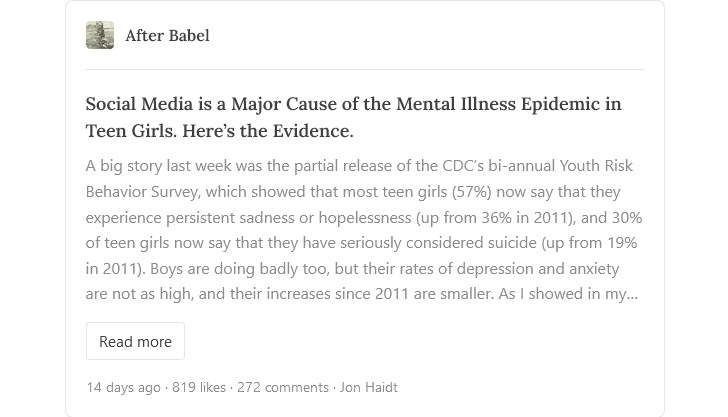
Freddie deBoer is convinced that much of the reason for widespread depression among teenagers can be traced directly to their obsessive devotion to the online world through their smartphones:
Are smartphones to blame for the mental health crisis among teens? The debate has picked up steam lately, in part because of the steady accumulation of evidence that they are indeed, at least partially. (As you know, I’m a believer.) Jonathan Haidt has done considerable work marshaling this evidence. But there’s an attendant question of how phones make kids miserable, if indeed they do. In this post I offer some plausible answers. This is mostly just speculation and I don’t know if the proffered explanations can be tested empirically.
I want to start by establishing a sort of meta-layer on which a lot of these problems rest. We might be inclined to say that these problems are inherently problems of the internet/online life/digital culture, rather than smartphones as such; you can be hurt by what I’m going to describe from a laptop as well as from a smartphone. And I think that’s right, except for one key difference: ubiquity. No matter how portable and light it is, you’re not reflexively checking your laptop on the subway platform or in the bathroom. The iPhone took all of the various pathologies of the internet, made it possible for them to be experienced repetitively and at zero cost morning and night, and dramatically scaled up the financial incentives for companies to exploit those pathologies for gain. You can certainly have an unhealthy relationship with the internet when it’s confined to your desktop. But phones make relentless conditioning and reflexive engagement a mass phenomenon.
The other overriding factor here is the fact that adolescents are still developing mentally, and thus are likely more susceptible to these problems.
Constant exposure to unachievable conditions. Back in my youth, you might watch an MTV show about how rich people lived, or leaf through a magazine like US Weekly, and be exposed to opulence and material excess. Or you might go on vacation and see how the other half lives if you took a tour of the Hollywood hills or whatever. You were perfectly well aware that rich people and their privileged lives existed. But then you turned off the show or you put down the magazine or your vacation ended, and unless you were born rich, you lived in an environment that of necessity was modest and real. Your friends might have lived in nice houses, but you didn’t see riches everywhere you looked, and your definition of what a hot girl looked like was mostly derived from the girls you went to school with. Your environment conditioned the scope of your desires.
Now, exposure to lifestyles that are completely unachievable is constant. Instagram is a machine for making you feel like whatever you’ve got isn’t enough. (That’s how it functions financially, through advertising idealized lives.) There are young people out there who have arranged their various feeds such that they’re always a few seconds away from seeing concerts they can’t attend, cars they can’t drive, houses they can’t live in, clothes they can’t wear, women they can’t fuck or whose bodies they can’t have, places they can’t travel to, food they can’t eat, and lives they can’t live. When I was young, if I wanted to see a picture of a Ferrari, I had to seek out a picture of a Ferrari. It was hard to see suggestive photos of intimidatingly hot women, which is why the Sports Illustrated swimsuit edition was a big deal. Mostly, the world around you was quotidian and its pleasures attainable. What can it be doing to these generations of young people, having completely unrealistic visions of what life is like being shoved into their brains all the time? How could their actual lives ever compare?
(Incidentally, I am thoroughly convinced that a majority of self-described incels are men who could find meaningful and fulfilling sexual and romantic success, both short-term and long, but who have developed such a wildly unrealistic idea about what actual human women look like that their standards are laughably high. And it’s easy to make fun of that, but I also think that the conditioning inherent to constantly looking at filtered and photoshopped pictures is powerful.)
February 19, 2023
Andrew Sullivan on the legacy media’s coverage of transgender issues
In the free portion of his Weekly Dish, Andrew Sullivan looks at how the legacy media chooses to cover (or ignore) different aspects of pre-teen and teenage transgenderism:
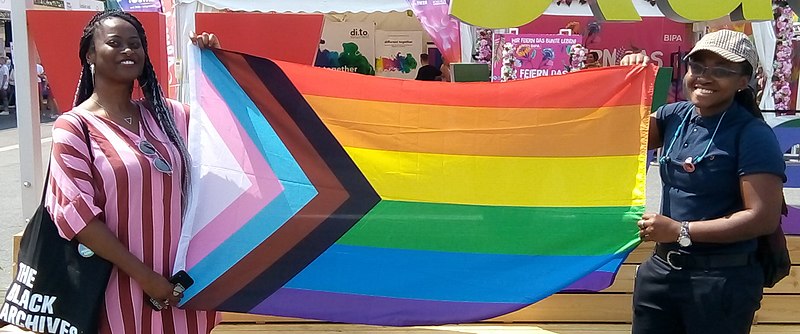
Two people at EuroPride 2019 in Vienna holding an LGBTQ+ pride rainbow flag featuring a design by Daniel Quasar; this variation of the rainbow flag was initially promoted as “Progress” a PRIDE Flag Reboot.
Photo by Bojan Cvetanović via Wikimedia Commons.
One more criticism of the letter. It uses the terrible history of the [New York Times] on coverage of gay men and AIDS in the 20th century as equivalent to the reporting of Bazelon, Baker, et al, today. This is unhinged. Transgender people today are fully covered under the Civil Rights Act; in the 1980s, gays had nothing. In the 1980s and 1990s, the NYT opposed using the word “gay” because it legitimized homosexuality in some way; today the NYT prints “queer” or “trans” or LGBTQ+ in almost every other article.
Today, the paper has published a mountain of empathetic coverage of trans people — over 800 stories in the past year. Since January 1, the NYT has run a moving profile about a trans man in Mexico; a celebration of “queer” life in Alabama by a trans staffer; an exploration of nonbinary fashion; a critical orgasm over “queer” theater; and a news story explaining that “the flood of [trans-related] legislation is part of a long-term campaign by national groups that see transgender rights as an issue on which they can harness voter anger”. Comparing this with A.M. Rosenthal’s reign of homophobic terror and censorship is just obscene.
One historical analogy does seem salient to me, though: the drugs they now give to gender-dysphoric teens are very closely related to the drugs they used to “cure” Alan Turing of his gayness. Every time I think of that I shudder.
And this attempt to suppress reporting on the subject comes at a very strange time. Next week, a new book will be published about the Tavistock Centre, the place responsible for the medical and psychological treatment of children with gender dysphoria in Britain. It’s written by a liberal female journalist, Hannah Barnes, of a flagship British documentary show, Newsnight.
Her book exposes a huge medical scandal, in which countless children were put on puberty blockers with almost no psychological evaluation, and with rates of autism and domestic abuse that were already through the roof. It shows what happened when the new affirmation-only puberty-blocker experiment, only begun in the late 1990s, was left to run its course, with no opposition and no dissent allowed. Check out an extract here. Here’s where I sat up straight:
Clinicians recall multiple instances of young people who had suffered homophobic bullying at school or at home, and then identified as trans. According to the clinician Anastassis Spiliadis, “so many times” a family would say, “Thank God my child is trans and not gay or lesbian.” Girls said, “When I hear the word ‘lesbian’ I cringe”, and boys talked to doctors about their disgust at being attracted to other boys.
When Gids [the Gender Identity Development Service] asked adolescents referred to the service in 2012 about their sexuality, more than 90 per cent of females and 80 per cent of males said they were same-sex attracted or bisexual. Bristow came to believe that Gids was performing “conversion therapy for gay kids” and there was a bleak joke on the team that there would be “no gay people left at the rate Gids was going”.
Just think about that for a second. And remember that gay groups cheer this on; and several gay writers put their names to the letter. What a massive reckoning may be in store for them. If any of this pans out, and gay groups have endorsed it, it could easily be the greatest scandal in the history of the gay rights movement.
More than a third of the kids pushed onto the trans track had autism, sometimes severe. Others were victims of domestic abuse: “[A natal girl] who’s being abused by a male, I think a question to ask is whether there’s some relationship between identifying as male and feeling safe”, one clinician at the center said. No questions about other aspects of a child’s mental health were considered if the kid was identifying as the opposite sex. And this took place in a socialized system, with constant oversight, and no massive financial incentives to treat children. Just imagine what could be happening in the US private system where trans patients are among the most lucrative to have in your care, and are under treatment their entire life.
[…]
One obvious area for research: why have the sex ratios shifted so radically in the past decade or so — with girls now vastly outstripping boys in the young patients involved? Why the explosion in requests? It’s far more dramatic and skewed to one sex than it would be if merely a function of declining stigma. Yet for woke journalists, it’s all Principal Skinner: “Let’s have no more curiosity about this bizarre cover-up.”
Something is going on among teen girls more generally. The CDC just issued a frightening new report:
Nearly 3 in 5 teen girls (57%) said they felt “persistently sad or hopeless”. That’s the highest rate in a decade. And 30% said they have seriously considered dying by suicide — a percentage that’s risen by nearly 60% over the past 10 years.
Now check out Jamie Reed’s and Tavistock’s overwhelmingly female, often deeply unhappy, clients. Is there a connection? I don’t know. What I do know is that it’s the job of the media to find out, and not to shut itself down.
The lobby groups and often well-intentioned doctors who have pioneered this massive experiment on children will naturally resist any idea they have been facilitating abuse, or concede any points — because as soon as they confess doubt, the whole house of cards can come tumbling down; and lawsuits alone could end the practice very quickly. The Democrats and the Biden administration have locked themselves to the idea that this kind of treatment is a no-brainer and never does any harm — and they just keep repeating that like a mantra and never address the recent restriction of these experimental practices in progressive Europe. The far right can use the issue to gin up homophobic tropes and cruel treatment of trans people.
February 10, 2023
“What’s happening to children is morally and medically appalling”
In The Free Press, Jamie Reed explains why she gave up her job as as a case manager at The Washington University Transgender Center at St. Louis Children’s Hospital and is now speaking out against the early and aggressive therapeutic treatment of gender-confused children and teens:
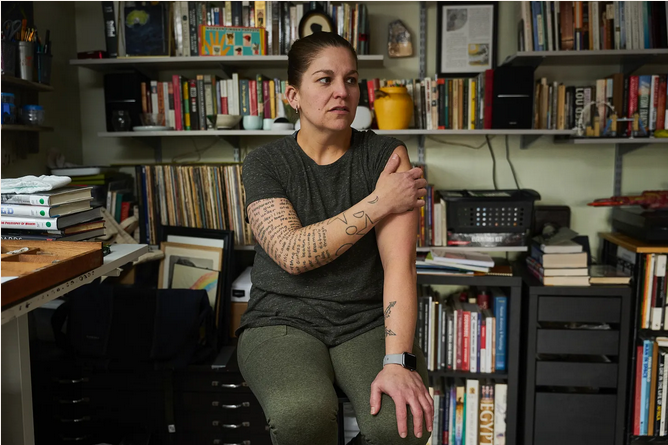
Reed in her office. (Theo R. Welling).
Soon after my arrival at the Transgender Center, I was struck by the lack of formal protocols for treatment. The center’s physician co-directors were essentially the sole authority.
At first, the patient population was tipped toward what used to be the “traditional” instance of a child with gender dysphoria: a boy, often quite young, who wanted to present as — who wanted to be — a girl.
Until 2015 or so, a very small number of these boys comprised the population of pediatric gender dysphoria cases. Then, across the Western world, there began to be a dramatic increase in a new population: Teenage girls, many with no previous history of gender distress, suddenly declared they were transgender and demanded immediate treatment with testosterone.
I certainly saw this at the center. One of my jobs was to do intake for new patients and their families. When I started there were probably 10 such calls a month. When I left there were 50, and about 70 percent of the new patients were girls. Sometimes clusters of girls arrived from the same high school.
This concerned me, but didn’t feel I was in the position to sound some kind of alarm back then. There was a team of about eight of us, and only one other person brought up the kinds of questions I had. Anyone who raised doubts ran the risk of being called a transphobe.
The girls who came to us had many comorbidities: depression, anxiety, ADHD, eating disorders, obesity. Many were diagnosed with autism, or had autism-like symptoms. A report last year on a British pediatric transgender center found that about one-third of the patients referred there were on the autism spectrum.
Frequently, our patients declared they had disorders that no one believed they had. We had patients who said they had Tourette syndrome (but they didn’t); that they had tic disorders (but they didn’t); that they had multiple personalities (but they didn’t).
The doctors privately recognized these false self-diagnoses as a manifestation of social contagion. They even acknowledged that suicide has an element of social contagion. But when I said the clusters of girls streaming into our service looked as if their gender issues might be a manifestation of social contagion, the doctors said gender identity reflected something innate.
To begin transitioning, the girls needed a letter of support from a therapist — usually one we recommended — who they had to see only once or twice for the green light. To make it more efficient for the therapists, we offered them a template for how to write a letter in support of transition. The next stop was a single visit to the endocrinologist for a testosterone prescription.
That’s all it took.
When a female takes testosterone, the profound and permanent effects of the hormone can be seen in a matter of months. Voices drop, beards sprout, body fat is redistributed. Sexual interest explodes, aggression increases, and mood can be unpredictable. Our patients were told about some side effects, including sterility. But after working at the center, I came to believe that teenagers are simply not capable of fully grasping what it means to make the decision to become infertile while still a minor.
December 31, 2022
If Hell is “other people”, then the deepest level of Hell must be “other high school students”
Tom Knighton on a recent post from FEE about the awfulness of the school experience for a lot of students:

“Leaside High School entrance Toronto Ontario Canada” by ammiiirrrr is licensed under CC BY-NC-SA 2.0 


 .
.
I was never a big fan of school. While I always thought education was important, I never liked school itself.
Part of that was because I was the kid most likely to get picked on, but even when that wasn’t happening, I still didn’t like it. Learning boring stuff while not getting to delve deeper into interesting topics just made it a chore to be endured.
Couple with the fact that cruelty is such a part of the “educational experience”, it’s no wonder that I didn’t like it.
Hell, even when everyone was being chill, the fact that I didn’t fit in did a number on me, including a time when I genuinely wanted to end my own life. I don’t talk about that kind of thing much, but it was a stark reality of that time.
[…]
Granted, I always chalked my difficulties at the time — and I’m much better now, I should note — with a number of things besides the structure of school itself. Mostly the fact that it was a small school, I was the weird kid, and while I had friends, I never felt like I really fit in.
Yet I can’t rule out that the structured nature of education at the time contributed greatly to the problem.
As noted in the original piece, the patterns for suicidal behavior in teens don’t match up with adults. That tells us that there’s something at play other than just the weather, the temperature, or whatever.
Regardless, it raises serious questions about our schools as an environment. Teachers and administrators would tell you that they strive to create a nurturing environment for students of all ages. I’m pretty sure most of them mean it, too.
Yet these studies suggest that they’re failing. Miserably.
But let’s not ignore the possibility that much of this may well be because, frankly, kids can be little sociopaths. They’re mean. They’re cruel. Someone will seek out those they perceive as weak and victimize them while others get to enjoy the show, even while being glad they’re not the target.
Then there’s the fact that it’s impossible to hide from any deficiencies you might have, including social deficiencies just as good fortune with finding romantic partners of your preferred sex and that’s going to play a role as well.
October 14, 2022
QotD: High school
You didn’t understand this back then, of course, but your parents did, and — crucially — your teachers did. If you wanted to be a Metalhead this semester, they’d treat you like a Metalhead, complete with the “Why are you wasting your potential (and ruining your ears) with that godawful noise?” They’d make a show of having a Very Serious Conversation with you about the dangers of drugs and satanism … knowing full well that you weren’t on drugs, weren’t sacrificing virgins to Moloch (if for no other reason than you didn’t actually know any girls), and would, in fact, come back as a clean-scrubbed Preppie after summer break your junior year.
The key word in “adolescent rebellion”, after all, is adolescent. All of that stuff was just practice. If it proceeded in the normal way, what going through all the permutations of high school identity taught you was:
- you’re a fairly normal person; and
- that’s ok.
In other words, you are not a collection of externals — clothes, music, hairstyles. You’re you. The externals can change, fairly radically — remember that one summer you broke your nose trying to be a skater? — but there’s a core in there that’s you. Which is great, because it means that you are just a person who takes customer service calls in a cubicle farm to pay the bills; they’re not going to put “Here lies Bill, a Customer Service Representative” on your tombstone.
Severian, “The Basic College Girl”, Rotten Chestnuts, 2019-07-24.
October 8, 2022
QotD: Does homework, well, work? ¯\_(ツ)_/¯
Unfortunately, all the research on this (showcased in eg Cooper 2006) is terrible.
Most studies cited by both sides use “time spent doing homework” as the independent variable, then correlate it with test scores or grades. If students who do more time on homework get better test scores, they conclude homework works; otherwise, that it doesn’t.
One minor complaint about this methodology is that we don’t really know if anyone is reporting time spent on homework accurately. Cooper cites some studies showing that student-reported time-spent-on-homework correlates with test scores at a respectable r = 0.25. But in the same sample, parent-reported time-spent-on-homework correlates at close to zero. Cooper speculates that the students’ estimates are better than the parents’, and I think this makes sense — it’s easier to reduce a correlation by adding noise than to increase it — but in the end we don’t know. According to a Washington Post article, students in two very similar datasets reported very different amounts of time spent on homework — maybe because of the way they asked the question? I don’t know, self-report from schoolchildren seems fraught.
But this is the least of our problems. This methodology assumes that time spent on homework is a safe proxy for amount of homework. It isn’t. Students may spend less time on homework because they’re smart, find it easy, and can finish it very quickly. Or they might spend more time on homework because they love learning and care about the subject matter a lot. Or they might spend more time because they’re second-generation Asian immigrants with taskmaster parents who insist on it being perfect. Or they might spend less time because they’re in some kind of horrible living environment not conducive to sitting at a desk quietly. All of these make “time spent doing homework” a poor proxy for “amount of homework that teacher assigned” in a way that directly confounds a homework-test scores correlation. Most studies don’t bother to adjust for these factors. The ones that do choose a few of them haphazardly, make wild guesses about what model to use, and then come up with basically random results.
Both homework proponents (Harris Cooper) and opponents (Alfie Kohn) briefly nod to this problem, then take these studies seriously anyway. If you do that, you find that probably homework isn’t helpful in elementary school, but might be helpful during high school (though some people disagree with either half of that statement). But why would you take these seriously?
Scott Alexander, “Nobody Knows How Well Homework Works”, Astral Codex Ten, 2022-07-07.
October 3, 2022
“Still, what about the boys?”
Janice Fiamengo on the far-from-impartial emphasis of concern on young people being pushed toward radical “solutions” to gender dysphoria:
Last year, conservative educational institution Prager U published “Why Girls Become Boys“, a short video by journalist Abigail Shrier, the author of Irreversible Damage: The Transgender Craze Seducing Our Daughters, published in 2020. Shrier’s focus is evident from the titles: girls. Previously, Shrier had been profiled in an interview with Candace Owens when she was still working on the book. Though the interview is now three years old, its canvassing of teen transitioning — in a discussion that moves from concern about girls being “seduced” into trans, to anger at society’s failure to protect girls from boys who transition — provides a fairly accurate representation, I believe, of conservative positioning on this subject. Girls who transition are seen as victims; while boys who transition are seen (if they are seen at all) as predators.
This double emphasis is clear in the interview. Shrier and Owens describe the collusion of media influencers, the public school system, woke punditry, and medical authorities to encourage girls (but not boys, it seems) to consider their gender identity “fluid”. Feelings of discomfort are too readily interpreted as signs of a trans identity. Girls can be made to believe themselves trans very quickly, sometimes simply from viewing one or more internet videos; and schools are not required to tell parents if their daughter begins identifying as male. From age fifteen, girls can find gender clinics willing to prescribe testosterone without their parents’ consent; a girl can have her breasts amputated as early as age sixteen. The lifetime of dependency on hormones (their consequences unknown), the risky surgeries, and the tragic missed opportunities — of motherhood in particular, but even of having breasts — were emphasized by both pundits.
It’s almost impossible to imagine these two women discussing the tragedy of losing a penis, of being denied the opportunity to become a father, of being denied the joy of male sexuality.
From this point, the conversation moved seamlessly into discussing the victimhood of girls forced to share their private spaces — and of course their sporting competitions — with biological males (often called “men” as in “Men are invading girls’ sports”). These males are not discussed as vulnerable innocents duped into taking body-altering hormones or undergoing dangerous surgeries. No imaginative effort was spent on why these boys want to live as trans female. The underlying assumption seemed to be that boys’ transition, far from being an attempt to relieve real distress, is an act of appropriation of female experience. The boys were depicted as aggressors who invade girls’ locker-rooms and deny girls opportunities (or, even worse, masquerade as trans in order to prey on girls sexually). Are there boys made uncomfortable in their change rooms or other private spaces by the presence of biological girls? The question seems never to have occurred to Shrier and Owens.
Shrier and Owens agree in decrying feminism for failing to protect girls and for failing (allegedly) to affirm femininity and girlhood. “Girls aren’t being told how wonderful it is to be a girl!” Their own feminist — or at least female-centered — assumptions are clearly evident in their conviction that the trans phenomenon is about multiple harms to females, harms which must always take precedence over the legitimate needs and experiences of males. And in fact, contrary to what Shrier and Owens seem to believe, there are many feminists who vehemently denounce biological male incursions into female bodies and spaces; many of them, such as Meghan Murphy, Julie Bindel, and Sheila Jeffreys, to name only a few, advocate from an avowedly anti-male perspective.
Shrier might respond that the overwhelming majority of adolescents who believe themselves to be trans are female (as she states in her Prager U video). This may be true (a recent Psychology Today article puts the number at greater than 80% female) but does not mitigate my objection. Teen suicide is about 80% male (more on this later), but it is hard to imagine concerned pundits ignoring the troubles of girls. Many discussions of teen suicide, in fact, make much of the fact that girls attempt suicide more often than boys, downplaying the fact that boys carry out their suicides in such distinctively high numbers. Don’t get me wrong: I have no objection to a focus on girls’ difficulties in adolescence — except when it improperly ignores and even maligns boys.
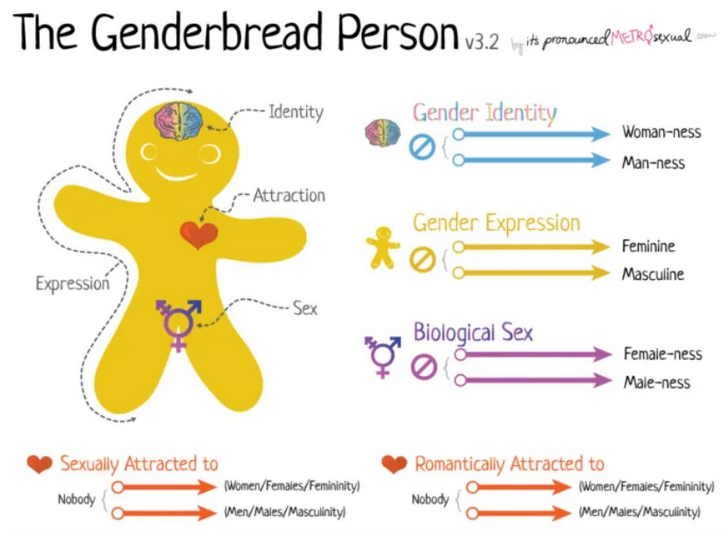
It wasn’t all that long ago that the vast majority of young people seeking “gender-affirming” therapy were males hoping to become trans-females. In the last few years, that proportion has flipped completely.
September 25, 2022
The five-paragraph essay straitjacket
In Aeon, David Labaree discusses the good intent and terrible results of forcing students to rigidly follow the “five paragraph” model of essay writing:
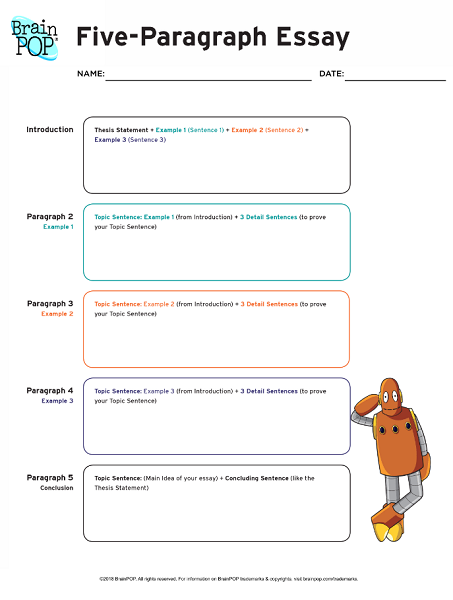
Schools and colleges in the United States are adept at teaching students how to write by the numbers. The idea is to make writing easy by eliminating the messy part – making meaning – and focusing effort on reproducing a formal structure. As a result, the act of writing turns from moulding a lump of clay into a unique form to filling a set of jars that are already fired. Not only are the jars unyielding to the touch, but even their number and order are fixed. There are five of them, which, according to the recipe, need to be filled in precise order. Don’t stir. Repeat.
So let’s explore the form and function of this model of writing, considering both the functions it serves and the damage it does. I trace its roots to a series of formalisms that dominate US education at all levels. The foundation is the five-paragraph essay, a form that is chillingly familiar to anyone who has attended high school in the US. In college, the model expands into the five-section research paper. Then in graduate school comes the five-chapter doctoral dissertation. Same jars, same order. By the time the doctoral student becomes a professor, the pattern is set. The Rule of Five is thoroughly fixed in muscle memory, and the scholar is on track to produce a string of journal articles that follow from it. Then it’s time to pass the model on to the next generation. The cycle continues.
Edward M White is one participant in the cycle who decided to fight back. It was the summer of 2007, and he was on the plane home from an ordeal that would have crushed a man with a less robust constitution. An English professor, he had been grading hundreds of five-paragraph essays drawn from the 280,000 that had been submitted that June as part of the Advanced Placement Test in English language and composition. In revenge, he wrote his own five-paragraph essay about the five-paragraph essay, whose fourth paragraph reads:
The last reason to write this way is the most important. Once you have it down, you can use it for practically anything. Does God exist? Well you can say yes and give three reasons, or no and give three different reasons. It doesn’t really matter. You’re sure to get a good grade whatever you pick to put into the formula. And that’s the real reason for education, to get those good grades without thinking too much and using up too much time.
White’s essay – “My Five-Paragraph-Theme Theme” – became an instant classic. True to the form, he lays out the whole story in his opening paragraph:
Since the beginning of time, some college teachers have mocked the five-paragraph theme. But I intend to show that they have been mistaken. There are three reasons why I always write five-paragraph themes. First, it gives me an organisational scheme: an introduction (like this one) setting out three subtopics, three paragraphs for my three subtopics, and a concluding paragraph reminding you what I have said, in case you weren’t paying attention. Second, it focuses my topic, so I don’t just go on and on when I don’t have anything much to say. Three and only three subtopics force me to think in a limited way. And third, it lets me write pretty much the same essay on anything at all. So I do pretty well on essay tests. A lot of teachers actually like the five-paragraph theme as much as I do.
Note the classic elements of the model. The focus on form: content is optional. The comfortingly repetitive structure: here’s what I’m going to say, here I am saying it, and here’s what I just said. The utility for everyone involved: expectations are so clear and so low that every writer can meet them, which means that both teachers and students can succeed without breaking a sweat – a win-win situation if ever there was one. The only thing missing is meaning.
For students who need a little more structure in dealing with the middle three paragraphs that make up what instructors call the “body” of the essay, some helpful tips are available – all couched in the same generic form that could be applicable to anything. According to one online document by a high-school English teacher:
The first paragraph of the body should contain the strongest argument, most significant example, cleverest illustration, or an obvious beginning point. The first sentence of this paragraph should include the “reverse hook” which ties in with the transitional hook at the end of the introductory paragraph. The topic for this paragraph should be in the first or second sentence. This topic should relate to the thesis statement in the introductory paragraph. The last sentence in this paragraph should include a transitional hook to tie into the second paragraph of the body.
You probably won’t be surprised that the second paragraph “should contain the second strongest argument, second most significant example, second cleverest illustration, or obvious follow-up to the first paragraph …” And that the third paragraph “should contain the third strongest argument …” Well, you get the picture.
August 2, 2022
QotD: Basic College Girl (aka “Becky”)
That’s the effect on guys, at any rate. Bad as that is, it’s far worse on girls. Guys establish social hierarchy through conflict; when they can’t compete with each other, they drop out and embrace the Ritalin Zombie lifestyle of video games and onanism. Girls compete through approval-seeking, which, since nowadays nobody’s different from anybody and everyone’s the best at everything, is easily channeled into conspicuous consumption. Hence all the items on that list.
For the Basic College Girl, then, conformism is a virtue. In fact, it’s the highest virtue — the “winner” is the one who does nothing, says nothing, thinks nothing but that which gets upvoted on social media …
… or downvoted on social media, as the case may be. Self-esteem culture has completely bypassed the normal feedback loops. Back in the days of meatspace-only communication, strong signals of disapproval from your peers were, 99 times out of 100, clear indicators that you’re doing it wrong. If the kids are making fun of your personal hygiene, then unless your name really is “Dick Smelley”, you need to take a long hard look at your showering habits. Kids can be horribly cruel, but most of the time they’re not wrong. And yes, bullying can (and often did) go overboard, but generally “stop being such a dork!” is great life advice, and the process of figuring out just what you’re doing that’s so dorky, and how to stop it, is crucial for one’s social development.
Social media changes all that. Anyone who has ever written a blog post — really, anyone who has ever made a substantive comment on a blog post — has had the experience of some drive-by troll shitting on you. As functional adults who grew up in meatspace we recognize this for what it is, and ignore it. But imagine that you hadn’t grown up in meatspace. What if you mistake this for substantive criticism? As it’s not psychologically sustainable to take it that way for long, you do what the Basic College Girl does: You call the commenter a “h8r” and, crucially, you consider having “h8rs” as confirmation that whatever you’re doing is right. After all, they couldn’t “h8” if they weren’t thinking about you.
Thus “approval-seeking”, a.k.a. chick competition, curdles into an attitude where you actively seek out “h8rs” to annoy.
This is where Normals grossly underestimate women like Alexandria Ocasio-Cortez. I’m personally terrified of AOC, because she is the embodiment of the Basic College Girl. Basic College Girls can’t be bargained with, they can’t be reasoned with, and the reason for both is: Both “bargaining” and “reasoning” imply that you think she’s doing something wrong, which is “h8”. And since “ur h8in”, that means you’re thinking about her more than she’s thinking about you, which means she’s validated, which means she wins. Which means she’s not only going to keep on doing what she’s doing, but will crank it up past 11, in order get more h8, to attract more h8rz.
This is our future. Since the only way to deal with a Basic College Girl is to say “no” — all the time, to everything, unconditionally — and we as a society have lost the ability to do that, we’re screwed. Get to know your new mistress. Xzhyr name is Becky, and she’s everywhere.
Severian, “The Basic College Girl”, Rotten Chestnuts, 2019-07-24.
July 22, 2022
Sexual liberation to sexual revolution to … today’s sexual desert
Chris Bray thinks that the sexual revolution “missed a turn, somewhere out in the desert”:
The discussion of what we didn’t mean to do is becoming an interesting one:
After decades of sexual liberation — Mattachine, Stonewall, Loving v. Virginia, Griswold v. Connecticut, Second Wave feminism and the Sexual Revolution, Lawrence v. Texas, Obergefell v. Hodges, and whatever else I’m missing in there (and I’m not sure Roe belongs on the list, but maybe) — we somehow arrive at a moment in which we merge a sexualized display of childhood and a relentless media-driven commodification of sexuality with the very clear reality that nobody’s having any sex:
One of the most comprehensive sex studies to date — the National Survey of Sexual Health and Behavior — found evidence of declines in all types of partnered sexual activity in the U.S. Over the course of the study from 2009 to 2018, those surveyed reported declines in penile-vaginal intercourse, anal sex and partnered masturbation …
Over the last 22 years, Herbenick has co-authored several studies about our sexual activity. Her most recent research finds that all of us, regardless of age, are having less sex, with the most dramatic decline among teenagers.
At the start of the study in 2009, 79% of those ages 14 to 17, revealed they were not having sex. By 2018, that number rose to 89%.
Liberation stabbed pleasure in the heart; we emptied sex. Hypersexualization turns out to be desexualization. The unrelenting joylessness and death odor of contemporary sexual culture emerges from seventy years of growing openness and freedom. How?
There’s no way to fully cover a question of that scope in a single post — but I refer, as a start, to the earlier posts I wrote about the sexualization of childhood and the way Jim Jones used sex as a weapon. Breaking barriers and repressive anchors broke connections and reference points: Yes, some people were trapped in oppressive societal norms, and it’s not at all my view that all the sexual liberation in our past wasn’t really liberating. But we broke marriage to set people free, and whoops. Some people experienced bourgeois heteronormativity as a prison, and so set out to release everybody from their cages, which seem to have not been cages for a whole lot of people. Congratulations, we’ve freed you from being part of a family.
July 19, 2022
How dating apps have changed the dating world
Rob Henderson on the changes dating sites have accelerated in the dating community:

“In the United States, 35 percent of Tinder users are college students ages 18 to 24 … ‘I’ve heard a joke on campus that goes something like this: ‘First base is hooking up, second base is talking, third base is going on a date and fourth base is dating’.“ (source).
I am just old enough to remember what the dating scene was like before the rise of Tinder and other dating/hook-up apps. It has changed a lot.
2012 was another world in many ways.
The situation has changed for everyone on the dating market. Even those who don’t use these apps. This is because even for the people who don’t use the apps, they still live in an environment where others use them. Over time, those who don’t use apps must adapt to the preferences and behavior of those who use them. Not the other way around.
One example of how the scene has changed. I have a friend from college. A good-looking guy. He showed me how many women he has matched with: More than 21,000. Twenty-one thousand. Tinder actually identified him as a valuable user early on, and gave him free perks and upgrades. They lifted his radius restrictions. This allowed him to match with even more women. I have another friend. Doesn’t have the best pictures on his profile. But not a bad looking guy. Over roughly the same period of time as my other friend, he has matched with seven women.
Some findings on dating apps:
- 18 to 25 percent of Tinder users are in a committed relationship.
- Women aged 23 to 27 are twice as likely to swipe right (“liked”) on a man with a master’s degree compared with a bachelor’s degree.
- Men swipe right (“liked”) on 62 percent of the women’s profiles they see; women swipe right (“liked”) on only 4.5 percent of the men’s profiles they see.
- Half of men who use dating apps while in a committed relationship reported having sex with another person they met on a dating app. All women who used dating apps while in a committed relationship reported having sex with another person they met on a dating app.
- 30 percent of men who use Tinder are married.
- In terms of attractiveness, the bottom 80% of men are competing for the bottom 22% of women and the top 78% of women are competing for the top 20% of men.
One way dating apps might be changing the dating scene. People used to have to go out to meet people. And it was costly to lose a relationship partner, in part because of the process involved in meeting someone new. Today, people know that a new partner is a few swipes away. Partners might be more replaceable. If things start deteriorating with their current partner, some can pull out a goldmine in their pocket.
There may be some sexual stratification going on as well. My two friends are examples of the above finding that being slightly more attractive as a man leads to far more matches.
June 22, 2022
Puberty, “white guilt”, and social contagion helps drive huge numbers of teen girls to think they are transgender
Until a few years ago — a blink of the eye in social terms — most individuals who wanted to transition to the other gender were born male. That is no longer the situation in North America, as vast numbers of young teens have been hammered with accusations of “privilege” for being white, while already undergoing the stresses and social disruption of puberty, seem to be deciding in groups that they must have been “assigned the wrong gender” at birth. In City Journal, Leor Sapir tells some of their stories:
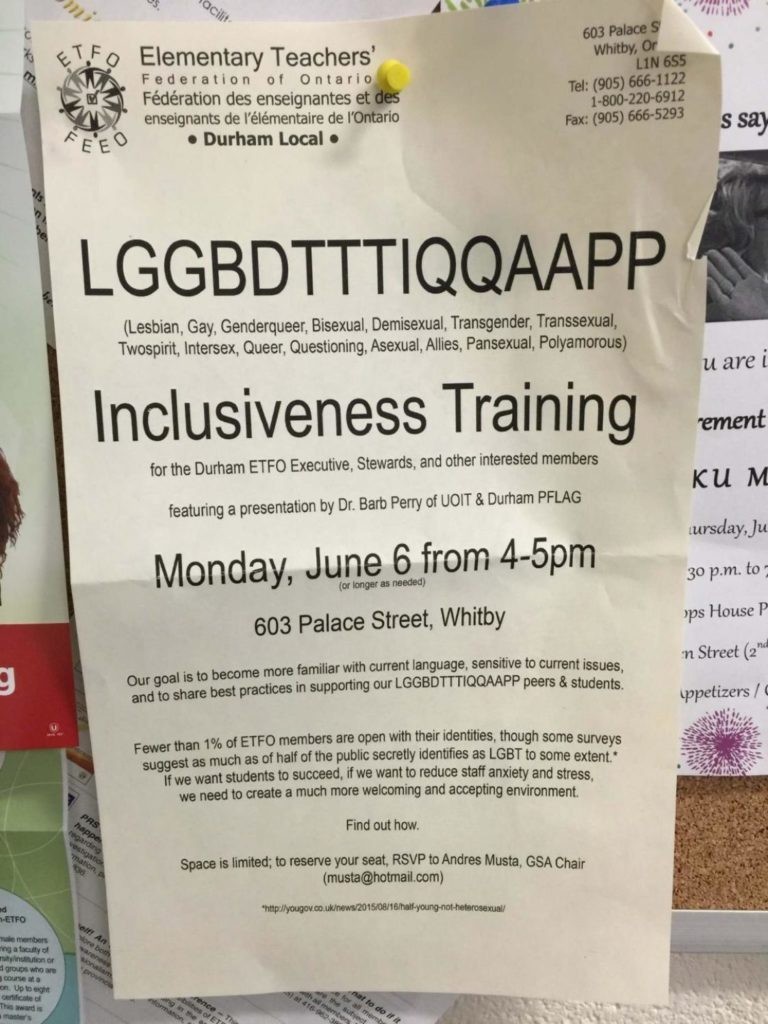
Patricia (a pseudonym) is the mother of a teenage girl who in recent years has come to identify as transgender. She lives in California, considers herself progressive, votes Democrat, and leads a group for parents of children with rapid onset gender dysphoria (ROGD) — that is, youth who suddenly experience distress with their bodies and believe that undergoing medical “transition” will make them whole again. When I spoke to her recently, she recounted how her daughter’s at-first-lesbian and then trans identity emerged in response to feelings of shame about being white.
I have since spoken to more than a dozen ROGD parents and parent-group leaders who tell a similar story. Their schools compulsively tell their children how awful it is to be white, how white people enjoy unearned “privilege”, how they benefit from “systems” put in place by and for white people for the sole purpose of oppressing “people of color”. Plagued by guilt, the children — almost all of them girls — rush to the sanctuary of “LGBTQ+” identity. Once there, they are catapulted into hero status. According to Patricia, some teachers at her daughter’s school are more forgiving toward “queer” and “trans” kids who hand in their homework late.
The students, especially the girls, absorb this messaging. They are acutely sensitive to how identity affects their social status and academic fortunes. They want the warmth that comes with queer/trans identity, but above all they don’t want to be thought of as vicious oppressors. Lacking maturity and self-confidence, they fail to put “anti-racist” indoctrination in its proper context. They do not appreciate its ahistorical, anti-intellectual, and anti-humanist foundations, nor are they aware of the incentives leading teachers and administrators to foist it on them. Being white is not something these teenagers can escape, but they can mitigate its social costs by declaring themselves part of an oppressed group.
The wages of whiteness for teenagers are, however, only half of the story. Decades of gay rights activism have taught us that being gay or lesbian is not something one chooses. The mainstream narrative of transgenderism — promoted aggressively in the context of civil rights policymaking — holds that even being transgender is something people have little control over. Gender identity, experts have argued in Title IX lawsuits, is innate, immutable, and “primarily dictated by messages from the brain”. Thus, membership in the “LGBTQ+ community” would seem to be nonvoluntary. One is either “born that way” or not.
[…]
Several of the parents I spoke to told me that their daughters’ friends all identify as non-heterosexual, despite none having ever kissed another teenager or been in a romantic relationship. LGBT identity is, for them, not related to sexual attraction or behavior. As Kate Julian has written in The Atlantic, America is going through a “sex recession”. Whereas in 1991, most teenagers would have had at least one sexual encounter by the time they graduated high school, by 2017 most had had none. The vacuum left by the hollowing out of courting and relationships has been filled, so it would seem, by a new, inward form of “sexuality” in which the sexual side of our nature is purely a private experience. The 1960s sexual-liberation movement has somehow bred asexual atomism.
April 24, 2022
“This is the status of mental illness in youth culture today, where […] they would like the laurel of victimhood without the actuality of being victimized”
Freddie deBoer has become convinced that there’s no such thing as “Multiple Personality Disorder”, despite the vastly increased numbers of young people with social media accounts who have built their online personas around their MPD or dissociative identity disorder (DID) issues:
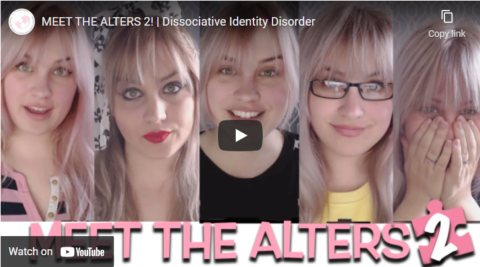
The technical name is dissociative identity disorder, but it’s more commonly referred to as multiple personality disorder. It’s been in a thousand cheesy cop shows and legal dramas, too many novels written in MFA programs, and untold freshman Into to Psychology textbooks. M. Night Shyamalan’s films Split and Glass are typical of pop culture portrayals of the disorder as a lurid and impossibly dramatic disorder, with clear and distinct switches between entirely separate personalities that occur at the most narratively convenient times. And in recent years there’s been an explosion of interest and claims of diagnosis of the disorder, coincident with the rise of Tumblr and TikTok, where there are thriving communities of adolescents who claim to have dozens of “alters” and who refer to themselves as “systems”, along with a whole boutique identity vocabulary that they’ve developed. The number of views of videos tagged with #DID on TikTok is in the billions.
And yet.
And yet dissociative identity disorder is probably not even real. Its presence in the DSM has proven to be persistently and deeply controversial. Diagnostic criteria and standards are perceived by many to be highly impressionistic and unacceptably subject to the biases of the evaluator. The disorder reflects a cinematic and exaggerated vision of what mental illness looks like, which may make it more attractive to people looking for a diagnosis. DID is often presented as a kind of get-of-accountability-free card, as someone who claims to have it can always say that past bad behavior was caused by another personality and is thus not their responsibility. Many high-profile cases have been revealed to be frauds or, at least, the product of a therapist or doctor forcing patients to think they have it. The most famous DID patient, Chris Costner Sizemore of The Three Faces of Eve, claimed that her alters were not the product of childhood trauma but that she was born with multiple selves with fully-formed personalities, which completely contradicts the established etiology for the disorder.
Some who have claimed to have it have done so only after being accused of a crime. (An embezzler’s sole defense in a trial in the early 1980s was that an alter stole the money.) Diagnosis often involves the use of “recovered memories” and hypnosis, both of which are controversial if not outright discredited. And claiming to have it does not even require conscious dishonesty, just an active imagination and too much awareness of DID’s presence in culture. Regardless, the mere existence of the disorder provokes angry disagreement in a way that simply does not exist for other major psychiatric conditions like schizophrenia or bipolar disorder. Even proponents of the prevalence of DID acknowledge major overlapping symptoms with schizophrenia and major difficulties in diagnosis.
[…]
Even if we accept the disorder and are particularly generous in our criteria, the number of genuine cases from the past one hundred years is probably somewhere in the three digits. It’s that rare, if real. And its newfound prevalence among adolescents is particularly hard to understand, given that the condition has generally been identified among those in their 30s and 40s and is even rarer among the young. As stated in a 2011 lit review, “Despite continuing research on the related concepts of trauma and dissociation, childhood DID itself appears to be an extremely rare phenomenon that few researchers have studied in depth.”
The people who have traditionally been treated for DID have suffered, greatly, and not in the cool arty time-to-dye-my-hair-again type of suffering common to social media performance, but actual, painful, pitiable suffering. Those patients who have been diagnosed in the past with the disorder, by doctors, and who have spent years and years dealing with the consequences, are often truly debilitated people, whether the disorder itself is real or not. They require intense therapy, are often medicated with powerful drugs, and are frequently subject to long-term hospitalization. They tend to live broken and pain-filled lives, like most people with serious mental illness.
Of the dozens of high-follower DID accounts that I’ve seen, almost none are experiencing any of that. Plenty of them are in therapy, but judging from how they talk about it, it all seems to be of the customer service variety of therapy. Hardly any of them say they’re medicated, which I guess makes sense — every last one I’ve seen comes from the school that sees mental illness as some adorable personality quirk that makes them unique and high status, rather than as a source of great pain and personal destruction. They don’t take meds because they don’t think there’s anything to treat. And, indeed, they aren’t living debilitated lives. On the contrary, they’re flourishing, going about self-actualized and successful lives, getting into Ivy League schools, bragging about their social media clout, being girlbosses. This is the status of mental illness in youth culture today, where we are expected to extend every accommodation to those who say they have mental illness even as they would seem to require no accommodation at all; they would like the laurel of victimhood without the actuality of being victimized.
þ to Colby Cosh for the link.
April 16, 2022
How much of teenagers identifying as transgender is “social contagion and the development of a new youth subculture”?
The sheer number of children and teens who are deciding that they are “trans” is far in excess of previous generations. How much of this phenomena may be accounted for by social contagion?

My teenage daughter has decided that she is “trans”. So have all her friends. Not some of them. Not most of them. Every. Single. One.
She had never heard of trans, and had no signs of gender dysphoria, until she was moved to a new, cool trans-friendly school by her unsuspecting, politically liberal parents. There she met a group of geeky (or dare I say nerdy?), smart, slightly (but not very) gender nonconforming, artsy kids. As I understand it, they all discovered “trans” together. The old “cis” friends were swiftly discarded in favour of this exciting new peer group.
Exploring “trans stuff” online with friends is a source of great interest and excitement — a real social event. What’s not to love about 245 gender identities, complete with their own unique flags? Then there are those cool neo-pronouns. Forcing your out-of-touch old parents to refer to you as “ze” or “ey” (how do you pronounce that again??) in the name of “inclusivity” is just too delicious to resist. The manga, the cute avatars in computer games, the blue or pink hair — all part of the fun as well. Mocking the outgroup (in this case so-called “cis” people in general and the dreaded TERFs in particular) is also good for a laugh — especially if they happen to be your parents as well.
There is even a special vocabulary with lots of new terms — deadnaming, misgendering, sex assigned at birth, and much more. If these concepts need to be explained to your uncool parents (accompanied by eye rolls of course), so much the better.
Bonding with friends, searching for their identity and place in life, working out their sexuality, separating from family — these are all normal developmental tasks for teens. For many, youth subcultures can be a natural part of that. Some are harmless. Some, like drug use and extreme dieting, not so much. But in the case of the latter, sensible adults usually intervene to help steer the young people in the right direction. Not in the case of trans. Here we have adults steering kids down a dangerous path, which involves permanent, life altering drugs and surgeries for which there is no good evidence base.
For many of these kids, LGBTQ+ is a youth subculture. It really is as simple as that. Recent surveys have been identifying skyrocketing rates of “trans” or “queer” identification in young people. One found that an astonishing 39% of young adults in the US aged between 18-24 identified with the label LGBT — the figure for teens <18 may well be even higher. Of course this figure includes gay and lesbian people as well as those identifying as trans. Another poll, which looked only at gender, found that nearly 10% of US high schoolers identified as “gender diverse”. Yet another survey gives a lower figure of 1.8%. Whichever figure is correct, this is a huge explosion in numbers over a very short period of time. As endocrinologist Dr Will Malone asks; “How do we reconcile these numbers with 2013 data reporting the prevalence of adult gender dysphoria to be a rare 2-14 in 100,000?”
Social contagion and the development of a new youth subculture, that’s how.
H/T to Blazing Cat Fur for the link.


