Sparta had a formidable military reputation, but their actual battlefield performance hardly backed it up. During the fifth and fourth centuries, Sparta lost as often as it won. Spartan battlefield tactics were a bit better than other Greek poleis, but this is damning with faint praise. The Spartiates themselves were mostly like every other group of wealthy Greek hoplites. But the Spartan military reputation was extremely valuable – the loss of that reputation during the Peloponnesian War does much to explain the rough decades Sparta would experience following its end.
That is one of the core things we can learn from Sparta: a reputation for military excellence can often be more valuable than the excellence itself – real or imagined. A powerful army can only fight one battle at a time, but the idea of a powerful army can intimidate any number of enemies all at once. […] when Sparta was forced to turn from intimidation to force, it ran out of force with frightening speed.
Those who have been here for a while may already be wondering, “Wait, though – this is the guy who is always telling us that winning battles isn’t as important as achieving strategic objectives and who is always on about logistics and operations! What about that?” I think that actually goes a long way to explaining how an army with a modest advantage in tactics and organization ends up without a winning record. […] I want to stress something here: the horrors of Spartan society cannot be justified on the grounds they produced superior soldiers, because they quite evidently did not. Sparta’s actual military record was, in fact, depressingly average. Only the reputation was special; the men were just men.
Bret Devereaux, “Collections: This. Isn’t. Sparta. Part VI: Spartan Battle”, A Collection of Unmitigated Pedantry, 2019-09-20.
May 18, 2022
QotD: Sparta’s excellent military reputation was not matched by actual battlefield excellence
May 6, 2022
QotD: “… the Spartiates were quite possibly the least productive people to ever exist”
Bret Devereaux, “Collections: This. Isn’t. Sparta. Part II: Spartan Equality”, A Collection of Unmitigated Pedantry, 2019-08-23.
April 30, 2022
QotD: The position of helots in Spartan society
We are very poorly informed about the helots. Our snobbish sources … are, for the most part, singularly uninterested in them, so we’re left putting together a patchwork of information. That in turn leads into situations where students of ancient Greece can can up with the wrong impression if they don’t have all of the sources in mind (we’ll see this is a common trend with Sparta – reading just Xenophon or just Plutarch can be deeply misleading).
First, let us dispense with the argument, sometimes offered, that the helots were more like medieval serfs than slaves as we understand the ideas and thus not really slaves – this is nonsense. Helots seem to have been able to own moveable property (money, clothing etc), but in fact this is true of many ancient slaves, including Roman ones (the Romans called this quasi-property peculium, which also applied to the property of children and even many women who were under the legal power (potestas) of another). Owning small amounts of moveable property was not rare among ancient non-free individuals (or, for that matter, other forms of slavery).
No, what legally separated helots from douloi (chattel slaves in most Greek societies) was that they were slaves of the Spartan state rather than of individual Spartans – this had nothing to do with any sense of greater freedom they might have had. Indeed, Plutarch relates the saying that “in Sparta the free man is more free than anywhere else in the world, and the slave more a slave” (Plut. Lyc. 28.5). He can only be referring to the helots here. Indeed, Plutarch’s statement is telling – the helots were treated poorly by the standards of ancient chattel slavery, which is, I must stress, an incredibly low bar. Ancient societies treated enslaved people absolutely horribly and yet somehow the helot lot was commonly thought worse.
But the final word on if we should consider the helots fully non-free is in their sanctity of person: they had none, at all, whatsoever. Every year, in autumn by ritual, the five Spartan magistrates known as the ephors declared war between Sparta and the helots – Sparta essentially declares war on part of itself – so that any spartiate might kill any helot without legal or religious repercussions (Plut. Lyc. 28.4; note also Hdt. 4.146.2). Isocrates – admittedly a decidedly anti-Spartan voice – notes that it was a religious, if not legal, infraction to kill slaves everywhere in Greece except Sparta (Isoc. 12.181). As a matter of Athenian law, killing a slave was still murder (the same is true in Roman law). One assumes these rules were often ignored by slave-holders of course – we know that many such laws in the American South were routinely flouted. Slavery is, after all, a brutal and inhuman institution by its very nature. The absence of any taboo – legal or religious – against the killing of helots marks the institution as uncommonly brutal not merely by Greek standards, but by world-historical standards.
We may safely conclude that the helots were not only enslaved persons, but that of all slaves, they had some of the fewest protections – effectively none, not even protections in-name-only.
But what do the helots do?
The answer is mostly “they farm” but getting more specific than that get sticky fast. But we may try to keep this brief: helots were enslaved agricultural laborers. Helots were owned not by individual spartiates, but by the Spartan state, where they were assigned – through whatever method we do not know – to work the plots of land (kleroi, see above) assigned to the spartiates who, as noted above, were forbidden from engaging in any kind of productive labor. The helots seem to have lived in their own villages and settlements – no great surprise, as the Messenian helots seem to have been far more numerous than the Laconian ones and the spartiates themselves did not live in Messenia in any great numbers. It does seem that the Messenian helots were gathered in a smaller number of nucleated villages rather than split up as farmsteads, probably to make it easier for the small number of spartiates stationed there to keep watch on them. And they seemed to have produced not only simple cereal staples, but the full range of agricultural products: wheat (Xen Lac. 5.3 – we’ll come back to this), barley, grapes and wine, figs, olives and olive oil, cheese, textiles (wool) and animal products, including meat and fish.
Bret Devereaux, “Collections: This. Isn’t. Sparta. Part II: Spartan Equality”, A Collection of Unmitigated Pedantry, 2019-08-23.
March 25, 2022
QotD: Herodotus as Spartan propagandist
Herodotus seems to be at the start of it, at least in our sources – he relates a story where, after an embarrassing failure in an effort to reduce tiny Tegea to helotage (the Tegeans kicked the Spartans’ asses) in the mid-sixth century, the Spartans supposedly stole the bones of the hero Orestes. Consequently, Herodotus notes, the Spartans were from that point on able to always beat Tegea and subdued the Peloponnese (Hdt. 1.68), resulting in the creation of the Spartan-led Peloponnesian League. The unbeatable Spartans thus appear. It’s possible the Spartan reputation predated this, but – as we’ll see – Herodotus will be the one who codifies that reputation and cements it.
Except, hold on a minute – how hard was it to subdue the Peloponnese? It seems to have been done with a fairly adept mix of diplomacy and military force (champion one side in a local dispute, beat the other, force both into your alliance, repeat, see Kennell (2010), 51-3 for details). But it is little surprise that Sparta would be dominant in the Peloponnese. Messenia and Laconia together was around 2,600 square miles or so. This is – if you’ll pardon the expression – flippin’ massive by the standards of Greek poleis. More than twice as large as the next largest polis in all of Greece (Athens). Sparta is fully one-third of the Peloponnese (the peninsula Sparta is located on). The remaining two-thirds is home to many other poleis – Corinth, Argos, Elis, Tegea, Mantinea, Troezen, Sicyon, Lepreum, Aigeira and on and on. Needless to say, Sparta was several times larger than all of them – only Corinth and Argos came even remotely close in size. The population differences seem to have roughly followed land area. Sparta was just much, MUCH larger and more powerful than any nearby state by the start of the fifth century.
Sparta thus spends the back half of the 500s as the teenager beating up all of the little kids in the sandbox and making himself leader. When you are upwards of three times larger (and in some cases, upwards of ten times larger) than your rivals, a reputation for victory should not be hard to achieve. And, in the event, it turns out it wasn’t.
Which brings us back to Herodotus […] because he isn’t just observing the Spartan reputation, Herodotus is manufacturing the Spartan reputation. Herodotus is our main source for early Greek history (read: pre-480) and for the two Persian invasions of Greece. Herodotus’ Histories cover a range of places and topics – Persia, Greece, Scythia, Egypt – and contain a mixture of history, ethnography, mythology and straight up falsehoods. But – as François Hartog famously pointed out in his The Mirror of Herodotus (originally in French as Le Miroir d’Hérodote), Herodotus is writing about Greece, even when he is writing about Persia – those other cultures and places exist to provide contrasts to the things that Herodotus thinks bind all of the fractious and fiercely independent Greek poleis. And he is perfectly willing to manufacture the past to make it fit that vision.
Sparta has a role to play in that narrative: the well-governed polis, a bastion of freedom, ever opposed to tyranny, be it Greek or Persian. We’ll come back to Sparta’s … let’s say relationship … with Persian “tyranny” next week. But for Herodotus, Sparta is the expression of an ideal form of “Greekness” and in Herodotus’ logic, being well-governed (eunomia is the Greek term) results primarily in military excellence. For the story Herodotus is telling to work, Sparta – as one of the leading states resisting Persia – must be well governed and it must be militarily excellent. That’s what will make a good story – and Herodotus never lets the facts get in the way of a good story.
(Sidenote: Athens – at least post-Cleisthenic Athens – gets this treatment too. Athens ends up embodying a different set of “Greek” virtues and where Sparta shows its prowess on land, the Athenians do so at sea.)
And so, Herodotus – the myth-maker – talks up the Spartiates at Thermopylae (you know, the brave 300) and quietly leaves out the other Laconians (who, if you scrutinize his numbers, he knows must be there, to the tune of c. 900 men), downplaying the other Greeks. Spartan leadership is lionized, even when it makes stupid mistakes (Thermopylae, to be clear, was a military disaster and Spartan intransigence nearly loses the battle of Plataea, but Herodotus represents this as boldness in the face of the enemy; even more fantastically inept was the initial Spartan plan to hold on the Isthmus of Corinth as if no one had ever seen a boat before).
Bret Devereaux, “Collections: This. Isn’t. Sparta. Part VI: Spartan Battle”, A Collection of Unmitigated Pedantry, 2019-09-20.
February 23, 2022
QotD: Debunking the “Spartan one-man-army” myth
Well, ok, perhaps they fought in groups, but were individually better at it. There is something to this. Multiple sources – most notably Xenophon stresses the greater degree of physical fitness that the Spartiates display (Xen. Lac. 4.5, 5.9). The Spartiates were rich after all, so they were well fed and able to build muscle accordingly; they also had a pretty active life-style (mostly things like sport-hunting) and kept athletically active. Chances are the average Spartiate was thus larger and fitter than the average hoplite – although again, the other Lakedaemonians in the phalanx (perioikoi, hypomeiones, mothakes, neodamodes, even helots fighting as hoplites) would probably balance out this effect to at least some degree (more strongly as time went on and the number of Spartiates shrunk!)
But what about martial skills and combat expertise? The fact is, there isn’t much evidence for a Spartan military training regime – certainly nothing like what the Romans had, or even what later Hellenistic Greek poleis set up. We’ve already discussed the agoge and you will note that at no point did swordsmanship, spear use, shield use, or anything of the like come up. There is, to be fair, some mock battles with fennel stalks in place of spears and some war-dances which may have served to mimic combat, but the agoge isn’t a training program, it’s an indoctrination program. Plutarch and Xenophon – who describe it – are quite clear on this: the point is to produce men who are obedient to the laws and subservient to the community (Xen. Lac. 2.10-11; Plut. Lyc. 25.3). Any advantages to military quality are evidently secondary (e.g. Xen. Lac. 2.7).
Xenophon himself notes – in the words of Cyrus (who he presents as an ideal ruler) – that hoplite-style warfare in close-combat required little practice (Xen. Cyrop. 2.1.9-16). And I want to stress two things about this statement: first that Xenophon had seen a lot of hoplite battle when he knew this and was in a position to know and second that he had also seen a lot of Sparta. It is hard to imagine Xenophon – with his Laconophilia – saying that practice for hoplites was unimportant if the Spartans had relied on it heavily. Nevertheless, there he is, saying that all of the movements a hoplite actually needed to perform – blocking with the shield, striking with spear or sword – were instinctive and did not need to be taught or practiced.
Plato provides our first solid evidence for the hoplomachia – practice drills in hoplite warfare – but immediately suggests through the person of Laches that the Spartans, specifically do not practice it (Plat. Lach. 182d-183a), because they think it doesn’t work. There is clearly some practicing with arms in Sparta as elsewhere in Greece (see J. K. Anderson, Military Theory and Practice in the Age of Xenophon (1970), 84-93 for the best discussion of the evidence; note also Wheeler, “Hoplomachia and Greek Dances in Arms” (1982)), but it never approaches the formal weapons drills we see from the Romans, or the complex fighting systems of the late Middle Ages. Nor does Sparta appear to be meaningfully exceptional in this regard; they seem to be exactly as tutored – or untutored – as all the other Greeks.
Nor may we rely on the assumption that the Spartan has more battle experience than his foes. The fact is that Greek poleis went to war fairly regularly and that they tended to bring most of their hoplite class out to battle when they did and as such most Greeks of the hoplite class from anywhere will have likely experienced combat. The Spartans are not unique in this and it is not clear that Sparta fights more often – they murder helots more often, sure, but this is hardly effective preparation for open battle.
(The contrast with Rome is again instructive. Sparta is intermittently at war, but the Roman Republic is continuously at war for all but six years out of five centuries, with the average Roman citizen probably spending upwards of seven years under arms – and this is before the professionalization of the legion. The average Roman free-holding farmer (the technical term is assidui) of the Middle Republic might truthfully have considered Leonidas and his 300 as amateurish by comparison.)
So what can we conclude? Well, the Spartiates are probably, on the whole, better nourished and fitter than their average opponent. If they have an edge in weapons training, it is fairly small – some sort of martial arts experts or superlative weapon-masters they are not. Which, of course they aren’t; the way they fight doesn’t require them to be. Hoplite fighting was never about individual martial excellence or skill, but about holding a position in the formation, supporting and being supported in turn by the shields of the men around you. The hoplite didn’t need to be a spear-master and evidently – we must agree with Xenophon – gained little from becoming so.
Bret Devereaux, “Collections: This. Isn’t. Sparta. Part VI: Spartan Battle”, A Collection of Unmitigated Pedantry, 2019-09-20.
February 11, 2022
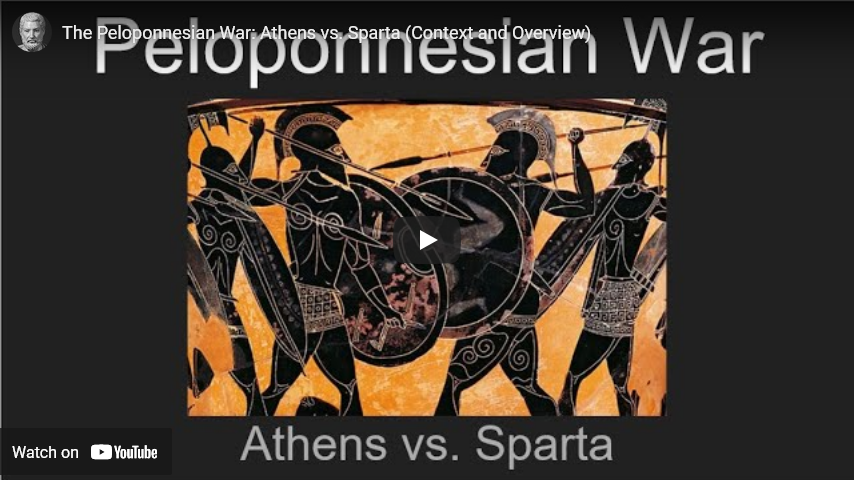
The Peloponnesian War: Athens vs. Sparta (Context and Overview)
Thersites the Historian
Published 28 Oct 2021In this lecture, I cover Greek history from 478-404 BCE with an emphasis on the Peloponnesian War. This is intended as a primer on the topic and I devote more time to establishing the context and causes of the war than I do going through the details of conflict itself.
Patreon link: https://www.patreon.com/thersites
PayPal link: paypal.me/thersites
Discord: https://discord.gg/QCaXXFr
Brave Browser: https://brave.com/noa557
Twitter link: https://twitter.com/ThersitesAthens
Minds.com link: https://www.minds.com/ThersitestheHis…
Steemit/dtube link: https://steemit.com/@thersites/feed
BitChute: https://www.bitchute.com/channel/jbyg…
February 10, 2022
QotD: Classical Greek Polis governance
The standard ingredients of a Greek polis are an assembly of all adult citizen males (often called an ekklesia, meaning “assembly”), a smaller advisory committee (frequently called a boule), and then a set number of elected officials who carried out the laws of the other two (magistrates). I’ve given the common names for these components, but they often have different names in different poleis.
Those basic units don’t change from a democracy (like Athens) to an oligarchy (like Corinth) or even a tyranny (like Syracuse) – the type of government just reflects the division of power between them, and the method of selection. In a democracy, like Athens, the ekklesia will have most of the power, being able to overrule the boule or the magistrates. Often the members of the boule can come from a wide range of wealth classes or even be randomly selected.
In an oligarchy, power is generally focused in the magistrates – drawn from the upper-crust of society – and a smaller boule, with the ekklesia having much less power to restrain them. Alternately, the ekklesia may be restricted in size to only a wealthy subset of the citizenry. In a tyranny, a single person (the tyrant) is able to gain control of the system, through a mix of demagoguery, charisma and well-placed cronies. Even under a tyranny, the basic three-part system still exists, it is simply subverted and controlled by one person (much like how some modern dictatorships have all of the institutions of a democracy – courts, elections, etc – but all of the power is still in one set of hands and the elections are shams).
I want to note this up front because it is important to recognize that the existence of a popular assembly does not make a Greek polis a democracy, nor does the existence of a powerful magistrate make it a tyranny. As we’ll see, Sparta has an assembly, it is just laughably weak; it also has two very powerful magistrates, but their power is strongly checked. What matters is the division of power between these parts. I also wanted to start here because Sparta follows this basic model, but with some interesting variations. Knowing what the normal model looks like will make it easier to spot the variations that are unique to Sparta.
Bret Devereaux, “Collections: This. Isn’t. Sparta. Part V: Spartan Government”, A Collection of Unmitigated Pedantry, 2019-08-29.
January 28, 2022
Spartan glossary
As part of a multi-post series at A Collection of Unmitigated Pedantry on explaining (and debunking) the modern day mythology of classic-era Sparta, Bret Devereaux compiled a useful glossary of terms that will be of use as I’ll be excerpting several sections of his series for today’s and several future QotD entries. I’ve added a few entries that seem necessary and expanded some others, but these are enclosed in square brackets “[ ]” to show they’re not directly from Bret’s original post.
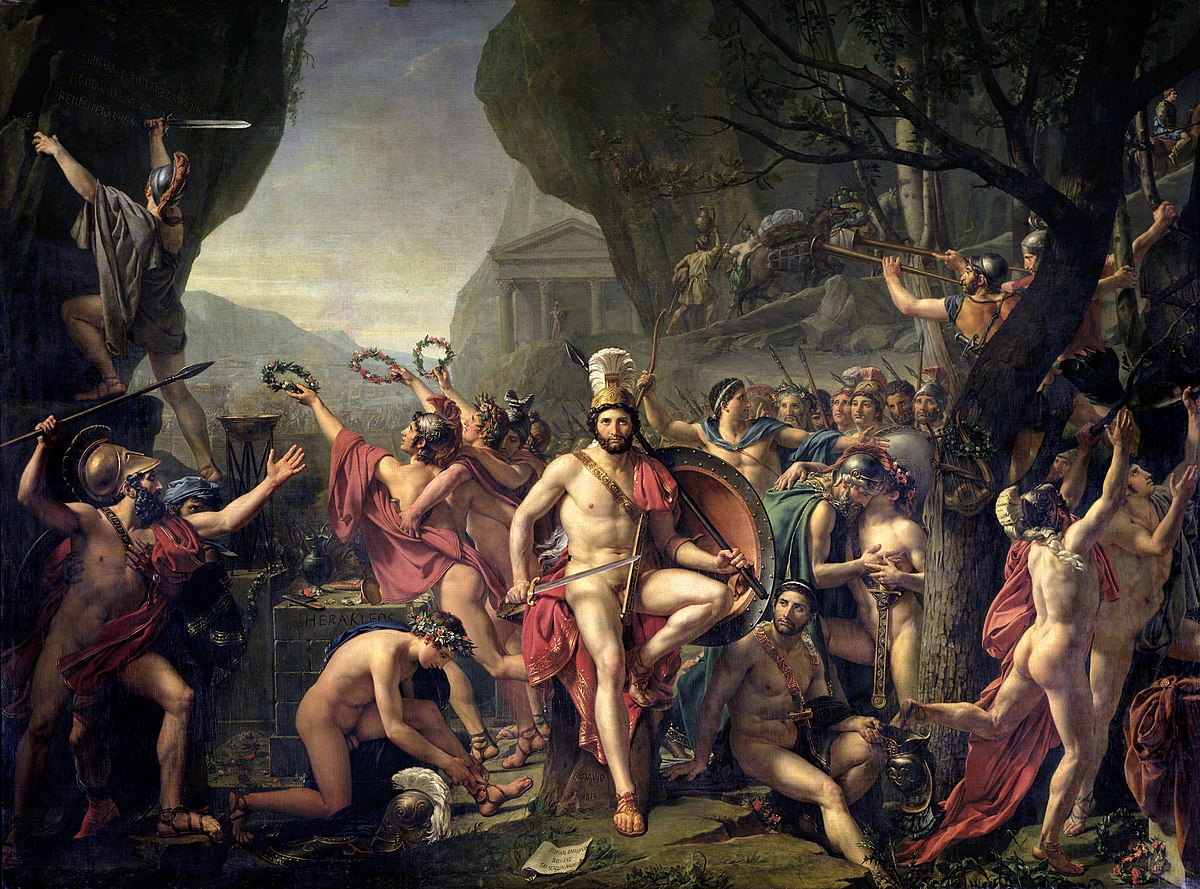
Leonidas at Thermopylae by Jacques-Louis David, 1814.
Wikimedia Commons.
Acclamation. A vote held by acclamation (sometimes called a “voice vote”) is a vote where, instead of getting an exact count of yes and no votes, the outcome is judged by the volume of people calling out yes or no. Obviously it would be very hard to tell who had really won a close vote. This is used in modern democracies only for very lopsided (typically unanimous) votes; in Classical Sparta, this was the only voting system, votes were never counted.
[Agoge. The Spartan education system for boys (ἀγωγή, pronounced ah-go-GAY). “Spartan boys were, at age seven, removed from their families and grouped into herds (agelai) under the supervision of a single adult male Spartan – except for the heirs to the two hereditary kings, who were exempt. Order was kept by allowing the older boys to beat and whip the younger boys (Xen. Lac. 2.2). The boys were intentionally underfed (Plut. Lyc. 17.4; Xen. Lac. 2.5-6). They were thus encouraged to steal in order to make up the difference, but severely beaten if caught (Plut. Lyc. 17.3-4; Xen. Lac. 2.6-9). … We are not told, but it seems unavoidable that in a system that intentionally under-feeds groups of boys to force them to steal, that the weakest and smallest boys will end up in a failure spiral where the lack of food leads to further weakness and further victimization at the hands of other boys. I should note that while ancient parenting and schooling was certainly more violent than what we do now – the Spartan system was recognized as abnormally violent towards these boys, even by the standards of the time.”]
Apella. The Apella was the popular assembly of Sparta, consisting of all adult male Spartiates over the age of thirty. The Apella was presided over by the Ephors and all votes were by acclamation. The Apella did not engage in debate, but could only vote “yes” or “no”. The Gerousia had the power to ignore the decisions of the Apella. [In most other Greek poleis the equivalent body would be called the ekklesia.]
Ephor. The Ephors were a board of five officials in Sparta, elected annually by the Apella (technically plus the two kings). The Ephors oversaw the two hereditary Spartan kings and could even bring a king up on charges before the Gerousia. In practice, the Ephors – not the kings – wielded the most political power in Sparta. The Ephors were also responsible for ritually declaring war on the helots every year. The institution as a whole is sometimes collectively referred to as the Ephorate.
Gerousia. The Gerousia – literally a council of old men (the members were “Gerontes” – literally “old men”) which consisted of thirty members, 28 elected (by acclamation in the Apella) plus the two hereditary kings. The elected members all had to be over the age of 60. Gerontes were elected for life. The Gerousia decided what motions could be voted on by the Apella and had the power to cancel any decision of the Apella. It also functioned as a court, with the power to try Spartiates and even the kings. In practice, with the Ephors, the Gerousia wielded the real political power in Sparta.
Helot. The subjugated slave class of Sparta, which made up the overwhelming majority of its residents, the Helots did the agricultural labor which kept the Spartan state running. Helots can be further subdivided into the Laconian helots (those living in Sparta proper) and the Messenian helots (the populace of Messenia which had been reduced to helotry after being conquered by Sparta in the 7th century B.C.). Helots often fought in Sparta’s armies, apparently as screening light-infantry forces (and also as camp followers and servants).
Homoioi. See: Spartiates.
Hoplite. Hoplites were Greek heavy infantry soldiers who fought with a heavy round shield (sometimes called a “hoplon” but more correctly an “aspis“) and a spear, typically in armor.
Hypomeiones. One of several sub-citizen underclasses in Sparta, the Hypomeiones (literally “the inferiors”) were former Spartiates who had fallen off the bottom of the Spartan social system, either through cowardice or (more likely) being unable to pay the contribution to the Syssitia. Though free, they had no role in government.
[Kings. Sparta had two royal lines and two kings at all times. The kings were drawn from the Agaids and the Eurypontid families. In theory, both kings had the same set of powers. The kings’ wealth was derived from lands allocated from territory taken from the perioikoi, and the eldest son of the current king in each line was the presumptive heir. On this basis, the kings were almost always the two wealthiest men in Sparta.]
[Kleroi (sing. kleros). The (theoretically) equal plots of land allocated to each Spartiate, worked on his behalf by Helots to generate the contributions to the individual Spartiate‘s Syssitia. Up to half of the production of the kleros had to be paid to the Spartiate by the Helots who worked that land. At some point, the kleroi became inheritable property, which facilitated the accumulation of wealth in fewer and fewer hands, contributing to the demographic collapse of the Spartiate class.]
Lycurgus. [The name of the (almost certainly) mythical founder figure of Sparta.] Lycurgus had been the younger brother of one of Sparta’s two kings, but had left Sparta to travel when his brother died, so that he would be no threat to his young nephew. After a time, the Spartans begged Lycurgus to come back and reorganize society, and Lycurgus – with the blessing of the Oracle at Delphi – radically remade Spartan society into the form it would have for the next 400 years. He did not merely change the government, but legislated every facet of life, from child-rearing to marriage, to the structure of households, the economic structure, everything. Once he had accomplished that, Lycurgus went back to Delphi, but before he left he made all the Spartans promise not to change his laws until he returned. Once the Oracle told him his laws were good, he committed suicide, so that he would never return to Sparta, thus preventing his laws from ever being over turned. So the Spartans never changed Lycurgus’ laws, which had been declared perfect by Apollo himself. Subsequently, the Spartans accorded Lycurgus divine honors, and within Sparta he was worshiped as a god.
Mothax. One of several sub-citizen underclasses in Sparta, the Mothakes were non-citizen men, generally thought to have been the children of Spartiate fathers and helot mothers, brought up alongside their full-citizen half-siblings. Mothakes fought in the Spartan army alongside spartiates, but had no role in government. A surprising number of innovative Spartan commanders – Gylippus and Lysander in particular – came from this class.
Neodamodes. One of several sub-citizen underclasses in Sparta, the Neodamodes were freed helots, granted disputed land on the border with Elis. Though they served in the Spartan army, the Neodamodes lacked any role in government. We might consider the helots who served in Brasidas’ army, the Brasideioi as a type of the Neodamodes (they did settle in the same place).
Peers: See: Spartiates.
Perioikoi (sing. Perioikos). The perioikoi (literally the “dwellers around”) were one of several sub-citizen underclasses in Sparta. The perioikoi were residents of communities which were subjected to the Spartan state, but not reduced to helotry. They lived in their own settlements under the control of the Spartan state, but with limited internal autonomy. The perioikoi seem to have included Sparta’s artisans, producing weapons, armor and tools; they were also made to fight in Sparta’s armies as hoplites.
Polis (pl. poleis). A complicated and effectively untranslatable term, polis most nearly means “community” and is often translated as “city-state”. However, there were poleis in Greece without cities (Sparta being one – a fact often concealed by translators rendering polis as city). Instead a polis consists of a body of citizens, their state, and the territory it controls (including smaller villages but not other subjugated poleis), usually but not always centered on a single urban center. Poleis are almost by definition independent and self-governing (that is, they have eleutheria and autonomia).
Skiritai. The Skiritai were one of several sub-citizen underclasses in Sparta. Dwellers in Skiritis, the mountains between Laconia and Arcadia, they were mostly rural people who were free, but subject to the Spartan state, similar to the perioikoi. The main difference between the two was that the Skiritai – perhaps because of their mountainous homes – served not as hoplites, but as an elite corps of light infantry in the Spartan army.
Spartiates, also called peers or homoioi. The citizen class at Sparta, the Spartiates were a closed ethnic aristocracy. Membership required both a Spartiate father and a Spartiate mother, as well as successful completion of the Agoge and membership in a Syssitia. Spartiate males over thirty were the only individuals in Sparta who could participate in government, although the political power of the average Spartiate was extremely limited.
Syssitia (sing. syssition). The Syssitia were the common mess-groups into which all adult Spartiates were divided. Each member of the Syssitia contributed a portion of the mess-group’s food; the contribution was a condition of citizenship. Spartiates who could not make the contribution lost citizenship and became Hypomeiones.
QotD: The Myth of Spartan Equality
Where does this idea come from? Well, it comes from the same pro-Spartan sources we discussed last time. Plutarch claims that Lycurgus‘ decision to banish money from Sparta essentially removed greed by making all of the Spartans equal (Plut. Lyc. 9.1-4) – or equally poor – though we should note that Plutarch is writing 900 years after Lycurgus (again, probably not a real person) was supposed to have lived. Xenophon notes approvingly that Lycurgus forbade the Spartans from engaging in productive business of any kind, making them thus unable to accumulate wealth (Xen. Lac. 7.1-6). Land was supposed to be distributed equally to each full Spartan citizen – the spartiates or homoioi (we’ll define these terms in a second) in equal plots called kleroi.
This idea – the Myth of Spartan Equality – is perhaps the single “biggest idea” in the conception of the Spartan state, rivaled only by the myth of Spartan military excellence (don’t worry, we’ll get there!). There is something deeply appealing, at a bedrock emotional level, to the idea of a perfectly equal society like that. And that myth of equality has prompted all sorts of thinkers from all sorts of eras (Rousseau, most famously) – including our own – to be willing to look past Sparta’s many, many failings.
And on the face of it, it does sound like a very equal society – practically a collectivist utopia. It is a pleasant vision. Unfortunately, it is also a lie.
[…] every Greek polis had a three-level layer-cake of status: the citizen body, free non-citizens (like foreigners), and non-free persons (slaves). You could – and the Greeks did – divide that top group by wealth and birth and so on, but we’ll get to that a bit later in this post and the next. For now, let’s stick with the three-level layer cake. Sparta follows this scheme neatly.
At the top were the Spartiates, the full-citizen male Spartans. According to Herodotus there were once 8,000 of these (Hdt. 7.234.2); supposedly 9,000 based on the initial number of equal land plots (kleroi) handed out (Plut. Lyc. 8.3 – or rather than saying “handed out” we might say “seized”). Of course these are tallies of Spartiate males, but women could be of citizen stock (but not citizens themselves) and we ought to imagine an equal number of spartiate women at any given time. For a child to be born into the citizen class (and thus eligible for the agoge and future full citizenship), he had to have a citizen father and a citizen mother. We’ll deal with the bastards a bit further down. Also, the spartiates were often also called the homoioi, sometimes translated as “peers” but literally meaning something like “the equals”. As we’ll see, that equality is notional at best, but this ideal of citizen equality was something Sparta advertised about itself.
[…]
But the final word on if we should consider the helots fully non-free is in their sanctity of person: they had none, at all, whatsoever. Every year, in autumn by ritual, the five Spartan magistrates known as the ephors declared war between Sparta and the helots – Sparta essentially declares war on part of itself – so that any spartiate might kill any helot without legal or religious repercussions (Plut. Lyc. 28.4; note also Hdt. 4.146.2). Isocrates – admittedly a decidedly anti-Spartan voice – notes that it was a religious, if not legal, infraction to kill slaves everywhere in Greece except Sparta (Isoc. 12.181). As a matter of Athenian law, killing a slave was still murder (the same is true in Roman law). One assumes these rules were often ignored by slave-holders of course – we know that many such laws in the American South were routinely flouted. Slavery is, after all, a brutal and inhuman institution by its very nature. The absence of any taboo – legal or religious – against the killing of helots marks the institution as uncommonly brutal not merely by Greek standards, but by world-historical standards.
We may safely conclude that the helots were not only enslaved persons, but that of all slaves, they had some of the fewest protections – effectively none, not even protections in-name-only.
Bret Devereaux, “Collections: This. Isn’t. Sparta. Part II: Spartan Equality”, A Collection of Unmitigated Pedantry, 2019-08-23.
January 5, 2022
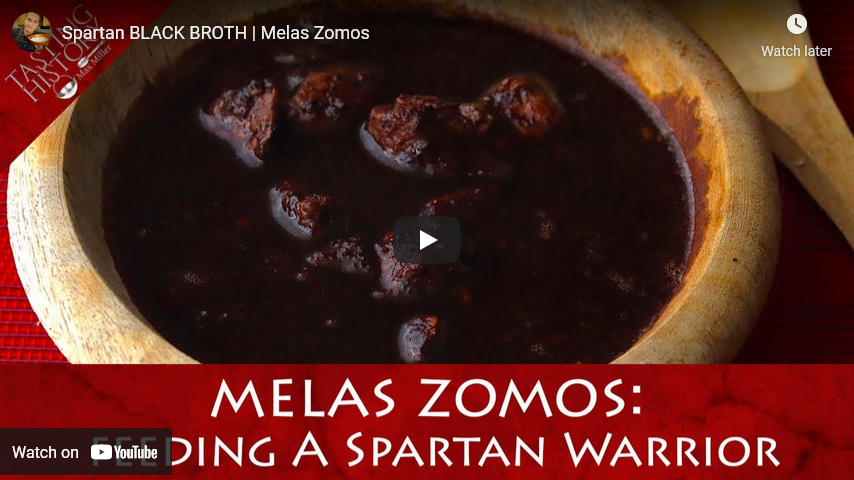
Spartan BLACK BROTH | Melas Zomos
Tasting History with Max Miller
Published 6 Oct 2020If you’ve ever wanted to be a Spartan warrior, then making a bowl of Melas Zomos is just a part of the process. Today, I cover each step in making both Melas Zomos and in making a Spartan warrior.
Follow Tasting History here:
Instagram: https://www.instagram.com/tastinghist…
Twitter: https://twitter.com/TastingHistory1
Reddit: r/TastingHistoryHelp Support the Channel with Patreon: https://www.patreon.com/tastinghistory
LINKS TO INGREDIENTS & EQUIPMENT**
Canon EOS M50 Camera: https://amzn.to/3amjvwu
Canon EF 50mm Lens: https://amzn.to/3iCrkB8
All-Clad Stock Pot: https://amzn.to/32HsYMx
Bay Leaves: https://amzn.to/33DnaTP
KitchenAid Blender: https://amzn.to/2RBkWi4LINKS TO SOURCES**
The Spartans by Paul Cartledge: https://amzn.to/35Jd2vo
Plutarch On Sparta: https://amzn.to/2H6SBhy
The Deipnosophistai by Athenaeus: https://amzn.to/3my5v8D
The Histories by Herodotus: https://amzn.to/32NdcQF
A Companion to Sparta by Anton Powell: https://amzn.to/3c94PSq
The Rise of the Greek Aristocratic Banquet by Marek Wecowski: https://amzn.to/2RFD5LK
Sparta Reconsidered by Helena P. Schrader: https://bit.ly/32FQOIM**Amazon offers a small commission on products sold through their affiliate links, so each purchase made from this link, whether this product or another, will help to support this channel with no additional cost to you.
MELAS ZOMOS
INGREDIENTS
– 2lb (1kg) Pig Leg (or other pork product)
– 2 Cups (1/2 liter) Pig Blood
– 1 Cup (235ml) White Wine Vinegar
– 2 Tablespoons Olive Oil
– 1 Tsp Salt
– 4 Cups (1 Litre) Water
– 3 Bay Leaf
– 1 Large Chopped OnionMETHOD
1. Set a large stock pot over medium heat, then add the olive oil and onions and cook until tender and lightly brown, about 10 minutes.
2. Add the chopped pork to the pot book for another 10 minutes.
3. Pour in the vinegar and 3-4 cups of water (4 if you have fresh pig’s blood, 3 if you have coagulated blood), the salt and the bay leaves. Once boiling, lower the heat to medium low and let the soup simmer, covered, for 45 minutes to and hour or until the pork is cooked through.
4. Add the pork blood* and simmer for 15 minutes more, then serve.
*If you are using coagulated pork blood, mix it with the final cup of water in a blender and blend until most of it is liquid. Strain out any large chunks and add the liquid to the soup.PHOTO CREDITS
Symposium Scene: Marie-Lan Nguyen / https://bit.ly/3muYyoI
Schwarzsauer: Overbergderivative work / https://bit.ly/2ZJxBUq
Dinuguan with puto: Lambanog / https://bit.ly/3mrLyAg
Odaker: https://bit.ly/2ZKFRUi
Plutarch Bust: Odyssey / https://bit.ly/2FAYO54
Roman mosaic from Dougga: Pascal Radigue / https://bit.ly/2E6Wu4Y
Greek Vase with Child: National Archaeological Museum of Athens / https://bit.ly/2H04tlo
Sarcophagus Marcus Cornelius Statius: Louvre Museum / https://bit.ly/2ZK3bla
Dionysus with Hermes on Jug: MatthiasKabel – https://bit.ly/2FECCqL
Mt Taygetus: Gepsimos – https://bit.ly/32A4SU8
Eurotas River: Gepsimos / https://bit.ly/2Fv4AVY
Xerxes: Darafsh / https://bit.ly/2H0lWds
October 2, 2021
This Is Sparta: The Material Remains of a Warrior Polis
Thersites the Historian
Published 1 Oct 2021A video about the material remains to be found at Sparta, or perhaps more precisely, why there isn’t more to see given the obvious importance of Sparta.
Patreon link: https://www.patreon.com/thersites
PayPal link: paypal.me/thersites
Discord: https://discord.gg/QCaXXFr
Brave Browser: https://brave.com/noa557
Twitter link: https://twitter.com/ThersitesAthens
Minds.com link: https://www.minds.com/ThersitestheHis…
Steemit/dtube link: https://steemit.com/@thersites/feed
BitChute: https://www.bitchute.com/channel/jbyg…
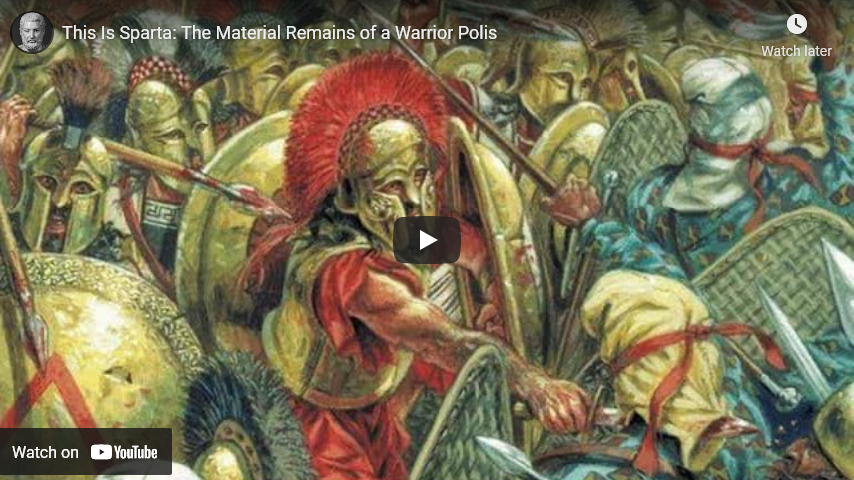
I was unaware that Sparta, after its final military defeat by Roman forces in 192 BC, was effectively turned into a full-time “Living History” theme park for the benefit of tourists … subsidized by the Roman state.
June 4, 2021
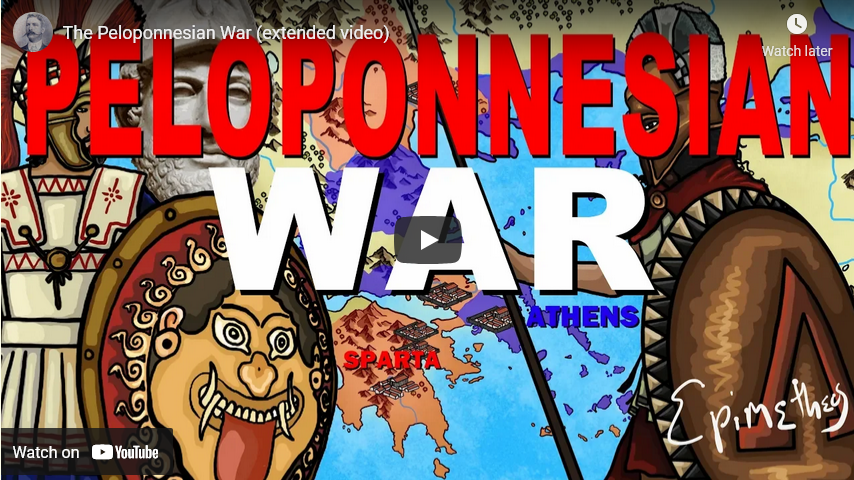
The Peloponnesian War
Epimetheus
Published 21 Oct 2018The Peloponnesian War (extended Video)
Support new videos from Epimetheus on Patreon! 😀
https://www.patreon.com/Epimetheus1776
From the comments:
Epimetheus
2 years ago (edited)
On Spartan society I left out the council of five ephors who were elected annually and shared power with the two kings. This video is a little less edited and recorded partially earlier this year and this evening — sorry if the audio sounds a little all over the place — but I thought some of you may enjoy a finished video rather than one that does not get released — let me know what you think of this longer less polished style of video in contrast to the shorter version of this videoI have increasingly committed to using most of my time on this channel writing researching editing drawing and narrating these videos by myself, I love doing it and would not like to go back to working full time in a cubicle (doing boring stuff) if you want to help me out with upgrading my software and equipment (I use a slow old computer and a tablet) you can do so on Patreon https://www.patreon.com/Epimetheus1776
Even if it is just a single dollar I greatly appreciate you taking the time and your generosity
April 12, 2021
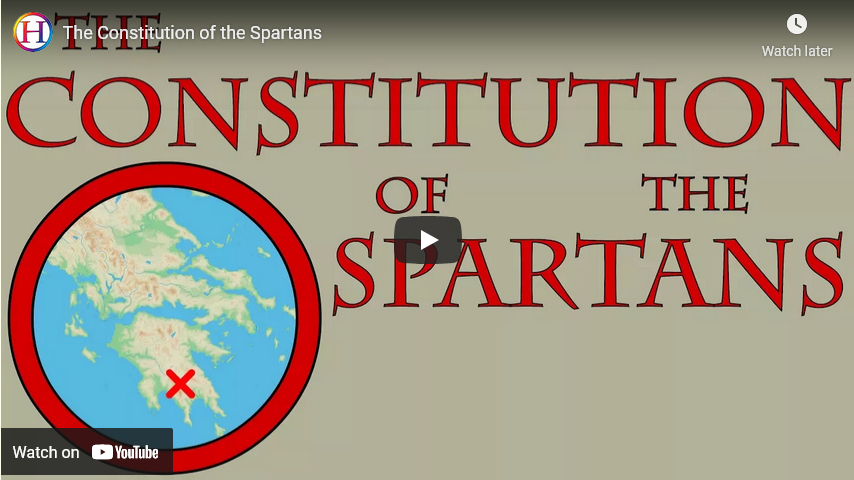
The Constitution of the Spartans
Historia Civilis
Published 11 Sep 2017Patreon | http://historiacivilis.com/patreon
Donate | http://historiacivilis.com/donate
Merch | http://historiacivilis.com/merch
Mailing List | http://historiacivilis.com/mailinglist
Twitter | http://historiacivilis.com/twitter
Website | http://historiacivilis.comSources:
The Constitution of the Spartans, by Xenophon: http://amzn.to/2j7JXTB
The Moralia, by Plutarch: http://amzn.to/2gNMYHU
Parallel Lives: The Life of Lycurgus, by Plutarch: http://amzn.to/2xS29nI
Politics, by Aristotle: http://amzn.to/2wMq5ss
Rhetoric, by Aristotle: http://amzn.to/2xS3niO
Laws, by Plato: http://amzn.to/2wLpsiN
On the Republic, by Cicero: http://amzn.to/2j7Flgg
The Histories, by Herodotus: http://amzn.to/2xdH4a7
The Spartan Regime, by Paul A. Rahe: http://amzn.to/2vPmRqS
Property and Wealth in Classical Sparta, by Stephen Hodkinson: http://amzn.to/2xdV7MS
The Rise of Athens, by Anthony Everitt: http://amzn.to/2j69uMS
Persian Fire, by Tom Holland: http://amzn.to/2vPyCxEWe are a participant in the Amazon Services LLC Associates Program, an affiliate advertising program designed to provide a means for us to earn fees by linking to Amazon.com and affiliated sites.
Music:
“Air Hockey Saloon,” by Chris Zabriskie
“Candlepower,” by Chris Zabriskie
“CGI Snake,” by Chris Zabriskie
“Heliograph,” by Chris Zabriskie
“Hallon,” by Christian Bjoerklund
From the comments:
Temporary Fakename
3 years ago
You know, i thought the Roman political system was pretty odd and arcane. But the Spartans have a dual monarchy that has absolute power, except when it doesn’t, an elected Senate that is chosen partially randomly that can pass whatever the hell they want with a public assembly and punish kings, except when an all-male aristocracy decided no, a female aristocracy that is overwhelmingly rich but can’t vote, and a population so terrified of its own slaves that it ritually committed atrocities against them. Compared to that Roman politics look simple and elegant.
I found the presentation quite interesting and informative, but I felt that some discussion of the differences between the terrible plight of the Helots and the not-quite-free status of the Perioikoi was merited. I also felt that the final segment on the eventual decline of Sparta missed a major factor — Spartan military defeats in the Battle of Leuctra in 371 BC and the Battle of Mantinea in 362 BC — but reading down in the comments, I saw someone else had already brought this up:
xelena
2 years ago (edited)
This is a good video, but is missing a super important point at the end: The cause for the decline of Spartan power was its defeat by Epaminondas of Thebes and his freeing of Messenia (the land of the Helots). He also founded Messene in Messenia and Megalopolis in Arcadia for the Helots, which became a powerful check to Sparta. Spartan power never recovered from this death blow to its slave economy and continued to wither away into the nothingness you describe.Epaminondas is mostly forgotten today, but he was one of the greatest men of antiquity. It was him and Pelopidas who put to bed the myth of Spartan invincibility and freed an entire people who had been enslaved for centuries. So in a way, the crippling blow did come from other Greeks, and the Helots did participate in it.
January 27, 2021
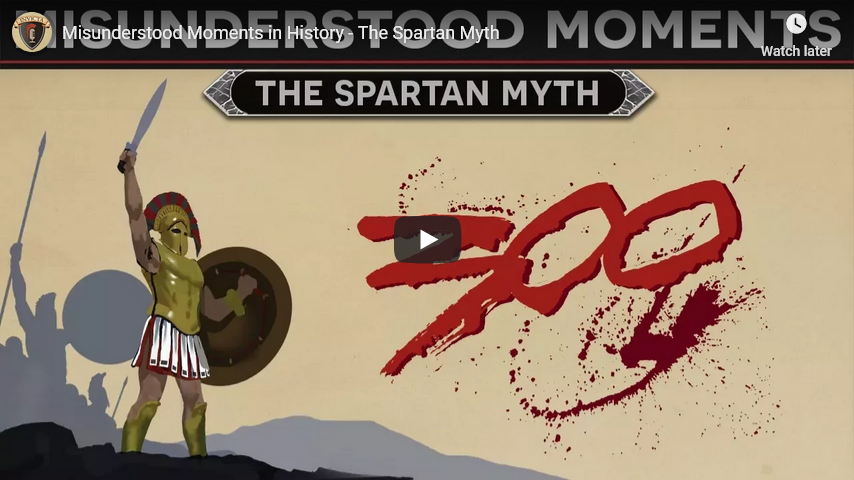
Misunderstood Moments in History – The Spartan Myth
Invicta
Published 27 Oct 2017Start your 30 day free trial here: http://ow.ly/eCd230fiZ7Q
The Spartans are immortalized in history as super soldiers bred for war. However most of what we think we know about them is a lie. Today we will unmask the truth behind the Spartan Myth.
The Great Courses Plus is currently available to watch through a web browser to almost anyone in the world and optimized for the US market. The Great Courses Plus is currently working to both optimize the product globally and accept credit card payments globally.
Documentary Credits:
Research: Dr Roel Konijnendijk
Script: Invicta
Artwork: Milek J
Editing: Invicta
Music: Total War OST, SoundnoteDocumentary Bibliography:
Paul Anthony Cartledge, The Spartans: The World of the Warrior-heroes of Ancient Greece
Nigel Kennell, Spartans: A New History (2010)
S. Hodkinson, Property and Wealth in Classical Sparta (2000)
J. Ducat, Spartan Education: Youth and Society in the Classical Period (2006)
S.M. Rusch, Sparta at War: Strategy, Tactics and Campaigns, 550-362 BC (2011)
E. Rawson, The Spartan Tradition in European Thought (1969)
S. Hodkinson & I.M. Morris (eds.), Sparta in Modern Thought (2012)
August 22, 2020
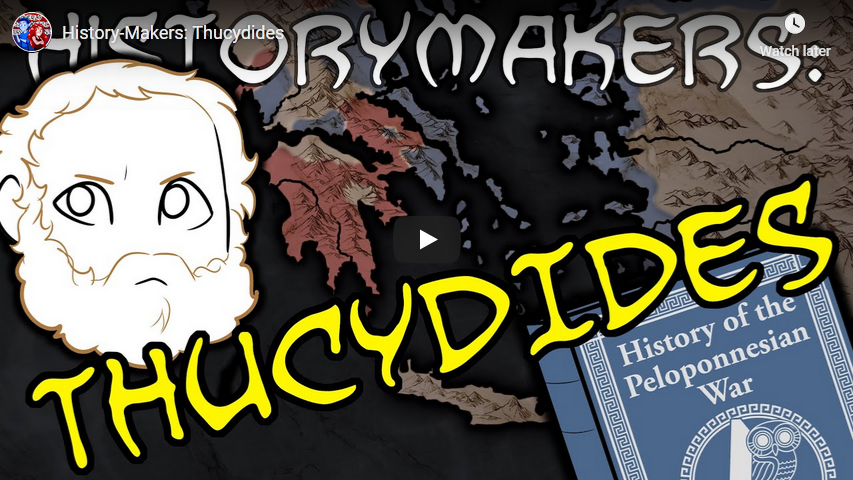
History-Makers: Thucydides
Overly Sarcastic Productions
Published 21 Aug 2020Start your free trial at http://squarespace.com/overlysarcastic and use code
OVERLYSARCASTICto get 10% off your first purchase.Ahh ancient Greece, it has been entirely too long. Today we’ll take a look at the foundational work of my entire career path — Thucydides’ History of the Peloponnesian War, a book that almost single-handedly set the standard for how we engage in historical inquiry. Also it has the added benefit of being about Ancient Greece so win-win!
SOURCES & Further Reading: History of the Peloponnesian War by Thucydides, Histories by Herodotus, Hellenica by Xenophon, and the 4 straight years I spent studying this in university — Boy do I love doing a video about a topic I’m specifically trained in.
This video was edited by Sophia Ricciardi AKA “Indigo”. https://www.sophiakricci.com/
Our content is intended for teenage audiences and up.PATREON: https://www.Patreon.com/OSP
DISCORD: https://discord.gg/kguuvvq
MERCH LINKS: https://www.redbubble.com/people/OSPY…
OUR WEBSITE: https://www.OverlySarcasticProductions.com
Find us on Twitter https://www.Twitter.com/OSPYouTube
Find us on Reddit https://www.Reddit.com/r/OSP/