
seangabb
Published 27 Dec 2022This is a video record of a lecture given by Sean Gabb, in which he discusses the three Emperors who followed in swift succession between the fall of Nero and the accession of Vespasian — Galba, Otho, and Vitellius.
The Roman Empire was the last and the greatest of the ancient empires. It is the origin from which springs the history of Western Europe and those nations that descend from Western Europe.
(more…)
January 12, 2023
The Early Emperors, Part 10 – The Year of the Four Emperors
Comments Off on The Early Emperors, Part 10 – The Year of the Four Emperors
January 11, 2023
QotD: “Little” gods in the ancient world
When we teach ancient religion in school – be it high school or college – we are typically focused on the big gods: the sort of gods who show up in high literature, who create the world, guide heroes, mint kings. These are the sorts of gods – Jupiter, Apollo, Anu, Ishtar – that receive state cult, which is to say that there are rituals to these gods which are funded by the state, performed by magistrates or kings or high priests (or other Very Important People); the common folk are, at best, spectators to the rituals performed on their behalf by their social superiors.
That is not to say that these gods did not receive cult from the common folk. If you are a regular sailor on a merchant ship, some private devotion to Poseidon is in order; if you are a husband wishing for more children, some observance of Ishtar may help; if you are a farmer praying for rain, Jupiter may be your guy. But these are big gods, whose vast powers are unlimited in geographic scope and their right observance is, at least in part, a job for important people who act on behalf of the entire community. Such gods are necessarily somewhat distant and unapproachable; it may be difficult to get their attention for your particular issue.
Fortunately, the world is full up of smaller and more personal gods. The most pervasive of these are household gods – god associated with either the physical home, or the hearth (the fireplace), or the household/family as a social unit. The Romans had several of these, chiefly the Lares and Penates, two sets of gods who presided over the home. The Lares seem to have originally been hearth guardians associated with the family, while the Penates may have begun as the guardians of the house’s storeroom – an important place in an agricultural society! Such figures are common in other polytheisms too – the fantasy tropes of brownies, hobs, kobolds and the like began as similar household spirits, propitiated by the family for the services they provide.
(As an aside, the Lares and Penates provide an excellent example on how practice was valued more than belief or orthodoxy in ancient religion: when I say that they “seem” or “may have originally been”, that is because it was not entirely clear to the Romans, exactly what the distinction between the Lares and Penates were; ancient authors try to reconstruct exactly what the Penates are about from etymologies (e.g. Cic. De Natura Deorum 2.68) and don’t always agree! But of course, the exact origins of the Lares or the Penates didn’t matter so much as the power they held, how they ought to be appeased, and what they might do to you!)
Household gods also illuminate the distinctly communal nature of even smaller religious observances. The rituals in a Roman household for the Lares and Penates were carried out by the heads of the household (mostly the paterfamilias although the matron of the household had a significant role – at some point, we can talk about the hierarchy of Roman households, but now I just want to note that these two positions in the Roman family are not co-equal) on behalf of the entire family unit, which we should remember might well be multi-generational, including adult children with their own children – in just the same way that important magistrates (or in monarchies, the king or his delegates) might carry out rituals on behalf of the community as a whole.
There were other forms of little gods – gods of places, for instance. The distinction between a place and the god of that same place is often not strong – when Achilles enrages the god of the river Scamander (Iliad 20), the river itself rises up against him; both the river and the god share a name. The Romans cover many small gods under the idea of the genius (pronounced gen-e-us, with the “g” hard like the g in gadget); a genius might protect an individual or family […] or even a place (called a genius locus). Water spirits, governing bodies of water great and humble, are particularly common – the fifty Nereids of Greek practice, or the Germanic Nixe or Neck.
Other gods might not be particular to a place, but to a very specific activity, or even moment. Thus (these are all Roman examples) Arculus, the god of strongboxes, or Vagitanus who gives the newborn its first cry or Forculus, god of doors (distinct from Janus and Limentinus who oversaw thresholds and Cardea, who oversaw hinges). All of these are what I tend to call small gods: gods with small powers over small domains, because – just as there are hierarchies of humans, there are hierarchies of gods.
Fortunately for the practitioner, bargaining for the aid of these smaller gods was often quite a lot cheaper than the big ones. A Jupiter or Neptune might demand sacrifices in things like bulls or the dedication of grand temples – prohibitively expensive animals for any common Roman or Greek – but the Lares and Penates might be befriended with only a regular gift of grain or a libation of wine. A small treat, like a bowl of milk, is enough to propitiate a brownie. Many rituals to gods of small places amount to little more than acknowledging them and their authority, and paying the proper respect.
Bret Devereaux, “Collections: Practical Polytheism, Part IV: Little Gods and Big People”, A Collection of Unmitigated Pedantry, 2019-11-15.
Comments Off on QotD: “Little” gods in the ancient world
January 10, 2023
The Early Emperors, Part 9 – Nero: Can We Trust the Sources?
seangabb
Published 25 Dec 2022This is a video record of a lecture given by Sean Gabb, in which he discusses the reasons for the black reputation possessed by the Emperor Nero.
The Roman Empire was the last and the greatest of the ancient empires. It is the origin from which springs the history of Western Europe and those nations that descend from Western Europe.
(more…)
Comments Off on The Early Emperors, Part 9 – Nero: Can We Trust the Sources?
January 5, 2023
Roman Emperors, Part 8 – Nero: Life and Death
seangabb
Published 20 Dec 2022This is a video record of a lecture given by Sean Gabb, in which he discusses what we can know or suspect about the life of the Emperor Nero. Some criticism here of Tacitus as a reliable source.
The Roman Empire was the last and the greatest of the ancient empires. It is the origin from which springs the history of Western Europe and those nations that descend from Western Europe. It is the political entity within which the Christian faith was born, and the growth of the Church within the Empire, and its eventual establishment as the sole faith of the Empire, have left an indelible impression on all modern denominations. Its history, together with that of the Ancient Greeks and the Jews, is our history. To understand how the Empire emerged from a great though finally dysfunctional republic, and how it was consolidated by its early rulers, is partly how we much understand ourselves.
(more…)
Comments Off on Roman Emperors, Part 8 – Nero: Life and Death
December 18, 2022
QotD: Citation systems and why they were developed
The first thing that needs to be noted here is that systems of citation are for the most part a modern invention. Pre-modern authors will, of course, allude to or reference other works (although ancient Greek and Roman writers have a tendency to flex on the reader by omitting the name of the author, often just alluding to a quote of “the poet” where “the poet” is usually, but not always, Homer), but they did not generally have systems of citation as we do.
Instead most modern citation systems in use for modern books go back at most to the 1800s, though these are often standardizations of systems which might go back a bit further still. Still, the Chicago Manual of Style – the standard style guide and citation system for historians working in the United States – was first published only in 1906. Consequently its citation system is built for the facts of how modern publishing works. In particular, we publish books in codices (that is, books with pages) with numbered pages which are typically kept constant in multiple printings (including being kept constant between soft-cover and hardback versions). Consequently if you can give the book, the edition (where necessary), the publisher and a page number, any reader seeing your citation can notionally go get that edition of the book and open to the very page you were looking at and see exactly what you saw.
Of course this breaks down a little with mass-market fiction books that are often printed in multiple editions with inconsistent pagination (thus the endless frustration with trying to cite anything in A Song of Ice and Fire; the fan-made chapter-based citation system for a work without numbered or uniquely named chapters is, I must say, painfully inadequate.) but in a scholarly rather than wiki-context, one can just pick a specific edition, specify it with the facts of publication and use those page numbers.
However the systems for citing ancient works or medieval manuscripts are actually older than consistent page numbers, though they do not reach back into antiquity or even really much into the Middle Ages. As originally published, ancient works couldn’t have static page numbers – had they existed yet, which they didn’t – for a multitude of reasons: for one, being copied by hand, the pagination was likely to always be inconsistent. But for ancient works the broader problem was that while they were written in books (libri) they were not written in books (codices). The book as a physical object – pages, bound together at a spine – is more technically called a codex. After all, that’s not the only way to organize a book. Think of a modern ebook for instance: it is a book, but it isn’t a codex! Well, prior to codex becoming truly common in third and fourth centuries AD, books were typically written on scrolls (the literal meaning of libri, which later came to mean any sort of book), which notably lack pages – it is one continuous scroll of text.
Of course those scrolls do not survive. Rather, ancient works were copied onto codices during Late Antiquity or the Middle Ages and those survive. When we are lucky, several different “families” of manuscripts for a given work survive (this is useful because it means we can compare those manuscripts to detect transcription errors; alas in many cases we have only one manuscript or one clearly related family of manuscripts which all share the same errors, though such errors are generally rare and small).
With the emergence of the printing press, it became possible to print lots of copies of these works, but that combined with the manuscript tradition created its own problems: which manuscript should be the authoritative text and how ought it be divided? On the first point, the response was the slow and painstaking work of creating critical editions that incorporate the different manuscript traditions: a main text on the page meant to represent the scholar’s best guess at the correct original text with notes (called an apparatus criticus) marking where other manuscripts differ. On the second point it became necessary to impose some kind of organizing structure on these works.
The good news is that most longer classical works already had a system of larger divisions: books (libri). A long work would be too long for a single scroll and so would need to be broken into several; its quite clear from an early point that authors were aware of this and took advantage of that system of divisions to divide their works into “books” that had thematic or chronological significance. Where such a standard division didn’t exist, ancient libraries, particularly in Alexandria, had imposed them and the influence of those libraries as the standard sources for originals from which to make subsequent copies made those divisions “canon”. Because those book divisions were thus structurally important, they were preserved through the transition from scrolls to codices (as generally clearly marked chapter breaks), so that the various “books” served as “super-chapters”.
But sub-divisions were clearly necessary – a single librum is pretty long! The earliest system I am aware of for this was the addition of chapter divisions into the Vulgate – the Latin-language version of the Bible – in the 13th century. Versification – breaking the chapters down into verses – in the New Testament followed in the early 16th century (though it seems necessary to note that there were much older systems of text divisions for the Tanakh though these were not always standardized).
The same work of dividing up ancient texts began around the same time as versification for the Bible. One started by preserving the divisions already present – book divisions, but also for poetry line divisions (which could be detected metrically even if they were not actually written out in individual lines). For most poetic works, that was actually sufficient, though for collections of shorter poems it became necessary to put them in a standard order and then number them. For prose works, chapter and section divisions were imposed by modern editors. Because these divisions needed to be understandable to everyone, over time each work developed its standard set of divisions that everyone uses, codified by critical texts like the Oxford Classical Texts or the Bibliotheca Teubneriana (or “Teubners”).
Thus one cited these works not by the page numbers in modern editions, but rather by these early-modern systems of divisions. In particular a citation moves from the larger divisions to the smaller ones, separating each with a period. Thus Hdt. 7.234.2 is Herodotus, Book 7, chapter 234, section 2. In an odd quirk, it is worth noting classical citations are separated by periods, but Biblical citations are separated by colons. Thus John 3:16 but Liv. 3.16. I will note that for readers who cannot access these texts in the original language, these divisions can be a bit frustrating because they are often not reproduced in modern translations for the public (and sometimes don’t translate well, where they may split the meaning of a sentence), but I’d argue that this is just a reason for publishers to be sure to include the citation divisions in their translations.
That leaves the names of authors and their works. The classical corpus is a “closed” corpus – there is a limited number of works and new ones don’t enter very often (occasionally we find something on a papyrus or lost manuscript, but by “occasionally” I mean “about once in a lifetime”) so the full details of an author’s name are rarely necessary. I don’t need to say “Titus Livius of Patavium” because if I say Livy you know I mean Livy. And in citation as in all publishing, there is a desire for maximum brevity, so given a relatively small number of known authors it was perhaps inevitable that we’d end up abbreviating all of their names. Standard abbreviations are helpful here too, because the languages we use today grew up with these author’s names and so many of them have different forms in different languages. For instance, in English we call Titus Livius “Livy” but in French they say Tite-Live, Spanish says Tito Livio (as does Italian) and the Germans say Livius. These days the most common standard abbreviation set used in English are those settled on by the Oxford Classical Dictionary; I am dreadfully inconsistent on here but I try to stick to those. The OCD says “Livy”, by the by, but “Liv.” is also a very common short-form of his name you’ll see in citations, particularly because it abbreviates all of the linguistic variations on his name.
And then there is one final complication: titles. Ancient written works rarely include big obvious titles on the front of them and often were known by informal rather than formal titles. Consequently when standardized titles for these works formed (often being systematized during the printing-press era just like the section divisions) they tended to be in Latin, even when the works were in Greek. Thus most works have common abbreviations for titles too (again the OCD is the standard list) which typically abbreviate their Latin titles, even for works not originally in Latin.
And now you know! And you can use the link above to the OCD to decode classical citations you see.
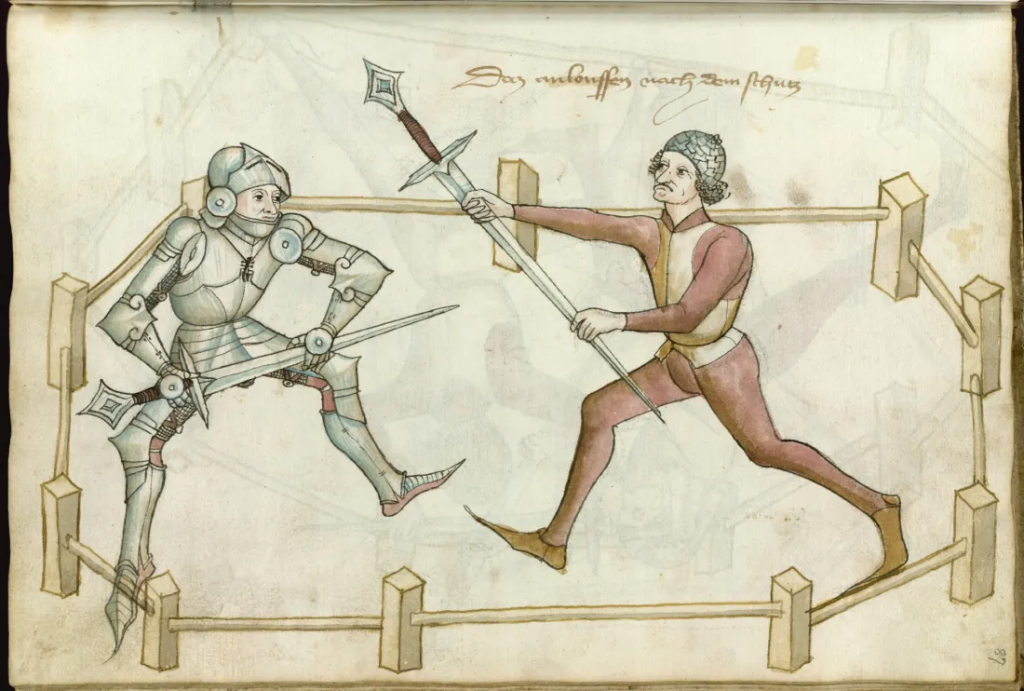
One final note here: manuscripts. Manuscripts themselves are cited by an entirely different system because providence made every part of paleography to punish paleographers for their sins. A manuscript codex consists of folia – individual leaves of parchment (so two “pages” in modern numbering on either side of the same physical page) – which are numbered. Then each folium is divided into recto and verso – front and back. Thus a manuscript is going to be cited by its catalog entry wherever it is kept (each one will have its own system, they are not standardized) followed by the folium (‘f.’) and either recto (r) or verso (v). Typically the abbreviation “MS” leads the catalog entry to indicate a manuscript. Thus this picture of two men fighting is MS Thott.290.2º f.87r (it’s in Det Kongelige Bibliotek in Copenhagen):
MS Thott.290.2º f.87r which can also be found on the inexplicably well maintained Wiktenauer; seriously every type of history should have as dedicated an enthusiast community as arms and armor history.
And there you go.
Bret Devereaux, “Fireside Friday, June 10, 2022”, A Collection of Unmitigated Pedantry, 2022-06-10.
Comments Off on QotD: Citation systems and why they were developed
October 26, 2022
Four Myths About Construction Debunked
Practical Engineering
Published 21 Jun 2022
Let’s set the record straight for a few construction misconceptions!Errata: The shot at 4:16 is of the Greek Acropolis (not a Roman structure).
Over the past 6 years of reading emails and comments from people who watch Practical Engineering, I know that parts of heavy construction are consistently misunderstood. So, I pulled together a short list of the most common misconceptions. Hope you don’t mind just a little bit of ranting from me 😉
(more…)
Comments Off on Four Myths About Construction Debunked
October 18, 2022
CENSORED: The Great Escape from Death Camp Sobibor – October 16, 1943 – WAH 082
World War Two
Published 16 Oct 2022The German Nazis and their helpers are facing increasing resistance, this week in Rome from the Vatican, and at the Sobibor extermination camp from their victims.
(more…)
Comments Off on CENSORED: The Great Escape from Death Camp Sobibor – October 16, 1943 – WAH 082
October 13, 2022
The Nazis’ Justification for the Genocide – October 9, 1943 – WAH 081
World War Two
Published 12 Oct 2022This week the Nazis go on the record about their genocide of the Jews. Meanwhile the Jews in Denmark are coming closer to safety, and the Roman Jews are again at peril.
(more…)
Comments Off on The Nazis’ Justification for the Genocide – October 9, 1943 – WAH 081
October 3, 2022
QotD: The foundation of Rome, as recounted by Vergil and Livy
Aeneas (son of Aphrodite/Venus and a mortal man, Anchises) does appear, by the by, in the Iliad, though he isn’t a particularly notable or impressive hero (naturally Vergil will embroider Aeneas until he is presented as the equal of an Achilles or Odysseus because … well, wouldn’t you?). The Aeneid follows (with the aid of a major flashback) Aeneas as he shepherds his surviving Trojans from Troy to their prophesied new homeland in Italy (with a minor stopover in Carthage) and then covers also the war that breaks out between Aeneas’ Trojans and the local inhabitants (the Latins) when he arrives. Vergil cuts off at the climactic moment of the war (which in turn presents Aeneas as rather morally grey, a feature that is also present, as we’ll see, in Livy’s retelling of Rome’s legends), but Livy provides the denouement. After a period of conflict (Livy presents two different versions of the exact sequence), Aeneas ends up married to Lavinia, the daughter of Latinus, king of the Latins (Livy calls them the Aborigines – lit, “the native inhabitants”, Vergil the Latins; in both cases Latinus is their king) and the Trojan exiles and Latinus’ people form a single community at Lavinium, which in turn founds a colony at Alba Longa, both in Latium (the region of Italy in which Rome is, although note we haven’t founded Rome yet).
We then fast forward a few generations. Rhea Silvia, a priestess of Vesta at Alba Longa gives birth to twins, Romulus and Remus by (Livy expresses some doubt) the god Mars. The twins are exposed (for complicated royal-family-drama reasons we needn’t get into) and rescued by either a she-wolf or a woman of ill-repute (Livy isn’t sure which on account of Latin lupa having both meanings and clearly both legends existed, Liv. 1.4) and raised among shepherds in the hills of northern Latium. More politics ensues, Romulus and Remus, having grown to adulthood, right some wrongs in their home city of Alba Longa and set out to found their own city.
At which point Romulus promptly gets into a fight with and murders Remus over who is going to be in charge (this sort of intense moral ambiguity where the venerated legendary founder figures are also quick to violence and deeply flawed is also a feature of the Aeneid and can be read either as a commentary on Augustus or as some lingering Roman discomfort with their own recent history of civil wars running from 88 to 31 BC; we are not the first people in history to have very mixed feelings about how well people in our country’s past lived up to our ideals). Crucially, Romulus forms his new settlement (prior to the fratricide) out of – as Livy has it – “the excess multitudes of the Albans and Latins, to which were added the shepherds” (Liv. 1.6.3). After this, desiring to increase the population of the city, Romulus sets a place of refuge in the city so that “a crowd of people from neighboring places, altogether without distinction, free and slave, fled there eager for new things” (Liv. 1.8.6) and were incorporated into Romulus’ growing city. Livy approves of this, by the by, declaring it the first step towards rising greatness.
Romulus quickly has another problem because all of these new settlers were men, so he concocts a plot to carry off all of the unmarried women of the neighboring people, the Sabines – an Umbrian people (we’ll come back to this, for now we’ll note they are ethnically and linguistically distinct from the Latins) – who lived in the hills north of Rome under the guise of a religious ceremony (Liv. 1.9-13). At a festival where the Sabines had been lured to under false pretenses, the Romans abduct and forcibly marry the Sabine women, while using hidden weapons to chase away their families (I should note Livy goes to some length to assure the reader that the captured maidens were subsequently persuaded to marry their Roman captors, rather than forced (Liv. 1.9.14-16), though what choice he imagines the unarmed, captive women to have had is left for the reader to wonder at in vain; in any event, we need not share Livy’s judgement or his effort at patriotic euphemism and may simply note that bride-capture is a form of rape). The Sabines naturally go to war over this but (according to Livy) a peace is mediated by the captured women (according to Livy, unwilling to see their new husbands and old fathers kill each other) and the two communities instead merge on equal terms. In the midst of all of this, Livy does have Romulus set down a set of common customs for his people, which he thinks to have been mostly Etruscan (Liv. 1.8.3), the Etruscans being the people inhabiting Etruria (modern Tuscany) the region directly north of Rome (Rome sits, in essence, on the dividing line between Latium to the South and Etruria to the North).
Now we want to note two things here from this high-speed trip through the first few chapters of Livy. First is the deep ambivalence towards Roman violence here. Livy presents Rome as a city founded on fratricide, conquest, rape and sacrilege. Livy occasionally attempts to soften the impact of these legends (particular with the Sabines), but only so far. This isn’t really the place to unpack of all of that but suffice to say that I think that Livy’s willingness to open his history of Rome – practically an official history of Rome – so darkly speaks to a literary project still attempting to come to grips with the stunning civil violence which had gripped Rome for Livy’s entire adult life and had, as he wrote, only recently ended. And one day we also ought to come back and do a deeper look at how women function in Livy’s legends and histories (Livy’s account becomes much more properly historical as he gets closer to his own time); women, mostly Roman women, suffering (often sexual) violence so that in their sacrifice the Roman state might be enhanced is a repeated motif in Livy (e.g. Lucretia, Verginia).
But more directly to our topic today, I want to note at this point exactly the sort of society Livy is imagining the earliest Rome, under its first king Romulus, in particular that it consists of a lot of different peoples and heritages. We’ll come back to exactly who all of these peoples are (historically speaking) in a moment. But Livy and Vergil first create a Trojan-Latin fusion community, which produces both Romulus and Remus and their initial core of settlers (mixed in with other, apparently purely Latin communities), who then gather up shepherds from all around, and then invite literally anyone from nearby communities to join them (which must include Etruscan communities to the north as well as Umbrians and Falisci of various sorts from the hills) and then finally fuses that community with the Sabines (an Umbrian people).
So we have our very first Romans, as the first Senate is being set up (1.8.7) and the very first spolia opima – the prize for when one commander defeats his opposite number in single combat – being won (1.10.7) and the very first temple being founded in the city (1.10.7). And those very first Romans, as Livy imagines them, are not autochthonous (that is, the original inhabitants of the place they live), nor ethnically homogeneous, but rather a Trojan-Aborigines-Latin-Faliscian-Umbrian-Etruscan-Sabine fusion community. For Livy, diversity – ethnic, linguistic, religious – defines Rome, from its very first days.
But of course this is all legends – important for understanding how the Romans viewed themselves, but necessarily less valuable for understanding the actual conditions in Rome at its earliest. Unfortunately, we lack reliable written sources for this part of the world so early (most of the “regal” period, when Rome was ruled by kings, notionally from 753 – the legendary founding date for the city – to 509, is beyond historical reconstruction).
Bret Devereaux, “Collections: The Queen’s Latin or Who Were the Romans? Part I: Beginnings and Legends”, A Collection of Unmitigated Pedantry, 2021-06-11.
Comments Off on QotD: The foundation of Rome, as recounted by Vergil and Livy
September 12, 2022
QotD: On the nature of our evidence of the ancient world
So let’s take a look at the sort of sources an ancient historian has to work with and what their limits are and what that means for what it is possible to know and what must be merely guessed.
The most important body of sources are what we term literary sources, which is to say long-form written texts. While rarely these sorts of texts survive on tablets or preserved papyrus, for most of the ancient world these texts survive because they were laboriously copied over the centuries. As an aside, it is common for students to fault this or that later society (mostly medieval Europe) for failing to copy this or that work, but given the vast labor and expense of copying and preserving ancient literature, it is better to be glad that we have any of it at all (as we’ll see, the evidence situation for societies that did not benefit from such copying and preservation is much worse!).
The big problem with literary evidence is that for the most part, for most ancient societies, it represents a closed corpus: we have about as much of it as we ever will. And what we have isn’t much. The entire corpus of Greek and Latin literature fits in just 523 small volumes. You may find various pictures of libraries and even individuals showing off, for instance, their complete set of Loebs on just a few bookshelves, which represents nearly the entire corpus of ancient Greek and Latin literature (including facing English translation!). While every so often a new papyrus find might add a couple of fragments or very rarely a significant chunk to this corpus, such additions are very rare. The last really full work (although it has gaps) to be added to the canon was Aristotle’s Athenaion Politeia (“Constitution of the Athenians”) discovered on papyrus in 1879 (other smaller but still important finds, like fragments of Sappho, have turned up as recently as the last decade, but these are often very short fragments).
In practice that means that, if you have a research question, the literary corpus is what it is. You are not likely to benefit from a new fragment or other text “turning up” to help you. The tricky thing is, for a lot of research questions, it is in essence literary evidence or bust. […] for a lot of the things people want to know, our other forms of evidence just aren’t very good at filling in the gaps. Most information about discrete events – battles, wars, individual biographies – are (with some exceptions) literary-or-bust. Likewise, charting complex political systems generally requires literary evidence, as does understanding the philosophy or social values of past societies.
Now in a lot of cases, these are topics where, if you have literary evidence, then you can supplement that evidence with other forms […], but if you do not have the literary evidence, the other kinds of evidence often become difficult or impossible to interpret. And since we’re not getting new texts generally, if it isn’t there, it isn’t there. This is why I keep stressing in posts how difficult it can be to talk about topics that our (mostly elite male) authors didn’t care about; if they didn’t write it down, for the most part, we don’t have it.
Bret Devereaux, “Fireside Friday: March 26, 2021 (On the Nature of Ancient Evidence”, A Collection of Unmitigated Pedantry, 2021-03-26.
Comments Off on QotD: On the nature of our evidence of the ancient world
August 19, 2022
QotD: How pre-modern polytheistic religions originated
This is exactly backwards for how the ancients, practicing their practical knowledge, learn about the gods. The myths, philosophical discussions and well-written treatises are not the foundation of the religion’s understanding of the gods, but rather the foaming crest at the top of the wave. In practice, the ruminations of those philosophers often had little to do the religion of the populace at large; famously Socrates’ own philosophical take on the gods rather upset quite a lot of Athenians.
Instead of beginning with a theory of the divine and working forwards from that, the ancients begin with proven methods and work backwards from that. For most people, there’s no need to know why things work, only that they work. Essentially, this knowledge is generated by trial and error.
Let’s give an example of how that kind of knowledge forms. Let’s say we are a farming community. It is very important that our crops grow, but the methods and variations in how well they grow are deep and mysterious and we do not fully understand them; clearly that growth is governed by some unseen forces we might seek the aid of. So we put together a ritual – perhaps an offering of a bit of last year’s harvest – to try to get that favor. And then the harvest is great – excellent, we have found a formula that works. So we do it next year, and the year after that.
Sometimes the harvest is good (well performed ritual there) and sometimes it is bad (someone must have made an error), but our community survives. And that very survival becomes the proof of the effectiveness of our ritual. We know it works because we are still here. And I mean survival over generations; our great-great-grandchildren, for whom we are nameless ancestors and to whom our ritual has always been practiced in our village can take solace in the fact that so long as this ritual was performed, the community has never perished. They know it works because they themselves can see the evidence.
(These sorts of justifications are offered in ancient works all the time. Cicero is, in several places, explicit that Roman success must, at the first instance, be attributed to Roman religio – religious scruples. The empire itself serves as the proof of the successful, effective nature of the religion it practices!)
Bret Devereaux, “Collections: Practical Polytheism, Part I: Knowledge”, A Collection of Unmitigated Pedantry, 2019-10-25.
Comments Off on QotD: How pre-modern polytheistic religions originated
August 10, 2022
Barbarian Europe: Part 7 – The Lombards in Italy
seangabb
Published 31 Aug 2021In 400 AD, the Roman Empire covered roughly the same area as it had in 100 AD. By 500 AD, all the Western Provinces of the Empire had been overrun by barbarians. Between April and July 2021, Sean Gabb explored this transformation with his students. Here is one of his lectures. All student contributions have been removed.
(more…)
Comments Off on Barbarian Europe: Part 7 – The Lombards in Italy
July 26, 2022
Barbarian Europe: Part 4 – The Ostrogoths in Italy
seangabb
Published 10 May 2021In 400 AD, the Roman Empire covered roughly the same area as it had in 100 AD. By 500 AD, all the Western Provinces of the Empire had been overrun by barbarians. Between April and July 2021, Sean Gabb explored this transformation with his students. Here is one of his lectures. All student contributions have been removed.
(more…)
Comments Off on Barbarian Europe: Part 4 – The Ostrogoths in Italy
July 25, 2022
Stalin, Hitler, and Churchill – Architects of Death – WAH 070 – July 24, 1943
Comments Off on Stalin, Hitler, and Churchill – Architects of Death – WAH 070 – July 24, 1943
July 19, 2022
Barbarian Europe: Part 2 – The Fall of Rome
seangabb
Published 22 Apr 2021In 400 AD, the Roman Empire covered roughly the same area as it had in 100 AD. By 500 AD, all the Western Provinces of the Empire had been overrun by barbarians. Between April and July 2021, Sean Gabb explored this transformation with his students. Here is one of his lectures. All student contributions have been removed.
(more…)
Comments Off on Barbarian Europe: Part 2 – The Fall of Rome


