
seangabb
Published 2 Jul 2023A lecture, given in June 2023, about bathing and keeping clean in the Roman World — plus an overview of depilation and going to the toilet.
(more…)
November 2, 2023
Keeping Clean in Rome
Comments Off on Keeping Clean in Rome
August 12, 2023
The urge to compare our own culture to the declining Roman Empire
In UnHerd, Alexander Poots wants pundits to stop comparing this or that country in the West to the latter stages of the Gibbonian decline of Rome:
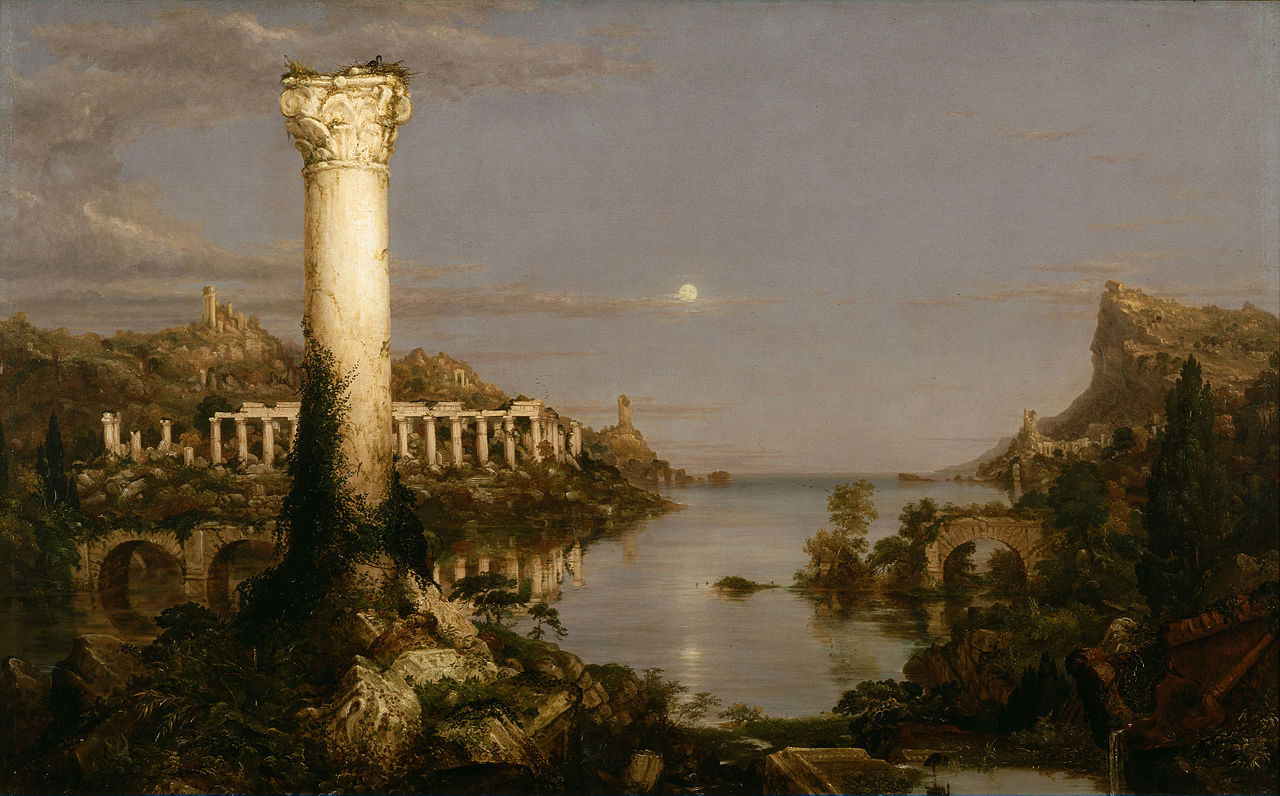
“The Course of Empire – Desolation” by Thomas Cole, one of a series of five paintings created between 1833 and 1836.
Wikimedia Commons.
On both sides of the Atlantic, hysterical comparisons between the collapse of the Roman Empire and the senile polities of the modern West have become the journalistic norm. Every major problem facing our society — from climate change to Covid to inflation — has received the Gibbon treatment.
There are, of course, regional variations. The British, tied by geography to Europe’s fortunes, tend to favour the definitive fall of the Western empire in AD 476. The Americans, ever fearful of an over-mighty executive, linger on the collapse of senatorial authority in 49 BC. And it is also more than a journalistic trope, with the unacknowledged legislators of our world also playing the same game. Elon Musk recently suggested that today’s baby drought is analogous to the low birth rates of Julius Caesar’s dictatorship. Marc Andreessen has compared California to Rome circa AD 250. Joe Rogan, meanwhile, is beginning to suspect that all this gender business might have a worrying ancient precedent.
Such appeals to the past are only human. The fourth word in Virgil’s Aeneid is Troiam. This is the first fact that we learn about Aeneas: he is from Troy. Virgil does not even bother to tell us his hero’s name until the 92nd line. Doubtless, the poets of Ur and Hattusha had their own Troys. And perhaps the first men who placed one mud brick upon another sang of flooded valleys, choked caves and herds that no longer ran. But Rome has been our common loss since the early Middle Ages. As Virgil looked back to Priam, so we look back to Virgil. In 1951, it was perfectly natural for W. H. Auden to compare a dying Britain with a dead Rome: “Caesar’s double-bed is warm / As an unimportant clerk / Writes I DO NOT LIKE MY WORK / On a pink official form”
But journalists and billionaires do not work in a poetic register. They deal in facts and lucre. When they say that Britain or America is following imperium Romanum down the dusty track to oblivion, they seem to be speaking literally. This is not a mistake that Virgil would have made. It is all very well to evoke Rome as an elegiac warning. But if we believe that there are concrete lessons to learn from the Roman Empire’s decline and fall, then we will have to examine the mother of cities as she really was. The results are surprising.
In AD 384, 400 years after Virgil composed his Aeneid, Quintus Aurelius Symmachus had a bridge problem. Symmachus was Urban Prefect of Rome, a role of huge responsibility. By the fourth century, the city of Rome was no longer the imperial capital of the western empire; it had been replaced in 286 by Mediolanum (modern Milan), which was a good deal closer to the empire’s febrile northern borders. But Rome remained the nation’s hearthstone. Her good governance was of the highest priority. The Urban Prefect dispensed justice, organised games, fed the mob and looked after the material fabric of the city. It was not an enviable position. One man had to keep the vast, turbulent metropolis ticking over with the minimum of rioting. Symmachus was well aware of the touchiness of the Roman pleb. His own father had been burned out of his house and chased from the city after making a catty remark of the “let them eat cake” variety during the wine shortage of 375.
The bridge problem went like this. Around 382, the emperor Gratian ordered that a new bridge be built across the Tiber. It soon became clear that construction was taking too long and costing too much. Two years later, as the project neared completion, one span collapsed. Such waste of public funds could not be ignored, and so an inquiry was launched. A specialist diver was engaged to examine the structure; he discovered that the job had been bodged. The engineers responsible for the project, Cyriades and Auxentius, were summoned to account for their failure. Each blamed the other, before Auxentius, who had been caught backfilling sections of the bridge with bales of hay, fled the city — pockets doubtless jingling with public gold.
On the face of it, this sounds like a very late Roman story: a nation once famous for its engineering prowess could no longer build a bridge across the Tiber without everything going horribly wrong. But I’m not sure that’s true. Problems arise all the time, and in themselves tell us very little about a society. What matters is the response to those problems. And Symmachus’s dispatches to the imperial court make it clear that his response was considered and comprehensive. The bridge was completed in the end, and stood for over 1,000 years until its demolition in 1484. Now think of 21st-century London: remember what happened the last time we tried to build a bridge across the Thames?
Comments Off on The urge to compare our own culture to the declining Roman Empire
August 7, 2023
The Longest Year in Human History (46 B.C.E.)
Historia Civilis
Published 24 Apr 2019
(more…)
Comments Off on The Longest Year in Human History (46 B.C.E.)
July 29, 2023
QotD: How pre-modern cities shaped the surrounding landscape
When it comes to shaping the landscape outside of the city – our main point of investigation – the key element of the pre-modern city that matters is the intense demand it creates for agricultural products that the non-farmers who live in the city cannot produce themselves, chiefly (but not exclusively!) food. The intensity of that demand scales with the size of the city. A small town might only really shape land-use and farming patterns out a few miles; a huge mega-city like first century Rome (c. 1m people) re-shapes land patterns for hundreds of miles, its economic influence intruding into the territory of other, smaller cities.
Every town or city, of course, will be different. For agricultural societies especially, local terrain sharply constrains possible land uses. Some land is simply too wet or dry or rough or rocky or infertile for this or that purpose. In a modern city, apartments or factories or offices can be built almost anywhere; the sort of land suitable for intensive farming is more limited. This is even more true for pre-modern societies working without modern fertilizer, without electric-powered irrigation and without the industrial technology to massively reshape terrain (draining swamps, filling ravines, flattening hills, irrigating the desert, etc – some of these can be done with hand tools, but not to the extent we can today).
Still, we want to begin thinking about how cities impact the land around them without all of these difficult and confusing variables. We want to image a city, isolated and alone in the middle of an endless, flat and featureless plain. This is exactly what J. H. von Thünen did in The Isolated State (Der isolierte Staat). This kind of exercise can give us a baseline of what the landscape around a decent sized city might look like, which we can then modify to respond to different terrain, technology and social organization.
(Note: I would be remiss if I didn’t note that my discussion of these ideas owes heavily to Neville Morley’s Metropolis and Hinterland (1996), where he applied this very method to the city of Rome and its hinterland (and also first introduced me to von Thünen’s ideas). That book and also his Trade in Classical Antiquity are both great books to give a read if you want to begin building a sense of how pre-modern economies work).
The key factor von Thünen looks at is transportation costs. For a society without trains or trucks, moving bulk materials of any kind over long distances is extraordinarily expensive. Moving grain overland, for instance, would cause its cost to double after 100 miles. Thus land close to our theoretical city is extremely valuable for production, while land far away is substantially less valuable (because the end goal is transporting the agricultural production of that land to the city). As a result, transit costs – and thus distance – dominates how cities influence land-use patterns (along with population, which determines the intensity of the city’s influence).
Bret Devereaux, “Collections: The Lonely City, Part I: The Ideal City”, A Collection of Unmitigated Pedantry, 2019-07-12.
Comments Off on QotD: How pre-modern cities shaped the surrounding landscape
June 11, 2023
The Invasion of Normandy begins! – WW2 – Week 250 – June 10, 1944
World War Two
Published 10 Jun 2023The Allies’ gigantic amphibious invasion of France begins and by the end of the week they’ve carved out a decent-sized beachhead. Meanwhile in Italy the Allied advance takes Rome. The Soviets are launching new attacks of their own — now against the Finns, and the Japanese at Kohima … have just plain had enough.
(more…)
Comments Off on The Invasion of Normandy begins! – WW2 – Week 250 – June 10, 1944
June 4, 2023
The Allies are Driving for Rome – WW2 – Week 249 – June 3, 1944
World War Two
Published 3 Jun 2023The Allies head north in Italy after the fall of Monte Cassino last week; the Japanese head south in China in a new phase of their offensive; and the Soviets and the Western Allies make ever more concrete plans for their huge offensives, to go off very soon.
(more…)
Comments Off on The Allies are Driving for Rome – WW2 – Week 249 – June 3, 1944
May 23, 2023
Mustard: A Spicy History
The History Guy: History Deserves to be Remembered
Published 15 Feb 2023In 2018 The Atlantic observed “For some Americans, a trip to the ballpark isn’t complete without the bright-yellow squiggle of French’s mustard atop a hot dog … Yet few realize that this condiment has been equally essential — maybe more so — for the past 6,000 years.”
(more…)
Comments Off on Mustard: A Spicy History
May 14, 2023
Arming God’s Battalions: a Papal States Rolling Block
Forgotten Weapons
Published 13 Feb 2023The Remington Rolling Block was a very popular rifle in the 1860s and 1870s, and probably would have been a better choice than the Trapdoor Springfield for the US military. But among the nations that did adopt is were the Papal States. While Vatican City is a tiny sovereign enclave today in Rome, in the 1800s the Pope directly controlled a much larger area, roughly the size of Switzerland early in the 1800s.
Three different models of Rolling Block were adopted by the Papal States in the effort to rebuild their military after a serious defeat in 1860 — rifles, carbines, and musketoons — the latter being what we have today. All three were made by the Nagant Brothers in Liege and can be identified by the Papal crest (the crossed keys of St Peter) on the top of the barrel. Westley Richards in the UK also produced 5,000 rolling block rifles, but these had serious quality problems.
The Nagant Brothers rifles began to arrive in the fall of 1868. They saw service for only a few years, as the departure of French forces in the fall of 1870 (to take part in the Franco-Prussian War) allowed the Italian Army to seize Vatican City without much difficulty. A few survived in the hands of the Pope’s personal guard, but most of these rolling blocks were taken into Italian Army service. They would serve until being replaced by Vetterli rifles, and were eventually sent to Ethiopia as military aid to Emperor Menelik II in the 1880s.
(more…)
Comments Off on Arming God’s Battalions: a Papal States Rolling Block
May 11, 2023
QotD: Divination
But that distinction is crucial, because what you are actually doing in a ritual involving divination is not asking questions about the future, but asking questions of the gods. Divination is not an exercise in seeing, but in hearing – that is, it is a communication, a conversation, with the divine. […]
Many current religions – especially monotheistic ones – tend to view God or the gods as a fundamentally distant, even alien being, decidedly outside of creation. The common metaphor is one where God is like a painter or an architect who creates a painting or a building, but cannot be in or part of that creation; the painter can paint himself, but cannot himself be in the painting and the architect may walk in the building but she cannot be a wall. Indeed, one of the mysteries – in the theological sense […] – of the Christian faith is how exactly a transcendent God made Himself part of creation, because this ought otherwise be inconceivable.
Polytheistic gods do not work this way. They exist within the world, and are typically created with it (as an aside: this is one point where, to get a sense of the religion, one must break with the philosophers; Plato waxes philosophic about his eternal demiurge, an ultimate creator-god, but no one in Greece actually practiced any kind of religion to the demiurge. Fundamentally, the demiurge, like so much fine Greek writing about the gods, was a philosophical construct rather than a religious reality). As we’ll get to next week, this makes the line between humans and gods a lot more fuzzy in really interesting ways. But for now, I want to focus on this basic idea: that the gods exist within creation and consequently can exist within communities of humans.
(Terminology sidenote: we’ve actually approached this distinction before, when we talked about polytheistic gods being immanent, meaning that they were active in shaping creation in a direct, observable way. In contrast, monotheistic God is often portrayed as transcendent, meaning that He sits fundamentally outside of creation, even if He still shapes it. Now, I don’t want to drive down the rabbit hole of the theological implications of these terms for modern faith (though I should note that while transcendence and immanence are typically presented as being opposed qualities, some gods are both transcendent and immanent; the resolution of an apparent contradiction of this sort in a divine act or being like this is what we call a mystery in the religious sense – “this should be impossible, but it becomes possible because of divine action”). But I do want to note the broad contrast between gods that exist within creation and the more common modern conception of a God whose existence supersedes the universe we know.)
Thus, to the polytheistic practitioner, the gods don’t exist outside of creation, or even outside of the community, but as very powerful – and sometimes inscrutable – members of the community. The exact nature of that membership varies culture to culture (for instance, the Roman view of the gods tends towards temperamental but generally benevolent guardians and partners of the state, whereas the Mesopotamian gods seem to have been more the harsh rulers set above human society; that distinction is reflected in the religious structure: in Rome, the final deciding body on religious matters was the Senate, whereas Mesopotamian cities had established, professional priesthoods). But gods do a lot of the things other powerful members of the community do: they own land (and even enslaved persons) within the community, they have homes in the community (this is how temples are typically imagined, as literal homes-away-from-home for the gods, when they’re not chilling in their normal digs), they may take part in civic or political life in their own unique way. […] some of these gods are even more tightly bound to a specific place within the community – a river, stream, hill, field.
And, like any other full member of the community (however “full membership” is defined by a society), the gods expect to be consulted about important decisions.
Bret Devereaux, “Collections: Practical Polytheism, Part III: Polling the Gods”, A Collection of Unmitigated Pedantry, 2019-11-08.
Comments Off on QotD: Divination
April 6, 2023
QotD: The general’s pre-battle speech to the army
Now, there is tremendous debate as to if these speeches were ever delivered and if so, how they were delivered (see the bibliography note below; none of this is really original to me). For my part, while I think we need to be alive to the fact that what we see in our textual sources are dressed up literary compressions of the tradition of the pre-battle speech, I suspect that, particularly by the Roman period, yes, such speeches were a part of the standard practice of generalship. Onasander, writing about the duties of a general in the first century CE, tells us as much, writing, “For if a general is drawing up his men before battle, the encouragement of his words makes them despise the danger and covet the honour; and a trumpet-call resounding in the ears does not so effectively awaken the soul to the conflict of battle as a speech that urges to strenuous valour rouses the martial spirit to confront danger.” Onasander is a philosopher, not a military man, but his work became a standard handbook for military leaders in Antiquity; one assumes he is not entirely baseless.
And of course, we have the body of literature that records these speeches. They must be, in many cases, invented or polished versions; in many cases the author would have no way of knowing the real worlds actually said. And many of them are quite obviously too long and complex for the situations into which they are placed. And yet I think they probably do represent some of what was often said; in many cases there are good indications that they may reflect the general sentiments expressed at a given point. Crucially, pre-battle speeches, alone among the standard kinds of rhetoric, refuse to follow the standard formulas of Greek and Roman rhetoric. There is generally no exordium (meaning introduction; except if there is an apology for the lack of one, in the form of, “I have no need to tell you …”) or narratio (the narrated account), no clear divisio (the division of the argument, an outline in speech form) and so on. Greek and Roman oratory was, by the first century or so, quite well developed and relatively formulaic, even rigid, in structure. The temptation to adapt these speeches, when committing them to a written history, to the forms of every other kind of oratory must have been intense, and yet they remain clearly distinct. It is certainly not because the genre of the battle speech was more interesting in a literary sense than other forms of rhetoric, because oh my it wasn’t. The most logical explanation to me has always been that they continue to remain distinct because however artificial the versions of battle speeches we get in literature are, they are tethered to the “real thing” in fundamental ways.
Finally, the mere existence of the genre. As I’ve noted elsewhere, we want to keep in mind that Greek and Roman literature were produced in extremely militarized societies, especially during the Roman Republic. And unlike many modern societies, where military service is more common among poorer citizens, in these societies military service was the pride of the elite, meaning that the literate were more likely both to know what a battle actually looked like and to have their expectations shaped by war literature than the commons. And that second point is forceful; even if battle speeches were not standard before Thucydides, it is hard to see how generals in the centuries after him could resist giving them once they became a standard trope of “what good generals do.”
So did generals give speeches? Yes, probably. Among other reasons we can be sure is that our sources criticize generals who fail to give speeches. Did they give these speeches? No, probably not; Plutarch says as much (Mor. 803b) though I will caution that Plutarch is not always the best when it comes to the reality of the battlefield (unlike many other ancient authors, Plutarch was a life-long civilian in a decidedly demilitarized province – Achaea – who also often wrote at great chronological distance from his subjects; his sense of military matters is generally weak compared to Thucydides, Polybius or Caesar, for instance). Probably the actual speeches were a bit more roughly cut and more compartmentalized; a set of quick remarks that might be delivered to one unit after another as the general rode along the line before a battle (e.g. Thuc. 4.96.1). There are also all sorts of technical considerations: how do you give a speech to so many people, and so on (and before you all rush to the comments to give me an explanation of how you think it was done, please read the works cited below, I promise you someone has thought of it, noted every time it is mentioned or implied in the sources and tested its feasibility already; exhaustive does not begin to describe the scholarship on oratory and crowd size), which we’ll never have perfect answers for. But they did give them and they did seem to think they were important.
Why does that matter for us? Because those very same classical texts formed the foundation for officer training and culture in much of Europe until relatively recently. Learning to read Greek and Latin by marinating in these specific texts was a standard part of schooling and intellectual development for elite men in early modern and modern Europe (and the United States) through the Second World War. Napoleon famously advised his officers to study Caesar, Hannibal and Alexander the Great (along with Frederick II and the best general you’ve never heard of, Gustavus Adolphus of Sweden). Reading the classical accounts of these battles (or, in some cases, modern adaptations of them) was a standard part of elite schooling as well as officer training. Any student that did so was bound to run into these speeches, their formulas quite different from other forms of rhetoric but no less rigid (borrowing from a handful of exemplars in Thucydides) and imbibe the view of generalship they contained. Consequently, later European commanders tended for quite some time to replicate these tropes.
(Bibliography notes: There is a ton written on ancient battle speeches, nearly all of it in journal articles that are difficult to acquire for the general public, and much of it not in English. I think the best possible place to begin (in English) is J.E. Lendon, “Battle Description in the Ancient Historians Part II: Speeches, Results and Sea Battles” Greece & Rome 64.1 (2017). The other standard article on the topic is E. Anson “The General’s Pre-Battle Exohortation in Graeco-Roman Warfare” Greece & Rome 57.2 (2010). In terms of structure, note J.C. Iglesias Zoida, “The Battle Exhortation in Ancient Rhetoric” Rhetorica 25 (2007). For those with wider language skills, those articles can point you to the non-English scholarship. They can also serve as compendia of nearly all of the ancient battle speeches; there is little substitute for simply reading a bunch of them on your own.)
Bret Devereaux, “Collections: The Battle of Helm’s Deep, Part VII: Hanging by a Thread”, A Collection of Unmitigated Pedantry, 2020-06-12.
Comments Off on QotD: The general’s pre-battle speech to the army
March 29, 2023
QotD: Sacrifice
There is some concern for the place and directionality of the gods in question. Sacrifices for gods that live above are often burnt so that the smoke wafts up to where the gods are (you see this in Greek and Roman practice, as well in Mesopotamian religion, e.g. in Atrahasis, where the gods “gather like flies” about a sacrifice; it seems worth noting that in Temple Judaism, YHWH (generally thought to dwell “up”) gets burnt offerings too), while sacrifices to gods in the earth (often gods of death) often go down, through things like libations (a sacrifice of liquid poured out).
There is also concern for the right animals and the time of day. Most gods receive ritual during the day, but there are variations – Roman underworld and childbirth deities (oddly connected) seem to have received sacrifices by night. Different animals might be offered, in accordance with what the god preferred, the scale of the request, and the scale of the god. Big gods, like Jupiter, tend to demand prestige, high value animals (Jupiter’s normal sacrifice in Rome was a white ox). The color of the animal would also matter – in Roman practice, while the gods above typically received white colored victims, the gods below (the di inferi but also the di Manes) darkly colored animals. That knowledge we talked about was important in knowing what to sacrifice and how.
Now, why do the gods want these things? That differs, religion to religion. In some polytheistic systems, it is made clear that the gods require sacrifice and might be diminished, or even perish, without it. That seems to have been true of Aztec religion, particularly sacrifices to Quetzalcoatl; it is also suggested for Mesopotamian religion in the Atrahasis where the gods become hungry and diminished when they wipe out most of humans and thus most of the sacrifices taking place. Unlike Mesopotamian gods, who can be killed, Greek and Roman gods are truly immortal – no more capable of dying than I am able to spontaneously become a potted plant – but the implication instead is that they enjoy sacrifices, possibly the taste or even simply the honor it brings them (e.g. Homeric Hymn to Demeter 310-315).
We’ll come back to this idea later, but I want to note it here: the thing being sacrificed becomes sacred. That means it doesn’t belong to people anymore, but to the god themselves. That can impose special rules for handling, depositing and storing, since the item in question doesn’t belong to you anymore – you have to be extra-special-careful with things that belong to a god. But I do want to note the basic idea here: gods can own property, including things and even land – the temple belongs not to the city but to the god, for instance. Interestingly, living things, including people can also belong to a god, but that is a topic for a later post. We’re still working on the basics here.
Bret Devereaux, “Collections: Practical Polytheism, Part II: Practice”, A Collection of Unmitigated Pedantry, 2019-11-01.
Comments Off on QotD: Sacrifice
March 23, 2023
History Summarized: Rome After Empire
Overly Sarcastic Productions
Published 11 Nov 2022“It’s gonna take more than killing me to kill me” – Rome, constantly.
Rome “Fell” in 476 … but we still have Rome. How’d that happen, and what does the Pope have to do with it?
(more…)
Comments Off on History Summarized: Rome After Empire
February 15, 2023
Ancient Rome’s Naked Fertility Festival (Lupercalia)
Tasting History with Max Miller
Published 8 Feb 2022
(more…)
Comments Off on Ancient Rome’s Naked Fertility Festival (Lupercalia)
January 25, 2023
Dinner with Attila the Hun
Tasting History with Max Miller
Published 24 Jan 2023
(more…)
Comments Off on Dinner with Attila the Hun
January 13, 2023
The greatest conspiracy in ancient art
BBC Reel
Published 7 Sep 2022Do we have a bias against colour in classical art?
Matt Wilson explores prejudices that have built up over centuries – leading to what has been labelled ‘chromophobia’, the subject of an exhibition at New York’s Metropolitan Museum of Art.
Wilson finds out why we don’t value colour, questioning a centuries-old misunderstanding. As Chroma’s curator Sarah Lepinski tells him: “It’s important that audiences come to understand the way they see ancient Greek and Roman sculpture isn’t the way it was first created.”
(more…)
Comments Off on The greatest conspiracy in ancient art


