World War Two
Published 25 Jun 2026Magda Goebbels was one of the most infamous women in Hitler’s inner circle. Known as the wife of Nazi Propaganda Minister Joseph Goebbels and often treated as an unofficial “First Lady” of the Third Reich, she helped project an image of family, elegance, and loyalty while standing beside one of history’s most murderous regimes. But her story ends in one of the darkest acts of the Second World War.
As Berlin collapsed in 1945, Magda Goebbels took her six children into Hitler’s Führerbunker. Offered chances to escape, she refused. One day after Hitler’s suicide, she helped murder her own children with cyanide, claiming that a world without National Socialism was not worth living in.
In this episode of our new format, Baddies and Battleaxes, Anna Deinhard returns to tell the story of Magda Goebbels: socialite, Nazi fanatic, mother, accomplice, and child murderer. Her life reveals how women in the Third Reich were not always passive bystanders. Some, like Magda, actively embraced Nazi ideology, helped legitimize the regime, and chose loyalty to Hitler over humanity itself.
This is the story of the Nazi “First Lady” who followed fascism all the way into the bunker.
Who should Anna cover next in Baddies and Battleaxes? Tell us which heroines and villainesses of WW2 you want to see in a future episode.
June 26, 2026
Magda Goebbels: The Nazi Mother Who Murdered Her Children
June 25, 2026
Passively shaping public opinion is one of big tech’s favourite techniques
In the portion of this post above the paywall, Celina shows a good example of how social engineering doesn’t have to be blatant to be effective:
Before reading further, open a new browser tab and type the search term “married white woman” into Google Images. Scroll through the first several rows of results. What do you see?
The output which is consistently replicated across different devices and geographic locations is a deluge of mixed-race couples. The output is overwhelmingly dominated by images of white women intimately paired with black or non-white men. To the casual observer passively consuming this digital output, the presentation establishes an immediate baseline for normalcy. The volume and priority of these specific demographic pairings create the distinct impression that such relationships are the standard, ubiquitous, and foundational reality of modern Western society.
Yet, when we contrast this algorithmic simulation with reality, a massive discrepancy emerges. Statistically, interracial marriages remain a distinct minority of overall unions in the United States and across the broader Western world. According to comprehensive data from the Pew Research Center, in 2020, only 11% of all married couples in the United States were interracial or interethnic. When we drill down into the specific pairing that dominates the aforementioned image search, the numbers shrink even further. Marriages specifically between a white woman and a black man account for a mere 7% of that already small 11% sliver of intermarriages. In absolute terms, out of over 51 million married white women in the United States, less than 1% are married to black men.
Despite this statistical rarity, the digital simulation feels entirely “normal” to the modern consumer because media giants like Google, alongside massive stock photography conglomerates like Getty Images and Shutterstock, consciously and relentlessly curate it that way. This immense disparity between reality is the result of neutral, blind code cataloging human existence. It is an intentional act of social enforcement, by artificially elevating specific demographic pairings, media platforms execute a subtle but pervasive socio-cultural engineering project.
It can thus be argued that this engineered visual output serves a distinct ideological purpose: pushing European women toward demographic change and eroding the visual primacy of the homogeneous nuclear family that built and sustained Western nation-states for centuries. When digital representations are manipulated to consistently overwrite physical realities, a significant ontological shift occurs within the host population. The native majority is conditioned to view their own demographic decline as an organic, inevitable, and morally righteous progression. This forces us to confront the question: If images precede and dictate reality, who is engineering our extinction?


I’m long out of the habit of watching TV, so when the NFL season gets started and I’m presented with three-plus hours per week of commercial TV to watch my favourite team play, I can’t help but notice that most commercials that include representations of married couples are inter-racial or non-white. The advertisers are also presenting a small minority of marriages in North America as being the overwhelming majority in their TV ads. Why might they want to do that?
June 21, 2026
How To Make War Inevitable – Death of Democracy 20 – Q4 1937
World War Two and Spartacus Olsson
Published 20 Jun 2026By late 1937, Nazi Germany’s rearmament economy had trapped itself. Autarky was failing. Hjalmar Schacht was pushed aside. Göring’s Four-Year Plan dominated economic policy. And at the secret Hossbach meeting of November 5, Hitler turned economic impossibility into an argument for territorial conquest.
This episode covers Q4 1937: the Hossbach Memorandum, Schacht’s resignation, the Anti-Comintern alignment, Lord Halifax’s visit, Himmler’s police-state consolidation, the December “Preventive Crime Fighting” decree, and the antisemitic propaganda exhibition Der Ewige Jude.
The argument is not that war was metaphysically inevitable. It is that the Nazi regime built an ideological, economic, and police-state machine that made war look increasingly necessary to its own leadership. This is a historical analysis of Nazi dictatorship, antisemitic propaganda, and war planning. It condemns Nazism and uses extremist material only for educational and documentary context.
Chapters:
0:00 Q4 1937 Intro
0:53 The world at the end of 1937
1:36 Germany’s quarter of acceleration
3:30 Himmler Tightens Police Power
6:26 Der Ewige Jude and dehumanization
8:30 Hossbach: autarky fails
11:16 Halifax and diplomatic confidence
13:03 Mood inside Germany
15:09 Mein Kampf has become policy
17:16 Conclusion: the politics of beasts
June 14, 2026
How to Make Dissent Disappear – Death of Democracy 19 – Q3 1937
World War Two and Spartacus Olsson
Published 13 Jun 2026In 1937, Nazi Germany moved from controlling politics to controlling thought itself. Churches, artists, workers, and dissenters all came under attack.
Berlin, September 1937. From the outside, Germany can seem strangely quiet while the rest of the world slides deeper into war, civil conflict, and authoritarianism. But inside the Reich, the Nazi state is tightening its grip on the last spaces where dissent can still exist.
This quarter, the Gestapo arrests Pastor Martin Niemöller and intensifies the attack on the Confessing Church. The regime opens the House of German Art in Munich, then stages the infamous “Degenerate Art” exhibition to mock, vilify, and destroy modernist culture. The SS establishes Buchenwald near Weimar, forcing prisoners to build their own prison. Meanwhile, Göring’s new state industrial empire and the Nuremberg “Rally of Work” reveal a society being reorganized for war.
This is Step 19 in the death of democracy: when the authoritarian state stops merely silencing opposition and begins fighting the inner freedom to believe, imagine, worship, create, and think.
June 7, 2026
How Hitler Tested His Next War in Spain – Death of Democracy 18 – Q2 1937
World War Two and Spartacus Olsson
Published 6 Jun 2026Berlin, June 30, 1937. Hitler has not staged a major diplomatic shock this quarter — but beneath the surface, Nazi Germany is preparing for war.
In Spain, the Condor Legion helps Franco’s Nationalists and the bombing of Guernica gives the world a terrifying preview of modern aerial terror. At home, the regime escalates its assault on the Catholic Church, begins the purge of “degenerate art”, tightens the link between courts and concentration camps, and hides rearmament behind spectacles of economic success.
This episode of Death of Democracy looks at Q2 1937: the quarter when Nazi Germany normalized aggression abroad while deepening tyranny at home.
00:00 Berlin, June 30, 1937
00:05 No Hitler Surprise — But War Preparations Continue
00:51 The Hindenburg and the Shadow of Modern War
01:50 The “Give Me Four Years” Exhibition
02:25 Guernica and the Condor Legion
02:55 The Bombardment of Almería
03:11 Case Green and Case Otto
03:54 Degenerate Art and Cultural Cleansing
04:22 The Judiciary and the Concentration Camps
05:13 The Nazi Assault on the Catholic Church
06:07 Goebbels, Propaganda, and the Morality Trials
07:45 Autarky, Rearmament, and Hidden Austerity
08:52 Mood Inside the Nazi Leadership
09:48 Ordinary Germans and Apathy
12:15 Analysis: War Abroad, Tyranny at Home
14:19 Conclusion: Nazi Double-Talk
June 6, 2026
Lies “in a good cause” are still frickin’ lies
This was posted in late May, but only came to my attention today, so apologies if you’ve already waded through the details here:

The problem with this meme is … well, just read the article.
This meme keeps entering my feed and it bugs me every time I see it. For search engines and the visually impaired: it shows, on the left, a large McDonald’s French fry priced at $1.99. On the right, it shows a delectable fruit cup, including mixed berries, cubed melon, and prominent slices of starfruit priced at $5.99. The caption above both declares, “The Problem With Our Food System”.
Invariably, this meme is met with earnest rejoinders, often in thread 🧵 form, explaining the complexities of food distribution. One particularly clever one that I just saw introduces the concept of “Malicious Design” as a sort of secular creationism where the limitations imposed by nature are imagined as human systems intentionally engineered to harm the masses. Threads like these usually go on to describe how potatoes are cheap, hardy, and practically preserve themselves, while berries are delicate, seasonal, and expensive to ship. They argue that the price difference is simply the natural consequence of supply chains, not the machinations of a capitalist oligarchy trying to keep the proletariat down.
All of that might be true.
But it doesn’t matter.
Because the entire discussion rests on a premise that is demonstrably false.
Not the stuff about potatoes or berries or supply chains. Not even the stuff about the oligarchs insofar as, if they are trying to poison us, they are doing a middling job at best. The problem is that everyone accepts the meme’s starting point as if it were genuine. They never check the most basic fact: the prices themselves!!!
Let’s start with the French fries, because they are on the left and because I have the McDonald’s app on my phone. I can tell you without looking that $1.99 is the wrong price for a large fry because I am a fast-food proletarian myself.
Behold: in my market — Omaha — the price is $4.39. According to the Interwebs, this is a pretty representative price nationwide outside of larger cities. The reason we are considering a large fry instead of a small, which still comes in at a whopping $3.99, is because the meme uses a picture of a large.
Already, the price of the fruit cup and the French fries are much more comparable. Ah, but those crafty capitalists know that the stupid masses will steer toward the cheaper option, regardless of the health risks, even if it is only to save a penny. That’s how the fast-food-to-pharma pipeline gets you! By tricking you into passing on the much healthier and obviously more delicious fruit cup. (Never mind last week’s newsletter about all the poisonous chemicals they’re spraying on the fruit.)
So, I will check on the fruit cup now. The first wrinkle is that the image of the fruit cup does not come from the McDonald’s app. That’s because McDonald’s doesn’t sell a fruit cup in most — if any — markets. If they did, it would arrive to the store frozen and the kid who was supposed to move it from the freezer to the refrigerator last night will have forgotten to do so, meaning that what you will receive is a cup of brightly colored ice cubes that you can pretend to enjoy in a couple of hours. (source: 5+ years personally serving in the McTrenches coinciding with the deployment of the Fruit ‘n Yogurt Parfait™.) In other word, you will not see these two items side-by-side on the menu.
And this is where it gets tricky. Because I can’t actually find that particular fruit cup. Reverse image search turns up a big fat nada. Not on any fast food site, online grocery store, stock photo outlet, food blog, or news page.

Read the whole thing, I believe is the term d’art for this. H/T to Kim du Toit for the link.
June 5, 2026
The Canadian economy, RIP
On the social media site formerly known as Twitter, James E. Thorne writes an obituary for the Canadian economy:
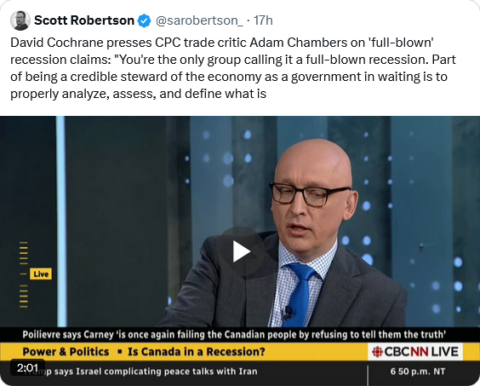
For the record.
In Canada, It Matters How the Economy Dies.
The Canadian economy is dead. It just didn’t die with a crash big enough to satisfy the models. No Lehman moment, no Covid-style cliff, just two negative quarters of GDP, years of falling output per person, negative productivity, and a private sector slowly strangled by rates and regulation while the establishment insists the patient is “resting”.
On the facts, this isn’t ambiguous. Real GDP has contracted for two consecutive quarters on an annualized basis. Labour productivity has been flat or negative since 2021. Real GDP per capita is below its pre-pandemic level. Ontario has logged its worst non-pandemic quarterly job losses since the mid-1970s. The only consistent growth is in government payrolls and compliance, not in private enterprise and investment. If that isn’t recessionary, the word is meaningless.
And yes Macklem threatens rate hikes through all of this insanity.
Yet Canada’s official guardians insist nothing fundamental has broken. The C.D. Howe recession-dating committee says the downturn is not “pronounced, persistent, and pervasive” enough. The central bank warns against overreacting to “technical” weakness. Bay Street talks about “soft landings” and “resilience”. In some quarters, the answer to this slow-motion collapse is not relief, but further rate hikes. Ignore the body on the table, we are told, the vital signs aren’t quite bad enough yet to fill out the certificate.
Their rulebook was built for heart attacks, not cancers. It excels at spotting sudden collapses in aggregate GDP and jobs. It barely registers slow organ failure: a few tenths off real GDP per capita each year, productivity edging down, ugly quarters for private-sector employment and capex offset by public hiring. None of that triggers the old alarms until the damage is permanent.
Meanwhile, Canada has been busy throwing away the advantages that once justified its prosperity. Energy and resource projects are stalled or strangled. Business investment per worker trails peers. A country rich in capital, talent, and geography behaves as if it can live forever off inherited endowments while making it harder to build anything new. That is not “resilience”. It is delusion.
Canada’s economic establishment needs to wake up.
Two negative quarters of GDP, negative productivity, falling GDP per person, historic job losses in the core province, a suffocated private sector and calls for more tightening on top, are not signs of an economy “cooling toward trend”. They are signs of an economy that has already crossed the line from stagnation into decay.
The Canadian economy is dead in the way that matters: as an engine of rising living standards and a place where private capital is rewarded for building the future. It just didn’t die loudly enough for the old definitions. The real question now is not what we call it, but how long our institutions will keep pretending the corpse is “resilient”.
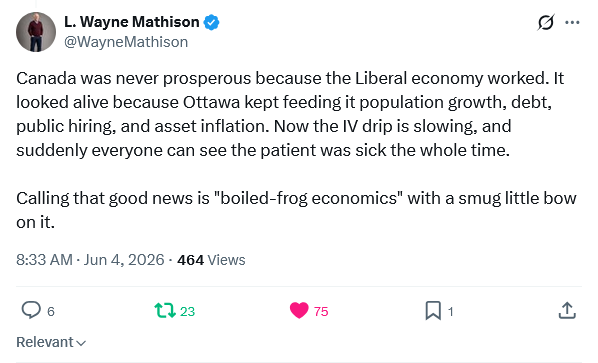
As the propagandists of the mainstream media do everything they can to deflect any hint of blame from their Liberal paymasters, we can still see that things are getting worse, not better:
The federal Liberals are getting fantastic return on their investment … giving our money to the presstitutes of the legacy media in return for kid-glove treatment of the government and attack-dog tactics against the opposition:
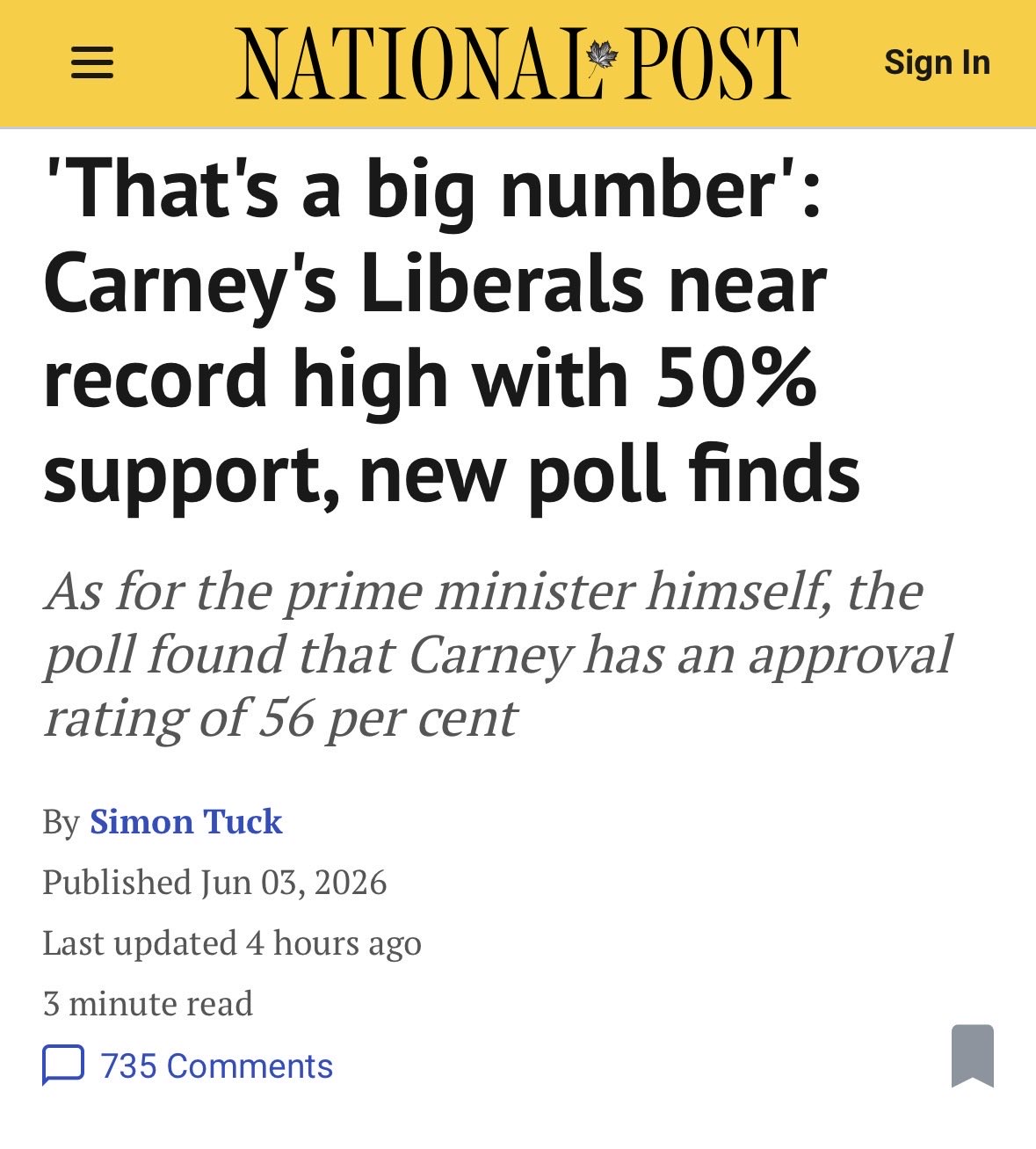
Why Do 50% Still Support Carney? My long-winded response.
That is a question we need to take seriously.
Leger’s latest federal polling has the Liberals at 50% support among decided voters, their highest level in that firm’s tracking since the Liberals first formed government in 2015. Abacus also found the political environment still favourable for Carney and the Liberal government. So this is not imaginary. This is not just CBC fairy dust sprinkled over Ottawa. The support is real. The harder question is whether it is rational.
My answer is simple: many Canadians are not voting for results. They are voting for the illusion of relief.
Even though Carney was in the economic background since 2020 he appeared to arrive after the Trudeau years like a man in a clean suit walking into a room after the dog crapped on the floor. Trump threatened 51st State. Carney looked calm. Unlike Trudeau. He spoke in complete sentences. He had the central banker aura. For exhausted voters, that was enough. They did not examine the wiring. They just saw someone who did not seem to be setting the curtains on fire.
Carney’s appeal is not built mainly on performance. It is built on contrast. Compared with Trudeau’s theatre-kid government of slogans, selfies, and moral lectures, Carney looks serious. But “serious” is not the same as right. A surgeon can look serious while operating on the wrong leg.
Canada’s economy is now weak enough that Carney himself has had to acknowledge ugly economic data. Reuters reported him addressing Canada’s technical recession and warning that some data will be “uneven” “ah ah ah” as the government pushes through policy changes. The Wall Street Journal reported GDP weakness, including two consecutive quarterly contractions, while Carney framed the pain as part of a broader economic rebuild.
That is where the sales pitch gets slippery.
When the economy weakens under Conservatives, it is called failure. When it weakens under Liberals, it becomes “transition”, “restructuring”, or “long-term transformation”. Same corpse, nicer label on the toe tag.
The deeper problem is that Canadians were never really asked whether they wanted Carney’s ideology. They were sold competence, not doctrine. They were sold expertise, not a governing philosophy that puts the state, regulators, climate finance, and elite managerial planning at the centre of national life.
Nobody knocked on doors saying, “Would you like a prime minister who believes markets should be bent around elite-defined social and environmental values?” No. They said, “He is smart. He ran banks. He knows Trump. He will steady things.”
That is not a mandate. That is a branding exercise.
And this is why the Conservative attack has to get sharper. Not louder. Sharper.
Calling voters stupid is a dead end. Many Carney supporters are not stupid. They are terrified of Trump. They are tired. They are anxious. They are looking at housing, debt, food prices, crime, productivity, health care, and a country that feels smaller than it used to, and they want someone who looks like an adult. Carney gives them the visual. He gives them the voice. He gives them the vibe.
But vibes do not build houses. Vibes do not raise productivity. Vibes do not lower debt. Vibes do not attract investment. Vibes do not make young Canadians believe they have a future.
The Carney government’s strongest weapon is not success. It is emotional permission. It lets Liberal voters tell themselves they have moved on from Trudeau without admitting the Liberal machine remains fundamentally intact. Same operating system, cleaner looking wallpaper.
That is why 50% still support him.
They are not endorsing the results. They are postponing the verdict.
Canada does not need a better-spoken manager of decline. It needs a government willing to reverse the policies that caused the decline in the first place.
Because a tight ship headed toward the rocks is still headed toward the rocks.
June 3, 2026
The Korean War Week 102 – American Bioweapons on Korean Soil? – June 2, 1952
The Korean War by Indy Neidell
Published 2 Jun 2026The Chinese continue their campaign of accusing the US of practicing germ warfare in North Korea and Manchuria. Meanwhile in South Korea, Syngman Rhee has declared martial law in Pusan as part of his campaign to remain in power.
00:00 Intro
00:50 Recap
01:23 Germ Warfare Charges
11:17 Bull Boatner
15:34 Holding POWs
17:58 Summary
18:13 Conclusion
19:21 Call to Action
May 31, 2026
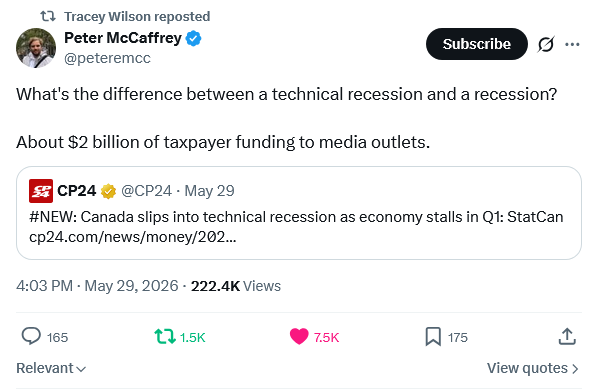
Canada slips into recession: state media rally to attack official opposition
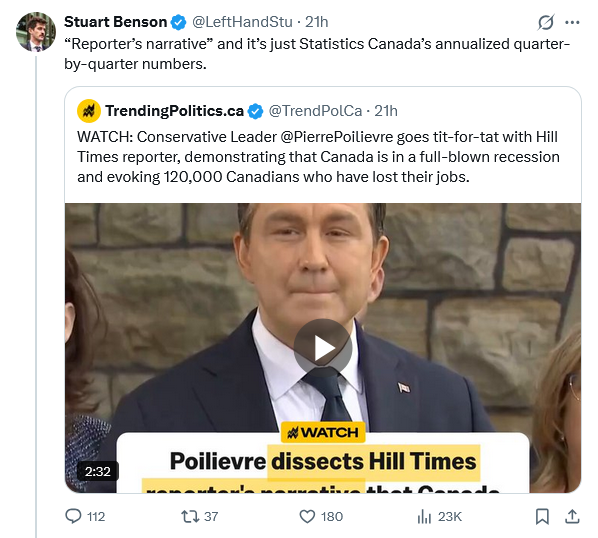
Even before they became explicitly subsidized presstitutes for the Liberal Party, the Canadian mainstream media have always been far more critical of conservatives, so this pivot to defend the government after official statistics show the country is in a technical recession is very much on brand:
Stuart, this is exactly the problem.
You’re acting like annualized quarter-by-quarter numbers are some exotic partisan invention. They aren’t. That is one of the standard ways GDP is reported and understood.
And the “reporter’s narrative” point is weak. The reporter framed the question as if calling it a recession was irresponsible, even though the numbers show real weakness: contraction, stalled growth, falling investment, weak productivity, and Canadians losing ground.
Pierre did what more politicians should do: he challenged the frame.
Because the frame matters.
When Conservatives warn about decline, it’s “doom”.
When Liberals preside over decline, it’s “complex global headwinds”.
When Canadians get poorer, it’s “resilience”.
When GDP shrinks, it’s “not quite the word we’d prefer today”.
Give me a break.
Canadians do not live inside a Statistics Canada footnote. They live inside rent, mortgage renewals, grocery bills, job insecurity, and taxes. Pierre is speaking to that reality.
The press gallery can massage the vocabulary all it wants. The country is weaker, poorer, less productive, and more expensive.
That is not a narrative.
That is the room.
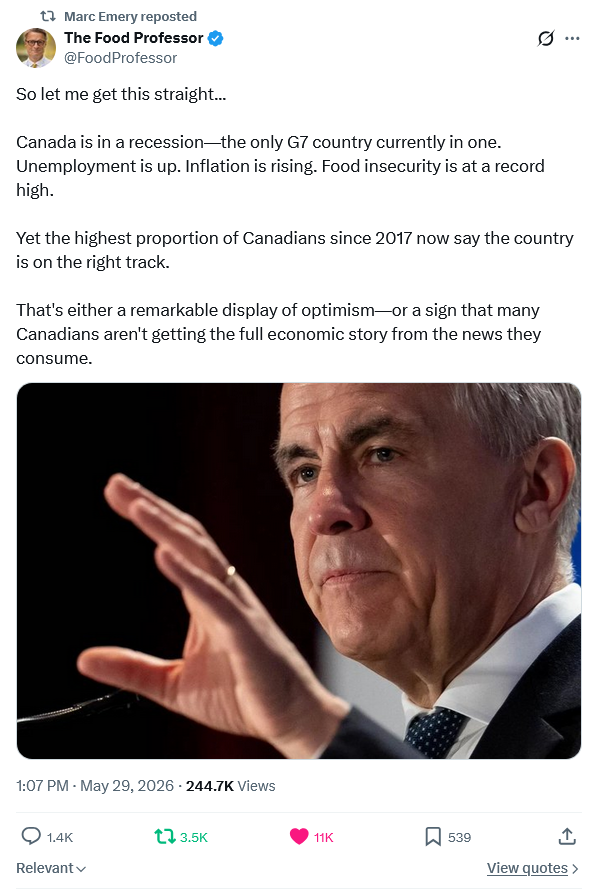
The Liberals are getting great value for their money — well, our money — as even though the economy is tottering, media-massaged messaging is reflected in polls (feel free to doubt the accuracy of polls like this if you like):
May 29, 2026
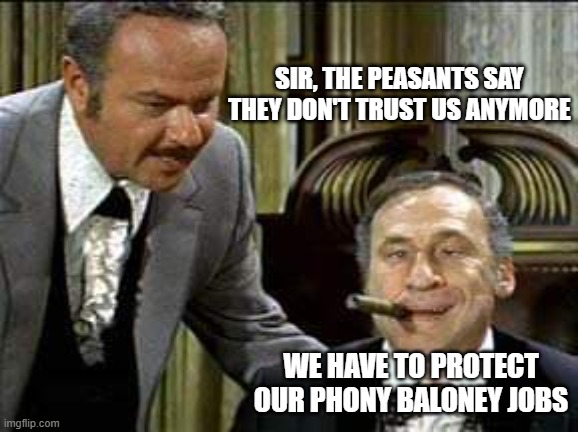
Progressives, suddenly – “We’ve gotta protect our phony baloney jobs!”
Apologies to Mel Brooks for hijacking that line from Blazing Saddles. On the social media site formerly known as Twitter, signs of panic from the media and media-adjacent progressive ranks as they realize Silicon Valley is an existential threat to their media monopoly:
Tim Shipman @ShippersUnbound
One aside on the Blair conversation
I’m absolutely gobsmacked at the level of hostility to “tech bros” and the belief that we can just insulate ourselves from AI and technology
Like listening to weavers on the spinning Jenny or Hanson cab drivers on the advent of the motor car
Look this isn’t complicated.
The left hates you because they’re (correctly) worried AI is going to replace the “work” they do for their comfortable professional-managerial class sinecures, while at the same time they are (correctly) concerned that AI generated video will completely neutralize the remaining cultural influence they wield via their control of entertainment media.
The right (correctly) views you with suspicion and contempt because you already replaced white men with H1Bindians, which hurt us economically, and also enshittified the Internet, which was further enshittified due to your perfidious collaboration with leftists during the peak of the Great Awokening’s censorship and deplatforming push.
Despite your years of service to them, the left wants to immolate your headless corpses on funeral pyres built from your burning data centres, merely because you MIGHT be a threat to them in the near future.
Despite your record of pusillanimity, the right — some of us — are willing to work with you. That is a godsend for you, because we are literally your only defence right now.
But we have conditions, and those conditions are not negotiable.
May 27, 2026
The Korean War Week 101 – Another Week, Another POW Riot – May 26, 1952
The Korean War by Indy Neidell
Published 26 May 2026In the wake of the kidnapping of the Koje-Do POW camp commandant, UN Commander Mark Clark is busy really working on expanding security at all the POW camps in Korea and gaining total internal control of them. However, the damage done to the UN’s global reputation by the whole incident is considerable, and at the negotiating table the Communists denounce the UN and UN Chief Delegate Turner Joy leaves his post to return to the states. The war in the field goes on as always, with the Philippine Battalion Combat Team seeing success in the field.
May 25, 2026
“When I was in high school, I was taught that every single Canadian adored Pierre Elliott Trudeau”
My family arrived in Canada in October 1967, just as the last of the Centennial events were shutting down. Pierre Trudeau became Liberal leader and Prime Minister not long afterwards. I think the “Trudeaumania” of 1968 was nearly 100% media generated, but it was new to Canadian voters who liked the idea of Canada being led by a sophisticated international playboy rather than the stolid, rather unfashionable men who preceded Trudeau. The media continued to “love him long time”, which definitely helped keep him in power and then back into power after the brief Joe Clark experiment. Since he left office, his reputation has been cherished and burnished by progressives in the educational system, as Harrison Lowman relates:
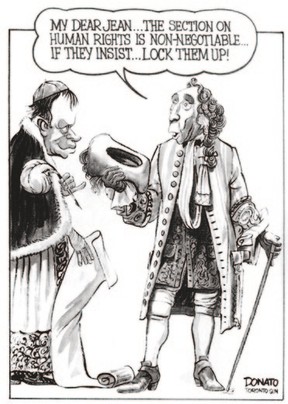
A Toronto Sun editorial cartoon by Andy Donato during Pierre Trudeau’s efforts to pass the Canadian Charter of Rights and Freedoms. You can certainly see where Justin Trudeau learned his approach to human rights.
“When I was in high school, I was taught that every single Canadian adored Pierre Elliott Trudeau. I learned that when the rose-pinned prime minister winked and pirouetted, the whole nation swooned.
It wasn’t until first-year university that I was first exposed to the fierce Western backlash to his National Energy Program.
It wasn’t until I graduated that I learned about any opposition to his Charter of Rights and Freedoms, his policy of national bilingualism, and official multiculturalism.
It was my Ontario high school civics teacher’s fault. While she was a great educator in other ways, the politics lessons she taught us were clearly slanted in the Liberal direction; a direction she supported.
My experience as a young person 20 years ago demonstrates the immense power teachers hold in moulding young minds. It’s a power that concerns me when I imagine dropping off my eight-month-old son at school in three years. Today, that teaching slant has become even steeper, with too many educators unwilling or unable to provide political or ideological balance in their classes.
This week, I interviewed Stephen Reich, a PhD student at The Ontario Institute for Studies in Education (OISE) who researches the proliferation of critical theory in kindergarten to Grade 12 policymaking.
Reich told me I should be concerned—that the educational leaders in this country have all but abandoned what should be the true purpose of education: imparting civilizational knowledge to the next generation. Instead, they’ve replaced it with seeking multiple “truths” and a narcissistic obsession with oppression narratives. Never mind that 92 percent of Canadians polled say they don’t want their children separated by race: taught to see themselves as “privileged” vs. “oppressed”. Reich says certain teachers are far less interested in producing independent thinkers and far more interested in producing activists.
“I have a feeling that success [for them] is ideological conformity,” he explained. That they aim to help foment some sort of “liberation.”
May 24, 2026
The British Climate Change Committee report is “full of howlers”
Matt Ridley expands on a recent Daily Mail article on the antics of the Climate Change Committee’s latest “findings”:
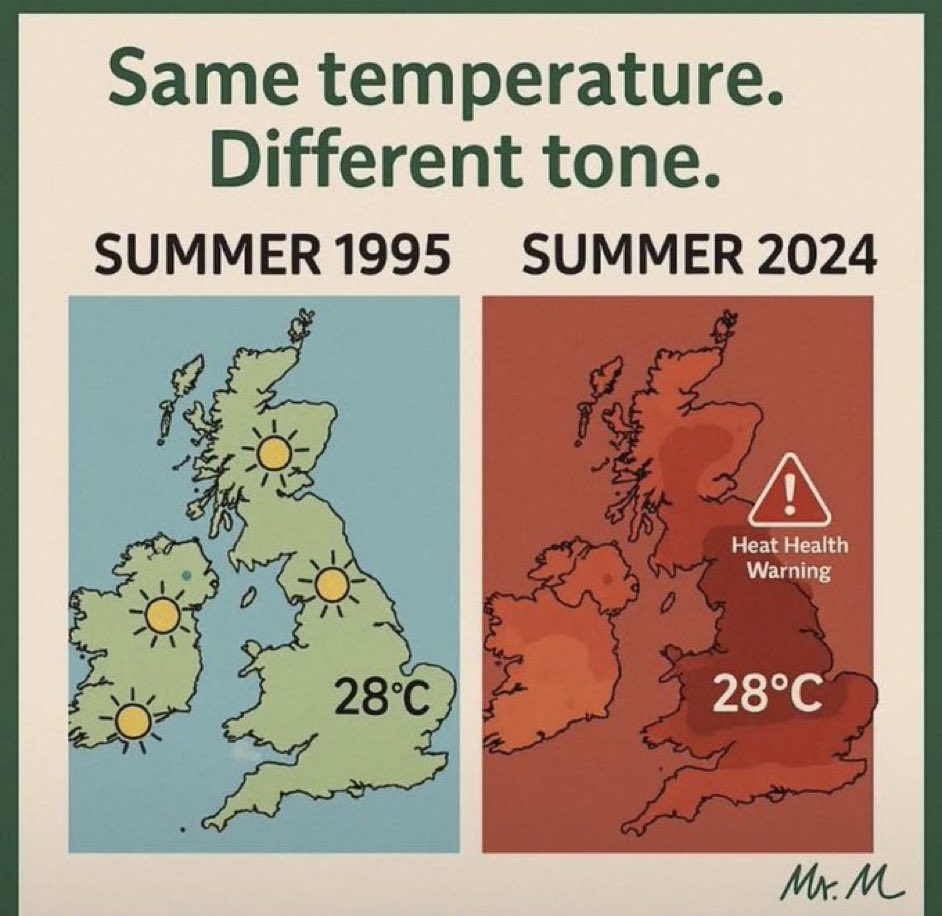
The British public has been propagandized to believe the most extreme risks are far more common than they really are … even in the way the weather is reported.
In my Daily Mail essay on the @theCCCuk‘s new report, I point out that they have a vested interest in exaggeration.
“Between the moment when these climatecrats wake in the morning and the moment they lay their overworked brains to rest on feather pillows at night, they have one all-consuming ambition: to maximise their own budget.
They achieve this goal by being as alarmist as possible.
Imagine if they found evidence that climate change was no big deal or even good news: would they want to publish this? Of course not. It would be disastrous for their (taxpayer-funded) income.
The committee has never produced a report on global greening: the remarkable 15-20 per cent increase in green vegetation on the planet over the past four decades, caused mostly by carbon dioxide emissions.
Nor do its members talk about falling deaths from cold weather anywhere near as much as they do about the smaller number of deaths from hot weather.
Good news for us, in short, is no news for them.
The report is full of howlers. It states emphatically that, by 2050, ‘sea levels will be [not “could be” or “may be”] 20–45 cm higher around UK coasts than today.’
That implies sea levels rising over the next 24 years by 8mm to 19mm per year.
But over the 35 years we have had satellites measuring it, sea levels have risen on average by just 3.4mm per year. There was a little acceleration in 2015-2020 and there has in fact been a deceleration since then: 4.5mm increase per year since 2010 and 3.7mm per year since 2015. (In some parts of the country, such as East Anglia, the land is sinking, a different effect.)
So to assume that the rate of sea-level rise could more than quadruple within the next quarter-century is completely unscientific. Neither Greenland nor Antarctica is losing ice at an accelerating rate — and they are the only possible sources for such a huge increase.
How, then, does @theCCCuk justify this hysteria over sea levels?
It bases its sea-level prediction “on a high-emissions scenario (RCP8.5), using the upper-end estimate (95th percentile)”.
RCP8.5 is an economic scenario that was produced in 2011 for the UN’s Intergovernmental Panel on Climate Change (IPCC) by a team of mathematical modellers.
Their instruction was to find out what it would take to increase CO2 emissions at a rapid rate to a very high level by the end of the century.
First, the modellers said, the world would have to massively increase the use of coal at the expense of oil and gas — using coal to make fuel for cars and planes, burning eight times much coal in 2100 as the world did in 2000, and projecting that fully half of all the world’s energy would be supplied by coal by the end of this century.
Yet even this back-to-coal fantasy was not enough to achieve the gargantuan emissions the modellers were tasked with producing. So they assumed both that the world’s population growth would also reverse its current slowdown, surging to 12 billion people by the end of the century, that innovation to make our lives more fuel-efficient would largely end, and also that we wouldn’t even try to cut emissions.
None of these are going to happen.
Scientists have been saying for more than a decade that the apocalyptic RCP8.5 scenario is extremely unrealistic, and even the alarmist BBC said in 2020 that it was “exceedingly unlikely”.
The IPCC has recently announced that it is abolishing RCP8.5 altogether, while one of the Climate Change Committee’s own members, Professor Piers Forster, wrote an article just last week “on the death of RCP8.5”.
Nobody, at all, ever, under any circumstance, should be using RCP8.5 to forecast climate. Yet the CCC is still using it to terrify the government and the British people – and even taking its “upper-end estimate”!
How to Indoctrinate a Generation – Death of Democracy 16 – Q4 1936
World War Two and Spartacus Olsson
Published 23 May 2026How did Nazi Germany seize control of its youth by the end of 1936? In this episode, Spartacus traces the Hitler Youth Law, the Four-Year Plan, Winterhilfswerk, the Anti-Comintern Pact, Goebbels’ attack on criticism, and the tightening exclusion of German Jews.
Berlin, December 31, 1936. The Nazi regime did not need another single dramatic coup. It connected the household, the factory, the school, the street collection, the newspaper, and the foreign threat into one system of mobilization.
This episode covers how the Law on the Hitler Youth declared all German youth organized within the Hitler Youth; how the Four-Year Plan redirected recovery toward rearmament and autarky; how charity became mandated patriotic ritual through Winterhilfswerk; how anti-Bolshevik propaganda linked Spain, Japan, Italy, and Germany; and how Jewish Germans were pushed further into isolation through administrative humiliation and police control.
This is an educational historical documentary condemning Nazism, antisemitism, dictatorship, racial exclusion, and political indoctrination.
May 22, 2026
Achtung! Achtung! Extremely extreme extreme-right alert! Achtung! Achtung!
Shocking and dreadful news from democratic Germany comes to us from eugyppius, as the extremely extreme extreme-right Hitler Nazi Fascist party continues to soar in the polls, signalling existential danger for “Our Democracy”, just like the 1930s all over again:
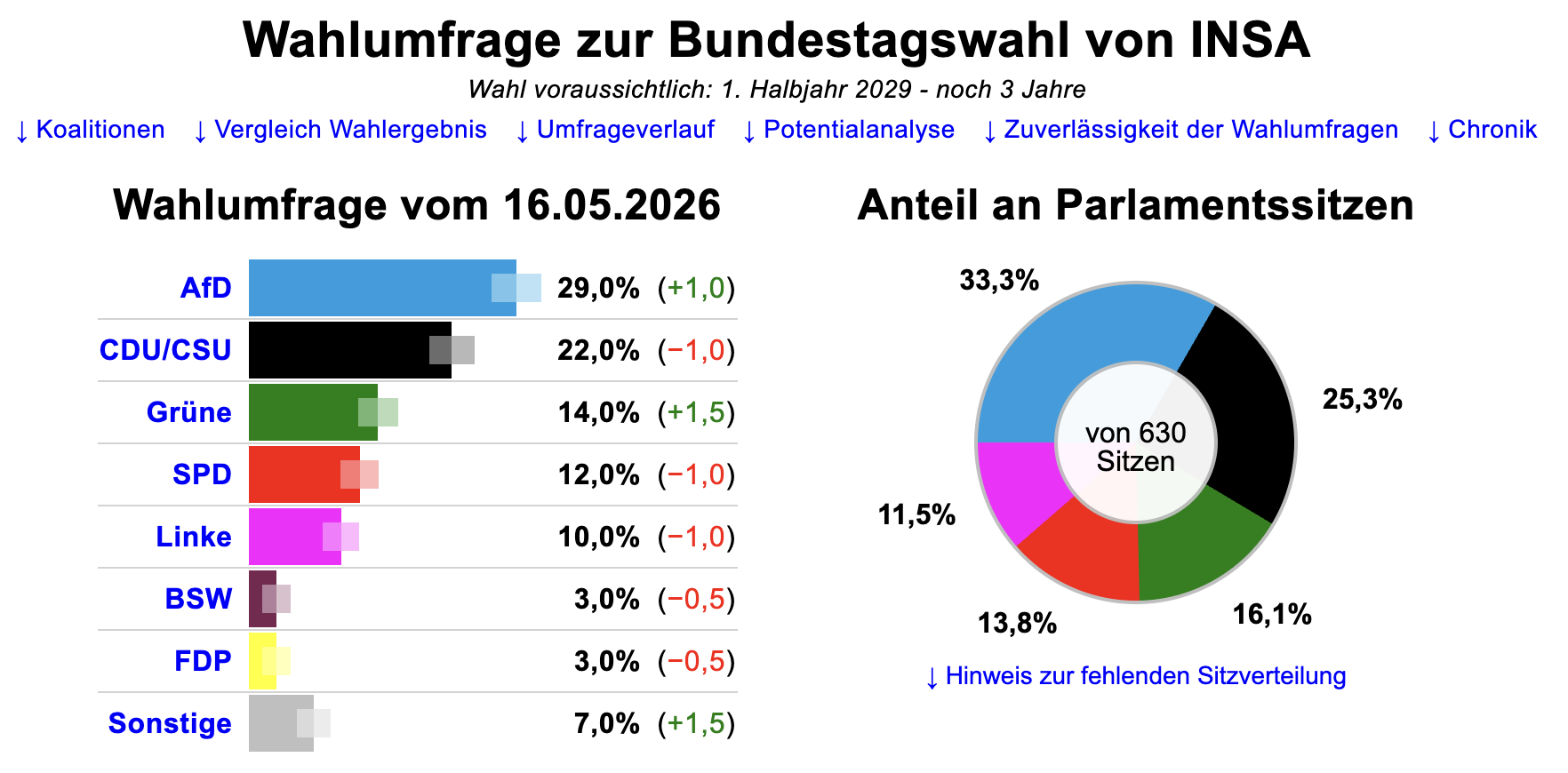
Last Saturday, INSA published a nationwide poll that caused immense disquiet among the defenders of Our Democracy because it showed Alternative für Deutschland a whole seven fat points ahead of the centre-right Union parties. That beastly Evil Fascist Nazi Hitler AfD had never polled so strongly before and had also never clocked such a large lead over the Union before.
Suddenly 1933 was that much closer, and this made the Defenders of Our Democracy uncomfortable. Thus there ensued a lot of hand-wringing and panic and motivated reasoning about how this poll might just be an outlier and also too leftoid conspiracy theories that INSA because reasons and as part of a nefarious plot might be cooking the numbers to make AfD look stronger than they actually are.
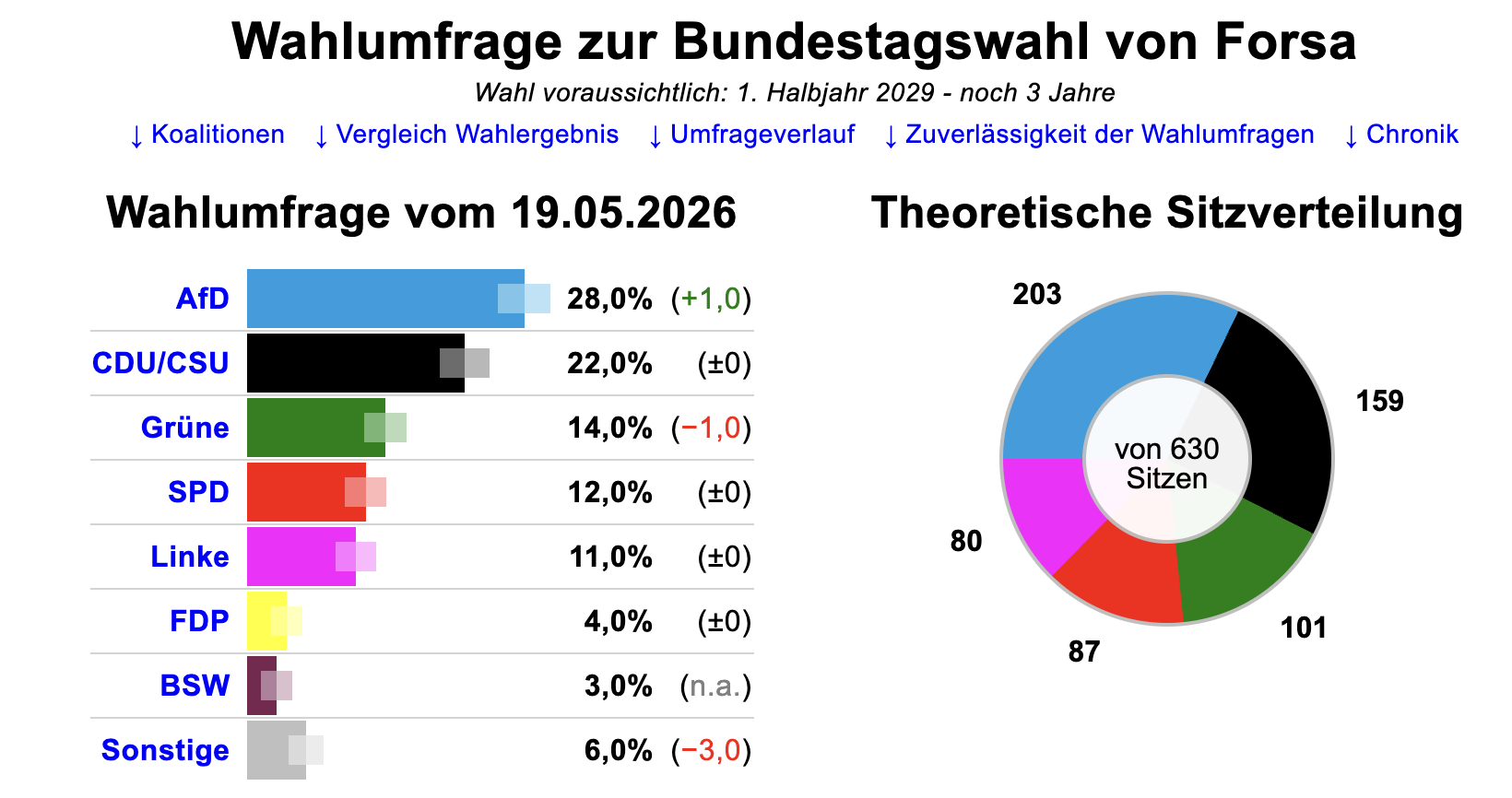
People stopped saying things like that when Forsa, another polling operation, published their own nationwide survey three days later, which had the AfD at 28% with a six-point lead over the CDU …
[…]
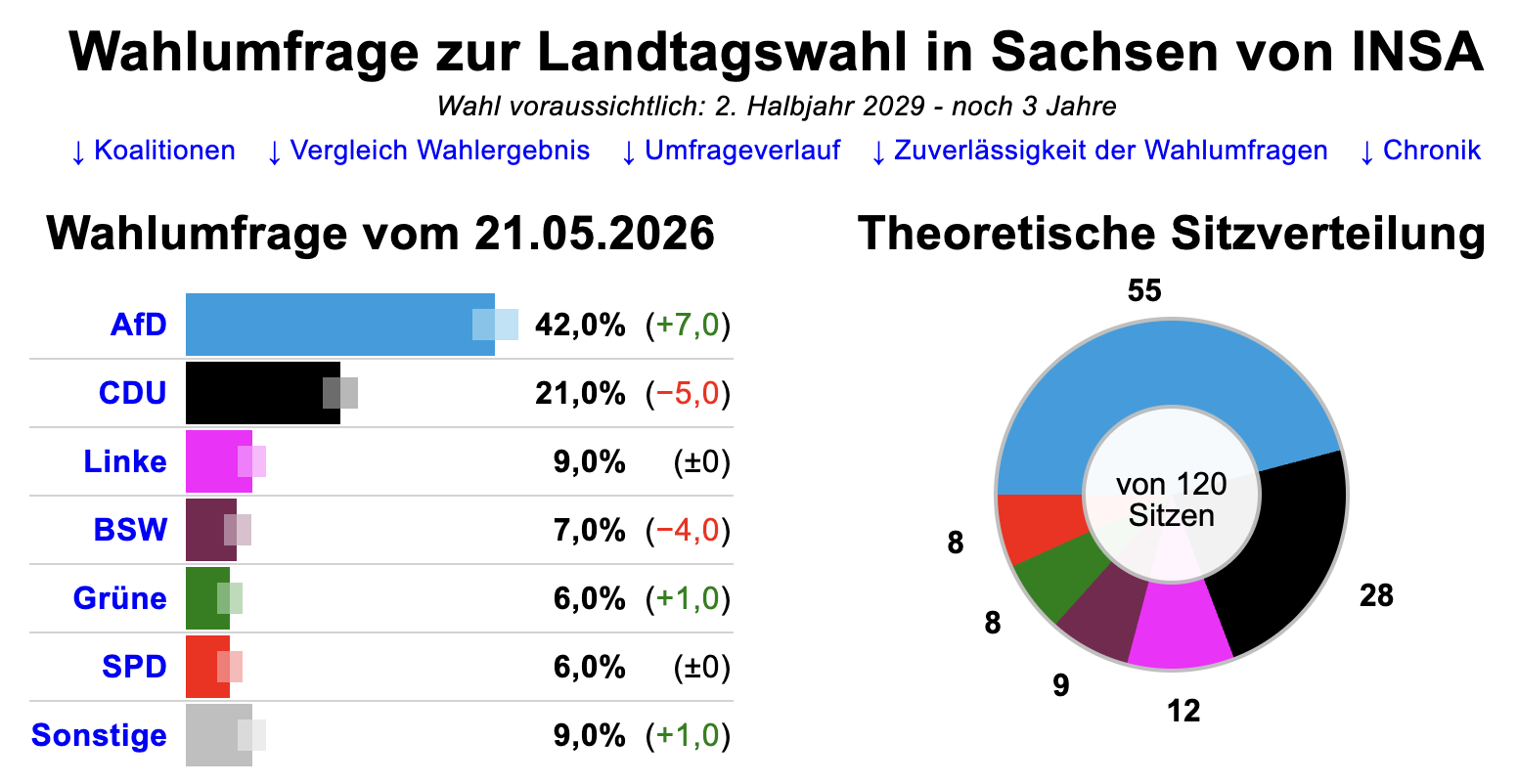
The establishment received their latest shit sandwich this morning, in the form of yet another INSA survey – this time a state poll – showing that the AfD in the Free State of Saxony with 42% support, against a badly weakened CDU at 21%:
These numbers are very close to a recent poll of Sachsen-Anhalt. Together, these polls show that the AfD is on track to achieve outright parliamentary majorities across multiple East German states in the coming years. Basically, we’re looking at a preference cascade, as the press turns on a badly weakened Pigeon Chancellor Friedrich Merz, voters move their support to the only CDU alternative in view, and AfD support thereby becomes socially normalised – which draws still more voters towards the party in turn. Who knows when it will end, or if any of these alienated voters can ever be won back from Evil Nazi Hitler Fascism to Our Democracy, or how the Union can hope to survive the tectonic shifts that are already moving the ground beneath them.
These and other imponderables have driven our political establishment to the brink of psychosis. The CDU have responded to their impending doom by publishing a defamatory 36-page pamphlet screeching that the AfD are “Detrimental to democracy”, “Anti-Semitic” and “Nationalist”. The screed reads like it was written by a pinched schoolmarm and portions of it are very likely legally actionable, mainly because they contain straight-up unadulterated lies. The document raised eyebrows across Germany because its hysterical, desperate tone is so out of character for the staid, unimaginative propagandists of the Union. They must really be losing their minds over there in the CDU.