Quotulatiousness

April 3, 2020

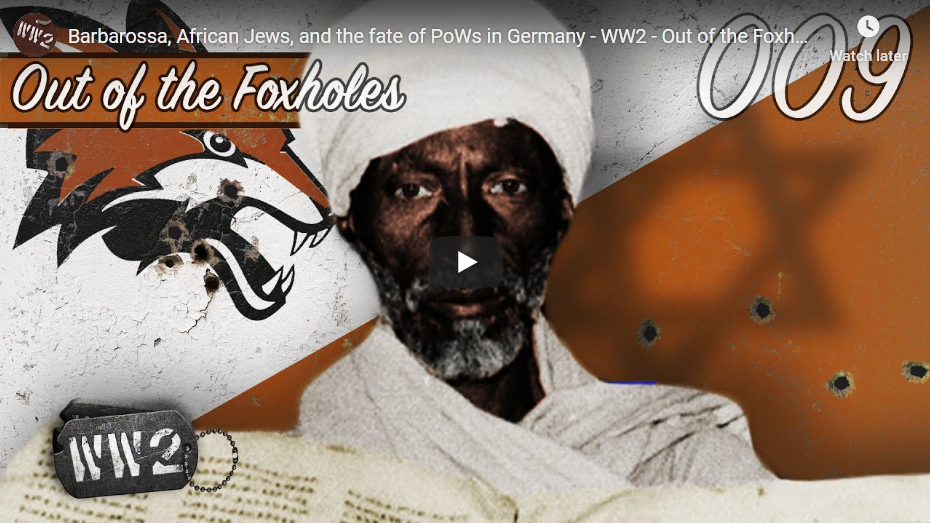
Barbarossa, African Jews, and the fate of PoWs in Germany – WW2 – Out of the Foxholes 009

Filed under: Africa, France, Germany, History, Military, Russia, WW2 — Tags: , , , , , — Nicholas @ 06:00

World War Two
Published 2 Apr 2020

Did the British government know of the German plans for Operation Barbarossa? What happened to Jewish communities in Ethiopia? And to Prisoners of War in occupied countries?

Submit your own question for OOTF: https://community.timeghost.tv/c/Out-…

Join us on Patreon: https://www.patreon.com/TimeGhostHistory
Or join The TimeGhost Army directly at: https://timeghost.tv

Follow WW2 day by day on Instagram @World_war_two_realtime https://www.instagram.com/world_war_t…
Between 2 Wars: https://www.youtube.com/playlist?list…
Source list: http://bit.ly/WW2sources

Written and Hosted by: Indy Neidell
Produced and Directed by: Spartacus Olsson and Astrid Deinhard
Executive Producers: Bodo Rittenauer, Astrid Deinhard, Indy Neidell, Spartacus Olsson
Creative Producer: Joram Appel
Post-Production Director: Wieke Kapteijns
Research by: Indy Neidell
Edited by: Mikołaj Cackowski
Map animations: Eastory (https://www.youtube.com/c/eastory)

Colorizations by:
Adrien Fillon – https://www.instagram.com/adrien.colo…

Sources:
IWM MH 26392, BU 5939, HU 58537
Religion by Berkah Icon from the Noun Project
Letter by Mochammad Kafi from the Noun Project
quiet by priyanka from the Noun Project
Doctor by Wilson Joseph from the Noun Project
jail by Luis Prado from the Noun Project

Soundtracks from the Epidemic Sound:
Johannes Bornlof – “The Inspector 4”
Johannes Bornlof – “Deviation In Time”
Andreas Jamsheree – “Guilty Shadows 4”

Archive by Screenocean/Reuters https://www.screenocean.com.

A TimeGhost chronological documentary produced by OnLion Entertainment GmbH.

June 23, 2019

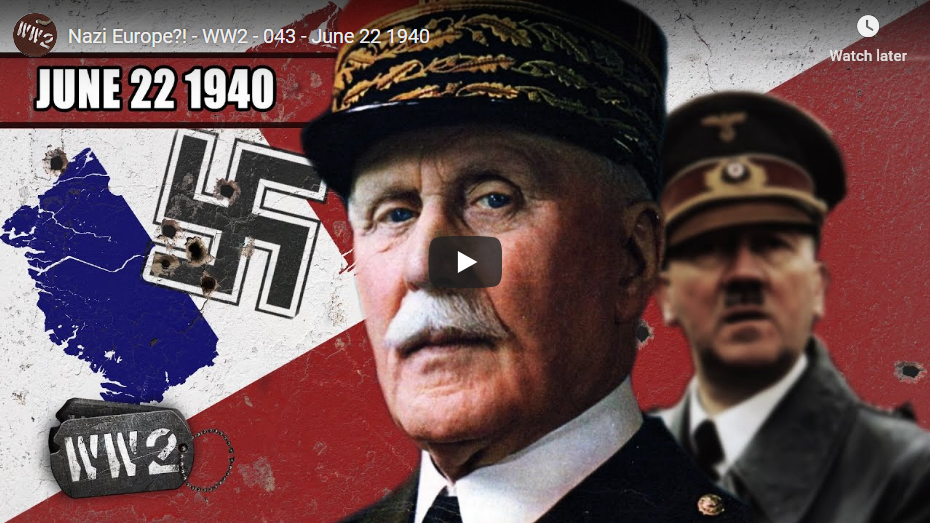
Nazi Europe?! – WW2 – 043 – June 22 1940

Filed under: Europe, France, Germany, History, Italy, Military, WW2 — Tags: , , , , , — Nicholas @ 06:00

World War Two
Published on 22 Jun 2019

While the fighting subsides in much of France, the Italians invade in the south, while tension continues to grow in the Baltic states as the Red Army increases its presence and the USSR makes plans for coups.

Join us on Patreon: https://www.patreon.com/TimeGhostHistory
Or join The TimeGhost Army directly at: https://timeghost.tv

Follow WW2 day by day on Instagram @World_war_two_realtime https://www.instagram.com/world_war_t…
Join our Discord Server: https://discord.gg/D6D2aYN.
Between 2 Wars: https://www.youtube.com/playlist?list…
Source list: http://bit.ly/WW2sources

Written and Hosted by: Indy Neidell
Produced and Directed by: Spartacus Olsson and Astrid Deinhard
Executive Producers: Bodo Rittenauer, Astrid Deinhard, Indy Neidell, Spartacus Olsson
Creative Producer: Joram Appel
Post-Production Director: Wieke Kapteijns
Research by: Indy Neidell
Edited by: Daniel Weiss
Map animations: Eastory

Colorisations by:
– Julius Jääskeläinen, https://www.facebook.com/JJcolorization/ – Norman Stewart, https://www.patreon.com/89tavern

Eastory’s channel: https://www.youtube.com/channel/UCEly…
Archive by Screenocean/Reuters https://www.screenocean.com.

Sources :IWM (F 4871), IWM_HU 76027, Bundesarchiv, Photos from the Jonatan Myhre Barlien photo collection.

A TimeGhost chronological documentary produced by OnLion Entertainment GmbH.

From the comments:

World War Two
2 days ago
After 44 days of fighting, the Battle of France seems to come to an end. For the Germans at least. For the French, the war goes on with Italy. And for us, it goes on as well. These were one of the most exciting videos for us to produce so far. We tried to take the videos to the next level with more and better maps (shoutout to Eastory: everyone who reads this should subscribe to his channel: ) and more animations. In general, we aim to constantly increase our production quality, which we humbly think is succeeding bit by bit. However, this wouldn’t be possible if it wasn’t for the support of those who financially aid us on http://www.patreon.com/timeghosthistory or on our own website https://timeghost.tv. Without them, we wouldn’t be doing any of this. If you like what we’re doing, please consider supporting us as well!

Cheers,
Joram

January 26, 2019

The US Army’s tank development and “The Emergency” in Eire

Filed under: Europe, History, Military, USA, WW2 — Tags: , , , , — Nicholas @ 03:00

A discussion on the TimeGhost forums the other day included a link to this fascinating article by World of Tanks writer The Chieftain:

Wouldn’t it have been a terrible thing if, in the middle of WW2, the people responsible for training and equipping the US Army’s armored force were taken prisoner? Well, they were.

Wait, what? I’m sure we’d have heard all about this if it had really happened, and it’s certainly news to me, so he’s just pulling the long bow here, right? Well, no, he’s not. It really did happen, but there were several reasons why it didn’t become even a nine-day wonder in 1942, because it happened in what had been the Irish Free State but known after 1937 as Éire. Ireland was neutral in WW2, and had a policy of interning combatant personnel who found themselves in Ireland during the war. Keep this in mind, as it’s the key point of the story.

Interned German military personnel at the K-Lines Internment Camp in the Curragh.

Going on another brief tangent, you may be aware of the fact that what we know as “World War II” […] is not known by that name universally. Over on the former Soviet side of the house, it’s “The Great Patriotic War”. (Well, OK, they do distinguish between WWII and TGPW, but not in everyday conversation). The Soviet Union wasn’t the only country to give the conflict a less common name: In Eire, (Ireland), it was known as “The Emergency”

The background to this is that the Irish government wanted to enact emergency powers due to the unusual state of affairs which obtained in Europe in September 1939. The Irish Constitution granted the government such emergency powers in case of war, but it wasn’t entirely sure if the war in Europe counted. So the First Amendment to the Irish Constitution was approved, to add, in effect, that “state of war” could include “wars of which Ireland is not a part if the government thinks it’s important enough.” Once that little clarification was made, the Oireachtas (Parliament) passed its declaration of a state of emergency with the Emergency Powers Act. As a general rule, the Irish ruling bodies were not fans of the concept of acknowledging that there was a war going on which they had chosen not to be a part of. It went so far that when the son of a notable member of the Irish gentry in Malahide was killed when HMS Hood was sunk, his death was noted in the Irish Times as being due to a boating incident. As a result, the entire period 1939-1946 is known as “The Emergency.”

In this, as in so many other things, Ireland is a weird place. But we digress.

In December of 1942, Lieutenant General Jacob Devers, head of the Armored Force, decided to go on a fact-finding mission to the European Theatre of Operations to see how the tank units were holding up. Well, actually, it was mainly the North African Theatre of Operations, as European tank combat hadn’t really gotten off the ground. So he took with him a couple of colleagues, including one Major General Edward Brook, two Brigadier Generals named Gladeon Barnes and William Palmer, a Colonel William Thaddeus Sexton, and to carry the baggage, a Major Earl Hormell. They set off on December 14th, going south to Brazil, Ascension, The Gold Coast, Nigeria and Sudan, arriving Cairo five days later after a distance of 11,140 miles. After spending a little time with the British, they hopped over to Algeria, Tunisia and Morocco. At the end of trip, they went to Gibraltar for a week to consolidate their findings 7-14 January. The result of all this flying around and taking people away from their jobs for a month was one page and a quarter of conclusions, and one half-page of recommendations (the other half is six signature blocks).

[…]

Their duty from their trip being completed, they took advantage of the fact that they were already on the other side of the Atlantic to go to the UK to check in with the goings-on there.

So they boarded their aircraft, a B-17 converted to a VIP transport role, departed Gibraltar, and set off North up the Atlantic’s Eastern edge, looping around to the West of France to avoid German interception. Their B-17 was named “Stinky”.

You can probably guess where this is going.

The daily diary of the Devers mission reads as follows:

“At 2:00pm, January 15th, departed from Gibraltar, weather splendid. At approximately 10:00am, just after daylight, sighted land which navigator described as Lundy Island. From the map, this island appeared to be 100 miles north of the point at which the plane should have turned east towards Port Reath. Retracing south, the contour of the coastline did not correspond to that on available maps. Searched for approximately two hours without finding a familiar landmark. The radio operator was unable to contact any stations. The navigator admitted that he was lost. The ground consisted of small grass fields traversed by stone walls. With the gasoline supply nearly exhausted, a crash landing was made near Athenry at 11:50am. The size of the field was such that after hitting the ground, the plane crashed through a stone wall at approximately 70 miles per hour. Although the plane was wrecked, the members of the party were uninjured. The plane was immediately surrounded by Irish civilians and members of the Home Guard. The local inhabitants were very friendly, offered food and any medical assistance necessary. Shortly thereafter, representatives of the Eire Army arrived and took charge of the situation”

Er, oops? Read the whole thing for the full story.

October 22, 2018

Looting – Pilates – Suicides Among Soldiers I OUT OF THE TRENCHES

Filed under: Europe, History, Military, WW1 — Tags: , , , — Nicholas @ 04:00

The Great War
Published on 20 Oct 2018

Crisis Call Center (US): http://crisiscallcenter.org/crisisser…

Crisis Service Canada: http://www.crisisservicescanada.ca/

Mind (UK): https://www.mind.org.uk/

Deutsche Depressionshilfe: https://www.deutsche-depressionshilfe…

August 19, 2018

Recruits from Alsace – Angel of Siberia I OUT OF THE TRENCHES

Filed under: France, History, Military, Russia, WW1 — Tags: , , — Nicholas @ 04:00

The Great War
Published on 18 Aug 2018

Next to the Chair of Wisdom, Indy Neidell talks about how the German Army dealt with recruits from Alsace-Lorraine and how Elsa Brändström became the Angel of Siberia to many prisoners of war.

January 14, 2018

POWs in Japan – Great War Remembrance – Marasesti I OUT OF THE TRENCHES

Filed under: Europe, Germany, History, Japan, Military, WW1 — Tags: , , , , — Nicholas @ 04:00

The Great War
Published on 13 Jan 2018

Ask your questions here: http://outofthetrenches.thegreatwar.tv

In today’s episode, Indy answers questions about the state of the prisoner of war camps in Japan, the ways in which WW1 is remembered in Germany and the food shortages in the Ottoman Empire, plus he takes a closer look at the Battle of Marasesti.

July 4, 2017

A Bit of Fry & Laurie – Nazi sketch

Filed under: Britain, Germany, History, Humour, WW2 — Tags: , — Nicholas @ 02:00

Published on 25 Apr 2007

Nazi Sketch

April 22, 2017

Flamethrower Units – Handling of Prisoners – Artillery Fuses I OUT OF THE TRENCHES

Filed under: Europe, Germany, History, Military, Weapons, WW1 — Tags: , , , — Nicholas @ 09:42

Published on 22 Apr 2017

In this week’s episode, Indy talks about flamethrower units, the handling of war prisoners and different types of artillery fuses.

March 12, 2017

Camouflage Patterns – Funerary Practices – Prisoner Exchange I OUT OF THE TRENCHES

Filed under: Europe, History, Military, WW1 — Tags: , , — Nicholas @ 04:00

Published on 11 Mar 2017

May 11, 2016

Prisoners of War During World War 1 I THE GREAT WAR Special

Filed under: Europe, France, Germany, History, Military, Russia, WW1 — Tags: , , — Nicholas @ 02:00

Published on 9 May 2016

Millions of men were captured during World War 1 and most of them spent years in prison camps as pawns of the nation that captured them. However, their experience was a taboo in the post war society. We take a look at the hardships of being a prisoner and how the world powers used the POWs as leverage.

March 20, 2016

Germans in the US – Talerhof Internment Camp I OUT OF THE TRENCHES

Filed under: Europe, Germany, History, Military, USA, WW1 — Tags: , , — Nicholas @ 03:00

Published on 19 Mar 2016

It’s chair of wisdom time again and this week Indy talks about German immigrants in the United States, the Austrian Talerhof internment camp and German East Africa.

March 24, 2014

The Great Escape (with bonus Canadian content)

Filed under: Cancon, Europe, Germany, History, Military, WW2 — Tags: , — Nicholas @ 16:06

It was 70 years ago today that the “Great Escape” from Stalag Luft III took place:

July 28, 2012

“Beevor’s book stinks”

Filed under: Books, History, Japan, Media, Military, WW2 — Tags: , — Nicholas @ 12:01

Yes, the headline is taken out of context. Here’s the context:

Granted, we already knew that World War II was brutal. What, then, can Beevor add to this horridly familiar tale? Or, stated differently, do we need another history of that war? Yes, we do. While the war itself remains a constant, the way it is viewed evolves according to changing moral perceptions. In late 1945, for instance, the Tokyo War Crimes Tribunal decided to suppress evidence of cannibalism in order not to traumatize the families of soldiers who died in Japanese prison camps. Beevor thinks that this once-taboo story needs now to be told. He’s probably right. His skill lies in telling it without descending into gratuitous horror.

The challenge that confronts historians is how to convey the immensity of total war without losing sight of singular torment. Too often, the grandeur of great battles smothers the suffering of the individual. Soldiers become battalions that attack on faceless flanks. “One death is a tragedy,” Stalin famously remarked. “A million deaths a statistic.” In the grand narrative, human beings disappear. War is thus sanitized; Stalingrad and Normandy are re-created without the detail of men and women screaming in agony. That is how some readers like it — war without the carnage and putrefaction, without the dismembered limbs and torn faces.

But that is chess, not war. Good military history should stink of blood, feces and fear. Beevor’s book stinks. It reconstructs the great battles but weaves in hundreds of tiny instances of immense suffering. War is presented on its most personal level. We learn not only of the vanity of Gen. Mark Clark, the cruelty of Gen. George Patton and the stupidity of Gen. Maurice Gamelin, but also of the terrible misery endured by what the poet Charles Hamilton Sorley once called “the millions of mouthless dead.” Very few heroes emerge, because heroes are too often cardboard constructs. Detail adds nuance and dimension, clouding characteristics worthy of worship. “Say not soft things as other men have said,” warned Sorley to those who wanted to remember war. Beevor constructs a true picture by avoiding soft things. The book brims with horror, but so it should.

July 11, 2012

Antony Beevor’s latest book

Filed under: Asia, Books, Europe, History, Military, Pacific, WW2 — Tags: , — Nicholas @ 00:02

In History Today, Roger Moorhouse talks to Antony Beevor on his latest booK:

I asked what novelties of approach or new material he employed for the book? Did he, for instance, set out to try to draw the two traditionally distinct narratives of the war in the Pacific and the war in Europe into a single integral whole? Though he does make a nod in that direction, Beevor believes that such an approach is not really feasible, adding that the war in the Pacific was ‘almost like a war on another planet’, such was its separation from events in Europe. ‘I was fascinated,’ he went on, ‘by the reaction of the US Marines on Okinawa when they heard about the surrender of Germany. It was “Who cares?” For them it was impossible to imagine, just as it was impossible for the people fighting in the snows of Russia to imagine war in the Pacific Islands.’

If the approach is largely conventional, the book does not lack new information. Russian sources are still yielding fascinating material, he notes, despite political retrenchment, while German scholarship is throwing up new approaches and new resources, such as the archive of Feldpostbriefe (soldiers ‘field post’ letters) in Stuttgart. Beevor’s most interesting revelation, however, is the horrific contention that the Japanese army practised organised cannibalism. As he explains: ‘Allied prisoners, especially Indian army prisoners, were kept as sort of human cattle and slaughtered one by one for their meat.’ News of such crimes was largely suppressed after the war, as it was considered ‘too awful even to be mentioned in the war crimes trials’, but has since been brought to light by Japanese historians.

[. . .]

Of course the heart of Beevor’s appeal is precisely that straightforward narrative approach, coupled with his lively, engaging style and his use of memorable, almost cinematic, set-pieces. I put it to him that, in tackling a book of this scope, perhaps he had been obliged to rein in some of those literary flourishes. ‘You are right,’ he conceded. ‘There is so much more to tell and there is much less room for the vignette, but it is still terribly important, serving to root the reader in the reality of the moment.’ He is swift to acknowledge a debt to John Keegan in this regard, under whom he studied at Sandhurst and whose The Face of Battle (1976) was hugely influential. ‘It is absolutely vital to give the reader a frequent reminder of what it was actually like, the view from below, otherwise it’s just history from above, which never really works.’

March 27, 2012

The first “home run” from the Colditz POW camp

Filed under: Britain, Europe, Germany, History, WW2 — Tags: — Nicholas @ 09:45

BBC News has an interesting bit of history about the first successful escape from the “escape-proof” prisoner-of-war camp at Colditz:

Forged papers used by a British escapee from Colditz to make one of the first “home runs” back to the UK from the notorious German prisoner-of-war camp are being sold along with his medals. The tale of his ingenuity and success has become the stuff of World War II legend.

Perched high on a rocky outcrop overlooking the River Mulde near Leipzig, eastern Germany, Colditz castle was considered by German authorities in WWII the ideal site for a high-security prison for allied officers with a history of trying to escape.

But despite its “escape proof” label, the Gothic building witnessed 174 attempts by its troublesome, spirited inmates.

Nevertheless, just 32 men were ever successful — and only half of these managed the feat from within the castle.

« Newer Posts

Powered by WordPress