Quotulatiousness

August 12, 2012

Relative poverty is not a very useful measurement

Filed under: China, Economics — Tags: , — Nicholas @ 08:37

At the Adam Smith Institute blog, Tim Worstall explains why measuring relative poverty isn’t helpful:

Here actually is the problem with using relative poverty as a measure:

    Compared to the 1960s, China today has higher income inequality, but also incomparably lower levels of material poverty. By Brady’s definition, China was less impoverished in the near-starvation years of the 1960s than it is as an economic superpower today. According to the OECD, during the last three decades the share of Chinese living in absolute poverty dramatically declined from eight in ten to one in ten (Garroway and de Laiglesia 2011). During the same period, relative poverty, measured exactly as Brady measures it, roughly doubled. Although inequality and relative poverty are not irrelevant for measuring the well-being of a society, we should be apprehensive about a measure of poverty that is incapable of detecting the largest decline in material poverty in human history.

As pointed out, a measure of poverty that not just ignores, but actually gets the sign wrong on, the largest reduction in poverty in the history of our species is of limited value.

[. . .]

Which leads us to something of a conclusion: it’s fine to consider the distribution of incomes within a society. But we do it rather too much with the constant political obsession over relative poverty. We need to be paying a lot more attention to absolute standards of living: most especially how these change over time. Most specifically I’m thinking about the effects attempts to reduce relative poverty might affect our ability to increase absolute standards of living in the future.

August 9, 2012

Individual property rights for First Nations people

Filed under: Cancon, Law, Politics — Tags: , , , — Nicholas @ 08:32

Canada’s treatment of First Nations people has been a disgrace for decades. After locating them (for the most part) on out-of-the-way reserves, they are mostly forgotten by the media and the politicians until something truly awful happens (like the situation on the Attawapiskat reserve) and then TV crews are dispatched, speeches are made and … usually the amnesia kicks in and all is forgotten.

In the National Post, Tasha Kheiriddin suggests that the time is finally ripe to address one of the root causes of poverty among First Nations people on Canadian reserves: their inability to own property. Band councils hold the land “in trust” for their people, which means there are lots of opportunities for those close to the band council to benefit from the administration of the shared resources. Not all bands suffer from this kind of corruption, but many do. Allocating the land to private ownership by individuals would have many beneficial effects:

This week, the federal government confirmed that it is working on legislation to allow the ownership of private property on First Nations reserves. Some aboriginal leaders, such as former chief Manny Jules, who heads the First Nations Tax Commission, applauded the move. But others see ulterior, sinister motivations at work, as Dr. Pam Palmater, a Mi’kmaw professor in the Indigenous Studies department at Ryerson University in Toronto, told Postmedia News’ Teresa Smith. “The quickest way to get that Enbridge pipeline through our territory would be to divide up those lands into individual parcels because it would be a lot quicker to pick off individuals — especially the impoverished ones. And then, if one neighbour sees that an individual gets $100,000 for his property, then what’s someone else, a single mom, with three kids, living on welfare gonna do?”

It’s easy to imagine situations on reserves that are currently governed by band councils that are less than scrupulous where the best land will somehow end up in the hands of the very people who currently benefit from the council’s favour. That is certainly one of the challenges that any such legislation will have to attempt to curtail (even assuming they can get enough support from existing First Nations representatives and groups to move forward with any privatization laws at all).

There is also no doubt that granting First Nations people full property rights – the right to buy, sell, mortgage, use and develop land – is a worthy cause. It would create an ownership culture, instead of the current system (in which reserve land is owned by the federal government, in trust for its Indian residents), which fosters dependency. It would free individual aboriginals from the too-often self-serving grip of band councils. At the same time, it would create responsible government, should those bands seek to tax property, by making them accountable to the property taxpayers they would then serve.

July 19, 2012

Walter Olson: more red flags in the Regnerus study

Filed under: Health, Politics, USA — Tags: , , , , , — Nicholas @ 11:00

Some studies provide results that challenge common beliefs and understandings. Others reinforce them. But some studies are designed from the desired results backwards. The Regnerus study on gay parents’ influence on their children appears to be one of the latter. Walter Olson points out that even in its own terms, the study shows something different from what it is intended to:

By now almost everyone has had a whack at the recent Mark Regnerus (University of Texas) study claiming that young adults who report having a gay parent score worse on a range of life-success indicators than children from intact biological families. According to the study, these kids as young adults have lower educational attainment, are arrested more often, and have more trouble in their own relationships, among other problems. Critics have pointed out that the story is mostly one of collapsed heterosexual families, not “same-sex parenting”: The great majority of the kids were born to male-female couples, most of the presumedly gay dads and many of the moms didn’t get custody of their kids after their relationships dissolved, and few of the kids were actually raised through long periods by gay couples. LGBT advocates point out that sociologist Mark Regnerus accepted $695,000 from the anti-gay Witherspoon Institute to carry out the study.

But many critics have missed one of Regnerus’ most unexpected findings, one that may illuminate his study’s shortcomings. Specifically, and feeding into pretty much all the other problems, the study diagnoses children of gay parents as having a huge problem with poverty. Here’s Regnerus:

    Sixty-nine (69) percent of LMs [respondents with lesbian mothers] and 57% of GFs [those with gay fathers] reported that their family received public assistance at some point while growing up, compared with 17% of IBFs [those with intact two-parent biological families]; 38% of LMs said they are currently receiving some form of public assistance, compared with 10% of IBFs. Just under half of all IBFs reported being employed full-time at present, compared with 26% of LMs.

Those are big gaps. And of course they’re much at odds with the affluent image of gay families presented in both pro- and anti-gay-parenting literature as well as Modern Family-style popular entertainment. What do they signify?

Probably the biggest single reason is the one cited at the outset: This is mostly a survey of what happens when heterosexual families crack up. (Interestingly, if a married couple stayed together, they were counted as an “IBF,” no matter whether one or both partners pursued same-sex liaisons.) Decades of data indicate that children of family breakup do worse than children whose parents stay together, on many variables related to adult success. One reason, though not the only reason, is that they grow up significantly poorer.

June 1, 2012

QotD: Debunking the notion that today’s students face “unprecedented” challenges

Filed under: Economics, Education, History, Liberty, Quotations — Tags: , , — Nicholas @ 00:08

Far from being penalized, this generation may be the most privileged ever. Every generation lives through challenges. Our grandparents or great-grandparents lived in a society of gross social inequality and endured a world war that consumed 35 million lives. Their children came of age in the Great Depression, followed by six years of war in which another 60 million died. Their own children, the Baby Boomers, were without question a pampered generation, yet even they lived through long stretches of high unemployment and deep economic uncertainty. The oil shock of the 1970s ushered in a decade of stagflation — high inflation accompanied by stagnant growth and high unemployment — that made decent jobs no easier to nail down than they are today. The 20 years since the end of the 1980s has been a cycle of boom and bust that has seen millions of people lose homes, careers and life savings they spent decades building, often watching them vanish overnight through circumstances far beyond their control.

The notion that there was a time when anyone could coast through high school and land a nice secure career with minimal effort is sheer fantasy. Yes, a university degree carried more weight, because there were fewer of them, but that same scarcity limited the advantage to a relatively small group. The majority scratched out positions in competition with one another just as they do today. There was never, in my recollection, a bull market in sociologists, psych specialists or arts majors. A BA didn’t help you sell anything, build anything or invent anything. Entrepreneurs and self-starters never needed a university degree, and they don’t now.

[. . .]

If the 1960s and 1970s was a golden age of easy work and high pay, I missed it. If people skipped from school directly into secure jobs, happy families and a home of their own, it’s news to me. The challenges faced by youth are daunting, but no more daunting than they ever were. If Montreal’s graduates have been deprived of anything, it would appear to be lessons in history. Because they seem to have no clue how much tougher they’d have had it in almost any earlier generation they would care to choose.

Kelly McParland, “Quebec students are big on delusion, short on history”, National Post, 2012-05-31

May 22, 2012

Lucasfilm fires Parthian shot in “retreat”

Filed under: Media, Politics, USA — Tags: , , , , — Nicholas @ 10:14

In the New York Times, Norimitsu Onishi reports on recent developments (if you’ll pardon the expression) in Marin County, California:

In 1978, a year after “Star Wars” was released, George Lucas began building his movie production company far from Hollywood, in the quiet hills and valley of Marin County here just north of San Francisco. Starting with Skywalker Ranch, the various pieces of Lucasfilm came together over the decades behind the large trees on his 6,100-acre property, invisible from the single two-lane road that snakes through the area.

And even as his fame grew, Mr. Lucas earned his neighbors’ respect through his discretion. Marin, one of America’s richest counties, liked it that way.

But after spending years and millions of dollars, Mr. Lucas abruptly canceled plans recently for the third, and most likely last, major expansion, citing community opposition. An emotional statement posted online said Lucasfilm would build instead in a place “that sees us as a creative asset, not as an evil empire.”

If the announcement took Marin by surprise, it was nothing compared with what came next. Mr. Lucas said he would sell the land to a developer to bring “low income housing” here.

“It’s inciting class warfare,” said Carolyn Lenert, head of the North San Rafael Coalition of Residents.

It’s lovely to see NIMBY-ism spiked on its own hypocritical underpinnings. Just the threat of allowing “the other” into their lovely 1% outpost will be enough to rattle cages and upset the (self-nominated) “great and the good”:

Whatever Mr. Lucas’s intentions, his announcement has unsettled a county whose famously liberal politics often sits uncomfortably with the issue of low-cost housing and where battles have been fought over such construction before. His proposal has pitted neighbor against neighbor, who, after failed peacemaking efforts over local artisanal cheese and wine, traded accusations in the local newspaper.

The staunchest opponents of Lucasfilm’s expansion are now being accused of driving away the filmmaker and opening the door to a low-income housing development. That has created an atmosphere that one opponent, who asked not to be identified, saying she feared for her safety, described as “sheer terror” and likened to “Syria.”

Update: Jesse Walker comments at Hit and Run:

Lucas hasn’t always been a force for good in land-rights fights: His same statement that complains about the barriers to building on his property also complains that he wasn’t able to put up similar barriers himself when a developer built a neighborhood nearby. But that’s forgiven now. You have to appreciate a move that will simultaneously achieve four worthy goals: making housing more affordable for the poor, showing up the hypocrisies of the local limousine liberals, taking revenge (whether or not Lucas wants to call it that) on the people who restricted his property rights, and setting off a reaction that promises to be far more entertaining than any of the director’s recent movies.

May 21, 2012

Will privacy be on one of the things that differentiates the rich from the rest?

Filed under: Britain, Bureaucracy, Government, Media — Tags: , , , , — Nicholas @ 09:23

Brendan O’Neill in the Telegraph:

Is privacy being turned into a privilege that only the moneyed and the well-connected may enjoy? Two striking stories in the news last week suggest that it is.

In the first story, it was reported that activists and hacks are heaping further pressure on Mark Zuckerberg to improve the privacy settings on Facebook, so that they might update their statuses and post photos of their social shenanigans without having the world and its mother peering over their shoulders. In the second story, we were told that social workers, backed by much of the media, are calling on the prime minister to get rid of “red tape” so that they might more easily interfere in — I’m sorry, intervene in — so-called problem families. There are a lot of damaged families out there, the social workers hinted, and thus we need to rip up some of the rules governing when it is and isn’t okay to stick our snouts into their business.

That these two stories could appear in the same week, and not be considered contradictory, suggests we have a pretty screwed-up attitude to privacy today. Indeed, sometimes the very same members of the political and media classes who believe that their private lives must remain absolutely private will think it is perfectly logical that other people’s private lives — the lives of Them — should be thrown open to state snooping.

May 20, 2012

Reducing child mortality in Africa

Filed under: Africa, Health — Tags: , — Nicholas @ 10:08

An interesting post at The GiveWell Blog, looks at the claims for the Millennium Villages Project (MVP):

The evaluation argues that the MVP was responsible for a substantial drop in child mortality. However, we see a number of problems.

Summary

  • Even if the evaluation’s conclusions are taken at face value, insecticide-treated net distribution alone appears to account for 42% of the total effect on child mortality (though there is high uncertainty).
  • The MVP is much more expensive than insecticide-treated net distribution — around 45x on a per-person basis. Therefore, we believe that in order to make an argument that the MVP is the best available use of dollars, one must demonstrate effects far greater than those attained through distributing bednets. We believe the evaluation falls short on this front, and that the mortality averted by the MVP could have been averted at about 1/35th of the cost by simply distributing bednets. Note that the evaluation does not claim statistically significant impacts beyond health; all five of the reported statistically significant impacts are fairly closely connected to childhood mortality reduction.
  • There are a number of other issues with the evaluation, such that we believe the child mortality effect should not be taken at face value. We have substantial concerns about both selection bias and publication bias. In addition, a mathematical error, discovered by the World Bank’s Gabriel Demombynes and Espen Beer Prydz, overstates the reduction in child mortality, and the corrected effect appears similar to the reduction in child mortality for the countries as a whole that the MVP works in (though still greater than the reduction in mortality for the villages the MVP chose as comparisons for the evaluation). The MVP published a partial retraction with respect to this error (PDF) today.

We would guess that the MVP has some positive effects in the villages it works in — but for a project that costs as much per person as the MVP, that isn’t enough. We don’t believe the MVP has demonstrated cost-effective or sustainable benefits. We also don’t believe it has lived up (so far) to its hopes of being a “proof of concept” that can shed new light on debates over poverty.

H/T to Tim Harford for the link.

May 17, 2012

Defining “sustainability”

Ben Pile explains what is really meant by the term “sustainability” and the real agenda of those who argue for it:

Another reason might be that the concepts of ‘global’ and ‘sustainability’ are at best nebulous. To what extent are ‘global problems’ really global? And to what extent can making and doing things ‘sustainably’ really address problems such as poverty and inequality? Poverty is not, in fact, a problem of too much exploitation of natural resources, but too little. And poverty is not a global problem, but a categorically local one, in which a population is isolated from the rest of the world.

We can only account for poverty and inequality in the terms preferred by environmentalists if we accept the limits-to-growth thesis and the zero-sum game that flows from it. In other words, that there are limits on what we can take from the planet and we can only solve poverty if we divide those limited resources more equitably. Such an argument for reducing and redistributing resources has the reactionary consequence of displacing the argument for creating more wealth.

But to date, the arguments that there exist limits to growth, an optimum relationship between people and the planet, and that industrial society is ‘unsustainable’, have not found support in reality. The neo-Malthusians’ predictions in the Sixties and Seventies were contradicted by growth in population and wealth. And now there is a growing recognition that the phenomenon most emphasised by environmentalists — climate change — has been overstated. [. . .]

‘Sustainability’ is not about delivering ‘what we want’ at all but, on the contrary, mediating our desires, both material and political. Accordingly, the object of the Rio meeting is not as much about finding a ‘sustainable’ relationship between humanity and the natural world as it is about finding a secure basis for the political establishment. The agenda for the Rio +20 conference is the discussion of ‘decent jobs, energy, sustainable cities, food security and sustainable agriculture, water, oceans and disaster readiness’. Again, noble aims, perhaps. But is the provision of life’s essentials, and the creation of opportunities for jobs and the design of cities, really a job for special forms of politics and supranational organisations?

The idea that there are too many people, or that the natural world is so fragile that these things are too difficult for normal, democratic politics to deliver, flies in the face of facts. It would be easier to take environmentalists and the UN’s environmental programmes more seriously if millions of people were marching under banners calling for ‘lower living standards’ and ‘less democracy’. Instead, just a tiny elite speaks for the sustainability agenda, and only a small section of that elite is allowed to debate what it even means to be ‘sustainable’. We are being asked to take at face value their claims to be serving the ‘common good’. But there is no difference between the constitutions of benevolent dictatorships and tyrannies.

Sustainability is a fickle concept. And its proponents are promiscuous with scientific evidence and ignorant of the context and the development of the sustainability agenda, believing it to be simply a matter of ‘science’ rather than politics. The truth of ‘sustainability’, and the meeting at Rio next month, is that it is not our relationship with the natural world that it wishes to control, but human desires, autonomy and sovereignty. That is why, in 1993, the Club of Rome published its report, The First Global Revolution, written by the club’s founder and president, Alexander King and Bertrand Schneider. The authors determined that, in order to overcome political failures, it was necessary to locate ‘a common enemy against whom we can unite’. But in fighting this enemy — ‘global warming, water shortages, famine and the like’ — the authors warned that we must not ‘mistake symptoms for causes’. ‘All these dangers are caused by human intervention in natural processes, and it is only through changed attitudes and behaviour that they can be overcome. The real enemy then is humanity itself.’

May 12, 2012

The best news out of Africa in … well, ever

Filed under: Africa, Health — Tags: , — Nicholas @ 09:56

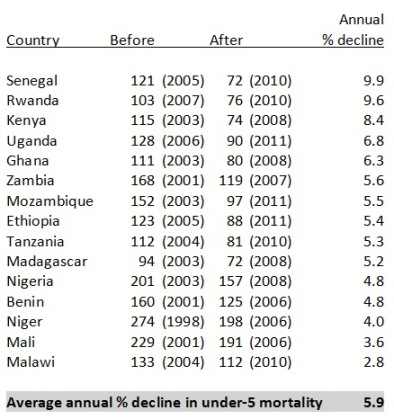
From Tim Worstall at the Adam Smith Institute:

That is the annual change in child mortality in those selected countries. No country, no group of countries, has ever seen anything like this, it simply has not happened so quickly anywhere else at all. Something, blessedly, is going very right indeed in this world. My suggestion is that we keep doing exactly what it is that we are currently doing: we might call it globalisation, foreign direct investment, openness to trade or as Madsen puts it, buying things made by poor people in poor countries. But it’s working, isn’t it?

May 11, 2012

Sneering at both the rich and the poor: the modern “equality” campaigners

Filed under: Economics, Media, Politics — Tags: , , , , , — Nicholas @ 09:16

Daniel Ben-Ami on the equal-opportunity snobs in the so-called “equality” movement:

It is easy to make the mistake of assuming there is a big drive towards equality in the world today. Politicians, pundits and even billionaire financiers rail against the dangers of inequality, excess and greed. A handful of Occupy protesters claiming to represent the ‘99 per cent’ against the super-rich ‘one per cent’ are widely lauded in influential circles. Parallel campaigns slate the wealthy for failing to pay their fair share of tax. Officially sanctioned campaigns promote fairness, social justice, social equality, equal access to education and the like.

From this false premise it appears to follow that radical politics is alive and well. If equality was historically a core principle of the left then, so it is assumed, the current discussion must be enlightened and humanistic. Those who oppose the plethora of apparently pro-equality initiatives are therefore cast as reactionary souls who are probably in the pay of giant corporations.

[. . .]

In contrast, the discussion in recent years has shifted decisively against the idea of economic progress and towards a deep suspicion, even hatred, of humanity. It promotes initiatives to counter the dangers of social fragmentation in an unequal society. Indeed, this fear of a disintegrating society can be seen as the organising principle behind a wide range of measures to regulate supposedly dysfunctional behaviour. These range across all areas of personal life, including childrearing, drinking alcohol, eating, sex and smoking. Such initiatives assume that public behaviour must be subject to strict regulation or it could fragment an already broken society.

A distinct feature of the current discussion is that the rich are also seen as posing a threat to social cohesion. Their greed is viewed as generating unrealistic expectations among ordinary people. In this conception, inequality leads to status competition in which everyone competes for ever-more lavish consumer products. A culture of excess is seen to be undermining trust and a sense of community.

The contemporary consensus thus marries the fear of social fragmentation with anxiety about economic growth. It insists that the wealthy must learn to behave responsibly by maintaining a modest public face. It also follows that prosperity must be curbed. This is on top of fears about the damage that economic expansion is alleged to do to the environment.

This drive to curb inequality is informed by what could be called the outlook of the anxious middle. It is middle class in the literal sense of feeling itself being torn between the rich on one side and ordinary people on the other. Its aim is to curb what it regards as excesses at both the top and bottom of society. It sees itself as living in a nightmare world being ripped apart by greedy bankers at one extreme and ‘trailer trash’ at the other.

May 8, 2012

Now available for download: License to Work

Filed under: Bureaucracy, Economics, Government, Liberty, USA — Tags: , , , , — Nicholas @ 10:14

The Institute for Justice has released a new study, License to Work: A National Study of Burdens from Occupational Licensing, which shows the negative effects imposed on (especially) poor and minority workers across the United States:

The report documents the license requirements for 102 low- and moderate-income occupations — such as barber, massage therapist and preschool teacher — across all 50 states and the District of Columbia. It finds that occupational licensing is not only widespread, but also overly burdensome and frequently irrational.

On average, these licenses force aspiring workers to spend nine months in education or training, pass one exam and pay more than $200 in fees. One third of the licenses take more than a year to earn. At least one exam is required for 79 of the occupations.

Barriers like these make it harder for people to find jobs and build new businesses that create jobs, particularly minorities, those of lesser means and those with less education.

May 6, 2012

One of the worst moves African countries can make

Filed under: Africa, Economics — Tags: , , , — Nicholas @ 09:55

Tim Worstall at the Adam Smith Institute blog:

You don’t have to go far into NGO land to find people arguing that poor countries need to protect their baby industries from the big bad wolves of international capitalism. That trade barriers are a good idea, that infant industries need to be nurtured and, as is the way of these things, the Washington Consensus is the imposition of the poverty that the poor suffer from.

That this is entire nonsense does not stop those idiots wearing ideological blinkers from repeating it. Which is something of a pity as it really is trade, openness to it, which drives economic growth:

    In recent years, sub-Saharan African countries have grown remarkably. According to data from the Penn World Table 7.0 (Heston et al. 2011), average annual real GDP per capita growth from 2005-9 has been over 2.5% (3.5% when excluding 2008 and 2009). This recent growth performance is remarkable given that, for over four decades since 1960, real GDP per capita growth in sub-Saharan Africa was dismal, averaging less than 0.5% per annum.

We are, as we know, talking about the poorest of the poor and any uptick in their fortunes has been both extremely difficult to find and extremely welcome when it is.

One thing that might be remembered is that, post-colonialism, most sub-Saharan countries did in fact follow the policies of infant industry protection behind tariff and licencing barriers. It was the falling apart of this in the 80s and then the gradual adoption of good old neoliberalism in the mid to late 90s which has turned the numbers around.

April 27, 2012

Social polarization in America

Filed under: Economics, Education, Media, USA — Tags: , , , — Nicholas @ 09:27

Frank Furedi reviews the latest book by Charles Murray, Coming Apart: The State of White America, 1960-2010.

The nineteenth-century British politician Benjamin Disraeli once characterised ‘the rich and the poor’ as ‘two nations between whom there is no intercourse and no sympathy; who are as ignorant of each other’s habits, thoughts and feelings, as if they were dwellers in different zones, or inhabitants of different planets’. It is a description that applies uncannily to contemporary American society.

I recall the first time I travelled to America — back in 1967 — having a discussion with my then girlfriend about how difficult it was to distinguish between the well-off and the not so well-off people on the streets of the places we visited. That was then. When I visit these days, I am struck by the contrast in appearance between rich and poor white citizens. They now look so different. They eat different food; they pursue different cultural interests; they speak differently; and, most important of all, they communicate values and attitudes that are often strikingly at odds with one another. It is all very redolent of the kind of social and cultural polarisation so prevalent during the nineteenth century.

Coming Apart: The State of White America, 1960-2010, Charles Murray’s exploration of the socioeconomic segregation that divides the US, is a valiant attempt to give a coherent account of this polarisation. What is important about Murray’s discussion of the intensification of the socioeconomic segregation of America is that it shows not simply the economic but also the cultural drivers of this process. So differences in income and living standards, and growing economic inequality, are also paralleled by a divergence in ‘core behaviours and values’. For example, Murray focuses on divergent attitudes towards marriage, industriousness, honesty and religion to demonstrate the disturbing fact that upper-class and lower-class Americans inhabit very different moral communities. His thesis is that this polarisation of cultural attitudes threatens the coherence of society and puts the American project at risk.

April 26, 2012

Organic farming: larger “footprint” to produce compared to non-organic

Filed under: Economics, Environment, Food, Science — Tags: — Nicholas @ 10:57

Summary of a recent study published in Nature, which found that organic farming has a lower production per acre than non-organic methods:

Organic farming may yield up to a third less of some crop types, according to a study proposing a hybrid with conventional agriculture as the best way to feed the world without destroying it.

Organic farming seeks to limit the use of chemical pesticides and fertilizers, but critics suggest lower crop yields require bigger swaths of land for the same output as conventional farms.

This would conceivably require parts of forests and other natural areas being turned into farmland, undoing some of the environmental gains of organic tilling methods, they say.

The new study by Canadian and American researchers, published in Nature Wednesday, reviewed 66 studies comparing the yields of 34 different crop species in organic and conventional farming systems. The review limited itself to studies assessing the total land area used, allowing researchers to compare crop yields per unit area. Many previous studies have shown large yields for organic farming but ignored the size of the area planted — which is often bigger than in conventional farming.

This means, as most people probably suspected, that true “organic” farming methods are likely to be a boutique for well-off western consumers rather than a solution to malnutrition and poverty in developing nations.

April 24, 2012

Corruption in Afghanistan reaches new heights

Filed under: Asia, Government, Middle East, Military — Tags: , , , , — Nicholas @ 08:33

From Strategy Page:

A major obstacle to improving security in Iraq and Afghanistan was not equipment, training or leadership, but corruption. No matter how well led, trained and equipped the troops were, if they could be bought they were worse than useless. But the corruption went beyond the troops themselves. Government officials had to be carefully monitored to prevent the money for equipment, training and pay from being stolen before it got to the troops. More fundamentally, corruption was the reason Iraq, Afghanistan and so many other nations are poor and full of unhappy, and often violent, people. Corruption is why these places are chaotic and so often in the news. Corruption is the major cause of Islamic terrorism. Corruption does not get the recognition it deserves.

But in Afghanistan corruption has recently risen to new heights; literally. Several recent attacks in Kabul have made use of unfinished high-rise buildings, where terrorists used the height advantage to do more damage. American advisors noted that there were a lot of unfinished tall buildings in Kabul, and many had apparently been abandoned. The Americans asked the local government who owned these high-rise structures and was told that the government didn’t know. Kabul has undergone a construction boom in the last decade, and many of the builders (or their backers) didn’t bother with getting construction permits. If the cops or officials came around asking questions they were offered a bribe, or a death threat, or both. Inquisitive journalists were handled the same way.

« Newer PostsOlder Posts »

Powered by WordPress