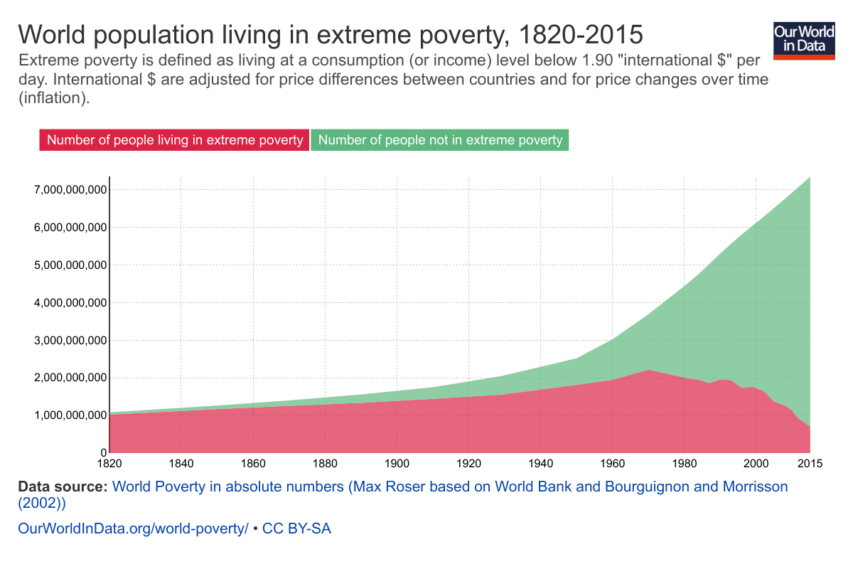
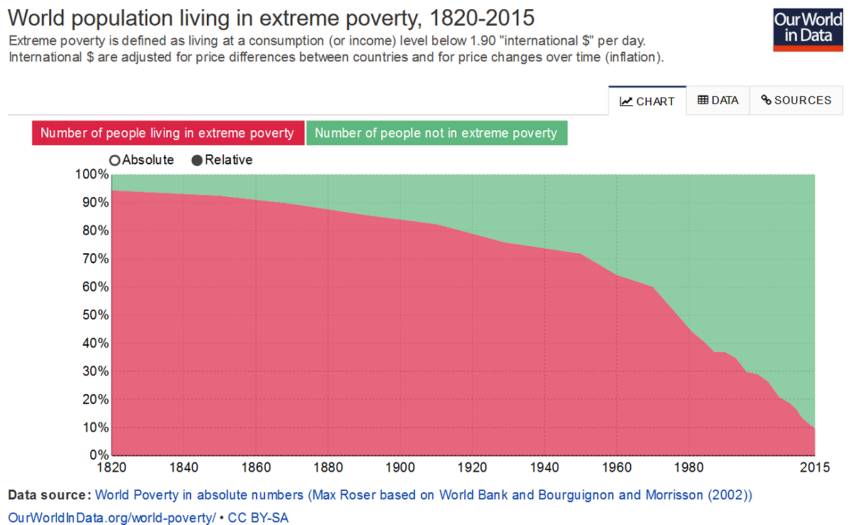
The same world poverty data, presented as absolute or relative levels of poverty:
H/T to Rob Fisher at Samizdata for the link.

The same world poverty data, presented as absolute or relative levels of poverty:
H/T to Rob Fisher at Samizdata for the link.
Other things equal, the larger the lot, the more you’ll pay for it. Regulations that specify minimum lot sizes — that say you can’t build on land smaller than that minimum — increase prices. Regulations that forbid building more units on a given-size lot have the same effect: they restrict supply and make housing more expensive.
People who already live there may only want to preserve their lifestyle. But whether they intend to or not (and many certainly do so intend) the effect of these regulations is to exclude lower-income families. Where do they go? Where they aren’t excluded — usually poorer neighborhoods. But that increases the demand for housing in poorer neighborhoods, where prices will tend to be higher than they would have been.
And it’s not just middle-class families that do this. Very wealthy residents of exclusive neighborhoods and districts also have an incentive to support limits on construction in order to maintain their preferred lifestyle and to keep out the upper-middle-class hoi polloi. Again, the latter then go elsewhere, very often to lower-income neighborhoods — Williamsburg in Brooklyn is a recent example — where they buy more-affordable housing and drive up prices. Those who complain about well-off people moving into poor neighborhoods — a phenomenon known as “gentrification” — may very well have minimum-lot-size and maximum-density regulations to thank.
When government has the authority to restrict building and development, established residents of all income levels will use that power to protect their wealth.
Sandy Ikeda, “Shut Out: How Land-Use Regulations Hurt the Poor”, The Freeman, 2015-02-05.
Of the numerous and occasionally contradictory techniques used to ration demand and supply [when monetary prices are not used], perhaps the most common is past behavior: persons already in apartments are given preference under rent control, or past acreage determines current allotments under agricultural price support programs. Another common technique is queuing or first come – first served: taxicabs, theater tickets, medical services, and many other goods and services are rationed in this way when their prices are controlled. Of course, discrimination and nepotism are also widely used; the best way to get a rent-controlled apartment is to have a (friendly) relative own a controlled building. Other criteria are productivity – the least productive workers are made unemployed by minimum wage laws;…. collateral – borrowers with little collateral cannot receive legal loans when effective ceilings are placed on interest rates.
Each rationing technique benefits certain groups at the expense of other groups relative to their situation in a free market. Price controls are almost always rationalized, at least in part, as a desire to help the poor, yet it is remarkable how frequently they harm the poor.
Gary Becker, Economic Theory, 1971.
I would point you to one of the great economic resources of our times. The work of Angus Maddison. Download that database (it’s a simple Excel file). Play around with it. And then think about it.
While you think about it, ponder the point that Brad Delong likes to make (derived in part from Maddison and also from his own work). The one fact of economics that we need to explain is what the heck happened around 1700? Why did living standards flatline, roughly and around about, from the founding of Ur until someone worked out how to use a steam engine? That’s the one supreme puzzle. Now, we think we’ve found a lot of answers, Malthusian growth giving way to Smithian (and possibly, as Deepak Lal puts it, Promethean). We might want to ascribe it to capitalism, to markets, to the welfare state, to a step change in technology: and bits and pieces of all of those have obviously contributed to where we are now. But something the heck happened which was different from everything that preceded it.
And now back to Maddison’s numbers. To explain them a little bit (and this again draws on points I’ve lifted from Delong). They are in constant dollars. So, an adjustment has been made for inflation over the decades and centuries. We can’t say that sure, peoples’ incomes in the past were low but so were prices. These numbers are at modern prices (actually, the prices of 1992 if I recall correctly, so adjust by 20 odd years mentally). They are also PPP adjusted, another version of the same thing. So they really are (trying, this is more of an art than a science at this distance) trying to reflect different prices in different places as well as the inflation adjustment across time.
Finally, they are of GDP per capita. This isn’t the same as the average income, not at all. Some amount of GDP will flow to capital, there will be inequality of distribution and so on. However, the average living standard of a place and time cannot be more than that GDP per capita. And then look at the numbers again. Up until 1600 or so GDP per capita wandered around between $500 a year and $1,000 a year or so. All over the world. Up a bit, down a bit, the central years of the Roman Empire were better when the Romans were civilising my Celtic forbears than when the Saxons were slaughtering my Celtic forbears but no real breakout from that range.
And remember: this is at 1992 prices. We really are saying that people had the standard of living that we would have if we had $500 or $1,000 a year to go spend in a 1992 Walmart. Now go look at 1890s America. That house on the prairies time. We really are saying that the average American in 1890 (less than in fact, that difference between incomes and GDP, distributional effects) was living on $3,900 a year. And no, not at some different price level. All housing, clothing, heating, food, everything, at the prices that we would see in a 1992 Walmart.
That’s poor.
In the year of my birth it was $12,200: better, certainly, but simply nowhere near as good as today.
It really is important to understand this point. The past was unimaginably poor by our current standards. As are parts of ther world today. Or, as the man said, the Good Old Days are right now.
Tim Worstall, “Joni Ernst, Bread Bags And The Poverty Of The Past”, Forbes, 2015-02-02.
In the Wall Street Journal, economist Deirdre McCloskey pinpoints the launch point of the greatest increase in global human wealth ever seen:
In the 18th century, liberal thinkers such as Voltaire and Benjamin Franklin courageously advocated liberty in trade. By the 1830s and 1840s, a much enlarged intelligentsia, mostly the sons of bourgeois fathers, commenced sneering loftily at the liberties that had enriched their elders and made possible their own leisure. The sons advocated the vigorous use of the state’s monopoly of violence to achieve one or another utopia, soon.
Intellectuals on the political right, for instance, looked back with nostalgia to an imagined Middle Ages, free from the vulgarity of trade, a nonmarket golden age in which rents and hierarchy ruled. Such a conservative and Romantic vision of olden times fit well with the right’s perch in the ruling class. Later in the 19th century, under the influence of a version of science, the right seized upon social Darwinism and eugenics to devalue the liberty and dignity of ordinary people and to elevate the nation’s mission above the mere individual person, recommending colonialism and compulsory sterilization and the cleansing power of war.
On the left, meanwhile, a different cadre of intellectuals developed the illiberal idea that ideas don’t matter. What matters to progress, the left declared, was the unstoppable tide of history, aided by protest or strike or revolution directed at the evil bourgeoisie — such thrilling actions to be led, naturally, by themselves. Later, in European socialism and American Progressivism, the left proposed to defeat bourgeois monopolies in meat and sugar and steel by gathering under regulation or syndicalism or central planning or collectivization all the monopolies into one supreme monopoly called the state.
While all this deep thinking was roiling the intelligentsia of Europe, the commercial bourgeoisie — despised by the right and the left, and by many in the middle, too — created the Great Enrichment and the modern world. The Enrichment gigantically improved our lives. In doing so, it proved that both social Darwinism and economic Marxism were mistaken. The supposedly inferior races and classes and ethnicities proved not to be so. The exploited proletariat was not driven into misery; it was enriched. It turned out that ordinary men and women didn’t need to be directed from above, and when honored and left alone, became immensely creative.
The Great Enrichment is the most important secular event since human beings first domesticated wheat and horses. It has been and will continue to be more important historically than the rise and fall of empires or the class struggle in all hitherto existing societies. Empire did not enrich Britain. America’s success did not depend on slavery. Power did not lead to plenty, and exploitation was not plenty’s engine. Progress toward French-style equality of outcome was achieved not by taxation and redistribution but by the Scots’ very different notion of equality. The real engine was the expanding ideology of classical liberalism.
The Great Enrichment has restarted history. It will end poverty. For a good part of humankind, it already has. China and India, which have adopted some of economic liberalism, have exploded in growth. Brazil, Russia and South Africa, not to speak of the European Union — all of them fond of planning and protectionism and level playing fields — have stagnated.
There’s no sign of it here in Magnolia, Ark., but the boycott season is upon us, and graduates of Princeton and Bryn Mawr are demanding “justice” from Wal-Mart, which is not in the justice business but in the groceries, clothes, and car-batteries business. It is easy to scoff, but I am ready to start taking the social-justice warriors’ insipid rhetoric seriously — as soon as two things happen: First, I want to hear from the Wal-Mart-protesting riffraff a definition of “justice” that is something that does not boil down to “I Get What I Want, Irrespective of Other Concerns.”
Second, I want to turn on the radio and hear Jay-Z boasting about his new Timex.
It is remarkable that Wal-Mart, a company that makes a modest profit margin (typically between 3 percent and 3.5 percent) selling ordinary people ordinary goods at low prices, is the great hate totem for the well-heeled Left, whose best-known celebrity spokesclowns would not be caught so much as downwind from a Supercenter, while at the same time, nobody is out with placards and illiterate slogans and generally risible moral posturing in front of boutiques dealing in Rolex, Prada, Hermès, et al. It’s almost as if there is a motive at work here other than that which is stated by our big-box-bashing friends on the left and their A-list human bullhorns.
What might that be?
Kevin D. Williamson, “Who Boycotts Wal-Mart? Social-justice warriors who are too enlightened to let their poor neighbors pay lower prices”, National Review, 2014-11-30.
People buy Rolex watches for reasons other than their timekeeping excellence, just as people buy Ferraris and horses for reasons other than going to the store to pick up a gallon of milk and a loaf of bread. Economists talk about “Veblen goods,” which are more valued because of their high prices rather than in spite of them, coveted not for their conventional utility but for their exclusivity. Owning a Rolls-Royce isn’t about the car — it’s about you. Which is why you see magazines such as The Robb Report — one of those glossies full of “bland advertisements for being wealthy,” as the novelist William Gibson put it — for sale in places such as Wal-Mart, where the typical customer is not actually in the market for a yacht or Kiton overcoat. If you’ve ever seen the heartbreaking sight of a young woman stopping a Wal-Mart checker three-fourths of the way through ringing up her purchases — because she does not have enough money to pay for what’s left in her cart — then you can be pretty sure that what’s going in her sack is more or less the opposite of Veblen goods.
Ironically, the anti-Wal-Mart crusaders want to make life worse for people who are literally counting pennies as they shop for necessities. Study after study has shown that Wal-Mart has meaningfully reduced prices: 3.1 percent overall, by one estimate — with a whopping 9.1 percent cut to the price of groceries. That comes to about $2,300 a year per household, savings that accrue overwhelmingly to people of modest incomes, not to celebrity activists and Ivy League social-justice crusaders.
Ultimately, these campaigns are exercises in tribal affiliation. The Rolex tribe, and those who aspire to be aligned with it, signal their status by sneering at the Timex tribe — or by condescending to it as they purport to act on its behalf, as though poor people were too stupid to know where to find the best deal on a can of beans. Or call it the Trader Joe’s tribe vs. the Wal-Mart tribe, the Prius tribe vs. the F-150 tribe.
Kevin D. Williamson, “Who Boycotts Wal-Mart? Social-justice warriors who are too enlightened to let their poor neighbors pay lower prices”, National Review, 2014-11-30.
Matt Ridley on how horrible implementations of the ideas of Thomas Malthus have made the world an even more cruel place:
For more than 200 years, a disturbingly vicious thread has run through Western history, based on biology and justifying cruelty on an almost unimaginable scale. It centres on the question of how to control human population growth and it answers that question by saying we must be cruel to be kind, that ends justify means. It is still around today; and it could not be more wrong. It is the continuing misuse of Malthus.
According to his epitaph in Bath Abbey, the Rev Thomas Robert Malthus, author of An Essay on the Principle of Population (1798), was noted for “his sweetness of temper, urbanity of manners and tenderness of heart, his benevolence and his piety”. Yet his ideas have justified some of the greatest crimes in history. By saying that, if people could not be persuaded to delay marriage, we would have to encourage famine and “reprobate specific remedies for ravaging diseases”, he inadvertently gave birth to a series of heartless policies — the poor laws, the British government’s approach to famine in Ireland and India, social Darwinism, eugenics, the Holocaust, India’s forced sterilisations and China’s one-child policy. All derived their logic more or less directly from a partial reading of Malthus.
To this day if you write or speak about falling child mortality in Africa, you can be sure of getting the following Malthusian response: but surely it’s a bad thing if you stop poor people’s babies dying? Better to be cruel to be kind. Yet actually we now know, this argument is wrong. The way to get population growth to slow, it turns out, is to keep babies alive so people plan smaller families: to bring health, prosperity and education to all.
Britain’s Poor Law of 1834, which attempted to ensure that the very poor were not helped except in workhouses, and that conditions in workhouses were not better than the worst in the outside world, was based explicitly on Malthusian ideas — that too much charity only encouraged breeding, especially illegitimacy, or “bastardy”. The Irish potato famine of the 1840s was made infinitely worse by Malthusian prejudice shared by the British politicians in positions of power. The Prime Minister, Lord John Russell, was motivated by “a Malthusian fear about the long-term effect of relief”, according to a biographer. The Assistant Secretary to the Treasury, Charles Trevelyan, had been a pupil of Malthus at the East India Company College: famine, he thought, was an “effective mechanism for reducing surplus population” and a “direct stroke of an all-wise and all-merciful Providence” sent to teach the “selfish, perverse and turbulent” Irish a lesson. Trevelyan added: “Supreme Wisdom has educed permanent good out of transient evil.”
In India in 1877, a famine killed ten million people. The viceroy, Lord Lytton, quoted almost directly from Malthus in explaining why he had halted several private attempts to bring relief to the starving: “The Indian population has a tendency to increase more rapidly than the food it raises from the soil.” His policy was to herd the hungry into camps where they were fed on — literally — starvation rations. Lytton thought he was being cruel to be kind.
Brendan O’Neill says it’s time to smash the welfare system because it’s too badly broken to fix:
… however much the the apologists for the Byzantine system of welfarism might kick and shout, we need to get the facts out there, and we need to talk about them frankly.
The fact that more than half of Britain’s households, 13.7m, receive more in welfare benefits than they pay in taxes. The fact that this represents a rise from 45.9 per cent of households in 1997 to 51.5 per cent today. The fact that 20.3m families now receive some kind of state benefit. The fact that for 9.6m of these families, benefits account for more than half of their income. The fact that nearly five million people have their rent paid by the state. The fact that vast numbers of people, first through Incapacity Benefit and then through Employment Support Allowance, have been redefined by the state as ‘incapable’ — of work, of independence, of dignity, in effect — and have been put out to pasture. There are parts of Britain where a state-sanctioned culture of incapacity has deadened community spirit, destroyed its soul.
The growth of welfarism in recent decades, the replacement of economic vision and the creation of new wealth with a colossal system of state charity and therapy, has terrible consequences. It dents individual ambition, and corrodes social solidarity. When people are invited to rely for their every financial and psychic need on the distant, faceless state, then they’re less likely to rely on their own volition and on the support and kindness of neighbours and friends.
Welfarism is a classic good intention turned hellish: in the name of helping people it actually weakens both individual pluck and community zest. Of course, the loudest cheerleaders of welfarism — the comfortable, cushioned liberals who shout down anyone who criticises the welfare state — have no experience of this. They don’t even want to see it on their TV, as their lust to censor Benefits Streets demonstrated. Yet a few miles from the leafy suburbs in which they churn out their defences of welfarism there will be communities branded incapable and made divided by that welfarism.
Some people say, ‘But welfare benefits is not a huge part of government spending!’ This is true. It accounts for somewhere over 20 per cent. Or they say, ‘And old people get most of it!’ This is also true, and I think it is quite proper: the generational jihadists who moan about pension spending don’t seem to realise that old people who have worked or child-reared all their lives deserve society’s help in their twilight years, and that this is massively different to giving state largesse to fit, young 25-year-olds.
But my concern with welfarism is not how much it costs the government but the costs it has for community life, public spirit, the self-willed individual. Welfarism should be radically rethought not in order to save a few billion quid but in order to reverse the state’s spread into communities and to repair the self-belief and independence of working-class and poorer sections of society.
Several months ago, the Washington Post reported on a new study of wealth and inequality that tracked how many billionaires got rich through competition in the market and how many got rich through political “connections”:
The researchers found that wealth inequality was growing over time: Wealth inequality increased in 17 of the 23 countries they measured between 1987 and 2002, and fell in only six, Bagchi says. They also found that their measure of wealth inequality corresponded with a negative effect on economic growth. In other words, the higher the proportion of billionaire wealth in a country, the slower that country’s growth. In contrast, they found that income inequality and poverty had little effect on growth.
The most fascinating finding came from the next step in their research, when they looked at the connection between wealth, growth and political connections.
The researchers argue that past studies have looked at the level of inequality in a country, but not why inequality occurs — whether it’s a product of structural inequality, like political power or racism, or simply a product of some people or companies faring better than others in the market. For example, Indonesia and the United Kingdom actually score similarly on a common measure of inequality called the Gini coefficient, say the authors. Yet clearly the political and business environments in those countries are very different.
So Bagchi and Svejnar carefully went through the lists of all the Forbes billionaires, and divided them into those who had acquired their wealth due to political connections, and those who had not. This is kind of a slippery slope — almost all billionaires have probably benefited from government connections at one time or another. But the researchers used a very conservative standard for classifying people as politically connected, only assigning billionaires to this group when it was clear that their wealth was a product of government connections. Just benefiting from a government that was pro-business, like those in Singapore and Hong Kong, wasn’t enough. Rather, the researchers were looking for a situation like Indonesia under Suharto, where political connections were usually needed to secure import licenses, or Russia in the mid-1990s, when some state employees made fortunes overnight as the state privatized assets.
The researchers found that some countries had a much higher proportion of billionaire wealth that was due to political connections than others did. As the graph below, which ranks only countries that appeared in all four of the Forbes billionaire lists they analyzed, shows, Colombia, India, Australia and Indonesia ranked high on the list, while the U.S. and U.K. ranked very low.

Looking at all the data, the researchers found that Russia, Argentina, Colombia, Malaysia, India, Australia, Indonesia, Thailand, South Korea and Italy had relatively more politically connected wealth. Hong Kong, the Netherlands, Singapore, Sweden, Switzerland and the U.K. all had zero politically connected billionaires. The U.S. also had very low levels of politically connected wealth inequality, falling just outside the top 10 at number 11.
When the researchers compared these figures to economic growth, the findings were clear: These politically connected billionaires weighed on economic growth. In fact, wealth inequality that came from political connections was responsible for nearly all the negative effect on economic growth that the researchers had observed from wealth inequality overall. Wealth inequality that wasn’t due to political connections, income inequality and poverty all had little effect on growth.
As an editor, I have the privilege of working with all sorts of interesting and influential Canadians. On paper, many of these people are “diverse” — men, women, black, white, straight, gay, trans, cis, Jew, Christian, Hindu, Muslim. Yet scratch the surface, and you find a remarkable sameness to our intellectual, cultural, and political elites, no matter what words they use to self identify. In most cases, they grow up middle-class or wealthier, attend the same good schools, and join the same high-value social networks. They have nice teeth because mom and dad pay for braces, and hit a nice forehand (or three iron) because mom and dad pay for lessons. They know the best patisseries in Paris, because of that epic backpacking trip between undergrad and law school. And as ambitious young adults, they feel okay about ditching the law-firm grind for a prominent life in politics, art, journalism or activism — because a wealthy parent or spouse is paying the mortgage.
We rightly worry about how many women, or blacks, or First Nations individuals are represented in public life. Yet that concern is rarely extended to people whose marginalization cannot be reduced to tidy demographic categories.
In two decades of journalism, I have written and edited countless articles about Canada’s criminal justice system. But never once have I, or any of my close journalistic colleagues, ever spent a night in prison. I have written and edited countless articles about the Canadian military. But never once have I, or any of my close journalistic colleagues, witnessed the hell of war. Nor, to my knowledge, have I ever had a close colleague who lived in public housing; who experienced real hunger; who suffered from a serious health condition that went untreated for economic reasons; whose career or education was compromised by the need to support impoverished relatives; or who had been forced to remain in an abusive relationship for purely financial reasons. We often describe people like this as living “on the margins.” But collectively, this is a vast bulk of Canadians whose hardship and anxiety are rarely witnessed by politicians and media except through survey data and think-tank reports.
Jonathan Kay, “Diversity’s Final Frontier: The real schism in our society isn’t sex or race. It’s social class”, The Walrus, 2015-11-03.
Another post I stashed away, intending to blog and then somehow forgot … Dan Mitchell on the two main varieties of statist supporters:
At the risk of oversimplifying, there are two types of statists.
The first type is generally insincere and simply views bigger government and increased dependency as a strategy to obtain and preserve political power. Most inside-the-beltway leftists in Washington are in this category.
The second type genuinely cares about the less fortunate but makes the mistake of thinking that good intentions somehow lead to good results. You could call these people the Pope Francis leftists.
As you might imagine, there’s very little hope of persuading the first category of statists. You could show them all the data and evidence in the world, for instance, that a flat tax would boost prosperity, and they’ll simply shrug and tell you to jump in a lake because genuine tax reform would reduce the power and influence of Washington’s political elite.
But the second group of statists should be persuadable. That’s why I share so many comparisons of nations with smaller government and freer markets versus countries with bigger government and more intervention. I want open-minded folks on the other side to see how good policy leads to better economic performance, particularly since the poor will be big beneficiaries. That should be compelling, especially when combined with the data on how the welfare state simply traps poor people in government dependency.
David Warren looks at the work of the late Daniel Patrick Moynihan:
We are celebrating this year, if that is the word, the fiftieth anniversary of perhaps the most inconsequential sociological study ever published. That was, The Negro Family: The Case For National Action, by the brilliant American politician and thinker, Daniel Patrick Moynihan (1927–2003).
Working then in the U.S. Department of Labour, Moynihan focused his attention on a counter-intuitive statistical fact. Unemployment among black males was falling, in 1965. But rates of welfare enrollment for black families was rising. This did not make sense. The two lines on this chart had always fallen or risen together. But they had crossed over in 1962. He had put his finger in what came to be called, “Moynihan’s scissors.”
[…] while the “Moynihan Report” is famous, and at one time, everyone claimed to have read it, it contains something so obnoxious to enlightened post-modern thought as to remain invisible to all participants in the discussion.
This was Moynihan’s sociological and anthropological observation that the American black culture was becoming “matriarchal.” Whether without, or more likely with the help of welfare programmes, women were becoming the heads of households, and men were being removed from that station.
(The background: All of the higher civilizations have been unambiguously patriarchal; matriarchy is associated in the prehistoric and anthropological record with savage, gratuitously violent, self-destructive tribes.)
Already, in 1965, one in four black kids in the USA were born out of wedlock. Today it is more than three in four, and levels of bastardy among the other races have risen in course. By the end of the last century (1990s), white children were as likely to be raised in fatherless homes as black children had been in the 1960s. “Progress” has been progressing rapidly.
The Nanny State has replaced fathers as the principal source of income for such families (bankrupting itself in the process), and the feminist movement has supplied the arguments — or more precisely, misandronist slogans and vindictive clichés — for the overthrow of “patriarchy” and its systematic replacement with a shrewish matriarchy in all facets of social life. The movement has been, moreover, so successful in achieving its objects — the emasculation of men, and degradation or actual inversion of traditional morality — that it has now moved on. For with the defeat of masculinity, new horizons of “gender-bending” or “transgendering” have come into view.
Now, part of the reason people can’t get their little heads around what has actually happened — first to the black family, then to the brown, then to the white — is the surviving, basically modern (i.e. pre-post-modern) belief that eunuchs behave much like fairies; that they become docile and effeminate, harmless and nurturing, sensitive and sweet; that their previously reprehensible “masculine” traits will quietly disappear. Some men do indeed respond to emasculation by becoming the pathetic, contemptible wimps that all women, including feminists, instinctively abhor. But some do not.
As a well-read student of social sciences and history, Moynihan knew better than this. The masculine capacity for violence (at all levels, spiritual as much as physical) does not go away. From Spartan Laconia, backwards and forwards through history on all continents, we see that eunuchs and other “homosexual” (the word is inadequate) guards and soldiers have been employed by the great warrior despots. This is because they make the fiercest fighters. Having no families, no heritage to protect, no women and children to feed and shelter in safety, they become a purely destructive force. They become men who do not care even for their own lives, let alone for the lives of others.
Powered by WordPress