Quotulatiousness

February 11, 2013

Police dogs as “probable cause on a leash”

Filed under: Law, Liberty, USA — Tags: , , , , , — Nicholas @ 11:19

Jacob Sullum on how credulous courts have granted police dogs the power to circumvent Americans’ right to be free from intrusive search and seizure by police officers on fishing expeditions:

The deputy and another officer who arrived during the stop nevertheless went through Burns’ truck for half an hour or so, reaching up into the boat, perusing his cargo, looking under the seats and the hood, examining the gas tank and the undercarriage. They found no trace of drugs, although they did come across the loaded pistol that Burns mentioned to them once it was clear they planned to search the truck.

“They were cool with the gun,” Burns says. “If it had been California, God knows what would have happened.” He was so relieved that he barely minded the delay and inconvenience, which stretched a brief traffic stop into more than an hour. “I’m not a lawyer, and I’m not a super-libertarian,” Burns says. “Once I realized that the pistol was not going to be an issue, man, they could have spent all day going over that car and under that car. My only concern was that one of the guys might have slipped something in to cover up for the fact that they didn’t find anything.”

That’s one way of looking at it. But even if you are neither a lawyer nor a super-libertarian, you might wonder 1) how often this sort of thing happens, 2) how it came to be that police can get permission from a dog to rifle an innocent man’s belongings, and 3) whether that state of affairs is consistent with the Fourth Amendment’s guarantee against “unreasonable searches and seizures.” The answers, in brief, are 1) fruitless searches based on dog alerts happen a lot more often than commonly believed, 2) dogs acquired this authority with the blessing of credulous courts mesmerized by their superhuman olfactory talents, and 3) this dog license is hard to square with the Fourth Amendment, unless it is reasonable to trust every officer’s unsubstantiated claim about how an animal of undetermined reliability reacted to a person, a suitcase, a car, or a house.

All of these issues come together in two cases the U.S. Supreme Court heard a few weeks after Bob Burns was pulled over. Florida v. Harris raises the question of how a judge knows that a dog’s alert is reliable enough to justify a search. Florida v. Jardines asks whether police need a warrant to use a drug-sniffing dog at the doorstep of a home. These cases, which will be decided by this summer, give the Supreme Court an opportunity to reconsider its heretofore unshaken faith in dogs, or at least limit the damage caused by the amazing canine ability to transform hunches into probable cause.

“I don’t want to use the word buffoonery but it really is unbridled police lawlessness”

Filed under: Law, Liberty, USA — Tags: , , , , — Nicholas @ 08:57

There’s more than a little bit of “explaining” due from the LAPD over these incidents:

David Perdue was on his way to sneak in some surfing before work Thursday morning when police flagged him down. They asked who he was and where he was headed, then sent him on his way.

Seconds later, Perdue’s attorney said, a Torrance police cruiser slammed into his pickup and officers opened fire; none of the bullets struck Perdue.

His pickup, police later explained, matched the description of the one belonging to Christopher Jordan Dorner — the ex-cop who has evaded authorities after allegedly killing three and wounding two more. But the pickups were different makes and colors. And Perdue looks nothing like Dorner: He’s several inches shorter and about a hundred pounds lighter. And Perdue is white; Dorner is black.

“I don’t want to use the word buffoonery but it really is unbridled police lawlessness,” said Robert Sheahen, Perdue’s attorney. “These people need training and they need restraint.”

That incident is pretty bad, and thank goodness that David Perdue wasn’t shot in the Keystone Kops re-enactment. In this earlier incident, however, the innocent civilians didn’t get off without injury:

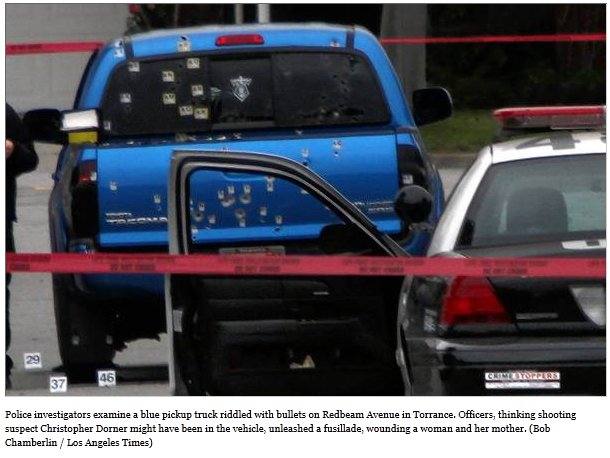
As the vehicle approached the house, officers opened fire, unloading a barrage of bullets into the back of the truck. When the shooting stopped, they quickly realized their mistake. The truck was not a Nissan Titan, but a Toyota Tacoma. The color wasn’t gray, but aqua blue. And it wasn’t Dorner inside the truck, but a woman and her mother delivering copies of the Los Angeles Times.

Pickup shooting by LAPD

In an interview with The Times on Friday, LAPD Chief Charlie Beck outlined the most detailed account yet of how the shooting unfolded. Margie Carranza, 47, and her mother, Emma Hernandez, 71, were the victims of “a tragic misinterpretation” by officers working under “incredible tension,” he said. Just hours before, Dorner allegedly shot three police officers, one fatally. And, in an online posting authorities attributed to him, Dorner threatened to kill more police and seemed to take responsibility for the slaying over the weekend of the daughter of a retired LAPD captain and her fiance.

Beck and others stressed that the investigation into the shooting is in its infancy. They declined to say how many officers were involved, what kind of weapons they used, how many bullets were fired and, perhaps most important, what kind of verbal warnings — if any — were given to the women before the shooting began.

H/T to Jon, my former virtual landlord, for the links to both articles and the urgent advice “You might want to park the Tacoma in the garage for awhile”.

February 8, 2013

Charles Stross: that invasion from Mars really did happen

Filed under: Bureaucracy, Government, Media, Politics — Tags: , , , , , — Nicholas @ 09:31

Charles does a good job of explaining why our representative democracies in the west seem to have all become bland, indistinguishable minor variants of one another:

For a while I’ve had the unwelcome feeling that we’re living under occupation by Martian invaders. (Not just here in the UK, but everyone, everywhere on the planet.) Something has gone wrong with our political processes, on a global scale. But what? It’s obviously subtle — we haven’t been on the receiving end of a bunch of jack-booted fascists or their communist equivalents organizing putsches. But we’ve somehow slid into a developed-world global-scale quasi-police state, with drone strikes and extraordinary rendition and unquestioned but insane austerity policies being rammed down our throats, government services being outsourced, peaceful protesters being pepper-sprayed, tased, or even killed, police spying on political dissidents becoming normal, and so on. What’s happening?

Here’s a hypothesis: Representative democracy is what’s happening. Unfortunately, democracy is broken. There’s a hidden failure mode, we’ve landed in it, and we probably won’t be able to vote ourselves out of it.

[. . .] Parties are bureaucratic institutions with the usual power dynamic of self-preservation, as per Michels’s iron law of oligarchy: the purpose of the organization is to (a) continue to exist, and (b) to gain and hold power. We can see this in Scotland with the SNP (Scottish National Party) — originally founded with the goal of obtaining independence for Scotland and then disbanding, the disbanding bit is now nowhere to be seen in their constitution.

Per Michels, political parties have an unspoken survival drive. And they act as filters on the pool of available candidates. You can’t easily run for election — especially at national level — unless you get a party’s support, with the activists and election agents and assistance and funding that goes with it. (Or you can, but you then have to build your own machinery.) Existing incumbent representatives have an incentive to weed out potential candidates who are loose cannons and might jeopardize their ability to win re-election and maintain a career. Parties therefore tend to be self-stabilizing.

[. . .]

So, here’s my hypothesis:

  • Institutional survival pressure within organizations — namely political parties — causes them to systematically ignore or repel candidates for political office who are disinclined to support the status quo or who don’t conform to the dominant paradigm in the practice of politics.
  • The status quo has emerged by consensus between politicians of opposite parties, who have converged on a set of policies that they deem least likely to lose them an election — whether by generating media hostility, corporate/business sector hostility, or by provoking public hostility. In other words, the status quo isn’t an explicit ideology, it’s the combined set of policies that were historically least likely to rock the boat (for such boat-rocking is evaluated in Bayesian terms — “did this policy get some poor bastard kicked in the nuts at the last election? If so, it’s off the table”).
  • The news cycle is dominated by large media organizations and the interests of the corporate sector. While moral panics serve a useful function in alienating or enraging the public against a representative or party who have become inconveniently uncooperative, for the most part a climate of apathetic disengagement is preferred — why get involved when trustworthy, reassuringly beige nobodies can do a safe job of looking after us?
  • The range of choices available at the democratic buffet table have therefore narrowed until they’re indistinguishable. (“You can have Chicken Kiev, Chicken Chasseur, or Chicken Korma.” “But I’m vegan!”) Indeed, we have about as much choice as citizens in any one-party state used to have.
  • Protests against the range of choices available have become conflated with protests against the constitutional framework, i.e. dissent has been perceived as subversion/treason.
  • Occasionally cultural shifts take place: over decades, they sometimes reach a level of popular consensus that, when not opposed by corporate stakeholders, leads to actual change. Marriage equality is a fundamentally socially conservative issue, but reflects the long-term reduction in prejudice against non-heteronormative groups. Nobody (except moral entrepreneurs attempting to build a platform among various reactionary religious institutions) stands to lose money or status by permitting it, so it gets the nod. Decriminalization of drug use, on the other hand, would be catastrophic for the budget of policing organizations and the prison-industrial complex: it might be popular in some circles, but the people who count the money won’t let it pass without a fight.

Overall, the nature of the problem seems to be that our representative democratic institutions have been captured by meta-institutions that implement the iron law of oligarchy by systematically reducing the risk of change.

It’s not just your imagination that the last presidential election hinged far more on trivia than on actual policy differences — because Mitt Romney was offering only a slight variation of policy choices than what Barack Obama had been doing (heated rhetoric and animated posturing aside). “Conservatives” and “Liberals” in Canada became almost interchangeable (except on foreign policy and military matters). “Conservatives” and “Liberal Democrats” have been able to form and hold a coalition government together in the UK relatively amicably (once again, aside from the meaningless noise and fury at the margins).

Party politics requires parties that want to achieve power to more closely resemble the party that already holds power (look at Canada’s NDP for evidence of that: the more similar to the Liberal party they became, the more popular they became, to the point they completely eclipsed the Liberals in the last federal election).

January 29, 2013

NYC’s petty bureaucrats and the evolution of modern jazz

Filed under: Bureaucracy, Law, Media — Tags: , , , , , , — Nicholas @ 11:09

From the latest issue of Reason, Chris Kjorness outlines some of the pitfalls New York City thoughtfully put in the way of some of the greatest performers of Jazz:

For more than two decades musicians, comedians, and anyone else employed by a Gotham nightclub would be fingerprinted, photographed, and interviewed by police in exchange for a license to work. The card had to be renewed every two years, and it could be revoked at the whim of the police. The story of the cabaret card illustrates how small men with a little bit of power can inhibit creative expression, stifle artistic growth, and humiliate individual citizens, all in the name of the “public good.”

The cabaret card had its origins in the roaring ’20s. Prohibition made outlaws out of ordinary Americans, and the allure of booze, jazz, and debauchery brought the upper and lower classes together in clandestine after-hours spots. It was the height of the Harlem Renaissance, and white New Yorkers frequently made the trip uptown, looking for adventure and an escape from the tight moral constraints of downtown society.

[. . .]

More than just a barrier to work, the cabaret card for beboppers was an impediment to self-expression and artistic fulfillment. While originating in nightclubs, bebop represented something much more than bar music. The color line had not been broken in American symphony orchestras, so for a young black musician at a prestigious music conservatory — Miles Davis at Julliard, for example — sharing a cramped stage in a 52nd Street nightclub with someone like Charlie Parker was the highest realization of artistic ambition. But before he could do so, a musician would have to be judged not just by lauded masters and discerning aficionados but by the police.

Cops distrusted beboppers for three main reasons: The new breed of jazzmen were anti-establishment, they were confrontational in matters of race, and they had a fondness for heroin. The police had an unlikely ally in their crusade against the upstarts: older establishment jazz musicians who had their own reasons to dislike the beboppers.

In a 1951 Ebony article, Cab Calloway, a king of the 1930s jazz world, decried the widespread drug use in the current jazz scene. Though Calloway didn’t single anyone out by name, the magazine illustrated his essay with photos of bebop musicians, and the publication coincided with an upswing in police enforcement. One musician snared in this crackdown was Charlie Parker.

Taking the fight against CCTV surveillance to the streets of Berlin

Filed under: Europe, Germany, Government, Liberty — Tags: , , , , — Nicholas @ 10:00

TechEye looks at the “gamification” of resistance against CCTV surveillance in Berlin:

A group of German activists has come up with an intriguing campaign to counter state surveillance — turning the destruction of CCTV cameras into a game.

Dubbed ‘Camover’, the aim of the game is simple: destroy as many CCTV cameras as possible.

Once your target is destroyed, you can upload a video of the act to YouTube for internet points and kudos. The rules say players should come up with a name starting with ‘command’, ‘brigade’, or ‘cell’, followed by the name of a historical figure, then destroying as many CCTV cameras as possible.

“Video your trail of destruction and post it on the game’s website,” the activists suggest, but warn that the homepage is continuously being shut down. It’s recommended that players conceal their identities, but this is “not essential”.

January 11, 2013

Public choice theory is neither Left nor Right

Filed under: Bureaucracy, Economics, Government — Tags: , , , , — Nicholas @ 00:01

In his obituary for the late James Buchanan, Radley Balko debunks the meme that public choice theory — of which Buchanan was one of the founding fathers — is by nature anti-left:

The discrepancy struck me at the time, and has stuck with me ever since. Buchanan’s work is often seen on the right as a critique of the left’s faith in public service. He showed that like everyone else, public servants tend to serve their own interests, not necessarily the interests of the greater public good. When a new federal agency is created to address some social ill, for example, there’s a strong incentive for the employees of that agency to never completely solve the problem they’ve been hired to solve. To do so would mean there would no longer be a need for their agency. It would mean layoffs, smaller budgets, even elimination entirely. In fact, there’s a strong incentive to exaggerate the problem, if not even exacerbate it. The agency itself is never going to get blamed for the problem. So exaggerating it helps the agency argue for more staff and a larger budget. (Thus, Milton Friedman’s axiom, “Nothing is so permanent as a temporary government program.”)

It doesn’t even need to be a deliberate thing. When your livelihood, your self-worth, and your career depend on things looking a certain way, there’s always going to be a strong incentive for you to see them that way.

Conservatives have always bought into public choice theory when it comes to paper-pushing bureaucrats. But when it come to law enforcement, they often have the same sort of blind faith in the good intentions and public-mindedness of public servants that the left has for, say, EPA bureaucrats. But public choice problems are as prevalent in law enforcement as they are in any other field of government work. And you could make a strong argument that it’s more important that we recognize and compensate for the incentive problems among cops and prosecutors because the consequences of bad decisions can be quite a bit more dire.

If we reward prosecutors who rack up convictions with reelection, higher office, and high-paying jobs at white-shoe law firms, and at the same time provide no real sanction or punishment when they break the rules in pursuit of those convictions, we shouldn’t be surprised if we start to see a significant number of wrongful convictions. If we reward cops who rack up impressive raw arrest numbers with promotions and pay raises, and at the same time don’t punish or sanction cops who violate the civil and constitutional rights of the people who live in the communities they serve, we shouldn’t be surprised if we start to see a significant number of cops more interested in detaining and arresting people than in protecting the rights of the citizens they encounter on their patrols. We can certainly hope that a sense of civic virtue and veneration for justice will override those misplace incentives, but it would be foolish — and has been foolish — for us to rely on that. Incentives do matter.

Any time I link to an article, it’s assumed that I suggest you read the whole thing. In this case, it’s a very strong recommendation that you read the whole thing.

January 7, 2013

“[N]o person in Canada stands above or outside of the law”

Filed under: Cancon, Law, Liberty, Media, Railways — Tags: , , , , — Nicholas @ 15:09

Christie Blatchford on the inability of Canadian police to shut down protests by First Nations groups that violated the law:

Saying “I do not get it,” an Ontario Superior Court judge Monday bemoaned the passivity of Ontario police forces on illegal native barricades and issued a lament for the state of law-and-order in the nation.

“…no person in Canada stands above or outside of the law,” Judge David Brown said in a decision that was alternately bewildered and plaintive.

“Although that principle of the rule of law is simple, at the same time it is fragile. Without Canadians sharing a public expectation of obeying the law, the rule of law will shatter.”

Judge Brown was formally giving his reasons for having granted CN Rail an emergency injunction last Saturday night, when the railway rushed to court when Idle No More protesters blocked the Wymans Road crossing on the main line between Toronto and Montreal.

January 1, 2013

Happy New Year

Filed under: Personal, Randomness — Tags: , , — Nicholas @ 13:36

Yeah, I slept in this morning after attending Brendan’s New Year’s Eve party in Toronto. It was a nice party, although we had our traditional problems with the wine (Bren has terrible luck in the particular bottles of wine he opens when I visit). As I was driving, I only sampled the wine anyway…

Driving through downtown Toronto at two in the morning is rarely as entertaining as it is on New Year’s: between the staggering celebrants on the sidewalk stumbling into traffic and the overly-cautious-drivers trying to get past them safely, it can be frustratingly slow. Last night’s worst drivers were the cabbies — but not for the usual excessive speed/random lane change reasons. Last night, it seemed like half the cabbies were drunk or stoned … and were driving too slowly and weaving in the lane even as they were going too slowly. That, combined with their seemingly random stops to pick up and drop off customers, made the taxis even more of a hazard than they usually are.

Even more remarkable was that we saw only a single marked police car over the entire drive (no RIDE checkpoints, either). I’m sure they were out at full strength, but aside from one SUV that pulled a fast U-turn at Yonge & Carleton, they were clearly patrolling different routes than the one we took.

December 27, 2012

“We had no idea how to handle them without offending our agonised liberal consciences”

Filed under: Britain, Humour, Media — Tags: , , , — Nicholas @ 12:11

George “The Great Moonbat” Monbiot has an unscheduled trip down memory lane:

A group of us had occupied a piece of land on St George’s Hill in Surrey, 70 miles from where we now sat. In 1649, the Diggers had built their settlement there, in the hope of establishing a “common treasury for all”. Our aim had been to rekindle interest in land reform. It had been going well — we had placated the police, started to generate plenty of public interest — when two young lads with brindled staffordshire bull terriers arrived in an old removals van.

Everyone was welcome at the site and, as they were travellers, one of the groups marginalised by the concentration of control and ownership of land in Britain, we went out of our way to accommodate them. They must have thought they had died and gone to heaven.

Almost as soon as they arrived they began twocking stuff. A radio journalist left his equipment in his hire car. They smashed the side window. Someone saw them bundling the kit, wrapped in a stolen sleeping bag, into their lorry. There was a confrontation — handwringing appeals to reason on one side, pugnacious defiance on the other — which eventually led to the equipment being handed back.

They wound their dogs up, making them snap and snarl at the other occupiers. At night they roamed the camp, staffies straining at the leash, cans of Special Brew in their free hands, shouting “fucking hippies, we’re going to burn you in your tents!”

We had no idea how to handle them without offending our agonised liberal consciences. They saw this and exploited it ruthlessly. Eventually the police solved the problem for us. Most of the cars parked at a nearby attraction had had their windows smashed and radios stolen, and someone had followed their lorry back to our site. As they were led away, my anarchist beliefs battled my bourgeois instincts, and lost.

December 26, 2012

QotD: Those who have given up liberty for “security”

Filed under: Government, Liberty, Quotations, USA — Tags: , , , , , — Nicholas @ 11:13

Furthermore, do we really want to live in a world of police checkpoints, surveillance cameras, metal detectors, X-ray scanners, and warrantless physical searches? We see this culture in our airports: witness the shabby spectacle of once proud, happy Americans shuffling through long lines while uniformed TSA agents bark orders. This is the world of government provided “security,” a world far too many Americans now seem to accept or even endorse. School shootings, no matter how horrific, do not justify creating an Orwellian surveillance state in America.

Do we really believe government can provide total security? Do we want to involuntarily commit every disaffected, disturbed, or alienated person who fantasizes about violence? Or can we accept that liberty is more important than the illusion of state-provided security? Government cannot create a world without risks, nor would we really wish to live in such a fictional place. Only a totalitarian society would even claim absolute safety as a worthy ideal, because it would require total state control over its citizens’ lives. We shouldn’t settle for substituting one type of violence for another. Government role is to protect liberty, not to pursue unobtainable safety.

Our freedoms as Americans preceded gun control laws, the TSA, or the Department of Homeland Security. Freedom is defined by the ability of citizens to live without government interference, not by safety. It is easy to clamor for government security when terrible things happen; but liberty is given true meaning when we support it without exception, and we will be safer for it.

Ron Paul, “Seeking Total Security Leads to a Totalitarian Society”, Eurasia Review, 2012-12-26

December 6, 2012

“Yeah, uhhh … I don’t think driving around with 20 pounds of drugs in my car is really a good idea”

Filed under: Law, USA — Tags: , , — Nicholas @ 12:23

What do you do when you find $175,000-worth of drugs stashed on your property?

I am standing chest-deep in a dank, muddy concrete-lined hole in Silver Lake, staring eye-level into a duffel bag full of high-grade drugs.

It smells strongly of marijuana — despite the fact that someone sealed it tightly into jars, Ziplocs and professionally vacuum-sealed pouches before THEY HID IT IN MY BACK YARD.

I am starting to panic.

I already did the full Tex-Avery-wolf AOOOOGAH! upon discovering the mammoth sackful of dope — estimated to be worth somewhere north of $175,000. My jaw already dropped. My eyes already bugged out. Now my heart is thumping my gullet. Breathing is getting iffy.

I try to speak. I think my exact words to the solar-panel technician standing equally open-mouthed next to me are something to the effect of “Holy. Fucking. SHIT!”

H/T to Matt Welch:

November 6, 2012

It’s official: Morris Dancers are “offensive”

Filed under: Britain, History, Media — Tags: , , , , — Nicholas @ 11:19

Well, they’re “offensive” to a couple of Police Constables in Surrey, anyway:

A group of Morris Dancers were ordered to stop performing in the middle of a routine after police received a complaint that their dancing was ‘offensive’.

The 15-strong group of English folk dancers from the respected Wild Hunt Bedlam Morris troupe were told to ‘stop making a din’ during a performance outside The White Lion pub in Warlingham, Surrey.

The folk dancers were performing in spooky costumes for a free Halloween show outside the 15th century pub to an audience of around 30 customers, but were cut short after just six dances.

The group had planned at least 10 other dances, but were interrupted by two police officers who told them to ‘down’ their handkerchiefs and sticks and ‘move on’ as they were causing a noise nuisance.

Despite pleading with the officers to continue their routine – which includes songs like Thor’s Hammer, Maiden Castle and Half a Farthing Candle, they were told to leave in the ‘interest of community relations’ last Tuesday.

Apparently the campaign against the evil Morris Dancers has been going on for a while:

In August last year a group of Morris dancers from the Slubbing Billys troupe were booted out of the Swan and Three Cygnets pub in Durham after a barmaid said the bells on their shoes broke the bar’s music ban.

H/T to Nick Packwood for the link.

October 13, 2012

Chinese shipyards adapt to slower international sales

Filed under: Business, China, Military — Tags: , , — Nicholas @ 11:17

Strategy Page on one of the ways Chinese ship builders are adapting to a tougher market for new ships:

Recent photos from China show three 1,500 ton coastal patrol ships (“cutters” in American parlance.) being built simultaneously, next to each other. This is part of a 36 ship order, in part to help the domestic ship building industry, for the China Marine Surveillance (CMS). Seven of the new ships are the size of corvettes (1,500 tons), while the rest are smaller (15 are 1,000 ton ships and 14 are 600 tons). The global economic recession has hit shipbuilding particularly hard over the last four years, and China is one of the top three shipbuilding nations in the world. For a long time coastal patrol was carried out by navy cast-offs. But in the last decade the coastal patrol force has been getting more and more new ships (as well as more retired navy small ships). Delivery of all 36 CMS ships is to be completed in the next two years.

The CMS service is one of five Chinese organizations responsible for law enforcement along the coast. The others are the Coast Guard, which is a military force that constantly patrols the coasts. The Maritime Safety Administration handles search and rescue along the coast. The Fisheries Law Enforcement Command polices fishing grounds. The Customs Service polices smuggling. China has multiple coastal patrol organizations because it is the custom in communist dictatorships to have more than one security organization doing the same task, so each outfit can keep an eye on the other.

CMS is the most recent of these agencies, having been established in 1998. It is actually the police force for the Chinese Oceanic Administration, which is responsible for surveying non-territorial waters that China has economic control over (the exclusive economic zones, or EEZ) and for enforcing environmental laws in its coastal waters. The new program will expand the CMS strength from 9,000 to 10,000 personnel. CMS already has 300 boats and ten aircraft. In addition, CMS collects and coordinates data from marine surveillance activities in ten large coastal cities and 170 coastal counties. When there is an armed confrontation over contested islands in the South China Sea, it’s usually CMS patrol boats that are frequently described as “Chinese warships.”

September 30, 2012

If you’re not getting enough convictions on drug charges, tamper with the evidence at the lab

Filed under: Law, Liberty, USA — Tags: , , , , , — Nicholas @ 10:56

The war on drugs is already insane enough, with civil liberties being curtailed in pursuit of drug dealers and even drug users. The number of US citizens in prison for drug charges helps make the US one of the most-imprisoned societies in the world. But even with all that, things can still get worse, as this story from the Huffington Post shows:

“Annie Dookhan’s alleged actions corrupted the integrity of the entire criminal justice system,” state Attorney General Martha Coakley said during a news conference after Dookhan’s arrest. “There are many victims as a result of this.”

Dookhan faces more than 20 years in prison on charges of obstruction of justice and falsely pretending to hold a degree from a college or university. She testified under oath that she holds a master’s degree in chemistry from the University of Massachusetts, but school officials say they have no record of her receiving an advanced degree or taking graduate courses there.

State police say Dookhan tested more than 60,000 drug samples involving 34,000 defendants during her nine years at the Hinton State Laboratory Institute in Boston. Defense lawyers and prosecutors are scrambling to figure out how to deal with the fallout.

[. . .]

Verner said Dookhan later acknowledged to state police that she sometimes would take 15 to 25 samples and instead of testing them all, she would test only five of them, then list them all as positive. She said that sometimes, if a sample tested negative, she would take known cocaine from another sample and add it to the negative sample to make it test positive for cocaine, Verner said.

September 19, 2012

Hawaii Five-0, the most unrealistic cop show yet

Filed under: Law, Media, USA — Tags: , , , — Nicholas @ 00:01

As usual, Gregg Easterbrook’s weekly NFL column contains a fair bit of non-football stuff. This week, he spends a bit of time detailing just how unrealistic the rebooted TV show Hawaii Five-0 is. It’s a rather overwhelming list of unlikely, unrealistic, and just plain silly TV:

All action shows contain some nonsense. As the television critic James Parker has noted, an action series that consists entirely of nonsense is an art form. Parker thought 24 was an achievement in that sense. Inheriting this mantle is the reimagined Hawaii Five-0, whose third season kicks off Monday. Five-0 has emerged as television’s most entertaining delivery system for pure nonsense.

An episode begins with a prisoner on a commercial flight killing the U.S. marshal escorting him. The murder weapon? I am not making this up: Two plastic airline knives held together with a rubber band. Passengers were unaware a murder was in progress onboard, because the marshal inexplicably did not fight back or cry out, although it would take quite a while — probably hours — to kill someone using two plastic airline knives held together with a rubber band.

[. . .]

On Hawaii Five-0, a small group of cops has an omniscient supercomputer the CIA would envy. Plots regularly involve automatic-weapons fire on the streets of Honolulu. The Aliiolani Hale, a Hawaii landmark, is presented as the secret headquarters of Five-0, as if a Washington, D.C., detective show presented the Washington Monument as a secret headquarters. “I confer on you blanket immunity from prosecution, so you can go outside the law to stop crime,” the governor tells McGarrett. Gov, think about what you just said! Not even Oliver North had advance immunity.

There’s a long list of laughable TV cop tropes, including the inability of bullets to even slow down Five-0 agents, immortal super bad guys, better-than-SF crime-solving technology, plus the usual imaginary laws, ignoring both common sense and the laws of physics, and so on. But he also points out a serious flaw in most modern TV representation of police and other law enforcement activities:

On TV, cops in street clothes just say, “Police” or “NYPD,” and instantly are believed. In a CSI: Miami episode, the David Caruso character, asked to prove he is a cop, dismissively waves his badge too far away to be seen. In a Five-0 episode, a person being questioned asks McGarrett for proof of who he is. “This is all the proof you’re going to get,” McGarrett snaps, flashing his badge so briefly no one could know whether it was real, let alone read his name.

Why do TV script writers promote the idea that it is unreasonable to ask law enforcement officers to establish identity? No honest cop objects to this. Fake badges can be purchased in a costume store, and criminals pretending to be police are a long-standing problem. If a guy banged on the door of a Hawaii Five-0 producer, claiming to be a detective but refusing to show ID, that producer surely would dial 911.

Of course action shows are preposterous. But it is troubling that television crime dramas imply that law enforcement officers should never be questioned. Why does Hollywood think this is a notion the American public should be force fed?

« Newer PostsOlder Posts »

Powered by WordPress