
The Great War
Published on 20 Sep 2018In a turbulent week of the First World War, the Allies break through at the Macedonian Front during the Battle of Vadar and in Palestine during the Battle for Palestine. At the same time, the Ottoman defeats the last defenders of Baku.
September 21, 2018
Allied Breakthroughs In Palestine And Macedonia I THE GREAT WAR Week 217
Comments Off on Allied Breakthroughs In Palestine And Macedonia I THE GREAT WAR Week 217
August 7, 2018
QotD: Sailing past Byzantium
To those who know nothing about the mediaeval, “byzantine” East of Christendom (and what do I know about anything?) a book by the respectable Oxford scholar, Averil Cameron, is worth mentioning. It is a short survey of developments in her academic field, entitled, Byzantine Matters (2014). It poses five basic questions on which our common assumptions are mostly wrong, and provides succinct directions for thinking again.
Mediaeval Greece, the Byzantine dynasties, and Orthodox Christianity: these are far from interchangeable concepts. Moreover, “Byzantine art” — the focus of enthusiasm in the anglosphere through the last century or so — is misunderstood. The term “Byzantine” itself — conceived from late antiquity as a deprecation — persists in the academy as an intelligence neutralizer. The vanity of “the West” gets in the way of appreciating a parallel Christian realm, which flourished for more than a thousand years, and never succumbed to the Arabs. (It finally succumbed to the Turks.) We disdain what amounts to an alternative universe of Christian witness and high culture, of great variety and depth, even more obtusely than we disdain our own Middle Ages.
We are narrowed and prejudiced by the attitudinizing of Edward Gibbon, and the inheritance (or disinheritance) of our Western “Enlightenment,” to view as backward a civilization in most ways superior to our “modern” own, from pride in the tinsel of technology. From AD 330 (the founding of Constantine’s capital) to 1453 (when it fell into Ottoman hands), we see only a continuous story of “decline.” But there were many declines over this vast period, and in the intervals between them, many recoveries.
David Warren, “Sailing past Byzantium”, Essays in Idleness, 2016-11-07.
Comments Off on QotD: Sailing past Byzantium
July 31, 2018
German Asia Corps In The Ottoman Empire During WW1 I THE GREAT WAR Special
The Great War
Published on 30 Jul 2018German-Ottoman military cooperation predated World War 1 by a few decades. But their alliance during the First World War meant that German (and Austrian) troops would actually fight in and with the Ottoman Empire.
Comments Off on German Asia Corps In The Ottoman Empire During WW1 I THE GREAT WAR Special
June 29, 2018
The Run For The Baku Oil Fields I THE GREAT WAR Week 205
The Great War
Published on 28 Jun 2018While the Ottoman Army of Islam is marching on Baku and the Caspian Sea, multiple other players are trying to stake their claim of the Baku oil fields.
Comments Off on The Run For The Baku Oil Fields I THE GREAT WAR Week 205
June 15, 2018
The French Counter Attack At Matz I THE GREAT WAR Week 203
The Great War
Published on 14 Jun 2018The French have cracked the German radio code on the Western Front and use their advantage for a counterattack at Matz. The already hastily planed German attack during Operation Gneisenau is called off after just 4 days. Meanwhile Austria-Hungary plans another offensive in Italy and German and Ottoman forces fight each other in Georgia.
Comments Off on The French Counter Attack At Matz I THE GREAT WAR Week 203
June 12, 2018
The Goeben & The Breslau – Two German Ships Under Ottoman Flag I THE GREAT WAR On The Road
The Great War
Published on 11 Jun 2018How SMS Goeben and SMS Breslau, two German warships in 1914 sailed under Ottoman flag and helped Enver Pasha to get the Ottoman Empire into World War 1.
Comments Off on The Goeben & The Breslau – Two German Ships Under Ottoman Flag I THE GREAT WAR On The Road
April 20, 2018
Knocking Out The Hejaz Railway I THE GREAT WAR Week 195
The Great War
Published on 19 Apr 2018While the Germans are still advancing in Flanders (Operation Georgette), the other fronts are not always quiet. In Palestine, the British forces and the Arab Revolt are taking the initiative again. T.E. Lawrence (Lawrence of Arabia) and the Arab Revolt are attacking the vital Hejaz Railway, a major transport factor for the Ottoman Empire.
Comments Off on Knocking Out The Hejaz Railway I THE GREAT WAR Week 195
January 30, 2018
British Special Forces – Bulgarian-Ottoman Relations – Caporetto I OUT OF THE TRENCHES
The Great War
Published on 29 Jan 2018Ask your questions here: http://outofthetrenches.thegreatwar.tv
Comments Off on British Special Forces – Bulgarian-Ottoman Relations – Caporetto I OUT OF THE TRENCHES
January 12, 2018
Woodrow Wilson’s Fourteen Points I THE GREAT WAR WEEK 181
The Great War
Published on 11 Jan 2018In the first full week of 1918, U.S. President Woodrow Wilson outlines his points for peace. In the Caucasus, the increasing instability leads to daily skirmishes between the Armenians and Ottomans. Ludendorff continues planning for an upcoming German offensive whilst his countrymen negotiate peace terms with Russia.
Comments Off on Woodrow Wilson’s Fourteen Points I THE GREAT WAR WEEK 181
December 19, 2017
Transcaucasia in World War 1 I THE GREAT WAR Special
The Great War
Published on 18 Dec 2017The Caucasus region with its many different ethnic groups and its resources was always of particular interest to the greater powers like Russia, Persia or the Ottoman Empire. In the late 19th and early 20th century, the idea of ethnic self determination and resulting national movements, the fluctuating powers situation caused by World War 1 created a unique situation for Georgians, Azerbaijanis and Armenians.
Comments Off on Transcaucasia in World War 1 I THE GREAT WAR Special
October 6, 2017
Sabotage In The Desert – Battle of Broodseinde I THE GREAT WAR Week 167
The Great War
Published on 5 Oct 2017While the regular British forces were advancing towards Jerusalem and Baghdad, T.E. Lawrence and the Arab Revolt were causing havoc behind the lines. This week 100 years ago, they were continuing to attack the important Hejaz railway which was one of the vital supply routes for the Ottoman Army. On October 4, the Battle of Broodseinde was fought near Ypres and the costly British victory there caused real headaches for German general Erich Ludendorff.
Comments Off on Sabotage In The Desert – Battle of Broodseinde I THE GREAT WAR Week 167
September 25, 2017
Great Northern War – V: Rise and Fall – Extra History
Extra Credits
Published on 23 Sep 2017Charles XII narrowly escaped the Russian pursuit, with help from the Ottoman Empire. But the weak points in his army had been clearly exposed. Northern Europe united against him – but of course, Charles XII responded by launching a fateful counter-offensive into Norway.
Comments Off on Great Northern War – V: Rise and Fall – Extra History
June 18, 2017
Ottoman Soldiers in Europe – Naval Tactics – Officer PoWs I OUT OF THE TRENCHES
Published on 17 Jun 2017
Signup for your FREE trial to The Great Courses Plus* here: http://ow.ly/UYp930acl8m
Another exciting episode of Out Of The Trenches featuring naval tactics, the treatment of officers as prisoners of war and two questions related to the Ottoman Empire.
*The Great Courses Plus is currently available to watch through a web browser to almost anyone in the world and optimized for the US market. The Great Courses Plus is currently working to both optimize the product globally and accept credit card payments globally.
Comments Off on Ottoman Soldiers in Europe – Naval Tactics – Officer PoWs I OUT OF THE TRENCHES
May 29, 2017
On this day in 1453
In the Smithsonian Magazine in 2008, Fergus M. Bordewich described the events of 29 May, 1453:
In the 11th century, the Byzantines suffered the first in a series of devastating defeats at the hands of Turkish armies, who surged westward across Anatolia, steadily whittling away at the empire. The realm was further weakened in 1204 when western European crusaders en route to the Holy Land, overtaken by greed, captured and looted Constantinople. The city never fully recovered.
By the mid-15th century, Constantinople was hemmed in by Ottoman-controlled territories. On May 29, 1453, after a seven-week siege, the Turks launched a final assault. Bursting through the city’s defenses and overwhelming its outnumbered defenders, the invaders poured into the streets, sacking churches and palaces, and cutting down anyone who stood in their way. Terrified citizens flocked to Hagia Sophia, hoping that its sacred precincts would protect them, praying desperately that, as an ancient prophesied, an avenging angel would hurtle down to smite the invaders before they reached the great church.
Instead, the sultan’s janissaries battered through the great wood-and-bronze doors, bloody swords in hand, bringing an end to an empire that had endured for 1,123 years. “The scene must have been horrific, like the Devil entering heaven,” says Crowley. “The church was meant to embody heaven on earth, and here were these aliens in turbans and robes, smashing tombs, scattering bones, hacking up icons for their golden frames. Imagine appalling mayhem, screaming wives being ripped from the arms of their husbands, children torn from parents, and then chained and sold into slavery. For the Byzantines, it was the end of the world.” Memory of the catastrophe haunted the Greeks for centuries. Many clung to the legend that the priests who were performing services that day had disappeared into Hagia Sophia’s walls and would someday reappear, restored to life in a reborn Greek empire.
That same afternoon, Constantinople’s new overlord, Sultan Mehmet II, rode triumphantly to the shattered doors of Hagia Sophia. Mehmet was one of the great figures of his age. As ruthless as he was cultivated, the 21-year-old conqueror spoke at least four languages, including Greek, Turkish, Persian and Arabic, as well as some Latin. He was an admirer of European culture and patronized Italian artists, such as the Venetian master Gentile Bellini, who painted him as a bearded, introspective figure swathed in an enormous robe, his small eyes gazing reflectively over an aristocratically arched nose. “He was ambitious, superstitious, very cruel, very intelligent, paranoid and obsessed with world domination,” says Crowley. “His role models were Alexander the Great and Julius Caesar. He saw himself as coming not to destroy the empire, but to become the new Roman emperor.” Later, he would cast medallions that proclaimed him, in Latin, “Imperator Mundi” — “Emperor of the World.”
Before entering the church, Mehmet bent down to scoop up a fistful of earth, pouring it over his head to symbolize his abasement before God. Hagia Sophia was the physical embodiment of imperial power: now it was his. He declared that it was to be protected and was immediately to become a mosque. Calling for an imam to recite the call to prayer, he strode through the handful of terrified Greeks who had not already been carted off to slavery, offering mercy to some. Mehmet then climbed onto the altar and bowed down to pray.
Among Christians elsewhere, reports that Byzantium had fallen sparked widespread anxiety that Europe would be overrun by a wave of militant Islam. “It was a 9/11 moment,” says Crowley. “People wept in the streets of Rome. There was mass panic. People long afterward remembered exactly where they were when they heard the news.” The “terrible Turk,” a slur popularized in diatribes disseminated across Europe by the newly invented printing press, soon became a synonym for savagery.
Comments Off on On this day in 1453
April 22, 2017
Movie on the Armenian Genocide attracts massive number of Turkish trolls
One of the worst aspects of the First World War was the attempt by Ottoman forces to eliminate the Armenian “threat” by launching an organized campaign of murder and deportation that killed an estimated 1.5 million Armenians. A new movie which is set in this time has been drawing trollish attention from Turkish detractors:
The Promise, the grandest big-screen portrayal ever made about the mass killings of Armenians during World War I, has been rated by more than 111,300 people on IMDb — a remarkable total considering it doesn’t open in theaters until Friday and has thus far been screened only a handful of times publicly.
The passionate reaction is because The Promise, a $100-million movie starring Oscar Isaac and Christian Bale, has provoked those who deny that 1.5 million Armenians were massacred between 1915 and 1923 by the Ottoman Empire or that the deaths of Armenians were the result of a policy of genocide. Thousands, many of them in Turkey, have flocked to IMDb to rate the film poorly, sight unseen. Though many countries and most historians call the mass killings genocide, Turkey has aggressively refused that label.
Yet that wasn’t the most audacious sabotage of The Promise, a passion project of the late billionaire investor and former MGM owner Kirk Kerkorian.
In March, just a few weeks before The Promise was to open, a curiously similar-looking film called The Ottoman Lieutenant appeared. Another sweeping romance set during the same era and with a few stars of its own, including Ben Kingsley and Josh Hartnett, The Ottoman Lieutenant seemed designed to be confused with The Promise. But it was made by Turkish producers and instead broadcast Turkey’s version of the events — that the Armenians were merely collateral damage in World War I. It was the Turkish knockoff version of The Promise, minus the genocide.
“It was like a reverse mirror image of us,” said Terry George, director and co-writer of The Promise. George, the Irish filmmaker, has some experience in navigating the sensitivities around genocide having previously written and directed 2004’s Hotel Rwanda, about the early ’90s Rwandan genocide.
George bought a ticket to see it. “Basically the argument is the Turkish government’s argument, that there was an uprising and it was bad and we had to move these people out of the war zone — which, if applied to the Nazis in Poland would be: ‘Oh, there was an uprising in the Warsaw Ghetto and we need to move these Jews out of the war zone,’” says George. “The film is remarkably similar in terms of structure and look, even.”
The movie itself, however, didn’t win over A.V. Club critic Ignatiy Vishnevetsky:
Among the many virtues of James Gray’s The Lost City Of Z is its sense of proportion, which turns a decades-spanning historical epic into a pas de deux between vision and madness. Unfortunately, most recent historical epics have been more on the order of Terry George’s The Promise: messes of soap and cheese. Here at last is a film that tackles the Armenian genocide by way of a flimsy love triangle and an international cast (it really captures the diversity of the Armenian people), straining so hard to show its good intentions that it doesn’t bother to be directed. What does a movie that can’t even mount a competent horse chase — despite repeated attempts — have to say about the murder of 1.5 million people? At least George can rest easy knowing that his film is less bungled than Bitter Harvest, the February release that turned the Holodomor into the stuff of schmaltz. Up next, presumably, is Nicholas Sparks’ Auschwitz.
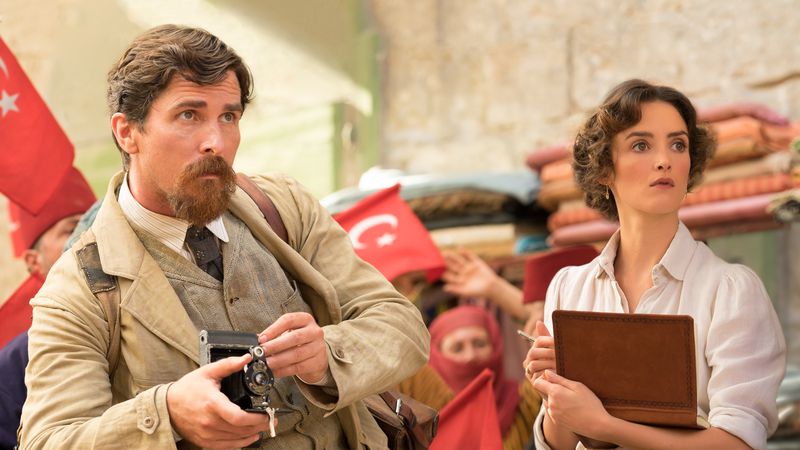
Doing his best impression of Omar Sharif, Oscar Isaac stars as Mikael Boghosian, a village apothecary who agrees to marry doe-eyed local girl Maral (Angela Sarafyan) in order to use her dowry to finance his dream of becoming a doctor. (Pity poor Maral, as no two members of the cast seem to agree on how to pronounce her name.) Arriving in Constantinople, the capital of the Ottoman Empire, Mikael moves in with his wealthy uncle and enrolls in medical school, but soon develops a crush on Ana (Charlotte Le Bon), the modern young woman who tutors his uncle’s children. But it’s 1914, and the Ottoman Empire is about to enter World War I as an ally of Germany and Austria-Hungary and within months will begin a strategic elimination of its large Armenian minority. As if to make matters worse, Ana has an American boyfriend, Chris Myers (Christian Bale), the Associated Press’ bureau chief of Armenian genocide exposition.
Still from The Promise, by Open Road Films.
Comments Off on Movie on the Armenian Genocide attracts massive number of Turkish trolls


