Quotulatiousness

September 24, 2015

Ontario takes baby steps toward liberalizing the beer market

Filed under: Bureaucracy, Business, Cancon, Politics — Tags: , , , , — Nicholas @ 05:00

At the Toronto Beer Blog, a less-than-enthused look at the latest changes to minimally change the just-barely-beyond-prohibition-era rules for selling beer in Ontario:

This has been a noisy day in the wonderful world of beer sales in Ontario. The Liberal government released the details of the new 195 page master agreement between The Beer Store, the Province (LCBO), and the new kids on the block, grocery stores.

Much of the information is what we heard when they announced it with the budget. Some more details have come out. If you read my thoughts in April, you will remember I was not happy. I’m still not.

The good from today’s news is there are some clear definitions of what constitutes a grocery store (10 000 sq/feet dedicated to groceries, not primarily identified as a pharmacy); that the 20% craft shelf space is for both grocery stores and The Beer Store, and that there cannot be a fee to get listed (though we all know how effectively the province enforces pay-to-play in bars around the province); and that they have some novel system to divide sales licenses between both huge chains and independent grocers.

The old news about shared shipping for smaller breweries and no volume limit for a second on-site retail location are accurate, and very good news.

But here’s the thing: This is just more Ontario political craziness.

This is to “level the field”, apparently for small brewers, who nobody would suggest get a fair shake in the current system.

But what could have been an actual leveling of the playing field, turned out to be more insanity and government control and meddling. And remember, I’m saying that as a sworn lefty nutjob, who generally thinks having controls and regulations is a good thing.

Remember, these are not the ravings of a far-right-wing free-enterprise-maniac … these are the regrets of a self-described “sworn lefty nutjob”:

A level playing field would be one where anybody could apply for a license to sell beer, and do it. A brewery can pick and choose who they sell to, as a retailer can choose who they do business with. Nobody would need to guarantee a percentage of shelf space, because the market would control what products were successful and got shelf space.

This isn’t a level playing field, it’s just a bunch of new rules to try to counter how horrible we’ve allowed our playing field to get. Yes, it will be more convenient for people who shop at one of the 450 stores that have a license. But the agreement still favours The Beer Store heavily (for instance, grocers are limited in the volume they can sell. They can exceed the limit, but then have to pay a fine to the LCBO who distribute it to, you guessed it, the breweries who own The Beer Store to offset their lost sales. Seriously).

September 18, 2015

Beer? In Ontario grocery stores? It’s more likely than you think

Filed under: Business, Cancon, Government — Tags: , , — Nicholas @ 02:00

Ben’s Beer Blog scores an exclusive interview with Tom Barlow, President and CEO of the Canadian Federation of Independent Grocers on the topic of liberalizing Ontario’s Prohibition-era market access rules for beer:

Some details about beer in grocery stores

  • We will likely see beer on grocery store shelves in the next 18 months
  • The province still hasn’t decided how to auction off licenses to sell beer in a way that is fair to small grocers
  • At least one grocery store chain has stated they’d like to sell “100% craft beer.”
  • If you have fears that bigger brewers are going to be able to buy shelf space, continue to be scared of that very real possibility
  • Brewers will be allowed to do direct-to-store delivery

A transcript of my chat with Tom Barlow, President and CEO of CFIG, edited slightly for length

Ben Johnson: Thanks for chatting with me Tom. It’s been pretty quiet in terms of the announcement about exactly how we’re going to get beer in grocery stores. So can you tell me a little about the process for becoming eligible to sell beer in your stores? Speculation has been pretty rampant that we’d only see bigger chains getting the privilege, so it’s interesting to hear that independent grocers are at the table.

Tom Barlow: Yeah, I’ll share what I can. The regs will be coming out soon, and the people that have been in discussions are under a non-disclosure but what I can tell you is that the original conversation was that it would be just large chains, then the government through consultations with [CFIG] and regions decided that it should be open to “grocery” under the North American definition of what grocery is, namely that they carry fresh produce, fresh meat, and that kind of thing. I don’t know if they’ve settled on a size — there was some discussion that there would be a minimum size — but for all intents and purposes it would be “grocery” and it would be wide open. The discussion we’ve had so far is that there would be so many licenses to start and they’d step it out, then get comfortable, then release some more, and then release some more. The number that was floated was around 450 licenses. That is, 450 retailers are going to have the opportunity to sell beer.

BJ: I’m assuming it’s a bidding process for getting the license and that’s the part you can’t talk about?

TB: They’re still working through the mechanism, but are looking at a biding process. I think we made our point that privately held — vs. publicly held — the access to cash is different, so there needs to be a plan made so all the licenses don’t all get swallowed up by —

BJ: Galen Weston?

TB: — Yeah, exactly. We were a little frustrated at first but after numerous conversations they’ve heard our position, and I think it’s the same with the corporate chains, is that they should have just opened it up to “grocery” from the start. If you’re going to go grocery, go grocery. This contest for picking winners and losers is a slippery slope to be going down.

August 17, 2015

Flying Monkeys …. in spaaaaaaace!

Filed under: Cancon, Randomness, Space — Tags: , — Nicholas @ 04:00

Published on 11 Aug 2015

On June 4th, 2015 we sent Flying Monkeys SuperCollider 2.0 DIPA craft beer into space just for kicks. After 3 hours in flight it came back to earth from 109,780 feet. The footage is unbrew-lieveable!

August 12, 2015

“… premiers look to Ottawa for one reason and one reason only: To beat the Prime Minister … over the head with their begging bowls”

Filed under: Cancon, Government — Tags: , , , , — Nicholas @ 03:00

Richard Anderson explains why Ontario Premier Kathleen Wynne is upset with Prime Minister Stephen Harper:

It is a time honoured tradition that premiers look to Ottawa for one reason and one reason only: To beat the Prime Minister of the day over the head with their begging bowls. What Kathleen Wynne is looking for is not a “partnership” but a ceaseless no-strings-attached flow of federal money. Like a petulant teenager the sextuagenarian premier always wants more and offers little in return. Prime Minister Harper has wisely refused to play her game.

[…]

Now imagine that you’re Kathleen Wynne — please try to subdue the gag reflex — and billions of dollars now flow into the provincial coffers from this de facto payroll tax. Perhaps the money gets tossed into general revenues. Queen’s Park then turns arounds and issues IOUs to the “arm’s length board” in the form of increasingly worthless provincial bonds. The pension would for actuarial purposes be “fully funded” but as a practical matter one pocket of government is borrowing from the other.

But perhaps the Wynnesters are a tad more clever than all that. The revenues from this payroll tax go directly to the allegedly “arms length” investment board. Nothing goes into general revenues and the Liberals allow themselves a patina of fair dealing. The board, however, will almost certainly have its investment guidelines laid out by the government. Those guidelines, by the strangest coincidence, will likely have an “invest in Ontario” component.

Some of the money will get used to buy up provincial bonds, lowering the government’s cost of borrowing at a time when capital markets are getting skittish about Ontario debentures. Quite a lot of the rest will be used to fund infrastructure projects, private-public sector partnerships and other initiatives that will, mysteriously, favour Liberal allies. The Chretien era Adscam scandal will seem like chump change in comparison.

August 9, 2015

Bob Rae then, and Bob Rae now

Filed under: Cancon, Economics, Politics — Tags: , , — Nicholas @ 04:00

I missed when Colby Cosh started writing for the National Post a while back, and only just remembered to pick up the RSS feed for his column, so this one is nearly a month old (I’m hoping that the Post has given up on their goofy licensing idea for bloggers, which was why I stopped reading or linking to the paper when they introduced it):

Ever since May, when Alberta raised the orange flag of rebellion and keelhauled its Progressive Conservatives, we have heard much about the danger that Rachel Notley will turn out to be another Bob Rae. Every time I have heard this, I have asked myself a question: which Bob Rae?

I know they mean the callow young Rae who, as premier of Ontario, blew up the welfare rolls, fiddled with rent control and pay equity while the treasury hemorrhaged and struggled tumultuously against NAFTA. But what, I wondered, if Notley turned out to be more like Liberal-elder-statesman Bob Rae, who is often a more eloquent defender of markets than just about any Conservative politician one can name? (Fine: I’ll spot you Maxime Bernier.) The older he gets, the more explicit Rae becomes about his Damascene conversion to the primacy of economic competitiveness.

In May, Rae wrote a little-noticed article about Notley that was essentially a warning: don’t be me.

“Keeping spending on operations (health care and education in particular) in check has been the greatest challenge for social democratic governments around the world,” Rae wrote. “From the Labour government in the U.K. in the seventies, to the travails of François Hollande in France, the examples are legion. It ain’t easy.” The heavy sigh is almost audible.

“Government can’t defy gravity,” Rae added, taking what unreconstructed socialists would now call a “pro-austerity” position. “There’s a limit to what any government, of any stripe, can borrow, tax and spend.… The laws of economics are not exactly like the laws of physics, but reality has a way of rushing in.”

When it comes to Rachel Notley and the New Democratic Party, the truth is that Alberta, nauseated by the banana-republican habits of its PC caste, took a conscious gamble. Notley put forward an economic platform with a minimum of utopianism, and upheld the icons of relatively successful, fiscally austere prairie New Democrats: Roy Romanow, Gary Doer.

July 1, 2015

Riding the “Budd cars” from Sudbury to White River

Filed under: Cancon, Railways — Tags: , — Nicholas @ 04:00

Malcolm Kenton reports on his recent trip on VIA Rail’s unique passenger service between Sudbury and White River, Ontario:

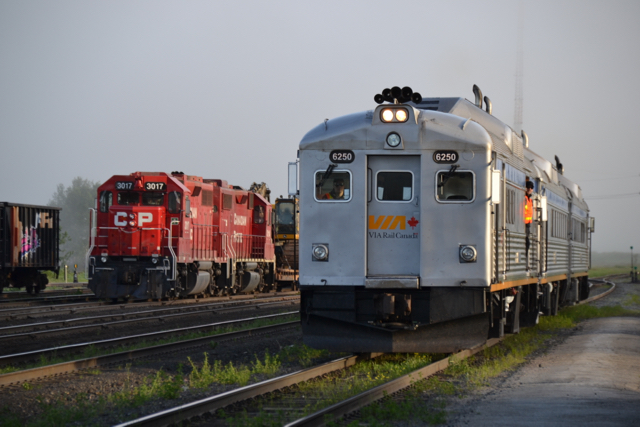
VIA Rail Canada’s Sudbury-White River train (formerly known as the Lake Superior), consisting of two (sometimes three) Budd-built Rail Diesel Cars (RDCs) that operate three days a week in each direction along a 301-mile section of Canadian Pacific’s transcontinental main line, is the only passenger train of its kind in North America for several reasons. It is currently the only regularly scheduled intercity passenger service using Budd RDCs (the only others being used as backups on two commuter lines, Tri-Met’s Westside Express in Oregon and Trinity Railway Express in Texas, and on a handful of excursion trains). It is the only intercity passenger train in Canada that uses Canadian Pacific trackage for a significant stretch (western Canada’s privately-run Rocky Mountaineer excepted). And it is one of three passenger train routes in northern Ontario that delivers people, supplies and equipment to points along the line that are not accessible by road (except for a few dirt logging roads) or air (except for a few wilderness lodge sites that have small landing strips for bush planes). I had the opportunity to travel aboard this service — whose parallel cannot be found on this side of the 49th Parallel — last week (June 18 & 19).

VIA refurbished all three of the RDCs within the past year, giving them new seats, electric outlets at each seat, restrooms, heating & air conditioning systems, and wheelchair accessibility features. One car has a large restroom whose doors slide open or closed and lock with the push of a button. A crew member on my trip referred to it as “the Cadillac bathroom.” Next to the engineer’s cab on each coach is an area that doubles as a baggage area and a crew break area, with refrigerator, sink and coffee maker. The highest passenger train speed limit on the route is 75 mph, reached for just a brief stretch between Sudbury and Cartier. Otherwise, it generally tops out at 60 — though on rare occasions where the train has had to run with just one RDC, it is limited to 45 mph — meaning the trip is usually completed just barely within the engineers’ legal limit of 12 consecutive hours of service, between which periods crews must be given at least eight consecutive hours of rest.

The vast majority of passengers on “the Budd cars” (as most locals refer to the train) — usually only a handful on each trip, though occasionally all 48 seats on both cars are occupied for a portion of the trip — are visiting remote cabins along the line to fish, hunt/trap, canoe or kayak, mountain bike, or otherwise enjoy the great outdoors. There are also year-round residents of the mid-route communities of Ramsey and Chapleau who use the train to visit family and friends and go to medical appointments in Sudbury (as there are no medical specialists in their hometowns). Passengers bring aboard an array of gear for wilderness expeditions — canoes, fishing gear, coolers, etc. — which is loaded into the baggage section of one of the RDCs (in the busy season, a third RDC car is added that is solely a baggage car, as was the case on my jaunt). And owners of cabins and retreats near the line use the train as a parcel service, having others buy groceries and supplies at one of the endpoints and drive them to the train, to be loaded into the baggage hold and unloaded at the stop nearest their outpost.

Eastbound train 186, with the RDC baggage car in the lead, passes a CP freight train carrying backhoes at the small White River, ON yard on June 19, approaching the station to begin its run towards Sudbury. (Photo by Malcolm Kenton)

Eastbound train 186, with the RDC baggage car in the lead, passes a CP freight train carrying backhoes at the small White River, ON yard on June 19, approaching the station to begin its run towards Sudbury. (Photo by Malcolm Kenton)

April 10, 2015

The Jailer’s Daughter on the CBC

Filed under: Cancon, Media — Tags: , , — Nicholas @ 03:00

Well, technically it’s the CBC’s website, but still it’s nice to see the band getting a bit of exposure:

Click to go to the CBC artist page for The Jailer's Daughter

Click to go to the CBC artist page for The Jailer’s Daughter

April 4, 2015

Canadian schools

Filed under: Bureaucracy, Cancon, Education — Tags: , , — Nicholas @ 03:00

David Warren is hiding from reality at the moment, so he’s reposting some of his older articles, like this one:

… I was parachuted briefly into a Canadian public school, from my earlier life in Asia (and before returning to Asia again). Canadian school came as a shock; quite unlike what I was used to. I had difficulty at first adapting to the sudden disappearance of anything resembling academic standards. Later, parachuted again, I was better prepared for life in the perpetual kindergarten. I found myself in something called a “high school,” with a curriculum that seemed especially designed for children with learning disabilities. Oddly, it considered itself to be an elite high school, which perhaps it was by Canadian standards. I bid my time until age sixteen, when I could legally drop out. For in my humble but unalterable opinion, these public “schools” are great crushers of the human spirit. No responsible parent will allow a child to be exposed to them. Ditto, no aspiring teacher should work in one, even if the alternative is starvation. The administrators should be prosecuted for crimes against humanity.

[…]

So far as I can see the purpose of the Canadian education system, or modern public education in general, is to suppress curiosity and enterprise in children; to cripple them morally, aesthetically, and intellectually; and make them identical on a bed of Procrustes. Hilda Neatby spelt this out in her remarkable survey, So Little for the Mind, published at Toronto in 1953. One must read it to realize that the demonic ideas of John Dewey, the American “philosopher of democratic education,” had already far advanced in Canadian schools by that year; and that as a result, standards once achieved and maintained through the later nineteenth and earlier twentieth century, had already collapsed. It is a myth they collapsed in the 1960s. Look at the schoolbooks for the Province of Ontario from that earlier period, and compare them with those introduced after the Second World War (we once did this for an article in the Idler magazine). The declination is obvious. The hippie generation was not the cause of this catastrophe. They were instead the effect.

February 17, 2015

Ontario’s political future seems unusually feminine

Filed under: Cancon, Politics — Tags: , , , — Nicholas @ 03:00

After the last serious challenger dropped out of the race to be leader of the Progressive Conservatives, Christine Elliot (my local MPP) now appears to be the default choice to fill the leadership role. Richard Anderson has a characteristic take on the near future of Ontario politics:

So that leaves Christine Elliott and a bunch of other people. I could, of course, look up the names of the other people but that would be a waste of valuable electrons. No doubt they are all honourable and public spirit individuals whose contributions to the political process Ontarians eagerly acknowledge. I guess. One would assume given the circumstances.

Christine Elliott is now unofficially the leader of the official opposition. In 2019 she will have the honour of being defeated by Kathleen Wynne in another improbable landslide. To some this sounds like a daunting and terrifying prospect. Don’t worry. When 2019 comes around you won’t be worried about another Win for Wynne. No sir. You’ll be too busy fighting for food at the burnt-out Loblaws to give a damn about politics. Change that you can believe in.

[…]

Growing up in that dark epoch known as the 1980s I well recall feminists complaining about how the world was run by cranky old men stuck in the past. Ancient dinosaurs who monopolized power and prevented those with youth and innovative ideas from coming to the fore of public life. So much has changed since that time. The male gerontocracy of the Reagan Era has been swept away by the female gerontocracy of the Wynne-Elliott Era. You’ve come a long way baby.

Now that feminism has utterly triumphed, with all three of the major parties run by women, we can appreciate how right the early feminists were about, well, everything. Now that women rule Ontario the economy is humming along splendidly, the finances are managed like a prudent housewife of old and peace and love has spread through out the land. Ordinary voters look to the Ontario matriarchy with a degree of trust and understanding that no male politician has ever commanded.

Let us give a moment of thanks.

February 16, 2015

Ontario Southland Railway plow chase

Filed under: Cancon, Railways — Tags: , — Nicholas @ 06:00

Published on 12 Feb 2015

On February 3, Ontario Southland operated their first plow of the season from Salford south to Tillsonburg, then west to St. Thomas. This was also the first time a pair of F units have been used in plow duty on the railroad.

H/T to Laura Spring for the link.

January 22, 2015

Rumours of privatization in Ontario’s liquor control monopoly?

Filed under: Bureaucracy, Cancon, Government, Law, Wine — Tags: , , , — Nicholas @ 09:57

In the latest issue of Michael Pinkus Wine Review, Michael talks about the hints and portents (dealing with the Ontario government requires a certain amount of Kremlinological observation skills) that a tiny measure of privatization may be coming:

There’s a rumour in the wind that a certain amount of privatization is coming to Ontario (wouldn’t that be nice), but I wouldn’t get my hopes up about it just yet – no time line has been given and I am sure that ‘more study’ is necessary … and of course, if track record is any indication, this government will find some way to either screw it up or make it such a complicated piece of legislation that it’ll take years to get through all the red tape behind it. I once heard Jerry Agar, of NewsTalk 1010 fame, say (and I’m paraphrasing here) ‘if you want something screwed up get government involved’; he’s a proponent of the private sector because they can do it more efficiently than government if only ‘the man’ would just get outta the way … I would have to agree with him here. So far the government has made a mess of our liquor system that even repressed, despotic and 3rd world countries have better access to alcohol then we do.

Sadly, I believe it might be too little too late for some of Ontario wineries who have suffered this long, but might not be around to see the light at the end of the tunnel (if and/or when it comes). Yes, this might be the end of the line for a number of our precious wineries and we only have ourselves to blame for their demise. They have been as vocal as any sector, crying for help, not necessarily a hand out (which the grape growers seem to get) as much as a hand up – basically they’ve been pleading with each government: “please give us access to (our own) market (at the very least) and we’ll show you what we can do”, all to no avail.

Why the pessimistic attitude? Let’s look at the facts. It takes some rather deep pockets to own a winery in Ontario, that or a good credit rating, because money is the number one thing required to open the doors. But making it is more of an uphill battles then in any other business I this province. Post-1993, when the majority of the wineries around today opened their doors, your cellar door is the only place you can sell your wine – sure you could tap into the LCBO and the restaurant market, but that’s it. And although recent federal regulations have been lifted regarding the selling and especially shipping of wine across the country, many provinces have yet to enact their own legislation governing the practice, hence leaving the entire topic, not to mention hundreds of wineries, in limbo, unable to tap the rest of the country as a market for fear of breaking the law. With so few avenues to sell home-grown wine the government has basically handcuffed the industry – let alone the number of asinine rules that govern the industry from within (more on that next time) – it has all been put in place it would seem, so that wineries are destined to fail; that they remain open is a testament to their resolve and passion.

January 6, 2015

When Stephen met Kathleen

Filed under: Cancon, Politics — Tags: , , , — Nicholas @ 07:40

Paul Wells explains why, despite all the blather from Harper “supporters”, the PM finally got around to meeting with the premier of Ontario. It has to do with a number … a very large number:

The “readout” is a term of art, one I’ve actually only learned in the past couple of years, for a summary of a conversation between two political leaders. It’s usually perfunctory, often designed to obscure as much as it reveals. The readout supplied by the Ontario premier’s office after Kathleen Wynne’s meeting with Stephen Harper is athletically happy-happy. Deleting the details actually clarifies the tone. I’m not making this excerpt up. Everyone make friends!:

    “Today’s meeting with the Prime Minister is a positive step forward… The Prime Minister and I agreed… Today, the Prime Minister and I had a good discussion… we agreed that, going forward, our governments will work together … I am pleased that Prime Minister Harper and I agreed today to continue working together… agreed to deepen our collaboration… I am confident that today’s meeting can mark the beginning of such a partnership. The Prime Minister and I agreed to continue…”‎‎

But what’s striking is that though the PMO sent out no readout that I’ve received, it did publish a photo of the blessed event. And it’s also a flattering pic of both of them.

Okay, so what is the big number of significance here?

One scrap of data for you: in the 2011 federal election, there were 951,156 more Ontario voters who voted for the Harper Conservatives than there were Ontario voters who voted for the Hudak Conservatives in the 2014 Ontario election.

That’s not quite a million Ontario voters who didn’t vote for Hudak, but whom Harper needs to vote for him if he’s to hold his majority. That’s what political moderation looks like. Harper needs the votes of a hell of a lot of Ontarians who basically have no problem with Kathleen Wynne. Realizing that, and acting on it, is an election-year instinct. It’s the same instinct that made him campaign with old Bill Davis in 2006 after excoriating the former Red Tory premier in print. It’s the instinct that has his PMO send out photos of Harper with Jean Chrétien and Harper with Barack Obama every time the PM nears those men. His base can’t stand Chrétien, Obama or Wynne. He needs more than his base. On Monday, he came back from vacation and sucked it up.

Logjam at the top of Canadian academia

Filed under: Bureaucracy, Cancon — Tags: , , , , — Nicholas @ 04:00

Another example of unexpected consequences, this time from Frances Woolley at Worthwhile Canadian Initiative, who says we need to beware of middle-aged men waving feminist flags:

On December 12, 2006, Ontario ended “mandatory retirement.” As of that date, employers could no longer base termination decisions on an employee’s age. Ontario was following the lead of Quebec and Manitoba, which stopped having a standard retirement age in the early 1980s. Within a couple of years, mandatory retirement had effectively ended right across the country.

Fast forward to 2014. The first Ontario professors to elude retirement are now collecting their pensions. Yup, Canada Revenue Agency requires people to begin drawing their pensions at age 71, regardless of employment status. The average salary of a full professor in Ontario is around $150,000 per year […], and university pension plans are generally fairly generous. So a typical professor working full-time into his 70s will have a combined pension plus salary income of at least $200,000 a year, often more. No wonder professors 65 and older outnumber the under 35s […]. Who would willingly give up a nice office, the freedoms of academia, and a quarter million dollars or so a year?

Now if the professors fighting to eliminate the standard retirement age had said, “we have a very pleasant lifestyle and we’d like to hang onto it, thank you very much,” I could have respected their honesty, if nothing else. But instead, they draped themselves in the feminist flag. A standard retirement age of 65 was wrong because it hurt women. Thomas Klassen and David Macgregor, writing in the CAUT (Canadian Association of University Teachers) Bulletin, challenged ageism in academy on the grounds that “Mandatory retirement at an arbitrary age is devastating for female faculty who often began their careers later than males and may have had interruptions to raise children.”

[…]

Two thirds of university teachers between 65 and 69 are men […], as are three quarters of those over the age of 70. This is not simply a reflection of an academy that, 20 or 30 or 40 years ago, when these folks were hired, favoured men over women. Let’s rewind five years, to when the people who are now 65 to 69 were 60 to 64. This is more or less the same group of people, just at two different points in time.

In 2005-6, just before the standard retirement age ended, 65 percent of academics aged 60 to 64 were male […].

In 2010-11, when that same cohort of people were 65-69, 68 percent of those working as university teachers were male. There is hardly any hiring of individuals into university teaching in that age group. The only plausible explanation of the three percentage point increase in the proportion of men in the academia is that more women than men retired in that cohort.

[…]

The PhD students in the pipeline are 47 percent female […], as are 46 percent of Canadian assistant professors […]. Just 23 percent of full professors, however, are women. Replacing over 65 full professors with PhD students would result in a more gender-balanced academy.

I’m not trying to argue that we should reintroduce mandatory retirement in order to achieve greater gender balance. I am merely pointing out that who thought the end of mandatory retirement would disproportionately benefit women and promote gender equity were mistaken.

January 3, 2015

Urban Canada – where China’s one-child policy has been religiously observed

Filed under: Cancon, Humour, Politics — Tags: , , , , — Nicholas @ 03:00

I can’t imagine what has gotten into David Warren to distract him from posts on the inner spirituality of the Catholic Church to suddenly turn to a bit of Canadian Ethnography:

… in a DINK household (“double income, no kids”) the rules subtly change, or rather change overtly, and no need remains for any sort of manliness. Indeed, should the woman make a substantial income, perhaps the man should consider living off her. She can claim him for a little break on her taxes, after all. Consider: housework, without kids, is a snip. And when his “partner” gets home, physically and emotionally exhausted from work, burning with the little humiliations she has suffered out there in the “real world,” and seriously hungry into the bargain — he can remind her that they are a “modern” couple. Tasks such as cooking should be shared equally.

This is old hat, of course. For the most part it also applies where the Red Chinese “one child policy” is obeyed, as across most of urban Canada.

I became exceptionally aware of the new arrangements in a visionary experience, twenty years ago. It consisted of attending a “bake sale” for the public school in which my sons were enrolled (temporarily, I assure you). I got to meet the whole “sorority” in my new liberal neighbourhood. (Kingston, Ontario: never go there.) This was mostly an “audio” vision, I should explain, though it had a video component. I’d never seen nor heard before so many whole-earth, left-wing, squeaky-voiced “house husbands,” all in one place. The immediate revelation was that spiritual emasculation actually changes a man’s voice in the same way physical emasculation does.

Among other discoveries was that the men had done most of the baking — which was good, for men often make better bakers. And we turn to the castrati to hit the highest notes.

The women, on the other hand, I could hear roar. The tone in which they addressed their squeakers was beyond instructive. I reflected that if a man spoke to his wife like that, in public, he’d be courting arrest. The feminists had now got exactly what they wanted.

There was more. The “gender” stereotypes had reversed at every other level. These women were now the sexual aggressors. I recall one in particular — an executive in a local “arts” operation — who had previously called me “fascist” as well as “sexist” in reference to something I had written in a newspaper. That she hated me still, I could take for granted. But right in front of her lamentable house-husband she was, unbelievably, “flirting” (although the term seemed over-refined). The wee fellow looked harmlessly outraged. He made sounds such as I imagine a gerbil makes when his mate shoves him aside. On his fidelity, I’m sure she could rely, for no other woman could want him. But she was trawling for something more masculine, herself.

Feminism alone could account for the collapse of the birth rate (which does, incidentally, have economic repercussions); for it operates at so many levels, from the neutering of males, to making females so extremely unattractive. But it cannot account for the rise of feminism. On that, I’m with Marx: it has a chiefly economic causation.

November 29, 2014

Lorne Scots unveil two Cenotaph additions in Brampton and Georgetown

Filed under: Cancon, Military — Tags: , , — Nicholas @ 00:03

My old militia regiment was in the news recently:

Lorne Scots at Georgetown Cenotaph

The communities of Brampton and Georgetown paid a special tribute to veterans of Afghanistan during Remembrance Week, adding the 12-year mission to local cenotaphs dedicated to Canada’s war dead.

On the year that the Canadian mission in Afghanistan drew to a close, civic leaders in both communities determined that adding “Afghanistan,” beneath the names of Canada’s other major conflicts would be a fitting tribute.

In separate ceremonies during Remembrance Week, The Lorne Scots (Peel, Dufferin and Halton Regiment) were given the honour of unveiling the new additions to the cenotaphs at the Brampton War Memorial and the Georgetown War Memorial.

“We are honoured by our communities and their tributes, this is a fine way to honour the soldiers who fell or were wounded in Afghanistan,” said Lieutenant-Colonel Duane Hickson, Commanding Officer of the Lorne Scots and an Afghanistan veteran. “And it’s very fitting to be doing this during Remembrance Week.”

The Canadian Armed Forces first deployed to Afghanistan in October, 2001, just weeks after the 9/11 attacks on New York and Washington.

The first Lorne Scot deployed in 2004, with the International Security Assistance Force in Kabul, with the Regiment’s biggest contributions in 2008, 2009 and 2010. The final Lorne Scot returned in September 2013 as part of the final rotation of Canadian soldiers in Afghanistan.

By the end of the mission, the Lorne Scots had deployed 46 soldiers and officers, nearly 25% of the unit, to Afghanistan, with the last soldier returning in 2013.

The Lorne Scots take pride in their role in their communities, participating in community events and parades every year, and represent them to the nation and on the world stage when they deploy abroad. LCol Hickson said the Regiment was honoured to be asked to take part in the unveiling and will continue to serve their nation and their communities.

« Newer PostsOlder Posts »

Powered by WordPress