Quotulatiousness

July 31, 2013

Vikings training camp in full swing … and evil genius Rick Spielman is proven right again

Filed under: Football, Media — Tags: , , , , , — Nicholas @ 08:58

The Vikings are at their off-site training camp in Mankato this week, and the various fan blogs are doing a great job of covering the event (especially The Daily Norseman which has bloggers accredited and attending all open sessions). 1500ESPN has filled the void left when the great Tom Pelissero moved on to USA Today‘s sports department with Andrew Krammer (to team up with Judd Zulgad), while the main ESPN coverage is by Kevin Seifert. I hit my “maximum number of articles viewed” limit at the Minneapolis Star Tribune earlier this week, so the coverage from the St. Paul Pioneer Press is filling that gap for me until rollover.

I know most of you don’t much care for sports chatter, so I’ll put the rest of this post behind the curtain…

(more…)

July 28, 2013

Snowden is not the story

Filed under: Liberty, Media, Technology — Tags: , , , , — Nicholas @ 10:16

In the Observer, John Naughton makes a few corrections to the way the media is reporting the saga of Edward Snowden and his revelations about the NSA’s global surveillance operations:

Repeat after me: Edward Snowden is not the story. The story is what he has revealed about the hidden wiring of our networked world. This insight seems to have escaped most of the world’s mainstream media, for reasons that escape me but would not have surprised Evelyn Waugh, whose contempt for journalists was one of his few endearing characteristics. The obvious explanations are: incorrigible ignorance; the imperative to personalise stories; or gullibility in swallowing US government spin, which brands Snowden as a spy rather than a whistleblower.

In a way, it doesn’t matter why the media lost the scent. What matters is that they did. So as a public service, let us summarise what Snowden has achieved thus far.

Without him, we would not know how the National Security Agency (NSA) had been able to access the emails, Facebook accounts and videos of citizens across the world; or how it had secretly acquired the phone records of millions of Americans; or how, through a secret court, it has been able to bend nine US internet companies to its demands for access to their users’ data.

Similarly, without Snowden, we would not be debating whether the US government should have turned surveillance into a huge, privatised business, offering data-mining contracts to private contractors such as Booz Allen Hamilton and, in the process, high-level security clearance to thousands of people who shouldn’t have it. Nor would there be — finally — a serious debate between Europe (excluding the UK, which in these matters is just an overseas franchise of the US) and the United States about where the proper balance between freedom and security lies.

These are pretty significant outcomes and they’re just the first-order consequences of Snowden’s activities. As far as most of our mass media are concerned, though, they have gone largely unremarked. Instead, we have been fed a constant stream of journalistic pap — speculation about Snowden’s travel plans, asylum requests, state of mind, physical appearance, etc. The “human interest” angle has trumped the real story, which is what the NSA revelations tell us about how our networked world actually works and the direction in which it is heading.

July 24, 2013

Anti-porn UK MP gets hacked, threatens reporter who publicized the hack

Filed under: Britain, Liberty, Media, Politics — Tags: , , , , , — Nicholas @ 11:13

Apparently British Conservative MP Claire Perry doesn’t know a lot about the way the internet works, despite being described as an “architect” for David Cameron’s proposed porn blocker:

UK MP Claire Perry hacked

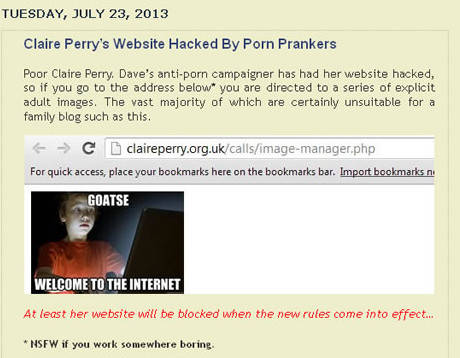
Claire Perry is the UK Tory MP who architected David Cameron’s idiotic national porno firewall plan. Her website was hacked and defaced with pornographic gross-out/shock images. When Guido Fawkes, a reporter and blogger, wrote about it on his website, Perry took to Twitter to accuse him of “sponsoring” the hack, and publicly announced that she would be speaking to his editor at the Sun (Fawkes has a column with the tabloid) to punish him for writing about her embarrassment.

Perry is so technologically illiterate that she can’t tell the difference between writing about someone hacking your website and hacking itself. No wonder she’s credulous enough to believe the magic-beans-peddlers who promise her that they’ll keep porn off the British Internet — a feat that neither the Chinese nor the Iranian governments have managed.

July 23, 2013

Future monarchs and present-day “republicans”

Filed under: Britain, Government, Media — Tags: , , , — Nicholas @ 09:48

As you may have noticed, I haven’t devoted any space on the blog to coverage of the Duke and Duchess of Cambridge and their son. It’s not that I’m a rabid republican — I’m as much of a mild monarchist as a libertarian can be. What I have found even more tedious than the celebrity pregnancy coverage of the royal baby is the spitting and moaning coming from the “republican” side. Brendan O’Neill (a noted republican) points out that the moaners don’t actually represent real republicans:

So, the royal baby is finally here, and across Blighty the little people will have made themselves virtually bald through frenzied forelock-tugging, or perhaps busted their backs by bowing and scraping before their mewling future king. At least, that’s the impression that has been given by a certain breed of observer, the ironically public-allergic republicans who seem to hate the monarchy primarily because of the behaviour and emotions it induces in the plebs. Once, being a republican meant trusting the public (the clue was in the name) and believing it had the capacity to think and act rationally. Today, if the ostentatious chattering-class wailing about the mob hysteria over Kate’s baby is anything to go by, it means the opposite — it means despairing of the public and shaking a snobby head over its Stepford-like enthralment to all things monarchical.

As soon as it was announced that Kate was expecting, these shallow republicans started bemoaning the mass hysteria that would ensue. Britain will once again become ‘a nation of forelock-tuggers’, clever broadsheet people warned. Apparently, ‘forelock-tugging is all the rage’ in this supposedly modern nation, where the daft blob formerly known as the public is being kept non-angry about the recession and other horror stories through being dripfed info about Kate, Wills and their baby. In the words of the Mirror’s poetic Brian Reade, ‘Our austere country need not grieve, for Wills’ missus can conceive’. That has been the central message of most of the apparently rad commentary on Kate — that the plebs are easily bought off with photos of a pregnant princess and smiling prince. One columnist wrote of the ‘ready-to-whoop peasants’ waiting for news of Kate’s babe. A writer for the Independent said of Kate’s pregnancy, ‘Everyone laps it up… it makes plebs of us all’.

[…]

There are two annoying things about all this. The first is that it’s plain wrong to depict today’s media and public interest in Kate’s baby as a resuscitation of old-world royalist sentiment. Most of the public relates to Kate in the way they relate to celebs — not as a godly bearer of a babe whom we will one day bow before, but as another preggers celeb in nice clothes we can read about in our spare time; a posher Kim Kardashian, if you will. The House of Windsor has self-consciously cultivated a celebrity image for itself in recent years, sensing that its old imperial, mysterious, God-derived powers and so-called right to rule are on the wane in this era of profound crisis for traditionalism, and that celebrity is now a far more powerful source of authority than kingliness. Indeed, the popularity of Kate as just another celeb, albeit a super-A-list one, speaks to the moral diminution of monarchism as it was once understood, to the emptying-out of its alleged magic and power, not to its rehabilitation.

And secondly, this pleb-mauling republicanism is not republicanism at all. It is very often fuelled by an anachronistic desire to protect Kate from the prying eyes of the princess-hungry throng. We are putting poor Kate in a ‘gilded cage’, lefty columnists fret. Others claim we are hounding her — we have clearly ‘learned nothing since Princess Diana’. It’s a very odd republicanism which feels empathy for individual members of the royal family and disdain for the public. For me, editor of the uber-republican spiked, republicanism is not about sneering, but rather is about engagement, taking ourselves and the public seriously, talking about how society should be run, and by whom. And as the American revolutionary John Adams said, pursuing such republicanism means believing the public can be ‘sufficiently enlightened to disabuse themselves of artifice, imposture, hypocrisy and superstition’. Sadly, too few British republicans believe that these days.

Full points to Private Eye for their royal baby cover:
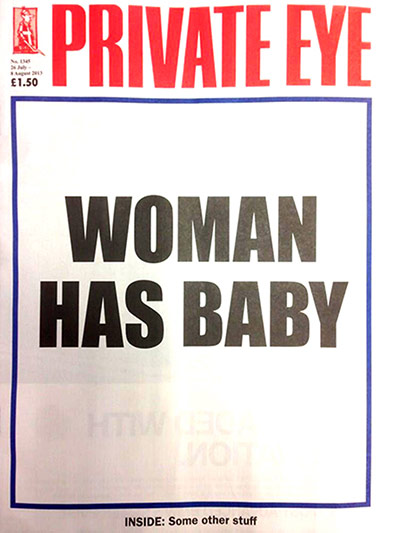
Private Eye

Update: Charles Stross — another republican — has an almost sympathetic view of the new prince’s future:

The kid is not going to have anything remotely approaching a normal life. For one thing, under current UK law, he isn’t eligible to vote. His ultimate career path is already known and if he doesn’t want to put up with it, tough: the pressure to conform to expectations is enormous — he was born under a life sentence. When he ends up in that final occupation he won’t even be eligible for a passport (for long and complex constitutional reasons). He’s going to be the subject of paparazzi attention for the rest of his life. He’s almost certainly going to be sent to a private boarding school of some variety (probably Eton, as with his father), to ensure that he’s exposed to normal people (for “public schoolboy” values of normality); this is normal for the royal family, and it’s worked on previous generations. The usual recipe is for it to be followed by university, then officer training in one of the branches of the military, before joining the Old Firm and learning the onerous duties of public ceremonies and diplomatic receptions. The royals get a particularly brutal work-out in return for their privileges: what other family business would expect an 87 year old great-grandmother to make over 400 public appearances per year?

But those are the traditional parameters of a crown prince’s upbringing. This prince is going to find things a little different because he’s going to be the first designated future British monarch to grow up in a hothouse panopticon, with ubiquitous surveillance and life-logging …

I expect there to be Facebook account-hacking attacks on his friends, teachers, and associates — and that’s just in the near term. He’s going to be the first royal in the line of succession to grow up with the internet: his father, Prince William, was born in 1982 and, judging by his A-level coursework, is unlikely to have had much to do with computer networking in the late 1990s. This kid is going to grow up surrounded by smartphones, smart glasses (think in terms of the ten-years-hence descendants of Google Glass), and everything he does in public can be expected to go viral despite the best efforts of the House of Windsor’s spin doctors.

July 17, 2013

Keep calm, and don’t panic about bee-pocalypse now

Filed under: Environment, Food, Media, Science — Tags: , , , , — Nicholas @ 08:17

You’ve heard about the mysterious colony collapse disorder (CCD) that has been devastating bee colonies across the world, right? This is serious, as bees are a very important part of the pollenization of many crops. As you’ll know from many media reports, this is a food disaster unfolding before us and we’re all going to starve! Or, looking at the facts, perhaps not:

In a rush to identify the culprit of the disorder, many journalists have made exaggerated claims about the impacts of CCD. Most have uncritically accepted that continued bee losses would be a disaster for America’s food supply. Others speculate about the coming of a second “silent spring.” Worse yet, many depict beekeepers as passive, unimaginative onlookers that stand idly by as their colonies vanish.

This sensational reporting has confused rather than informed discussions over CCD. Yes, honey bees are dying in above average numbers, and it is important to uncover what’s causing the losses, but it hardly spells disaster for bees or America’s food supply.

Consider the following facts about honey bees and CCD.

For starters, US honey bee colony numbers are stable, and they have been since before CCD hit the scene in 2006. In fact, colony numbers were higher in 2010 than any year since 1999. How can this be? Commercial beekeepers, far from being passive victims, have actively rebuilt their colonies in response to increased mortality from CCD. Although average winter mortality rates have increased from around 15% before 2006 to more than 30%, beekeepers have been able to adapt to these changes and maintain colony numbers.

[…]

“The state of the honey bee population—numbers, vitality, and economic output — are the products of not just the impact of disease but also the economic decisions made by beekeepers and farmers,” economists Randal Rucker and Walter Thurman write in a summary of their working paper on the impacts of CCD. Searching through a number of economic measures, the researchers came to a surprising conclusion: CCD has had almost no discernible economic impact.

But you don’t need to rely on their study to see that CCD has had little economic effect. Data on colonies and honey production are publicly available from the USDA. Like honey bee numbers, US honey production has shown no pattern of decline since CCD was first detected. In 2010, honey production was 14% greater than it was in 2006. (To be clear, US honey production and colony numbers are lower today than they were 30 years ago, but as Rucker and Thurman explain, this gradual decline happened prior to 2006 and cannot be attributed to CCD).

H/T to Tyler Cowen for the link.

July 11, 2013

Rupert “Emmanuel Goldstein” Murdoch

Filed under: Britain, Business, Liberty, Media — Tags: , , , , — Nicholas @ 07:57

James Delingpole on the quick march to government control over the British media:

I was listening to Radio 4 news yesterday as with salivating glee it reported the recall of Rupert Murdoch to the Culture Media and Sport Select Committee and I thought to myself, not for the first time: “Britain is losing the battle for press freedom.”

What worries me most is that so few of us seem capable of comprehending a) how we’re losing it and b) why it might be a problem. The default assumption behind the BBC’s reportage — and unfortunately, probably, an accurate one — is that most normal people think that Murdoch is the very type of low-down reptilian evil, that he is primarily responsible for dumbing down our culture and abasing standards within our media, and that every time he gets his comeuppance it’s a jolly good thing.

Needless to say, I disagree totally with this analysis — and not purely because I’d love it if he plucked me from obscurity and gave me an incredibly well paid job, writing, say, the James Delingpole Tells It Like It Is column in the Sun. No, I say it because I sincerely believe it. Tabloid media moguls like Murdoch do not create public taste: they reflect it. And if, like me, you believe in free markets and freedom of choice then we should applaud the farsightedness and tenacity with which he broke the print unions at Wapping, and the way he pioneered satellite viewing in Britain with Sky and the way in the US his Fox channel and his Wall Street Journal fight such a heroic and inspiring battle against the liberal consensus. Sure, I’ve no doubt he’s very good at drowning kittens — he’s a ruthless billionaire businessman, for heaven’s sake — but the benefits this buccaneer has brought to our world economically and socially far, far outweigh any he damage he might have done.

Yet you’d never guess this from his treatment in the media nor from the way he’s represented in public debate. Really, he’s like our very own Emmanuel Goldstein — the all-purpose hate-figure created by Big Brother in Nineteen Eighty-Four in order to channel the people’s discontent in the “correct” direction.

July 9, 2013

Replacing impartial courts with revolutionary tribunals

Filed under: Government, Greece, Law, Media, USA — Tags: , , , — Nicholas @ 08:57

Victor Davis Hanson talks about earlier experiments with tribunals:

In ancient Athens, popular courts of paid jurors helped institutionalize fairness. If a troublemaker like Socrates was thought to be a danger to the popular will, then he was put on trial for inane charges like “corrupting the youth” or “introducing new gods.”

Convicting gadflies would remind all Athenians of the dangers of questioning democratic majority sentiment. If Athenian families were angry that their sons had supposedly died unnecessarily in battle, then they might charge the generals with capital negligence — a warning to all commanders to watch their backs. As in the case of Socrates, a majority vote often led to conviction, and conviction to a death sentence, or at least ostracism or exile. The popular courts freelanced to ensure that “the people” would hold sway over the perceived powerful and elite.

For a couple of years in revolutionary France, a Tribunal Révolutionnaire tried royalists, clergy, the wealthy, and supposed counter-revolutionaries on trumped-up charges of crimes against the people. Their purpose was a more violent version of the Athenian idea that the courts should serve the public by targeting the prominent, influential, or wealthy.

We in the United States are in jeopardy of turning our own criminal-justice system into revolutionary tribunals — fanned by the popular media and public opinion and directed against so-called enemies of the people.

[. . .]

The American court system is insidiously focusing on social transformation rather than individual justice. If Neanderthal reactionaries in California twice voted to reiterate that marriage is between a man and a woman, then leave it to judges and courts to find them bigoted and politically incorrect. In the present revolutionary environment, the degree of the Obama administration’s enforcement of federal laws concerning gay marriage, or illegal immigration, or the new health-care law has hinged on politics and perceptions about social justice — and the courts increasingly predicate their own decision-making on these same considerations. The street can brand a court either an esteemed ally or a reactionary enemy of the people, and so the courts make the necessary adjustments.

Update: The New York Times editorial board expresses its concern about “the laws you can’t see”.

As Eric Lichtblau reported in The Times on Sunday, the Foreign Intelligence Surveillance Court has for years been developing what is effectively a secret and unchallenged body of law on core Fourth Amendment issues, producing lengthy classified rulings based on the arguments of the federal government — the only party allowed in the courtroom. In recent years, the court, originally established by Congress to approve wiretap orders, has extended its reach to consider requests related to nuclear proliferation, espionage and cyberattacks. Its rulings, some of which approach 100 pages, have established the court as a final arbiter in these matters.

But the court is as opaque as it is powerful. Every attempt to understand the court’s rulings devolves into a fog of hypothesis and speculation.

[. . .]

As outrageous as the blanket secrecy of the surveillance court is, we are equally troubled by the complete absence of any adversarial process, the heart of our legal system. The government in 2012 made 1,789 requests to conduct electronic surveillance; the court approved 1,788 (the government withdrew the other). It is possible that not a single one of these 1,788 requests violated established law, but the public will never know because no one was allowed to make a counterargument.

When judicial secrecy is coupled with a one-sided presentation of the issues, the result is a court whose reach is expanding far beyond its original mandate and without any substantive check. This is a perversion of the American justice system, and it is not necessary.

July 4, 2013

Bonfire of the civil liberties

Filed under: Liberty, Media, Politics, USA — Tags: , , , , , , — Nicholas @ 11:06

A recent article by Dan Gillmore in the Guardian was reposted on Alternet yesterday:

No one with common sense believes Obama is planning to become a dictator. But the mail list question was indeed not paranoid — because Obama, building on the initiatives of his immediate predecessors, has helped create the foundation for a future police state. This has happened with bipartisan support from patriotic but short-sighted members of Congress and, sad to say, the general public.

The American media have played an essential role. For decades, newspaper editors and television programmers, especially local ones, have chased readers and ratings by spewing panic-inducing “journalism” and entertainment that helped foster support for anti-liberty policies. Ignorance, sometimes willful, has long been part of the media equation. Journalists have consistently highlighted the sensational. They’ve ignored statistical realities to hype anecdotal — and extremely rare — events that invite us to worry about vanishingly tiny risks and while shrugging off vastly more likely ones. And then, confronted with evidence of a war on journalism by the people running our government, powerful journalists suggest that their peers — no, their betters — who had the guts to expose government crimes are criminals. Do they have a clue why the First Amendment is all about? Do they fathom the meaning of liberty?

The founders, for all their dramatic flaws, knew what liberty meant. They created a system of power-sharing and competition, knowing that investing too much authority in any institution was an invitation to despotism. Above all, they knew that liberty doesn’t just imply taking risks; it absolutely requires taking risks. Among other protections, the Bill of Rights enshrined an unruly but vital free press and guaranteed that some criminals would escape punishment in order to protect the rest of us from too much government power. How many of those first 10 amendments would be approved by Congress and the states today? Depressingly few, one suspects. We’re afraid.

America has gone through spasms of liberty-crushing policies before, almost always amid real or perceived national emergencies. We’ve come out of them, to one degree or another, with the recognition that we had a Constitution worth protecting and defending, to paraphrase the oath federal office holders take but have so casually ignored in recent years.

What’s different this time is the surveillance infrastructure, plus the countless crimes our lawmakers have invented in federal and state codes. As many people have noted, we can all be charged with something if government wants to find something — the Justice Department under Bush and Obama has insisted that simply violating an online terms of service is a felony, for example. And now that our communications are being recorded and stored (you should take that for granted, despite weaselly government denials), those somethings will be available to people looking for them if they decide you are a nuisance. That is the foundation for tyranny, maybe not in the immediate future but, unless we find a way to turn back, someday soon enough.

H/T to Tim O’Reilly for the link.

June 30, 2013

The Observer has an embarrassing day

Filed under: Britain, Media, USA — Tags: , , , — Nicholas @ 10:56

In his Forbes column, Tim Worstall gleefully recounts the steps in a publishing cock-up by The Observer:

It looks like The Guardian/Observer* has managed to get itself mightily stung over a revelation about PRISM and the NSA. Which is all very amusing given the paper’s part in the Glenn Greenwald/Edward Snowden revelations. But what turns it into an absolute joy is that, while the news originally came from someone with, hmm, rather “out there” views, the actual information itself seems to be roughly true. And yet they’ve still taken the piece down.

The story starts here, at a site called The Privacy Surgeon. The site does an interview with an ex-NSA guy called Wayne Madsen. In which he claims that there are various European and other countries that cooperate with the NSA in the collection and then dissemination of information picked up from the monitoring of communications.

[. . .]

So, The Guardian/Observer has published a piece using allegations made by someone we’d already be predisposed to think of as being less than entirely correct in his descriptions of the real world. And, as a result, they’ve taken the piece down:

    This article has been taken down pending an investigation.

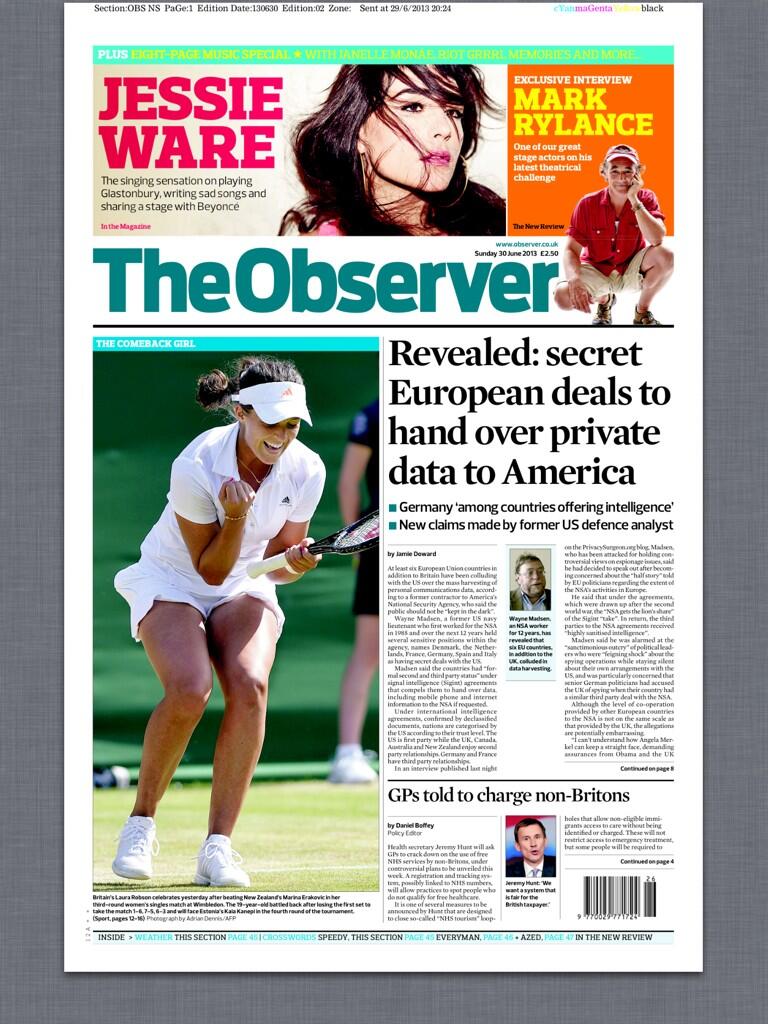
So far so good, just as in any other walk of life you think you’ve made a mistake you try to correct it. Just as Mother always told you you should. The slightly unfortunate thing is that the Sunday papers in the UK print quite early on the Saturday evening. Thus we get this front page of the physical paper:

Observer front page 20130630

The paper is now running as its front page a story that it has already retracted online. This is something of an “Ooops!” moment and as such one to be treasured as an example of the fallibility of both human beings and organisations that contain them.

However, the story really gets even better than this.

Steps towards a police state

Rick Falkvinge thinks that the United States is at the point of no return as far as civil liberties are concerned:

While this may seem a trivial observation, it is critical in this context: people tend to be focused on what affects them in the here and now. While some people can connect the dots and follow the line with their eyes into the future, the vast majority of people don’t bother with something that doesn’t affect them directly, personally, and in the present. In 1932, families were still skating in the park in Berlin on weekends. All that nasty stuff was theoretical, rumored, and somewhere else. People who look ahead and try to sound the alarm bell tend to be regarded as tinfoil hats, eccentric, and nuts.

One of the first things that happens past the point of no return into a police state is the persecution of reporters. As a society is closing down, those persecuted first are those with the audience and an interest in reporting the worrying trends that society seems to be closing. This is the proverbial canary in the coal mine. This is the alarm bell. Once that happens, get out of the mine.

An event horizon is a term from astrophysics. It is the edge of a black hole – so the event horizon appears like a black sphere, if you like. Nothing, not even light, can escape from within the event horizon – hence the term black hole. But if you were traveling through space, in direction of the black hole (which may be as large as an entire solar system), then you would notice absolutely nothing as you crossed the event horizon. You would pass a point of no return, and register not a single thing while doing so. The analogy is depressingly apt.

I’ve written before that I believe that the U.S. is lost to encroaching totalitarianism, which it will likely endure for a number of years before it collapses under its own weight (as all empires do sooner or later). With Edward Snowden being hunted relentlessly across the globe for leaking evidence of systematic abuse of power, Glenn Greenwald – who published Snowden’s leaks – was recently criticized for aiding and abetting the leak itself. This is a key choice of words, for aiding and abetting a crime is itself a crime – the wording suggested that the reporter who published evidence of abuse of power is himself a criminal.

June 28, 2013

Edmonton and Calgary – united by mutual dislike

Filed under: Cancon, Media — Tags: , , , , — Nicholas @ 13:51

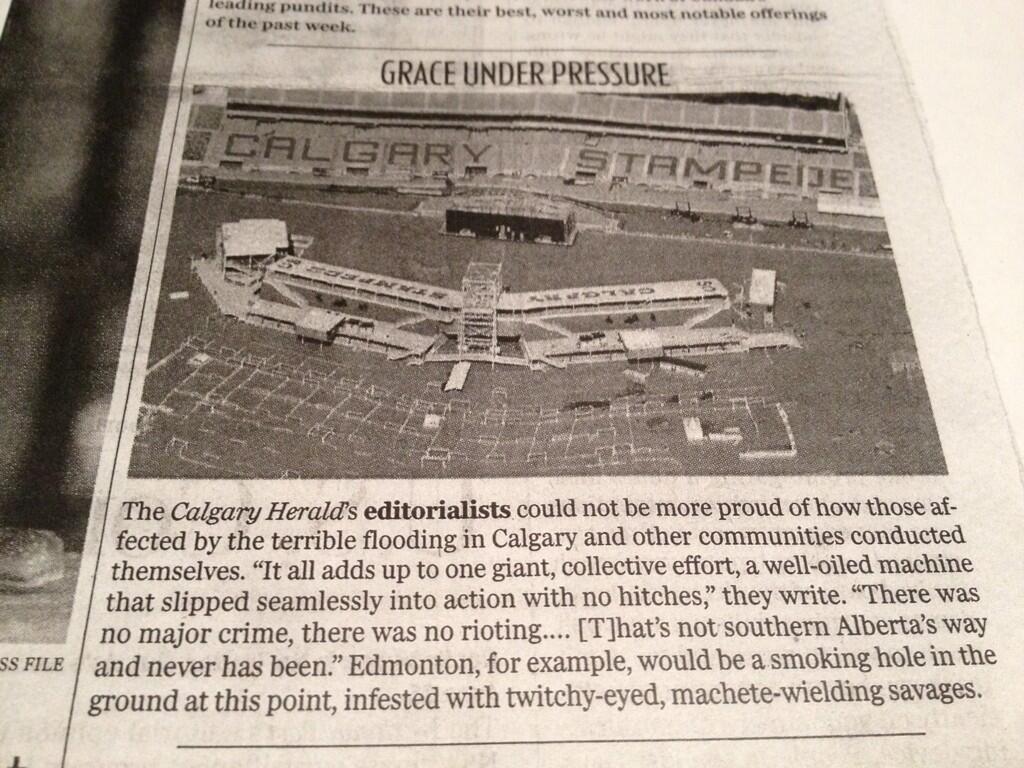
When the flooding hit Calgary, some of the first responders to the scene from outside the city were soldiers from Edmonton. There were several jokes on Twitter about the war of words between the two cities, and a few “invasion” hints, but for those of us outside Alberta local politics, we just didn’t know:

Calgary and Edmonton mutual dislike

I think we have a new meme.

June 27, 2013

Calgary’s mayor Naheed Nenshi gets praise from unexpected source

Filed under: Cancon, Government, Media — Tags: , , , , , — Nicholas @ 09:23

The Calgary Sun gets all gushy and enthusiastic over the mayor they usually like to beat up:

No one goes after the mayor of this city harder than we do.

We don’t apologize for that. It’s our job and we like to think we do it louder than most.

But it’s never personal.

So, with that as background, we would like to take this space today to commend Mayor Naheed Nenshi for his amazing leadership under the most trying of circumstances.

He has been a beacon of strength, support and optimism as Calgary battles the affects of the single-biggest disaster to hit our city.

The mayor, as always, has been a great communicator.

Through social media, traditional media and constant briefings, Nenshi has made it his personal undertaking to deliver the most up-to-date information to all Calgarians through all mediums.

June 23, 2013

Ecuador press law to mandate coverage of government propaganda items

Filed under: Americas, Law, Liberty, Media — Tags: , , , , , — Nicholas @ 10:28

Ecuador has a new law on the books that may force the media to carry government propaganda or risk prosecution:

Under Ecuador’s new Communications Law, however, journalists may have to pay far more attention to ribbon-cutting ceremonies and other government PR events. Article 18 of the law forbids the “deliberate omission of … topics of public interest.” But this wording is so vague that nearly any action by local, state, or national government official could be considered of public interest.

“Newspapers don’t have enough journalists or space to cover all these events. Radio programs don’t have enough air time,” Paúl Mena, president of the Ecuadoran Journalists’ Forum, told CPJ. “If the government starts demanding coverage, there are going to be problems.”

More conflict between the media and the Correa government seems inevitable under the Communications Law, which was approved by the National Assembly on June 14 and will go into effect next month. Not only does the law create a state watchdog entity to regulate media content, but it is filled with ambiguous language demanding that journalists provide accurate and balanced information or face civil or criminal penalties. “This is completely crazy,” Monica Almeida, an editor at the Guayaquil daily El Universo, told CPJ. “The law is designed to regulate everything we do.”

[. . .]

The 44-page law contains 119 articles. In interviews with CPJ, Ecuadoran journalists were at a loss to pick out the worst provisions since they view nearly all of them as serious violations of press freedom.

For example, under the law reporters are now required to earn a journalism degree. Rather than serving as a neutral referee, the Superintendence of Information and Communication — the government’s new watchdog agency — could be used by Correa to simply bash the press. And reporters are especially incensed by Article 26 that prohibits “media lynching.” This is defined as “the dissemination of concerted and reiterative information … with the purpose of undermining the prestige” of a person or legal entity. Media outlets found violating this provision could be ordered to issue public apologies and would be subject to criminal and civil sanctions that are not specified in the legislation.

One magazine editor in Quito, who asked to remain anonymous, said the article seems designed to thwart investigations. That’s because such in-depth reporting often requires publishing a series of stories over several days or weeks that could be construed as harassment.

June 20, 2013

Supreme Court refuses to hear appeal of Rob Ford’s conflict-of-interest case

Filed under: Cancon, Law, Media, Politics — Tags: , , , , , — Nicholas @ 11:07

The Toronto Star must be feeling devastated by this:

The Supreme Court of Canada says it will not hear an appeal in a conflict-of-interest case against Toronto Mayor Rob Ford.

The court dismissed it with costs, but did not give reasons for the ruling.

Lawyer Clayton Ruby was trying to restore a lower court decision from November 2012, in which Superior Court Justice Charles Hackland ruled Ford be removed from office.

However, as part of Ford’s appeal, the decision was overturned by an Ontario Divisional Court panel in January 2013.

Deputy mayor Doug Holyday said this was all about antagonizing the mayor.

“There was no reason to take this to the Supreme Court; there was very little likelihood of it every getting put before the Supreme Court,” Holyday said.

Update: The CBC reports that Ford feels vindicated by the decision:

Toronto Mayor Rob Ford expressed relief Thursday that a conflict challenge that previously threatened to oust him from office won’t be revived in the country’s top court.

“I’m so happy this is finally over. I’ve been vindicated and we can move on,” Ford told reporters in Toronto, about two hours after the Supreme Court of Canada rejected an application to hear a final appeal in the much-publicized conflict case that began last year.

As is customary, the Supreme Court gave no reasons for dismissing the appeal, but legal experts — including the lawyer who filed the application himself — had acknowledged the odds of reviving the conflict of interest case were a long shot.

The court only accepted 12 per cent of appeal requests made last year.

Toronto resident Paul Magder filed an application in an Ontario court last year, alleging that Ford had violated conflict of interest legislation when he participated in a council vote that absolved his need to pay back funds donated to his private football foundation.

June 3, 2013

Turkey’s unexpected wave of protests

Filed under: Europe, Government, Media, Politics — Tags: , , , — Nicholas @ 08:51

The Economist explains what is happening in Turkey:

The wave of unrest was completely unexpected. The protestors cut across ideological, religious and class lines. Many are strikingly young. But there are plenty of older Turks, many of them secular-minded, some overtly pious. There are gays, Armenians, anarchists and atheists. There are also members of Turkey’s Alevi Muslim minority. What joins them is the common sentiment that an increasingly autocratic Mr Erdogan is determined to impose his worldview. The secularists point to a raft of restrictions on booze; liberals to the number of journalists in jail (there are more journalists in prison than in any other country in the world). Thousands of activists of varying stripes (mainly Kurds), convicted under Turkey’s vaguely worded anti-terror laws, are also behind bars. Then there are those incensed by mega urban-development projects, including a third bridge over the Bosphorus, which will entail felling thousands of trees. Scenting the public mood, retailers announced that they had pulled out of the planned arcade in Taksim Square. “This is not about secularists versus Islamists — it’s about pluralism versus authoritarianism,” commented a foreign diplomat.

Mr Erdogan wants to be elected president when the post comes free in August 2014. And he has made no secret of his desire to boost the powers of the presidency “a la Turca” as he put it, spurring accusations that what Erdogan really wants is to become a “Sultan”.

“Tayyip [Erdogan] istifa”, a call for the prime minister to resign, was the slogan most commonly chanted by the protestors. Not that most Turks would have known. Media bosses fearful of jeopardising their other business interests shunned coverage of the protests for nearly two days, opting instead to screen programmes about breast-reduction surgery and gourmet cooking. Faced with a public outcry, the main news channels began broadcasting live from Taksim Square. But pro-government papers continue to point the finger of blame at provocateurs and “foreign powers” bent on undermining Turkey. It seems an odd description of the thousands of housewives leaning over their balconies clanging their pots.

« Newer PostsOlder Posts »

Powered by WordPress