
Quotulatiousness

November 3, 2013

“More bombshells” in the police document on Mayor Rob Ford, says the Toronto Star

Filed under: Cancon, Law, Media, Politics — Tags: , , , , — Nicholas @ 10:03

I’ll be honest: I haven’t been following the twists and turns of the crusade by the Toronto media to oust Mayor Rob Ford. That’s not to say there isn’t actually news on the situation:

More bombshells are contained in a weighty police document used to obtain a search warrant for Mayor Rob Ford’s friend and occasional driver, according to a Star analysis of court information already released.

“Project Traveller and the Rob Ford connection” is the bold heading atop one section of still-sealed information. The pages are blacked out pending an ongoing court challenge.

Project Traveller was the recent guns and gangs investigation that saw massive arrests in north Etobicoke. Police Chief Bill Blair has said information learned in that probe led to the creation of the Ford investigation, dubbed Project Brazen 2. (Brazen 1 was an unrelated Scarborough investigation.)

Nearly 500 pages of a document presented before a judge to obtain a warrant to search Alexander “Sandro” Lisi’s home were released Thursday. Half is censored pending a court challenge by the Star and other media lawyers.

In examining the document, the Star has learned that some remarkable information remains sealed.

Whether any of the censored pages relate to the mysterious second video the Star first learned about in early August, and Blair confirmed last week, is not known.

The Star has been told by two sources this second video also features the mayor. Blair has said the second video is “relevant to this investigation.”

In his dramatic Thursday news conference Blair answered a question about whether Ford was in the first video. The chief first said the mayor was in “those” videos, then caught himself and only spoke about the first video.

Update: It’s worth noting that Ford’s popularity actually increased after the latest news came out.
October 26, 2013

The media zombie horde

Filed under: Humour, Media, Politics, USA — Tags: , , , , , — Nicholas @ 10:24

In The Goldberg File email, Jonah Goldberg memorably characterizes the modern media:

When I go to Alaska to visit the Fair Jessica’s people, I’ll often hear some version of a joke about grizzly bears. The gist is, if a bear is chasing you, you don’t need to be faster than the bear, you need to be faster than the guy you’re hiking with. A similar dynamic applies in scandals of this nature: You don’t have to be blameless, you just need to be harder to blame than the other guy.

That’s because the media tends to stalk its prey like the unthinking zombie horde it so often is. Twenty miscreants, malefactors, and scalawags could be in on some scheme to defraud or bilk the public fisc, and the zombie horde will start chasing all of them, but the zombies will stop to feed on the first poor soul who can’t keep up.

Now Bill Clinton always understood this. Whenever it was necessary, he’d reassure his co-conspirators and enablers that he had their back, right up until the minute he found it necessary to handcuff them to the rear fender of a broken down Ford Pinto. Sometimes he varied his techniques, of course. Here’s a reenactment of how Bill Clinton treated Webb Hubbell. But you could always count on Bill to climb to safety over the backs of those who trusted him most.

Barack Obama, who holds a patent on a device that hurls aides and friends under a bus from great distances, also understands this. That is why Kathleen Sebelius these days looks a lot like a Soviet general on his way to brief Stalin on the early “progress” in the battle of Stalingrad.

Anyway, yesterday’s hearings were just the early try-outs. There are 55 contractors and countless nameless bureaucrats who can be thrown into the Great Pit of Carkoon (“You’re just determined to keep mixing metaphors aren’t you?” — The Couch) and given the full scope of this fustercluck, they could all be made to walk the plank before this is over.

October 25, 2013

QotD: The dangers of reading internet comments

Filed under: Humour, Media, Quotations — Tags: , , — Nicholas @ 00:01

I joke — hilariously — but there is a serious issue here. At least, I assume there is. Frankly, I can’t remember, because I made the mistake of scrolling down to the reader comments about the visa story. Reading online comments is like letting someone punch your brain in the face with a fistful of stupid. If you doubt this, consider that I’ve been hit with the “fist of stupid” so many times, I now think brains have faces. Kudos, Internet.

Scott Feschuk, “Mexico is ‘really mad’ at us, and it is so a big whoop: Diplomacy should be more like ‘Mean Girls’”, Maclean’s, 2013-09-20

October 7, 2013

Harsanyi – Better openly partisan than “impartial” media

Filed under: Media, Politics, USA — Tags: , , , — Nicholas @ 10:22

David Harsanyi thinks the political scene would be better if more media outlets were up-front about their partisan stance rather than pretending to be objective and impartial:

As much as it pains me, let me take a few moments to defend MSNBC. Last week’s much-talked about testy exchange between anchor Thomas Roberts and Republican National Committee Chair Reince Priebus has been predictably negative. Media bias is a perpetual grievance of the Right — for obvious reasons. But maybe the only way to improve on the situation is to champion more openly ideologically driven political journalism? By any measure, it’s a lot less destructive than what we had for decades: a media feigning impartiality.

[…]

It can be uncomfortable watching a head-on collision of hackery, but the truth is the entire exchange is weirdly honest, entertaining and informative. It’s not often a TV anchor admits to viewers that he’s reading “directly from what the president just gave us.” Roberts is standing in for the president. Perfect. It’s not as if Reince Priebus was on MSNBC to offer his dispassionate impression of the situation, either. He should be challenged. And though the table-setting question is preposterously biased, it’s exactly the kind of question Priebus should be able to deflect. And he gets to do it in front of an audience that generally detests Republicans. I saw many people on Twitter wondering why Priebus does it to himself. They should be wondering why he doesn’t do it more often.

We all know where MSNBC or FOX News stand. It’s establishment media masquerading as impartial that has the real impact. This bias is rooted in insularity, showing a lack curiosity about the other side’s worldview — the ignorance about religion, guns or free-market economic ideas are the most glaring example — and, even worse, a lack of skepticism towards its own conceptions about how things work.

To the untrained eye, the Obamacare rollout may seem like an unmitigated disaster. But editors at Reuters (“Web traffic, glitches slow Obamacare exchanges launch”) or the Associate Press (“Rollout of ‘historic’ Obamacare in California hits some snags”) will try to dissuade people of this notion. Bias doesn’t only manifest in what you write but what you don’t, in what goes above the fold and what sort of delicate nouns and adjectives you sprinkle in your headlines.

October 2, 2013

Now we have the real reason for the decline in newspaper revenue

Filed under: Media, USA — Tags: , , , , — Nicholas @ 08:25

If you guessed “the internet” — particularly the internet sites that ate the classified ad business alive — you’re apparently wrong. The real culprit is … an amazingly old-fashioned racist and sexist stereotype:

For years, we’ve talked about the ridiculousness with which many old school journalists want to blame the internet (or, more specifically Google or Craigslist) for the troubles some in the industry have had lately. It is a ridiculous claim. Basically, newspapers have survived for years on a massive inefficiency in information. What newspapers did marginally well was bring together a local community of interest, take their attention, and then sell that attention. What many folks in the news business still can’t come to terms with is the fact that there are tons of other communities of attention out there now, so they can’t slide by on inefficiencies like they did in the past.

Either way, it’s always nice to see some in the industry recognize that blaming the internet is a mistake. However, Chris Powell, the managing editor for the Journal Inquirer in Connecticut’s choice of a different culprit doesn’t seem much more on target. Powell, who it appears, actually does have a journalism job (I can’t fathom how or why) published an opinion piece (found via Mark Hamilton and Mathew Ingram) that puts the blame squarely on… single mothers. Okay, not just any single mothers:

    Indeed, newspapers still can sell themselves to traditional households — two-parent families involved with their children, schools, churches, sports, civic groups, and such. But newspapers cannot sell themselves to households headed by single women who have several children by different fathers, survive on welfare stipends, can hardly speak or read English, move every few months to cheat their landlords, barely know what town they’re living in, and couldn’t afford a newspaper subscription even if they could read. And such households constitute a rising share of the population.

September 14, 2013

Vlad the (journalistic) Impaler

Filed under: Media, Politics, Russia, USA — Tags: , , — Nicholas @ 08:06

Mark Steyn on the sudden re-emergence of Russia on the international stage:

For generations, eminent New York Times wordsmiths have swooned over foreign strongmen, from Walter Duranty’s Pulitzer-winning paeans to the Stalinist utopia to Thomas L. Friedman’s more recent effusions to the “enlightened” Chinese Politburo. So it was inevitable that the cash-strapped Times would eventually figure it might as well eliminate the middle man and hire the enlightened strongman direct. Hence Vladimir Putin’s impressive debut on the op-ed page this week.

It pains me to have to say that the versatile Vlad makes a much better columnist than I’d be a KGB torturer. His “plea for caution” was an exquisitely masterful parody of liberal bromides far better than most of the Times’ in-house writers can produce these days. He talked up the U.N. and international law, was alarmed by U.S. military intervention, and worried that America was no longer seen as “a model of democracy” but instead as erratic cowboys “cobbling coalitions together under the slogan ‘you’re either with us or against us.’” He warned against chest-thumping about “American exceptionalism,” pointing out that, just like America’s grade-school classrooms, in the international community everyone is exceptional in his own way.

All this the average Times reader would find entirely unexceptional. Indeed, it’s the sort of thing a young Senator Obama would have been writing himself a mere five years ago. Putin even appropriated the 2008 Obama’s core platitude: “We must work together to keep this hope alive.” In the biographical tag at the end, the Times editors informed us: “Vladimir V. Putin is the president of Russia.” But by this stage, one would not have been surprised to see: “Vladimir V. Putin is the author of the new memoir The Audacity of Vlad, which he will be launching at a campaign breakfast in Ames, Iowa, this weekend.”

As Iowahawk ingeniously summed it up, Putin is “now just basically doing donuts in Obama’s front yard.” It’s not just that he can stitch him up at the G-8, G-20, Gee-don’t-tell-me-you’re-coming-back-for-more, and turn the leader of the free world into the planet’s designated decline-and-fall-guy, but he can slough off crappy third-rate telepromptered mush better than you community-organizer schmucks, too. Let’s take it as read that Putin didn’t write this himself any more than Obama wrote that bilge he was drowning in on Tuesday night, when he took to the airwaves to argue in favor of the fierce urgency of doing something about gassed Syrian moppets but not just yet. Both guys are using writers, but Putin’s are way better than Obama’s — and English isn’t even their first language. With this op-ed Tsar Vlad is telling Obama: The world knows you haven’t a clue how to play the Great Game or even what it is, but the only parochial solipsistic dweeby game you do know how to play I can kick your butt all over town on, too.

Reason.tv: George Will’s Libertarian Evolution

“I’ve lived in Washington now for 44 years, and that’s a lot of folly to witness up close,” says Washington Post columnist George Will. “Whatever confidence and optimism I felt towards the central government when I got here on January 1, 1970 has pretty much dissipated at the hands of the government.”

“In part, I owe my current happiness to Barack Obama,” continues the 72-year-old Will, who “so thoroughly concentrates all of the American progressive tradition and the academic culture that goes with it, that he’s really put the spring in my step.”

Branded “perhaps the most powerful journalist in America” by the Wall Street Journal, Will received the Pulitzer Prize for commentary in 1977 and is the author of numerous books, including Statecraft as Soulcraft: What Government Does, Men at Work: The Craft of Baseball, and One Man’s America: The Pleasures and Provocations of our Singular Nation. A regular panelist on ABC’s This Week, Will has the distinction of having been attacked in the pages of Doonesbury and praised in an episode of Seinfeld (for his “clean, scrubbed look”).

More recently Will has become a champion of libertarianism, both in print and on the air. “America is moving in the libertarians’ direction,” Will wrote in a 2011 review of The Declaration of Independents, “not because they have won an argument but because government and the sectors it dominates have made themselves ludicrous.”

Will sat down with Reason‘s Nick Gillespie and Matt Welch to discuss his libertarian evolution (2:16), how Sen. John McCain spurred his political transformation (4:07), Ronald Reagan (4:29), the tax code (8:45), why the Republicans are becoming more interesting (19:30), what the government should be spending money on (23:14), war hawks and foreign policy (25:19), the benefits of judicial activism (34:49), gay marriage (37:55), marijuana legalization (39:04), the importance of Barry Goldwater (40:28), Mitt Romney (45:45), the 2016 election (46:37), Medicare (48:52), how Everett Dirksen’s untimely death changed his life (50:42), why President Obama makes him happy (52:06), affirmative action (53:07), and his optimism in America’s future (57:31).

September 4, 2013

“Despite a rash of deadly train crashes…”

Filed under: Media, Railways — Tags: , , , , — Nicholas @ 09:15

Coyote Blog indulges in a good old-time fisking of an article built on the claim that there has been a “trend” of increasingly deadly railway accidents:

The best way to explain the phenomenon is with an example, and the Arizona Republic presented me with a great one today, in the form of an article by Joan Lowy of the Associated Press. This in an article that reads more like an editorial than a news story. It is about the Federal requirement for railroads to put safety electronics called Positive Train Control (PTC) on trains by a certain date. The author has a pretty clear narrative that this is an absolutely critical piece of equipment for the public good, and that railroads are using scheming and lobbying to unfairly delay and dilute this critical mandate (seriously, I am not exaggerating the tone, you can read it for yourself.)

My point, however, is not to challenge the basic premise of the article, but to address this statement in her opening paragraph (emphasis added).

    Despite a rash of deadly train crashes, the railroad industry’s allies in Congress are trying to push back the deadline for installing technology to prevent the most catastrophic types of collisions until at least 2020, half a century after accident investigators first called for such safety measures.

The reporter is claiming a “rash of deadly train crashes” — in other words, she is saying, or at least implying, that there is an upward trend in deadly train crashes. So let’s ask ourselves if this claimed trend actually exists. She says it so baldly, right there in the first seven words, that surely it must be true, right?

[…]

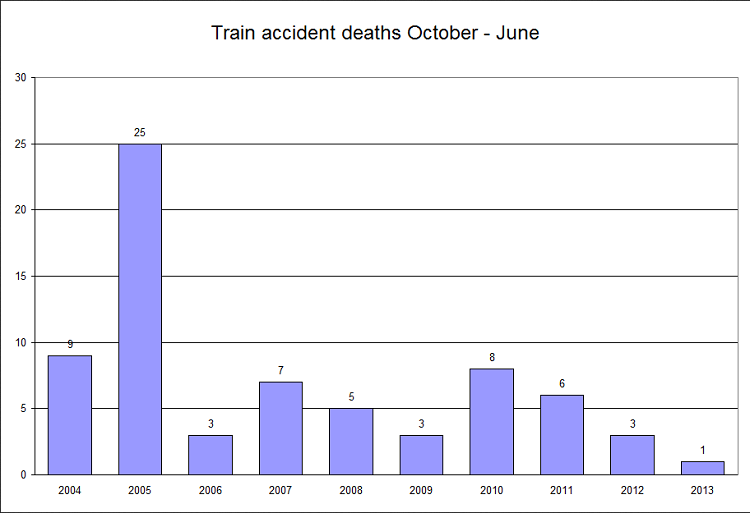
So let’s go to the data. It is actually very easy to find, and I would be surprised if Ms. Lowy did not actually have this data in her hands. It is at the Federal Railway Administration Office of Safety Analysis. 2013 data is only current through June and seems to be set up on an October -September fiscal year. So I ran the data only for October-June of every year to make sure the results were comparable to 2013. Each year in the data below is actually 9 months of data.

By the way, when one is looking at railroad fatalities, one needs to understand that railroads do kill a lot of people every year, but the vast, vast majority of these — 99% or more — are killed at grade crossings. People still do not understand that a freight train takes miles to stop. (see postscript below, but as an aside, I would be willing to make a bet: Since deaths at grade crossings outnumber deaths from collisions by about 100:1, I would be willing to bet any amount of money that I could take the capital the author wants railroads to invest in PTC and save far more lives by investing it in grade crossing protection. People like Ms. Lowy who advocate for these regulations never, ever seem to consider prioritization and tradeoffs.)

Anyway, looking at the data, here is the data for people killed each year in US railroad accidents (as usual click to enlarge any of the charts):

Train accident deaths Oct-Jun

So, rather than a “rash”, we have just the opposite — the lowest number of deaths in a decade. One. I will admit that technically she said rash of “fatal accidents” and this is data on fatalities, but I’m going to make a reasonable assumption that one death means one fatal accident — which certainly cannot be higher than the number of fatal accidents in previous years and is likely lower.

Most of you will agree that this makes the author’s opening statement a joke. Believe it or not — and this happens a surprising number of times — this journalist is claiming a trend that not only does not exist, but is of the opposite sign.

August 27, 2013

Hey, Kids! It’s time for back-to-school bad journalism bingo!

Filed under: Education, Humour, Media — Tags: , , — Nicholas @ 10:57

The slow news days of August have reached the traditional back-to-school phase of page filling:

I love back-to-school time: the joy, the energy, the sense of limitless possibilities. It’s almost enough to make you forget about the tsunami of dreadful journalism that accompanies it.

There are basically three reasons for bad back-to-school journalism. First, higher education is complicated; it doesn’t lend itself to the simplistic narratives required for 800-word articles. Second, there’s a serious lack of decent data about higher education in Canada, what with the Millennium Scholarship Foundation gone, HRSDC no longer funding any decent Statscan surveys, and provinces and universities holding on tightly to their own data on the grounds that someone might use it to compare them against other provinces/institutions (and that would never do!). In this data vacuum, interested parties with their own agendas find it easy to peddle all sorts of demented, half-true factoids to journalists; hence, the frequent appearance of stories based on “data” which simply aren’t true.

The third problem is the lack of outcome measures. Everyone wants “good” education, but no one knows what that is. So journalists tend to fall back on input measures: small classes, students per professors, etc., which inevitably lead to a weird mythologizing of university life in the 1970s. Nothing wrong with the 1970s of course, but it somehow never quite clicks with op-ed writers that a major reason life was so great for students back then was that access was restricted to a fairly small elite, and that the comparative “failures” of today’s universities are largely the result of expanded access.

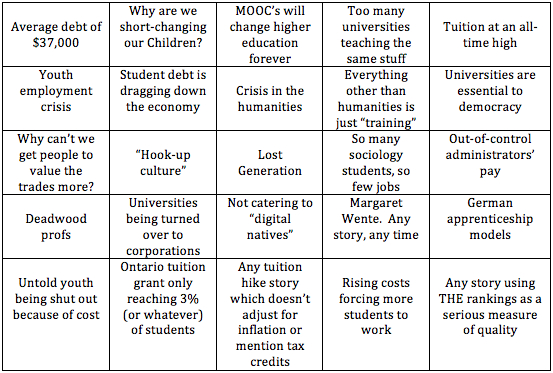
Here’s the Bingo card for you to play along at home:

Back to school bingo

August 26, 2013

Stephen Harper’s media aversion

Filed under: Cancon, Media, Politics — Tags: , , , — Nicholas @ 09:01

Michael Den Tandt seems puzzled that Stephen Harper and his staff treat the media as though they were a bunch of rancid/poisonous/radioactive zombies that would love to eat their brains on live TV:

Stephen Harper, it will sadden some to learn, is not an ogre or a troll. Nor are the members of his staff orcs, goblins, hobgoblins or cave wights out of Tolkien. They are all, shockingly, human beings.

Having spent the last week locked up with them cheek by jowl — the staffers that is, not the prime minister, more on that later — in rattletrap buses, dingy hotel basements and in the belly of a flying tank, I can attest that they work very hard. Managing a tour of the Arctic, on a very tight schedule, observed and criticized at all times by a gaggle of touchy, tired, grumpy journalists, can’t be anyone’s idea of fun. Yet I saw Harper’s staff do that, with good nature, resilience and aplomb for the most part.

But for the incident Friday afternoon, in which a Chinese journalist from a state-owned newspaper was prevented from asking a question of the PM and shoved a female staffer, last week’s Arctic tour, Harper’s eighth as prime minister, went off without a hitch, from a Conservative standpoint. He hit all the thematic and policy notes he intended to, appeared in a series of photo ops that reinforced those themes and policies, and avoided any major missteps. Another job done, on to the next.

That said, they — meaning Harper and the Conservatives — could be doing so much better than this. To watch the PM in action, up close, is to see repeated opportunities missed, for reasons that make little sense. Much of this appears to stem from his aversion to, and discomfort with, the national media.

Why, it’s almost as though Harper has learned not to trust the media or to allow them to get too close. I wonder how he’d have come to that conclusion? It’s a mystery, sure enough.

August 21, 2013

The Guardian gets a taste of the medicine it prescribed for the tabloids

Filed under: Britain, Government, Liberty, Media — Tags: , , , , — Nicholas @ 08:25

In sp!ked, Brendan O’Neill talks about the amazing double standards of Britain’s “chattering classes”:

If there was a Nobel Prize for Double Standards, Britain’s chattering classes would win it every year. This year, following their expressions of spittle-flecked outrage over the detention of Glenn Greenwald’s partner David Miranda by anti-terrorism police at Heathrow airport, they’d have to be given a special Lifetime Achievement Award for Double Standards.

For the newspaper editors, politicians and concerned tweeters now getting het up about the state’s interference in journalistic activity, about what they call the state’s ‘war on journalism’, are the very same people – the very same – who over the past two years cheered the state harassment of tabloid journalists; watched approvingly as tabloid journalists were arrested; turned a blind eye when tabloid journalists’ effects were rifled through by the police; said nothing about the placing of tabloid journalists on limbo-like, profession-destroying bail for months on end; said ‘Well, what do you expect?’ when material garnered by tabloid journalists through illegal methods was confiscated; applauded when tabloid journalists were imprisoned for the apparently terrible crime of listening in on the conversations of our hereditary rulers.

For these cheerleaders of the state’s two-year war on redtop journalism now to gnash their teeth over the state’s poking of its nose into the affairs of the Guardian is extraordinary. It suggests that what they lack in moral consistency they more than make up for with brass neck.

Everything that is now being done to the Guardian has already been done to the tabloid press, a hundred times over, and often at the behest of the Guardian. For all the initial depictions of Mr Miranda as ‘just Glenn Greenwald’s partner’, in fact he was ferrying encrypted information from the NSA leaker Edward Snowden on flights paid for by the Guardian. That is, he was detained and questioned over journalistic material acquired through illegal means. That’s already happened to the tabloids. Over the past two years of post-phone hacking, post-News of the World harassment of tabloid hacks by the state, 104 people have been arrested, questioned, usually put on unjustly elongated bail, and sometimes imprisoned. These include many journalists but also office secretaries and other non-journalist types, like Mr Miranda, who stand accused of handling illegally acquired material. The 104’s crimes include ‘disclosure of confidential information’ – not that dissimilar to what Greenwald and Miranda have done in terms of getting hold of and publishing Snowden’s illegally leaked confidential material. Yet while the redtop writers rot in legal limbo, Mr Miranda becomes a chattering-class cause célèbre.

[…]

But, believe it or not, the double standards run even deeper than that. For today’s outraged defenders of Greenwald, Miranda and the Guardian from a state war on journalism were the architects of the state’s far larger, far more destructive war on tabloid journalism. From the Guardian itself to Labour MP Tom Watson to various influential members of the Twitterati, many of those now shocked to find officials harassing journalists for doing allegedly dodgy things were at the forefront of demanding that officialdom harass redtop hacks for doing dodgy things. If you unleash and cheer a war on journalism by the state, you really cannot be surprised when the warmongers eventually put you and your journalism in the crosshairs, too.

August 20, 2013

“You’ve had your debate. There’s no need to write any more.”

Filed under: Britain, Law, Liberty, Media — Tags: , , , , , — Nicholas @ 10:29

Things are getting surreal at the Guardian:

A little over two months ago I was contacted by a very senior government official claiming to represent the views of the prime minister. There followed two meetings in which he demanded the return or destruction of all the material we were working on. The tone was steely, if cordial, but there was an implicit threat that others within government and Whitehall favoured a far more draconian approach.

The mood toughened just over a month ago, when I received a phone call from the centre of government telling me: “You’ve had your fun. Now we want the stuff back.” There followed further meetings with shadowy Whitehall figures. The demand was the same: hand the Snowden material back or destroy it. I explained that we could not research and report on this subject if we complied with this request. The man from Whitehall looked mystified. “You’ve had your debate. There’s no need to write any more.”

During one of these meetings I asked directly whether the government would move to close down the Guardian‘s reporting through a legal route — by going to court to force the surrender of the material on which we were working. The official confirmed that, in the absence of handover or destruction, this was indeed the government’s intention. Prior restraint, near impossible in the US, was now explicitly and imminently on the table in the UK. But my experience over WikiLeaks — the thumb drive and the first amendment — had already prepared me for this moment. I explained to the man from Whitehall about the nature of international collaborations and the way in which, these days, media organisations could take advantage of the most permissive legal environments. Bluntly, we did not have to do our reporting from London. Already most of the NSA stories were being reported and edited out of New York. And had it occurred to him that Greenwald lived in Brazil?

The man was unmoved. And so one of the more bizarre moments in the Guardian‘s long history occurred — with two GCHQ security experts overseeing the destruction of hard drives in the Guardian‘s basement just to make sure there was nothing in the mangled bits of metal which could possibly be of any interest to passing Chinese agents. “We can call off the black helicopters,” joked one as we swept up the remains of a MacBook Pro.

Update: Charlie Beckett at the LSE’s Polis blog:

The narrative of increasing totalitarian persecution has a few flaws. Firstly, I think it was entirely reasonable for security forces to question someone linked to security breaches. I just think that doing it under terror laws was wrong, especially as Miranda is part of a journalism team.

I am still a little unsure of the Greenwald/Guardian narrative. I am puzzled by why the team chose to fly Miranda through London at all. I am also unclear as to why the Guardian let security officials smash up their hard-drives without making them go down a legal path.* [Someone with more profound doubts about the Guardian and Greenwald is former Tory MP Louise Mensch — good piece by her here]

But those are details. Overall, it’s clear that US and UK officials, long-tortured by WikiLeaks and Julian Assange, are now losing patience with whistle-blowers and their accomplices in the news media. Whatever the absolute truth of the NSA/PRISM revelations it is clear that the security service are pushing the boundaries on what they can do with new technologies to increase their information and surveillance. They are also seeking to reduce scrutiny by journalists, as they told Rusbridger:

    “You’ve had your debate. There’s no need to write any more.”

That in itself may be worrying but it’s hardly surprising. That is what they are there for. We would all be very cross if there was an act of terror missed because of inadequate data collection by spooks or if a press leak endangered our safety. But it’s also journalism’s job to hold these people to account and let the public know the scope of what they are up to. That’s what worries me about the Miranda incident.

August 19, 2013

Glenn Greenwald’s partner detained by UK authorities

Filed under: Britain, Government, Media — Tags: , , , , , — Nicholas @ 08:49

The British government sends a message:

The partner of the Guardian journalist who has written a series of stories revealing mass surveillance programmes by the US National Security Agency was held for almost nine hours on Sunday by UK authorities as he passed through London’s Heathrow airport on his way home to Rio de Janeiro.

David Miranda, who lives with Glenn Greenwald, was returning from a trip to Berlin when he was stopped by officers at 8.05am and informed that he was to be questioned under schedule 7 of the Terrorism Act 2000. The controversial law, which applies only at airports, ports and border areas, allows officers to stop, search, question and detain individuals.

The 28-year-old was held for nine hours, the maximum the law allows before officers must release or formally arrest the individual. According to official figures, most examinations under schedule 7 — over 97% — last less than an hour, and only one in 2,000 people detained are kept for more than six hours.

Miranda was released, but officials confiscated electronics equipment including his mobile phone, laptop, camera, memory sticks, DVDs and games consoles.

Since 5 June, Greenwald has written a series of stories revealing the NSA’s electronic surveillance programmes, detailed in thousands of files passed to him by whistleblower Edward Snowden. The Guardian has also published a number of stories about blanket electronic surveillance by Britain’s GCHQ, also based on documents from Snowden.

Update: The opposition Labour party calls for an investigation into this use of anti-terrorism legislation (but as Charles Stross point out … they passed the laws themselves).

Labour has called for an urgent investigation into the use of anti-terror powers to detain David Miranda, the partner of a Guardian journalist who interviewed US National Security Agency whistleblower Edward Snowden.

Yvette Cooper, the shadow home secretary, said ministers must find out whether anti-terror laws had been “misused”, after Miranda was held for nine hours by authorities at Heathrow airport under the Terrorism Act.

His detention has caused “considerable consternation” and the Home Office must explain how this can be justified as appropriate and proportionate, she said.

[…]

“The independent reviewer of terrorism legislation, David Anderson, has already warned of the importance of using schedule 7 of the Terrorism Act appropriately and proportionately. The purpose of schedule 7 is to determine whether or not someone is involved in or associated with terror activity. The Home Office and police need to explain rapidly how they can justify using that purpose under the terrorism legislation to detain David Miranda for nine hours. This has caused considerable consternation and swift answers are needed.

“The police and security agencies rightly work hard to protect national security and prevent terrorism. But public confidence in security powers depends on them being used proportionately within the law, and also on having independent checks and balances in place to prevent misuse.”

August 11, 2013

Debunking the “Cameron’s gunboat diplomacy” meme

Filed under: Britain, Europe, Media — Tags: , , , — Nicholas @ 09:22

Sir Humphrey points out that the British media’s collective gasp about Royal Navy ships being sent to Gibraltar merely highlights what a slow news month it is:

It’s an amusing irony that the recent row in Gibraltar has suddenly given the Royal Navy more publicity about its forthcoming COUGAR deployment in one evening, than it may have got in several months of deployment. The news that the Response Force Task Group (RFTG) is deploying to the Med has been seen as a clear example of gunboat diplomacy by Fleet Street’s finest, many of whom seem terribly keen on starting a war in order to fill column inches during a slow news month…

Its perhaps worth noting that this deployment is extremely long standing — the sort of planning which goes into deploying a major Task Force will usually commence at around 12 months prior to the event, when the rough outline of a plan is put together on the objectives of the deployment, likely ports, aims and intended outcomes and so on. While maritime power is about flexibility, it’s often forgotten that most RN deployments these days are the end product of months of well co-ordinated planning and staffing to ensure that the UK gets the best possible value from its naval assets.

[…]

What we can perhaps draw from this is that firstly the RN has enjoyed an unexpected boon of coverage, tapping into the nation’s subliminal psyche which holds that sending a grey hull is a key means of solving a crisis, no matter what or where the crisis is. There is perhaps work for some analysts to understand why, almost alone among all major powers, the cries of ‘send a gunboat’ seem to resonate most strongly in the UK (albeit to a lesser extent the same applies with the ‘send a carrier’ debate in the US). While deployments of warships can be seen as a useful indicator of interest in situations, it appears to be held most strongly in the UK — there is, at times, a fervent belief that deploying vessels is akin to the legend of waving the ancient banner three times in order for Arthur and his knights to appear — it makes little practical sense, but is somehow strangely comforting to the people.

August 8, 2013

A brief moment of sympathy for Thomas Mulcair

Filed under: Cancon, Media, Politics — Tags: , , , , , , — Nicholas @ 07:54

Richard Anderson finds a drop of sympathy for the unexpected plight of the leader of Her Majesty’s loyal opposition:

It must be galling to be Thomas Mulcair right now. A decades long career spent climbing the greasy pole of Quebec politics. A quick ascent to the federal level and then, by the oddest stroke of luck, an unexpected death places you into the leader’s role. It seems that with a bit of luck your old nemesis the Liberal Party might be finished after the next election. Happy days to be leader of the Official Opposition.

That is until the MSM started following around the latest bright shiny thing: Justin Trudeau.

While the Once and Future King is touring the sumptuous beauty of British Columbia, poor Tommy is wandering through the backwoods of Northern Ontario. The region is horribly neglected. An afterthought to provincial administrators in downtown Toronto. The area above the French River, sadly, has always failed to capture the imagination of Canadians.

The settlement of the West is one of the great romances of Canadian history, if not the greatest. The charm of the Maritimes is irresistible. The North’s terrible majesty demands admiration. Quebec is Quebec. Southern Ontario is the center of English Canada, Toronto commanding the region like, well, an Imperial Capital around which all else revolves.

Northern Ontario is kind of just up there. Somewhere between Barrie and Winnipeg. What small romance that region conveys is from faded memories of the great mineral boom a century ago, and the twangy recollections of Stompin’ Tom. Only he could make Sudbury Saturday Nights memorable. At least Hamilton has the virtue of being between Burlington and Niagara.

Poor, poor Tommy. There isn’t a major media outlet that gives a damn about his “listening tour.” Leader of the NDP shaking hands with a miners union representative doesn’t make for great copy, especially not when competing with Justin’s adorable family.

« Newer PostsOlder Posts »

Powered by WordPress


