Quotulatiousness

August 3, 2019

The unexpected rise of Tulsi Gabbard in the Democratic race

Filed under: Media, Politics, USA — Tags: , , , , , — Nicholas @ 05:00

Brendan O’Neill says that Tulsi Gabbard is the Democratic candidate who is worth supporting:

Tulsi Gabbard speaks at the “People’s Rally” in Washington DC on 17 November, 2016.
Photo by Lorie Shaull via Wikimedia Commons.

The liberal establishment is so scared of Tulsi Gabbard that they’ve convinced themselves she’s an unwitting stooge of Russia, being pushed by Putin’s evil online robots to destroy America from within.

Yes, in the febrile, conspiracist, Russian-bot-obsessed brains of the increasingly unhinged liberal elite, Ms Gabbard, the Democratic congresswoman for Hawaii and easily the most impressive 2020 presidential candidate, is the fave of those dastardly bots whose ultimate aim is to screw over the USA. Following this week’s Democratic candidates’ debate in Detroit, in which Gabbard made mincemeat of the California Democrat Kamala Harris on the issue of judicial authoritarianism, an actual New York Times writer said: “Beware the Russian bots and their promotion of Tulsi Gabbard and sowing racial discord, especially around Kamala Harris.”

This idea that Gabbard – the most principled critic of military interventionism to have emerged in the US mainstream in decades – is in the ascendant because Russian bots and other evil online forces are doing her bidding is becoming widespread among centrists. Newsweek columnist Seth Abramson says “there’s a concerted far-right effort (possibly involving foreign actors) to bolster Tulsi Gabbard”. He based this nuts claim on the fact that, during the Detroit debate, Ms Gabbard was the most-searched name online in every state in the US. Erm, isn’t it possible that viewers who weren’t entirely sure who Ms Gabbard is, but who were impressed by her articulate takedown of Harris and other candidates, took to the web to find out more? Surely that’s a more rational explanation than the idea that a Russian troll army and loads of fascists are on the web promoting Gabbard as chief wrecker of the United States.

It’s ceaseless. “Russia’s propaganda machine discovers 2020 Democratic candidate Tulsi Gabbard”, declares NBC News. What all this nonsense reveals is that Russophobic conspiracy theories play a really important role for dazed Hillary-era centrists. They are now the main means through which these people try to make sense of a political world that no longer conforms to their tastes or their ideology. So just as they used the Russian-bots rubbish to explain why Trump beat Hillary, now they use it to explain why a candidate who, horror of horrors, is opposed to US military intervention overseas is proving popular with viewers and voters. Given that Gabbard’s worldview runs so counter to theirs – on war, on free speech, even on identity politics – the only way they can explain her presence in politics is as a result of foreign, fascistic meddling. That tells us far more about their own political arrogance than it does about Gabbard’s Russian fanbase.

In a sense, they’re right to be scared of Gabbard. She feels like a genuinely fresh force in Democratic politics. A former soldier who served in Iraq, and now the Democratic member of the House of Representatives for the 2nd congressional district of Hawaii, she represents a challenge both to the old militaristic US establishment and to the newer, more woke wing of the establishment.

QotD: The 1968 election and the schizoid break of the American media

… in hindsight 1968 was obviously the country’s schizoid break. The Democratic Party didn’t go completely off the rails — cf. all the candidates they ran, 1972-2004, who were the definition of anodyne — but The Media sure as hell did. 1968 was also the year of the Tet Offensive, you’ll recall, with Walter Cronkite proclaiming the war unwinnable. It doesn’t matter if Cronkite was right or not (of course he wasn’t); nor does it matter if his proclamation actually made everyday Americans lose faith in the war. What matters is that The Media believed it, with all their hearts and souls. No profession is dumber, or more addicted to singing hosannas to itself, than journalism. And then they “got” Richard Nixon, and that’s all she wrote — from there on out, The Media decided they were the country’s real rulers, and what they want, they get.

Fortunately for the Democrats, what The Media wanted and what the Democratic Party wanted were in the same ballpark for most of the next three decades. But then Bill Clinton happened, as my students would write. He played The Media’s Messiah fantasies for all they were worth, such that every bobblehead in the country was still defending him as Liberalism’s avatar even as he was governing (in the few odd moments he bothered) as Newt Gingrich’s mini-me and acting like a frat boy on nickel beer night at the strip club.

You just don’t get over something like that.

Which brings us to the elections of 2000 and 2004. Boy do these look different in hindsight! […] I knew The Media was all-in on the Democrat, like they always are. But at the time, I thought that was a tactical decision. That is, I really believed that their attacks on W. were calculated political moves, designed to drag Gore and especially Kerry over the finish line. I thought that only the Mother Jones types were delusional, Iranian mullah-style fanatics.

Nope. The Media — ALL of them — really did see W. as the antichrist, the Twelfth Invisible Hitler (as the Z Man likes to put it) come to destroy the world. So when despite all their sacrifices to Moloch the Chimperor won, The Media went full retard. Like UFO cultists who keep the faith by telling themselves only their fervent prayers staved off the apocalypse, The Media convinced themselves that only more Social Justice would do …

Severian, “The Spirit of ’68”, Rotten Chestnuts, 2019-07-01.

July 29, 2019

Life and love aboard HMS Pacific Princess

Filed under: Britain, Media, Military — Tags: , , , — Nicholas @ 05:00

Sir Humphrey is not amused at the stories in the British press about pregnant Royal Navy sailors needing to be flown back to the UK from some of Her Majesty’s deployed ships:

Life in the Royal Navy is less about preparing for war, and more like spending time on the loveboat. That seems to be the gist of quite a few stories in the media today which breathlessly relate to the news that since 2005 35 women sailors from 18 different ships have been airlifted to shore as a result of becoming pregnant and discovering this while they were at sea.

This news has been met with shock and horror by some commentators online, some of whom give the distinct impression that they are not intimately familiar with the process by which babies are made. At least one Daily Mail reader suggested that Chasity belts should form part of naval uniform for female members of the naval service (presumably in the RN kit record book it would be recorded as a “Torpedo Protection Belt”?).

Is the nation being let down by a bunch of serial shaggers in uniform or is perhaps the truth of the matter a little more complex than originally conceived?

The specific FOI that was referred to in the article, which looks like it originated in the Daily Star (alongside another story suggesting that the 2003 Iraq war occurred due to Saddam possessing “stargate” technology and the US and allies wanting to prevent various aliens attacking the Earth) asked for the total number of females aeromedically evacuated between 2005 and 2019. Confusingly though there is also some suggestion that the Sun also got the story as an exclusive – to be honest, its rather hard to tell.

To start with, a sense of context is perhaps useful. This FOI is a well worn question which seems to have been asked quite a few times over the years. Humphrey has found similar articles from 2015 and 2017 and 2018, so its not exactly breaking news that the RN has had to occasionally return sailors ashore when they find out they are pregnant.

The numbers involved sound dramatic – a whole 35 women flown at public expense due to getting pregnant. In 2015 the number was 25, so in the last four years a whole 10 additional women sailors have discovered they were pregnant while onboard a ship.

Given that the Royal Navy consists of about 3,000 women at any one time (roughly 10% of the Naval Service) and that each year roughly 3000 people join the Royal Navy (lets assume 300 women based on the above figure), then in very big handfuls between 2005 and 2019 roughly 7500 women have served in the Royal Navy at different times. The figure is likely to be even higher still, but it’s a useful, albeit very rough, “guesstimate”.

This means that of the 7500 women, a total of 35 have discovered they were pregnant while at sea during this period. That works out at, roughly, 0.5% of the total force spread over 14 years. This doesn’t sound quite as dramatic as first made out to be.

July 21, 2019

Debunking the “common wisdom” about the “Scopes Monkey Trial”

Filed under: Education, History, Law, Media, USA — Tags: , , , , , , — Nicholas @ 05:00

Mark Pulliam explains what really caused the “Scopes Monkey Trial” and what was at stake … which doesn’t match up well at all against what little most people will remember about it today:

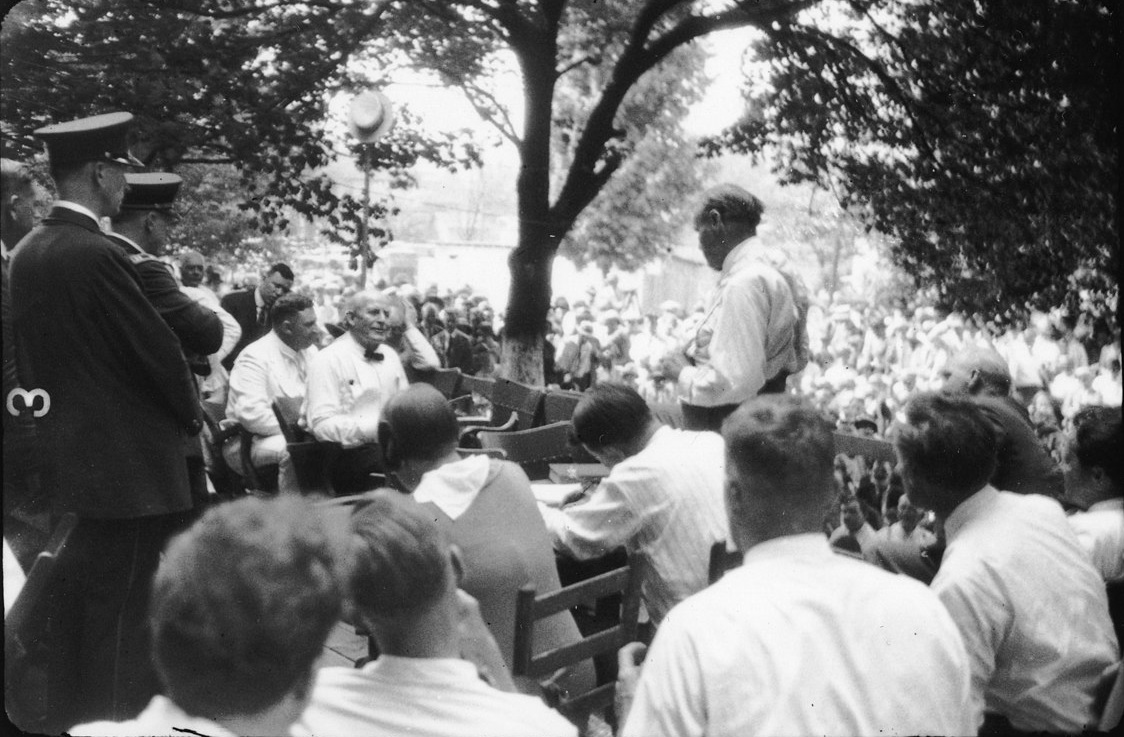
William Jennings Bryan (seated at left) being interrogated by Clarence Darrow, during the trial of the State of Tennessee v. John Thomas Scopes, July 20, 1925. That Monday afternoon, because of the extreme heat, Judge Raulston moved court proceedings outdoors. The session was held on a platform that had been erected at the front of the Rhea County Courthouse to accommodate ministers who wanted to preach during the time of the trial. Defense lawyers for Scopes (John R. Neal, Arthur Garfield Hays, and Dudley Field Malone) are visible seated to the extreme right. One of the men at left, with his back to the photographer, appears to be Scopes. The court reporters are seated at the table.
Photograph by Watson Davis via Wikimedia Commons.

We are again in another contentious period in America where battles over our culture and how we should live together are acrimonious. But there have been many points in our history that indicate we are only re-engaging a form of politics that is quintessentially American. One prominent past episode that occurred in Dayton, Tennessee during the summer of 1925 — the so-called “Scopes Monkey Trial” — has captured the American imagination like few legal proceedings ever have. Noted trial lawyer Clarence Darrow was part of the large legal team representing a 24-year-old substitute high school teacher, John Thomas Scopes, who was accused of violating the state’s Butler Act, which prohibited the teaching of evolution in a state-funded school. The celebrity co-prosecutor was William Jennings Bryan, the three-time Democratic presidential nominee, former Nebraska congressman, and Secretary of State to President Woodrow Wilson. Both Darrow and Bryan were prominent Progressive figures. Bryan, a left-wing evangelical and a fiery orator, is best known for his “Cross of Gold” speech at the 1896 Democratic National Convention.

The trial provided an opportunity for Darrow, whose reputation had been sullied by questionable tactics employed in the defense of radical labor leaders, to vindicate himself before a national audience. Chicago’s WGN radio station broadcast the trial nationwide and hundreds of reporters, some of them from overseas, covered the case. Geoffrey Cowan, author of the exhaustively-researched book The People v. Clarence Darrow, notes that Darrow achieved national notoriety, “won the support of Eastern sophisticates,” and “found new acceptance” as a result of the widely-publicized trial, especially his alleged humiliation of Darrow’s “old hero,” Bryan. This canard, which formed the dramatic crux of the 1960 movie Inherit the Wind, a highly-fictionalized depiction of the trial adapted from the 1955 play written by Jerome Lawrence and Robert E. Lee, is just one aspect of the popular mythology that surrounds the case.

Almost all of the “conventional wisdom” concerning the Scopes trial is false. Contrary to the impression created by Inherit the Wind and other popular accounts (including the sensational reportage of H. L. Mencken of The Baltimore Sun, one of the leading journalists of his day), the trial was not a fundamentalist inquisition, but an ill-conceived publicity stunt by Dayton businessmen who were trying to attract tourists to the small town — to put Dayton on the map. To generate a test case challenging the statute, the American Civil Liberties Union had offered to defend any teacher charged with violating the Butler Act, gratis. Dayton businessmen recruited Scopes to agree to serve as the defendant, even though he was unsure he had actually taught evolution. Nonetheless, Scopes volunteered to be charged. The trial — for a misdemeanor offense — was staged. Celebrity lawyers were solicited to participate for the sole purpose of increasing public interest in the case. The Baltimore Sun paid part of the defense’s expenses because it knew that the spectacle would sell newspapers, and it did. A lot of them.

I think it would be fair to say that H.L. Mencken had a passionate dislike for William Jennings Bryan, even after Bryan’s death a few days later:

It is the national custom to sentimentalize the dead, as it is to sentimentalize men about to be hanged. Perhaps I fall into that weakness here. The Bryan I shall remember is the Bryan of his last weeks on earth — broken, furious, and infinitely pathetic. It was impossible to meet his hatred with hatred to match it. He was winning a battle that would make him forever infamous wherever enlightened men remembered it and him. Even his old enemy, Darrow, was gentle with him at the end. That cross-examination might have been ten times as devastating. It was plain to everyone that the old Berserker Bryan was gone — that all that remained of him was a pair of glaring and horrible eyes.

But what of his life? Did he accomplish any useful thing? Was he, in his day, of any dignity as a man, and of any value to his fellow-men? I doubt it. Bryan, at his best, was simply a magnificent job-seeker. The issues that he bawled about usually meant nothing to him. He was ready to abandon them whenever he could make votes by doing so, and to take up new ones at a moment’s notice. For years he evaded Prohibition as dangerous; then he embraced it as profitable. At the Democratic National Convention last year he was on both sides, and distrusted by both. In his last great battle there was only a baleful and ridiculous malignancy. If he was pathetic, he was also disgusting.

Bryan was a vulgar and common man, a cad undiluted. He was ignorant, bigoted, self-seeking, blatant and dishonest. His career brought him into contact with the first men of his time; he preferred the company of rustic ignoramuses. It was hard to believe, watching him at Dayton, that he had traveled, that he had been received in civilized societies, that he had been a high officer of state. He seemed only a poor clod like those around him, deluded by a childish theology, full of an almost pathological hatred of all learning, all human dignity, all beauty, all fine and noble things. He was a peasant come home to the dung-pile. Imagine a gentleman, and you have imagined everything that he was not.

H/T to “WarEagle82” for the link.

The humble egg – wonder food or deadly poison?

Filed under: Food, Health, Media, Science — Tags: , , , , , — Nicholas @ 03:00

If you’ve paid any attention to popular reporting on nutrition studies over the years, you’ll have noticed how just about any advice on food has not only changed, but has often been completely the opposite of advice offered just a few years earlier. During my teenage years, the egg was pushed (thanks in part to the “Egg Marketing Board”, one of Canada’s supply management bureaucracies) as “the perfect food”. During the next decade, as newer nutrition studies were published, suddenly the wonderful, nutritious egg was now a huge risk to your cardiovascular health and even one egg per week might be enough to kill you. Rinse and repeat for so many other foods and you either stop eating altogether or, more sensibly, stop paying any attention at all to mainstream media interpretations of nutrition studies.

It’s been a tortuous path for the humble egg. For much of our history, it was a staple of the American breakfast — as in, bacon and eggs. Then, starting in the late 1970s and early 1980s, it began to be disparaged as a dangerous source of artery-clogging cholesterol, a probable culprit behind Americans’ exceptionally high rates of heart attack and stroke. Then, in the past few years, the chicken egg was redeemed and once again touted as an excellent source of protein, unique antioxidants like lutein and zeaxanthin, and many vitamins and minerals, including riboflavin and selenium, all in a fairly low-calorie package.

This March, a study published in JAMA put the egg back on the hot seat. It found that the amount of cholesterol in a bit less than two large eggs a day was associated with an increase in a person’s risk of cardiovascular disease and death by 17 percent and 18 percent, respectively. The risks grow with every additional half egg. It was a really large study, too — with nearly 30,000 participants — which suggests it should be fairly reliable.

So which is it? Is the egg good or bad? And, while we are on the subject, when so much of what we are told about diet, health, and weight loss is inconsistent and contradictory, can we believe any of it?

Quite frankly, probably not. Nutrition research tends to be unreliable because nearly all of it is based on observational studies, which are imprecise, have no controls, and don’t follow an experimental method. As nutrition-research critics Edward Archer and Carl Lavie have put it, “‘Nutrition’ is now a degenerating research paradigm in which scientifically illiterate methods, meaningless data, and consensus-driven censorship dominate the empirical landscape.”

Other nutrition research critics, such as John Ioannidis of Stanford University, have been similarly scathing in their commentary. They point out that observational nutrition studies are essentially just surveys: Researchers ask a group of study participants — a cohort — what they eat and how often, then they track the cohort over time to see what, if any, health conditions the study participants develop.

H/T to Marina Fontaine for the link.

July 12, 2019

QotD: Warmongers, propaganda, and the intelligentsia

Filed under: Europe, History, Military, Quotations — Tags: , , , , , , — Nicholas @ 01:00

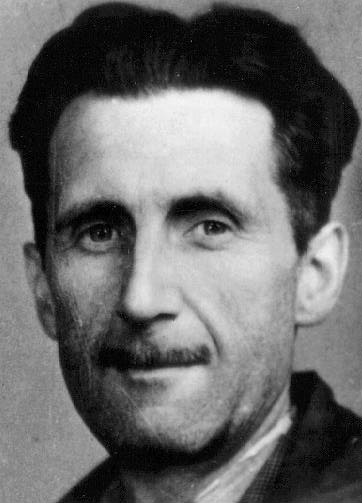
Orwell’s press card portrait, 1943

Our memories are short nowadays, but look back a bit, dig out the files of New Masses or the Daily Worker, and just have a look at the romantic warmongering muck that our left-wingers were spilling at that time. All the stale old phrases! And the unimaginative callousness of it! The sang-froid with which London faced the bombing of Madrid! Here I am not bothering about the counter-propagandists of the Right […]; they go without saying. But here were the very people who for twenty years had hooted and jeered at the “glory” of war, at atrocity stories, at patriotism, even at physical courage, coming out with stuff that with the alteration of a few names would have fitted into the Daily Mail of 1918. If there was one thing that the British intelligentsia were committed to, it was the debunking version of war, the theory that war is all corpses and latrines and never leads to any good result. Well, the same people who in 1933 sniggered pityingly if you said that in certain circumstances you would fight for your country, in 1937 were denouncing you as a Trotsky-Fascist if you suggested that the stories in New Masses about freshly wounded men clamouring to get back into the fighting might be exaggerated. And the Left intelligentsia made their swing-over from “War is hell” to “War is glorious” not only with no sense of incongruity but almost without any intervening stage. Later the bulk of them were to make other transitions equally violent. There must be a quite large number of people, a sort of central core of the intelligentsia, who approved the “King and Country” declaration in 1935, shouted for a “firm line against Germany” in 1937, supported the People’s Convention in 1940, and are demanding a Second Front now.

As far as the mass of the people go, the extraordinary swings of opinion which occur nowadays, the emotions which can be turned on and off like a tap, are the result of newspaper and radio hypnosis. In the intelligentsia I should say they result rather from money and mere physical safety. At a given moment they may be “pro-war” or “anti-war”, but in either case they have no realistic picture of war in their minds. When they enthused over the Spanish war they knew, of course, that people were being killed and that to be killed is unpleasant, but they did feel that for a soldier in the Spanish Republican army the experience of war was somehow not degrading. Somehow the latrines stank less, discipline was less irksome. You have only to glance at the New Statesman to see that they believed that; exactly similar blah is being written about the Red Army at this moment. We have become too civilized to grasp the obvious. For the truth is very simple. To survive you often have to fight, and to fight you have to dirty yourself. War is evil, and it is often the lesser evil. Those who take the sword perish by the sword, and those who don’t take the sword perish by smelly diseases. The fact that such a platitude is worth writing down shows what the years of rentier capitalism have done to us.

George Orwell, “Looking back on the Spanish War”, New Road, 1943 (republished in England, Your England and Other Essays, 1953).

July 10, 2019

Fake news, whacky conspiracy theories, and the arrest of Jeffrey Epstein

Filed under: Law, Media, Politics, USA — Tags: , , , , — Nicholas @ 05:00

In The Week, Matthew Walther uses the Epstein case to illustrate why many so-called “low information voters” tend to believe all sorts of odd things like Pizzagate:

The arrest of the apparent billionaire investor Jeffrey Epstein at a New Jersey airport on Saturday on federal charges for crimes he was accused of during the Bush administration should not be surprising to anyone who has followed the news carefully. He may have escaped in 2008 with a ludicrous one-year stint in a county jail that he was allowed to leave six days a week, but his name has never quite been out of the headlines. Between 2008 and 2015 Epstein reportedly settled more than a dozen lawsuits from Jane Does alleging sexual assault; the youngest of his alleged victims was 14 years old.

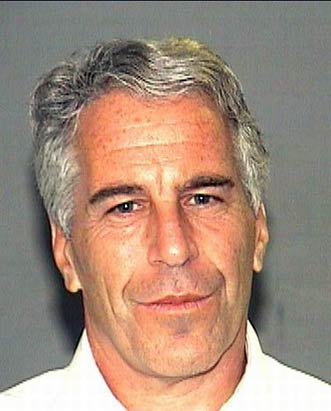
Mug shot of Jeffrey Epstein made available by the Palm Beach County Sheriff’s Department, taken following his indictment for soliciting a prostitute in 2006.
Image via Wikimedia Commons.

The only question is why did it take this long? Why was the ludicrous deal that gave Epstein and his fellow conspirators immunity in exchange for a slap-on-the-wrist jail sentence ever allowed to go through in the first place?

[…]

We should keep all of this in mind the next time we feel inclined to sneer at so-called “low-information voters,” especially the kookier sort. You know the people I mean. Wackos. Gun nuts. 8channers. Conspiracy theorists in Middle America who watch InfoWars (one of the few journalistic outlets to discuss the issue of pedophilia regularly) and post about QAnon and “spirit cooking” and the lizard people. The news that a globalized cabal of billionaires and politicians and journalists and Hollywood bigwigs might be flying around the world raping teenaged girls will not surprise them in the least because it is what they have long suspected. For the rest of us it is like finding out that the Jersey Devil is real or turning on cable news and finding Anderson Cooper and his panel engaged in a matter-of-fact discussion of Elvis’s residence among the Zixls on the 19th moon of Dazotera.

Among other things, the Epstein case forces us to ask ourselves some uncomfortable questions about the real meaning of “fake” news. There is, or should be, more to being informed than fact-checking formalism. If you have spent the last few years earnestly consuming mainstream left-of-center media in this country you will be under the impression that the United States has fallen under the control of a spray-tanned Mussolini clone who is never more than five minutes away from making birth control illegal. If you watch Fox News and read conservative publications, you no doubt bemoan the fact that Ronald Reagan’s heir is being hamstrung by a bunch of avocado toast-eating feminist witches. Meanwhile, Alex Jones’s audience will tell you that America, like the rest of the world, is ruled by a depraved internationalist elite whose ultimate allegiance is not to countries or political parties or ideologies but to one another. These people believe in nothing. They will safeguard their wealth and privilege at any cost. They will never break rank. And they will commit unspeakable crimes with impunity, while anyone who dares to speculate openly is sued or hounded out of public life as a kook.

June 17, 2019

QotD: Betteridge’s Law of Headlines

Filed under: Humour, Media, Quotations — Tags: , , , — Nicholas @ 01:00

This story is a great demonstration of my maxim that any headline which ends in a question mark can be answered by the word “no.” The reason why journalists use that style of headline is that they know the story is probably bullshit, and don’t actually have the sources and facts to back it up, but still want to run it.

Ian Betteridge, TechCrunch: Irresponsible journalism”, Techechnovia.co.uk, 2009-02-23. (Link goes to archived page at the Wayback Machine.)

May 30, 2019

Moving the Overton window, illustrated

Filed under: Media, Politics, USA — Tags: , , — Nicholas @ 05:00

The Wikipedia entry for Overton window reads:

The Overton window is a term for the range of ideas tolerated in public discourse, also known as the window of discourse. The term is named after Joseph P. Overton, who stated that an idea’s political viability depends mainly on whether it falls within this range, rather than on politicians’ individual preferences. According to Overton, the window contains the range of policies that a politician can recommend without appearing too extreme to gain or keep public office in the current climate of public opinion.

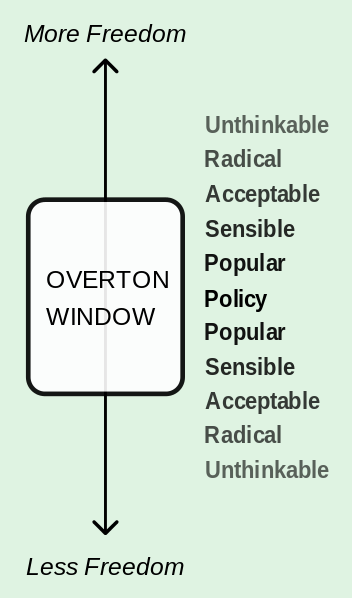
Overton described a spectrum from “more free” to “less free” with regard to government intervention, oriented vertically on an axis, to avoid comparison with the left-right political spectrum. As the spectrum moves or expands, an idea at a given location may become more or less politically acceptable. Political commentator Joshua Treviño postulated that the degrees of acceptance of public ideas are roughly:

  • Unthinkable
  • Radical
  • Acceptable
  • Sensible
  • Popular
  • Policy

The Overton window is an approach to identifying which ideas define the domain of acceptability within a democracy’s possible governmental policies. Proponents of policies outside the window seek to convince or persuade the public in order to move and/or expand the window. Proponents of current policies, or similar ones, within the window seek to convince people that policies outside it should be deemed unacceptable.

There’s also a helpful illustration of the concept:

Diagram of the “Overton Window”, based on a concept promoted by Joseph P. Overton (1960–2003), former director of the Mackinac Center for Public Policy. The term “Overton Window” was coined by colleagues of Joe Overton after his death. In the political theory of the Overton Window, new ideas fall into a range of acceptability to the public, at the edges of which an elected official risks being voted out of office.
Illustration by Hydrargyrum via Wikimedia Commons

To move the Overton window is to shift how the public considers certain ideas, making once unthinkable things merely radical, then acceptable, and so on. Shifting the window is usually something that takes time and media preparation, as a series of tweets from Zach Goldberg handily illustrates:


The full thread can be viewed at this Thread Reader link.

April 24, 2019

The west is being haunted by the spectre of the “far right”

Filed under: Media, Politics — Tags: , , , , , , — Nicholas @ 05:00

Back in my younger days, I attended a seminar — I think it was Marshall Fritz presenting — that discussed the need to “define, or be defined” as a political tool. If you allow your critics or opponents to set the terms of the debate, you’ve already lost. Arthur Chrenkoff knows this well:

It was not Orwell’s original idea that those who control the language control the society and determine its nature. In any case, the left hardly ever needed inspiration from critics on how to achieve their agenda. They are instinctively good at manipulating speech and cultural expression. Watch out, therefore, for the current pattern of marginalising and delegitimising mainstream ideas they are hostile to by associating them with political fringes.

[…] we increasingly live in a world where, if you believe the media, everywhere you turn there’s the “far right”. Mainstream centre-right ideas and concerns are now being redefined as being somehow associated with and tainted by extremism. If you are worried about the violence against and the persecution of Christians you might be far right. If you value the cultural and philosophical heritage of the Western civilisation you might be far right. If you don’t believe in an open borders immigration policy you might be far right. If you prefer local democracy to transnational institutions you might be far right. If you are defending your country from an armed invasion by another country you might be far right too. If these are all to be the indicators of far right extremism, then what exactly is the “normal” right right now?

This effort to use language as a cudgel has several sinister implications. It delegitimises perfectly normal political ideas through guilt by association. It also creates the impression that the (genuine) far right is much bigger, more influential and more threatening and dangerous than it actually is. This in turn is used to downplay and minimise the dangers of Islamist and far-left extremism and terrorism. But perhaps the scariest aspect of it all is that the left, by manufacturing the far right monster, are actually genuinely contributing to the growth of far-right extremism. The relentless flood of identity politics, grievance and victimhood, and shaming and guilting entire sections of population based on their skin colour and culture is genuinely radicalising some misfits into fascism, like the Christchurch terrorist, for example. For every action there is eventually an equal and opposite reaction. The left might think it’s courageously defanging the fascist dragon but instead it’s just sowing its teeth.

March 30, 2019

The EU’s copyright regulation is a stalking horse for online censorship and control

To the amazement of many non-EU observers, the European Parliament passed blatantly authoritarian and corporatist changes to the rules on copyrights that will have potentially vast impact on the internet across the world, not just inside the EU. At City A.M., Kate Andrews explains why this is such bad news for all internet users:

The two most controversial points in the law – Article 11 and Article 13 – are almost certain to stifle digital activity, and interfere with the free way that people currently use online platforms.

Article 11, known as the “link tax”, would make online platforms compensate press publishers for links and article content posted on their sites.

As my colleague Victoria Hewson highlighted in her latest briefing, this approach has been “widely criticised as a distortive measure that seeks to prop up a declining industry”.

As many local and national newspapers decline in readership and revenue, governments have become increasingly protectionist in their attempts to “rebalance” the sector, by cracking down on online platforms.

The link tax has little merit, even if rebalancing is the goal. News outlets which require payment for readership already have logins and paywalls to protect their content from free access.

[…]

Article 13 will also be distortive to the market, as it makes online platforms increasingly liable for copyright infringement.

As Hewson’s briefing notes, major online platforms already have routine screening processes for content that violates copyright law or their own rules. But the new regulations “remove the protection for platforms previously available if they removed violating content promptly on receiving notice of it, and contravene fundamental rights such as free expression and freedom from monitoring”.

The Directive claims that safeguards – including pastiche, parody, and quotations – will be protected, and that meme content has been excluded.

But the algorithms which these platforms will have to implement to adhere to Article 13 are going to struggle to see the difference between infringement and fair use when comparing uploads to content that is registered as copyrighted.

March 26, 2019

Matt Taibbi on “a death-blow for the reputation of the American news media”

Filed under: Law, Media, Politics, USA — Tags: , , , — Nicholas @ 03:00

A revised and updated chapter from his Hate, Inc.:

Note to readers: in light of news that Special Prosecutor Robert Mueller’s investigation is complete, I’m releasing this chapter of Hate Inc. early, with a few new details added up top.

[…]

Over the weekend, the Times tried to soften the emotional blow for the millions of Americans trained in these years to place hopes for the overturn of the Trump presidency in Mueller. As with most press coverage, there was little pretense that the Mueller probe was supposed to be a neutral fact-finding mission, as apposed to religious allegory, with Mueller cast as the hero sent to slay the monster.

The Special Prosecutor literally became a religious figure during the last few years, with votive candles sold in his image and Saturday Night Live cast members singing “All I Want for Christmas is You” to him featuring the rhymey line: “Mueller please come through, because the only option is a coup.”

The Times story today tried to preserve Santa Mueller’s reputation, noting Trump’s Attorney General William Barr’s reaction was an “endorsement” of the fineness of Mueller’s work:

    In an apparent endorsement of an investigation that Mr. Trump has relentlessly attacked as a “witch hunt,” Mr. Barr said Justice Department officials never had to intervene to keep Mr. Mueller from taking an inappropriate or unwarranted step.

Mueller, in other words, never stepped out of the bounds of his job description. But could the same be said for the news media?

For those anxious to keep the dream alive, the Times published its usual graphic of Trump-Russia “contacts,” inviting readers to keep making connections. But in a separate piece by Peter Baker, the paper noted the Mueller news had dire consequences for the press:

    It will be a reckoning for President Trump, to be sure, but also for Robert S. Mueller III, the special counsel, for Congress, for Democrats, for Republicans, for the news media and, yes, for the system as a whole…

This is a damning page one admission by the Times. Despite the connect-the-dots graphic in its other story, and despite the astonishing, emotion-laden editorial the paper also ran suggesting “We don’t need to read the Mueller report” because we know Trump is guilty, Baker at least began the work of preparing Times readers for a hard question: “Have journalists connected too many dots that do not really add up?”

The paper was signaling it understood there would now be questions about whether or not news outlets like itself made galactic errors by betting heavily on a new, politicized approach, trying to be true to “history’s judgment” on top of the hard-enough job of just being true. Worse, in a brutal irony everyone should have seen coming, the press has now handed Trump the mother of campaign issues heading into 2020.

Nothing Trump is accused of from now on by the press will be believed by huge chunks of the population, a group that (perhaps thanks to this story) is now larger than his original base. As Baker notes, a full 50.3% of respondents in a poll conducted this month said they agree with Trump the Mueller probe is a “witch hunt.”

March 24, 2019

Trust in scientific findings decreasing among the general public

Filed under: Education, Environment, Health, Media, Science — Tags: , , — Nicholas @ 03:00

In Scientific American, Louise Lief discusses the problem of rising public distrust of science:

We live in a moment when preventable infectious diseases like measles are spreading because parents distrust vaccines, and scientists at government agencies are being told not to use terms like “evidence-based.” The president dismisses the findings of a National Climate Assessment by more than 300 scientists and 13 federal agencies that warns of massive economic and environmental damage totaling hundreds of billions of dollars, crop failures, disrupted supply chains and multiple threats to human health, saying, “I don’t believe it.”

But when I argued in favor of the proposition (Resolved: “Science writers are responsible for building public trust in science”) during a debate at the National Association of Science Writers’ 2018 annual conference last fall, the majority of science writers and science journalists present voted that building public trust in science was not the responsibility of science writers.

[…]

Kathleen Hall Jamieson, director of the Annenberg Public Policy Center at the University of Pennsylvania’s Annenberg School for Communication also tackled the science trust question at the NASW conference, and researchers at Cardiff University have traced credibility and accuracy problems to press releases from scientists’ own academic institutions.

If a problem is discovered or a study is retracted, said Jamieson, the scientist or scientific journal needs to explain to journalists and the public how the error was discovered, what the problem is, and what steps are being taken to ensure it doesn’t happen again.

Scientists often make it hard for journalists to cover these three interrelated issues, she says. Scholarly journal publication protocols may cause scientists to write one article on the problem they’re investigating, and a second or third article on processes and solutions, resulting in coverage that emphasizes problems and shortchanges corrective action.

For their part, researchers at Cardiff University found that press releases from scientists’ own academic institutions about their work were a significant source of exaggerated claims and spin, even though most scientists can approve their wording.

Their study of press releases from 20 leading British universities on health-related science news found that when the press releases exaggerated, it was likely the news stories would too.

An analysis of 41 news articles on randomized controlled trials based on 70 press releases showed only four articles that contained exaggerated claims not included in the press release or journal abstract. Interestingly, they also found the hype and spin intended to tempt the media did not result in more news coverage.

H/T to Blazing Cat Fur for the link.

February 28, 2019

ProTip – Never, ever, ever read the comments

Filed under: Liberty, Media, Politics, Technology — Tags: , , — Nicholas @ 05:00

Scott Alexander explains why he had to ask the moderators to shut down the r/slatestarcodex subreddit’s Culture War thread:

This post is called “RIP Culture War Thread”, so you may have already guessed things went south. What happened? The short version is: a bunch of people harassed and threatened me for my role in hosting it, I had a nervous breakdown, and I asked the moderators to get rid of it.

I’ll get to the long version eventually, but first I want to stress that this isn’t just my story. It’s the story of everyone who’s tried to host a space for political discussion on the Internet. Take the New York Times, in particular their article Why No Comments? It’s A Matter Of Resources. Translated from corporate-speak, it basically says that unmoderated comment sections had too many “trolls”, so they decided to switch to moderated comment sections only, but they don’t have enough resources to moderate any controversial articles, so commenting on controversial articles is banned.

And it’s not just the New York Times. In the past five years, CNN, NPR, The Atlantic, Vice, Bloomberg, Motherboard, and almost every other major news source has closed their comments – usually accompanied by weird corporate-speak about how “because we really value conversations, we are closing our comment section forever effective immediately”. People have written articles like The Comments Apocalypse, A Brief History Of The End Of The Comments, and Is The Era Of Reader Comments On News Websites Fading? This raises a lot of questions.

Like: I was able to find half a dozen great people to do a great job moderating the Culture War Thread 100% for free without even trying. How come some of the richest and most important news sources in the world can’t find or afford a moderator?

Or: can’t they just hide the comments behind a content warning saying “These comments are unmoderated, read at your own risk, click to expand”?

This confused me until I had my own experience with the Culture War thread.

The fact is, it’s very easy to moderate comment sections. It’s very easy to remove spam, bots, racial slurs, low-effort trolls, and abuse. I do it single-handedly on this blog’s 2000+ weekly comments. r/slatestarcodex’s volunteer team of six moderators did it every day on the CW Thread, and you can scroll through week after week of multiple-thousand-post culture war thread and see how thorough a job they did.

But once you remove all those things, you’re left with people honestly and civilly arguing for their opinions. And that’s the scariest thing of all.

Some people think society should tolerate pedophilia, are obsessed with this, and can rattle off a laundry list of studies that they say justify their opinion. Some people think police officers are enforcers of oppression and this makes them valid targets for violence. Some people think immigrants are destroying the cultural cohesion necessary for a free and prosperous country. Some people think transwomen are a tool of the patriarchy trying to appropriate female spaces. Some people think Charles Murray and The Bell Curve were right about everything. Some people think Islam represents an existential threat to the West. Some people think women are biologically less likely to be good at or interested in technology. Some people think men are biologically more violent and dangerous to children. Some people just really worry a lot about the Freemasons.

Each of these views has adherents who are, no offense, smarter than you are. Each of these views has, at times, won over entire cultures so completely that disagreeing with them then was as unthinkable as agreeing with them is today. I disagree with most of them but don’t want to be too harsh on any of them. Reasoning correctly about these things is excruciatingly hard, trusting consensus opinion would have led you horrifyingly wrong throughout most of the past, and other options, if they exist, are obscure and full of pitfalls. I tend to go with philosophers from Voltaire to Mill to Popper who say the only solution is to let everybody have their say and then try to figure it out in the marketplace of ideas.

But none of those luminaries had to deal with online comment sections.

The thing about an online comment section is that the guy who really likes pedophilia is going to start posting on every thread about sexual minorities “I’m glad those sexual minorities have their rights! Now it’s time to start arguing for pedophile rights!” followed by a ten thousand word manifesto. This person won’t use any racial slurs, won’t be a bot, and can probably reach the same standards of politeness and reasonable-soundingness as anyone else. Any fair moderation policy won’t provide the moderator with any excuse to delete him. But it will be very embarrassing for to New York Times to have anybody who visits their website see pro-pedophilia manifestos a bunch of the time.

“So they should deal with it! That’s the bargain they made when deciding to host the national conversation!”

No, you don’t understand. It’s not just the predictable and natural reputational consequences of having some embarrassing material in a branded space. It’s enemy action.

Every Twitter influencer who wants to profit off of outrage culture is going to be posting 24-7 about how the New York Times endorses pedophilia. Breitbart or some other group that doesn’t like the Times for some reason will publish article after article on New York Times‘ secret pro-pedophile agenda. Allowing any aspect of your brand to come anywhere near something unpopular and taboo is like a giant Christmas present for people who hate you, people who hate everybody and will take whatever targets of opportunity present themselves, and a thousand self-appointed moral crusaders and protectors of the public virtue. It doesn’t matter if taboo material makes up 1% of your comment section; it will inevitably make up 100% of what people hear about your comment section and then of what people think is in your comment section. Finally, it will make up 100% of what people associate with you and your brand. The Chinese Robber Fallacy is a harsh master; all you need is a tiny number of cringeworthy comments, and your political enemies, power-hungry opportunists, and 4channers just in it for the lulz can convince everyone that your entire brand is about being pro-pedophile, catering to the pedophilia demographic, and providing a platform for pedophile supporters. And if you ban the pedophiles, they’ll do the same thing for the next-most-offensive opinion in your comments, and then the next-most-offensive, until you’ve censored everything except “Our benevolent leadership really is doing a great job today, aren’t they?” and the comment section becomes a mockery of its original goal.

I’ll allow one exception to the rule I provided in the headline: the comments at David Thompson’s blog are always worth reading, but I have to assume that David or countless unpaid minions must work very hard indeed to maintain the quality of comments that get posted. I’ve never actively encouraged commenting here at Quotulatiousness, and I don’t spend a lot of time on the various social media sites as I have a low tolerance for the kinds of “conversation” you tend to find there.


January 2, 2019

In non-breaking, non-news … politicians lie

Filed under: Britain, Government, Media, Politics — Tags: , , , , — Nicholas @ 05:00

Hector Dummond explains why what might seem like a shocking revelation from a former Thatcher MP isn’t even getting a raised eyebrow from the British media:

In a highly revealing article former MP Matthew Parris admits that the Conservative Party would often lie so that it could do what it wanted. And when it didn’t lie it fudged and avoided issues in order to prevent the ‘people’ having any say in the country’s governance:

    our challenge was to find ways of ducking the issue. Once I became an MP, I did so by voting for the principle and against the practice. This subversion of democracy (in Theresa May’s phrase) caused me embarrassment, but not a second’s guilt. Sod democracy: hanging was wrong …

    Among ourselves we talked cheerfully about subterfuge. The Britain of 1979 and 1983 most emphatically did not vote for a massive confrontation with the coal miners. We made sure the electorate was never asked.

These candid admissions have been completely ignored by the media. One reason they’ve been ignored is, of course, that most people have come to work this out for themselves, so Parris isn’t telling us anything we don’t already know. But surely hearing it from the horse’s mouth has great value? Why hasn’t the media splashed on this? Why haven’t Parris’s old enemies in the Labour party made hay with it?

The main reason is that most of the media, and virtually all the Labour party, is on his side over this. Even newspapers like the Guardian. You might think the Guardian would be the natural enemy of a former Tory MP, especially one who worked with Thatcher, and certainly on some issues they will regard Parris as an enemy, but the fact is that the Guardian wants government to be free of restraint by the people, because its vision of the state involves a leftist government getting into power, imposing its own ideology onto society and removing the power for the people to have a democratic say from most areas of life. So it can hardly criticise Parris for having done what it longs to do. It doesn’t want to bring about anything that might lessen the freedom government currently has to ignore the voter.

« Newer PostsOlder Posts »

Powered by WordPress