Quotulatiousness

August 10, 2011

China’s second-hand aircraft carrier puts to sea for initial trials

Filed under: China, Military, Pacific — Tags: , — Nicholas @ 08:45

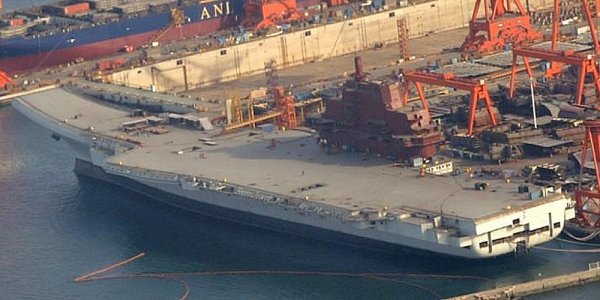
The Shi Lang, formerly the Varyag, is undergoing a set of sea trials:

China’s first aircraft carrier began sea trials on Wednesday, the state-run Xinhua news service reported, a highly symbolic step in what is certain to be a years-long effort to create a carrier presence in the Pacific waters off its coast.

The carrier, once known as the Varyag, left Dalian, its northeast China port for what analysts said would be a test of its rudder, propulsion system and other basics. Xinhua’s two-sentence report stated only that the carrier would make a short voyage before returning to Dalian for further tests.

The Chinese Defense Ministry said last month that the carrier would be used largely for scientific research and training. Foreign military analysts say it could be a decade or more before the Chinese can deploy and operate a true fleet of carriers, the most costly and complex weapons systems in any nation’s arsenal.

August 9, 2011

(Temporarily) Drying out USS Monitor

Filed under: History, Technology, USA — Tags: , , — Nicholas @ 13:07

John Tierney reports on the conservation efforts on one of the most revolutionary warships in history:

[In 1861] a shipyard in Greenpoint, Brooklyn, launched not merely an ironclad but an entirely new kind of warship. The U.S.S. Monitor had no masts and no line of cannons. It was essentially a submarine beneath a revolving gun turret, something so tiny and bizarre-looking that many experts doubted the “cheese box on a raft” would float, much less fight.

But somehow it survived both the Navy bureaucracy and a broadside barrage to become one of the most celebrated ships in the world. Its designer and crew were the 19th-century celebrity equivalent of astronauts. Long after the ship sank in a storm off Cape Hatteras, N.C., the turret remained a cultural icon: an “armored tower” in Melville’s poetry, an image on book covers and film posters, a shape reproduced in items from toys to refrigerators.

Now the original turret, which was recovered from the ocean floor nine years ago and placed in a freshwater tank to protect it from corrosion, is on display again. It has been temporarily exposed to the air so that it can be scraped clean — very carefully, in front of museum visitors and a live webcam — by a team of researchers at the U.S.S. Monitor Center of the Mariners’ Museum here in Newport News. The team expects to have nearly all the barnacles and sediment removed by the end of this month, giving the public a new look at the dents from the Confederate cannonballs and shells that would have sunk any ordinary ship of its day. Then the turret will be submerged again in fresh water for 15 more years, until enough ocean salt has been removed from the metal to allow it to face the air permanently.

July 28, 2011

F-22 fleet still grounded due to pilot oxygen supply problems

Filed under: Military, Technology, USA — Tags: , , , , — Nicholas @ 12:08

Earlier this month, I linked to an article about the F-22 oxygen problems. According to Strategy Page, the problem still has not been resolved:

The U.S. Air Force is making some progress in finding out what is wrong with their F-22s. It appears that some toxins are somehow getting into the pilot’s air supply. This has kept all 168 F-22s grounded for three months, so far. Despite the new findings, the air force still has not nailed down the exact cause of the problem, much less fixed it. The U.S. Navy had a similar problem with its F-18s (there were 64 incidents between 2002-9, resulting in two dead pilots). The navy found that the problem was carbon monoxide getting sucked into the aircraft air system (which the navy modified, eliminating the problem). The air force is looking into the navy experience with these similar problems, to see if there is anything similar going on with the F-22s.

First F-35C catapult launch

Filed under: Military, Technology, USA — Tags: , , , — Nicholas @ 09:18

Lewis Page has more:

The test launch took place on the landbased steam catapult at US Naval Air Station Lakehurst (also the location of a prototype electromagnetic one of the type the Royal Navy will be compelled to use).

The F-35C is intended to operate from the catapult-equipped fleet carriers of the US Navy and will equip the Royal Navy and the RAF too. The jumpjet F-35B (formerly the chosen British model) will now be delivered only to the US Marines to begin with. The F-35A version, intended for ordinary landbased runway operations, will serve with the US Air Force and many allied nations.

July 27, 2011

Okay, everyone relax: China says aircraft carrier to be used for “research and training”

Filed under: China, Military, Pacific — Tags: , — Nicholas @ 07:44

That’s the latest story from China, which has finally acknowledged that they are rebuilding the former Soviet aircraft carrier Shi Lang:

China has officially acknowledged that it is rebuilding an aircraft carrier it bought more than a decade ago, but says the refurbished ship will be used only for research and training.

A defence ministry spokesman, Geng Yansheng, told reporters on Wednesday that work was under way on refitting an old carrier, a reference to the Varyag, whose stripped-down hull was towed from Ukraine in 1998 and has been under reconstruction for the best part of a decade.

“Building an aircraft carrier is extremely complex and at present we are using a scrapped aircraft carrier platform to carry out refurbishment for the purposes of technological research, experiments and training,” Geng said.

US Navy’s (small) death ray/machine gun mounts

Filed under: Military, Technology, USA, Weapons — Tags: , — Nicholas @ 07:36

Lewis Page reports on the latest bit of weaponry being added to US Navy ships:

US Navy warships will soon be equipped with fearful combination weapons mounts boasting both heavy machine-guns and high powered laser rayguns, it has been announced.

Manufacturer Boeing says it has inked a teaming agreement with the US operations of arms globo-mammoth BAE Systems to build the Mk 38 Mod 2 Tactical Laser System to naval requirements. We learn that the new raygun installation will be based on the existing Mk 38 Machine Gun System, a robotic gun turret whose primary punch is provided by the fearsome M242 Bushmaster Chain Gun, effectively a light auto-cannon.

[. . .]

We aren’t told the power level offered by the laser, which suggests that it isn’t very high: raygun projects always like to boast of any decent power level. The fact that the laser is small enough to be clipped onto an existing weapon also suggests light weight and limited puissance, as does the suggestion that it is an alternative to the Bushmaster rather than a replacement for it.

July 4, 2011

More on the British MoD shake-up

Filed under: Britain, Bureaucracy, Military — Tags: , , — Nicholas @ 10:26

Lewis Page has more on the British government’s major re-organization of the Ministry of Defence:

In outline, the three single services — and their chiefs — will lose massively in power and influence: and there will be an attempt to create a Joint Forces Command which will be the first step towards a future in which the services actually expect to work together as routine, rather than only when forced to or when there’s a war on.

The Levene report says that the First Sea Lord, the Chief of the General Staff and the Chief of the Air Staff — heads of the navy, army and air force respectively — should be booted out of MoD Main Building on Whitehall and made to go and sit in their service headquarters outside London. They will be allowed to leave behind only a small number of staff types to fight their Service’s corner in the corridors of power, and these rump contingents will be headed by mere two-star officers: a rear-admiral, a major-general and an air vice-marshal. If they commanded combat formations, such officers would be important indeed — the entire British Army can put into the field only one or two formations worthy of being commanded by a major-general — but among the mandarins of Whitehall, many of whom are equivalent to three-, four- and even five-star military officers, they will be insignificant small fry.

[. . .]

Or in other words, the Service heads may retain their headquarters, maps etc but in fact they will almost never be in charge of what their people are doing: another blow to their prestige, and another boost for that of the Joint Force Command.

If all this happens, it will be a fairly seismic shift at the MoD: the Joint way of doing business might actually gain ascendance, as any smart officer would have his sights set on an interesting career at PJHQ and the Joint command in Whitehall, actually involved with operations and action, rather than boring routine work in his Service HQ out of town sorting out training and recruitment and leave rosters etc.

It’s probably a good thing, as anyone who knows the MoD would admit that foolish interservice squabbling is one of the main factors paralysing it. That said, any such knowledgeable person would enter the caveat that Joint could be a disaster if it turned out merely to mean one Service achieving dominance over the other two (which would be the most disastrous varies with the commentator).

Britain’s overdue defence reforms

Filed under: Britain, Bureaucracy, Military — Tags: , , — Nicholas @ 09:30

Britain has, proportional to American forces, four times the number of general officers. This is a visible sign of an unbalanced force. The current government has announced some changes that may begin to correct this problem:

George Osborne, the chancellor of the exchequer, reportedly observed that the defence budget was “the most chaotic, the most disorganised, the most overcommitted.” In addition to the 8% cut in its funding (over four years) demanded as part of the government’s fiscal-austerity plan, the Ministry of Defence (MoD) has somehow to close an unfunded liability of £38 billion ($61 billion) up to 2020. This week, just before announcing a major shake-up of the way his department and the armed forces are run, Dr Fox said: “The future defence programme was worse than a delusion — it was a deliberate lie.”

The problem with correcting long-term issues like those in the MoD is that you have to maintain the active forces at a minimum level of effectiveness while addressing issues that may have been developing for a generation. I’ve mentioned in earlier posts how the most effective arm of the British forces in the last ten years has clearly been the Royal Air Force — not so much for their performance of their military duties, but for the skill with which they outmatched the army and the Royal Navy in bureaucratic infighting. The RN has been gutted, losing their force projection capabilities (the aircraft carriers), the army has been left over-extended and lacking airlift capabilities, while the RAF has kept their core anti-Soviet flying white elephants almost completely untouched by budget cuts.

At the heart of Lord Levene’s plan is a new slimmed-down Defence Board, the MoD’s senior decision-making body, which will be chaired by the secretary of state and will no longer include the three service chiefs. There will be a fresh emphasis on integrating the armed forces through the establishment of a Joint Forces Command led by a four-star officer. That will bring together capabilities such as logistics, planning, intelligence, cyber and some equipment purchases. Dr Fox sees the Joint Forces Command as both an important organisation in its own right and a symbol of the ethos of co-operation and flexibility he wants to cultivate.

One consequence is that the role of the three service chiefs in influencing departmental strategy and resource allocations will be sharply reduced. They will be kept busy by being given greater responsibility for managing their own budgets. Lord Levene also wants to see a halt to the merry-go-round of staff changes that undermines accountability by insisting that senior military and civilian staff should stay in their posts for at least four years.

June 17, 2011

Argentina: British PM “stupid” about the Falkland Islands

Filed under: Americas, Britain, Military — Tags: , , , , — Nicholas @ 09:39

Remember when the Royal Navy got gutted, reducing their ability to project force outside European waters? It appears that Argentina has drawn the obvious conclusion that the Falkland Islands are now back in play:

The Argentinian president has criticised David Cameron for insisting the Falkland Islands should remain a British territory.

Cristina Kirchner described the prime minister as “arrogant” and said his comments were an “expression of mediocrity and almost of stupidity”.

Cameron had been prompted by Conservative MP Andrew Rosindell during prime minister’s questions to remind Barack Obama that the British government would not accept any kind of negotiations over the south Atlantic islands, over which Argentina and Britain fought a 10-week war in 1982.

Cameron told the Commons: “I would say this: as long as the Falkland Islands want to be sovereign British territory, they should remain sovereign British territory — full stop, end of story.”

In her criticism of his comments, Kirchner said Britain “continues to be a crude colonial power in decline”.

Well, Mr. Cameron, you’ve given Argentina a ten-year window of opportunity here between your (in my opinion stupid) scrapping your last carriers and getting rid of their Harrier aircraft and the time that your next carrier comes into service. By the time you have HMS Queen Elizabeth in commission and with a full complement of aircraft, the Falkland Islands will likely be under Argentinian control.

If the government of Ronald Reagan had to be pushed into supporting Britain in 1982, there’s absolutely no chance that Barack Obama will lift a finger to help Britain in 2012 — in fact, it’s much more likely that Obama will decide that Argentina is more deserving of American help anyway.

June 10, 2011

Royal Navy still regrets decision to retire their aircraft carriers

Filed under: Africa, Britain — Tags: , , — Nicholas @ 12:56

With a significant portion of the Royal Navy deployed in the Mediterranean, the hasty decision to take HMS Ark Royal out of service looks even dumber now:

Just at the very moment that the decisions of the October 2010 “Strategic Defence Review” start to bite, the Royal Navy is being asked by government to do more than ever. With the crisis in Libya and the Middle East showing no signs of ending, RN warships are spread thin across the globe. A quick snapshot of the fleet shows the pace of operations. With such a tiny fleet, our naval ports are almost empty and there are few vessels able to provide reliefs should the Libya crisis continue or escalate.

RN ships involved in Operation Ellamy off Libya include HMS Ocean, HMS Albion, HMS Sutherland, HMS Liverpool, HMS Brocklesby and HMS Bangor and HMS Triumph. The RFA is playing an increasing role with RFA Fort Rosalie, RFA Wave Knight supporting them. RFA Argus, RFA Fort Victoria and RFA Cardigan Bay are ready off Yemen should UK citizens need to be evacuated. RN patrols in the Arabian Gulf continue (as they have since 1980) with HMS St Albans sailing this week to relieve HMS Iron Duke in addition to the 4 permanently deployed RN minehunters in the Gulf. HMS Richmond is involved in exercises in the Far East and HMS Edinburgh has sailed to relieve HMS York in the South Atlantic along with HMS Scott. RFA Wave Knight is in the Caribbean ready to provide relief in case of hurricanes.

That fleet is spread very thin indeed. If something else happens, the Royal Navy probably can’t provide any significant forces to address it: there aren’t any more ships to send.

June 9, 2011

Is the Shi Lang a naval “Potemkin Village”?

Filed under: China, Military, Russia — Tags: , , , , — Nicholas @ 17:30

David Axe is not losing any sleep over the soon-to-be commissioned Chinese carrier Shi Lang:

Leaving aside her modest size compared to American carriers, her incomplete air wing and escort force and the fact that she’ll sail without the company of allied flattops, Shi Lang could be even less of a threat than her striking appearance implies. Shi Lang’s greatest potential weakness could be under her skin, in her Ukrainian-supplied engines.

Powerplants — that is, jet engines for airplanes, turbines for ships — are some of the most complex, expensive and potentially troublesome components of any weapon system. Just ask the designers of the Pentagon’s F-35 stealth fighter and the U.S. Navy’s San Antonio-class amphibious ships. Both have been nearly sidelined by engine woes.

China has struggled for years to design and build adequate powerplants for its ships and aircraft. Although Chinese aerospace firms are increasingly adept at manufacturing airframes, they still have not mastered motors. That’s why the new WZ-10 attack helicopter was delayed nearly a decade, and why there appear to be two different prototypes for the J-20 stealth fighter. One flies with reliable Russian-made AL-31F engines; the other apparently uses a less trustworthy Chinese design, the WS-10A.

For Shi Lang, China reportedly purchased turbines from Ukraine. Though surely superior to any ship engines China could have produced on its own, the Ukrainian models might still be unreliable by Western standards. Russia’s Kuznetsov, also fitted with Ukrainian turbines, has long suffered propulsion problems that have forced her to spend most of her 30-year career tied to a pier for maintenance. When she does sail, a large tugboat usually tags along, just in case the carrier breaks down.

If Shi Lang is anything like her sister, she could turn out to be a naval version of the mythical “Potemkin village” — an impressive facade over a rickety interior.

H/T to Nicholas “Ghost of a Flea” Packwood for the link.

June 8, 2011

China admits it’s hard to hide 1000ft-long aircraft carrier

Filed under: China, Military, Pacific — Tags: , , — Nicholas @ 07:44

China has finally gotten around to acknowledging that they’re rebuilding the former Soviet aircraft carrier for use by their navy:

Gen Chen Bingde refused to say when the carrier — a remodelled Soviet-era vessel, the Varyag — would be ready.

A member of his staff said the carrier would pose no threat to other nations.

The 300m (990ft) carrier, which is being built in the north-east port of Dalian, has been one of China’s worst-kept secrets, analysts say.

Gen Chen made his comments to the Chinese-language Hong Kong Commercial Daily newspaper.

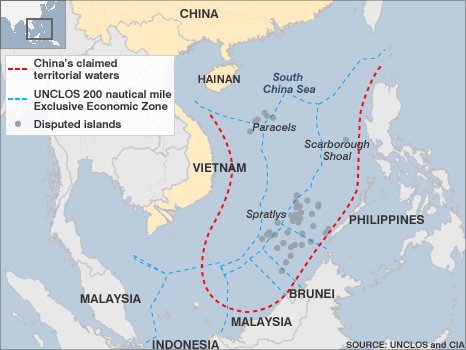
Although the Chinese say that the ship, once ready for operations, won’t enter other countries’ territorial waters, keep in mind that China doesn’t have the same idea about maritime rights as others in the South China Sea region:

Earlier posts about the Shi Lang (nee Varyag) here.

June 3, 2011

China’s first aircraft carrier edges closer to readiness

Filed under: China, Military, Russia, Weapons — Tags: , , , — Nicholas @ 10:25

The Chinese navy is a bit closer to having an operational aircraft carrier, as the Shi Lang (formerly Varyag in Russian service) is being equipped with radar and weapons:

In the last month, the new Chinese aircraft carrier, the Shi Lang (formerly Varyag) has had several major electronic systems, and its first weapons, installed. The most notable electronic item to show up are the four AESA radar panels. This is a state-of-the-art radar similar to the one used in the American Aegis system. There were a lot of other electronic items being carried into the Shi Lang, indicating that the ship will be equipped with extensive networked computers and communications systems.

The two main weapons were also installed. One was a new version of the older, Type 730 seven barrel, 30mm close-in anti-missile automatic cannon. Operating like the American Phalanx, the new version of the Type 730 seen on the Shi Lang had ten barrels. The other weapon was the FL-3000N anti-missile systems. These are similar to the American RAM anti-missile missile system, except that they come in a 24 missile launcher and are less accurate. FL-3000N was only introduced three years ago, and uses smaller missiles than RAM. The two meter long FL-3000N missiles have a max range of nine kilometers (about half that for very fast incoming missiles). The 120mm, two meter long missiles now use a similar guidance system to RAM, but are not as agile in flight.

[. . .]

The Shi Lang/Varyag is one of the Kuznetsov class carriers that Russia began building in the 1980s. Originally the Kuznetsovs were to be 90,000 ton, nuclear powered ships, similar to American carriers (complete with steam catapults). Instead, because of the high cost, and the complexity of modern (American style) carriers, the Russians were forced to scale back their plans, and ended up with 65,000 ton (full load) ships that lacked steam catapults, and used a ski jump type flight deck instead. Nuclear power was dropped, but the Kuznetsov class was still a formidable design. The 323 meter (thousand foot) long ship normally carries a dozen navalized Su-27s (called Su-33s), 14 Ka-27PL anti-submarine helicopters, two electronic warfare helicopters and two search and rescue helicopters. But the ship was meant to regularly carry 36 Su-33s and sixteen helicopters. The ship carries 2,500 tons of aviation fuel, allowing it to generate 500-1,000 aircraft and helicopter sorties. Crew size is 2,500 (or 3,000 with a full aircraft load.) Only two ships of this class exist; the original Kuznetsov, which is in Russian service, and the Varyag. Like most modern carriers, the only weapons carried are anti-missile systems like Phalanx and FL-3000N, plus some heavy machine-guns (which are often kept inside the ship, and mounted outside only when needed.) However, Russian practice was been to sometimes install long range anti-ship missiles as well. China may also do this with Shi Lang.

June 2, 2011

When shipyards produce pork instead of effective ships for the Navy

Filed under: Military, Politics, USA — Tags: , , , , — Nicholas @ 12:07

Shipbuilding for the navy has traditionally been a good source of pork for politicians to dole out as their political fortunes require. The US Navy is having monumental problems with the quality of ships, but the problem isn’t easy to fix:

The U.S. Navy continues to have serious problems with shoddy shipbuilders. The latest incident involved a support ship, the 12,000 ton, 172 meter (534 foot) long radar ship, the Howard O. Lorenzen. The ship recently failed its acceptance tests. The Lorenzen was built to carry a special, billion dollar, radar used to track ICBM tests. This tracking activity also supports verification of missile and nuclear weapons treaty compliance. The Lorenzen replaces a similar ship that is over 30 years old. The acceptance tests found serious problems with the steering, electrical system, damage control, anchor control, and aviation (helicopter) facilities. The yard that built the Lorenzen, VT Halter Marine, builds military and civilian ships, and has had problems with some of the other military ships it has built recently. Like the Lorenzen, the other ships were late, over budget and suffered quality control problems.

[. . .]

While the admirals are correct in blaming the shipyards for many of the problems, the navy shares a lot of the blame as well. It is, after all, the navy that draws up the contracts, and supplies inspectors during construction. However, inspectors are regularly deceived and lied to (about the quality of work and supervision and known defects being fixed). While Congressional interference can be blamed as well, in the end, it’s the navy that has the most to say, and do, about how the ships are built. The problem is, admirals who stand up and take on the contractors and politicians put their careers on the line. The ship builder deploys a large number of lobbyists and has many key politicians as allies.

[. . .]

The problems with nuclear subs and carriers were minor compared to the LPD 17 travails. Still, the sheer extent of the problems, across so many ships, is very disturbing. This may be why a growing number of admirals are willing to take career risks, and try for some fundamental reform, and finally fix the “system” that turns out more problems than warships. Victory is not assured. The shipyards and their suppliers have powerful allies in Congress. All that money translates into votes that gets incumbent politicians reelected. Congress is not inclined to attack this kind of patronage and pork, since nearly all members of Congress depend on it. The admirals can openly complain, but offended legislators can quietly cripple the careers of those critics. The smart money is betting against the good guys here. So far, the smart money is right. But the bad builder mess is so vast, expensive and messy that even many politicians are calling for some fundamental changes.

The poster children for defective ships is the San Antonio LPD 17 class of amphibious ships.

May 30, 2011

Formal review for Canadian defence policies?

Filed under: Cancon, Military — Tags: , , , , — Nicholas @ 08:46

David Pugliese has word that the “fully funded” Canada First Defence Strategy is going to be reviewed starting in late June:

Some are calling this a “Canada First Reset.” This review would look at what by how much this strategy is underfunded and how should DND proceed in the future on CFDS, according to sources. It was described to Defence Watch as a “step-back to look at the strategy” and an examination of what aspects of the plan — mainly within procurement — need to be dropped (something like….maybe JUSTAS) because of the lack of money.

My reaction? It’s all very interesting to say the least. That’s because the basis of this review team goes against what has been a DND/CF mantra for three years now: that is the Canada First Defence Strategy is fully funded.

Numerous generals and DND bureaucrats are on record stating that in no uncertain terms. No question about it. Period, full stop.

You may remember that a few defence analysts suggested the strategy was not proper funded and that the many projects outlined in the document wouldn’t see the light of day.

But those claims were dismissed outright.

Will a CFDS review committee even get off the ground considering that it has the potential to embarrass the government?

If the minister had been replaced, this might make some political sense: it’s a good opportunity to get in some significant change and the previous minister gets the “blame” for the change being necessary. Peter MacKay stayed on at the ministry, so that’s not the answer. It’s possible that the government, now in safe majority territory, can bear the burden of critically reviewing the CFDS without feeling the risk of triggering an election.

The CFDS was originally drawn up as a plan to address impending retirement of much of the Canadian Forces’ major equipment:

Over the next 20 years, six of the CF’s core equipment fleets will reach the end of their operational lives and will need to be replaced. These include destroyers, frigates, maritime patrol aircraft, fixed-wing search and rescue aircraft, next-generation fighter aircraft, and a new family of land combat vehicles and systems.

The question about whether the CFDS is fully funded, therefore, is key to addressing the real equipment replacement schedule. If the money isn’t there, something has to give.

« Newer PostsOlder Posts »

Powered by WordPress