Quotulatiousness

October 13, 2012

HMS Conqueror and “Operation Barmaid”

Filed under: Britain, History, Military — Tags: , , , , — Nicholas @ 00:01

In spite of the name, it had nothing to do with a crew booze-up in town:

HMS Conqueror is famous, some would say notorious, for sinking the Argentinian cruiser General Belgrano. The nuclear-powered attack submarine, a type also known menacingly as a hunter-killer, that year became the first of her kind to fire in anger. The Belgrano was sent to bottom in short order, her ancient hull rent by two torpedoes: 323 men, many of them young conscripts, died. The Falklands war began in earnest that day, May 2 1982.

But the ship now in the crosswires was not the Belgrano. This was August, almost two months after the liberation of the Falklands, and on the other side of the world, in the Barents Sea, backyard of the mighty Soviet Northern Fleet. Conqueror was sailing as close to Russian territorial waters as was legally allowed — or maybe closer. Submariners, a tight-knit community, politely disdainful of their surface counterparts, joke that there are two types of naval vessel: submarines and targets. Wreford-Brown’s target was a spy trawler — an AGI in Nato parlance, meaning Auxiliary General Intelligence. Crammed with interception and detection equipment, they were a ubiquitous presence during the Cold War, shadowing Nato exercises or loitering off naval bases.

This one was special: Polish-flagged, she was pulling a device long coveted by the British and Americans, a two-mile string of hydrophones known as a towed-array sonar. It was the latest thing in Soviet submarine-detection technology and Conqueror’s job was to steal it. To do so, the bow was equipped with electronically controlled pincers, provided by the Americans, to gnaw through the three-inch-thick steel cable connecting it to the trawler. The name of this audacious exercise in piracy? Operation Barmaid.

October 7, 2012

Flagship of Argentinian Navy seized for unpaid government debt in Ghana

Filed under: Africa, Americas, Government, Military — Tags: , , , , , — Nicholas @ 09:38

If I were you, I’d avoid investing in any Argentinian business (or businesses which have significant operations in Argentina), as the government is doing everything it can to prevent the flight of capital. Some of the debt holders are getting quite creative about finding ways to put pressure on Argentina to pay its debts:

If pirating didn’t work out, Capt. Jack Sparrow would perhaps have made a savvy hedge fund manager.

A New York hedge fund boss is being dubbed a real pirate of the Caribbean after seizing the flagship of the Argentinian navy in an attempt to settle some of the country’s huge debt.

Billionaire Paul Singer took control of the tall ship the A.R.A. Libertad with a court order in Ghana this week.

The triple-mast frigate, which stopped in the African country as it trained naval cadets, is valued at $10 million and is the ceremonial flagship of the Argentine fleet.


Photo by Martín Otero, 7 April, 2007

October 2, 2012

Warship spending then and now

Filed under: History, Military, Technology — Tags: — Nicholas @ 08:39

An article at Strategy Page looks at the much-higher cost of modern weapons systems and compares a few modern items to their historical predecessors. An eye-opening example is the comparison of a battleship to a modern US Navy destroyer:

A new U.S. destroyer design, the DDG-1000, displaces 14,000 tons, is 193.5 meters (600 feet) long and 25.5 meters (79 feet) wide. A crew of 150 sailors operates a variety of weapons, including two 155mm guns, two 40mm automatic cannon for close in defense, 80 Vertical Launch Tubes (containing either anti-ship, cruise or anti-aircraft missiles), six torpedo tubes, a helicopter and three helicopter UAVs. The DDG-1000 was to cost $2 billion each, but it has been cut back to just three ships, which drives the cost up to $6 billion each.

A century ago, a Mississippi class battleship displaced 14,400 tons, was 123.2 meters (382 feet) long and 24.8 meters (77 feet) wide. Adjusted for inflation, it cost $150 million. A crew of 800 operated a variety of weapons, including four 12 inch (300mm), eight 8 inch (200mm), eight 7 inch (177mm), twelve 3 inch (76mm), twelve 47mm and four 37mm guns, plus four 7.62mm machine-guns. There were also four torpedo tubes. The Mississippi had a top speed of 31 kilometers an hour, versus 54 for DDG-1000. But the Mississippi had one thing DDG-1000 lacked, armor. Along the side there was a belt of 226mm (9 inch) armor and the main turrets had 300mm (12 inch) thick armor. The Mississippi had radio, but the DDG-1000 has radio, GPS, sonar, radar and electronic warfare equipment.

Each of the three DDG-1000’s being built cost 40 times more than the two Mississippi class battleships. Is the DDG-1000 40 times more effective? The DDG-1000 would make quick work of the Mississippi, spotting the slower battleship by radar or helicopter, and dispatching her with a few missiles. The Mississippi’s 12 inch guns had a maximum range of 18 kilometers, versus 130 kilometers for the Harpoon anti-ship missile. There has always been some debate if modern anti-ship missiles could really take down a battleship, what with all that armor and plenty of sailors for damage control work. The USS Mississippi ended its career in the Greek navy, and was sunk by German aircraft in 1941. Many battleships have been sunk, usually by bombs and torpedoes delivered by aircraft.

Although the last two American World War II era battleships were only sold off six years ago, battleship advocates keep coming with ways to revive these massive (45,000 ton) armored ships. The boldest proposals had most of the World War II era mechanical equipment and replaced with gas turbine engines and modern generators and electronics. This would reduce crew size from 2,700 to 600. But what really killed the battleship was the smart bomb, especially the GPS guided ones. The 16 inch battleship guns could not match this accuracy, unless a GPS guided shell were developed (a major cost). What really killed the battleship was massive innovation.

The DDG-1000 is still “pre” whatever the next dominant type of warship will be. But it’s ironic that a hundred years later, the descendent of the 14,000 ton Mississippi is a 14,000 ton surface ship that has more firepower, a longer reach and the ability to see targets hundreds of kilometers away, and is called a destroyer. And what kind of destroyers escorted the Mississippi? They were ships of under a thousand tons displacement, with crews of about a hundred sailors. Armed with a few 3 inch guns and some torpedoes, no one at the time expected them to evolve into a 14,000 ton warship.
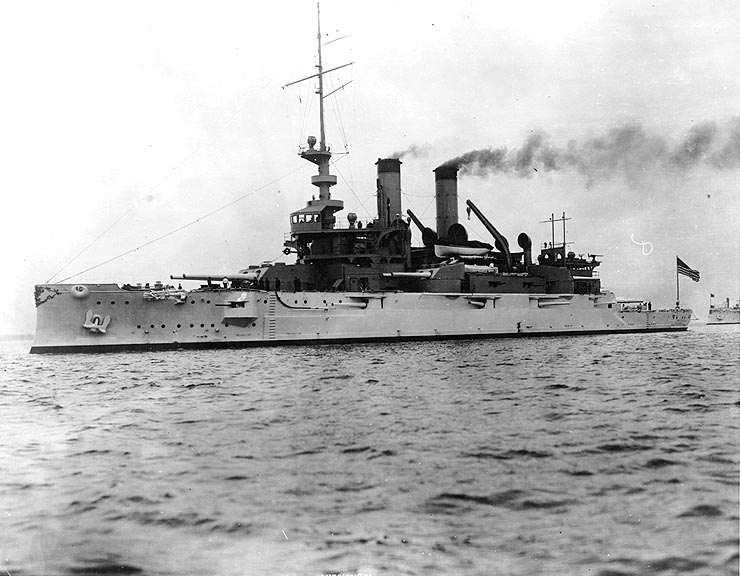

USS Mississippi (BB-23), from the Wikipedia entry
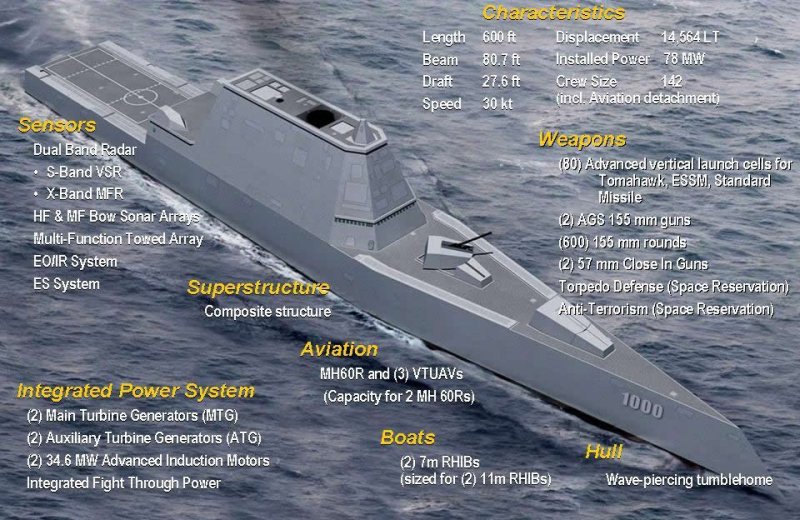

Artist’s conception of the DDG-1000 class lead ship USS Zumwalt. Full-size image at Defence Industry Daily.

September 26, 2012

Unthinking support of “the troops”

Filed under: Media, Military, Politics — Tags: , , , , — Nicholas @ 10:22

If you’ve read the blog for a while, you’ll know that I’m far from anti-military. I was in the Canadian militia (the army reserve) during my teenage years, and still have friends who are serving in the armed forces of Canada, Britain, and the US. Since 2001, Canadians in particular have re-evaluated their views of the military and are now much more likely to demonstrate their support for the army, the Royal Canadian Navy, and the Royal Canadian Air Force. Even so, Canadians are much more low-key in their demonstrations of respect and approval than Americans are.

Some of the more outspoken supporters actually give me the creeps … rather than showing their support for the soldiers, sailors, and airmen, they seem to be showing their support for militarism. That sort of thing enables and encourages military adventurism, armed intervention in other countries, and the militarization of civilian life (look at the military-style gear many police departments now operate, including drones for border surveillance and drug war operations). That’s a line I never want to see Canada cross.

At the Future of Freedom Foundation blog, Jacob Hornberger expresses some of the same concern:

One of the most fascinating phenomena of our time is the extreme reverence that the American people have been taught to have for the military. Wherever you go — airports, sports events, church — there is a god-like worship of the military.

“Let us all stand and express our sincerest thanks to our troops for the wonderful service they perform for our country,” declare the sports broadcasters.

“Let us pray for the troops, especially those in harm’s way,” church ministers exhort their parishioners.

“Let us give a big hand to our troops who are traveling with us today,” exclaim airline officials.

Every time I see this reverence for the military being expressed, I wonder if people ever give any thought to what exactly the troops are doing. No one seems to ask that question. It just doesn’t seem to matter. The assumption is that whatever the troops are doing, they are protecting our “rights and freedoms.” As one sports broadcaster I recently heard put it, “We wouldn’t be here playing this game if it weren’t for the troops.”

There is at least one big problem with this phenomenon, however: The troops are engaged in actions that are harmful to the American people, including most of the people who have a reverential attitude toward them.

September 25, 2012

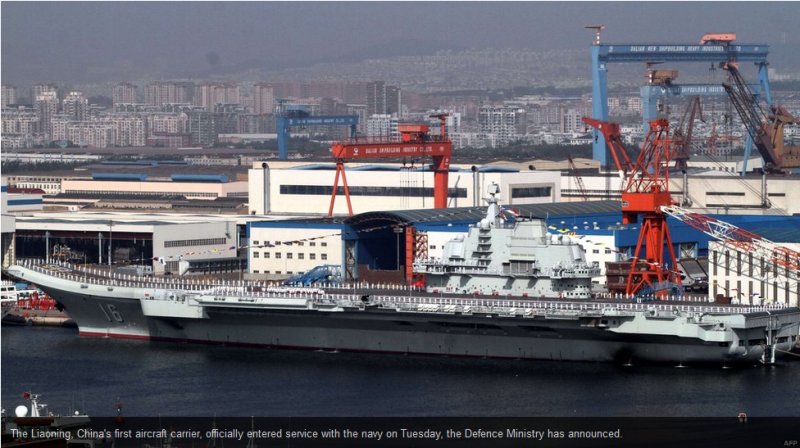
Chinese Navy commissions first aircraft carrier, the Liaoning

Filed under: China, Military — Tags: , , — Nicholas @ 09:13

China’s first aircraft carrier has been commissioned under the name Liaoning (not Shi Lang as most earlier reports had stated). Chinese news agency Xinhua posted this report earlier today:

China’s first aircraft carrier was delivered and commissioned to the People’s Liberation Army (PLA) Navy Tuesday after years of refitting and sea trials.

Overseen by President Hu Jintao and Premier Wen Jiabao, the carrier was officially handed over by the navy’s main contractor, the China Shipbuilding Industry Corporation, at a ceremony held at a naval base in northeast China’s port city of Dalian.

President Hu, also chairman of the Central Military Commission (CMC), endorsed a PLA flag and naming certificate to Senior Captain Zhang Zheng, commanding officer of China’s first carrier, the Liaoning.

“Today will be forever remembered as China’s Navy has entered an era of aircraft carrier,” Zhang told Xinhua on the carrier’s flight deck.

“When I received the PLA flag from the President, a strong sense of duty and commitment welled up in my heart,” said Zhang who has served as commanding officer on the Navy’s frigate and destroyer.

The carrier, rebuilt from the Soviet ship Varyag, was renamed “Liaoning” and underwent years of refitting efforts to install engines, weapons, as well as a year-long sea trial.

BBC News has a series of photos of the Liaoning from purchase to commissioning:


Click to see full-size images at the BBC website

Earlier reports on the progress of the carrier (under the name Shi Lang) can be found here.

Mine operations in the Straits of Hormuz

Filed under: Middle East, Military — Tags: , , — Nicholas @ 08:18

Strategy Page runs down the history of naval mines and explains why Iran is most likely to try using mines to close down the critical Straits of Hormuz to tanker traffic if a new Gulf War begins:

The U.S. and over 30 other nations recently held a joint mine clearing exercise called the International Mine Countermeasures Exercise 2012 (September 16-27). The numerous training events were directed at dealing with Iranian attempts to block the entrance (Straits of Hormuz) to the Persian Gulf. Iran insists it will have no trouble doing this and blocking the export of oil. Some 35 percent of the world’s oil shipments pass through these straits, which comes to about 15-20 tankers a day (plus a dozen or more non-tankers). The Persian Gulf, in general, is a busy waterway. It is 989 kilometers long, and the average depth is 50 meters (maximum depth is 90 meters). Naval mines are Iran’s best bet if they want to shut down the straits.

[. . .]

The Iranian military is in worse shape today than it was 25 years ago, and would not last long trying to attack ships. That leaves the Straits of Hormuz. This is actually a wide (about 30 kilometers) deep channel. Normally, shipping sticks to narrow (a few kilometers wide) channels, going in and out, to avoid collisions. The main Iranian threat has always been seen as naval mines. The Arab states have lots of mine clearing equipment, and more numerous air and naval forces than Iran. In addition, there are the United States and NATO forces in the area. The problem was that all these mines clearing forces had never practiced under realistic (wartime) conditions. In short, what would everyone do if Iran did mine the straits.

Iran would probably mine the straits if sanctions, or military action, halted all Iranian oil exports. Otherwise, mining the straits would be economic suicide. If Iran tried to shut down the Straits of Hormuz, it’s more likely that effort would fail and the straits would remain open for non-Iranian oil. With the loss of their oil exports, Iran would find its remaining military forces being hunted down and destroyed day after day. Not only would Iranian oil exports be halted, but so would imports. Iran depends on imports of food (over 100,000 tons a week) and gasoline to keep its economy operating.

For an Iranian mining attempt to work they would have to get the mines onto the bottom of the straits and then prevent the rest of the world from clearing those mines. That would be difficult, as will Iranian attempts to plant additional mines. Such attempts would not be impossible as Iran has small submarines and speed boats along with sailors willing to carry out suicidal missions to deliver the mines. Even that may not be sufficient as this sort of fanaticism failed against the Americans in the 1980s. While Iran has worked to overcome their shortcomings, most of the solutions appear to be publicity stunts mainly meant to make the Iranian population feel better.

September 24, 2012

US Navy works with Chinese Navy ship for anti-piracy exercise

Filed under: Africa, China, Military, USA — Tags: , , , — Nicholas @ 09:07

This is an unusual arrangement, but it makes sense in the larger picture:

The U.S. Navy and the Chinese Navy conducted their first joint anti-piracy drill. A Chinese frigate (the 4,000 ton Type 54A Yiyang) and an American destroyer (the 8,200 ton Burke class Churchill) carried out several training operations over five hours. This included joint use of communications as well as boarding and onboard search procedures. This was done in the Gulf of Aden, off Somalia.

While there was some PR angle to this, the crews of the two ships did get a useful look at how the other side operates. More to the point, it was a useful drill in the event that Chinese and American warships found themselves dealing with the same bunch of Somali pirates. Both sides will distribute what was learned throughout their respective fleets.

All this is part of a trend. China is becoming more inclined to work with ships from other nations patrolling the pirate infested waters off Somalia. Earlier this year, for example, China, India, and Japan agreed to have their warships off the Somali coast coordinate operations to more efficiently protect civilian ships in the area. Chinese and Indian warships have been operating independently off Somalia, while Japanese ships have been operating with Task Force 151. Most warships on anti-piracy duty belong to TF 151. Most of the remainder work with EUNFS (European Union Naval Force Somalia). But some nations continue to operate independently, more or less. In these cases there is always some communication, coordination, and sharing of information with TF 151 and EUNFS.

September 17, 2012

The real defence debate (that isn’t happening in the election campaign)

Filed under: Government, Military, USA — Tags: , , , , — Nicholas @ 14:00

Scott Rasmussen outlines the stark contrast between how ordinary Americans feel about their country’s defence establishment and how the politicians they elect fail to reflect those feelings:

As a starting point, Americans are proud of their country and hold its armed forces in high regard. Seventy-nine percent would rather live here than anywhere else, and at a time of deep cynicism about large institutions 81 percent have a favorable opinion of the U.S. military.

Yet this respect and admiration for the troops co-exists with doubts about the jobs they’ve been asked to do. Most voters now believe it was a mistake for the U.S. to have gotten involved in Iraq, and most now want to see troops brought home quickly from Afghanistan. Support for the military action in Libya peaked at 20 percent.

Americans are also in a mood to dramatically reduce our security guarantees for other nations. Less than half (49 percent) believe the U.S. should remain in its bedrock military alliance, NATO. Out of 54 countries with which Washington has signed mutual-defense treaty obligations, plus two others (Israel and Mexico) that receive our implicit backing, a majority of Americans supports defending just 12. Countries that don’t reach the 50 percent threshold include our oldest ally, France, along with Japan, Poland, and Denmark. The only four countries that 60 percent of Americans are willing to defend are Canada, the United Kingdom, Australia, and Israel.

These findings highlight the central 21st-century gap between the citizenry and its political class. Three out of four Americans believe U.S. troops should never be deployed for military action overseas unless vital national security interests are at stake. Yet the last several presidents have adopted far less restrictive criteria for sending troops abroad. The military is often dispatched for humanitarian purposes or in the belief that the U.S. should police the world, but only 11 percent of voters believe Uncle Sam should play global cop.

September 16, 2012

Reporting on “battleships”, “tanks”, and other military matters

Filed under: Media, Military — Tags: , , , , — Nicholas @ 09:17

Strategy Page on the regularly displayed woeful ignorance of military technology in media reporting:

On September 6th at the U.S. Democratic Party convention a tribute to military veterans featured a retired admiral giving a speech while behind him was projected an impressive image of four warships coming towards the audience. What most people viewing this scene did not realize was that the ships on that screen were Russian, not American. Such an error should not have been a surprise.

This sort of facile military reporting and media presentation of the military has become increasingly common. It goes beyond calling all warships (except carriers and subs) “battleships” (a class of ship that went out of wide use half a century ago) or calling self-propelled artillery (or even infantry fighting vehicles) “tanks” simply because they all have turrets (but very different uses). The bad reporting extends to many other basic items of equipment, training, leadership, tactics and casualties.

It all started back in the 1970s, when conscription in the United States ended and the many World War II veterans in journalism, public affairs and advertising (all of whom help out at major political events) began to retire. The end of conscription meant new journalists were much less likely to have any knowledge of military affairs. It became increasingly easy to make stupid, and embarrassing, mistakes.

September 9, 2012

Midway: the turning point of the Pacific War

Filed under: Books, History, Japan, Military, Pacific, USA, WW2 — Tags: , , , , — Nicholas @ 09:33

An interesting sketch of the importance of the 1942 Battle of Midway in the Spectator from Richard Freeman:

For many of us the Battle of Midway is just one more Hollywood spectacular in, to paraphrase Neville Chamberlain, a far-away sea of which we know little. But having recently taken a closer look at the battle I am struck both by what was at stake and what the consequences of the American victory were for the Allies at the time and geopolitics since then.

[. . .]

Because the Americans were the victors at Midway, it is easy to forget how near they came to losing the battle. On the day of the main action they attacked the Japanese carriers from dawn until 10.20 am without inflicting any serious damage. Then, between 10.20 am and 10.25 am, the American planes caught three of the Japanese carriers without adequate fighter protection. All three were completely disabled in just five minutes in what has been called ‘the miracle of Midway’.

[. . .]

Now suppose — and it almost happened — that the Japanese carriers, with their vastly superior fighter planes, had caught the American carriers off guard. The loss of those carriers and the destruction of the Midway airbase would have compelled America to give a much higher priority to the Pacific. A direct consequence of that would have been a slower build-up of American power in, first North Africa, and then Europe.

Shortly after the North African landings, there was the other great turning point of the war: Germany’s surrender at Stalingrad. From then on one of the great questions of the war was where the Russians would meet the Allies. Had America suffered a massive defeat at Midway, the Allies advance in Europe would have been slower. (As it was, D-day strained the Allies to the limit. Even a small reduction in ships, tanks, planes or men would have forced its delay.) In these circumstances it is not inconceivable that the Soviet Union would have taken the whole of Germany

I just finished reading one of the few accounts of the battle from the Japanese perspective, Midway: The Battle That Doomed Japan by Mitsuo Fuchida and Masatake Okumiya. Because I couldn’t remember Fuchida’s co-author’s name, I Google searched on the title of the book, only to find the top item after Fuchida’s Wikipedia entry was this:

The Western accounts of the Japanese side of the battle have heretofore been built around three primary sources: The after-action log of Admiral Nagumo (“The Nagumo Report”); the interviews with Japanese naval officers conducted after the war by the United States Strategic Bombing Survey (“USSBS”); and Mitsuo Fuchida’s book, Midway: The Battle That Doomed Japan, which was published in the United States in 1955. These three sources, augmented by fragmentary survivor accounts, have formed the backbone of the Japanese account for all Western histories up to this point.

Unfortunately, one of these sources — Fuchida’s Midway — is irretrievably flawed. Fuchida’s misstatements, which have lain undetected in the West until very recently, have had manifold negative effects on the veracity of the standard English-language battle accounts. His were not minor errors of omission that can be brushed off or explained away — they were fundamental and willful distortions of the truth that must be corrected. Intriguingly, Fuchida’s account was overturned and discredited in Japan more than twenty-five years ago. Yet in the West, he has remained as important as the day his book was first published.

September 7, 2012

The debut of energy weapons in the real military world

Filed under: Military, Technology, USA, Weapons — Tags: , , — Nicholas @ 00:03

The Economist looks at the long-anticipated introduction of energy weapons. They’re still a long way from matching the fictional capabilities of phasers, blasters, disruptors, or photon torpedoes:

In the late 1970s and early 1980s the idea was revived when American strategists began thinking in earnest about the technologies they would need to shoot down nuclear-armed ballistic missiles. Among the more fanciful ideas taken up by Ronald Reagan’s Strategic Defence Initiative (more commonly known as Star Wars) was the X-ray laser, which aimed to harness the energy of an atomic explosion to generate powerful laser beams. The hassle of having to explode a nuclear bomb every time a beam was needed meant the idea never went anywhere, though it did spur research into high-powered chemical lasers and the sophisticated optics needed to aim and control them.

The main appeal of using an energy beam to shoot things is that it travels at the speed of light, which means, in practice, that it will hit whatever it is aimed at. Trying to shoot down an incoming missile or warhead with a physical projectile, by contrast, is much more difficult. The guidance challenges of trying to “hit a bullet with a bullet” are enormous and are only gradually being solved using complex radars and missiles equipped with expensive sensors. A second attraction of lasers and other energy weapons is that in most cases they cannot run out of ammunition, and can keep firing for as long as they are plugged into a power source. The initial costs may be quite high, but each shot may then cost only a few dollars, compared with a price-tag of $3m or more for the latest missiles used to shoot down aircraft or other missiles.

[. . .]

The big trend now is to try to scale up three other sorts of laser that are far more compact than chemical lasers and can fire away merrily as long as they have power and don’t get too hot. The first sort is the fibre laser, in which the beam is generated within an optical fibre. Because this is already used in industry for welding and cutting, prices are falling, power output is increasing and reliability has been steadily improving. Industrial lasers can be turned into weapons pretty easily, simply by strapping them to a weapons mount.

But they are not very powerful. The Tactical Laser System being developed for the American navy by BAE Systems, a British firm, has an output of just 10kW, enough to run a few household kettles. Even so, it might be useful for frightening off (or burning holes in) small boats that look threatening but wouldn’t warrant a hail of machinegun fire. A slightly bigger version puts out about 33kW of power and fits neatly on existing turrets that house the rotary cannons used to shoot down incoming anti-ship missiles. It could blind optical or heat-seeking sensors on enemy missiles, or puncture small boats.

September 3, 2012

Military-political jockeying in the East China Sea

Filed under: China, Japan, Military — Tags: , , , , — Nicholas @ 10:26

At sp!ked, James Woudhuysen has a long essay on the many tiny islands in the East China Sea (and South China Sea) that may feature in future shooting wars:

Outside East Asia, very few people know where the Senkaku islands are. But inside East Asia, the Senkaku prompt great bitterness between Japan, China and Taiwan. At stake is the national pride of each country, which believes that it alone owns them. At stake also are each country’s hopes that it might find oil or gas nearby, and its desire to sail round them unimpeded. But there is more. The Senkaku, and islands like them, signify how, among all the continents in the world, Asia’s past century has been the most enduringly explosive — and how its next could follow the same pattern.

Two hundred nautical miles (nm) west of the Japanese prefecture of Okinawa, 200 nm east of the province of Fujian in the People’s Republic of China, and just 120 nm north-east of Taiwan, there lies an archipelago of five uninhabited islands, covering just seven square kilometres and covered in jungle. Coming from Tokyo, a team of 25 city officials, surveyors and — inevitably — estate agents circled the islands just this weekend, hoping to reinforce Japan’s control over them. In the past, similar moves by both Japan and China have prompted fury, and not a little diplomatic concern elsewhere.

In mid-August, a group of Chinese sailed to the islands in order to uphold Beijing’s claim to them, only to meet with deportation at the hands of Japan. A little later, 150 Japanese nationalists came by in a flotilla and 10 of them swam ashore to raise the Japanese flag. Then, in the latest of a series of tit-for-tat episodes stretching back years, demonstrators in several Chinese cities insisted that Japan get out of the islands. All that’s missing now is that, on top of Tokyo’s rule over what it calls Senkaku and Beijing’s claim over what it calls Diaoyu, is a Taiwanese incursion over what they call the Diaoyutai.

What’s going on? Could all this lead to some kind of fearsome war between Japan, China and Taiwan? And why are there disputes not only in the East China Sea, but also in the South China Sea? There, south-east of Hainan Island (China) and east of Vietnam, China controls the Paracel Islands and resists the complaints of Taiwan and Vietnam about them. There, too, all three parties occupy and are in contention over the myriad Spratly islands, which, lying west of the Philippines and north of Malaysia and Brunei, are also partly controlled and certainly contested by these three nations.

August 24, 2012

Ukraine rejoins the submarine team

Filed under: Europe, Military — Tags: , , , — Nicholas @ 09:18

The only submarine in Ukraine’s navy is seaworthy again:

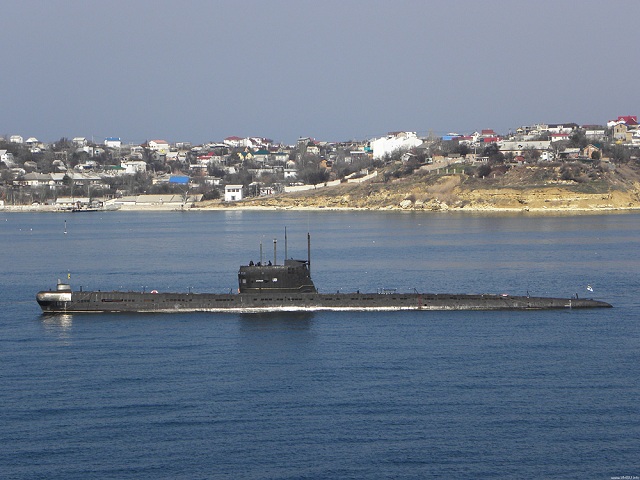
The Ukrainian Navy got its only submarine (the Zaporozhye) back into service. The 40 year old Foxtrot class boat has been out of action for 18 years and was recently refurbished. Zaporozhye is the only sub in the Ukrainian Navy, which mainly consists of small, Cold War era frigates (one) and corvettes (seven). There are also two amphibious ships and six minesweepers. The Foxtrot class diesel-electric subs were designed in the late 1950s and 58 were built until production ended in 1983. These are 1,900 ton boats with ten torpedo tubes and a crew of 78. Russia retired all of its Foxtrots by 2000, but they were all obsolete by the early 1980s. The Zaporozhye is the last Foxtrot still in service.

The Black Sea has not been kind to submarines. Three years ago the Russian Black Sea Fleet suffered a major blow when its only operational submarine, a 19 year old Kilo class boat, broke down at sea and limped back to port on partial power. The only other sub in the fleet, a 32 year old Tango class boat, was undergoing repairs (and still is, but will soon be scrapped.) During the Cold War, the Black Sea Fleet had thirty or more submarines.


Image from Navy Recognition.

Wikipedia says:

Zaporizhzhia (U-01) (Ukrainian: Запоріжжя) is a project 641 (“Foxtrot” class) submarine, the only submarine of the Ukrainian Navy at the moment. She formerly carried the Soviet Navy pennant number B435.

Zaporizhzhia is run by a naval crew of 78, commanded by 1st Rank Capt. Oleh Orlov.

August 21, 2012

Royal Navy faces shortage of trained submariners

Filed under: Britain, Military, Technology, Weapons — Tags: , , , — Nicholas @ 08:56

Thomas Harding in the Telegraph:

Internal documents warn that a lack of recruits for the Submarine Service may leave attack submarines and boats carrying the Trident nuclear missile stranded in port.

A separate threat comes from a predicted 15 per cent shortfall in engineers by 2015.

One in seven posts for weapons officers at the rank of lieutenant will also be vacant, raising operational questions over the boats equipped with nuclear and cruise missiles.

Many submariners are being poached by the civilian nuclear sector and those who remain are being forced to go to sea for longer and more frequently.

Adml Lord West, the former First Sea Lord, said the situation was “very worrying” and he hoped the Navy had mechanisms in place to make up for the shortfall.

[. . .]

The Navy has a fleet of six attack submarines and four Vanguard boats that carry the Trident nuclear missile, but the personnel issues could mean they cannot be deployed.

The report found that the recruiting and retention of submariners was also threatening operations. “Inability to recruit, retain and develop sufficient nuclear and submarine design qualified personnel will result in an inability to support the Defence Nuclear Programme,” the document said.

August 20, 2012

Royal Navy announces design of new “Type 26 Global Combat Ship”

Filed under: Britain, Military, Technology — Tags: , , — Nicholas @ 08:46

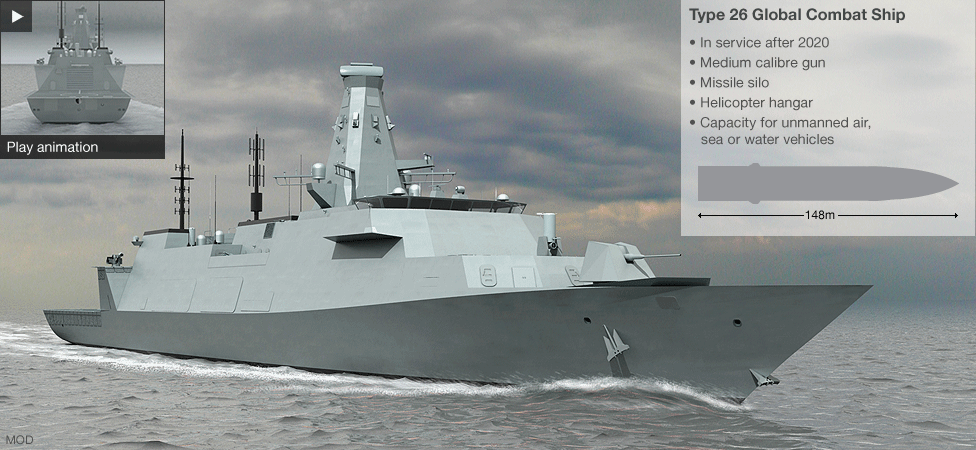
Britain’s Royal Navy revealed the design of the Type 26 today:

The announcement on the Type 26 Global Combat Ship has been described by officials as a “significant milestone” in a programme which will support “thousands of UK shipbuilding jobs”.

Basic specification images show sleek stealth features, familiar to modern warships, making them harder to detect.

The ship will be 148 metres long with a displacement of 5,400 tonnes.

The MoD has been working with BAE Systems since 2010 to determine the basic design for the ship. Detailed specifications of the vessel will now be examined.

Vertical missile silos for a range of weapons, such as cruise missiles, will be housed on board along with a medium calibre gun.

The hangar on board will house a Merlin or Wildcat helicopter and there will be extra space for unmanned drones, underwater vehicles or other specialist equipment.

[. . .]

The current plan is to build 13 of the ships, which are due to start coming into service after 2020.

The Type 26 will replace the 13 Type 23 frigates but the MoD is not giving a precise commitment on numbers until they know the unit cost.

The First Sea Lord, Admiral Sir Mark Stanhope, says the ship will be used “across the full spectrum of warfare”.

He added: “The T26 GCS will be a multi-mission warship designed for joint and multinational operations… including complex combat operations, maritime security operations such as counter piracy, as well as humanitarian and disaster relief work around the world.”

« Newer PostsOlder Posts »

Powered by WordPress