
World War Two
Published 23 Aug 2025Indy and Sparty dig into the Battle of Moscow. Was this the Soviet defence of the city the turning point of WW2? What if the Germans had taken Moscow in December 1941? How did the Holocaust transition from bullets to gas?
(more…)
August 24, 2025
June 4, 2024
Assassination-to-order, or war by other means
I was not well-informed about the goings-on within Vladimir Putin’s Russia even before the Russo-Ukrainian war went into high gear and disrupted all information from that part of the world and I hear much but trust nothing I’ve been hearing since then. kulak, on the other hand, seems to have paid much closer attention to Russian internal affairs, including one particular political assassination:
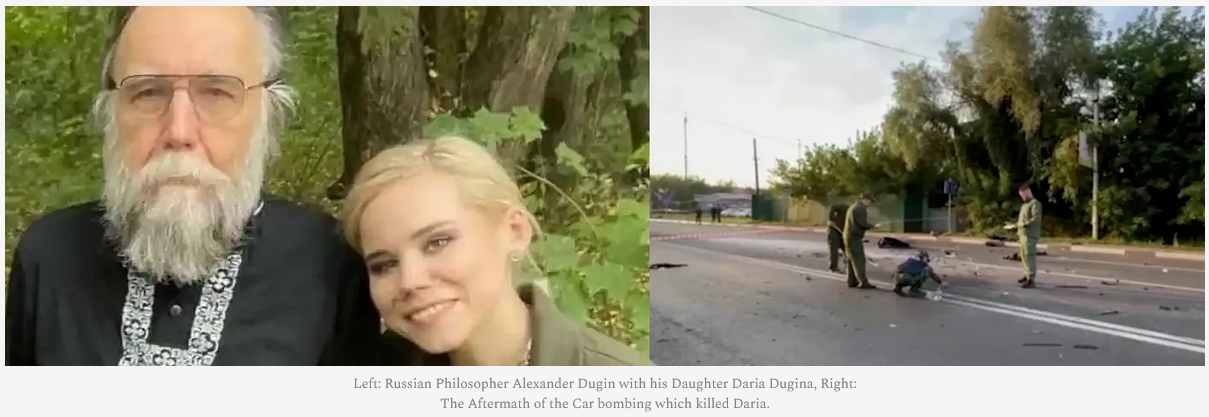
On August 20, 2022, 29 year old Daria Dugina was killed in a car bombing on the outskirts of Moscow. The bomb, it was widely agreed, had been intended for her father the famed/infamous Russian philosopher Alexander Dugin (whose works are now shockingly hard to get in English and appears on my “Real Banned Books List“), and while there were lots of deflections and denials, it was fairly widely agreed the plot had been carried out with US and UK backing by Ukrainian-aligned insurgents and agents within Russia.
Indeed many US aligned “Journalists”, “Open Source Intelligence” types, Bellingcat-associated influencers, and other CIA-aligned carve outs openly CELEBRATED the death of Daria, since she had been involved in Putin-aligned political youth organizing.
Of course, the fact political volunteers and door knockers have NEVER been considered legitimate military targets, nor the fact the real target was a PHILOSOPHER and everything he had ever done would have been perfectly legal to do even within the United States under the auspices of the first amendment … that somehow never occurred to these commentators. Nor the wider US intellectual class, and somehow neither did the natural logical conclusion.
Russia is by and large NOT run by its political organizers and academics. You could probably kill 1000 Russian university professors and it wouldn’t unbalance the Russian state too extraordinarily. Russia is run by a combination of old Soviet secret policemen, gangsters, and crooked/”reformed” oligarchs all attempting to reorganize themselves into a somewhat respectable upper-class, with a blend of impressive and farcical results.
Before he was killed in an internal power struggle the former head of Wagner PMC Yevgeny Prigozhin embodied this, turning from a St. Petersburg gangster, to a prisoner, to a (definitely money laundering) caterer for the presidential palace, to the head of a PMC mercenary company. Every prominent person in Russia has a career like this Right down to Putin going from a KGB officer, to a gangster/political fixer, to president … Every elite member of Russian society is basically leading a life ripped right from Grand Theft Auto IV, complete with the eternal struggles of trying to “go legit” and formalize everything as a normal upper-class elite, to being dragged back into gangsterism or even Soviet power struggles by their complex past.
Put simply the actual Russian Elite are not people very intimidated by assassination. They’ve all known people to be killed in power struggles, espionage, and criminal altercations, and are used to the anxiety that death might wait for them around the corner. And the US and Ukraine lashing out at academics who might be intimidated doesn’t really affect them.
However, if the Russian state did the logical tit-for-tat escalation and responded in kind … that would shake America to its knees. America actually IS run by its academics, political organizers, and bureaucrats. And almost none of the people with power have a gangster or KGB agent’s stoic familiarity with death and danger.
Killing a Russian Academics daughter did very little to the Russian state… It’d be a very different story for Russia’s armed agents to do the same in America and kill Chelsea Clinton, daughter of current Columbia professor Hillary Clinton.
It’s be a very different story if Russia assassinated Brookings senior fellow Robert Kagan, husband of former under-secretary of state Victoria Nuland. Or any number of Harvard, Stanford, Yale or Princeton political philosophers or International Relations commentators, or members of their family.
One can imagine the headlines if John Hopkins and RAND fellow Francis Fukuyama was so killed:
“It is the end of Fukuyama”
– History
And again remember, though the various income streams of the US elite may resemble embezzlement, protection rackets, and money laundering … these aren’t gangsters. These are complacent, highly agreeable, shockingly unoriginal and cowardly … academics and bureaucrats.
Indeed one can imagine Putin weighing the risk of such a reprisal and then deciding against it, not out of ethical concerns, but because the American ruling class is too unpredictable and prone to womanly hysterias.
Indeed amongst the few senior American and Ukrainian officials who knew of the attack beforehand you can imagine them salivating that Putin might respond in kind and the subsequent freakout might commit the US to joining the war (one of the few scenarios where Ukraine could possible survive against their overwhelming odds).
Comments Off on Assassination-to-order, or war by other means
February 8, 2024
“Mwa-mwa-mwa”, they said
Chris Bray expands on the topic of yesterday’s post about the legacy media wanting you not to do your own research because it might lead to the “wrong” kind of answers:
I’m a hundred pages into a book I’ve been meaning to read for years, and I meant to spend last night reading it. But then I accidentally looked at social media.
For years, now, I’ve been watching as journalists and politicians connect a set of fact claims to a conclusion that has nothing to do with the evidence they’ve just given: This happened, and this happened, and this happened, and, trust us, all of that means this. It snaps your head back, because the statement about the meaning of the evidence is so ridiculous they can’t possibly have failed to notice. The news is frequently a series of bizarre interpretive non-sequiturs.
I wrote about a favorite example here, as an army of Barack Obama hagiographers described The Lightbringer’s glorious childhood in Indonesia. He went there with his mother and Indonesian stepfather in 1966, during a massive purge of communists by the army that included a great deal of mass killing, and Obama’s biographers describe the future American president being a young child in a place where rivers were choked with corpses and soldiers marched prisoners through the streets. Then, casually, they conclude that his time in Indonesia was idyllic and warm, and Jakarta was the place where this wonderfully decent future leader learned the gentle values of civic engagement and democratic pluralism.
See also this example, from back in the days when I didn’t have many subscribers, discussing an op-ed piece that described the Freedom Convoy as a movement of anti-government radicals who wanted to live in a society with no rules at all and marched on Ottawa behind the banner of authoritarianism to implement their fascist agenda.
Over and over again, reading the “news” that these people write, you catch yourself muttering but you JUST SAID …
Fact claims don’t add up, categories clash, paragraphs self-refute, sentences start out insistently claiming X and then wander into a firm insistence upon Not X before the period arrives at the end. The great complex of global news and politics has the internal consistency and logic of the day ward at a mental hospital.
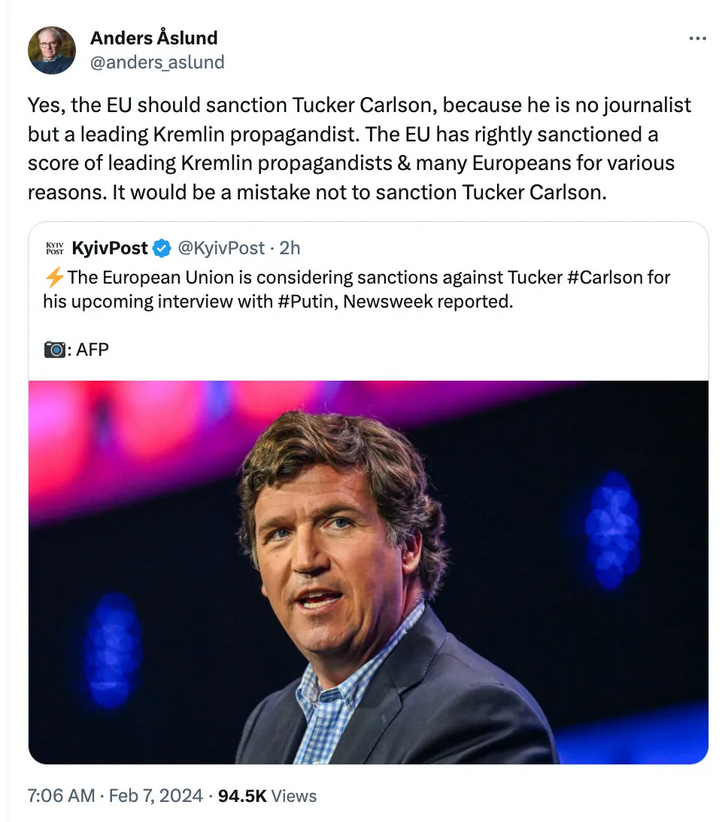
Last night we seem to have suddenly turned the knob on that machine up to eleven, BECAUSE HITLER IS IN MOSCOW TO DO AN INTERVIEW. The people who are proud that we’re fighting authoritarianism by arresting the leading figure of the political opposition and throwing him off the ballot are also very angry that Tucker Carlson is interviewing an autocrat, and they hate autocracy, so Tucker Carlson must be arrested and bankrupted and barred from returning to the United States, to stand up to authoritarianism. I had a moment last night when I sincerely wondered about the wisdom of paying attention, because the experience of hearing from The Responsible People™ became painfully hallucinatory.
The officials at the EU get to decide who counts as a real journalist and who gets ruined, to protect democracy. Ukraine is the brave and incorruptible vanguard of ideal democracy, by the way, and so pure it floats, like an ad for soap. Nothing bad has ever happened there, you Nazi, but now Satan Putin’s vampire fangs drip with innocent blood, and there’s absolutely nothing else to say about it, send cash.
Watching people like Bill Kristol and David Frum comment on real-world events now is like watching a homeless drug addict having a psychotic break at a bus shelter. The connection between fact and interpretation has become painfully severed. A whole layer of allegedly high-status people have gone barking mad. We need to arrest everyone who disagrees with us about politics or else we’re going to lose our system of open society to authoritarianism, and you really ought to smoke some of whatever we have inside this glass pipe.
Comments Off on “Mwa-mwa-mwa”, they said
June 27, 2023
“No one seems to understand what the hell just happened in Russia”
Discussing anything to do with the Russo-Ukraine war is difficult enough due to the signal-to-noise ratio in the information we get from both sides and (theoretically) disinterested observers. Trying to read the tea leaves in the events over the weekend was just an utter waste of time, despite the potentially earth-shaking possibilities being thrown up. The weekend dispatch from The Line doesn’t pretend to have any deep analysis to offer, which I think is by far the wisest approach:
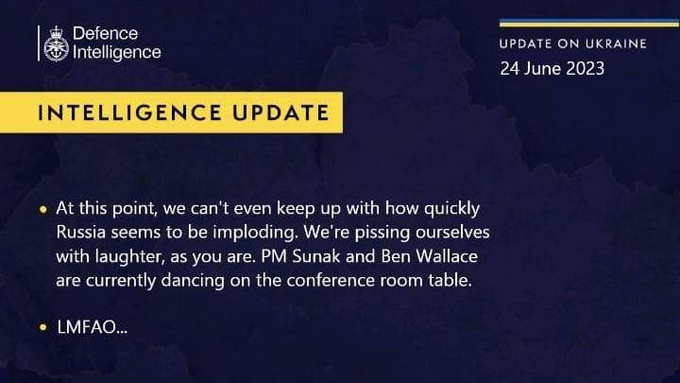
“Sir Humphrey Appleby” tweeted this, saying it was “the intelligence update slide every DI analyst secretly dreams of producing …
As we write this, roughly a day has passed since the sudden end of what briefly looked like a massive event with the potential to reshape global politics for a generation … before it fizzled. The rebellion of Russia’s Wagner mercenary group and its bolt toward Moscow was a stunning story, until it wasn’t. And that itself is a stunning story. Yevgeny Prigozhin, former chef and now Wagner leader, suddenly called off his mutiny, and it just … ended.
Really?
When the mutiny began on Friday, and especially when Wagner seized the southern city of Rostov, home to a major Russian military headquarters overseeing the invasion of Ukraine as well as a million other people, we were surprised, but the more we thought about it, we weren’t particularly shocked. There had been obvious signs of an imminent rupture of some kind in recent months; Line editor Gurney had wondered on Twitter how long it could last before something snapped. That was about three hours before the entire country seemed to snap and Prigozhin marched into Rostov and began moving north.
Events proceeded at a fairly frantic pace after that, with Wagner troops advancing almost all the way to Moscow while Russian security forces fortified the city and tore up roads along the route. It wasn’t clear to us that Wagner had enough men to actually take the city and potentially capture key members of the government. But it wasn’t clear that he didn’t: there are two sides of that equation — the troops Prigozhin had and the troops Putin could count on to oppose Wagner. It was the latter group that captured our interest.
Wagner encountered some resistance along the way, but not much. Most of Russia’s army is deployed in Ukraine, of course, and much of what’s left is now of famously poor quality and morale. But even those military and security forces that were able to block Wagner’s advance didn’t seem that interested in the job. There are reports that some units went over to Prigozhin’s side, but it seems that most of them just did … nothing in particular. And waited to see what happened. For a few hours, we wondered if Prigozhin’s small force would be just large enough in the face of a Russian military that seemed to have no appetite for battle on its own soil.
We can’t pretend to explain the bizarre conclusion to this chaotic day and a half, with an apparent deal brokered by Belarus seeing Wagner’s advance on Moscow called off, a broad amnesty granted to all participants and Prigozhin apparently set to continue to oversee Wagner’s global operations from Belarus in some kind of exile. This is all just wildly unrealistic. Prigozhin cannot be the last person around to realize that he’s put a target on his back and that he’ll soon experience some kind of fatal medical emergency or tragic tumble out of an open window. The moment his mercenaries took Rostov, he had only one path forward: all the way to the Kremlin. What the hell he’s thinking is frankly beyond our ability to guess, and we have fairly vivid imaginations. It’s baffling.
Nor will we try to guess what this will mean for Russia. In a situation like this, your Line editors would normally simply confess that we don’t have the deep knowledge of Russian domestic politics to turn ourselves into credible instant-experts on this. We’d seek out someone with that knowledge. We could interview them, solicit a column from them, or even — as we’ve done in the past — allow someone with deep expertise but who isn’t permitted to speak on the record in public to provide a blurb for one of these dispatches, to run under our shared byline. But in this case, we had to reject all those options, because at least for right now, all the experts seem as baffled as we are. No one seems to understand what the hell just happened in Russia.
We can say with at least reasonable confidence that if you happen to be named Vladimir Putin, it isn’t good. When Prigozhin announced that he was ending his mutiny and began withdrawing his forces from Rostov, the locals cheered them like some kind of conquering heroes. That’s gotta be on Putin’s mind. Also on his mind: the apparent, ahem, reluctance of much of his military and domestic security force to rally to his side during the crisis. This has wounded Putin. Time will tell how badly. Time will also tell how many other people in Russia today have carefully watched recent events, have adjusted their understanding of the facts on the ground there, and are now pondering a variety of intriguing options accordingly.
And the last thing time will tell is what Putin feels he must now do to assert his authority, such as it is. We must recall that whatever Putin’s domestic troubles, he has problems on the battlefield, too. While we haven’t yet seen major breakthroughs by Ukrainian forces, they are not yet fully committed, and their counteroffensive does seem to be making gradual progress in multiple sectors. Events of recent days can only hurt Russia’s combat performance and morale.
We wish we could offer you all a more firm and decisive statement to wrap all this up. But the best we can honestly promise you is that we’ll keep pondering this, trying to figure out what the hell happened, and we’ll certainly be watching this. It’s been a strange war. And we suspect it might get stranger still before it finally ends.
The most recent Defence Intelligence update map from the British Ministry of Defence shows what is thought to be a reasonably accurate representation of the battlefront in eastern Ukraine:
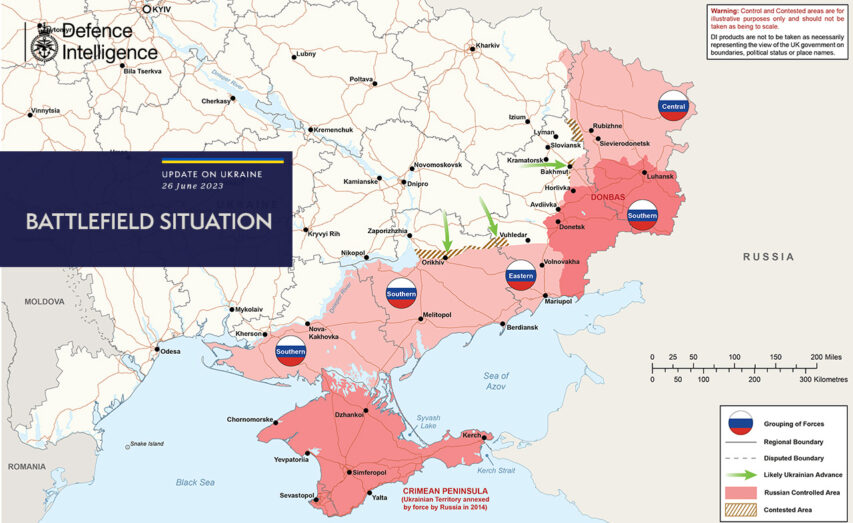
Comments Off on “No one seems to understand what the hell just happened in Russia”
March 21, 2023
Born in the Heart of Besieged Leningrad: the PPS-42
Forgotten Weapons
Published 11 Nov 2022One would think that the Shpagin PPSh-41 was as simple as a submachine gun could get, but that wasn’t the case in World War Two USSR. Barely had the PPSh gotten into real production than the Army was looking for something even simpler. An answer came from young designer Aleksey Sudaev with a completely-stamped gun that used about half the raw material and a third the machine time to produce as the PPSh. After winning the competitive trials, Factory 828 in Moscow was chosen as the lead production facility. They produced a series of drawings and preproduction guns in the summer of 1942.
Sudaev took those drawings into besieged Leningrad with orders to et up production in three factories within the city. The main one was Factory 209, and after fixing a few minor design flaws, the gun went into production in the spring of 1943. Sudaev PPS-42 SMGs pretty much went out the doors of the factory and right into combat trying to break the siege of the city. In total, about 46,000 would be produced before that siege was finally broken.
Meanwhile, Factory 828 in Moscow put a higher priority on policing the design than on immediate production. They implemented a substantial number of improvements, although the lack of communication into Leningrad prevented them from being used in the production going on there. Instead, the improvements culminated in the PPS-43 design, of which more than a million were made by the end of the war.
(more…)
Comments Off on Born in the Heart of Besieged Leningrad: the PPS-42
October 31, 2022
Executed for Telling a Joke – October 30, 1943 – WAH 084
World War Two
Published 30 Oct 2022From a conference in Moscow the United Nations Alliance issues a warning to Nazi Germany about their atrocities, while those atrocities continue unabated.
(more…)
Comments Off on Executed for Telling a Joke – October 30, 1943 – WAH 084
October 23, 2022
Stalin Agrees to the United Nations – WW2 – 217 – October 22, 1943
World War Two
Published 22 Oct 2022A conference in Moscow lays out some postwar plans of the Allies, but the war has to be won first. The Allies fight their way across both the Dnieper and Volturno Rivers, but the going looks like it’s going to be tougher after the crossings. Meanwhile, in the South Seas the Japanese change plans in the face of Allied advances over there.
(more…)
Comments Off on Stalin Agrees to the United Nations – WW2 – 217 – October 22, 1943
June 17, 2022
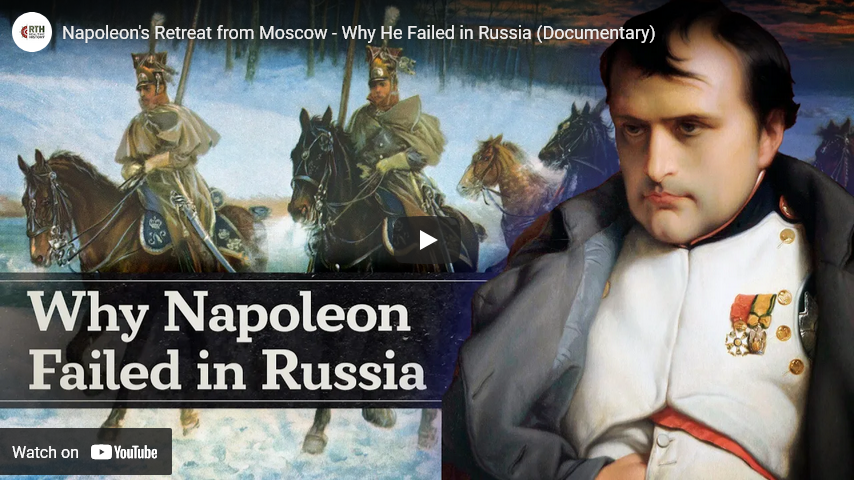
Napoleon’s Retreat from Moscow – Why He Failed in Russia
Real Time History
Published 16 Jun 2022Sign up for the CuriosityStream + Nebula Bundle: https://curiositystream.com/realtimeh…
Napoleon’s retreat from Moscow and from Russia as a whole is one of the most dramatic scenes in history. Starving and freezing, the French Grande Armée is desperately trying to reach the Berezina River. The revitalized Russian Army is on their heels and almost catches their prey in the 2nd Battle of Krasny. But it wasn’t just “General Winter” that defeated Napoleon in Russia.
» SUPPORT US ON PATREON
https://patreon.com/realtimehistory» THANK YOU TO OUR CO-PRODUCERS
John Ozment, James Darcangelo, Jacob Carter Landt, Thomas Brendan, Kurt Gillies, Scott Deederly, John Belland, Adam Smith, Taylor Allen, Rustem Sharipov, Christoph Wolf, Simen Røste, Marcus Bondura, Ramon Rijkhoek, Theodore Patrick Shannon, Philip Schoffman, Avi Woolf, Emile Bouffard, William Kincade, Daniel L Garza, Stefan Weiß, Matt Barnes, Chris Daley, Marco Kuhnert, Simdoom» SOURCES
Boudon, Jacques-Olivier. Napoléon et la campagne de Russie en 1812 (2021).
Chandler, David. The Campaigns of Napoleon, Volume 1 (New York 1966).
Lieven, Dominic. Russia Against Napoleon (2010).
Mikaberidze A. The Battle of the Berezina: Napoleon’s Great Escape (Pen&Sword Military, 2010)
Rey, Marie-Pierre. L’effroyable tragédie: une nouvelle histoire de la campagne de Russie. (2012).
Zamoyski, Adam. 1812: Napoleon’s Fatal March on Moscow. (2005).
Отечественная война 1812 года. Энциклопедия (Москва: РОССПЭН, 2004)
Безотосный В. М. Россия в наполеоновских войнах 1805–1815 гг. (Москва: Политическая энциклопедия, 2014)
Троицкий Н.А. 1812. Великий год России (Москва: Омега, 2007)
(Прибавление к «Санкт-Петербургским ведомостям» №87 от 29 октября 1812 / http://www.museum.ru/museum/1812/War/…)» OUR STORE
Website: https://realtimehistory.net»CREDITS
Presented by: Jesse Alexander
Written by: Jesse Alexander
Director: Toni Steller & Florian Wittig
Director of Photography: Toni Steller
Sound: Above Zero
Editing: Toni Steller
Motion Design: Toni Steller
Mixing, Mastering & Sound Design: http://above-zero.com
Digital Maps: Canadian Research and Mapping Association (CRMA)
Research by: Jesse Alexander, Sofia Shirogorova
Fact checking: Florian WittigChannel Design: Simon Buckmaster
Contains licensed material by getty images
Maps: MapTiler/OpenStreetMap Contributors & GEOlayers3
All rights reserved – Real Time History GmbH 2022
Comments Off on Napoleon’s Retreat from Moscow – Why He Failed in Russia
May 26, 2022
Why Napoleon’s Invasion of Russia Imploded in Moscow
Real Time History
Published 25 May 2022Sign up for the CuriosityStream + Nebula Bundle: https://curiositystream.com/realtimeh…
When Napoleon took Moscow, he expected victory over Russia was just a matter of time. But six weeks later he has to flee the city as his entire Russia campaign collapses. The strengthened Russian Army is attacking from three sides, winter is coming and in far away Paris a coup is underway.
» SUPPORT US ON PATREON
https://patreon.com/realtimehistory» THANK YOU TO OUR CO-PRODUCERS
John Ozment, James Darcangelo, Jacob Carter Landt, Thomas Brendan, Kurt Gillies, Scott Deederly, John Belland, Adam Smith, Taylor Allen, Rustem Sharipov, Christoph Wolf, Simen Røste, Marcus Bondura, Ramon Rijkhoek, Theodore Patrick Shannon, Philip Schoffman, Avi Woolf,» SOURCES
Boudon, Jacques-Olivier. Napoléon et la campagne de Russie en 1812. 2021.
Chandler, David. The Campaigns of Napoleon, Volume 1, New York 1966.
Lieven, Dominic. Russia Against Napoleon. 2010.
Maag, Albert. Die Schicksale der Schweizerregimente in Napoleons I. Feldzug nach Russland 1812. 1900.
Rey, Marie-Pierre. L’effroyable tragédie: une nouvelle histoire de la campagne de Russie. 2012.
Zamoyski, Adam. 1812: Napoleon’s Fatal March on Moscow. 2005.» OUR STORE
Website: https://realtimehistory.net»CREDITS
Presented by: Jesse Alexander
Written by: Jesse Alexander
Director: Toni Steller & Florian Wittig
Director of Photography: Toni Steller
Sound: Above Zero
Editing: Toni Steller
Motion Design: Toni Steller
Mixing, Mastering & Sound Design: http://above-zero.com
Digital Maps: Canadian Research and Mapping Association (CRMA)
Research by: Jesse Alexander
Fact checking: Florian WittigChannel Design: Simon Buckmaster
Contains licensed material by getty images
Maps: MapTiler/OpenStreetMap Contributors & GEOlayers3
All rights reserved – Real Time History GmbH 2022
Comments Off on Why Napoleon’s Invasion of Russia Imploded in Moscow
May 13, 2022
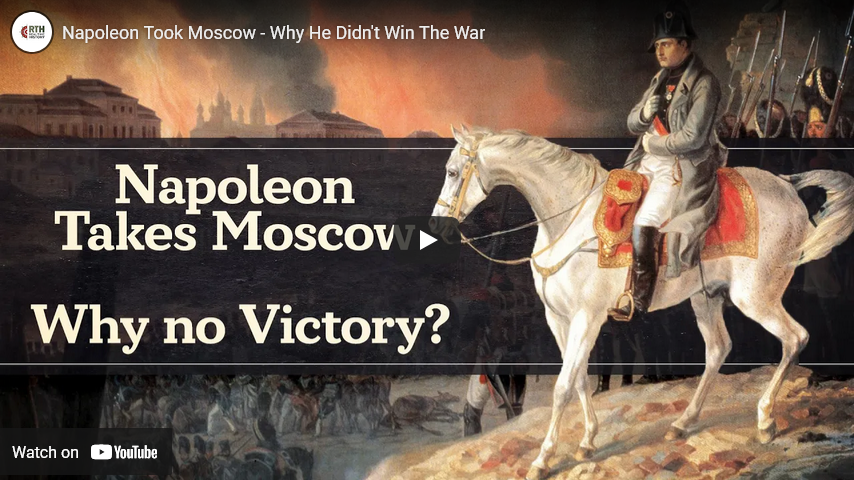
Napoleon Took Moscow – Why He Didn’t Win The War
Real Time History
Published 12 May 2022Support us on Patreon: https://patreon.com/realtimehistory
After the Battle of Borodino, both sides are badly mauled. Napoleon’s army marches on and reaches Moscow, the old Russian capital. In the Emperor’s eyes, capturing the city should win him the war. But while the local Russians set fire to the city, the Tsar in St. Petersburg and the Russian army command are thinking about turning the tide of the war — and not about accepting a French victory.
» THANK YOU TO OUR CO-PRODUCERS
John Ozment, James Darcangelo, Jacob Carter Landt, Thomas Brendan, Kurt Gillies, Scott Deederly, John Belland, Adam Smith, Taylor Allen, Rustem Sharipov, Christoph Wolf, Simen Røste, Marcus Bondura, Ramon Rijkhoek, Theodore Patrick Shannon, Philip Schoffman, Avi Woolf,» SOURCES
Boudon, Jacques-Olivier. Napoléon et la campagne de Russie en 1812. 2021.
Lieven, Dominic. Russia Against Napoleon. 2010.
Rey, Marie-Pierre. L’effroyable tragédie: une nouvelle histoire de la campagne de Russie. 2012.
Zamoyski, Adam. 1812: Napoleon’s Fatal March on Moscow. 2005.» OUR STORE
Website: https://realtimehistory.net»CREDITS
Presented by: Jesse Alexander
Written by: Jesse Alexander
Director: Toni Steller & Florian Wittig
Director of Photography: Toni Steller
Sound: Above Zero
Editing: Toni Steller
Motion Design: Toni Steller
Mixing, Mastering & Sound Design: http://above-zero.com
Digital Maps: Canadian Research and Mapping Association (CRMA)
Research by: Jesse Alexander
Fact checking: Florian WittigChannel Design: Simon Buckmaster
Contains licensed material by getty images
Maps: MapTiler/OpenStreetMap Contributors & GEOlayers3
All rights reserved – Real Time History GmbH 2022
Comments Off on Napoleon Took Moscow – Why He Didn’t Win The War
May 6, 2022
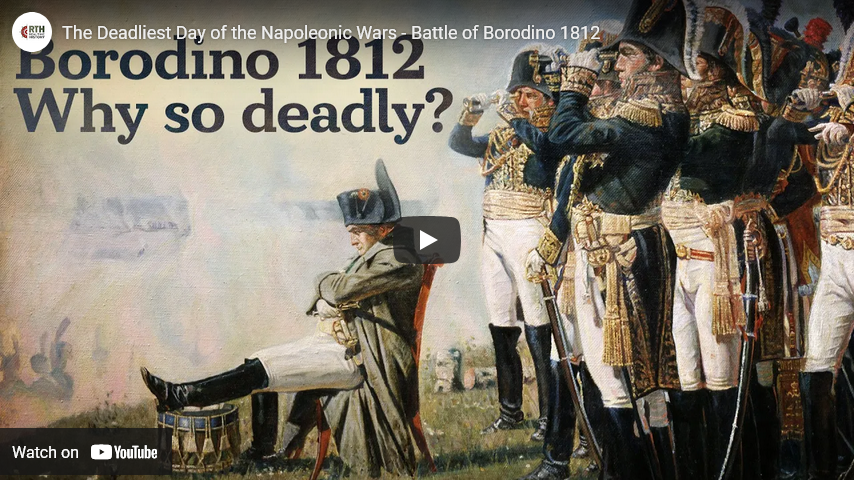
The Deadliest Day of the Napoleonic Wars – Battle of Borodino 1812
Real Time History
Published 5 May 2022Sign up for the CuriosityStream + Nebula Bundle: https://curiositystream.com/realtimeh…
The Battle of Borodino was the deadliest single day in history until the outbreak of the First World War. It was the culmination of Napoleon’s advance on Moscow. Due to the terrain and the Russian positions, it was a gigantic battle of attrition — which Napoleon won at a high cost.
» SUPPORT US ON PATREON
https://patreon.com/realtimehistory» THANK YOU TO OUR CO-PRODUCERS
John Ozment, James Darcangelo, Jacob Carter Landt, Thomas Brendan, Kurt Gillies, Scott Deederly, John Belland, Adam Smith, Taylor Allen, Rustem Sharipov, Christoph Wolf, Simen Røste, Marcus Bondura, Ramon Rijkhoek, Theodore Patrick Shannon, Philip Schoffman, Avi Woolf,» SOURCES
Boudon, Jacques-Olivier. Napoléon et la campagne de Russie en 1812. 2021.
Fileaux, Christian. “La bataille de la Moskova – 7 septembre 1812. Récit,” in Rey, Marie-Pierre and Thierry Lentz, eds. 1812, la campagne de Russie. 2012.
Lieven, Dominic. Russia Against Napoleon. 2010.
Mikaberidze, Alexander. The Battle of Borodino: Napoleon against Kutuzov. 2007.
Rey, Marie-Pierre. L’effroyable tragédie: une nouvelle histoire de la campagne de Russie. 2012.
Zamoyski, Adam. 1812: Napoleon’s Fatal March on Moscow. 2005.» OUR STORE
Website: https://realtimehistory.net»CREDITS
Presented by: Jesse Alexander
Written by: Jesse Alexander
Director: Toni Steller & Florian Wittig
Director of Photography: Toni Steller
Sound: Above Zero
Editing: Toni Steller
Motion Design: Toni Steller
Mixing, Mastering & Sound Design: http://above-zero.com
Digital Maps: Canadian Research and Mapping Association (CRMA)
Research by: Jesse Alexander
Fact checking: Florian WittigChannel Design: Simon Buckmaster
Contains licensed material by getty images
Maps: MapTiler/OpenStreetMap Contributors & GEOlayers3
All rights reserved – Real Time History GmbH 2022
Comments Off on The Deadliest Day of the Napoleonic Wars – Battle of Borodino 1812
June 19, 2021
“Defence of Moscow” – Autumn 1941- Sabaton History 103
Sabaton History
Published 17 Jun 2021While it is legendary, there is a lot of confusion and a lot of myths about Operation Typhoon, the German drive on Moscow in the fall of 1941, and Operation Barbarossa, the invasion of the Soviet Union that summer. Today I talk about the first 5.5 months of Barbarossa, and then Joakim and I discuss covers and covers of covers.
Support Sabaton History on Patreon: https://www.patreon.com/sabatonhistory
Listen to “Defence Of Moscow”: https://music.sabaton.net/DefenceOfMo…
Watch the Official Music Video of “Defence Of Moscow” here: https://www.youtube.com/watch?v=i7K4v…
Listen to Sabaton on Spotify: http://smarturl.it/SabatonSpotify
Official Sabaton Merchandise Shop: http://bit.ly/SabatonOfficialShopHosted by: Indy Neidell
Written by: Markus Linke and Indy Neidell
Directed by: Astrid Deinhard and Wieke Kapteijns
Produced by: Pär Sundström, Astrid Deinhard and Spartacus Olsson
Creative Producer: Maria Kyhle
Executive Producers: Pär Sundström, Joakim Brodén, Tomas Sunmo, Indy Neidell, Astrid Deinhard, and Spartacus Olsson
Community Manager: Maria Kyhle
Post-Production Director: Wieke Kapteijns
Editor: Karolina Dołęga
Sound Editor: Marek Kaminski
Maps by: Eastory – https://www.youtube.com/c/eastory
Archive: Reuters/Screenocean – https://www.screenocean.comColorizations by:
– Mikołaj Uchmann
– Julius Jääskeläinen – https://www.facebook.com/JJcolorization/Sources:
– National Archives Nara
– Narodowe Archiwum Cyfrowe NARA
– Bundesarchiv
– New York Public Library
– Train tracks icon by Danishicon from the Noun Project
– Picture of singer Loona courtesy of Sandstein https://commons.wikimedia.org/wiki/Ca…
– Imperial War Museums: HU 75543, PST 4712
– Australian War MemorialAll music by: Sabaton
RADIO TAPOK – Битва за Москву (В стиле Sabaton / ИзиРок / – Defence Of Moscow)An OnLion Entertainment GmbH and Raging Beaver Publishing AB co-Production.
© Raging Beaver Publishing AB, 2021 – all rights reserved.
Comments Off on “Defence of Moscow” – Autumn 1941- Sabaton History 103
December 6, 2020
Winter is Here! The failure of Barbarossa – WW2 – 119 – December 5, 1941
World War Two
Published 5 Dec 2020The Wehrmacht is halted by the Red Army at the gates of Moscow. Not only that, but a Red Army counteroffensive begins pushing the Germans back decisively. The Germans are also beginning to withdraw from their siege of Tobruk in North Africa. Japan, however, is advancing all over the Pacific, sending troop transports into the South China Sea, though it is unclear just whom Japan plans to attack. The Japanese are also — in top secrecy — sending a force of aircraft carriers to soon attack the American Pacific fleet at anchor at Pearl Harbor.
Join us on Patreon: https://www.patreon.com/TimeGhostHistory
Or join The TimeGhost Army directly at: https://timeghost.tvFollow WW2 day by day on Instagram @ww2_day_by_day – https://www.instagram.com/ww2_day_by_day
Between 2 Wars: https://www.youtube.com/playlist?list…
Source list: http://bit.ly/WW2sourcesWritten and Hosted by: Indy Neidell
Director: Astrid Deinhard
Producers: Astrid Deinhard and Spartacus Olsson
Executive Producers: Astrid Deinhard, Indy Neidell, Spartacus Olsson, Bodo Rittenauer
Creative Producer: Maria Kyhle
Post-Production Director: Wieke Kapteijns
Research by: Indy Neidell
Edited by: Miki Cackowski
Sound design: Marek Kamiński
Map animations: Eastory (https://www.youtube.com/c/eastory)Colorizations by:
Klimbim – https://www.flickr.com/photos/2215569…
Dememorabilia – https://www.instagram.com/dememorabilia/
Mikołaj Uchman
Jaris Almazani (Artistic Man) – https://www.instagram.com/artistic.man/Sources:
RIA Novosti #2410
Bundesarchiv
IWM A 10499, A 6784, CH 11140
Visuotinė-lietuvių-enciklopedija
Yad Vashem 5705/34
from the Noun Project: low temperature by The Icon Z, Skull by Muhamad UlumSoundtracks from the Epidemic Sound:
Johan Hynynen – “Dark Beginning”
Johannes Bornlof – “Death And Glory 3”
Reynard Seidel – “Deflection”
Johannes Bornlof – “Deviation In Time”
Hakan Eriksson – “Epic Adventure Theme 4”
Johannes Bornlof – “The Inspector 4”
Rannar Sillard – “March Of The Brave 4”
Fabien Tell – “Last Point of Safe Return”
Bonnie Grace – “Imperious”
Max Anson – “Maze Heist”
Gunnar Johnsen – “Not Safe Yet”
Jon Bjork – “Force Matrix”Archive by Screenocean/Reuters https://www.screenocean.com
A TimeGhost chronological documentary produced by OnLion Entertainment GmbH.
Comments Off on Winter is Here! The failure of Barbarossa – WW2 – 119 – December 5, 1941
November 22, 2020
Surprise Attack On Rommel! – Operation Crusader Begins – WW2 – 117- November 21, 1941
World War Two
Published 21 Nov 2020The long planned Allied Offensive in North Africa — Operation Crusader — begins, but the Allies are worrying about how to defend Singapore in case of Japanese aggression. The Germans renew their drive on Moscow, but their number one flying ace perishes, a major PR hit.
Join us on Patreon: https://www.patreon.com/TimeGhostHistory
Or join The TimeGhost Army directly at: https://timeghost.tvFollow WW2 day by day on Instagram @ww2_day_by_day – https://www.instagram.com/ww2_day_by_day
Between 2 Wars: https://www.youtube.com/playlist?list…
Source list: http://bit.ly/WW2sourcesWritten and Hosted by: Indy Neidell
Director: Astrid Deinhard
Producers: Astrid Deinhard and Spartacus Olsson
Executive Producers: Astrid Deinhard, Indy Neidell, Spartacus Olsson, Bodo Rittenauer
Creative Producer: Maria Kyhle
Post-Production Director: Wieke Kapteijns
Research by: Indy Neidell
Edited by: Miki Cackowski
Sound design: Marek Kamiński
Map animations: Eastory (https://www.youtube.com/c/eastory)Colorizations by:
Ruffneck88 https://commons.wikimedia.org/wiki/Ca…
Julius Jääskeläinen – https://www.facebook.com/JJcolorization/
Daniel Weiss
Adrien Fillon – https://www.instagram.com/adrien.colo…
Norman Stewart – https://oldtimesincolor.blogspot.com/
Spatacus OlssonSources:
Narodowe Archiwum Cyfrowe
Bundesarchiv
Australian War Memorial
Yad Vashem 143BO2
IWM E 6661, K 1261, A 3898, A 10499, FE 487, TR153, E 2384ESoundtracks from the Epidemic Sound:
Johannes Bornlof – “Death And Glory 2”
Johan Hynynen – “Dark Beginning”
Farrell Wooten – “Blunt Object”
Reynard Seidel – “Deflection”
Johannes Bornlof – “Last Man Standing 3”
Johannes Bornlof – “The Inspector 4”
Philip Ayers – “Under the Dome”
Max Anson – “Ancient Saga”
Johannes Bornlof – “Deviation In Time”
Jon Bjork – “Disposal”Archive by Screenocean/Reuters https://www.screenocean.com.
A TimeGhost chronological documentary produced by OnLion Entertainment GmbH.
From the comments:
World War Two
3 days ago
On December 7th we will cover the Japanese attack on Pearl Harbor in real time, minute by minute, as it happens … for five solid hours starting 0610 local Hawaiian time right here on this channel. Don’t miss it!And if you want a dose of WW2 action every day, then check out our day by day instagram coverage of the war right here: https://www.instagram.com/world_war_two_realtime/
Comments Off on Surprise Attack On Rommel! – Operation Crusader Begins – WW2 – 117- November 21, 1941
November 15, 2020
Night Vision Brings Triumph to the British! – WW2 – 116 – November 14, 1941
World War Two
Published 14 Nov 2020The British sink an entire convoy of supplies heading for Rommel in North Africa by using radar at night, something their opponents lack. In North Africa itself, the Allies are gearing up for a major offensive to begin in a few days. Meanwhile, the Germans are gearing up for a renewed drive on Moscow even as Georgy Zhukov launches small attacks there designed to spoil the larger German plans.
Join us on Patreon: https://www.patreon.com/TimeGhostHistory
Or join The TimeGhost Army directly at: https://timeghost.tvFollow WW2 day by day on Instagram @ww2_day_by_day – https://www.instagram.com/ww2_day_by_day
Between 2 Wars: https://www.youtube.com/playlist?list…
Source list: http://bit.ly/WW2sourcesWritten and Hosted by: Indy Neidell
Director: Astrid Deinhard
Producers: Astrid Deinhard and Spartacus Olsson
Executive Producers: Astrid Deinhard, Indy Neidell, Spartacus Olsson, Bodo Rittenauer
Creative Producer: Maria Kyhle
Post-Production Director: Wieke Kapteijns
Research by: Indy Neidell
Edited by: Karolina Dołęga
Sound design: Marek Kamiński
Map animations: Eastory (https://www.youtube.com/c/eastory)Colorizations by:
– Klimbim
– Daniel Weiss
– Mikołaj Uchman
– Dememorabilia – https://www.instagram.com/dememorabilia/
– Cassowary Colorizations
– Carlos Ortega Pereira, BlauColorizations – https://www.instagram.com/blaucolorizations
– Norman Stewart – https://oldtimesincolor.blogspot.com/
– Julius Jääskeläinen – https://www.facebook.com/JJcolorization/Visual Sources:
– Bundesarchiv
– Imperial War Museums: A 8158, FL 4822, A7266, G40, A 6329, A 6333, E 6724, WPN 298, IB2095, CM1725,
– Mil.ru
– Portrait of Alfred Godwin-Austen courtesy of Berserker276 from Wikimedia Commons
– Icons from Noun Project: boy by Mauro Lucchesi, Nick Novell, Calendar by Lorena Salagre, horse by Luis Prado, Gentleman by Samy Menai, man face by Nick Novell, Russian Russian soldier by Wonmo KangSoundtracks from Epidemic Sound:
– “March Of The Brave 10” – Rannar Sillard – Test
– “Last Point of Safe Return” – Fabien Tell
– “Weapon of Choice” – Fabien Tell
– “Please Hear Me Out” – Philip Ayers
– “Potential Redemption” – Max Anson
– “nBreak Free” – Fabien Tell
– “Moving to Disturbia” – Experia
– “The End Of The World 2” – Håkan Eriksson
– “Epic Adventure Theme 4” – Håkan ErikssonArchive by Screenocean/Reuters https://www.screenocean.com.
A TimeGhost chronological documentary produced by OnLion Entertainment GmbH.
From the comments:
World War Two
2 days ago
Mark December 7th in your calendars, for that day we have five hours of material — ten half-hour episodes — coming out to tell you the story of Pearl Harbor minute by minute in real time, starting 0610 local Hawaiian time.And in addition to specials like that and our regular week by week coverage here on YouTube, we also cover the war day by day on Instagram, filling in things we don’t have time to cover here. It’s a perfect complement to this. Check it out at: https://www.instagram.com/world_war_two_realtime/
Comments Off on Night Vision Brings Triumph to the British! – WW2 – 116 – November 14, 1941


